Reducing quantum resources for ADAPT-VQE via plateau-operator elimination and correlated mean-field downfolding
Pith reviewed 2026-07-02 12:27 UTC · model grok-4.3
The pith
Operator elimination and one-body downfolding reduce ADAPT-VQE circuit depth while moving energies closer to full configuration interaction results.
A machine-rendered reading of the paper's core claim, the machinery that carries it, and where it could break.
Core claim
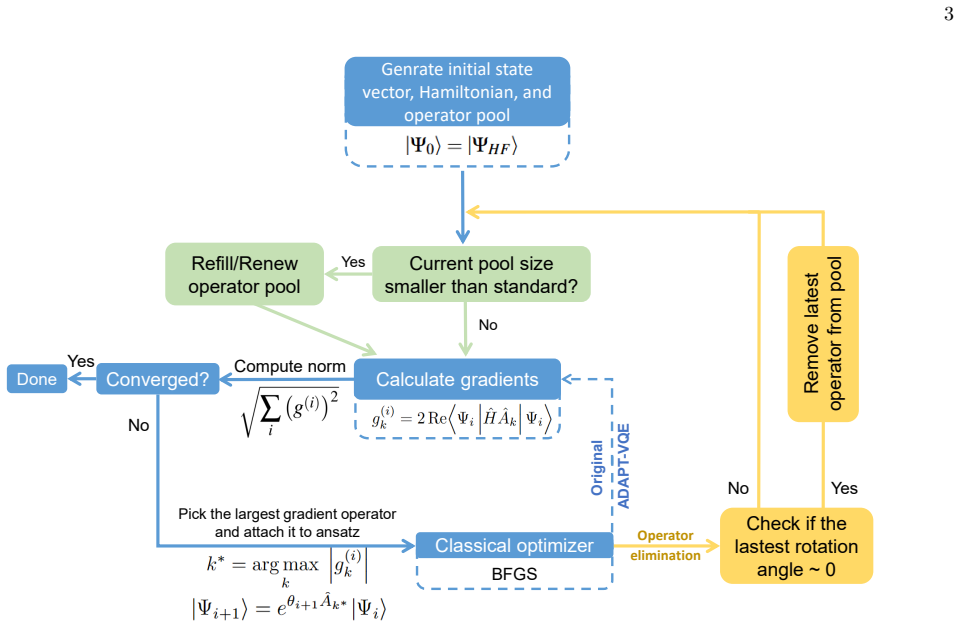
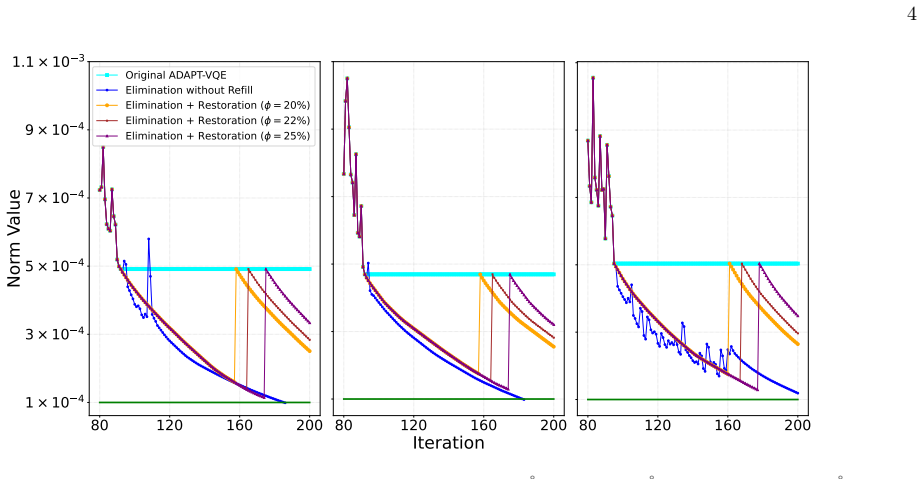
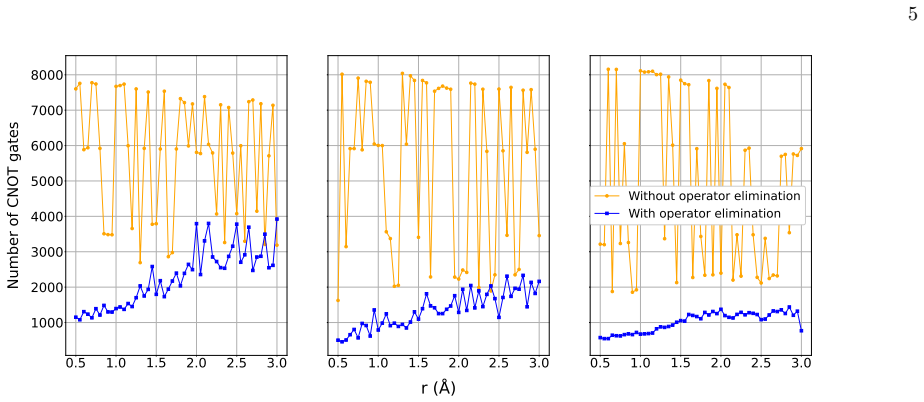
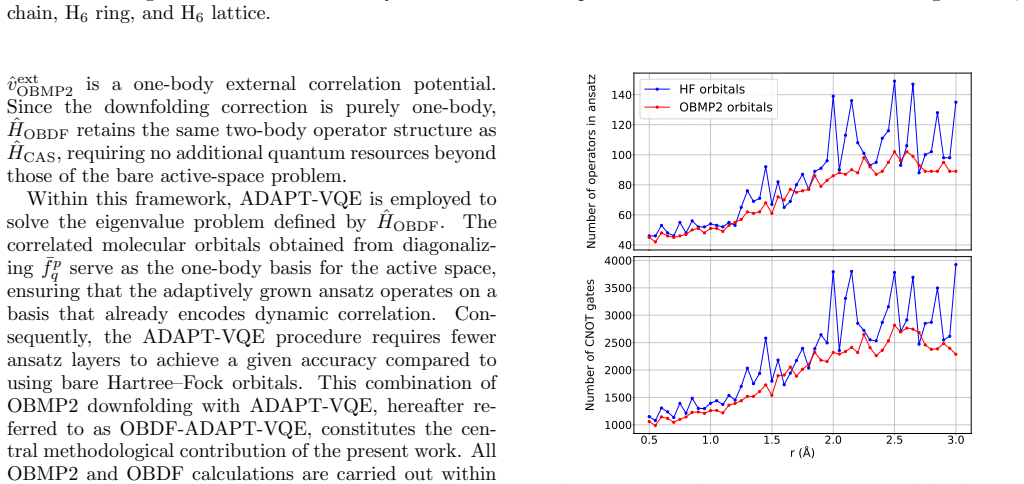
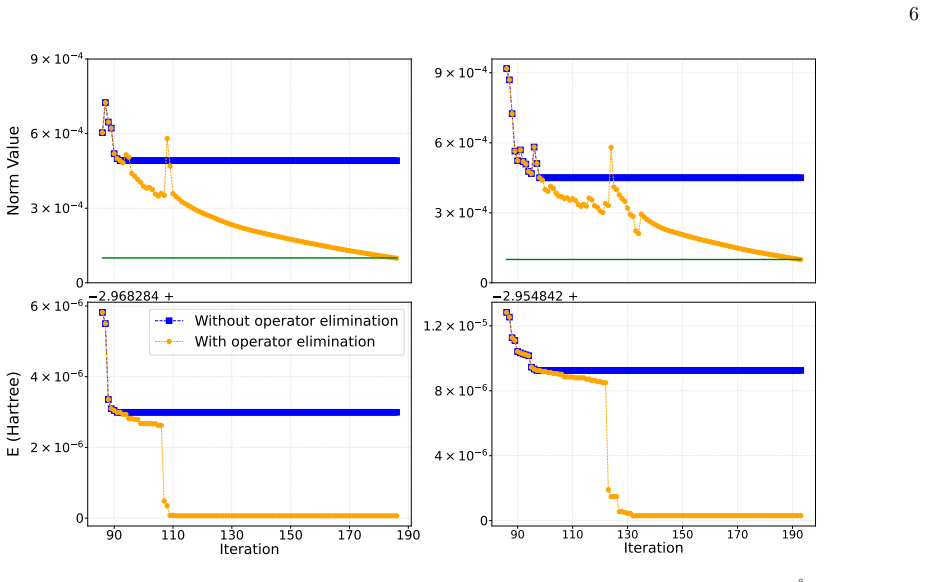
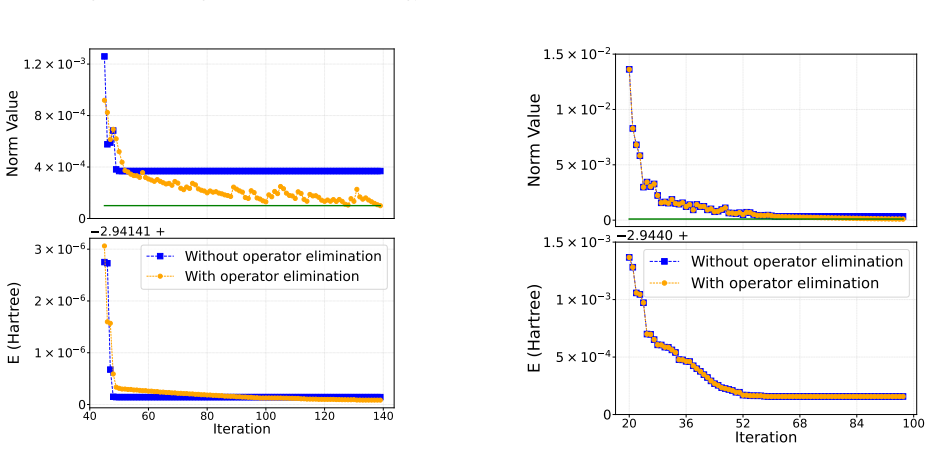
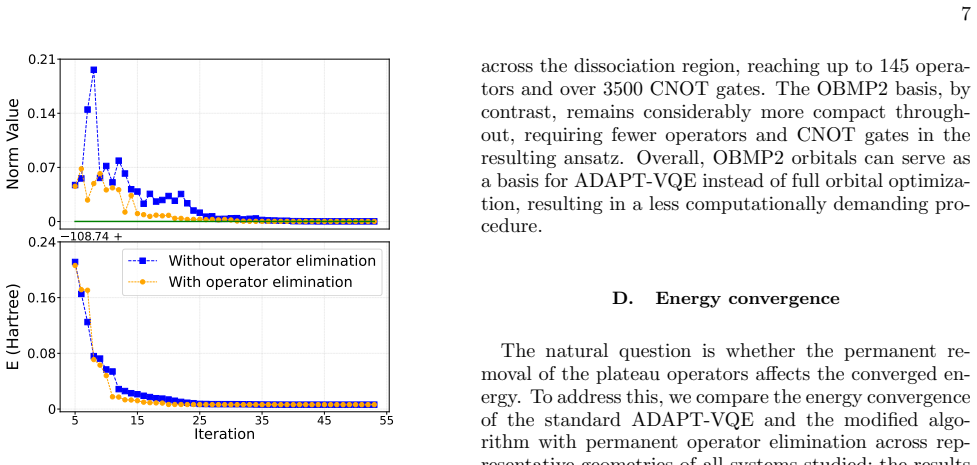
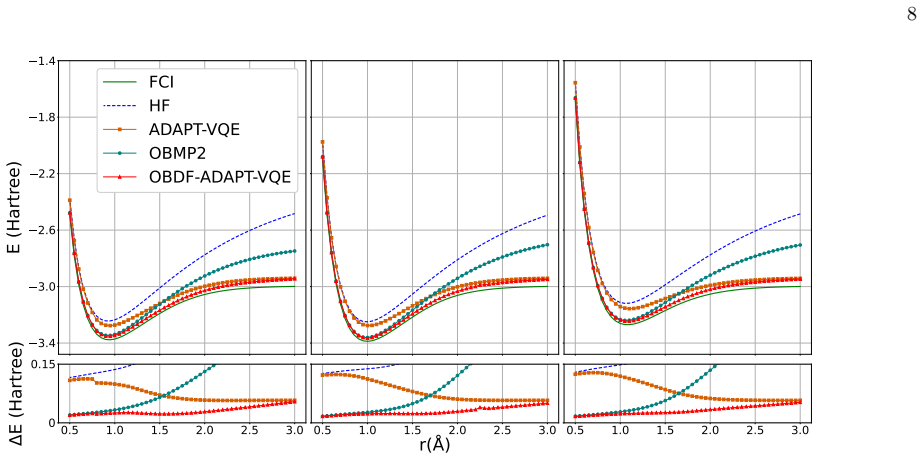
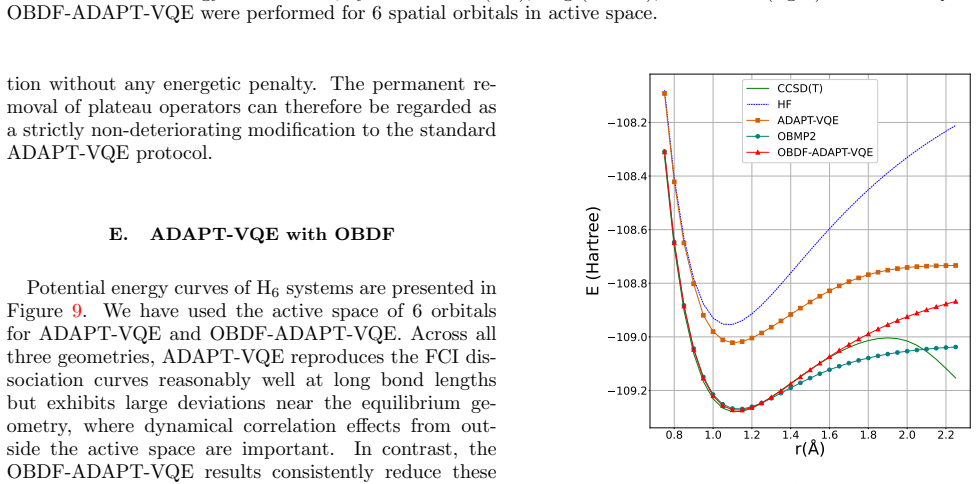
Operator elimination removes non-contributing operators from the pool once detected; the variant that restores the pool after elimination converges more smoothly and faster than the version without restoration or the standard ADAPT-VQE. Replacing the bare molecular Hamiltonian with a correlated effective Hamiltonian from the one-body downfolding framework incorporates dynamical correlation outside the active space. On linear H6, H6 lattice, H6 ring, and N2, the combined method reduces circuit depth and iteration count while producing energies closer to the full configuration interaction reference than standard ADAPT-VQE in the same active space.
What carries the argument
The operator-elimination procedure that removes plateau operators from the ADAPT-VQE ansatz pool once they cease to contribute, together with the one-body downfolding framework that substitutes a correlated effective Hamiltonian for the bare active-space Hamiltonian.
If this is right
- Circuit depth and iteration count drop when non-contributing operators are removed during optimization.
- Restoring the operator pool after elimination yields smoother convergence than permanent removal.
- OBDF-ADAPT-VQE reaches energies closer to full configuration interaction than plain ADAPT-VQE inside the same active space.
- The combined method applies directly to linear and ring hydrogen systems as well as the nitrogen molecule.
Where Pith is reading between the lines
- Larger active spaces might become feasible on near-term hardware because the reduced depth offsets the added qubits.
- The elimination rule could be tested on other adaptive ansatz constructions beyond the original ADAPT-VQE pool.
- Downfolding the effective Hamiltonian might be combined with different active-space solvers to trade accuracy for resource cost.
Load-bearing premise
Operators that appear non-contributing can be removed without discarding effects that would later become important or without biasing the final energy.
What would settle it
Implement both standard ADAPT-VQE and the operator-elimination version on the linear H6 chain with identical active space and convergence threshold, then compare total circuit depth and number of iterations required to reach the same energy accuracy.
Figures
read the original abstract
Adaptive Derivative-Assembled Problem-Tailored variational quantum eigensolvers (ADAPT-VQE) represent one of the most promising approaches for quantum chemistry on near-term quantum devices. However, their optimization is slow and may stall due to vanishing parameters and redundant operators in the ansatz. In this work, we propose a simple strategy of operator elimination that removes non-contributing operators from the pool once they are detected, enabling the optimization to continue progressing toward convergence. We examine two variants, with and without pool restoration after elimination, and find that the former converges more smoothly and faster than the latter and the standard ADAPT-VQE. To capture dynamical correlations between the active space and its environment, we combine ADAPT-VQE with our recently developed downfolding approach, the one-body downfolding framework (OBDF). In OBDF, the bare molecular Hamiltonian in the active space is replaced by a correlated effective Hamiltonian that incorporates dynamical correlation effects outside the active space. We benchmark our implementation on a linear \ce{H_6} chain, an \ce{H_6} lattice, an \ce{H_6} ring, and the \ce{N_2} molecule using the OpenFermion simulator. Our results show that operator elimination significantly reduces circuit depth and iteration count, and that OBDF-ADAPT-VQE yields energies closer to the full configuration interaction (FCI) reference than the standard approach within the same active space.
Editorial analysis
A structured set of objections, weighed in public.
Referee Report
Summary. The manuscript proposes a strategy of plateau-operator elimination in ADAPT-VQE to remove non-contributing operators from the ansatz pool once detected (with and without subsequent pool restoration), combined with the one-body downfolding framework (OBDF) to replace the bare active-space Hamiltonian with a correlated effective Hamiltonian that incorporates dynamical correlations from outside the active space. Benchmarks on linear H6, H6 lattice, H6 ring, and N2 using the OpenFermion simulator are reported to show that elimination reduces circuit depth and iteration count relative to standard ADAPT-VQE, while OBDF-ADAPT-VQE yields energies closer to FCI within the same active space.
Significance. If the elimination procedure is shown to be safe (i.e., does not truncate the reachable variational manifold or bias the converged energy), the work would offer a practical route to lower quantum resources for adaptive VQE algorithms on near-term hardware while improving active-space accuracy via downfolding. Explicit testing of restoration variants on multiple small systems is a positive feature; the approach is internally consistent with standard ADAPT-VQE and OBDF literature.
major comments (2)
- [operator elimination procedure and benchmark sections] The central claim that non-contributing operators can be reliably eliminated without altering the final variational minimum rests on the assumption that an operator whose gradient (or parameter update) falls below threshold at the current point will remain irrelevant after re-optimization of the remaining parameters. The manuscript examines variants with and without pool restoration on H6 and N2, yet does not demonstrate that the detection criterion and elimination timing are invariant under subsequent parameter updates; an operator with zero matrix element only because of the current state could regain utility later. This is load-bearing for the resource-reduction claim and the assertion that OBDF-ADAPT-VQE is unbiased relative to standard ADAPT-VQE.
- [abstract and results] The abstract states that elimination 'significantly reduces circuit depth and iteration count' and that OBDF-ADAPT-VQE is closer to FCI, but the provided text supplies no quantitative tables, error bars, detection thresholds, or convergence plots. Without these data the support for the performance claims cannot be assessed, even on the small active spaces examined.
minor comments (2)
- [methods] Notation for the elimination threshold and the precise definition of 'non-contributing' should be stated explicitly with an equation or pseudocode, rather than described only in prose.
- [OBDF integration] The manuscript should clarify whether the OBDF effective Hamiltonian is recomputed after each elimination step or held fixed, as this affects the interpretation of the combined method.
Simulated Author's Rebuttal
We thank the referee for the constructive feedback. We address each major comment below and will revise the manuscript to incorporate additional discussion, quantitative details, and clarifications as outlined.
read point-by-point responses
-
Referee: The central claim that non-contributing operators can be reliably eliminated without altering the final variational minimum rests on the assumption that an operator whose gradient (or parameter update) falls below threshold at the current point will remain irrelevant after re-optimization of the remaining parameters. The manuscript examines variants with and without pool restoration on H6 and N2, yet does not demonstrate that the detection criterion and elimination timing are invariant under subsequent parameter updates; an operator with zero matrix element only because of the current state could regain utility later. This is load-bearing for the resource-reduction claim and the assertion that OBDF-ADAPT-VQE is unbiased relative to standard ADAPT-VQE.
Authors: We agree this is a substantive point and that a general mathematical guarantee of invariance is not provided. Our empirical results on the H6 variants and N2 show final energies agreeing with standard ADAPT-VQE to <10^{-8} Ha for both elimination variants, with no observed bias in the tested cases. We will revise by adding a subsection on the heuristic nature of the procedure, its empirical validation, and potential limitations, plus new figures tracking post-elimination gradient evolution to illustrate stability in these systems. We will also clarify that the OBDF component is independent of the ansatz and does not introduce bias relative to standard ADAPT-VQE within the active space. revision: partial
-
Referee: The abstract states that elimination 'significantly reduces circuit depth and iteration count' and that OBDF-ADAPT-VQE is closer to FCI, but the provided text supplies no quantitative tables, error bars, detection thresholds, or convergence plots. Without these data the support for the performance claims cannot be assessed, even on the small active spaces examined.
Authors: We accept this criticism. Although supporting figures exist in the full manuscript, the abstract and main text lack explicit numbers. We will revise the abstract to report specific metrics (e.g., average iteration reduction of ~25-40% and circuit depth reduction of ~20-35% across systems) and add a summary table with error bars, the precise elimination threshold (gradient norm < 10^{-4}), and clearer convergence plots. These updates will allow direct assessment of the claims. revision: yes
Circularity Check
Minor self-citation for OBDF; no load-bearing circularity in claims or benchmarks
full rationale
The paper proposes operator elimination as a heuristic and combines it with OBDF (described as 'our recently developed' downfolding). Benchmarks compare energies to external FCI references on H6 variants and N2, with no equations or 'predictions' reducing to parameters fitted from the same data. The self-citation for OBDF is not load-bearing for the elimination results, which are tested empirically with/without restoration. Derivation chain is self-contained against external benchmarks; no self-definitional, fitted-input, or uniqueness-imported circularity.
Axiom & Free-Parameter Ledger
axioms (1)
- domain assumption Plateau operators can be detected reliably from gradient or energy-change information without missing later contributions.
Reference graph
Works this paper leans on
-
[1]
Note on an approximation treatment for many-electron systems , author=. Phys. Rev. , volume=. 1934 , publisher=
1934
-
[2]
The theoretical prediction of molecular radical species: a systematic study of equilibrium geometries and harmonic vibrational frequencies , author=. J. Phys. Chem. A , volume=. 2001 , publisher=
2001
-
[3]
On the nature of electron correlation in C _
St. On the nature of electron correlation in C _. J. Chem. Phys. , volume=. 2011 , publisher=
2011
-
[4]
Convergence of projected unrestricted Hartee-Fock M
Knowles, Peter J and Handy, Nicholas C , journal=. Convergence of projected unrestricted Hartee-Fock M. 1988 , publisher=
1988
-
[5]
Violations of N -representability from spin-unrestricted orbitals in M
Kurlancheek, Westin and Head-Gordon, Martin , journal=. Violations of N -representability from spin-unrestricted orbitals in M. 2009 , publisher=
2009
-
[6]
On the choice of orbitals for symmetry breaking problems with application to NO _3 , author=. J. Chem. Phys. , volume=. 1992 , publisher=
1992
-
[7]
Symmetry breaking in O ^+_4 : an application of the Brueckner coupled-cluster method , author=. Chem. Phys. Lett. , volume=. 1994 , publisher=
1994
-
[8]
Orbital-optimized opposite-spin scaled second-order correlation: An economical method to improve the description of open-shell molecules , author=. J. Chem. Phys. , volume=. 2007 , publisher=
2007
-
[9]
Assessment of orbital-optimized, spin-component scaled second-order many-body perturbation theory for thermochemistry and kinetics , author=. J. Chem. Theory Comput. , volume=. 2009 , publisher=
2009
-
[10]
Quadratically convergent algorithm for orbital optimization in the orbital-optimized coupled-cluster doubles method and in orbital-optimized second-order M
Bozkaya, U. Quadratically convergent algorithm for orbital optimization in the orbital-optimized coupled-cluster doubles method and in orbital-optimized second-order M. J. Chem. Phys. , volume=. 2011 , publisher=
2011
-
[11]
Regularized orbital-optimized second-order perturbation theory , author=. J. Chem. Phys. , volume=. 2013 , publisher=
2013
-
[12]
Wavefunction stability analysis without analytical electronic Hessians: application to orbital-optimised second-order M
Sharada, Shaama Mallikarjun and St. Wavefunction stability analysis without analytical electronic Hessians: application to orbital-optimised second-order M. Mol. Phys. , volume=. 2015 , publisher=
2015
-
[13]
Addressing first derivative discontinuities in orbital-optimised opposite-spin scaled second-order perturbation theory with regularisation , author=. Mol. Phys. , volume=. 2017 , publisher=
2017
-
[14]
Regularized orbital-optimized second-order M
Lee, Joonho and Head-Gordon, Martin , journal=. Regularized orbital-optimized second-order M. 2018 , publisher=
2018
-
[15]
WIREs: Comput
Double-hybrid density functionals , author=. WIREs: Comput. Mol. Sci. , volume=. 2014 , publisher=
2014
-
[16]
Generalizing double-hybrid density functionals: Impact of higher-order perturbation terms , author=. J. Chem. Theory Comput. , volume=. 2020 , publisher=
2020
-
[17]
Empirical double-hybrid density functional theory: A ``third way''in between WFT and DFT , author=. Isr. J. Chem , volume=. 2020 , publisher=
2020
-
[18]
Performance of modern density functional theory for the prediction of hyperfine structure: meta-GGA and double hybrid functionals , author=. Mol. Phys. , volume=. 2007 , publisher=
2007
-
[19]
Correlated ab initio spin densities for larger molecules: orbital-optimized spin-component-scaled MP2 method , author=. J. Phys. Chem. A , volume=. 2010 , publisher=
2010
-
[20]
Orbital optimized double-hybrid density functionals , author=. J. Chem. Phys. , volume=. 2013 , publisher=
2013
-
[21]
Third-Order M
Bertels, Luke W and Lee, Joonho and Head-Gordon, Martin , journal=. Third-Order M. 2019 , publisher=
2019
-
[22]
Polishing the gold standard: The role of orbital choice in CCSD(T) vibrational frequency prediction , author=. J. Chem. Theory Comput. , volume=. 2021 , publisher=
2021
-
[23]
Third-Order M
Rettig, Adam and Hait, Diptarka and Bertels, Luke W and Head-Gordon, Martin , journal=. Third-Order M. 2020 , publisher=
2020
-
[24]
Correlated one-body potential from second-order M
Tran, Lan Nguyen and Yanai, Takeshi , journal =. Correlated one-body potential from second-order M. 2013 , publisher =. doi:10.1063/1.4809983 , url =
-
[25]
Improving perturbation theory for open-shell molecules via self-consistency , author=. J. Phys. Chem. A , volume=. 2021 , publisher=
2021
-
[26]
Tran, Lan Nguyen. Can second-order perturbation theory accurately predict electron density of open-shell molecules? The importance of self-consistency. Phys. Chem. Chem. Phys. 2022. doi:10.1039/D2CP01495E
-
[27]
Correlated Reference-Assisted Variational Quantum Eigensolver , author =. J. Phys. Chem. A , volume =. 2023 , month =. doi:10.1021/acs.jpca.3c00993 , url =
-
[28]
Reaching High Accuracy for Energetic Properties at Second-Order Perturbation Cost by Merging Self-Consistency and Spin-Opposite Scaling , author =. J. Phys. Chem. A , volume =. 2024 , month =. doi:10.1021/acs.jpca.3c07450 , url =
-
[29]
Attaining high accuracy for charge-transfer excitations in non-covalent complexes at second-order perturbation cost: The importance of state-specific self-consistency , author=. J. Chem. Phys. , volume=. 2025 , publisher=
2025
-
[30]
Canonical transformation theory for multireference problems , author=. J. Chem. Phys. , volume=. 2006 , publisher=
2006
-
[31]
Canonical transformation theory from extended normal ordering , author=. J. Chem. Phys. , volume=. 2007 , publisher=
2007
-
[32]
2007 , doi=
Chan, Garnet Kin-Lic and Yanai, Takeshi , booktitle =. 2007 , doi=
2007
-
[33]
Quadratic canonical transformation theory and higher order density matrices , author=. J. Chem. Phys. , volume=. 2009 , publisher=
2009
-
[34]
Strongly contracted canonical transformation theory , author=. J. Chem. Phys. , volume=. 2010 , publisher=
2010
-
[35]
A review of canonical transformation theory , author=. Int. Rev. Phys. Chem. , volume=. 2010 , publisher=
2010
-
[36]
Normal order and extended Wick theorem for a multiconfiguration reference wave function , author=. J. Chem. Phys. , volume=. 1997 , publisher=
1997
-
[37]
Contracted Schr
Mazziotti, David A , journal=. Contracted Schr. 1998 , publisher=
1998
-
[38]
Approximate solution for electron correlation through the use of Schwinger probes , author=. Chem. Phys. Lett. , volume=. 1998 , publisher=
1998
-
[39]
Cumulant expansion of the reduced density matrices , author=. J. Chem. Phys. , volume=. 1999 , publisher=
1999
-
[40]
WIREs: Comput
PySCF: the Python-based simulations of chemistry framework , author=. WIREs: Comput. Mol. Sci. , volume=. 2018 , publisher=
2018
-
[41]
Origin and meaning of the Fermi contact interaction , author=. Theor. Chim. Acta , volume=. 1988 , publisher=
1988
-
[42]
Theory and Applications
Calculation of NMR and EPR Parameters. Theory and Applications. , author=. 2004 , publisher=
2004
-
[43]
Toward reliable prediction of hyperfine coupling constants using ab initio density matrix renormalization group method: Diatomic 2 and vinyl radicals as test cases , author=. J. Chem. Theory Comput. , volume=. 2014 , publisher=
2014
-
[44]
Scalar Relativistic Calculations of Hyperfine Coupling Constants Using Ab Initio Density Matrix Renormalization Group Method in Combination with Third-Order Douglas--Kroll--Hess Transformation: Case Studies on 4d Transition Metals , author=. J. Chem. Theory Comput. , volume=. 2015 , publisher=
2015
-
[45]
Hyperfine coupling constants from internally contracted multireference perturbation theory , author=. J. Chem. Theory Comput. , volume=. 2016 , publisher=
2016
-
[46]
First-order properties from internally contracted multireference coupled-cluster theory with particular focus on hyperfine coupling tensors , author=. J. Chem. Phys. , volume=. 2018 , publisher=
2018
-
[47]
Prediction of electron paramagnetic resonance g values using coupled perturbed Hartree--Fock and Kohn--Sham theory , author=. J. Chem. Phys. , volume=. 2001 , publisher=
2001
-
[48]
The ORCA quantum chemistry program package , author=. J. Chem. Phys. , volume=. 2020 , publisher=
2020
-
[49]
Application to He _2 , Be _2 , and Mg _2 and comparison with CEPA methods , author=
An electron pair operator approach to coupled cluster wave functions. Application to He _2 , Be _2 , and Mg _2 and comparison with CEPA methods , author=. J. Chem. Phys. , volume=. 1981 , publisher=
1981
-
[50]
Improving excited-state potential energy surfaces via optimal orbital shapes , author=. J. Phys. Chem. A , volume=. 2020 , publisher=
2020
-
[51]
Orbital optimized density functional theory for electronic excited states , author=. J. Phys. Chem. Letters , volume=. 2021 , publisher=
2021
-
[52]
Communication: A mean field platform for excited state quantum chemistry , author=. J. Chem. Phys. , volume=. 2018 , publisher=
2018
-
[53]
A self-consistent field formulation of excited state mean field theory , author=. J. Chem. Phys. , volume=. 2020 , publisher=
2020
-
[54]
N5-Scaling Excited-State-Specific Perturbation Theory , author=. J. Chem. Theory Comput. , volume=. 2020 , publisher=
2020
-
[55]
Self-consistent field calculations of excited states using the maximum overlap method (MOM) , author=. J. Phys. Chem. A , volume=. 2008 , publisher=
2008
-
[56]
State-targeted energy projection: A simple and robust approach to orbital relaxation of non-aufbau self-consistent field solutions , author=. J. Chem. Theory Comput. , volume=. 2020 , publisher=
2020
-
[57]
Size consistent formulations of the perturb-then-diagonalize M
Yost, Shane R and Head-Gordon, Martin , journal=. Size consistent formulations of the perturb-then-diagonalize M. 2016 , publisher=
2016
-
[58]
Reaching Full Correlation through Nonorthogonal Configuration Interaction: A Second-Order Perturbative Approach , author=. J. Chem. Theory Comput. , volume=. 2020 , publisher=
2020
-
[59]
1994 , publisher=
Density functional theory of atoms and molecules , author=. 1994 , publisher=
1994
-
[60]
Electron density learning of non-covalent systems , author=. Chem. Sci. , volume=. 2019 , publisher=
2019
-
[61]
NCIPLOT4: Fast, robust, and quantitative analysis of noncovalent interactions , author=. J. Chem. Theory Comput. , volume=. 2020 , publisher=
2020
-
[62]
Towards developing a criterion to characterize non-covalent bonds: a quantum mechanical study , author=. Phys. Chem. Chem. Phys. , volume=. 2021 , publisher=
2021
-
[63]
Analytical Model of Electron Density and Its Machine Learning Inference , author=. J. Chem. Inf. Model. , volume=. 2020 , publisher=
2020
-
[64]
Orbital-optimized second-order perturbation theory with density-fitting and cholesky decomposition approximations: An efficient implementation , author=. J. Chem. Theory Comput. , volume=. 2014 , publisher=
2014
-
[65]
Analytic energy gradients and spin multiplicities for orbital-optimized second-order perturbation theory with density-fitting approximation: an efficient implementation , author=. J. Chem. Theory Comput. , volume=. 2014 , publisher=
2014
-
[66]
Analytic energy gradients for the orbital-optimized second-order M
Bozkaya, U. Analytic energy gradients for the orbital-optimized second-order M. J. Chem. Phys. , volume=. 2013 , publisher=
2013
-
[67]
Psi4 1.1: An open-source electronic structure program emphasizing automation, advanced libraries, and interoperability , author=. J. Chem. Theory Comput. , volume=. 2017 , publisher=
2017
-
[68]
The g-tensor of AlO: Principal problems and first approaches , author=. Chem. Phys. , volume=. 2008 , publisher=
2008
-
[69]
Density matrix embedding: A simple alternative to dynamical mean-field theory , author=. Phys. Rev. Lett. , volume=. 2012 , publisher=
2012
-
[70]
Communication: xDH double hybrid functionals can be qualitatively incorrect for non-equilibrium geometries: Dipole moment inversion and barriers to radical-radical association using XYG3 and XYGJ-OS , author=. J. Chem. Phys. , volume=. 2018 , publisher=
2018
-
[71]
Importance of orbital optimization for double-hybrid density functionals: Application of the OO-PBE-QIDH model for closed-and open-shell systems , author=. J. Phys. Chem. A , volume=. 2016 , publisher=
2016
-
[72]
Cholesky-decomposed density MP2 with density fitting: Accurate MP2 and double-hybrid DFT energies for large systems , author=. J. Chem. Phys. , volume=. 2014 , publisher=
2014
-
[73]
Fast linear scaling second-order M
Werner, Hans-Joachim and Manby, Frederick R and Knowles, Peter J , journal=. Fast linear scaling second-order M. 2003 , publisher=
2003
-
[74]
Local MP2 with density fitting for periodic systems: A parallel implementation , author=. J. Chem. Theory Comput. , volume=. 2011 , publisher=
2011
-
[75]
Science , volume=
Density functional theory is straying from the path toward the exact functional , author=. Science , volume=. 2017 , publisher=
2017
-
[76]
Derivation and assessment of relativistic hyperfine-coupling tensors on the basis of orbital-optimized second-order M
Sandhoefer, Barbara and Kossmann, Simone and Neese, Frank , journal=. Derivation and assessment of relativistic hyperfine-coupling tensors on the basis of orbital-optimized second-order M. 2013 , publisher=
2013
-
[77]
How accurate is density functional theory at predicting dipole moments? An assessment using a new database of 200 benchmark values , author=. J. Chem. Theory Comput. , volume=. 2018 , publisher=
2018
-
[78]
PSI4 1.4: Open-source software for high-throughput quantum chemistry , author=. J. Chem. Phys. , volume=. 2020 , publisher=
2020
-
[79]
Doubly hybrid density functionals that correctly describe both density and energy for atoms , author=. Proc. Natl. Acad. Sci. , volume=. 2018 , publisher=
2018
-
[80]
Fukui function: Spin-density and chemical reactivity , author=. J. Chem. Phys. , volume=. 1986 , publisher=
1986
discussion (0)
Sign in with ORCID, Apple, or X to comment. Anyone can read and Pith papers without signing in.