Unveiling the Mysteries of Lightning: Exploring its fundamental Physical Processes with SKA-LOW
Pith reviewed 2026-07-02 05:46 UTC · model grok-4.3
The pith
SKA-LOW will use radio observations to explore how lightning initiates and propagates.
A machine-rendered reading of the paper's core claim, the machinery that carries it, and where it could break.
Core claim
SKA-LOW's unrivaled spectral bandwidth and sensitivity, combined with high resolution from large baselines, will allow detailed study of lightning's fundamental plasma physics processes such as initiation, propagation, connection to ground, and emission of high-energy radiation by observing radio signals including the very first emissions from a flash.
What carries the argument
SKA-LOW's spectral bandwidth, sensitivity, and resolution from large antenna baselines, which together enable mapping of VHF radiation and detection of faint lightning signals.
If this is right
- Direct tests of how lightning plasma emits VHF radiation across a broad frequency range.
- Detection of the initial radio emissions that mark the start of a lightning flash.
- New constraints on the plasma conditions during propagation and ground connection.
- Links between radio data and high-energy radiation events produced by the same processes.
Where Pith is reading between the lines
- If the observations succeed they could be combined with ground-based electric field or optical sensors to cross-check plasma models.
- The same instrument setup might be applied to other transient atmospheric radio sources beyond lightning.
- Results could inform whether dedicated SKA time for atmospheric studies becomes a standard use case.
Load-bearing premise
Lightning produces radio emissions in SKA-LOW's frequency bands at levels detectable even for its faintest processes.
What would settle it
A set of SKA-LOW observations of active lightning that detects no radio signals in the target bands or fails to resolve propagation details at the claimed scales would show the instrument cannot deliver the proposed insights.
Figures
read the original abstract
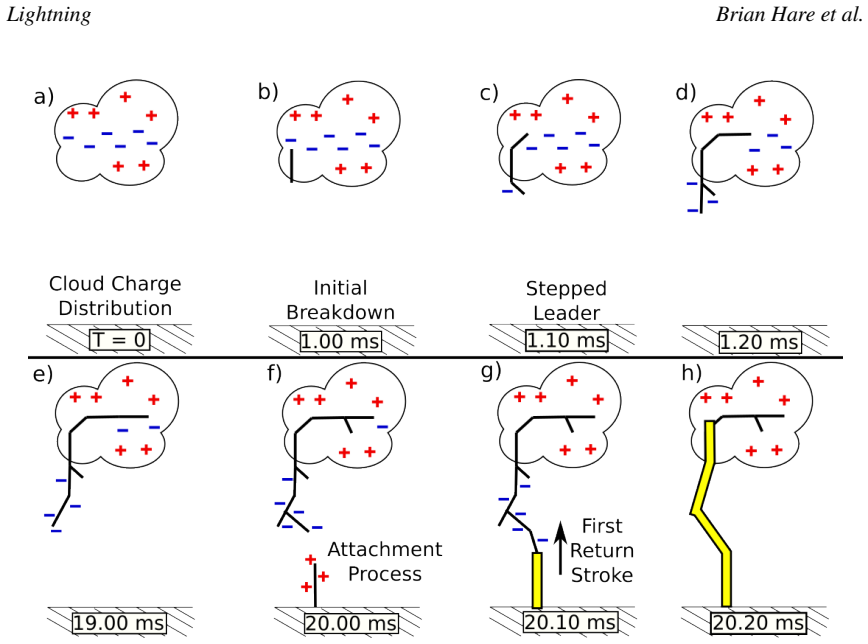
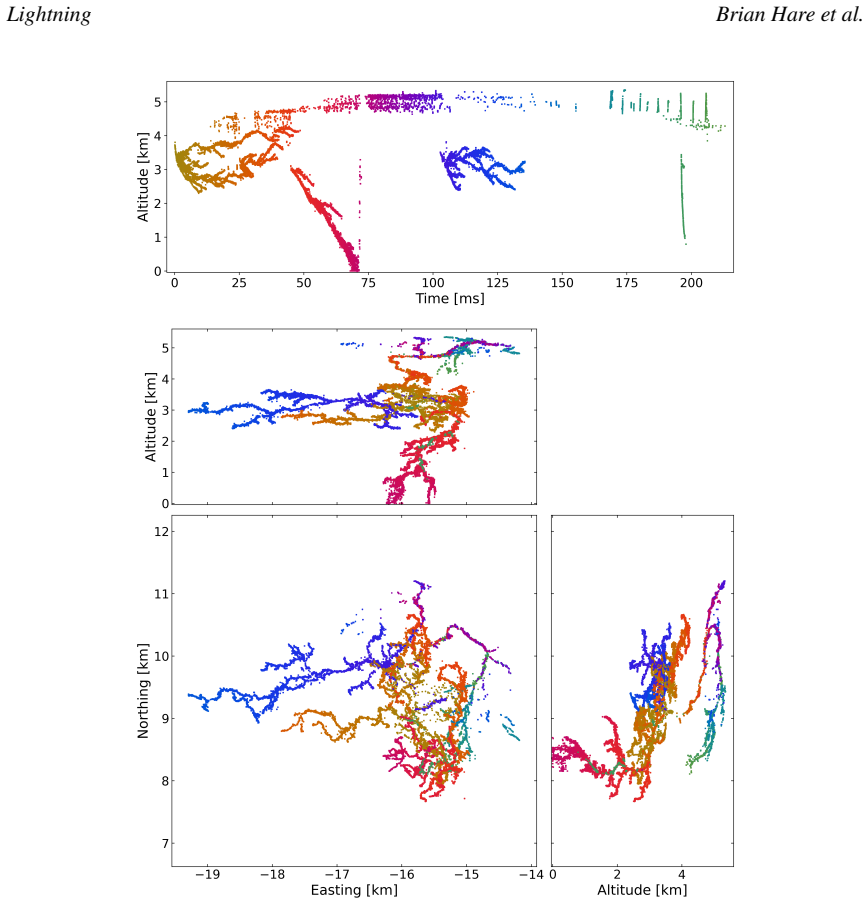
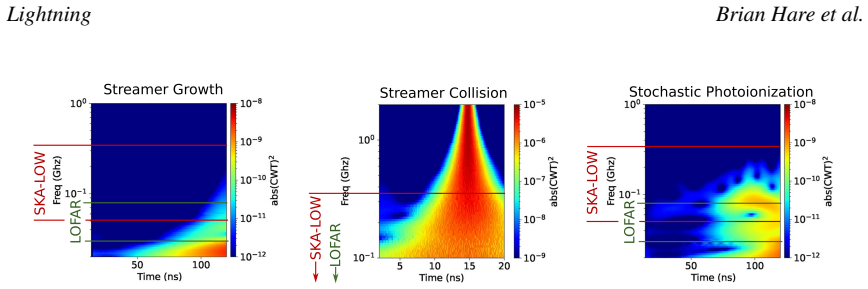
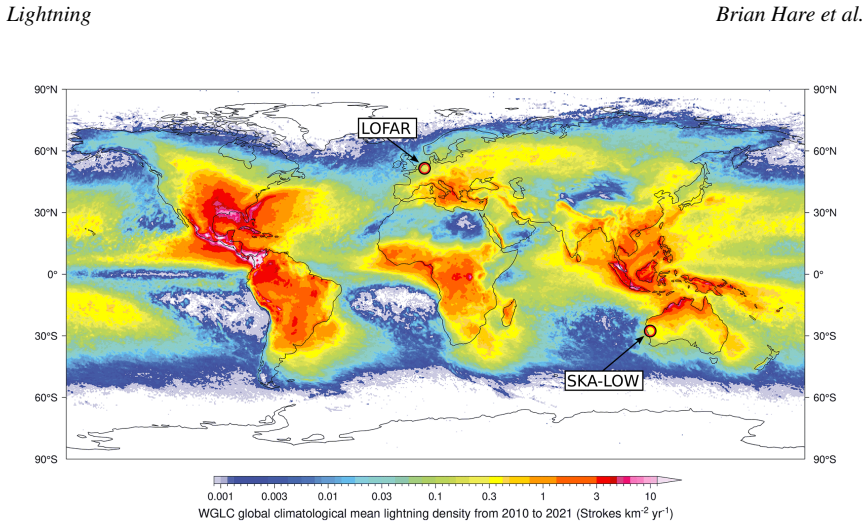
Lightning is a surprisingly poorly understood phenomena. It consists of a wide variety of complex processes such as initiation, propagation, connection to ground, even emission of high-energy radiation. However, due to the extreme challenges in observing lightning at fast time scales, small spatial scales, and behind obscuring clouds, these processes are not well understood. In the past, interferometers such as the LOFAR radio telescope have provided unique insight and discoveries into the physics of lightning. The new SKA-LOW being built in western Australia will provide unrivaled spectral bandwidth and sensitivity, which will be combined with high resolution resulting from large antenna baselines. We will use SKA-LOW to observe lightning in order to explore its fundamental plasma physics, such as how it initiates and propagates. SKA's high bandwidth will allow us to test how lightning emits VHF radiation, giving tremendous insight into precisely how the plasma behaves. SKA's sensitivity will allow us to explore extremely faint lightning processes, such as the very first radio emission from a lightning flash. Here, we detail the lightning physics that can be explored with SKA, as well as the observation strategy needed explore such physics.
Editorial analysis
A structured set of objections, weighed in public.
Referee Report
Summary. The manuscript is a forward-looking science case proposing the use of the completed SKA-LOW array (50–350 MHz) to observe lightning radio emission. It argues that the instrument’s wide bandwidth, sensitivity, and long baselines will enable new constraints on plasma processes including initiation, propagation, and faint early-stage emission, building on prior LOFAR results.
Significance. If the detectability premise holds, the proposed observations could deliver broadband, high-resolution data on processes that are currently inaccessible, extending LOFAR’s demonstrated capabilities and addressing open questions in lightning plasma physics. The strength of the case rests on the instrument’s technical specifications rather than new derivations or data.
major comments (2)
- Abstract and § on observation strategy: the claim that SKA-LOW sensitivity will reach “extremely faint lightning processes” and “the very first radio emission” is not supported by any quantitative estimate of expected flux density, source distance, or comparison to the array’s system equivalent flux density; without such numbers the central feasibility assertion remains untested within the manuscript.
- Section detailing VHF emission tests: the statement that high bandwidth “will allow us to test how lightning emits VHF radiation” does not specify which spectral features or polarization signatures are predicted to be diagnostic, nor how they differ from existing LOFAR constraints in the overlapping band.
minor comments (2)
- Abstract: “phenomena” should be “phenomenon”; “needed explore such physics” is missing “to”.
- The manuscript would benefit from explicit citation of the LOFAR lightning papers whose results are invoked as the foundation for the SKA-LOW case.
Simulated Author's Rebuttal
We thank the referee for their constructive comments, which highlight areas where the manuscript can be strengthened with additional quantitative support and specificity. We address each major comment below and will revise the paper accordingly.
read point-by-point responses
-
Referee: Abstract and § on observation strategy: the claim that SKA-LOW sensitivity will reach “extremely faint lightning processes” and “the very first radio emission” is not supported by any quantitative estimate of expected flux density, source distance, or comparison to the array’s system equivalent flux density; without such numbers the central feasibility assertion remains untested within the manuscript.
Authors: We agree that the current manuscript does not include the requested quantitative estimates. In the revised version we will add calculations of expected flux densities for early-stage and faint lightning emission, scaled from published LOFAR measurements, together with representative source distances for events observable from the SKA site and direct comparisons to the SKA-LOW SEFD across the 50–350 MHz band. These additions will place the feasibility claims on a firmer numerical footing. revision: yes
-
Referee: Section detailing VHF emission tests: the statement that high bandwidth “will allow us to test how lightning emits VHF radiation” does not specify which spectral features or polarization signatures are predicted to be diagnostic, nor how they differ from existing LOFAR constraints in the overlapping band.
Authors: We accept that greater detail is required. The revised manuscript will explicitly identify the diagnostic observables—such as the frequency-dependent spectral index of streamer emission, the presence or absence of narrowband features, and the degree of linear polarization—that SKA-LOW’s continuous 50–350 MHz coverage can measure. We will also clarify how these measurements extend LOFAR results by providing uninterrupted spectral coverage above 80 MHz and improved sensitivity, enabling tests of emission models that are currently limited by LOFAR’s narrower instantaneous bandwidth. revision: yes
Circularity Check
No significant circularity in this observational proposal
full rationale
This is a forward-looking observational proposal paper with no derivations, equations, fitted parameters, or predictions that could reduce to inputs by construction. The central premise—that SKA-LOW's capabilities will enable new insights into lightning plasma physics—rests on prior external LOFAR results in overlapping bands and on the instrument's stated specifications, neither of which is internally derived or self-referential. No self-citation chains, uniqueness theorems, or ansatzes are invoked as load-bearing steps. The manuscript is therefore self-contained against external benchmarks with a circularity score of 0.
Axiom & Free-Parameter Ledger
Reference graph
Works this paper leans on
-
[1]
doi: 10.1126/sciadv.abl8731. O. Chanrion et al.Geophysical Research Letters, 44(1):496–503,
-
[2]
doi: 10.1016/j.physrep.2013.09.004
ISSN 0370-1573. doi: 10.1016/j.physrep.2013.09.004. The Physics of Lightning. H. E. Edens, K. B. Eack, W. Rison, and S. J. Hunyady.Geophysical Research Letters, 41(4): 1336–1342,
-
[3]
doi: 10.1002/2013GL059180. B. M. Hare et al.Phys. Rev. Lett., 124:105101, Mar
-
[4]
doi: 10.1103/PhysRevLett.124.105101. B. M. Hare et al.Nature, 568:360–363,
-
[5]
doi: 10.1038/s41586-019-1086-6. J. D. Hill, M. A. Uman, and D. M. Jordan.Journal of Geophysical Research: Atmospheres, 116 (D16),
-
[6]
J.O.KaplanandK.H.-K.Lau.EarthSystemScienceData,14(12):5665–5670,2022
doi: 10.1029/2011JD015818. J.O.KaplanandK.H.-K.Lau.EarthSystemScienceData,14(12):5665–5670,2022. doi: 10.5194/ essd-14-5665-2022. URLhttps://essd.copernicus.org/articles/14/5665/2022/. X. Kong, X. Qie, and Y. Zhao.Geophysical Research Letters, 35(5),
-
[7]
doi: https://doi.org/10. 1029/2007GL032764. N.Liuetal.JournalofGeophysicalResearch: Atmospheres,124(17-18):10134–10153,2019. doi: 10.1029/2019JD030439. N. Y. Liu and J. R. Dwyer.Geophysical Research Letters, 47(23):e2020GL090325,
-
[8]
e2020GL090325 10.1029/2020GL090325
doi: https://doi.org/10.1029/2020GL090325. e2020GL090325 10.1029/2020GL090325. H. Malla et al. Calculating radio emissions of positive streamer phenomena using 3d simulations,
-
[9]
doi: 10.1088/1361-6595/abaa05. Y. Pu and S. A. Cummer.Geophysical Research Letters, 51(1):e2023GL107388,
-
[10]
doi: https://doi.org/10.1029/2023GL107388. e2023GL107388 2023GL107388. Y. Pu, S. A. Cummer, and N. Liu.Geophysical Research Letters, 48(11):e2021GL093145,
-
[11]
doi: https://doi.org/10.1029/2021GL093145. e2021GL093145. Y. Pu, N. Liu, and S. A. Cummer.Geophysical Research Letters, 49(5):e2021GL097374,
-
[12]
doi: https://doi.org/10.1029/2021GL097374. e2021GL097374 2021GL097374. W. Rison et al.Nature Communications, 7(1):10721,
-
[13]
URL https://doi.org/10.1038/ncomms10721
doi: 10.1038/ncomms10721. URL https://doi.org/10.1038/ncomms10721. M. M. F. Saba, D. R. R. da Silva, J. G. Pantuso, and C. L. da Silva.Geophysical Research Letters, 49(24):e2022GL101482,
-
[14]
doi: https://doi.org/10.1029/2022GL101482. e2022GL101482. O. Scholten et al.Atmospheric Research, 260:105688, 2021a. ISSN 0169-8095. doi: https: //doi.org/10.1016/j.atmosres.2021.105688. O.Scholtenetal.JournalofGeophysicalResearch: Atmospheres,126(4):e2020JD033126,2021b. doi: https://doi.org/10.1029/2020JD033126. O. Scholten et al.Phys. Rev. D, 105:062007, Mar
-
[15]
doi: 10.1103/PhysRevD.105.062007. O. Scholten et al.Geophysical Research Letters, 50(8):e2022GL101304, 2023a. doi: https: //doi.org/10.1029/2022GL101304. O. Scholten et al.Scientific Reports, 13(1):14485, Sep 2023b. ISSN 2045-2322. doi: 10.1038/ s41598-023-41218-x. F. Shi, N. Liu, J. R. Dwyer, and K. M. A. Ihaddadene.Geophysical Research Letters, 46(1): 443–451,
-
[16]
doi: 10.1029/2018GL080309. C. Sterpka et al.Geophysical Research Letters, 48(23):e2021GL095511,
-
[17]
doi: https://doi. org/10.1029/2021GL095511. M. Stock et al.Remote Sensing, 15(14),
-
[18]
doi: 10.3390/rs15143657. M. G. Stock et al.Journal of Geophysical Research: Atmospheres, 119(6):3134–3165,
-
[19]
doi: 10.1002/2013JD020217. M. Stolzenburg et al.Journal of Geophysical Research: Atmospheres, 118(7):2918–2937,
-
[20]
doi: 10.1002/jgrd.50276. J. N. Tilles et al.Nature Communications, 10(1):1648,
-
[21]
URLhttps://doi.org/10.1038/s41467-019-09621-z
doi: 10.1038/s41467-019-09621-z. URLhttps://doi.org/10.1038/s41467-019-09621-z. T. N. G. Trinh et al.Geophysical Research Letters, 52(8):e2025GL115586,
-
[22]
doi: https: //doi.org/10.1029/2025GL115586. e2025GL115586 2025GL115586. M. P. van Haarlem et al.aap, 556:A2, Aug
-
[23]
doi: 10.1051/0004-6361/201220873. 12
discussion (0)
Sign in with ORCID, Apple, or X to comment. Anyone can read and Pith papers without signing in.