Towards Robust Driving Perception: A Flexible Scale-Driven Family for Self-Supervised Monocular Depth Estimation
Reviewed by Pith2026-07-03 21:32 UTCgrok-4.3pith:2IOI4VBRopen to challenge →
The pith
FlexDepth uses a scale-driven decoder and decoupled training to deliver state-of-the-art self-supervised depth estimates across any scale in driving scenes with low overhead.
A machine-rendered reading of the paper's core claim, the machinery that carries it, and where it could break.
Core claim
FlexDepth achieves state-of-the-art performance on standard driving benchmarks across arbitrary scales without any auxiliary information by combining a two-stage static-dynamic decoupled training strategy with a Scale-Driven Decoder that dynamically selects components based on scale size, all while keeping computational overhead minimal.
What carries the argument
Scale-Driven Decoder (SDD), which dynamically selects components based on scale size to enable efficient feature fusion and high-precision depth output.
If this is right
- State-of-the-art results hold on standard benchmarks without auxiliary information.
- Computational cost stays low enough for real-time use on edge devices.
- Smallest variant runs at 0.7 GFLOPs and 37.6 FPS on mobile platforms.
- Zero-shot generalization remains strong on unseen driving data.
Where Pith is reading between the lines
- The static-dynamic split could let the model flag unreliable depth estimates on moving vehicles more reliably than single-stage approaches.
- The same decoder logic might transfer to other multi-scale vision tasks such as semantic segmentation in varying distances.
- Low overhead opens the possibility of running full perception stacks on cheaper automotive hardware.
Load-bearing premise
Separating static and dynamic elements during training allows independent confidence assessment, and letting the decoder pick components by scale keeps accuracy high without added complexity.
What would settle it
An ablation test that removes the scale-based component selection and measures whether depth accuracy drops on driving sequences containing both very near and far objects.
Figures




read the original abstract
Self-Supervised Monocular Depth Estimation (MDE) has garnered attention in recent years due to its independence from ground truth. However, most existing models are limited to a single scale and exhibit considerable performance degradation in complex driving environments. Networks specifically designed to handle dynamic traffic participants tend to be overly complex, hindering their deployment on resource-constrained automotive edge devices. To address these limitations and move towards robust driving perception, we propose FlexDepth, a scale-driven and flexible family of self-supervised MDE models tailored for challenging road scenarios. FlexDepth employs a two-stage static-dynamic decoupled training strategy, enabling the independent assessment of confidence for both static backgrounds and dynamic road objects. Furthermore, it introduces a meticulously designed Scale-Driven Decoder (SDD) to dynamically select components based on scale size, facilitating efficient feature fusion and the output of high-precision depth maps. Extensive experiments on standard driving benchmarks demonstrate that without any auxiliary information, our model achieves state-of-the-art performance across arbitrary scales with minimal computational overhead. Our smallest model, Flex-Nano, requires only 0.7 GFLOPs and achieves 37.6 FPS on mobile platforms, ensuring reliable real-time perception while maintaining excellent zero-shot generalization. Our source code is avalible: https://github.com/startnew/flexdepth
Editorial analysis
A structured set of objections, weighed in public.
Referee Report
Summary. The paper proposes FlexDepth, a flexible family of self-supervised monocular depth estimation (MDE) models for driving scenes. It introduces a two-stage static-dynamic decoupled training strategy for independent confidence assessment of static backgrounds and dynamic objects, plus a Scale-Driven Decoder (SDD) that dynamically selects components by scale size for efficient fusion. The central claim is that this achieves state-of-the-art performance across arbitrary scales without auxiliary information, with the smallest Flex-Nano variant using only 0.7 GFLOPs and running at 37.6 FPS on mobile while maintaining zero-shot generalization.
Significance. If the claims hold, the work would be significant for resource-constrained automotive perception by combining scale flexibility, dynamic-object handling, and low overhead in a self-supervised setting. The efficiency numbers and no-auxiliary-info SOTA positioning address real deployment constraints in complex road environments.
major comments (2)
- [Abstract] Abstract: the headline claim of SOTA performance 'without any auxiliary information' across scales rests on the two-stage static-dynamic decoupled training plus SDD component selection being achievable purely from photometric self-supervision. No loss terms, equations, or training details are supplied to demonstrate how motion/depth separation occurs without scale leakage or an implicit motion mask, which is load-bearing for the central claim.
- [Abstract] Abstract: reported metrics (0.7 GFLOPs, 37.6 FPS, SOTA across benchmarks) and the 'minimal computational overhead' assertion cannot be evaluated without the method section, experimental tables, ablation studies, or comparisons that would normally appear in §§3–5.
minor comments (1)
- [Abstract] Abstract: 'avalible' is a typo for 'available'.
Simulated Author's Rebuttal
We thank the referee for the comments on our submission. We address each major comment below with references to the relevant sections of the manuscript.
read point-by-point responses
-
Referee: [Abstract] Abstract: the headline claim of SOTA performance 'without any auxiliary information' across scales rests on the two-stage static-dynamic decoupled training plus SDD component selection being achievable purely from photometric self-supervision. No loss terms, equations, or training details are supplied to demonstrate how motion/depth separation occurs without scale leakage or an implicit motion mask, which is load-bearing for the central claim.
Authors: Section 3.2 details the two-stage static-dynamic decoupled training, including the photometric loss formulation (Equations 4–7) applied independently to static background and dynamic object branches. The separation is achieved by alternating optimization stages that use only self-supervised photometric consistency, with explicit scale normalization steps to avoid leakage; no auxiliary motion masks or external signals are introduced. The SDD component selection logic is formalized in Section 3.3 (Equations 9–11). These elements directly support the abstract claim and are validated through the zero-shot experiments in Section 4. revision: no
-
Referee: [Abstract] Abstract: reported metrics (0.7 GFLOPs, 37.6 FPS, SOTA across benchmarks) and the 'minimal computational overhead' assertion cannot be evaluated without the method section, experimental tables, ablation studies, or comparisons that would normally appear in §§3–5.
Authors: Section 3 fully specifies the architecture and SDD, Section 4 presents the main benchmark tables (Tables 1–3) with comparisons to prior self-supervised methods on KITTI, Cityscapes, and DDAD, and Section 5 reports efficiency metrics (Table 4) including the 0.7 GFLOPs and 37.6 FPS measurements on the target mobile platform together with ablation studies on the two-stage strategy and SDD. These sections enable direct evaluation of all headline numbers. revision: no
Circularity Check
No circularity; derivation chain self-contained against external benchmarks
full rationale
The abstract and provided text contain no equations, self-citations, or derivations. Claims rest on empirical SOTA results on standard driving benchmarks (externally falsifiable) and design choices (two-stage decoupling, SDD) presented as engineering decisions rather than derived outputs. No self-definitional, fitted-input, or uniqueness-imported patterns appear. The 'no auxiliary information' claim is a precondition for the empirical result, not a reduction of one quantity to another by construction within the paper.
Axiom & Free-Parameter Ledger
Reference graph
Works this paper leans on
-
[1]
In: Proceedings of the European conference on computer vision (ECCV) workshops
Aleotti, F., Tosi, F., Poggi, M., Mattoccia, S.: Generative adversarial networks for unsupervised monocular depth prediction. In: Proceedings of the European conference on computer vision (ECCV) workshops. pp. 0–0 (2018) 2
work page 2018
-
[2]
In: Proceedings of the IEEE/CVF conference on computer vision and pattern recognition
Bangunharcana, A., Magd, A., Kim, K.S.: Dualrefine: Self-supervised depth and pose estimation through iterative epipolar sampling and refinement toward equilib- rium. In: Proceedings of the IEEE/CVF conference on computer vision and pattern recognition. pp. 726–738 (2023) 2
work page 2023
-
[3]
In: Proceedings of the IEEE/CVF international conference on computer vision
Caron, M., Touvron, H., Misra, I., Jégou, H., Mairal, J., Bojanowski, P., Joulin, A.: Emerging properties in self-supervised vision transformers. In: Proceedings of the IEEE/CVF international conference on computer vision. pp. 9650–9660 (2021) 3
work page 2021
- [4]
-
[5]
Engineering Appli- cations of Artificial Intelligence138, 109313 (2024) 4, 10
Cheng, Z., Zhang, Y., Yu, Y., Song, Z., Tang, C.: Tinydepth: Lightweight self- supervised monocular depth estimation based on transformer. Engineering Appli- cations of Artificial Intelligence138, 109313 (2024) 4, 10
work page 2024
-
[6]
In: Proceedings of the IEEE conference on computer vision and pattern recognition
Cordts, M., Omran, M., Ramos, S., Rehfeld, T., Enzweiler, M., Benenson, R., Franke, U., Roth, S., Schiele, B.: The cityscapes dataset for semantic urban scene understanding. In: Proceedings of the IEEE conference on computer vision and pattern recognition. pp. 3213–3223 (2016) 1, 10, 11, 14, 25, 26, 31, 32
work page 2016
-
[7]
Dozat, T.: Incorporating nesterov momentum into adam (2016) 11
work page 2016
-
[8]
In: Proceedings of the IEEE in- ternational conference on computer vision
Eigen, D., Fergus, R.: Predicting depth, surface normals and semantic labels with a common multi-scale convolutional architecture. In: Proceedings of the IEEE in- ternational conference on computer vision. pp. 2650–2658 (2015) 10, 15, 25, 26, 27, 29, 30
work page 2015
-
[9]
Advances in neural information processing systems27 (2014) 11
Eigen, D., Puhrsch, C., Fergus, R.: Depth map prediction from a single image using a multi-scale deep network. Advances in neural information processing systems27 (2014) 11
work page 2014
-
[10]
In: European Conference on Computer Vision
Feng, Z., Yang, L., Jing, L., Wang, H., Tian, Y., Li, B.: Disentangling object motion and occlusion for unsupervised multi-frame monocular depth. In: European Conference on Computer Vision. pp. 228–244. Springer (2022) 2, 4, 10
work page 2022
-
[11]
In: European conference on computer vision
Garg, R., Bg, V.K., Carneiro, G., Reid, I.: Unsupervised cnn for single view depth estimation: Geometry to the rescue. In: European conference on computer vision. pp. 740–756. Springer (2016) 2, 3
work page 2016
-
[12]
In: 2012 IEEE Conference on Computer Vision and Pat- tern Recognition
Geiger, A., Lenz, P., Urtasun, R.: Are we ready for autonomous driving? the kitti vision benchmark suite. In: 2012 IEEE Conference on Computer Vision and Pat- tern Recognition. pp. 3354–3361 (2012).https://doi.org/10.1109/CVPR.2012. 62480741, 3, 10, 11, 12, 14, 15, 25, 26, 27, 28, 29, 30, 31, 32, 33, 34, 35
-
[13]
In: Proceedings of the IEEE conference on computer vision and pattern recognition
Godard, C., Mac Aodha, O., Brostow, G.J.: Unsupervised monocular depth es- timation with left-right consistency. In: Proceedings of the IEEE conference on computer vision and pattern recognition. pp. 270–279 (2017) 2, 9
work page 2017
-
[14]
CONCLUSION AND DISCUSSION 17
- [15]
-
[16]
Advances in Neural Information Processing Systems33, 12626–12637 (2020) 2
GonzalezBello, J.L., Kim, M.: Forget about the lidar: Self-supervised depth esti- mators with med probability volumes. Advances in Neural Information Processing Systems33, 12626–12637 (2020) 2
work page 2020
-
[17]
In: Proceedings of the IEEE/CVF conference on computer vision and pattern recognition
Guizilini, V., Ambrus, R., Pillai, S., Raventos, A., Gaidon, A.: 3d packing for self-supervised monocular depth estimation. In: Proceedings of the IEEE/CVF conference on computer vision and pattern recognition. pp. 2485–2494 (2020) 2, 31, 32
work page 2020
-
[18]
In: Pro- ceedings of the Computer Vision and Pattern Recognition Conference
Guo, H., Zhu, H., Peng, S., Lin, H., Yan, Y., Xie, T., Wang, W., Zhou, X., Bao, H.: Multi-view reconstruction via sfm-guided monocular depth estimation. In: Pro- ceedings of the Computer Vision and Pattern Recognition Conference. pp. 5272– 5282 (2025) 2
work page 2025
-
[19]
In: Proceedings of the IEEE/CVF conference on computer vision and pattern recognition
Hui, T.W.: Rm-depth: Unsupervised learning of recurrent monocular depth in dy- namic scenes. In: Proceedings of the IEEE/CVF conference on computer vision and pattern recognition. pp. 1675–1684 (2022) 2, 4
work page 2022
-
[20]
IEEE Sensors Journal21(24), 27225–27237 (2021) 25
Jiang, H., Ding, L., Sun, Z., Huang, R.: Unsupervised monocular depth perception: Focusing on moving objects. IEEE Sensors Journal21(24), 27225–27237 (2021) 25
work page 2021
-
[21]
Jocher, G., Qiu, J., Chaurasia, A.: Ultralytics YOLO (Jan 2023),https://github. com/ultralytics/ultralytics6
work page 2023
-
[22]
In: Proceedings of the ieee/cvf conference on computer vision and pattern recognition
Johnston, A., Carneiro, G.: Self-supervised monocular trained depth estimation using self-attention and discrete disparity volume. In: Proceedings of the ieee/cvf conference on computer vision and pattern recognition. pp. 4756–4765 (2020) 2
work page 2020
-
[23]
IEEE Transactions on Pattern Analysis and Machine Intelligence (2025) 2
Ke, B., Qu, K., Wang, T., Metzger, N., Huang, S., Li, B., Obukhov, A., Schindler, K.: Marigold: Affordable adaptation of diffusion-based image generators for image analysis. IEEE Transactions on Pattern Analysis and Machine Intelligence (2025) 2
work page 2025
-
[24]
In: Proceedings of the European conference on computer vision (ECCV)
Klodt, M., Vedaldi, A.: Supervising the new with the old: learning sfm from sfm. In: Proceedings of the European conference on computer vision (ECCV). pp. 698–713 (2018) 3
work page 2018
-
[25]
In: Proceedings of the AAAI conference on artificial intelligence
Lee, S., Im, S., Lin, S., Kweon, I.S.: Learning monocular depth in dynamic scenes via instance-aware projection consistency. In: Proceedings of the AAAI conference on artificial intelligence. vol. 35, pp. 1863–1872 (2021) 2, 4
work page 2021
-
[26]
In: Proceedings of the IEEE/CVF international conference on computer vision
Li, B., Huang, Y., Liu, Z., Zou, D., Yu, W.: Structdepth: Leveraging the struc- tural regularities for self-supervised indoor depth estimation. In: Proceedings of the IEEE/CVF international conference on computer vision. pp. 12663–12673 (2021) 3
work page 2021
-
[27]
In: Conference on Robot Learning
Li, H., Gordon, A., Zhao, H., Casser, V., Angelova, A.: Unsupervised monocular depth learning in dynamic scenes. In: Conference on Robot Learning. pp. 1908–
work page 1908
-
[28]
In: Proceedings of the IEEE/CVF international conference on computer vision
Liu, W., Lu, H., Fu, H., Cao, Z.: Learning to upsample by learning to sample. In: Proceedings of the IEEE/CVF international conference on computer vision. pp. 6027–6037 (2023) 7
work page 2023
-
[29]
Luginov, A., Shahzad, M.: Nimbled: Enhancing self-supervised monocular depth estimationwithpseudo-labelsandlarge-scalevideopre-training.In:EuropeanCon- ference on Computer Vision. pp. 235–251. Springer (2024) 2
work page 2024
-
[30]
In: Proceedings of the AAAI conference on artificial intelligence
Lyu, X., Liu, L., Wang, M., Kong, X., Liu, L., Liu, Y., Chen, X., Yuan, Y.: Hr- depth: High resolution self-supervised monocular depth estimation. In: Proceedings of the AAAI conference on artificial intelligence. vol. 35, pp. 2294–2301 (2021) 2, 4 18 Z. Zhu et al
work page 2021
-
[31]
In: Proceedings of the IEEE/CVF Conference on Computer Vision and Pattern Recognition
Moon, J., Bello, J.L.G., Kwon, B., Kim, M.: From-ground-to-objects: Coarse-to- fine self-supervised monocular depth estimation of dynamic objects with ground contact prior. In: Proceedings of the IEEE/CVF Conference on Computer Vision and Pattern Recognition. pp. 10519–10529 (2024) 4, 5, 10
work page 2024
-
[32]
In: Proceedings of the IEEE/CVF conference on computer vision and pattern recognition
Nguyen, H.C., Wang, T., Alvarez, J.M., Liu, M.: Mining supervision for dynamic regions in self-supervised monocular depth estimation. In: Proceedings of the IEEE/CVF conference on computer vision and pattern recognition. pp. 10446– 10455 (2024) 1, 2, 4, 5, 14
work page 2024
-
[33]
DINOv2: Learning Robust Visual Features without Supervision
Oquab, M., Darcet, T., Moutakanni, T., Vo, H., Szafraniec, M., Khalidov, V., Fernandez, P., Haziza, D., Massa, F., El-Nouby, A., et al.: Dinov2: Learning robust visual features without supervision. arXiv preprint arXiv:2304.07193 (2023) 3
work page internal anchor Pith review Pith/arXiv arXiv 2023
-
[34]
In: International conference on machine learning
Radford, A., Kim, J.W., Hallacy, C., Ramesh, A., Goh, G., Agarwal, S., Sastry, G., Askell, A., Mishkin, P., Clark, J., et al.: Learning transferable visual models from natural language supervision. In: International conference on machine learning. pp. 8748–8763. PmLR (2021) 3
work page 2021
-
[35]
In: Proceedings of the IEEE/CVF international conference on computer vision
Ranftl, R., Bochkovskiy, A., Koltun, V.: Vision transformers for dense prediction. In: Proceedings of the IEEE/CVF international conference on computer vision. pp. 12179–12188 (2021) 2
work page 2021
-
[36]
In: Proceedings of the IEEE/CVF conference on computer vision and pattern recognition
Rombach, R., Blattmann, A., Lorenz, D., Esser, P., Ommer, B.: High-resolution image synthesis with latent diffusion models. In: Proceedings of the IEEE/CVF conference on computer vision and pattern recognition. pp. 10684–10695 (2022) 2
work page 2022
-
[37]
Saxena, A., Sun, M., Ng, A.Y.: Make3d: Learning 3d scene structure from a single still image. IEEE transactions on pattern analysis and machine intelligence31(5), 824–840 (2008) 10, 11, 12, 14, 31, 32
work page 2008
-
[38]
In: European Conference on Computer Vision
Shu, C., Yu, K., Duan, Z., Yang, K.: Feature-metric loss for self-supervised learning of depth and egomotion. In: European Conference on Computer Vision. pp. 572–
-
[39]
Advances in Neural Information Processing Systems36, 54987– 55005 (2023) 2, 4, 5
Sun, Y., Hariharan, B.: Dynamo-depth: Fixing unsupervised depth estimation for dynamical scenes. Advances in Neural Information Processing Systems36, 54987– 55005 (2023) 2, 4, 5
work page 2023
-
[40]
In: 2017 international conference on 3D Vision (3DV)
Uhrig, J., Schneider, N., Schneider, L., Franke, U., Brox, T., Geiger, A.: Sparsity invariant cnns. In: 2017 international conference on 3D Vision (3DV). pp. 11–20. IEEE (2017) 15, 29, 30
work page 2017
-
[41]
In: Proceedings of the IEEE conference on computer vision and pattern recognition
Wang, C., Buenaposada, J.M., Zhu, R., Lucey, S.: Learning depth from monocular videos using direct methods. In: Proceedings of the IEEE conference on computer vision and pattern recognition. pp. 2022–2030 (2018) 2
work page 2022
-
[42]
Wang, P., Liu, S., Li, Q., Yi, Y., Wang, J.: Mg-mono: A lightweight multi- granularitymethodforself-supervisedmonoculardepthestimation.PatternRecog- nition p. 112223 (2025) 4
work page 2025
-
[43]
In: Proceedings of the IEEE/CVF international confer- ence on computer vision
Watson, J., Firman, M., Brostow, G.J., Turmukhambetov, D.: Self-supervised monocular depth hints. In: Proceedings of the IEEE/CVF international confer- ence on computer vision. pp. 2162–2171 (2019) 3
work page 2019
-
[44]
In: Proceedings of the IEEE/CVF conference on computer vision and pattern recognition
Watson, J., Mac Aodha, O., Prisacariu, V., Brostow, G., Firman, M.: The temporal opportunist: Self-supervised multi-frame monocular depth. In: Proceedings of the IEEE/CVF conference on computer vision and pattern recognition. pp. 1164–1174 (2021) 2, 10, 28, 32
work page 2021
-
[45]
In: European Conference on Computer Vision
Woo, S., Lee, W., Kim, W.J., Lee, D., Lee, S.: Prodepth: Boosting self-supervised multi-frame monocular depth with probabilistic fusion. In: European Conference on Computer Vision. pp. 201–217. Springer (2024) 2, 5, 10, 11, 14, 20, 32, 38
work page 2024
-
[46]
CONCLUSION AND DISCUSSION 19
-
[47]
In: Proceedings of the Computer Vision and Pattern Recognition Conference
Wu, H., Gu, S., Duan, L., Li, W.: Geodepth: From point-to-depth to plane-to- depth modeling for self-supervised monocular depth estimation. In: Proceedings of the Computer Vision and Pattern Recognition Conference. pp. 11525–11535 (2025) 10, 14
work page 2025
-
[48]
In: Proceedings of the IEEE/CVF conference on computer vision and pattern recognition
Yang, L., Kang, B., Huang, Z., Xu, X., Feng, J., Zhao, H.: Depth anything: Un- leashing the power of large-scale unlabeled data. In: Proceedings of the IEEE/CVF conference on computer vision and pattern recognition. pp. 10371–10381 (2024) 2, 14, 28
work page 2024
-
[49]
Advances in Neural Information Processing Systems37, 21875–21911 (2024) 14, 15, 28, 29, 30, 33
Yang, L., Kang, B., Huang, Z., Zhao, Z., Xu, X., Feng, J., Zhao, H.: Depth anything v2. Advances in Neural Information Processing Systems37, 21875–21911 (2024) 14, 15, 28, 29, 30, 33
work page 2024
-
[50]
In: Proceedings of the AAAI Conference on Artificial Intelligence
Yang, Z., Wang, P., Xu, W., Zhao, L., Nevatia, R.: Unsupervised learning of ge- ometry from videos with edge-aware depth-normal consistency. In: Proceedings of the AAAI Conference on Artificial Intelligence. vol. 32 (2018) 3
work page 2018
-
[51]
In: Proceed- ings of the IEEE/CVF international conference on computer vision
Yin, W., Zhang, C., Chen, H., Cai, Z., Yu, G., Wang, K., Chen, X., Shen, C.: Metric3d: Towards zero-shot metric 3d prediction from a single image. In: Proceed- ings of the IEEE/CVF international conference on computer vision. pp. 9043–9053 (2023) 2
work page 2023
-
[52]
IEEE Internet of Things Journal (2025) 2, 10
Yu, T., Pan, S., Chen, W., Tian, Z., Wang, Z., Yu, F.R., Leung, V.C.: Exploiting the potential of self-supervised monocular depth estimation via patch-based self- distillation. IEEE Internet of Things Journal (2025) 2, 10
work page 2025
-
[53]
In: Proceedings of the IEEE conference on computer vision and pattern recognition
Zhan, H., Garg, R., Weerasekera, C.S., Li, K., Agarwal, H., Reid, I.: Unsupervised learning of monocular depth estimation and visual odometry with deep feature reconstruction. In: Proceedings of the IEEE conference on computer vision and pattern recognition. pp. 340–349 (2018) 3
work page 2018
-
[54]
In: Pro- ceedings of the IEEE/CVF conference on computer vision and pattern recognition
Zhang, N., Nex, F., Vosselman, G., Kerle, N.: Lite-mono: A lightweight cnn and transformer architecture for self-supervised monocular depth estimation. In: Pro- ceedings of the IEEE/CVF conference on computer vision and pattern recognition. pp. 18537–18546 (2023) 2, 4, 5, 6, 10, 12, 14, 20, 28
work page 2023
-
[55]
Authorea Preprints (2025) 4, 8, 9, 10, 11, 14, 22, 23, 25, 31, 32, 38
Zhang, T., Zhang, L., Chu, X., Zhu, Z., Liu, Y.A.: Depth self-inhibition: An ad- vanced training framework for self-supervised monocular depth estimation in dy- namic scenes. Authorea Preprints (2025) 4, 8, 9, 10, 11, 14, 22, 23, 25, 31, 32, 38
work page 2025
-
[56]
In: Proceedings of the IEEE/CVF International Conference on Computer Vision
Zhang, W., Liu, H., Li, B., He, J., Qi, Z., Wang, Y., Zhao, S., Yu, X., Zeng, W., Jin, X.: Hybrid-grained feature aggregation with coarse-to-fine language guidance for self-supervised monocular depth estimation. In: Proceedings of the IEEE/CVF International Conference on Computer Vision. pp. 6678–6692 (2025) 2, 3
work page 2025
-
[57]
In: Proceedings of the European conference on computer vision (ECCV)
Zhang, Z., Cui, Z., Xu, C., Jie, Z., Li, X., Yang, J.: Joint task-recursive learning for semantic segmentation and depth estimation. In: Proceedings of the European conference on computer vision (ECCV). pp. 235–251 (2018) 3
work page 2018
-
[58]
In: 2022 international conference on 3D vision (3DV)
Zhao, C., Zhang, Y., Poggi, M., Tosi, F., Guo, X., Zhu, Z., Huang, G., Tang, Y., Mattoccia, S.: Monovit: Self-supervised monocular depth estimation with a vision transformer. In: 2022 international conference on 3D vision (3DV). pp. 668–678. IEEE (2022) 2, 10, 12, 14, 23, 24
work page 2022
-
[59]
In: Proceedings of the IEEE conference on computer vision and pattern recognition
Zhou, T., Brown, M., Snavely, N., Lowe, D.G.: Unsupervised learning of depth and ego-motion from video. In: Proceedings of the IEEE conference on computer vision and pattern recognition. pp. 1851–1858 (2017) 9, 10
work page 2017
-
[60]
IEEE transactions on pattern analysis and machine intelligence46(12), 9551–9566 (2024) 2, 4 20 Z
Zhou, Z., Fan, X., Shi, P., Xin, Y., Duan, D., Yang, L.: Recurrent multiscale feature modulation for geometry consistent depth learning. IEEE transactions on pattern analysis and machine intelligence46(12), 9551–9566 (2024) 2, 4 20 Z. Zhu et al. 6 Supplementary Material This document provides additional implementation details, ablation studies, and extend...
work page 2024
-
[61]
5: Decoder F eature F usion Comparison.baseline(left)vs.ourmethod(right) using same backbone
SUPPLEMENTARY MATERIAL 21 Fig. 5: Decoder F eature F usion Comparison.baseline(left)vs.ourmethod(right) using same backbone. Our approach yields sharper feature boundaries during fusion and cleaner edges in final depth estimation. Fig. 6: F eature Maps from thePacross Multiple Scales.This visualization demonstrateshowourPHeadmaintainsrich,multi-scalefeatu...
-
[62]
8: static-dynamic decoupled mask examples.The top row shows input scenes
SUPPLEMENTARY MATERIAL 23 Fig. 8: static-dynamic decoupled mask examples.The top row shows input scenes. The bottom row presents the corresponding dynamically predicted masks, each with a scene-specificµthreshold. This illustrates how our method automatically gen- erates a customizedµfor precise dynamic region detection in varying environments. T able 7:A...
-
[63]
SUPPLEMENTARY MATERIAL 25 T able 8: Dynamic-region analysis on KITTI [12] Eigen [8] test split.Static background and dynamic objects are segmented using semantic annotations from [19]. FlexDepth consistently improves depth estimation accuracy on dynamic regions while also improving static-background performance. Region Pixels Abs Rel↓Sq Rel↓δ <1.25↑ DSI-M...
-
[64]
Evaluation on the KITTI dataset [12] (Eigen split [8]) at 640×192 resolution
SUPPLEMENTARY MATERIAL 27 T able 11: Ablation Study on Decoder Components across Model Scales. Evaluation on the KITTI dataset [12] (Eigen split [8]) at 640×192 resolution. Legend: C:✓=HPB,◦=HEB.U:✓=dynamic upsampling,◦=bilinear.P:✓=inverted head, ◦=conventional head. Dynamic:✓=static-dynamic decoupled maskM,◦=fixed thresh- old,×=w/o stage-2.Bolddenotes t...
-
[65]
SUPPLEMENTARY MATERIAL 29 T able 12: Speed tests at640×192resolution.GPU benchmarks (RTX 4090, 2080Ti, V100) use batch size 16; mobile platforms (Snapdragon 865, 8 Elite) use batch size 1 in performance mode. Method Full Model↓Latency (ms)↓Speed (FPS)↑ Params(M) FLOPs(G) 4090 2080Ti V100 SD 865 SD 8Elite 4090 2080Ti V100 SD 865 SD 8Elite Monodepth2 14.329...
-
[66]
Depth Alignment.As detailed in the manuscript, self-supervised meth- ods typically use median scaling to align predicted disparity to metric depth, whereas foundation models adopt least-squares (LS) alignment in the disparity space. This affine alignment provides more degrees of freedom than per-image median scaling, yielding inherently lower error metric...
-
[67]
Ground Truth.The self-supervised methods often use KITTI [12] Eigen split [8] with reprojected LiDAR points as ground truth, which suffers from sparsity and does not handle moving objects. The improved Ground Truth [39] uses 5 consecutive frames with stereo completion to handle dynamic objects, covering 652 of 697 Eigen [8] test frames (93%). As illustrat...
-
[68]
Fair Comparison.First, it should be emphasised that the compari- son is inherently between two different paradigms. DA2 [47] is evaluated in a purely zero-shot setting without seeing any KITTI [12] training images, whereas Flex-X-Large is trained using only unlabeled KITTI [12] images without any ground-truth depth. The two settings reflect complementary ...
-
[69]
Quantitative.Under the unified LS + improved-GT protocol, Flex-X- LargeachievesanAbsRelof0.063,surpassingDA2ViT-L(0.070)whilerequiring only 32M parameters and 25 GFLOPs, compared with 335M parameters and over 1000 GFLOPs—roughly an order-of-magnitude reduction on both axes. Our reproduction of DA2 using the official inference pipeline yields slightly bett...
-
[70]
10–11 further reveal complementary behaviours between the two paradigms
Qualitative.The qualitative comparisons in Figs. 10–11 further reveal complementary behaviours between the two paradigms. Foundation models pre-
-
[71]
SUPPLEMENTARY MATERIAL 31 serve impressive local structures and fine details, benefiting from large-scale pre- training, especially in the near field. However, under zero-shot transfer they oc- casionally fail to recover distant or thin objects, including pedestrians, vehicles, traffic signs, and tree trunks, as illustrated in the highlighted regions. In ...
-
[72]
Take-home Message.Overall, these results suggest that foundation models and self-supervised methods are complementary rather than mutually ex- clusive.Whilefoundationmodelsprovidestrongzero-shotgeneralisationandrich local details, self-supervised learning remains an attractive solution for domain- specific deployment, offering competitive accuracy with su...
-
[73]
SUPPLEMENTARY MATERIAL 33 Input DA2-L 1722×518 DA2-L 1246×378 DA2-L 644×196 DA2-S 1722×518 DA2-S 1246×378 DA2-S 644×196 Flex-X-Large 640×192 (a) (b) Fig. 10: Qualitative depth comparison on KITTI [12].Each column shows the same scene; each row shows a different model and resolution.Resolutions:1722×518 (short-edge resized to 518, aspect ratio preserved,fo...
-
[74]
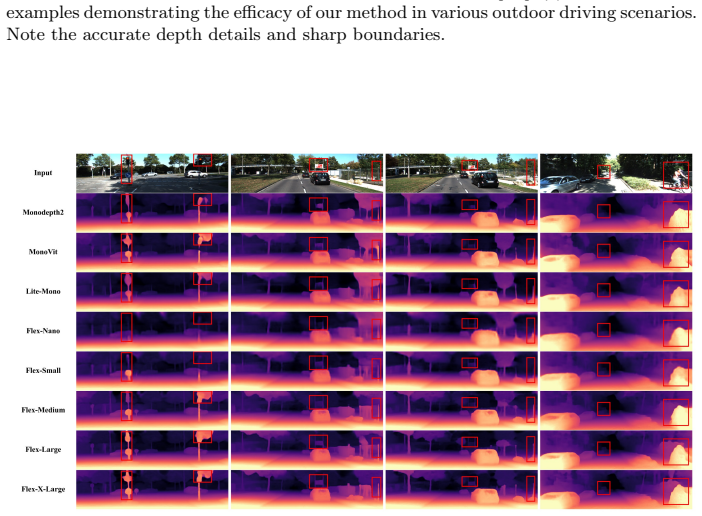
SUPPLEMENTARY MATERIAL 35 Fig. 12: Qualitative Results on the KITTI Dataset [12] (I).Representative examplesdemonstratingtheefficacyofourmethodinvariousoutdoordrivingscenarios. Note the accurate depth details and sharp boundaries. Fig. 13: Qualitative Results on the KITTI Dataset [12] (II).Additional qualita- tive examples from the KITTI dataset, highligh...
-
[75]
SUPPLEMENTARY MATERIAL 37 Fig. 15: Qualitative results on close-range car-following scenes.In tailgating scenarios, dynamic objects occupy large portions of the frame, creating severe occlusion and large motion regions that challenge conventional methods. Our approach achieves artifact-free depth predictions by adaptively filtering these dominant dynamic ...
discussion (0)
Sign in with ORCID, Apple, or X to comment. Anyone can read and Pith papers without signing in.