Symmetry Classification of Non-Reciprocal Responses in Multiterminal Ring Devices
Pith reviewed 2026-07-02 07:00 UTC · model grok-4.3
The pith
In three-terminal ring devices, non-reciprocal responses require breaking both time-reversal and spatial inversion symmetries together, after which residual geometry symmetry selects the allowed circulation patterns.
A machine-rendered reading of the paper's core claim, the machinery that carries it, and where it could break.
Core claim
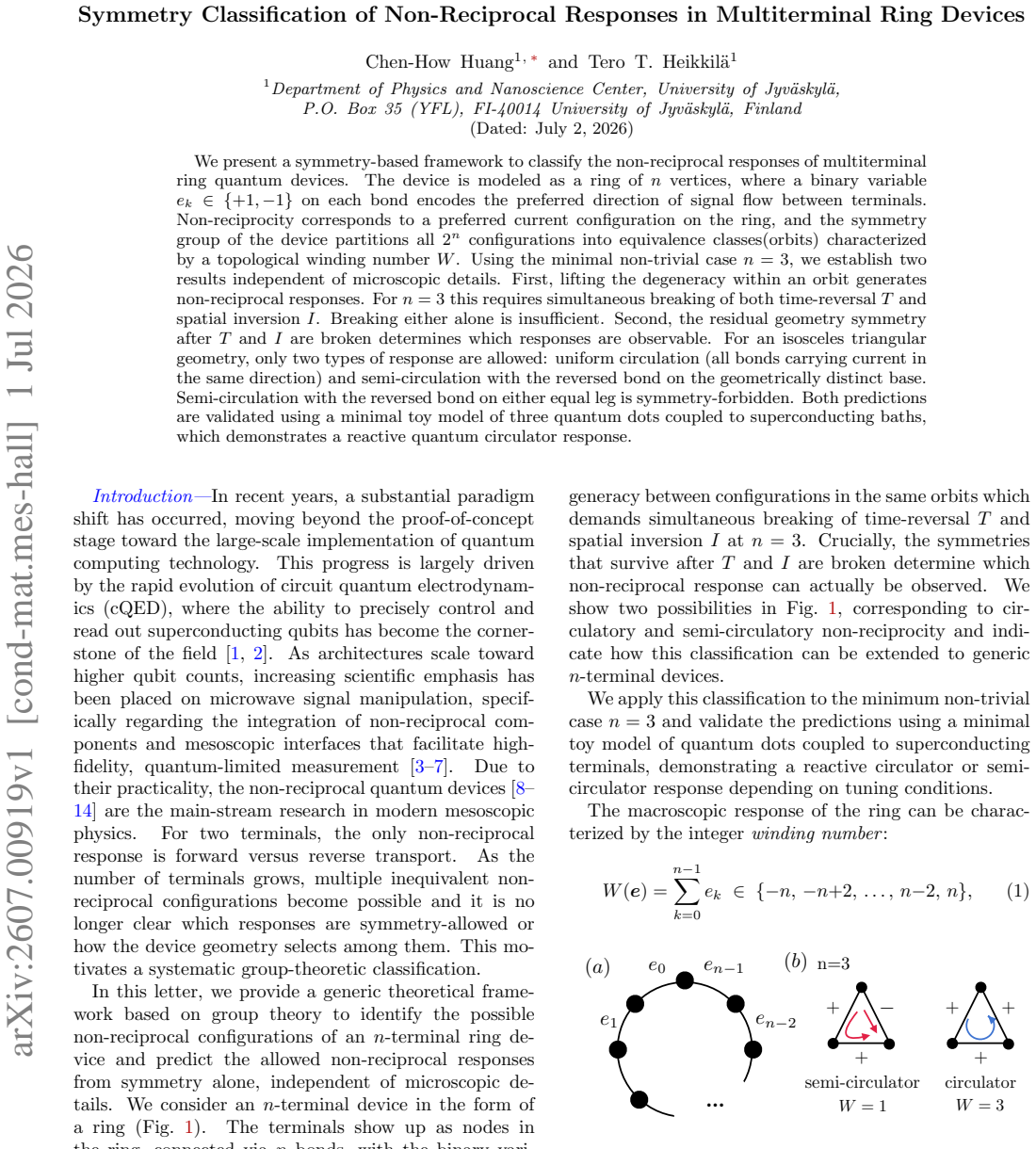
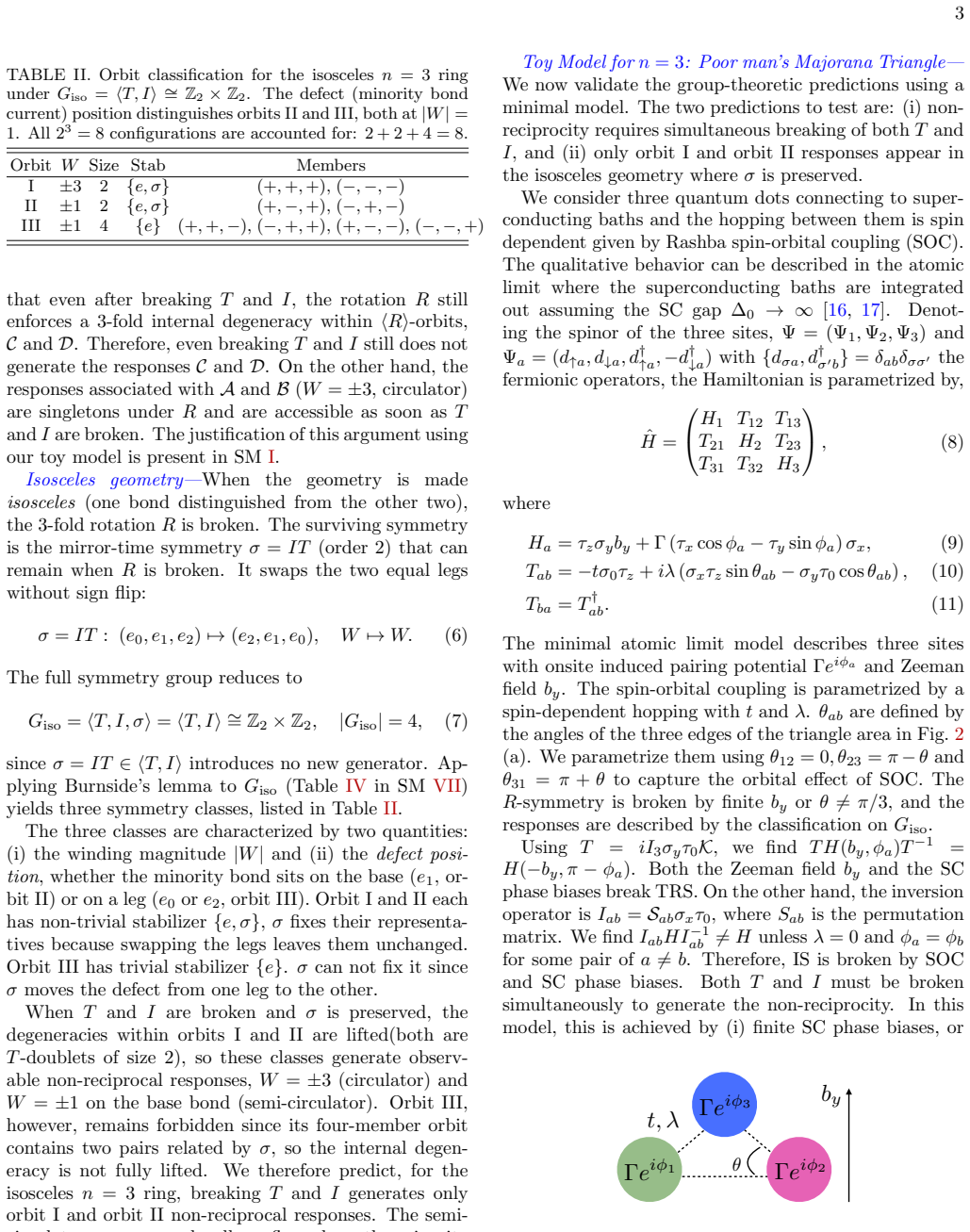
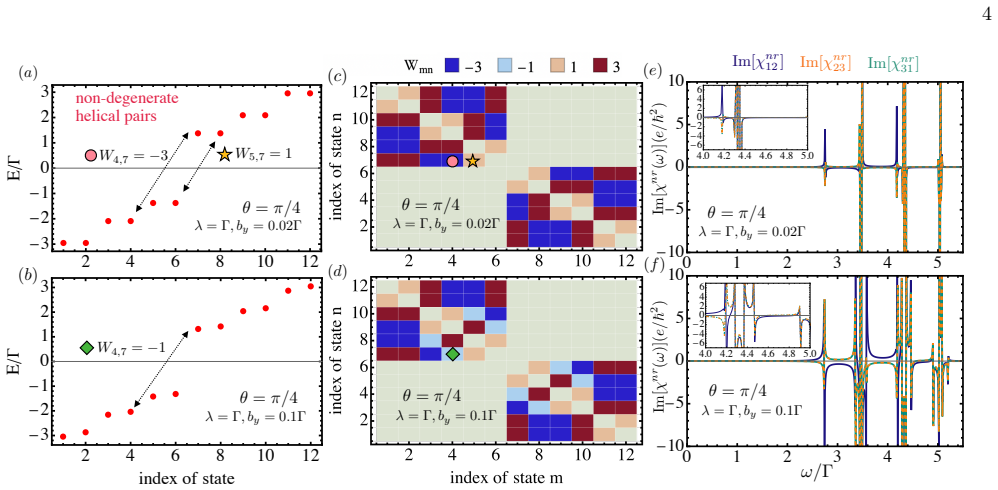
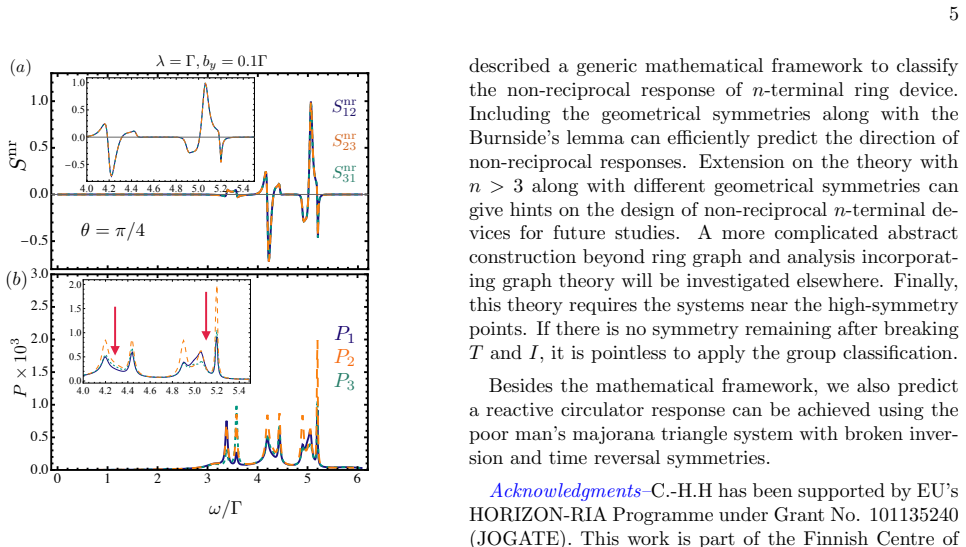
The symmetry group of the device partitions the 2^n possible flow configurations into orbits characterized by a topological winding number W. For n=3, lifting the degeneracy within an orbit produces non-reciprocal responses only when both time-reversal T and spatial inversion I are broken simultaneously; breaking either symmetry alone is insufficient. The residual geometry symmetry then determines which responses remain observable: in an isosceles triangular geometry only uniform circulation and semi-circulation with the reversed bond on the base are allowed, while semi-circulation with reversal on either equal leg is forbidden. These predictions are confirmed by a minimal toy model of three
What carries the argument
The symmetry group of the device that partitions all 2^n flow configurations into equivalence classes (orbits) labeled by topological winding number W.
If this is right
- For n=3 devices, non-reciprocal responses appear only after simultaneous breaking of both T and I.
- Residual geometry symmetry restricts allowed responses to uniform circulation and semi-circulation with reversal only on the geometrically distinct base.
- The orbit classification with winding number W organizes all possible flow patterns before symmetry breaking is applied.
- The toy model of quantum dots coupled to superconducting baths reproduces the symmetry-allowed responses without relying on specific microscopic parameters.
Where Pith is reading between the lines
- The same orbit-based classification could be applied to rings with n greater than 3 to predict which circulation patterns survive under different symmetry-breaking patterns.
- Device engineers could use the residual symmetry rules to design multiterminal structures that permit only selected non-reciprocal effects while forbidding others.
- The requirement of simultaneous T and I breaking may connect to other mesoscopic systems where non-reciprocity emerges only from combined symmetry violations.
Load-bearing premise
The symmetry group of the device partitions all 2^n configurations into equivalence classes characterized by a topological winding number W, and the toy model of three quantum dots coupled to superconducting baths captures the symmetry predictions independently of microscopic details.
What would settle it
Observation or calculation of a non-reciprocal response in an n=3 ring device that preserves either time-reversal symmetry or spatial inversion symmetry.
Figures
read the original abstract
We present a symmetry-based framework to classify the non-reciprocal responses of multiterminal ring quantum devices. The device is modeled as a ring of $n$ vertices, where a binary variable $e_k\in\{+1,-1\}$ on each bond encodes the preferred direction of signal flow between terminals. Non-reciprocity corresponds to a preferred current configuration on the ring, and the symmetry group of the device partitions all $2^n$ configurations into equivalence classes(orbits) characterized by a topological winding number $W$. Using the minimal non-trivial case $n=3$, we establish two results independent of microscopic details. First, lifting the degeneracy within an orbit generates non-reciprocal responses. For $n=3$ this requires simultaneous breaking of both time-reversal $T$ and spatial inversion $I$. Breaking either alone is insufficient. Second, the residual geometry symmetry after $T$ and $I$ are broken determines which responses are observable. For an isosceles triangular geometry, only two types of response are allowed: uniform circulation (all bonds carrying current in the same direction) and semi-circulation with the reversed bond on the geometrically distinct base. Semi-circulation with the reversed bond on either equal leg is symmetry-forbidden. Both predictions are validated using a minimal toy model of three quantum dots coupled to superconducting baths, which demonstrates a reactive quantum circulator response.
Editorial analysis
A structured set of objections, weighed in public.
Referee Report
Summary. The manuscript develops a symmetry-based framework for classifying non-reciprocal responses in multiterminal ring devices modeled as an n-vertex ring with binary bond variables e_k = ±1 encoding preferred current directions. The device symmetry group (including T and I) partitions the 2^n configurations into orbits labeled by a topological winding number W. For the minimal case n=3, two results are claimed to hold independently of microscopic details: (i) non-reciprocal responses arise only when degeneracy within an orbit is lifted by simultaneous breaking of both time-reversal T and spatial inversion I (breaking either alone is insufficient); (ii) residual geometry symmetry after T and I breaking restricts observable responses—for an isosceles triangular geometry only uniform circulation and base semi-circulation are allowed, while leg semi-circulation is forbidden. Both predictions are stated to be validated by a toy model of three quantum dots coupled to superconducting baths that exhibits a reactive quantum circulator response.
Significance. If the symmetry arguments are rigorously derived, the work supplies a model-independent classification scheme that directly links device geometry, symmetry breaking, and allowed non-reciprocal transport patterns. The explicit requirement that both T and I must be broken, together with the restriction imposed by residual geometry symmetry, offers concrete design rules for multiterminal quantum devices such as circulators. The topological orbit structure labeled by winding number W is a potentially powerful organizing principle; the toy-model validation, while limited, provides a falsifiable check of the symmetry predictions.
major comments (2)
- [Abstract / n=3 results] Abstract and the n=3 results paragraph: the central claim that the partitioning into orbits labeled by W follows directly from the device symmetry group action and is independent of microscopic details is asserted without any explicit definition of the group elements, their action on the 2^n bond configurations, or the computation of W. This makes it impossible to verify whether the stated necessity of simultaneous T and I breaking is a genuine symmetry consequence or an artifact of the (undescribed) toy-model parameters.
- [Toy-model validation] Toy-model validation paragraph: the manuscript states that the toy model of three quantum dots coupled to superconducting baths 'demonstrates' the two symmetry predictions, yet supplies no Hamiltonian, no parameter values, no explicit symmetry-breaking terms, and no quantitative comparison (e.g., current ratios or response magnitudes) between the numerical output and the symmetry-allowed responses. Without these, the validation cannot be assessed as independent confirmation.
Simulated Author's Rebuttal
We thank the referee for the detailed and constructive report. The comments highlight areas where additional explicitness will strengthen the manuscript. We address each major point below and will incorporate revisions to provide the requested definitions and details.
read point-by-point responses
-
Referee: [Abstract / n=3 results] Abstract and the n=3 results paragraph: the central claim that the partitioning into orbits labeled by W follows directly from the device symmetry group action and is independent of microscopic details is asserted without any explicit definition of the group elements, their action on the 2^n bond configurations, or the computation of W. This makes it impossible to verify whether the stated necessity of simultaneous T and I breaking is a genuine symmetry consequence or an artifact of the (undescribed) toy-model parameters.
Authors: We agree that the abstract and n=3 paragraph would benefit from explicit definitions to make the symmetry arguments self-contained. In the revised manuscript we will add a concise but complete definition of the device symmetry group (generated by T, I, and the geometric rotations/reflections of the ring), specify the action of each generator on the bond variables e_k, and compute the orbits and winding number W explicitly for n=3. This derivation shows that the requirement of simultaneous T and I breaking follows directly from the group action on configuration space and is therefore independent of any microscopic model; the toy model is used only for numerical validation of the resulting selection rules. revision: yes
-
Referee: [Toy-model validation] Toy-model validation paragraph: the manuscript states that the toy model of three quantum dots coupled to superconducting baths 'demonstrates' the two symmetry predictions, yet supplies no Hamiltonian, no parameter values, no explicit symmetry-breaking terms, and no quantitative comparison (e.g., current ratios or response magnitudes) between the numerical output and the symmetry-allowed responses. Without these, the validation cannot be assessed as independent confirmation.
Authors: We accept that the current presentation of the toy model is insufficient for independent verification. In the revision we will include the full Hamiltonian of the three quantum dots coupled to superconducting baths, list all parameter values, specify the explicit terms that break T and I (while preserving the residual geometric symmetry), and provide quantitative comparisons (current ratios and response magnitudes) between the computed non-reciprocal signals and the symmetry-allowed patterns. These additions will allow readers to confirm that the numerical results respect the predicted selection rules. revision: yes
Circularity Check
Symmetry classification is self-contained via group action on configurations
full rationale
The derivation begins from the device symmetry group acting on the 2^n binary bond configurations e_k, partitioning them into orbits labeled by topological winding number W; this is a standard group-theoretic construction with no fitted parameters or self-citation load-bearing steps. The n=3 claims (simultaneous T and I breaking required to lift degeneracy; residual geometry symmetry restricting responses to uniform circulation or base semi-circulation) follow directly from enumerating the orbits and their stabilizers after symmetry breaking, without reference to microscopic details. The toy model of three quantum dots is presented only as explicit validation of the symmetry predictions, not as their source. No step reduces by construction to an input or prior self-citation; the framework remains independent of the specific Hamiltonian.
Axiom & Free-Parameter Ledger
axioms (2)
- domain assumption The symmetry group of the device partitions all 2^n configurations into equivalence classes (orbits) characterized by a topological winding number W.
- domain assumption Non-reciprocity corresponds to a preferred current configuration on the ring.
Reference graph
Works this paper leans on
-
[1]
Kjaergaard, M
M. Kjaergaard, M. E. Schwartz, J. Braum¨ uller, P. Krantz, J. I.-J. Wang, S. Gustavsson, and W. D. Oliver, Superconducting qubits: Current state of play, Annual Review of Condensed Matter Physics11, 369 (2020)
2020
-
[2]
Blais, A
A. Blais, A. L. Grimsmo, S. M. Girvin, and A. Wall- raff, Circuit quantum electrodynamics, Reviews of Mod- ern Physics93, 025005 (2021)
2021
-
[3]
F. Ando, Y. Miyasaka, T. Li, J. Ishizuka, T. Arakawa, Y. Shiota, T. Moriyama, Y. Yanase, and T. Ono, Obser- vation of superconducting diode effect, Nature584, 373 (2020)
2020
-
[4]
Baumgartner, L
C. Baumgartner, L. Fuchs, A. Costa, S. Reinhardt, S. Gronin, G. C. Gardner, T. Lindemann, M. J. Manfra, P. E. Faria Junior, D. Kochan, J. Fabian, N. Paradiso, and C. Strunk, Supercurrent rectification and magne- tochiral effects in symmetric josephson junctions, Nature Nanotechnology17, 39 (2022)
2022
-
[5]
Misaki and N
K. Misaki and N. Nagaosa, Theory of the nonreciprocal josephson effect, Phys. Rev. B103, 245302 (2021)
2021
-
[6]
Gupta, G
M. Gupta, G. V. Graziano, M. Pendharkar, J. T. Dong, C. P. Dempsey, C. Palmstrøm, and V. S. Prib- iag, Gate-tunable superconducting diode effect in a three- terminal josephson device, Nature Communications14, 3078 (2023)
2023
-
[7]
Chiles, E
J. Chiles, E. G. Arnault, C.-C. Chen, T. F. Q. Lar- son, L. Zhao, K. Watanabe, T. Taniguchi, F. Amet, and G. Finkelstein, Nonreciprocal supercurrents in a field-free graphene josephson triode, Nano Letters23, 5257 (2023)
2023
-
[8]
Lau and A
H.-K. Lau and A. A. Clerk, Non-hermitian quantum sens- ing: Fundamental limits and non-reciprocal approaches, Nature Communications9, 4320 (2018)
2018
-
[9]
S. Barzanjeh, A. Xuereb, A. Al` u, S. A. Mann, N. Nefed- kin, V. Peano, and P. Rabl, Nonreciprocity in quantum 6 technology, arXiv 10.48550/arxiv.2508.03945 (2025)
-
[10]
A. R. Hamann, C. M¨ uller, M. Jerger, M. Zanner, J. Combes, M. Pletyukhov, M. Weides, T. M. Stace, and A. Fedorov, Nonreciprocity realized with quantum non- linearity, Phys. Rev. Lett.121, 123601 (2018)
2018
-
[11]
Kwende, T
R. Kwende, T. White, and O. Naaman, Josephson parametric circulator with same-frequency signal ports, 200 mhz bandwidth, and high dynamic range, Applied Physics Letters122, 224001 (2023)
2023
-
[12]
K. M. Sliwa, M. Hatridge, A. Narla, S. Shankar, L. Frun- zio, R. J. Schoelkopf, and M. H. Devoret, Reconfigurable josephson circulator/directional amplifier, Phys. Rev. X 5, 041020 (2015)
2015
-
[13]
Barzanjeh, M
S. Barzanjeh, M. Wulf, M. Peruzzo, M. Kalaee, P. B. Dieterle, O. Painter, and J. M. Fink, Mechanical on- chip microwave circulator, Nature Communications8, 953 (2017)
2017
-
[14]
A. C. Mahoney, J. I. Colless, S. J. Pauka, J. M. Horni- brook, J. D. Watson, G. C. Gardner, M. J. Manfra, A. C. Doherty, and D. J. Reilly, On-chip microwave quantum hall circulator, Phys. Rev. X7, 011007 (2017)
2017
-
[15]
Burnside,Theory of Groups of Finite Order, 2nd ed
W. Burnside,Theory of Groups of Finite Order, 2nd ed. (Cambridge University Press, Cambridge, 1911)
1911
-
[16]
Meden, The anderson–josephson quantum dot—a the- ory perspective, Journal of Physics: Condensed Matter 31, 163001 (2019)
V. Meden, The anderson–josephson quantum dot—a the- ory perspective, Journal of Physics: Condensed Matter 31, 163001 (2019)
2019
-
[17]
ˇZonda, P
M. ˇZonda, P. Zalom, T. c. v. Novotn´ y, G. Loukeris, J. B¨ atge, and V. Pokorn´ y, Generalized atomic limit of a double quantum dot coupled to superconducting leads, Phys. Rev. B107, 115407 (2023)
2023
-
[18]
Virtanen and T
P. Virtanen and T. T. Heikkil¨ a, Nonreciprocal josephson linear response, Phys. Rev. Lett.132, 046002 (2024)
2024
-
[19]
Kubo, Statistical-mechanical theory of irreversible processes
R. Kubo, Statistical-mechanical theory of irreversible processes. i. general theory and simple applications to magnetic and conduction problems, Journal of the Phys- ical Society of Japan12, 570 (1957)
1957
-
[20]
Trivedi and D
N. Trivedi and D. A. Browne, Mesoscopic ring in a mag- netic field: Reactive and dissipative response, Phys. Rev. B38, 9581 (1988)
1988
-
[21]
R. E. Collin,Foundations for Microwave Engineering, 2nd ed. (Wiley-IEEE Press, New York, NY, 2001)
2001
-
[22]
B¨ uttiker, H
M. B¨ uttiker, H. Thomas, and A. Prˆ etre, Mesoscopic ca- pacitors, Physics Letters A180, 364 (1993)
1993
-
[23]
cmo1a3PSWVhVGgETPTX1yrHOqEI=
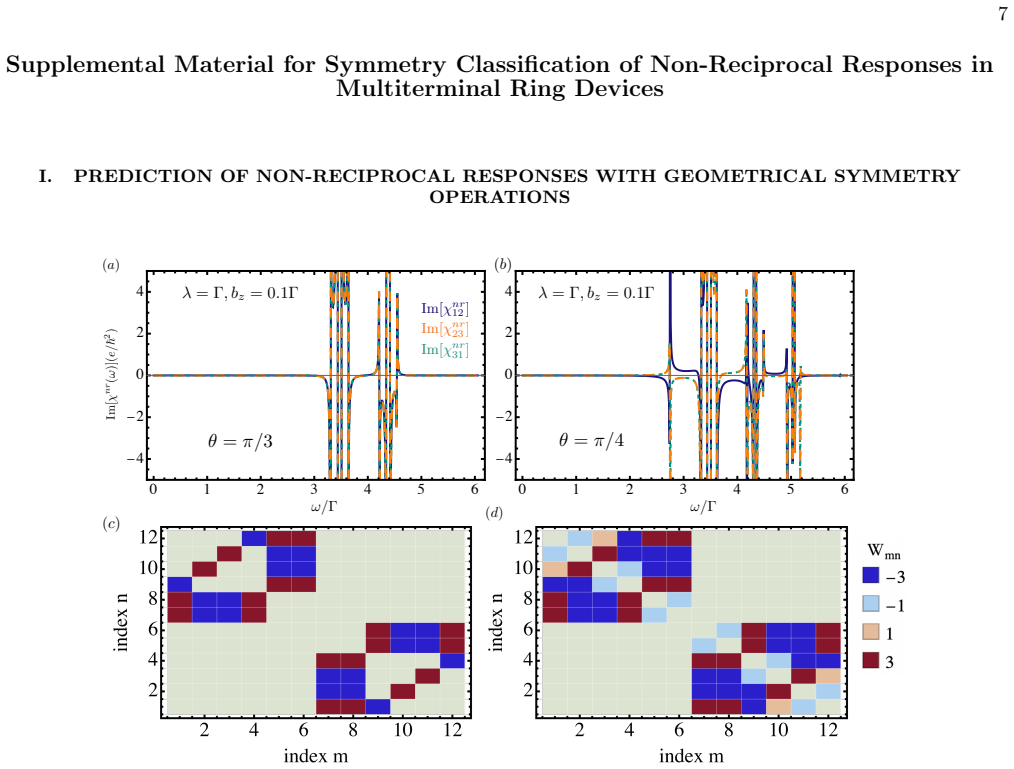
A. Y. Kitaev, Unpaired majorana fermions in quantum wires, Physics-Uspekhi44, 131 (2001). 7 Supplemental Material for Symmetry Classification of Non-Reciprocal Responses in Multiterminal Ring Devices I. PREDICTION OF NON-RECIPROCAL RESPONSES WITH GEOMETRICAL SYMMETRY OPERATIONS 0 1 2 3 4 5 6 -4 -2 0 2 4 0 1 2 3 4 5 6 -4 -2 0 2 4 <latexit sha1_base64="cmo1...
2001
-
[24]
4xpmBiXTQQIljMX1+il4/kZHXVE=
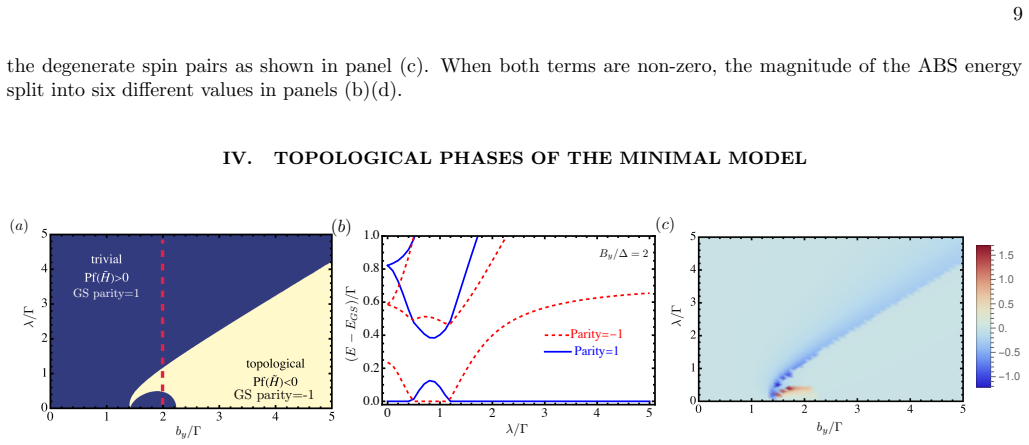
Denoting the Hamiltonian in the Majorana basis as ˜H, we have ˜H=U HU † whereU=I 3u/ √ 2 and, u= 1 0 1 0 0 1 0−1 −i0i0 0−i0−i .(14) The phase diagram is characterized by the Kitaev-Akhmerov invariant,Q= sign[Pf( ˜H)] [23]. A topologically non- trivial phase (Q <0) is obtained at strong zeeman field. In panel (b) we show the many-body energy le...
discussion (0)
Sign in with ORCID, Apple, or X to comment. Anyone can read and Pith papers without signing in.