AMBUSH: Collaborative Capture in Complex Environments with Neural Acceleration
Pith reviewed 2026-07-02 11:18 UTC · model grok-4.3
The pith
Ambush alone suffices for multiple slower pursuers to capture one faster evader in complex environments.
A machine-rendered reading of the paper's core claim, the machinery that carries it, and where it could break.
Core claim
The central claim is that a parameterized ambush strategy incorporating topological workspace properties, truncated line-of-sight visibility, relative speed ratio and limited capture range can be optimized by Hybrid Monte Carlo Tree Search and ranked by a neural network to enable multiple slower pursuers to capture one faster evader with varying intelligence levels in complex environments.
What carries the argument
Parameterized ambush strategy whose discrete and continuous parameters are optimized by Hybrid Monte Carlo Tree Search and scored by an offline-trained neural network that replaces rollouts.
If this is right
- Pursuer teams achieve capture without matching evader velocity in obstacle-rich spaces.
- The approach succeeds against both algorithmic and human-controlled evaders.
- Neural ranking accelerates planning while preserving solution quality for online deployment.
- The method extends to security, surveillance and search-and-rescue tasks in real settings.
Where Pith is reading between the lines
- If the neural scorer generalizes across map types it could shorten planning time in other multi-robot coordination tasks.
- Adding three-dimensional topology or moving obstacles would test whether the same ambush parameterization still suffices.
- Scaling experiments with larger numbers of pursuers or simultaneous evaders would reveal practical limits not addressed in the current trials.
Load-bearing premise
The parameterized ambush strategy can be reliably optimized and ranked to guarantee capture success across varied environments and evader intelligence levels.
What would settle it
A single simulation or hardware trial in a complex environment where the optimized ambush parameters fail to intercept an evader moving at twice the pursuer speed or under direct human control would falsify the claim.
Figures









read the original abstract
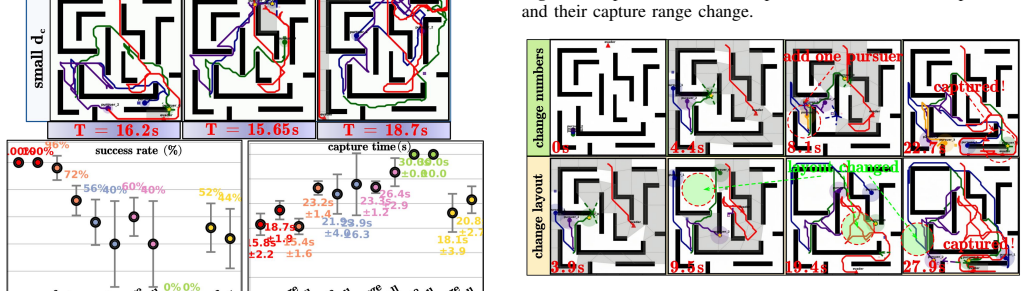
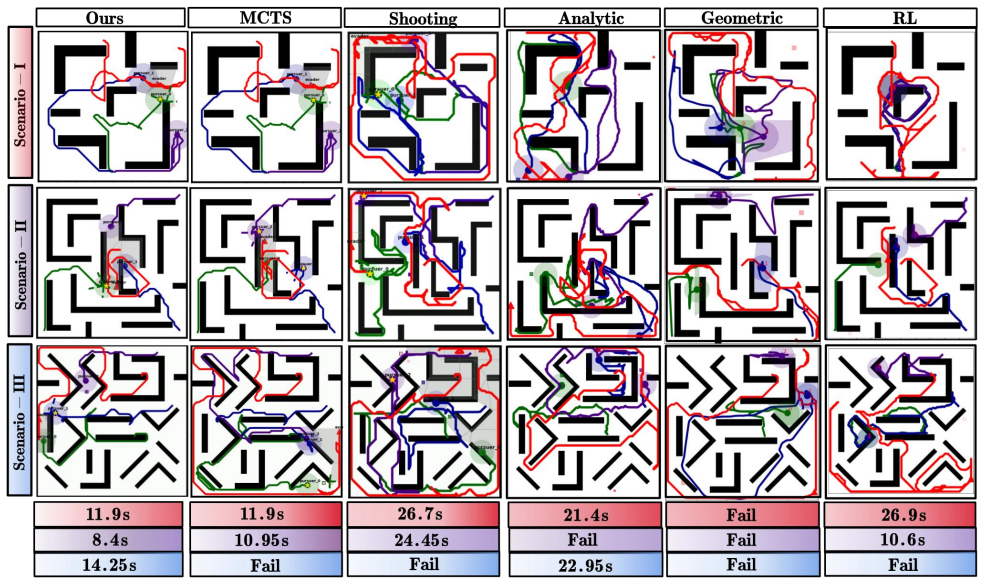
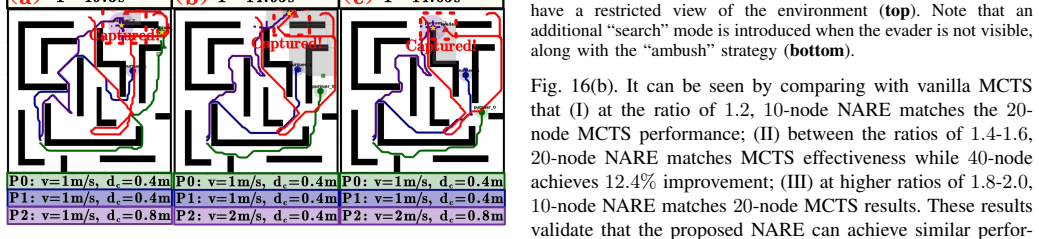
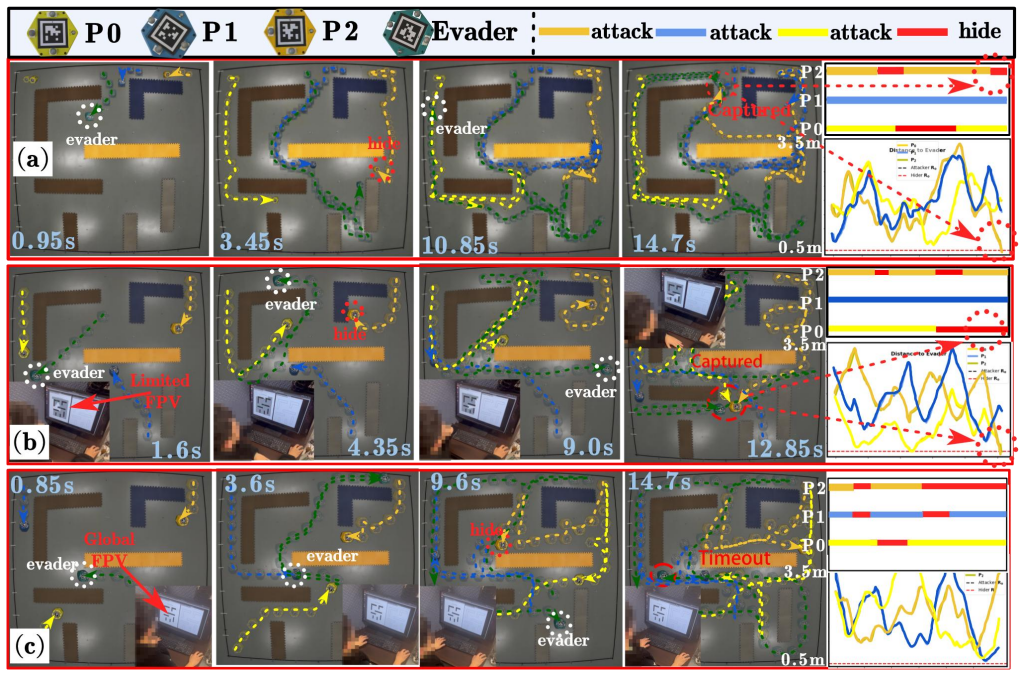
Collaborative capture of dynamic targets is common in nature as an essential strategy for weaker species against the strong. Similar concepts have shown to be useful for numerous robotic applications, such as security and surveillance, search and rescue. However, most existing works focus on analytical and geometric solutions or end-to-end reinforcement learning methods, which are largely constrained to obstacle-free environments or scenarios with sparse, regularly distributed obstacles. This work tackles the problem from a unique perspective: the renowned strategy of``ambush'' alone would suffice for multiple slower pursuers to capture one faster evader with different levels of intelligence efficiently in complex environments. A parameterized strategy of ambush (including discrete and continuous parameters) is designed first, which takes into account the topological properties of the workspace, the truncated line-of-sight visibility, the relative speed ratio and the limited capture range. Then, a Hybrid Monte Carlo Tree Search (H-MCTS) algorithm is proposed to optimize the associated parameters through long-term planning, enabling the identification of highly promising parameters for future capture. Lastly, the neural acceleration is trained offline to learn the ranking of different choices of parameters across various environments, and to directly predict scores, replacing the rollout process in H-MCTS. The neural acceleration is adopted during online H-MCTS to accelerate the planning procedure while guaranteeing the planning quality. Its efficiency and effectiveness are validated in extensive simulations and hardware experiments, against evaders with different capabilities and intelligence levels, including two-times higher velocity and human-controlled behavior.
Editorial analysis
A structured set of objections, weighed in public.
Referee Report
Summary. The paper claims that a parameterized ambush strategy—incorporating topological workspace properties, truncated line-of-sight visibility, relative speed ratio, and limited capture range—suffices for multiple slower pursuers to capture one faster evader (including 2x velocity or human-controlled) in complex environments. The strategy parameters are optimized via Hybrid Monte Carlo Tree Search (H-MCTS) for long-term planning, with a neural network trained offline to rank parameter choices across environments and replace rollouts for online acceleration, with claimed validation via extensive simulations and hardware experiments.
Significance. If the empirical results hold with proper quantitative support, the work offers a practical engineering approach to multi-robot pursuit-evasion that leverages domain-specific ambush parameterization and neural acceleration rather than pure geometric analysis or end-to-end RL, potentially enabling efficient capture in cluttered settings relevant to security, surveillance, and search-and-rescue.
major comments (1)
- [Abstract] Abstract: the central claim of validation 'in extensive simulations and hardware experiments' against evaders with different capabilities is asserted without any quantitative results, performance metrics, error bars, success rates, or comparison baselines, rendering the effectiveness of the H-MCTS + neural acceleration pipeline impossible to assess from the provided text.
minor comments (1)
- The abstract states 'two-times higher velocity' for the evader; explicit reporting of the exact speed ratios tested and how they interact with the parameterized capture range would improve clarity.
Simulated Author's Rebuttal
We thank the referee for the constructive comment on the abstract. We agree that quantitative support should be included to allow readers to assess the claims directly from the abstract.
read point-by-point responses
-
Referee: [Abstract] Abstract: the central claim of validation 'in extensive simulations and hardware experiments' against evaders with different capabilities is asserted without any quantitative results, performance metrics, error bars, success rates, or comparison baselines, rendering the effectiveness of the H-MCTS + neural acceleration pipeline impossible to assess from the provided text.
Authors: We acknowledge that the abstract currently states the validation without specific metrics. The full manuscript contains detailed quantitative results (success rates, timing comparisons, and baselines) in the experimental sections. We will revise the abstract to concisely report key quantitative highlights from those sections, such as capture success rates across evader types and planning speedups from the neural acceleration. revision: yes
Circularity Check
No significant circularity identified
full rationale
The paper describes an empirical engineering pipeline: a parameterized ambush strategy (incorporating workspace topology, truncated visibility, speed ratio, and capture range) is optimized via H-MCTS, after which a neural network is trained offline on the resulting parameter rankings to accelerate online search by replacing rollouts. No equations, uniqueness theorems, or self-citations appear in the provided abstract or high-level description that would make any claimed prediction or result equivalent to its inputs by construction. The neural acceleration step is a standard supervised approximation of an external planner rather than a fitted input renamed as prediction. Validation occurs via separate simulation and hardware experiments against varied evaders, keeping the method self-contained against external benchmarks.
Axiom & Free-Parameter Ledger
free parameters (1)
- ambush discrete and continuous parameters
Reference graph
Works this paper leans on
-
[1]
I. Bailey, J. P. Myatt, and A. M. Wilson, “Group hunting within the carnivora: physiological, cognitive and environmental influences on strategy and cooperation,”Behavioral ecology and sociobiology, vol. 67, no. 1, pp. 1–17, 2013
work page 2013
-
[2]
Intercepting rogue robots: An algorithm for capturing multiple evaders with multiple pursuers,
A. Pierson, Z. Wang, and M. Schwager, “Intercepting rogue robots: An algorithm for capturing multiple evaders with multiple pursuers,”IEEE Robotics and Automation Letters, vol. 2, no. 2, pp. 530–537, 2016
work page 2016
-
[3]
Adaptive partitioning for coordinated multi-agent perimeter defense,
D. G. Macharet, A. K. Chen, D. Shishika, G. J. Pappas, and V . Kumar, “Adaptive partitioning for coordinated multi-agent perimeter defense,” inIEEE/RSJ international conference on intelligent robots and Systems (IROS), 2020, pp. 7971–7977
work page 2020
-
[4]
W. Gan, X. Qu, D. Song, and P. Yao, “Multi-usv cooperative chasing strategy based on obstacles assistance and deep reinforcement learning,” IEEE Transactions on Automation Science and Engineering, vol. 21, no. 4, pp. 5895–5910, 2023
work page 2023
-
[5]
Poaching detection technologies—a survey,
J. Kamminga, E. Ayele, N. Meratnia, and P. Havinga, “Poaching detection technologies—a survey,”Sensors, vol. 18, no. 5, p. 1474, 2018
work page 2018
-
[6]
Uav-ugv-umv multi-swarms for cooperative surveillance,
D. H. Stolfi, M. R. Brust, G. Danoy, and P. Bouvry, “Uav-ugv-umv multi-swarms for cooperative surveillance,”Frontiers in Robotics and AI, vol. 8, no. 1, p. 616950, 2021
work page 2021
-
[7]
M. A.-M. Fromme and M. Aigner, “A game of cops and robbers,” Discrete Appl. Math, vol. 8, no. 2, pp. 1–12, 1984
work page 1984
-
[8]
Multiple pursuer multiple evader differential games,
E. Garcia, D. W. Casbeer, A. V on Moll, and M. Pachter, “Multiple pursuer multiple evader differential games,”IEEE Transactions on Automatic Control, vol. 66, no. 5, pp. 2345–2350, 2020
work page 2020
-
[9]
Bonato,The game of cops and robbers on graphs
A. Bonato,The game of cops and robbers on graphs. American Mathematical Soc., 2011
work page 2011
-
[10]
A visibility roadmap sampling approach for a multi- robot visibility-based pursuit-evasion problem,
T. Olsenet al., “A visibility roadmap sampling approach for a multi- robot visibility-based pursuit-evasion problem,” inIEEE International Conference on Robotics and Automation (ICRA), 2021, pp. 7957–7964
work page 2021
-
[11]
Distributed encirclement and capture of multiple pursuers with collision avoidance,
X. Wang, L. Xi, Y . Ding, and B. M. Chen, “Distributed encirclement and capture of multiple pursuers with collision avoidance,”IEEE Trans- actions on Industrial Electronics, vol. 71, no. 7, pp. 7520–7530, 2023
work page 2023
-
[12]
Cooperative pursuit with voronoi partitions,
Z. Zhou, W. Zhang, J. Ding, H. Huang, D. M. Stipanovi ´c, and C. J. Tom- lin, “Cooperative pursuit with voronoi partitions,”Automatica, vol. 72, no. 10, pp. 64–72, 2016
work page 2016
-
[13]
Group chasing tactics: how to catch a faster prey,
M. Janosov, C. Vir ´agh, G. V ´as´arhelyi, and T. Vicsek, “Group chasing tactics: how to catch a faster prey,”New Journal of Physics, vol. 19, no. 5, pp. 053–063, 2017
work page 2017
-
[14]
Multi-agent actor-critic for mixed cooperative-competitive environ- ments,
R. Lowe, Y . I. Wu, A. Tamar, J. Harb, O. Pieter Abbeel, and I. Mordatch, “Multi-agent actor-critic for mixed cooperative-competitive environ- ments,” inAdvances in neural information processing systems, 2017, pp. 30–35
work page 2017
-
[15]
On developing a uav pursuit-evasion policy using reinforcement learning,
B. Vlahovet al., “On developing a uav pursuit-evasion policy using reinforcement learning,” inIEEE International Conference on Machine Learning and Applications (ICMLA), 2018, pp. 859–864
work page 2018
-
[16]
Emergent behaviors in multiagent pursuit evasion games within a bounded 2d grid world,
S. Xu and Z. Dang, “Emergent behaviors in multiagent pursuit evasion games within a bounded 2d grid world,”Scientific Reports, vol. 15, no. 1, p. 29376, 2025
work page 2025
-
[17]
S. Xu, Z. Liu, and Z. Dang, “Modeling and analysis of cooperative pursuit actions in two-dimensional multi-agent pursuit-evasion games,” in2025 40th Youth Academic Annual Conference of Chinese Association of Automation (YAC), 2025, pp. 665–670
work page 2025
-
[18]
A survey of the pursuit– evasion problem in swarm intelligence,
Z. Mu, J. Pan, Z. Zhou, J. Yu, and L. Cao, “A survey of the pursuit– evasion problem in swarm intelligence,”Frontiers of Information Tech- nology & Electronic Engineering, vol. 24, no. 8, pp. 1093–1116, 2023
work page 2023
-
[19]
Pursuit-evasion of an evader by multiple pur- suers,
A. V on Mollet al., “Pursuit-evasion of an evader by multiple pur- suers,” inIEEE International Conference on Unmanned Aircraft Systems (ICUAS), 2018, pp. 133–142
work page 2018
-
[20]
A dimension-reduction solution of free-time differential games for spacecraft pursuit-evasion,
Z.-y. Li, H. Zhu, Z. Yang, and Y .-z. Luo, “A dimension-reduction solution of free-time differential games for spacecraft pursuit-evasion,” Acta Astronautica, vol. 163, no. 19, pp. 201–210, 2019
work page 2019
-
[21]
S. Vajda, “Differential games. a mathematical theory with applications to warfare and pursuit, control and optimization.”The Mathematical Gazette, vol. 51, no. 375, pp. 80–81, 1967
work page 1967
-
[22]
R. Isaacs,Differential games: a mathematical theory with applications to warfare and pursuit, control and optimization. Courier Corporation, 1999
work page 1999
-
[23]
S. Li, C. Wang, and G. Xie, “Pursuit-evasion differential games of players with different speeds in spaces of different dimensions,” inIEEE American Control Conference (ACC), 2022, pp. 1299–1304
work page 2022
-
[24]
Encirclement guaranteed cooperative pursuit with robust model predictive control,
C. Wang, H. Chen, J. Pan, and W. Zhang, “Encirclement guaranteed cooperative pursuit with robust model predictive control,” inIEEE/RSJ International Conference on Intelligent Robots and Systems (IROS), 2021, pp. 1473–1479
work page 2021
-
[25]
Cooperative pursuit with multi-pursuer and one faster free-moving evader,
X. Fang, C. Wang, L. Xie, and J. Chen, “Cooperative pursuit with multi-pursuer and one faster free-moving evader,”IEEE transactions on cybernetics, vol. 52, no. 3, pp. 1405–1414, 2020
work page 2020
-
[26]
Game-theoretic utility tree for multi-robot cooperative pursuit strategy,
Q. Yang and R. Parasuraman, “Game-theoretic utility tree for multi-robot cooperative pursuit strategy,” inISR Europe International Symposium on Robotics, 2022, pp. 1–7
work page 2022
-
[27]
Fg-pe: Factor-graph approach for multi-robot pursuit-evasion,
M. A. Esfahani, A. Bas ¸ar, and S. Saeedi, “Fg-pe: Factor-graph approach for multi-robot pursuit-evasion,”arXiv preprint arXiv:2411.00741, 2024
-
[28]
Decentralized multi-agent pursuit using deep reinforcement learning,
C. De Souza, R. Newbury, A. Cosgun, P. Castillo, B. Vidolov, and D. Kuli ´c, “Decentralized multi-agent pursuit using deep reinforcement learning,”IEEE Robotics and Automation Letters, vol. 6, no. 3, pp. 4552–4559, 2021
work page 2021
-
[29]
Cooperative control for multi-player pursuit-evasion games with reinforcement learning,
Y . Wang, L. Dong, and C. Sun, “Cooperative control for multi-player pursuit-evasion games with reinforcement learning,”Neurocomputing, vol. 412, no. 1, pp. 101–114, 2020
work page 2020
-
[30]
Learning to play pursuit-evasion with dynamic and sensor constraints,
B. M. Gonultas and V . Isler, “Learning to play pursuit-evasion with dynamic and sensor constraints,”arXiv preprint arXiv:2405.05372, 2024
-
[31]
G. Singh, D. M. Lofaro, and D. Sofge, “Pursuit-evasion with decen- tralized robotic swarm in continuous state space and action space via deep reinforcement learning.” inInternational Conference on Agents and Artificial Intelligence, 2020, pp. 226–233
work page 2020
-
[32]
On discrete-time pursuit-evasion games with sensing limitations,
S. D. Bopardikaret al., “On discrete-time pursuit-evasion games with sensing limitations,”IEEE Transactions on Robotics, vol. 24, no. 6, pp. 1429–1439, 2008
work page 2008
-
[33]
Distributed pursuit of an evader with collision and obstacle avoidance,
B. Tian, P. Li, H. Lu, Q. Zong, and L. He, “Distributed pursuit of an evader with collision and obstacle avoidance,”IEEE Transactions on Cybernetics, vol. 52, no. 12, pp. 13 512–13 520, 2021
work page 2021
-
[34]
Decentralized multi-robot pursuit of an evader in obstacle environments,
K. Rao, H. Yan, P. Yang, and Y . Lv, “Decentralized multi-robot pursuit of an evader in obstacle environments,” inIEEE Asian Control Conference (ASCC), 2024, pp. 321–326
work page 2024
-
[35]
Pursuit winning strategies for reach-avoid games with polygonal obstacles,
R. Yan, S. Mi, X. Duan, J. Chen, and X. Ji, “Pursuit winning strategies for reach-avoid games with polygonal obstacles,”IEEE Transactions on Automatic Control, vol. 70, no. 2, pp. 814–829, 2024
work page 2024
-
[36]
Pursuit-evasion problems of multi- agent systems in cluttered environments,
J. Ericsson and M. Bock Agerman, “Pursuit-evasion problems of multi- agent systems in cluttered environments,” 2024
work page 2024
-
[37]
Probabilistic strategies for pursuit in cluttered environments with multiple robots,
G. Hollingeret al., “Probabilistic strategies for pursuit in cluttered environments with multiple robots,” inIEEE International Conference on Robotics and Automation, 2007, pp. 3870–3876
work page 2007
-
[38]
R. Zhang, Q. Zong, X. Zhang, L. Dou, and B. Tian, “Game of drones: Multi-uav pursuit-evasion game with online motion planning by deep reinforcement learning,”IEEE Transactions on Neural Networks and Learning Systems, vol. 34, no. 10, pp. 7900–7909, 2022
work page 2022
-
[39]
J. Chen, C. Yu, G. Li, W. Tang, X. Yang, B. Xu, H. Yang, and Y . Wang, “Multi-uav pursuit-evasion with online planning in unknown environments by deep reinforcement learning,”IEEE Robotics and Automation Letters, vol. 10, no. 8, pp. 8196–8203, 2025
work page 2025
-
[40]
M. Kouzeghar, Y . Song, M. Meghjani, and R. Bouffanais, “Multi-target pursuit by a decentralized heterogeneous uav swarm using deep multi- agent reinforcement learning,” inIEEE International Conference on Robotics and Automation (ICRA), 2023, pp. 3289–3295
work page 2023
-
[41]
Multi-robot cooperative pursuit via potential field-enhanced reinforcement learning,
Z. Zhang, X. Wang, Q. Zhang, and T. Hu, “Multi-robot cooperative pursuit via potential field-enhanced reinforcement learning,” inIEEE International Conference on Robotics and Automation (ICRA), 2022, pp. 8808–8814
work page 2022
-
[42]
X. Qu, W. Gan, D. Song, and L. Zhou, “Pursuit-evasion game strategy of usv based on deep reinforcement learning in complex multi-obstacle environment,”Ocean Engineering, vol. 273, no. 19, pp. 114–125, 2023
work page 2023
-
[43]
Viper: Visibility-based pursuit-evasion via reinforcement learning,
Y . Wang, Y . Cao, J. Chiun, S. Koley, M. Pham, and G. A. Sartoretti, “Viper: Visibility-based pursuit-evasion via reinforcement learning,” in 8th Annual Conference on Robot Learning, 2024
work page 2024
-
[44]
Toward multi-target self-organizing pursuit in a partially observable markov game,
L. Sun, Y .-C. Chang, C. Lyu, Y . Shi, Y . Shi, and C.-T. Lin, “Toward multi-target self-organizing pursuit in a partially observable markov game,”Information Sciences, vol. 648, p. 119475, 2023
work page 2023
-
[45]
Matrixworld: A pursuit-evasion platform for safe multi-agent coordination and autocur- ricula,
L. Sun, Y .-C. Chang, C. Lyu, C.-T. Lin, and Y . Shi, “Matrixworld: A pursuit-evasion platform for safe multi-agent coordination and autocur- ricula,”arXiv preprint arXiv:2307.14854, 2023
-
[46]
Distributed pursuit-evasion without mapping or global localization via local frontiers,
J. W. Durham, A. Franchi, and F. Bullo, “Distributed pursuit-evasion without mapping or global localization via local frontiers,”Autonomous Robots, vol. 32, no. 1, pp. 81–95, 2012
work page 2012
-
[47]
Gurobi Optimizer Reference Manual
Gurobi Optimization, LLC, “Gurobi Optimizer Reference Manual.” [Online]. Available: https://www.gurobi.com
-
[48]
Belief state monte carlo planning for multi-agent visibility-based pursuit-evasion,
X. Xu, S. Guo, D. Li, P. Yu, X. Liu, and Y . Ren, “Belief state monte carlo planning for multi-agent visibility-based pursuit-evasion,” inAsian Simulation Conference. Springer, 2022, pp. 431–445
work page 2022
-
[49]
Holistically guided monte carlo tree search for intricate information seeking,
R. Ren, Y . Wang, J. Li, J. Jiang, W. X. Zhao, W. Wang, and T.-S. Chua, “Holistically guided monte carlo tree search for intricate information seeking,”arXiv preprint arXiv:2502.04751, 2025
-
[50]
Decentralized control strategies for unmanned aircraft system pursuit and evasion,
D. W. King and G. L. Peterson, “Decentralized control strategies for unmanned aircraft system pursuit and evasion,” inIEEE Vehicular Technology Conference, 2019, pp. 1–5
work page 2019
-
[51]
Bandit based monte-carlo planning,
L. Kocsis and C. Szepesv ´ari, “Bandit based monte-carlo planning,” in European conference on machine learning. Springer, 2006, pp. 282– 293
work page 2006
-
[52]
How powerful are graph neural networks?
K. Xu, W. Hu, J. Leskovec, and S. Jegelka, “How powerful are graph neural networks?” inInternational Conference on Learning Represen- tations, 2019, pp. 120–130
work page 2019
-
[53]
P. Veli ˇckovi´c, G. Cucurull, A. Casanova, A. Romero, P. Lio, and Y . Ben- gio, “Graph attention networks,”arXiv preprint arXiv:1710.10903, 2017
work page internal anchor Pith review Pith/arXiv arXiv 2017
-
[54]
Traversing mars: Cooperative informative path planning to efficiently navigate unknown scenes,
F. M. Rockenbaueret al., “Traversing mars: Cooperative informative path planning to efficiently navigate unknown scenes,”IEEE Robotics and Automation Letters, vol. 10, no. 2, pp. 1776–1783, 2024
work page 2024
-
[55]
F. Gulet al., “Novel implementation of multi-robot space exploration utilizing coordinated multi-robot exploration and frequency modified whale optimization algorithm,”IEEE access, vol. 9, no. 12, pp. 22 774– 22 787, 2021
work page 2021
-
[56]
Accelerated k-serial stable coalition for dynamic capture and resource defense,
J. Chen, Z. Tang, and M. Guo, “Accelerated k-serial stable coalition for dynamic capture and resource defense,”IEEE Robotics and Automation Letters, vol. 9, no. 1, pp. 443–450, 2023
work page 2023
-
[57]
E. D’Amatoet al., “A visibility graph approach for path planning and real-time collision avoidance on maritime unmanned systems,” inIEEE International Workshop on Metrology for the Sea; Learning to Measure Sea Health Parameters (MetroSea), 2021, pp. 400–405
work page 2021
-
[58]
Optimal reciprocal collision avoidance for multi-agent navigation,
J. Van Den Berg, S. J. Guy, M. Lin, and D. Manocha, “Optimal reciprocal collision avoidance for multi-agent navigation,” inProc. of the IEEE International Conference on Robotics and Automation (ICRA), Anchorage (AK), USA, 2010
work page 2010
discussion (0)
Sign in with ORCID, Apple, or X to comment. Anyone can read and Pith papers without signing in.