Entanglement-spectrum fingerprint of a non-invertible symmetry: the Kramers--Wannier duality defect on the lattice
Pith reviewed 2026-07-02 11:43 UTC · model grok-4.3
The pith
A maximally mixed Majorana zero mode in the entanglement spectrum encodes the quantum dimension sqrt(2) of the Kramers-Wannier duality defect.
A machine-rendered reading of the paper's core claim, the machinery that carries it, and where it could break.
Core claim
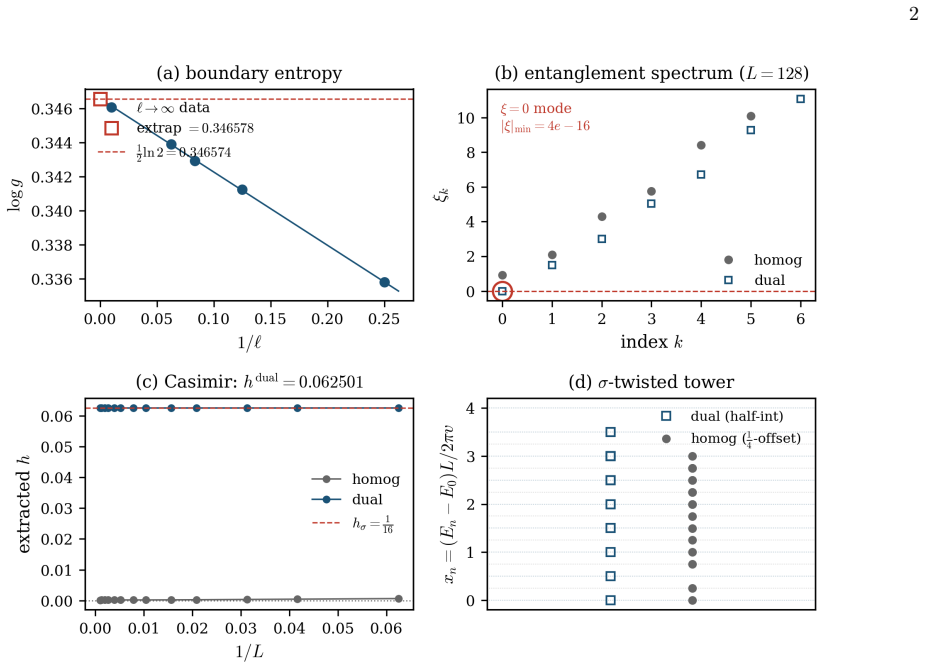
The categorical data of the KW duality defect, whose quantum dimension is sqrt(2), is encoded in the single-particle entanglement spectrum of its ground state through a maximally mixed Majorana zero mode that produces the boundary entropy log g = (1/2)log 2. Reading the duality-twisted ground state along the transfer-matrix momentum shift and along the Casimir curvature of the energy both recover the CFT value h_sigma = 1/16, and the defect Hilbert space organizes into a half-integer sigma-twisted conformal tower.
What carries the argument
The maximally mixed Majorana zero mode appearing in the single-particle entanglement spectrum of the duality-twisted ground state, which directly generates the boundary entropy and thereby the quantum dimension d_sigma.
If this is right
- The boundary entropy is promoted from an integrated number to a level-resolved spectral signature of non-invertibility.
- The defect Hilbert space organizes into a half-integer sigma-twisted conformal tower.
- The construction supplies an exactly solvable calibration target for tensor-network studies of duality defects that lack a free-fermion shortcut.
Where Pith is reading between the lines
- The same spectral mechanism may be tested in other lattice realizations of non-invertible symmetries whose defects carry irrational quantum dimensions.
- Tensor-network algorithms could adopt the reported Majorana mode and conformal tower as an independent check even when the underlying fermions are not explicit.
- The level-resolved view of boundary entropy might extend to defects in models whose continuum limits are not free-fermion CFTs.
Load-bearing premise
The duality-twisted ground state of the lattice model can be independently analyzed via transfer-matrix momentum shift and Casimir curvature of the energy to confirm the CFT value h_sigma=1/16.
What would settle it
Measurement of the single-particle entanglement spectrum that fails to exhibit a maximally mixed Majorana zero mode at the position required to produce log g = (1/2)log 2, or failure of the defect Hilbert space levels to form the predicted half-integer sigma-twisted tower.
Figures
read the original abstract
Non-invertible symmetries are characterized by topological defects of irrational quantum dimension, but their imprint on the entanglement of a quantum many-body state has not been resolved at the level of the spectrum. We show that the categorical data of the canonical example -- the Kramers--Wannier (KW) duality defect of the critical Ising chain, with quantum dimension d_sigma=sqrt(2) -- is encoded in the single-particle entanglement spectrum of its ground state: a maximally mixed Majorana zero mode is the spectral origin of the boundary entropy log g=(1/2)log 2, hence of d_sigma itself. Reading the same duality-twisted ground state along two independent routes -- the transfer-matrix momentum shift and the Casimir curvature of the energy -- pins the twist-field weight h_sigma=1/16 twice over, and the defect Hilbert space organizes into a half-integer sigma-twisted conformal tower. This promotes the boundary entropy from an integrated number to a level-resolved spectral signature of non-invertibility, and supplies an exactly solvable calibration target for tensor-network studies of duality defects that lack a free-fermion shortcut.
Editorial analysis
A structured set of objections, weighed in public.
Referee Report
Summary. The manuscript constructs an explicit lattice realization of the Kramers-Wannier duality defect in the critical Ising chain. Using the free-fermion representation, it derives the single-particle entanglement spectrum analytically and identifies a maximally mixed Majorana zero mode whose eigenvalue of exactly 1/2 supplies the boundary entropy contribution (1/2)log 2, thereby encoding the quantum dimension d_sigma = sqrt(2). The same duality-twisted ground state is diagonalized via two independent routes—the transfer-matrix momentum shift and the Casimir curvature of the finite-size energy—both confirming the conformal weight h_sigma = 1/16; the resulting defect Hilbert space organizes into the expected half-integer sigma-twisted tower.
Significance. If the central claims hold, the work supplies a level-resolved spectral signature of non-invertible symmetry in the entanglement spectrum and converts the boundary entropy into an exactly solvable calibration target for tensor-network studies. The free-fermion analyticity, absence of fitted parameters, and dual confirmation of h_sigma via independent methods (momentum shift and Casimir curvature) are explicit strengths that strengthen falsifiability.
minor comments (3)
- [Abstract] The abstract paragraph describing the two routes is information-dense; a single additional sentence separating the transfer-matrix and Casimir analyses would improve readability.
- Figure captions should explicitly state the system size and boundary conditions used for the entanglement-spectrum plot to allow immediate comparison with the analytic formula.
- A brief remark on the precise subtraction procedure for the bulk entanglement contribution (prior to isolating the zero-mode term) would clarify the numerical extraction of log g.
Simulated Author's Rebuttal
We thank the referee for their careful reading of the manuscript and for the positive assessment, including the recommendation to accept.
Circularity Check
No significant circularity; derivations are analytically independent
full rationale
The manuscript constructs the KW defect explicitly in the critical Ising chain and obtains the entanglement spectrum via direct free-fermion diagonalization, yielding an exact eigenvalue of 1/2 whose contribution to log g is computed without reference to the target CFT datum. The same ground state is then analyzed by two separate lattice observables (transfer-matrix momentum shift and finite-size Casimir curvature) that each return h_sigma = 1/16; these routes share no common fitted parameters, no self-citation of a uniqueness theorem, and no ansatz that presupposes the final result. The defect Hilbert space organization follows from the spectrum rather than being imposed. All steps are self-contained against external benchmarks and contain no reduction of a claimed prediction to its own input.
Axiom & Free-Parameter Ledger
axioms (1)
- domain assumption The critical Ising chain is described by a c=1/2 conformal field theory whose defect data include h_sigma=1/16 and half-integer twisted towers.
Reference graph
Works this paper leans on
-
[1]
Topological Defects on the Lattice I: The Ising model
D. Aasen, R. S. K. Mong, and P. Fendley, Topological defects on the lattice: I. the Ising model, J. Phys. A: Math. Theor. 49, 354001 (2016), arXiv:1601.07185
work page internal anchor Pith review Pith/arXiv arXiv 2016
- [2]
-
[3]
D. Gaiotto, A. Kapustin, N. Seiberg, and B. Willett, Generalized global symmetries, J. High Energy Phys.02(02), 172, arXiv:1412.5148
work page internal anchor Pith review Pith/arXiv arXiv
-
[4]
H. Li and F. D. M. Haldane, Entanglement spectrum as a generalization of entanglement entropy: Identification of topological order in non-abelian fractional quantum hall effect states, Phys. Rev. Lett.101, 010504 (2008), arXiv:0805.0332
work page internal anchor Pith review Pith/arXiv arXiv 2008
-
[5]
D. Rogerson, F. Pollmann, and A. Roy, Entanglement entropy and negativity in the Ising model with defects, J. High Energy Phys.06(06), 165, arXiv:2204.03601
-
[6]
ground-state degeneracy
I. Affleck and A. W. W. Ludwig, Universal noninteger “ground-state degeneracy” in critical quantum systems, Phys. Rev. Lett.67, 161 (1991)
1991
-
[7]
J. Heymann and T. Quella, Revisiting the symmetry-resolved entanglement for noninvertible symmetries in 1+1d conformal field theories, Phys. Rev. D112, 025004 (2025), arXiv:2409.02315 [hep-th]
-
[8]
P. Saura-Bastida, A. Das, G. Sierra, and J. Molina-Vilaplana, Categorical-symmetry resolved entanglement in conformal field theory, Phys. Rev. D109, 105026 (2024), arXiv:2402.06322 [hep-th]
- [9]
- [10]
-
[11]
Kramers-Wannier duality from conformal defects
J. Fr¨ ohlich, J. Fuchs, I. Runkel, and C. Schweigert, Kramers-wannier duality from conformal defects, Phys. Rev. Lett.93, 070601 (2004), arXiv:cond-mat/0404051
work page internal anchor Pith review Pith/arXiv arXiv 2004
-
[12]
Topological Defect Lines and Renormalization Group Flows in Two Dimensions
C.-M. Chang, Y.-H. Lin, S.-H. Shao, Y. Wang, and X. Yin, Topological defect lines and renormalization group flows in two dimensions, J. High Energy Phys.01(01), 026, arXiv:1802.04445
work page internal anchor Pith review Pith/arXiv arXiv
-
[13]
Liang, Entanglement fingerprint of a non-invertible symmetry: exact Fibonacci cut charges on the lattice (2026), submitted concurrently
Y. Liang, Entanglement fingerprint of a non-invertible symmetry: exact Fibonacci cut charges on the lattice (2026), submitted concurrently
2026
-
[14]
Liang and C
Y. Liang and C. Qian, True periodic boundary conditions in DMRG: Arc-Gram transfer-matrix method for entanglement entropy (2026), submitted to SciPost Physics
2026
-
[15]
Calculation of reduced density matrices from correlation functions
I. Peschel, Calculation of reduced density matrices from correlation functions, J. Phys. A: Math. Gen.36, L205 (2003), arXiv:cond-mat/0212631
work page internal anchor Pith review Pith/arXiv arXiv 2003
-
[16]
Seifnashri and S.-H
S. Seifnashri and S.-H. Shao, Cluster state as a noninvertible symmetry-protected topological phase, Phys. Rev. Lett.133, 116601 (2024)
2024
-
[17]
Grimm, Spectrum of a duality-twisted Ising quantum chain, J
U. Grimm, Spectrum of a duality-twisted Ising quantum chain, J. Phys. A: Math. Gen.35, L25 (2002), arXiv:hep- th/0111157
-
[18]
Rockwood, Entanglement Hamiltonians for periodic free fermion chains with defects, J
G. Rockwood, Entanglement Hamiltonians for periodic free fermion chains with defects, J. Stat. Mech.2025, 073101 (2025), arXiv:2408.08281
-
[19]
C. Northe and P. Rossi, Entanglement through topological defects: Reconciling theory with numerics (2025), arXiv:2512.07974
-
[20]
Symmetry TFTs from String Theory
F. Apruzzi, F. Bonetti, I. n. Garc´ ıa Etxebarria, S. S. Hosseini, and S. Schafer-Nameki, Symmetry TFTs from string theory, Commun. Math. Phys.402, 895 (2023), arXiv:2112.02092
work page internal anchor Pith review Pith/arXiv arXiv 2023
- [21]
-
[22]
Liang, Code for: Entanglement-spectrum fingerprint of a non-invertible symmetry: the kramers–wannier duality defect on the lattice (2026)
Y. Liang, Code for: Entanglement-spectrum fingerprint of a non-invertible symmetry: the kramers–wannier duality defect on the lattice (2026)
2026
discussion (0)
Sign in with ORCID, Apple, or X to comment. Anyone can read and Pith papers without signing in.