No evidence of vorticity production from initially irrotational turbulent gravitational collapse
Pith reviewed 2026-07-02 05:04 UTC · model grok-4.3
The pith
Gravitational collapse produces no vorticity from initially irrotational turbulence in direct simulations.
A machine-rendered reading of the paper's core claim, the machinery that carries it, and where it could break.
Core claim
In direct numerical simulations of gravitational collapse with an initially irrotational turbulent velocity field, a barotropic equation of state, and no magnetic fields, vorticity production occurs only through the initial turbulence and viscous effects, with no measurable contribution from the collapse flow within the parameter space accessible to the numerical resolution.
What carries the argument
Direct numerical simulations that enforce parallel pressure and density gradients via the barotropic equation of state, thereby restricting vorticity sources exclusively to viscosity and allowing isolation of any collapse-induced generation.
If this is right
- Vorticity in collapsing regions originates from pre-collapse turbulence rather than the collapse dynamics.
- Small-scale dynamo action during collapse requires initial vortical motions and is not seeded by the collapse itself.
- Barotropic models of collapse do not artificially generate vorticity through the flow geometry.
- Turbulence remains predominantly irrotational throughout the collapse when started from irrotational conditions.
Where Pith is reading between the lines
- Realistic collapses may need non-barotropic thermodynamics or magnetic fields to produce additional vorticity sources not captured here.
- Focus on setting realistic initial vorticity levels may be more important than modeling collapse-induced generation in astrophysical simulations.
- The result applies only within current resolution limits; unresolved small-scale effects could behave differently at higher resolution.
Load-bearing premise
The numerical resolution is sufficient to capture any vorticity generation mechanism that would operate during real gravitational collapse.
What would settle it
A higher-resolution simulation under identical initial conditions and barotropic setup that shows a net increase in vorticity attributable to the collapse flow rather than initial conditions would falsify the central claim.
Figures

read the original abstract
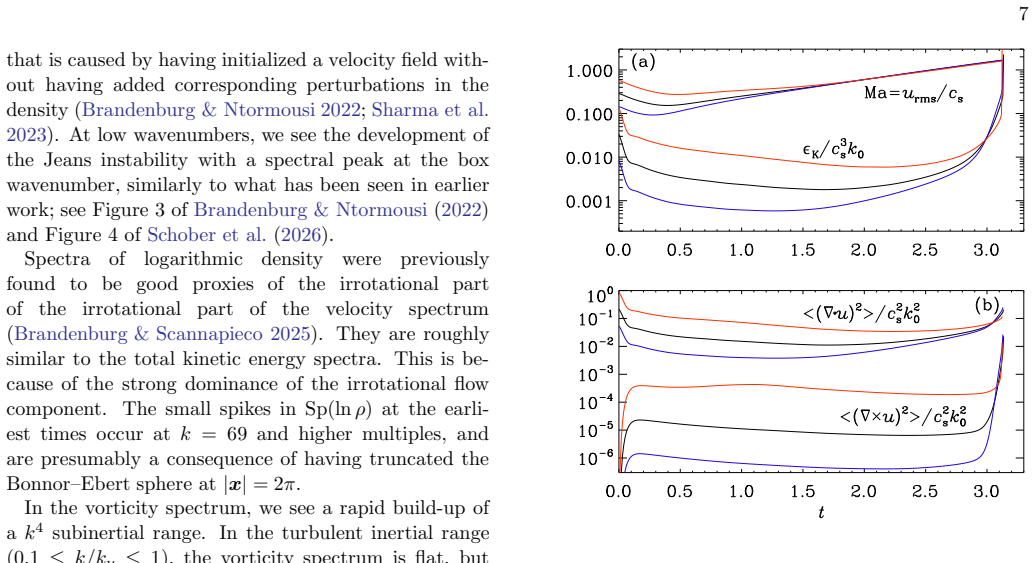
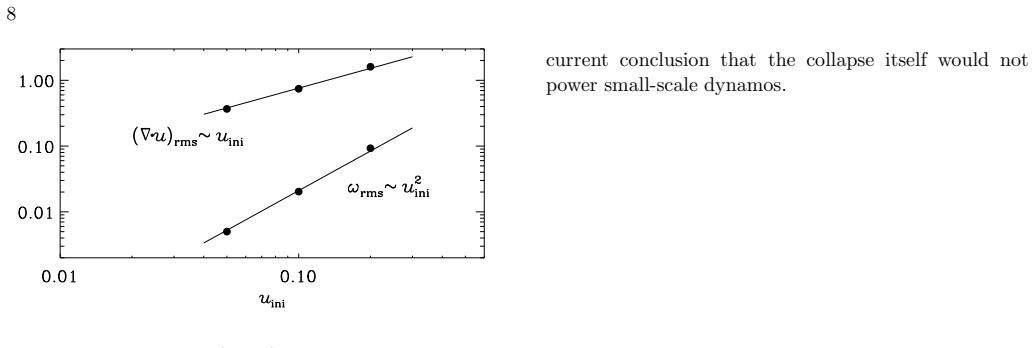
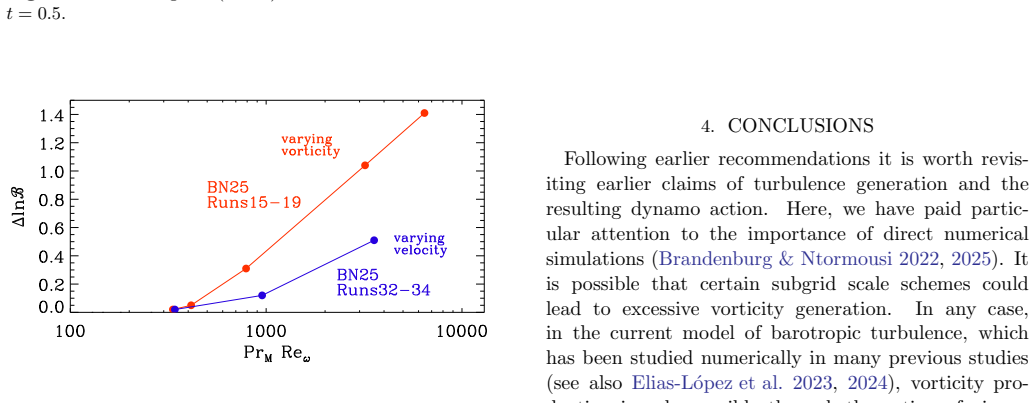
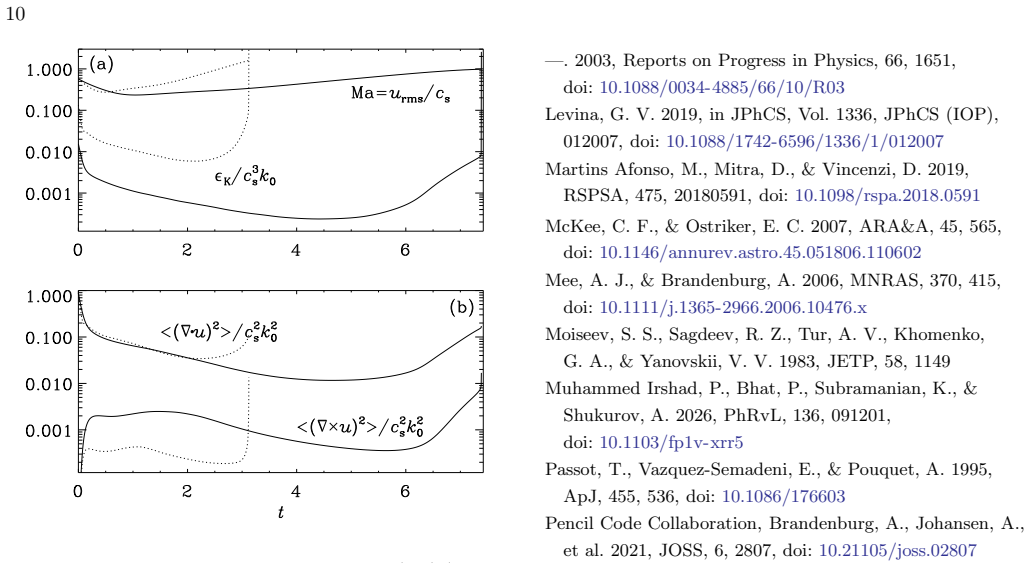
Gravitational collapse creates large amounts of kinetic energy that could potentially seed turbulence. If such turbulence were also suitable to initiate dynamo action, the resulting magnetic field would further modify the dynamics, especially on small length scales. However, a small-scale dynamo requires vortical turbulence, while the collapse produces mainly irrotational motions, which may not be efficient for dynamo action. Here, we study the efficiency of vorticity production during a turbulent collapse. We use a barotropic equation of state, where pressure and density gradients are parallel, and no magnetic field, so that vorticity can only be produced by viscosity. Using direct numerical simulations of gravitational collapse, we show that, for the parameter space accessible to our numerical resolution, this effect is related to the initial irrotational turbulence and is not a consequence of the collapse flow.
Editorial analysis
A structured set of objections, weighed in public.
Referee Report
Summary. The manuscript reports direct numerical simulations of gravitational collapse starting from initially irrotational turbulent conditions. Using a barotropic equation of state and no magnetic fields (so that vorticity can arise only from viscous effects), the authors find no evidence that the collapse flow itself generates vorticity; any vorticity present is instead attributable to the initial turbulence, within the parameter space accessible to the employed numerical resolution.
Significance. If the result holds under the stated scoping, it establishes a controlled negative finding that purely gravitational collapse of irrotational flow does not efficiently source vortical motions. This baseline is useful for assessing the conditions required for small-scale dynamo action in astrophysical collapse problems such as star formation, and it highlights the dominant role of initial conditions over the collapse dynamics in this simplified setup.
minor comments (2)
- [Abstract and § Conclusions] The abstract and introduction clearly scope the negative result to the accessible numerical resolution and the barotropic, non-magnetized setup; this scoping should be repeated explicitly in the conclusions to avoid over-generalization.
- [Numerical methods] A brief resolution study or convergence test (e.g., comparing vorticity spectra or enstrophy evolution across at least two grid resolutions) would strengthen the claim that the absence of collapse-induced vorticity is not a numerical artifact.
Simulated Author's Rebuttal
We thank the referee for their positive summary of our work and for recognizing the value of this controlled negative result. The recommendation for minor revision is noted. No specific major comments were provided in the report, so we have no points requiring response or revision at this time.
Circularity Check
No significant circularity
full rationale
The paper reports results from direct numerical simulations of gravitational collapse under a barotropic EOS with no magnetic fields. The central finding—that vorticity production is attributable to initial irrotational turbulence rather than the collapse flow—is scoped explicitly to the accessible numerical resolution and is presented as an empirical observation from the runs, not as a derivation or prediction that reduces to fitted parameters or self-citations by construction. No load-bearing equations, uniqueness theorems, or ansatzes are invoked that would create the enumerated circularity patterns. The result is therefore self-contained against external benchmarks within its stated limits.
Axiom & Free-Parameter Ledger
free parameters (2)
- numerical resolution
- viscosity coefficient
axioms (2)
- domain assumption Pressure is a function of density only (barotropic equation of state).
- domain assumption No magnetic field is present.
Reference graph
Works this paper leans on
-
[1]
Bonnor , W. B. 1956, , 116, 351, 10.1093/mnras/116.3.351
-
[2]
2003, in Advances in Nonlinear Dynamics, ed
Brandenburg , A. 2003, in Advances in Nonlinear Dynamics, ed. A. Ferriz-Mas & M. N \'u \ n ez , 269, 10.1201/9780203493137.ch9
-
[3]
2022, , 513, 2136, 10.1093/mnras/stac982
Brandenburg , A., & Ntormousi , E. 2022, , 513, 2136, 10.1093/mnras/stac982
-
[4]
2025, , 990, 223, 10.3847/1538-4357/adf725
---. 2025, , 990, 223, 10.3847/1538-4357/adf725
-
[5]
2023, , 518, 6367, 10.1093/mnras/stac3555
Brandenburg , A., Rogachevskii , I., & Schober , J. 2023, , 518, 6367, 10.1093/mnras/stac3555
-
[6]
2025, , 983, 105, 10.3847/1538-4357/adbe38
Brandenburg , A., & Scannapieco , E. 2025, , 983, 105, 10.3847/1538-4357/adbe38
-
[7]
2001, , 379, 1153, 10.1051/0004-6361:20011400
Brandenburg , A., & von Rekowski , B. 2001, , 379, 1153, 10.1051/0004-6361:20011400
-
[8]
2011, , 528, A145, 10.1051/0004-6361/201015661
Del Sordo , F., & Brandenburg , A. 2011, , 528, A145, 10.1051/0004-6361/201015661
-
[9]
1955, , 37, 217
Ebert , R. 1955, , 37, 217
1955
-
[10]
2023, , 677, A46, 10.1051/0004-6361/202346696
Elias-L \'o pez , A., Del Sordo , F., & Vigan \`o , D. 2023, , 677, A46, 10.1051/0004-6361/202346696
-
[11]
2024, , 690, A77, 10.1051/0004-6361/202450398
---. 2024, , 690, A77, 10.1051/0004-6361/202450398
-
[12]
2003, , 68, 016311, 10.1103/PhysRevE.68.016311
Elperin , T., Kleeorin , N., & Rogachevskii , I. 2003, , 68, 016311, 10.1103/PhysRevE.68.016311
-
[13]
1994, PhFl, 6, 1411, 10.1063/1.868255
Falkovich , G. 1994, PhFl, 6, 1411, 10.1063/1.868255
-
[14]
2011, , 107, 114504, 10.1103/PhysRevLett.107.114504
Federrath , C., Chabrier , G., Schober , J., et al. 2011, , 107, 114504, 10.1103/PhysRevLett.107.114504
-
[15]
Field , G. B., Blackman , E. G., & Keto , E. R. 2008, , 385, 181, 10.1111/j.1365-2966.2007.12609.x
-
[16]
Frisch , U., She , Z. S., & Sulem , P. L. 1987, PhyD, 28, 382, 10.1016/0167-2789(87)90026-1
-
[17]
Haugen , N. E. L., Brandenburg , A., & Mee , A. J. 2004, , 353, 947, 10.1111/j.1365-2966.2004.08127.x
-
[18]
2021, , 655, A3, 10.1051/0004-6361/202141650
Hennebelle , P. 2021, , 655, A3, 10.1051/0004-6361/202141650
-
[19]
J., Mitra , D., & Brandenburg , A
K \"a pyl \"a , P. J., Mitra , D., & Brandenburg , A. 2009, , 79, 016302, 10.1103/PhysRevE.79.016302
-
[20]
P., Ruzmaikin , A
Kazantsev , A. P., Ruzmaikin , A. A., & Sokolov , D. D. 1985, ZhETF, 61, 285
1985
-
[21]
Klessen , R. S., & Hennebelle , P. 2010, , 520, A17, 10.1051/0004-6361/200913780
-
[22]
1974, AN, 295, 93, 10.1002/asna.19742950205
Krause , F., & R \"u diger , G. 1974, AN, 295, 93, 10.1002/asna.19742950205
-
[23]
Larson , R. B. 1969, , 145, 271, 10.1093/mnras/145.3.271
-
[24]
2003, Reports on Progress in Physics, 66, 1651, 10.1088/0034-4885/66/10/R03
---. 2003, Reports on Progress in Physics, 66, 1651, 10.1088/0034-4885/66/10/R03
-
[25]
Levina , G. V. 2019, in JPhCS, Vol. 1336, JPhCS (IOP), 012007, 10.1088/1742-6596/1336/1/012007
-
[26]
2019, RSPSA, 475, 20180591, 10.1098/rspa.2018.0591
Martins Afonso , M., Mitra , D., & Vincenzi , D. 2019, RSPSA, 475, 20180591, 10.1098/rspa.2018.0591
-
[27]
Malicious User Experience Design Research for Cybersecurity
McKee , C. F., & Ostriker , E. C. 2007, , 45, 565, 10.1146/annurev.astro.45.051806.110602
work page internal anchor Pith review Pith/arXiv arXiv doi:10.1146/annurev.astro.45.051806.110602 2007
-
[28]
Mee , A. J., & Brandenburg , A. 2006, , 370, 415, 10.1111/j.1365-2966.2006.10476.x
-
[29]
S., Sagdeev , R
Moiseev , S. S., Sagdeev , R. Z., Tur , A. V., Khomenko , G. A., & Yanovskii , V. V. 1983, JETP, 58, 1149
1983
-
[30]
2026, , 136, 091201, 10.1103/fp1v-xrr5
Muhammed Irshad , P., Bhat , P., Subramanian , K., & Shukurov , A. 2026, , 136, 091201, 10.1103/fp1v-xrr5
-
[31]
1995, , 455, 536, 10.1086/176603
Passot , T., Vazquez-Semadeni , E., & Pouquet , A. 1995, , 455, 536, 10.1086/176603
-
[32]
2021, JOSS, 6, 2807, 10.21105/joss.02807
Pencil Code Collaboration , Brandenburg , A., Johansen , A., et al. 2021, JOSS, 6, 2807, 10.21105/joss.02807
-
[33]
Penston , M. V. 1969, , 144, 425, 10.1093/mnras/144.4.425
-
[34]
Porter , D. H., Jones , T. W., & Ryu , D. 2015, , 810, 93, 10.1088/0004-637X/810/2/93
-
[35]
Imprints of primordial magnetic fields in gravitational collapse during early structure formation
Schober , J., Abramson , M., Mandal , S., Mtchedlidze , S., & Kahniashvili , T. 2026, arXiv e-prints, arXiv:2602.23263, 10.48550/arXiv.2602.23263
work page internal anchor Pith review Pith/arXiv arXiv doi:10.48550/arxiv.2602.23263 2026
-
[36]
2023, , 2023, 042, 10.1088/1475-7516/2023/12/042
Sharma , R., Dahl , J., Brandenburg , A., & Hindmarsh , M. 2023, , 2023, 042, 10.1088/1475-7516/2023/12/042
-
[37]
Shu , F. H. 1977, , 214, 488, 10.1086/155274
-
[38]
Sulem , P. L., She , Z. S., Scholl , H., & Frisch , U. 1989, JFM, 205, 341, 10.1017/S0022112089002065
-
[39]
Sur , S., Federrath , C., Schleicher , D. R. G., Banerjee , R., & Klessen , R. S. 2012, , 423, 3148, 10.1111/j.1365-2966.2012.21100.x
-
[40]
Sur , S., Schleicher , D. R. G., Banerjee , R., Federrath , C., & Klessen , R. S. 2010, , 721, L134, 10.1088/2041-8205/721/2/L134
-
[41]
2020 a , , 890, 157, 10.3847/1538-4357/ab6e63
Xu , S., & Lazarian , A. 2020 a , , 890, 157, 10.3847/1538-4357/ab6e63
-
[42]
2020 b , , 899, 115, 10.3847/1538-4357/aba7ba
---. 2020 b , , 899, 115, 10.3847/1538-4357/aba7ba
discussion (0)
Sign in with ORCID, Apple, or X to comment. Anyone can read and Pith papers without signing in.