Controlling Waiting Time Statistics in Monitored Collective Spins: Mitigating Detector's Resolution Barrier in Measurement-Induced Phase Transitions
Pith reviewed 2026-07-03 20:22 UTC · model grok-4.3
The pith
Partitioning a monitored spin ensemble into two subsystems rotated by angle θ makes waiting times between quantum jumps remain finite at θ=π, overcoming the detector resolution barrier.
A machine-rendered reading of the paper's core claim, the machinery that carries it, and where it could break.
Core claim
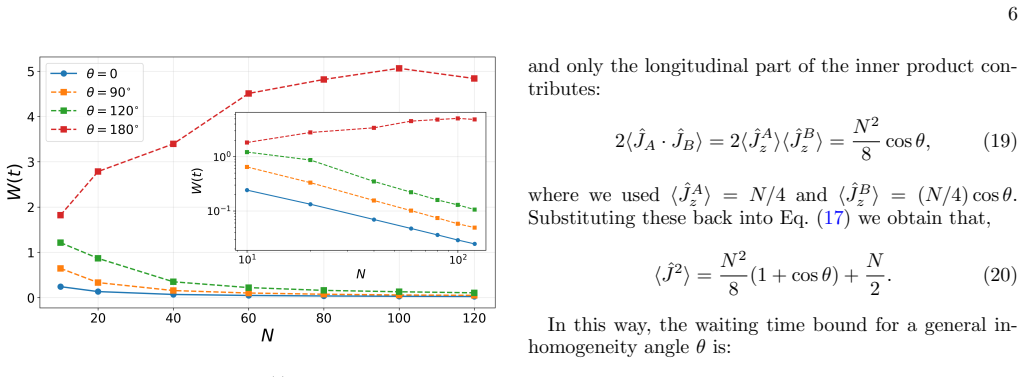
In a collectively monitored spin model with a boundary time-crystalline phase, partitioning the ensemble into two subsystems rotated by an angle θ allows the waiting time between quantum jumps to increase with θ while scaling as 1/N with an enhanced prefactor; at θ=π the waiting time remains finite, fully resolving the detector resolution barrier, even as the phase transition persists with altered entanglement scaling.
What carries the argument
The rotation angle θ that partitions the spin ensemble into two rotated subsystems and thereby controls the waiting-time statistics between quantum jumps.
If this is right
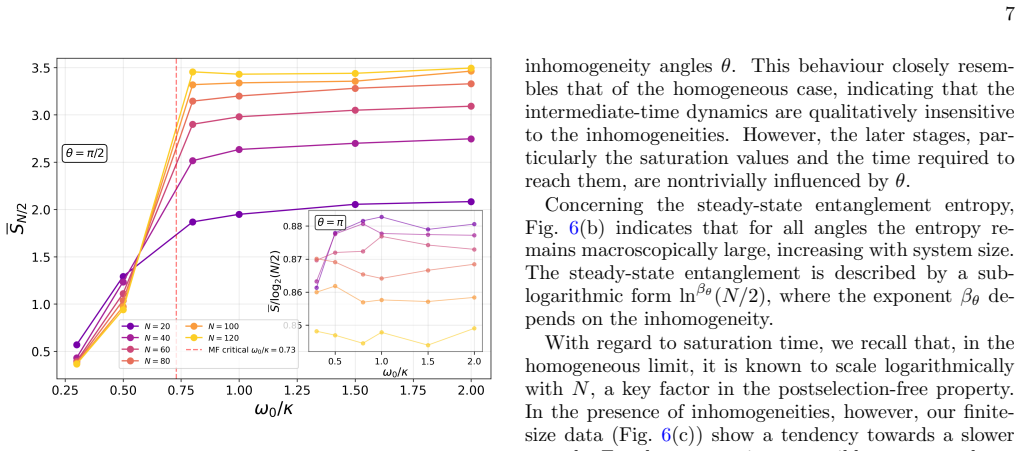
- The measurement-induced phase transition survives under inhomogeneities with different entanglement scaling regimes.
- Waiting time increases with θ, scaling as 1/N but with a prefactor enhanced by orders of magnitude.
- In the anti-aligned limit θ=π the waiting time remains finite.
- Entanglement saturation time becomes significantly longer, partially reintroducing the postselection barrier.
- A trade-off exists between detector resolution and postselection overhead for observing measurement-induced phenomena.
Where Pith is reading between the lines
- This partitioning approach could be tested experimentally by preparing rotated initial states and recording jump intervals with finite-resolution detectors.
- The method may extend to other monitored many-body systems where jump statistics need tuning without altering the monitoring protocol itself.
- If the phase transition persists for general inhomogeneities, similar rotations could serve as a control knob in related dissipative spin models.
Load-bearing premise
The collective monitoring model and boundary time-crystalline phase remain well-defined and the phase transition survives when the ensemble is partitioned into two rotated subsystems.
What would settle it
Measuring the waiting time between quantum jumps in the θ=π configuration and checking whether it stays finite rather than diverging or vanishing as the number of spins N increases.
Figures



read the original abstract
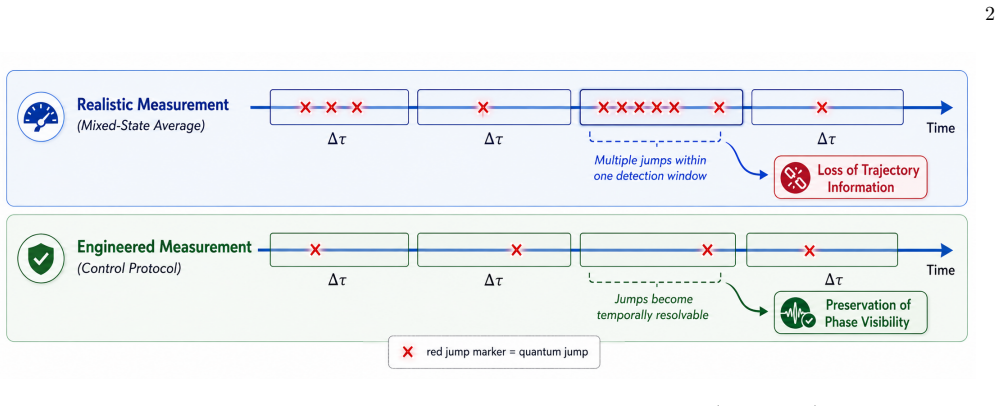
In collective dissipative spin systems, the postselection barrier can be partially mitigated; however, a further obstacle may be posed by the finite temporal resolution of detectors. In this work, we investigate how initial-state inhomogeneities can control waiting-time statistics between quantum jumps, thereby mitigating the detector-resolution problem. We consider a collectively monitored spin model with a boundary time-crystalline phase, introducing inhomogeneity by partitioning the ensemble into two subsystems rotated by an angle $\theta$. We find that the measurement-induced phase transition survives under inhomogeneities, with different entanglement scaling regimes. The waiting time increases with $\theta$, scaling as $1/N$ but with a prefactor strongly enhanced by orders of magnitude, and in the anti-aligned limit $\theta = \pi$ it remains finite, fully resolving the resolution barrier. This mitigation, however, comes at a cost: the entanglement saturation time becomes significantly longer, partially reintroducing the postselection barrier. Our results highlight a trade-off between detector resolution and postselection overhead, with direct implications for the experimental observation of measurement-induced phenomena.
Editorial analysis
A structured set of objections, weighed in public.
Referee Report
Summary. The manuscript examines a collectively monitored dissipative spin system with a boundary time-crystalline phase. Inhomogeneity is introduced by partitioning the ensemble into two subsystems rotated by angle θ. The authors report that the measurement-induced phase transition survives this inhomogeneity (with altered entanglement scaling), that the inter-jump waiting time increases with θ (scaling as 1/N with a strongly enhanced prefactor), and that the waiting time remains finite in the anti-aligned limit θ=π, thereby resolving the detector temporal-resolution barrier (at the cost of longer entanglement saturation times).
Significance. If the central numerical claims hold, the work identifies a concrete mechanism—initial-state inhomogeneity via subsystem rotation—to control waiting-time distributions and thereby mitigate a practical experimental obstacle (finite detector resolution) in observing measurement-induced phenomena. The explicit trade-off with postselection overhead is a useful observation for experimental design.
major comments (1)
- [Abstract] Abstract (and the headline claim): the assertion that the measurement-induced transition and boundary time-crystalline phase remain well-defined after partitioning into rotated subsystems, and that the waiting time stays finite at θ=π, is stated without an explicit construction of the collective jump operators or Lindblad terms for the rotated subsystems. This construction is load-bearing for deriving the finite-waiting-time result from the model.
Simulated Author's Rebuttal
We thank the referee for the careful reading, positive assessment of significance, and recommendation. We address the single major comment below and will revise the manuscript to strengthen the presentation of the operator construction.
read point-by-point responses
-
Referee: [Abstract] Abstract (and the headline claim): the assertion that the measurement-induced transition and boundary time-crystalline phase remain well-defined after partitioning into rotated subsystems, and that the waiting time stays finite at θ=π, is stated without an explicit construction of the collective jump operators or Lindblad terms for the rotated subsystems. This construction is load-bearing for deriving the finite-waiting-time result from the model.
Authors: We agree that an explicit statement of the rotated jump operators strengthens the abstract's claims. The full model is defined in Section II with Lindblad operators L = √(γ) (S^x_A + e^{iθ} S^x_B) for the two partitions (A,B) of the collective spin, which directly yields a non-vanishing effective jump rate at θ=π. To address the concern, we will revise the abstract to include a concise reference to this operator form and add a short clarifying sentence in the introduction that links the construction to the finite waiting-time result. This revision will make the load-bearing step transparent without altering the technical content. revision: yes
Circularity Check
No significant circularity; findings are direct numerical outputs.
full rationale
The paper reports numerical results on waiting-time statistics and survival of the measurement-induced transition under subsystem rotation by θ, including the finite-waiting-time claim at θ=π. These are presented as direct simulation outputs ('we find that', scaling behaviors observed) rather than fitted parameters renamed as predictions or quantities defined in terms of themselves. No self-citation load-bearing steps, uniqueness theorems imported from prior author work, or ansatz smuggling appear in the provided text. The central claims do not reduce by construction to the inputs via the enumerated patterns; the derivation chain remains self-contained.
Axiom & Free-Parameter Ledger
axioms (1)
- domain assumption Collective monitoring is described by a standard Lindblad master equation with jump operators acting uniformly on the ensemble
Reference graph
Works this paper leans on
- [1]
-
[2]
G. Passarelli, X. Turkeshi, A. Russomanno, P. Lucig- nano, M. Schir` o, and R. Fazio, Phys. Rev. Lett.132, 163401 (2024)
work page 2024
-
[3]
Y. Li, X. Chen, and M. P. A. Fisher, Phys. Rev. B98, 205136 (2018)
work page 2018
- [4]
-
[5]
H. J. Carmichael,Statistical Methods in Quantum Optics 1(Springer, 1999). 9
work page 1999
-
[6]
H. M. Wiseman and G. J. Milburn,Quantum Measure- ment and Control(Cambridge University Press, 2009)
work page 2009
-
[7]
Jacobs,Quantum Measurement Theory and its Appli- cations(Cambridge University Press, 2014)
K. Jacobs,Quantum Measurement Theory and its Appli- cations(Cambridge University Press, 2014)
work page 2014
-
[8]
Y. Li, X. Chen, and M. P. A. Fisher, Phys. Rev. B100, 134306 (2019)
work page 2019
-
[9]
M. Szyniszewski, A. Romito, and H. Schomerus, Phys. Rev. B100, 064204 (2019)
work page 2019
-
[10]
C.-M. Jian, Y.-Z. You, R. Vasseur, and A. W. W. Ludwig, Phys. Rev. B101, 104302 (2020)
work page 2020
- [11]
-
[12]
M. Szyniszewski, A. Romito, and H. Schomerus, Phys. Rev. Lett.125, 210602 (2020)
work page 2020
- [13]
-
[14]
O. Lunt, M. Szyniszewski, and A. Pal, Phys. Rev. B104, 155111 (2021)
work page 2021
-
[15]
P. Sierant, M. Schir` o, M. Lewenstein, and X. Turkeshi, Phys. Rev. B106, 214316 (2022)
work page 2022
- [16]
- [17]
- [18]
-
[19]
G. Chiriaco, M. Tsitsishvili, D. Poletti, R. Fazio, and M. Dalmonte, Phys. Rev. B108, 075151 (2023)
work page 2023
- [20]
-
[21]
X. Cao, A. Tilloy, and A. De Luca, SciPost Phys.7, 024 (2019)
work page 2019
- [22]
-
[23]
M. Buchhold, Y. Minoguchi, A. Altland, and S. Diehl, Phys. Rev. X11, 041004 (2021)
work page 2021
-
[24]
C.-M. Jian, B. Bauer, A. Keselman, and A. W. W. Lud- wig, Phys. Rev. B106, 134206 (2022)
work page 2022
-
[25]
M. Coppola, E. Tirrito, D. Karevski, and M. Collura, Phys. Rev. B105, 094303 (2022)
work page 2022
-
[26]
M. Fava, L. Piroli, T. Swann, D. Bernard, and A. Nahum, Phys. Rev. X13, 041045 (2023)
work page 2023
-
[27]
I. Poboiko, P. P¨ opperl, I. V. Gornyi, and A. D. Mirlin, Phys. Rev. X13, 041046 (2023)
work page 2023
- [28]
-
[29]
O. Alberton, M. Buchhold, and S. Diehl, Phys. Rev. Lett. 126, 170602 (2021)
work page 2021
-
[30]
X. Turkeshi, A. Biella, R. Fazio, M. Dalmonte, and M. Schir´ o, Phys. Rev. B103, 224210 (2021)
work page 2021
-
[31]
X. Turkeshi, M. Dalmonte, R. Fazio, and M. Schir´ o, Phys. Rev. B105, L241114 (2022)
work page 2022
-
[32]
G. Piccitto, A. Russomanno, and D. Rossini, Phys. Rev. B105, 064305 (2022)
work page 2022
-
[33]
G. Piccitto, A. Russomanno, and D. Rossini, SciPost Phys. Core6, 078 (2023)
work page 2023
-
[34]
E. Tirrito, A. Santini, R. Fazio, and M. Collura, SciPost Phys.15, 096 (2023)
work page 2023
- [35]
- [36]
- [37]
- [38]
-
[39]
P. Sierant, G. Chiriac` o, F. M. Surace, S. Sharma, X. Turkeshi, M. Dalmonte, R. Fazio, and G. Pagano, Quantum6, 638 (2022)
work page 2022
-
[40]
E. V. H. Doggen, Y. Gefen, I. V. Gornyi, A. D. Mir- lin, and D. G. Polyakov, Phys. Rev. Research4, 023146 (2022)
work page 2022
-
[41]
A. Altland, M. Buchhold, S. Diehl, and T. Micklitz, Phys. Rev. Research4, L022066 (2022)
work page 2022
-
[42]
C. Noel, P. Niroula, D. Zhu, A. Risinger, L. Egan,et al., Nat. Phys.18, 760 (2022)
work page 2022
-
[43]
J. M. Koh, S.-N. Sun, M. Motta, and A. J. Minnich, Nat. Phys.19, 1314 (2023)
work page 2023
- [44]
-
[45]
S. J. Garratt and E. Altman, PRX Quantum5, 10.1103/prxquantum.5.030311 (2024)
-
[46]
Google Quantum AI and Collaborators, Nature622, 481 (2023)
work page 2023
-
[47]
Y. Li, Y. Zou, P. Glorioso, E. Altman, and M. P. A. Fisher, Phys. Rev. Lett.130, 220404 (2023)
work page 2023
- [48]
- [49]
-
[50]
M. J. Gullans and D. A. Huse, Phys. Rev. Lett.125, 070606 (2020)
work page 2020
- [51]
-
[52]
T. Iadecola, S. Ganeshan, J. H. Pixley, and J. H. Wilson, Phys. Rev. Lett.131, 060403 (2023)
work page 2023
-
[53]
M. Buchhold, T. M¨ uller, and S. Diehl, Revealing measurement-induced phase transitions by pre-selection (2022), arXiv:2208.10506 [quant-ph]
-
[54]
A. Delmonte, Z. Li, G. Passarelli, E. Y. Song, D. Bar- berena, A. M. Rey, and R. Fazio, Measurement-induced phase transitions in monitored infinite-range interacting systems (2024), arXiv:2410.05394 [quant-ph]
- [55]
- [56]
-
[57]
F. Iemini, D. Chang, and J. Marino, Physical Review A 109, 10.1103/physreva.109.032204 (2024)
-
[58]
M. B. Plenio and P. L. Knight, Rev. Mod. Phys.70, 101 (1998)
work page 1998
-
[59]
A. J. Daley, Advances in Physics63, 77 (2014)
work page 2014
- [60]
-
[61]
L. d. S. Souza, L. F. dos Prazeres, and F. Iemini, Phys. Rev. Lett.130, 180401 (2023)
work page 2023
- [62]
discussion (0)
Sign in with ORCID, Apple, or X to comment. Anyone can read and Pith papers without signing in.