From Dirac Cones to Semions: An Exact Finite-Size Theory of Parity-Anomaly Transport in Chiral Spin Liquids
Pith reviewed 2026-07-03 18:43 UTC · model grok-4.3
The pith
The exact parity-odd determinant of a gapped Dirac cone on a cylinder shows finite-circumference corrections to spin Hall response are strictly exponential with no 1/L term.
A machine-rendered reading of the paper's core claim, the machinery that carries it, and where it could break.
Core claim
By evaluating the parity-odd determinant of a gapped Dirac cone on a cylinder and resumming it to all orders in the compact holonomy, the paper proves that finite-circumference corrections to the topological response are strictly exponential, with no universal 1/L term, and supplies the exact map from the microscopic spinon Chern number to the physical spin Hall conductance.
What carries the argument
exact parity-odd determinant of a gapped Dirac cone on a cylinder with compact holonomy, resummed to all orders
If this is right
- The physical spin Hall conductance equals half the spinon Chern number once the exponential corrections are accounted for.
- No power-law finite-size term appears in the topological response on cylinders of any width.
- The same determinant formula applies to any lattice realization of a chiral spin liquid whose spinons are gapped Dirac fermions.
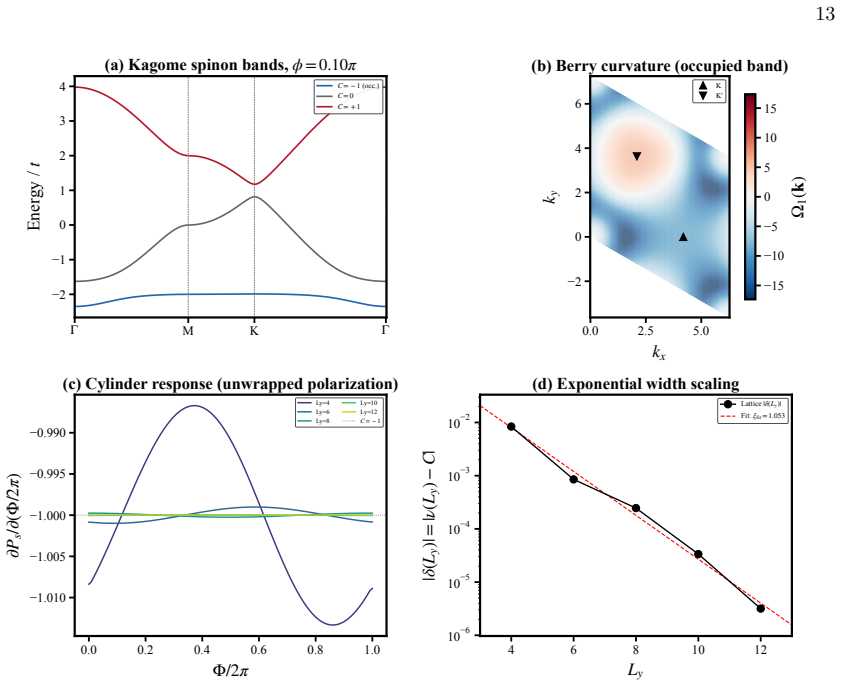
- Band-structure calculations on cylinders four to twelve sites wide already converge exponentially to the thermodynamic value.
Where Pith is reading between the lines
- Simulations on modestly wide cylinders can extract the thermodynamic fractional response to high accuracy once the exponential form is used.
- The method supplies a template for extracting other fractional responses, such as thermal Hall or orbital magnetization, from finite-size data in related states.
- The absence of a universal 1/L correction suggests that similar resummations may remove power-law artifacts in other anomaly-related observables on compact geometries.
Load-bearing premise
The spinons of the chiral spin liquid can be represented by a gapped Dirac cone whose parity-odd determinant on the cylinder determines the physical spin response.
What would settle it
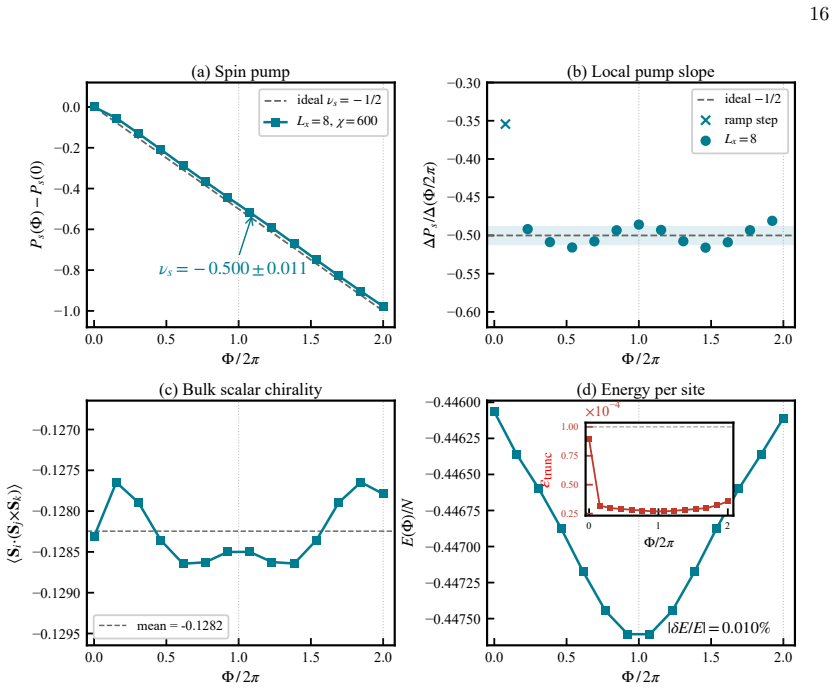
A DMRG flux-pump measurement on the kagome lattice that yields a spin Hall conductance differing from -0.5 by more than the reported error bar would falsify the claimed map.
Figures
read the original abstract
Chiral spin liquids carry a hidden bookkeeping problem: the integer Chern number of their fractionalized spinons, the level of the emergent Chern--Simons gauge field, and the fractional spin response actually measured in experiment or simulation are related but distinct quantities, and the literature routinely conflates them. Here we resolve this by deriving the exact parity-odd determinant of a gapped Dirac cone on a spatial cylinder, resummed to all orders in the compact holonomy rather than truncated at leading order. The result proves that finite-circumference corrections to the topological response are strictly exponential, with no universal $1/L$ term, and fixes the precise map from microscopic spinon Chern number to physical spin Hall conductance. We validate this chain of reasoning on the kagome lattice at three independent levels: an exact parton band-structure calculation ($C=-1$, converging exponentially over cylinders four to twelve sites wide), and an interacting density-matrix renormalization group flux pump ($\nu_s=-0.500\pm0.011$) that agrees with the analytic prediction without any adjustable parameter. Together, these results turn a one-loop anomaly calculation into a quantitatively verified bridge between microscopic topology and observable fractional response.
Editorial analysis
A structured set of objections, weighed in public.
Referee Report
Summary. The manuscript derives the exact parity-odd determinant of a gapped Dirac cone on a spatial cylinder, resummed to all orders in the compact holonomy. It claims this proves finite-circumference corrections to the topological response are strictly exponential (no universal 1/L term) and fixes the precise map from the microscopic spinon Chern number to the physical spin Hall conductance. Validation is provided at three levels on the kagome lattice: an exact non-interacting parton band-structure calculation for C=-1 showing exponential convergence on cylinders of width 4–12, and a parameter-free interacting DMRG flux-pump measurement yielding ν_s = -0.500 ± 0.011 that matches the analytic prediction.
Significance. If the central derivation holds, the work supplies a quantitatively verified, parameter-free bridge between microscopic spinon topology and observable fractional spin response in chiral spin liquids, directly addressing the common conflation of Chern numbers, Chern-Simons levels, and measured conductances. The exact all-orders resummation, the demonstration of strictly exponential finite-size corrections, and the independent DMRG check without adjustable parameters are notable strengths that elevate the result beyond standard one-loop anomaly arguments.
minor comments (3)
- Abstract, first paragraph: the phrase 'resummed to all orders in the compact holonomy rather than truncated at leading order' would benefit from an explicit statement of the resulting correction term (e.g., the functional form of the exponential decay) to make the 'strictly exponential' claim immediately verifiable.
- The mapping from spinon Chern number C to spin Hall conductance ν_s is stated as fixed by the determinant; a brief summary equation in the introduction or conclusion would help readers track this central relation without searching the main derivation.
- Figure captions for the parton band-structure and DMRG data should explicitly list the cylinder circumferences used and confirm that no post-selection or fitting was applied to the reported agreement of 0.011.
Simulated Author's Rebuttal
We thank the referee for their careful reading of the manuscript and for the positive assessment. We are pleased that the central results—the all-orders resummation of the parity-odd determinant, the proof of strictly exponential finite-size corrections, and the parameter-free mapping from spinon Chern number to spin Hall conductance—were found to be clear and significant. The recommendation to accept is appreciated.
Circularity Check
No significant circularity; derivation is self-contained
full rationale
The central derivation is an exact all-orders resummation of the parity-odd determinant for a gapped Dirac cone on a cylinder, presented as a direct mathematical computation rather than a fit or self-referential definition. This produces the claimed exponential corrections and the map from spinon Chern number to spin Hall conductance. Validation occurs via two independent external checks—an exact non-interacting parton band-structure computation on the kagome lattice and a parameter-free interacting DMRG flux-pump measurement—both of which test the output against microscopic data without using the same inputs or fitted parameters. No load-bearing step reduces to a self-citation, ansatz smuggled via prior work, or renaming of a known result. The paper is therefore self-contained against external benchmarks.
Axiom & Free-Parameter Ledger
Reference graph
Works this paper leans on
-
[1]
Kalmeyer and R
V. Kalmeyer and R. B. Laughlin, Phys. Rev. Lett.59, 2095 (1987)
2095
-
[2]
X. G. Wen, F. Wilczek, and A. Zee, Phys. Rev. B39, 11413 (1989)
1989
-
[3]
S.-S. Gong, W. Zhu, and D. N. Sheng, Sci. Rep. 4, 6317 (2014)
2014
-
[4]
Y.-C. He, D. N. Sheng, and Y. Chen, Phys. Rev. Lett.112, 137202 (2014)
2014
-
[5]
Bauer, L
B. Bauer, L. Cincio, B. P. Keller, M. Dolfi, G. Vidal, S. Trebst, and A. W. W. Ludwig, Nat. Commun.5, 5137 (2014)
2014
-
[6]
W.-J. Hu, W. Zhu, Y. Zhang, S. Gong, F. Becca, and D. N. Sheng, Phys. Rev. B91, 041124(R) (2015)
2015
-
[7]
Y.-C. He, S. Bhattacharjee, F. Pollmann, and R. Moessner, Phys. Rev. Lett.115, 267209 (2015)
2015
-
[8]
A. J. Niemi and G. W. Semenoff, Phys. Rev. Lett.51, 2077 (1983)
2077
-
[9]
A. N. Redlich, Phys. Rev. Lett.52, 18 (1984)
1984
-
[10]
A. N. Redlich, Phys. Rev. D29, 2366 (1984)
1984
-
[11]
Coste and M
A. Coste and M. L¨ uscher, Nucl. Phys. B323, 631 (1989)
1989
- [12]
-
[13]
Deser, L
S. Deser, L. Griguolo, and D. Seminara, Phys. Rev. D67, 065016 (2003)
2003
-
[14]
I. J. R. Aitchison and C. D. Fosco, Phys. Rev. D57, 1171 (1998), arXiv:hep-th/9709035
work page internal anchor Pith review Pith/arXiv arXiv 1998
-
[15]
C. D. Fosco, G. L. Rossini, and F. A. Scha- posnik, Phys. Rev. D59, 085012 (1999), arXiv:hep-th/9810199
work page internal anchor Pith review Pith/arXiv arXiv 1999
-
[16]
Q. Niu, D. J. Thouless, and Y.-S. Wu, Phys. Rev. B31, 3372 (1985)
1985
-
[17]
Phase of the fermion determinant in QED_3 using a gauge invariant lattice regularization
N. Karthik and R. Narayanan, Phys. Rev. D 92, 025003 (2015), arXiv:1505.01051
work page internal anchor Pith review Pith/arXiv arXiv 2015
-
[18]
K. S. Babu, A. Das, and P. Panigrahi, Phys. Rev. D36, 3725 (1987)
1987
-
[19]
Ishikawa and T
K. Ishikawa and T. Matsuyama, Nucl. Phys. B 280, 523 (1987)
1987
-
[20]
Kitaev, Ann
A. Kitaev, Ann. Phys.321, 2 (2006)
2006
-
[21]
Read and D
N. Read and D. Green, Phys. Rev. B61, 10267 (2000)
2000
-
[22]
Bieri, C
S. Bieri, C. Lhuillier, and L. Messio, Phys. Rev. B93, 094437 (2016)
2016
-
[23]
Efficient numerical simulations with Tensor Networks: Tensor Network Python (TeNPy)
J. Hauschild and F. Pollmann, SciPost Phys. Lect. Notes , 5 (2018), arXiv:1805.00055
work page internal anchor Pith review Pith/arXiv arXiv 2018
-
[24]
K. J. B. Ghosh and F. R. Klinkhamer, Nucl. Phys. B926, 335 (2018), arXiv:1706.07025. Appendix A: Full parity-odd kernel from Feynman parametrization For canonical velocities and the minimally normalized field, the quadratic loop is Πµν(p) =− 1 Leff X n Z d2k (2π)2 tr γµ −i/k+m k2 +m 2 γν −i(/k+ /p) +m (k+p) 2 +m 2 .(A1) With the trace orientation chosen t...
work page internal anchor Pith review Pith/arXiv arXiv 2018
discussion (0)
Sign in with ORCID, Apple, or X to comment. Anyone can read and Pith papers without signing in.