High-Precision Calibration Workflow Achieves Above 99.9\% CZ Gate Fidelity on a Scalable Superconducting Processor
Pith reviewed 2026-07-03 19:58 UTC · model grok-4.3
The pith
A closed-loop calibration workflow using ELEA and CAFE circuits reaches CZ gate fidelity above 99.9% on an 84-qubit superconducting processor.
A machine-rendered reading of the paper's core claim, the machinery that carries it, and where it could break.
Core claim
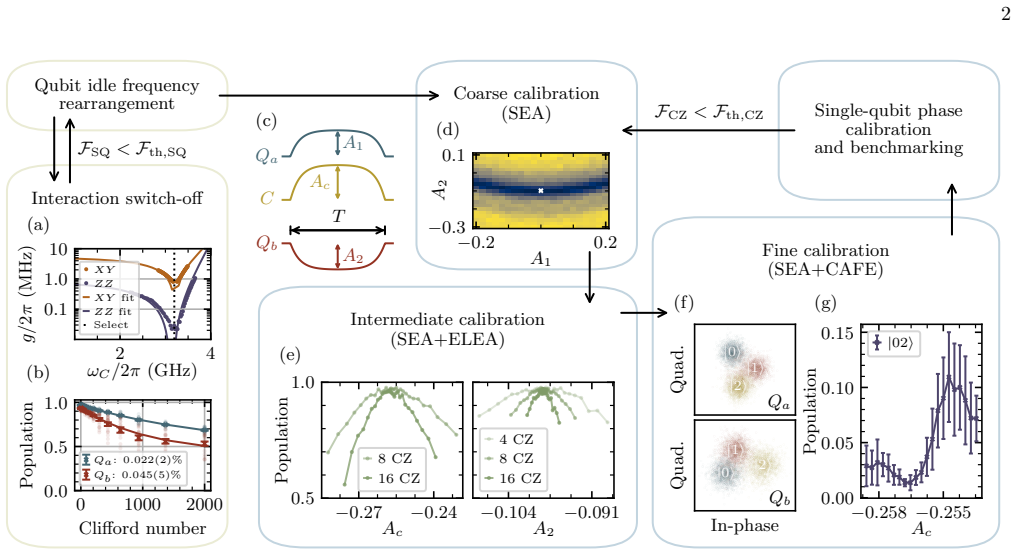
Utilizing the echoed leakage error amplification (ELEA) and the repurposed context-aware fidelity estimation (CAFE) circuits, we suppress the population leakage to non-computational states, and, for the first time, demonstrate a CZ gate fidelity exceeding 99.9% on an 84-qubit processor, with coherent error suppressed to 0.007%. Meanwhile, we obtain a median fidelity of 99.25% among 72 CZ gates, demonstrating that the workflow can be generalized to the calibration of parallel CZ gates. Finally, we realize automated calibration and observe enhanced stability of the CZ gate throughout 9-hour comparative monitoring experiments.
What carries the argument
The closed-loop workflow that combines echoed leakage error amplification (ELEA) and context-aware fidelity estimation (CAFE) circuits to deliver unbiased, high-precision estimates of leakage and coherent errors during CZ gate tuning.
If this is right
- The workflow extends to simultaneous calibration of many parallel CZ gates while preserving a median fidelity above 99%.
- Automated execution of the workflow produces measurable gains in gate stability across at least nine-hour monitoring intervals.
- Suppression of coherent error to 0.007% leaves more margin within the overall error budget for incoherent errors arising from finite coherence times.
- The method supplies an efficient calibration path for building larger superconducting processors aimed at fault-tolerant quantum computation.
Where Pith is reading between the lines
- The same circuits and closed-loop structure could be adapted to calibrate other two-qubit gates such as iSWAP on similar hardware.
- Repeated application across multiple chips would test whether the 99.9% threshold is reproducible under varying fabrication conditions.
- Integration with real-time feedback during algorithm execution might further reduce the overhead of error mitigation techniques.
Load-bearing premise
The ELEA and CAFE circuits supply unbiased high-precision estimates of leakage and coherent errors that translate directly into the reported gate fidelity without measurement artifacts or post-hoc data selection.
What would settle it
An independent fidelity measurement on the same 84-qubit processor using a different protocol such as randomized benchmarking that returns a value below 99.9% would falsify the central claim.
Figures


read the original abstract
High-fidelity universal two-qubit gates are critical for building fault-tolerant quantum computers. In scalable superconducting processors, shortened coherence times introduce more incoherent errors in gate operations. With a constrained error budget, there is reduced tolerance for coherent errors stemming from parameter deviations. In this work, we develop a closed-loop workflow to enhance the CZ gate calibration precision. Utilizing the echoed leakage error amplification (ELEA) and the repurposed context-aware fidelity estimation (CAFE) circuits, we suppress the population leakage to non-computational states, and, for the first time, demonstrate a CZ gate fidelity exceeding $99.9\%$ on an 84-qubit processor, with coherent error suppressed to $0.007\%$. Meanwhile, we obtain a median fidelity of $99.25\%$ among 72 CZ gates, demonstrating that the workflow can be generalized to the calibration of parallel CZ gates. Finally, we realize automated calibration and observe enhanced stability of the CZ gate throughout 9-hour comparative monitoring experiments. Our results, realized on a completely domestic platform, establish an efficient and automated route to quantum computation with superconducting quantum systems.
Editorial analysis
A structured set of objections, weighed in public.
Referee Report
Summary. The manuscript presents a closed-loop calibration workflow for CZ gates on an 84-qubit superconducting processor. It employs echoed leakage error amplification (ELEA) and context-aware fidelity estimation (CAFE) circuits to suppress leakage and coherent errors, claiming CZ gate fidelity exceeding 99.9% (with coherent error at 0.007%) on one gate, a median fidelity of 99.25% across 72 gates, generalization to parallel gates, and improved stability via automated calibration over 9-hour monitoring.
Significance. If the fidelity values are shown to be unbiased and directly measured without post-hoc adjustments, the work would be significant for demonstrating a scalable, automated route to high-fidelity two-qubit gates on large superconducting processors, addressing the tight error budgets needed for fault tolerance.
major comments (2)
- [Sections 3 and 4] Sections 3 and 4: The central claim of >99.9% CZ fidelity rests on ELEA and CAFE yielding unbiased estimates of leakage and coherent errors. No side-by-side comparison on the same device against interleaved randomized benchmarking (or other established protocols) is reported; any systematic offset in how CAFE extracts process fidelity or ELEA amplifies leakage would directly affect the headline number without detection by the internal checks shown.
- The manuscript provides no explicit description of data exclusion rules, how error bars on fidelity are computed, or whether the reported values derive from direct measurement versus modeling; these details are required to evaluate whether the 99.9% threshold and 0.007% coherent error are robust.
minor comments (1)
- [Abstract] The abstract states 'for the first time' without referencing the closest prior experimental benchmarks on similar platforms; a brief comparison would clarify the advance.
Simulated Author's Rebuttal
We thank the referee for the thorough review and valuable feedback on our manuscript. We address each major comment below with point-by-point responses. Where appropriate, we have revised the manuscript to improve clarity and robustness of the presented results.
read point-by-point responses
-
Referee: [Sections 3 and 4] Sections 3 and 4: The central claim of >99.9% CZ fidelity rests on ELEA and CAFE yielding unbiased estimates of leakage and coherent errors. No side-by-side comparison on the same device against interleaved randomized benchmarking (or other established protocols) is reported; any systematic offset in how CAFE extracts process fidelity or ELEA amplifies leakage would directly affect the headline number without detection by the internal checks shown.
Authors: We appreciate the referee's emphasis on cross-validation for confirming the absence of systematic bias. ELEA and CAFE were chosen for their ability to amplify specific error channels (leakage and coherent errors) in a controlled manner, with internal consistency checks (e.g., agreement between different sequence lengths and contexts) supporting unbiased extraction. However, we did not conduct a side-by-side comparison against interleaved randomized benchmarking on the same device and gates. In the revised manuscript we have expanded Section 4 with additional theoretical justification for the unbiased nature of the estimators and further internal validation metrics. We agree that an experimental cross-check would strengthen the claims but note that performing it would require substantial additional experimental time not available in the current study. revision: partial
-
Referee: The manuscript provides no explicit description of data exclusion rules, how error bars on fidelity are computed, or whether the reported values derive from direct measurement versus modeling; these details are required to evaluate whether the 99.9% threshold and 0.007% coherent error are robust.
Authors: We agree that these methodological details were insufficiently described. In the revised manuscript we have added a new subsection (Section 3.4) that explicitly details: (i) data exclusion rules based on signal-to-noise ratio thresholds and outlier detection via median absolute deviation; (ii) error bar computation via bootstrap resampling over 1000 iterations; and (iii) confirmation that all reported fidelity values are obtained from direct fits to measured data using the CAFE model, with coherent error extracted as a fitted parameter rather than post-hoc adjustment. revision: yes
- Direct side-by-side experimental comparison of ELEA/CAFE fidelity estimates against interleaved randomized benchmarking on the identical device and gate set is not available in our dataset.
Circularity Check
No circularity: experimental measurement claim with no derivations or self-referential reductions
full rationale
The paper reports an experimental demonstration of CZ gate fidelity >99.9% on an 84-qubit processor using ELEA and CAFE circuits for error estimation and calibration. No equations, derivations, fitted parameters renamed as predictions, or self-citation chains appear in the provided text. The central claim is a direct measurement result rather than a mathematical reduction to inputs by construction. The workflow is presented as a practical calibration procedure whose outputs (fidelity numbers) are obtained from circuit executions, not defined in terms of themselves. This is the most common honest finding for experimental papers lacking analytic derivations.
Axiom & Free-Parameter Ledger
Reference graph
Works this paper leans on
-
[1]
A. Aspuru-Guzik, A. D. Dutoi, P. J. Love, and M. Head- Gordon, Simulated quantum computation of molecular energies, Science309, 1704 (2005)
work page 2005
-
[2]
F. Jin, S. Jiang, X. Zhu, Z. Bao, F. Shen, K. Wang, Z. Zhu, S. Xu, Z. Song, J. Chen,et al., Topological prethermal strong zero modes on superconducting pro- cessors, Nature645, 626 (2025)
work page 2025
- [3]
-
[4]
C. W. Bauer, Z. Davoudi, A. B. Balantekin, T. Bhat- tacharya, M. Carena, W. A. De Jong, P. Draper, A. El- Khadra, N. Gemelke, M. Hanada,et al., Quantum simu- lation for high-energy physics, PRX Quantum4, 027001 (2023)
work page 2023
- [5]
- [6]
- [7]
-
[8]
J. Niu, L. Zhang, Y. Liu, J. Qiu, W. Huang, J. Huang, H. Jia, J. Liu, Z. Tao, W. Wei,et al., Low-loss intercon- nects for modular superconducting quantum processors, Nat. Electron.6, 235 (2023)
work page 2023
-
[9]
N. N. Gusarov, M. R. Perelshtein, P. J. Hakonen, and G. S. Paraoanu, Optimized emulation of quantum magne- tometry via superconducting qubits, Phys. Rev. A107, 052609 (2023)
work page 2023
-
[10]
G. Beaulieu, F. Minganti, S. Frasca, M. Scigliuzzo, S. Felicetti, R. Di Candia, and P. Scarlino, Criticality- 6 enhanced quantum sensing with a parametric supercon- ducting resonator, PRX Quantum6, 020301 (2025)
work page 2025
-
[11]
S. Danilin, N. Nugent, and M. Weides, Quantum sensing with tunable superconducting qubits: optimization and speed-up, New J. Phys.26, 103029 (2024)
work page 2024
- [12]
- [13]
-
[14]
B. Hall, S. Gicev, and M. Usman, Artificial neural net- work syndrome decoding on IBM quantum processors, Phys. Rev. Res.6, L032004 (2024)
work page 2024
- [15]
- [16]
-
[17]
P. W. Shor, Scheme for reducing decoherence in quantum computer memory, Phys. Rev. A52, R2493(R) (1995)
work page 1995
-
[18]
A. M. Steane, Error correcting codes in quantum theory, Phys. Rev. Lett.77, 793 (1996)
work page 1996
-
[19]
S. B. Bravyi and A. Y. Kitaev, Quantum codes on a lattice with boundary, arXiv preprint quant-ph/9811052 (1998)
work page internal anchor Pith review Pith/arXiv arXiv 1998
- [20]
-
[21]
N. P. Breuckmann and J. N. Eberhardt, Quantum low- density parity-check codes, PRX quantum2, 040101 (2021)
work page 2021
-
[22]
K. Wang, Z. Lu, C. Zhang, G. Liu, J. Chen, Y. Wang, Y. Wu, S. Xu, X. Zhu, F. Jin,et al., Demonstration of low-overhead quantum error correction codes, Nat. Phys. 22, 1 (2026)
work page 2026
-
[23]
How to factor 2048 bit RSA integers with less than a million noisy qubits
C. Gidney, How to factor 2048 bit RSA integers with less than a million noisy qubits, arXiv preprint arXiv:2505.15917 (2025)
work page internal anchor Pith review Pith/arXiv arXiv 2048
-
[24]
S. J. Evered, M. Xu, S. H. Li, A. A. Geim, J. Ataides, M. Kalinowski, D. Bluvstein, N. Maskara, C. Kokail, M. Greiner,et al., High-fidelity entangling gates and nonlocal circuits with neutral atoms, arXiv preprint arXiv:2604.25987 (2026)
work page internal anchor Pith review Pith/arXiv arXiv 2026
-
[25]
L. Ding, M. Hays, Y. Sung, B. Kannan, J. An, A. Di Paolo, A. H. Karamlou, T. M. Hazard, K. Azar, D. K. Kim,et al., High-fidelity, frequency-flexible two- qubit fluxonium gates with a transmon coupler, Phys. Rev. X13, 031035 (2023)
work page 2023
-
[26]
W.-J. Lin, H. Cho, Y. Chen, M. G. Vavilov, C. Wang, and V. E. Manucharyan, 24 days-stable CNOT gate on fluxonium qubits with over 99.9% fidelity, PRX Quantum 6, 010349 (2025)
work page 2025
- [27]
-
[28]
R. Li, K. Kubo, Y. Ho, Z. Yan, Y. Nakamura, and H. Goto, Realization of high-fidelity CZ gate based on a double-transmon coupler, Phys. Rev. X14, 041050 (2024)
work page 2024
-
[29]
F. Marxer, J. Mro˙ zek, J. Andersson, L. Abdurakhimov, J. Adam, V. Bergholm, R. Beriwal, C. F. Chan, S. Dahl, S. R. Das,et al., Above 99.9% fidelity single-qubit gates, two-qubit gates, and readout in a single superconduct- ing quantum device, arXiv preprint arXiv:2508.16437 (2025)
work page internal anchor Pith review Pith/arXiv arXiv 2025
-
[30]
J. A. Gross, ´E. Genois, D. M. Debroy, Y. Zhang, W. Mruczkiewicz, Z.-P. Cian, and Z. Jiang, Character- izing coherent errors using matrix-element amplification, npj Quantum Inf.10, 123 (2024)
work page 2024
-
[31]
K. X. Wei, E. Pritchett, D. M. Zajac, D. C. McKay, and S. Merkel, Characterizing non-markovian off-resonant er- rors in quantum gates, Phys. Rev. Appl.21, 024018 (2024)
work page 2024
-
[32]
K. D. Crowley, R. A. McLellan, A. Dutta, N. Shumiya, A. P. M. Place, X. H. Le, Y. Gang, T. Madhavan, M. P. Bland, R. Chang, N. Khedkar, Y. C. Feng, E. A. Um- barkar, X. Gui, L. V. H. Rodgers, Y. Jia, M. M. Feldman, S. A. Lyon, M. Liu, R. J. Cava, A. A. Houck, and N. P. de Leon, Disentangling losses in tantalum superconduct- ing circuits, Phys. Rev. X13, 0...
work page 2023
-
[33]
C. M¨ uller, J. H. Cole, and J. Lisenfeld, Towards under- standing two-level-systems in amorphous solids: insights from quantum circuits, Rep. Prog. Phys.82, 124501 (2019)
work page 2019
- [34]
-
[35]
C. Wang, X. Li, H. Xu, Z. Li, J. Wang, Z. Yang, Z. Mi, X. Liang, T. Su, C. Yang, G. Wang, W. Wang, Y. Li, M. Chen, C. Li, K. Linghu, J. Han, Y. Zhang, Y. Feng, Y. Song, T. Ma, J. Zhang, R. Wang, P. Zhao, W. Liu, G. Xue, Y. Jin, and H. Yu, Towards practical quantum computers: transmon qubit with a lifetime approaching 0.5 milliseconds, npj Quantum Inf.8, 3 (2022)
work page 2022
-
[36]
S. Kono, K. Koshino, D. Lachance-Quirion, A. F. van Loo, Y. Tabuchi, A. Noguchi, and Y. Nakamura, Break- ing the trade-off between fast control and long lifetime of a superconducting qubit, Nat. Commun.11, 3683 (2020)
work page 2020
-
[37]
S. Krinner, S. Storz, P. Kurpiers, P. Magnard, J. Hein- soo, R. Keller, J. Luetolf, C. Eichler, and A. Wallraff, Engineering cryogenic setups for 100-qubit scale super- conducting circuit systems, EPJ Quantum Techno.6, 2 (2019)
work page 2019
-
[38]
D. M. Debroy, ´E. Genois, J. A. Gross, W. Mruczkiewicz, K. Lee, S. Hong, Z. Chen, V. Smelyanskiy, and Z. Jiang, Context-aware fidelity estimation, Phys. Rev. Res.5, 043202 (2023)
work page 2023
-
[39]
BAQIS, Quafu superconducting quantum computing (2024),https://quafu-sqc.baqis.ac.cn
work page 2024
-
[40]
Q. Ding, A. V. Oppenheim, P. T. Boufounos, S. Gustavs- son, J. A. Grover, T. A. Baran, and W. D. Oliver, Pulse design of baseband flux control for adiabatic controlled- phase gates in superconducting circuits, Phys. Rev. Appl. 23, 064013 (2025)
work page 2025
-
[41]
F. Yan, P. Krantz, Y. Sung, M. Kjaergaard, D. L. Camp- bell, T. P. Orlando, S. Gustavsson, and W. D. Oliver, Tunable coupling scheme for implementing high-fidelity two-qubit gates, Phys. Rev. Appl.10, 054062 (2018). 7
work page 2018
- [42]
-
[43]
Z. Chen, J. Kelly, C. Quintana, R. Barends, B. Campbell, Y. Chen, B. Chiaro, A. Dunsworth, A. Fowler, E. Lucero, E. Jeffrey, A. Megrant, J. Mutus, M. Neeley, C. Neill, P. J. J. O’Malley, P. Roushan, D. Sank, A. Vainsencher, J. Wenner, T. C. White, A. N. Korotkov, and J. M. Mar- tinis, Measuring and suppressing quantum state leakage in a superconducting qu...
work page 2016
-
[44]
L. DiCarlo, M. D. Reed, L. Sun, B. R. Johnson, J. M. Chow, J. M. Gambetta, L. Frunzio, S. M. Girvin, M. H. Devoret, and R. J. Schoelkopf, Preparation and measure- ment of three-qubit entanglement in a superconducting circuit, Nature467, 574 (2010)
work page 2010
-
[45]
F. W. Strauch, P. R. Johnson, A. J. Dragt, C. Lobb, J. Anderson, and F. Wellstood, Quantum logic gates for coupled superconducting phase qubits, Phys. Rev. Lett. 91, 167005 (2003)
work page 2003
-
[46]
T. Yamamoto, M. Neeley, E. Lucero, R. Bialczak, J. Kelly, M. Lenander, M. Mariantoni, A. O’Connell, D. Sank, H. Wang,et al., Quantum process tomogra- phy of two-qubit controlled-Z and controlled-NOT gates using superconducting phase qubits, Phys. Rev. B82, 184515 (2010)
work page 2010
-
[47]
P. Zhao, K. Linghu, Z. Li, P. Xu, R. Wang, G. Xue, Y. Jin, and H. Yu, Quantum crosstalk analysis for simul- taneous gate operations on superconducting qubits, PRX Quantum3, 020301 (2022)
work page 2022
- [48]
- [49]
-
[50]
E. Magesan, J. M. Gambetta, B. R. Johnson, C. A. Ryan, J. M. Chow, S. T. Merkel, M. P. da Silva, G. A. Keefe, M. B. Rothwell, T. A. Ohki, M. B. Ketchen, and M. Steffen, Efficient measurement of quantum gate er- ror by interleaved randomized benchmarking, Phys. Rev. Lett.109, 080505 (2012)
work page 2012
-
[51]
Y. Sung, L. Ding, J. Braum¨ uller, A. Veps¨ al¨ ainen, B. Kan- nan, M. Kjaergaard, A. Greene, G. O. Samach, C. Mc- Nally, D. Kim, A. Melville, B. M. Niedzielski, M. E. Schwartz, J. L. Yoder, T. P. Orlando, S. Gustavsson, and W. D. Oliver, Realization of high-fidelity CZ and ZZ-free iSWAP gates with a tunable coupler, Phys. Rev. X11, 021058 (2021). 8 APPEN...
work page 2021
discussion (0)
Sign in with ORCID, Apple, or X to comment. Anyone can read and Pith papers without signing in.