The theory of electric dipole moments: the view from below
Pith reviewed 2026-07-03 19:13 UTC · model grok-4.3
The pith
Chiral perturbation theory maps a general set of CP-odd quark-gluon operators to a small number of hadronic low-energy constants whose relative sizes are fixed by chiral symmetry.
A machine-rendered reading of the paper's core claim, the machinery that carries it, and where it could break.
Core claim
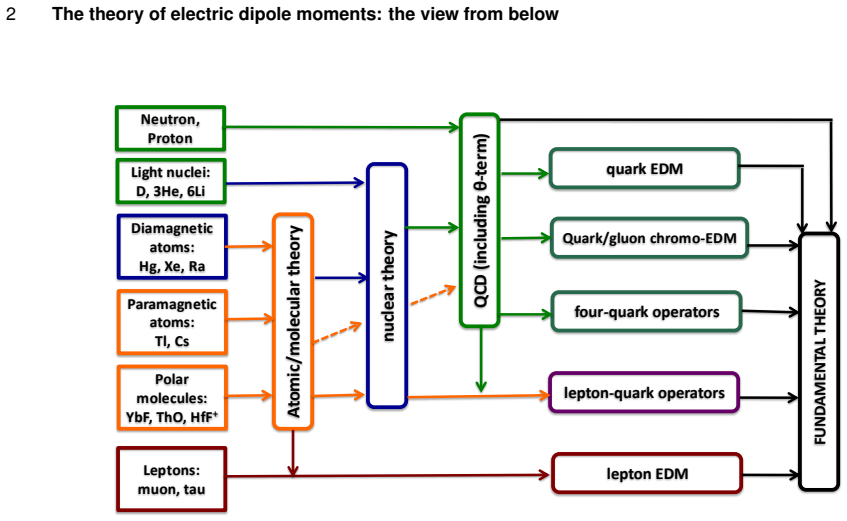
Starting from a general CP-odd effective Lagrangian at the quark-gluon level that includes the QCD theta term, quark EDMs and chromo-EDMs, the Weinberg operator, and CP-odd four-fermion interactions, chiral perturbation theory organizes the nonperturbative QCD dynamics into a small set of hadronic low-energy constants whose relative sizes are determined by the chiral representation of the underlying source. These hadronic interactions determine nuclear EDMs and Schiff moments, which enter atomic and molecular structure calculations that connect to experimentally accessible observables in diamagnetic and paramagnetic systems.
What carries the argument
Chiral perturbation theory applied to the CP-odd effective Lagrangian, which classifies each operator by its chiral transformation properties and thereby fixes the relative magnitudes of the resulting hadronic low-energy constants.
If this is right
- Different sources of CP violation generate distinct patterns of relative EDM sizes in the neutron, nuclei, and atoms.
- Paramagnetic systems acquire measurable sensitivity to hadronic CP violation in addition to their usual leptonic sensitivity.
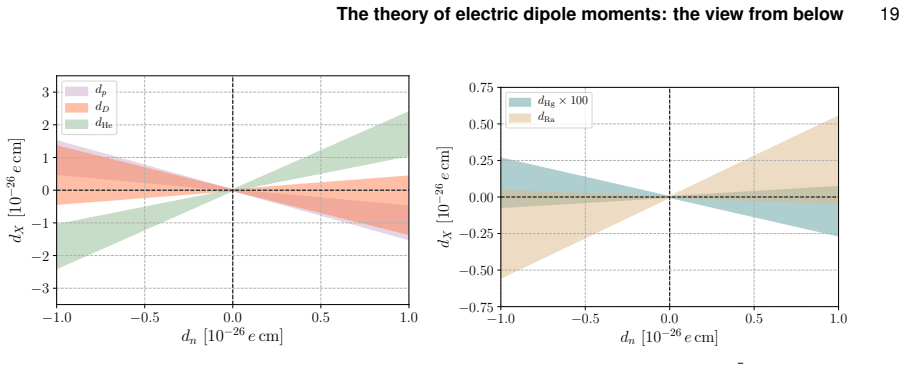
- Simultaneous measurements in multiple systems allow theory to disentangle which quark-gluon operator is responsible.
- The same hadronic constants also govern other low-energy observables tied to the strong CP problem.
Where Pith is reading between the lines
- The framework supplies concrete ratio predictions that future EDM experiments can test directly without new lattice input.
- Extensions to heavier nuclei would require additional lattice-QCD matching but would still obey the same chiral counting rules.
- The approach naturally connects EDM searches to other precision probes such as neutron electric dipole moment limits and rare meson decays.
Load-bearing premise
The listed operators at the quark-gluon level form a complete basis for all relevant CP-odd effects and their chiral representations fully fix the relative sizes of the hadronic constants they induce.
What would settle it
A set of EDM measurements across neutron, light nuclei, and both diamagnetic and paramagnetic atoms that cannot be reproduced by any linear combination of the hadronic constants with the chiral-symmetry-determined ratios.
Figures
read the original abstract
Permanent electric dipole moments (EDMs) of nucleons, nuclei, atoms, and molecules are among the most sensitive probes of CP violation beyond the Standard Model and are intimately connected to the strong CP problem and the origin of the matter-antimatter asymmetry of the universe. This review presents the theory of EDMs from the bottom up, tracing the chain of connections that links CP-violating interactions at level of elementary particles to observable EDMs across a wide range of systems. Starting from a general CP-odd effective Lagrangian at the quark-gluon level comprising the QCD theta term, quark EDMs and chromo-EDMs, the Weinberg operator, and CP-odd four-fermion interactions, I show how chiral perturbation theory organizes the nonperturbative QCD dynamics into a small set of hadronic low-energy constants, whose relative sizes are determined by the chiral representation of the underlying source. These hadronic interactions feed into calculations of nuclear EDMs and Schiff moments, which in turn enter atomic and molecular structure calculations that connect to experimentally accessible observables in diamagnetic and paramagnetic systems. Special attention is given to the recently identified sensitivity of paramagnetic systems to hadronic CP violation, which opens a new and relatively unexplored window on the quark-gluon sector. The complementarity of the full EDM portfolio including the neutron, light nuclei, atoms, and molecules, and the role of theory in disentangling the underlying source of CP violation is discussed throughout.
Editorial analysis
A structured set of objections, weighed in public.
Referee Report
Summary. The manuscript is a review that presents the theory of electric dipole moments from the bottom-up effective field theory perspective. It starts from a general CP-odd effective Lagrangian at the quark-gluon level that includes the QCD theta term, quark EDMs, chromo-EDMs, the Weinberg operator, and CP-odd four-fermion interactions. Chiral perturbation theory is used to match these operators onto a small set of hadronic low-energy constants whose relative sizes are fixed by the chiral representations of the sources. These hadronic operators are then connected through nuclear EDM and Schiff moment calculations to atomic and molecular structure factors, with explicit discussion of the sensitivity of paramagnetic systems to hadronic CP violation and the role of the full EDM portfolio in identifying the underlying source of CP violation.
Significance. If the review provides accurate syntheses of the standard EFT matching procedures and clear discussions of the complementarity between different EDM observables, it would be a useful reference for the EDM community. The bottom-up organization via chiral symmetry is the conventional framework in the literature, and the emphasis on paramagnetic systems as a relatively new probe of hadronic CP violation adds timely context. The value lies in the pedagogical tracing of the scale connections and in highlighting how theory helps disentangle contributions, rather than in new derivations.
minor comments (2)
- [Abstract] The abstract states that chiral representations determine the relative sizes of the hadronic constants, but a brief parenthetical example of one such representation (e.g., for the theta term versus a four-fermion operator) would help readers unfamiliar with the chiral counting.
- Ensure that the discussion of paramagnetic-system sensitivity includes explicit references to the most recent atomic-structure calculations that quantify the hadronic contribution, so that the claim of an 'unexplored window' is directly supported.
Simulated Author's Rebuttal
We thank the referee for their positive assessment of the manuscript and for recommending acceptance. The referee's summary correctly identifies the bottom-up EFT organization, the role of chiral perturbation theory, and the emphasis on paramagnetic systems as a probe of hadronic CP violation.
Circularity Check
No significant circularity identified
full rationale
The paper is a review summarizing the conventional bottom-up EFT construction for EDMs: a complete basis of CP-odd quark-gluon operators is matched via chiral perturbation theory onto hadronic operators whose structures are fixed by chiral symmetry. It cites external calculations for hadronic constants and structure factors rather than fitting parameters internally or reducing predictions to self-citations. No load-bearing step in the described chain (abstract and central claim) reduces by construction to its inputs; the derivation remains self-contained against external benchmarks.
Axiom & Free-Parameter Ledger
axioms (2)
- domain assumption The listed operators form a complete basis for CP-odd effects at the quark-gluon level
- domain assumption Chiral representations of the sources determine the relative sizes of hadronic low-energy constants
Reference graph
Works this paper leans on
-
[2]
author Abel C and et al. ( year 2020 ). title Measurement of the Permanent Electric Dipole Moment of the Neutron . journal Phys. Rev. Lett. volume 124 ( number 8 ): pages 081803 . doi doi:10.1103/PhysRevLett.124.081803 . 2001.11966 . Article
-
[13]
title CP Violating Effects in QCD
author Baluni V ( year 1979 ). title CP Violating Effects in QCD . journal Phys. Rev. D volume 19 : pages 2227--2230 . doi doi:10.1103/PhysRevD.19.2227 . Article
-
[18]
title Deuteron electric dipole moment from holographic QCD
author Bartolini L , author Bolognesi S and author Gudnason SB ( year 2020 ). title Deuteron electric dipole moment from holographic QCD . journal Phys. Rev. D volume 101 ( number 8 ): pages 086009 . doi doi:10.1103/PhysRevD.101.086009 . 1912.01641 . Article
-
[25]
title The Gluon Color - Electric Dipole Moment and Its Anomalous Dimension
author Braaten E , author Li CS and author Yuan TC ( year 1990 ). title The Gluon Color - Electric Dipole Moment and Its Anomalous Dimension . journal Phys. Rev. D volume 42 : pages 276--278 . doi doi:10.1103/PhysRevD.42.276 . Article
-
[29]
P- and T-Violating Lagrangians in Chiral Effective Field Theory and Nuclear Electric Dipole Moments
author Bsaisou J , author Mei ner UG , author Nogga A and author Wirzba A ( year 2015 b ). title P- and T-Violating Lagrangians in Chiral Effective Field Theory and Nuclear Electric Dipole Moments . journal Annals Phys. volume 359 : pages 317--370 . doi doi:10.1016/j.aop.2015.04.031 . 1412.5471 . Article
work page internal anchor Pith review Pith/arXiv arXiv doi:10.1016/j.aop.2015.04.031 2015
-
[42]
Parity- and Time-Reversal-Violating Form Factors of the Deuteron
author de Vries J , author Mereghetti E , author Timmermans RGE and author van Kolck U ( year 2011 b ). title Parity- and Time-Reversal-Violating Form Factors of the Deuteron . journal Phys. Rev. Lett. volume 107 : pages 091804 . doi doi:10.1103/PhysRevLett.107.091804 . 1102.4068 . Article
work page internal anchor Pith review Pith/arXiv arXiv doi:10.1103/physrevlett.107.091804 2011
-
[44]
The Effective Chiral Lagrangian From Dimension-Six Parity and Time-Reversal Violation
author de Vries J , author Mereghetti E , author Timmermans RGE and author van Kolck U ( year 2013 ). title The Effective Chiral Lagrangian From Dimension-Six Parity and Time-Reversal Violation . journal Annals Phys. volume 338 : pages 50--96 . doi doi:10.1016/j.aop.2013.05.022 . 1212.0990 . Article
work page internal anchor Pith review Pith/arXiv arXiv doi:10.1016/j.aop.2013.05.022 2013
-
[48]
title Two- and three-loop anomalous dimensions of Weinberg s dimension-six CP-odd gluonic operator
author de Vries J , author Falcioni G , author Herzog F and author Ruijl B ( year 2020 b ). title Two- and three-loop anomalous dimensions of Weinberg s dimension-six CP-odd gluonic operator . journal Phys. Rev. D volume 102 ( number 1 ): pages 016010 . doi doi:10.1103/PhysRevD.102.016010 . 1907.04923 . Article
-
[50]
title Renormalization of CP -violating nuclear forces
author de Vries J , author Gnech A and author Shain S ( year 2021 b ). title Renormalization of CP -violating nuclear forces . journal Phys. Rev. C volume 103 ( number 1 ): pages L012501 . doi doi:10.1103/PhysRevC.103.L012501 . 2007.04927 . Article
-
[71]
title On the Possibility to Study P Odd and T Odd Nuclear Forces in Atomic and Molecular Experiments
author Flambaum VV , author Khriplovich IB and author Sushkov OP ( year 1984 ). title On the Possibility to Study P Odd and T Odd Nuclear Forces in Atomic and Molecular Experiments . journal Sov. Phys. JETP volume 60 : pages 873 . Article
1984
-
[78]
title Parity and time-reversal violating nuclear forces with explicit -excitations
author Gandor L , author Krebs H and author Epelbaum E ( year 2024 ). title Parity and time-reversal violating nuclear forces with explicit -excitations . journal Eur. Phys. J. A volume 60 ( number 10 ): pages 211 . doi doi:10.1140/epja/s10050-024-01426-z . 2406.12980 . Article
-
[89]
title Parity non-conservation and electric dipole moments in cesium and thallium
author Hartley AC , author Lindroth E and author Martennsson-Pendrill AM ( year 1990 ). title Parity non-conservation and electric dipole moments in cesium and thallium . journal J. Phys. B volume 23 : pages 3417--3436 . Article
1990
-
[105]
$P$- and $T$-odd two-nucleon interaction and the deuteron electric dipole moment
author Liu CP and author Timmermans RGE ( year 2004 ). title P- and T-odd two-nucleon interaction and the deuteron electric dipole moment . journal Phys. Rev. C volume 70 : pages 055501 . doi doi:10.1103/PhysRevC.70.055501 . nucl-th/0408060 . Article
work page internal anchor Pith review Pith/arXiv arXiv doi:10.1103/physrevc.70.055501 2004
-
[110]
The Effective Chiral Lagrangian From the Theta Term
author Mereghetti E , author Hockings WH and author van Kolck U ( year 2010 ). title The Effective Chiral Lagrangian From the Theta Term . journal Annals Phys. volume 325 : pages 2363--2409 . doi doi:10.1016/j.aop.2010.03.005 . 1002.2391 . Article
work page internal anchor Pith review Pith/arXiv arXiv doi:10.1016/j.aop.2010.03.005 2010
-
[114]
title Renormalization-group equations of the LEFT at two loops: dimension-six operators
author Naterop L and author Stoffer P ( year 2026 ). title Renormalization-group equations of the LEFT at two loops: dimension-six operators . journal JHEP volume 02 : pages 016 . doi doi:10.1007/JHEP02(2026)016 . 2507.08926 . Article
-
[118]
Renormalization of One-Pion Exchange and Power Counting
author Nogga A , author Timmermans RGE and author van Kolck U ( year 2005 ). title Renormalization of one-pion exchange and power counting . journal Phys. Rev. C volume 72 : pages 054006 . doi doi:10.1103/PhysRevC.72.054006 . nucl-th/0506005 . Article
work page internal anchor Pith review Pith/arXiv arXiv doi:10.1103/physrevc.72.054006 2005
-
[121]
title CP Conservation in the Presence of Instantons
author Peccei RD and author Quinn HR ( year 1977 ). title CP Conservation in the Presence of Instantons . journal Phys. Rev. Lett. volume 38 : pages 1440--1443 . doi doi:10.1103/PhysRevLett.38.1440 . Article
-
[123]
Best Values for the CP-odd Meson-Nucleon Couplings from Supersymmetry
author Pospelov M ( year 2002 ). title Best values for the CP odd meson nucleon couplings from supersymmetry . journal Phys. Lett. B volume 530 : pages 123--128 . doi doi:10.1016/S0370-2693(02)01263-7 . hep-ph/0109044 . Article
work page internal anchor Pith review Pith/arXiv arXiv doi:10.1016/s0370-2693(02)01263-7 2002
-
[127]
title Electric Dipole Moments and New Physics 2509.23531
author Pospelov M and author Ritz A ( year 2025 ), month 9 . title Electric Dipole Moments and New Physics 2509.23531 . Article
-
[138]
title Parity Violation Effects in Diatomic Molecules
author Sushkov OP and author Flambaum VV ( year 1978 ). title Parity Violation Effects in Diatomic Molecules . journal Sov. Phys. JETP volume 48 : pages 608 . Article
1978
-
[139]
title Symmetry Breaking Through Bell-Jackiw Anomalies
author 't Hooft G ( year 1976 ). title Symmetry Breaking Through Bell-Jackiw Anomalies . journal Phys. Rev. Lett. volume 37 : pages 8--11 . doi doi:10.1103/PhysRevLett.37.8 . Article
-
[141]
title Bubble Trouble: a Review on Electroweak Baryogenesis
author van de Vis J , author de Vries J and author Postma M ( year 2026 ). title Bubble Trouble: a Review on Electroweak Baryogenesis . journal Prog. Part. Nucl. Phys. volume 150 : pages 104244 . doi doi:10.1016/j.ppnp.2026.104244 . 2508.09989 . Article
-
[146]
title Larger Higgs Exchange Terms in the Neutron Electric Dipole Moment
author Weinberg S ( year 1989 ). title Larger Higgs Exchange Terms in the Neutron Electric Dipole Moment . journal Phys. Rev. Lett. volume 63 : pages 2333 . doi doi:10.1103/PhysRevLett.63.2333 . Article
-
[158]
First Experimental Limit on the Permanent Electric Dipole Moment of the Deuteron
Andres, A. and others. First Experimental Limit on the Permanent Electric Dipole Moment of the Deuteron. 2026. arXiv:2602.20828
work page internal anchor Pith review Pith/arXiv arXiv 2026
-
[159]
Flambaum, V. V. and Khriplovich, I. B. and Sushkov, O. P. On the P and T Nonconserving Nuclear Moments. Nucl. Phys. A. 1986. doi:10.1016/0375-9474(86)90331-3
-
[160]
Dzuba, V. A. and Flambaum, V. V. and Ginges, J. S. M. and Kozlov, M. G. Electric dipole moments of Hg, Xe, Rn, Ra, Pu, and TlF induced by the nuclear Schiff moment and limits on time reversal violating interactions. Phys. Rev. A. 2002. doi:10.1103/PhysRevA.66.012111. arXiv:hep-ph/0203202
work page internal anchor Pith review Pith/arXiv arXiv doi:10.1103/physreva.66.012111 2002
-
[161]
Ginges, J. S. M. and Flambaum, V. V. Violations of fundamental symmetries in atoms and tests of unification theories of elementary particles. Phys. Rept. 2004. doi:10.1016/j.physrep.2004.03.005. arXiv:physics/0309054
work page internal anchor Pith review Pith/arXiv arXiv doi:10.1016/j.physrep.2004.03.005 2004
-
[162]
A Perturbative Calculation of the Electromagnetic Form Factors of the Deuteron
Kaplan, David B. and Savage, Martin J. and Wise, Mark B. A Perturbative calculation of the electromagnetic form-factors of the deuteron. Phys. Rev. C. 1999. doi:10.1103/PhysRevC.59.617. arXiv:nucl-th/9804032
work page internal anchor Pith review Pith/arXiv arXiv doi:10.1103/physrevc.59.617 1999
-
[163]
A New Expansion for Nucleon-Nucleon Interactions
Kaplan, David B. and Savage, Martin J. and Wise, Mark B. A New expansion for nucleon-nucleon interactions. Phys. Lett. B. 1998. doi:10.1016/S0370-2693(98)00210-X. arXiv:nucl-th/9801034
work page internal anchor Pith review Pith/arXiv arXiv doi:10.1016/s0370-2693(98)00210-x 1998
-
[164]
Nuclear electric dipole moment of three-body system
Song, Young-Ho and Lazauskas, Rimantas and Gudkov, Vladimir. Nuclear electric dipole moment of three-body systems. Phys. Rev. C. 2013. doi:10.1103/PhysRevC.87.015501. arXiv:1211.3762
work page internal anchor Pith review Pith/arXiv arXiv doi:10.1103/physrevc.87.015501 2013
-
[165]
The storage ring proton EDM experiment
Alexander, Jim and others. The storage ring proton EDM experiment. 2022. arXiv:2205.00830
-
[166]
Experimental search for electric dipole moments of light radioactive nuclei
Dutsov, Chavdar and Hume, Timothy and Pospelov, Maxim and Schmidt-Wellenburg, Philipp. Experimental search for electric dipole moments of light radioactive nuclei. Phys. Rev. D. 2025. doi:10.1103/hl5s-dqqw. arXiv:2506.13588
-
[167]
Yamaguchi, Yasuhiro and Yamanaka, Nodoka. Large long-distance contributions to the electric dipole moments of charged leptons in the standard model. Phys. Rev. Lett. 2020. doi:10.1103/PhysRevLett.125.241802. arXiv:2003.08195
-
[168]
Enhancement of the CP-odd effect in the nuclear electric dipole moment of $^6$Li
Yamanaka, Nodoka and Hiyama, Emiko. Enhancement of the CP-odd effect in the nuclear electric dipole moment of ^6 Li. Phys. Rev. C. 2015. doi:10.1103/PhysRevC.91.054005. arXiv:1503.04446
work page internal anchor Pith review Pith/arXiv arXiv doi:10.1103/physrevc.91.054005 2015
-
[169]
Electromagnetic Contributions to the Schiff Moment
Thomas, Scott D. Electromagnetic contributions to the Schiff moment. Phys. Rev. D. 1995. doi:10.1103/PhysRevD.51.3955. arXiv:hep-ph/9402237
work page internal anchor Pith review Pith/arXiv arXiv doi:10.1103/physrevd.51.3955 1995
-
[170]
Chiral Dynamics in Nucleons and Nuclei
Bernard, V. and Kaiser, Norbert and Meissner, Ulf-G. Chiral dynamics in nucleons and nuclei. Int. J. Mod. Phys. E. 1995. doi:10.1142/S0218301395000092. arXiv:hep-ph/9501384
work page internal anchor Pith review Pith/arXiv arXiv doi:10.1142/s0218301395000092 1995
-
[171]
Nuclear Schiff Moments and CP Violation
Engel, Jonathan. Nuclear Schiff Moments and CP Violation. Ann. Rev. Nucl. Part. Sci. 2025. doi:10.1146/annurev-nucl-121423-101030. arXiv:2501.02744
-
[172]
Flambaum, V. V. Spin hedgehog and collective magnetic quadrupole moments induced by parity and time invariance violating interaction. Phys. Lett. B. 1994. doi:10.1016/0370-2693(94)90646-7
-
[173]
Nuclear Octupole Correlations and the Enhancement of Atomic Time-Reversal Violation
Engel, J. and Friar, James Lewis and Hayes, A. C. Nuclear octupole correlations and the enhancement of atomic time reversal violation. Phys. Rev. C. 2000. doi:10.1103/PhysRevC.61.035502. arXiv:nucl-th/9910008
work page internal anchor Pith review Pith/arXiv arXiv doi:10.1103/physrevc.61.035502 2000
-
[174]
Schiff, L. I. Measurability of Nuclear Electric Dipole Moments. Phys. Rev. 1963. doi:10.1103/PhysRev.132.2194
-
[175]
Graner, B. and Chen, Y. and Lindahl, E. G. and Heckel, B. R. , journal =. Reduced Limit on the Permanent Electric Dipole Moment of ^. 2016 , month =. doi:10.1103/PhysRevLett.116.161601 , url =
-
[176]
Ab initio calculation of symmetry-breaking observables
Belley, A. and others. Ab initio calculation of symmetry-breaking observables. 2026. arXiv:2605.11353
work page internal anchor Pith review Pith/arXiv arXiv 2026
-
[177]
Nuclear Schiff Moment of the Fluorine Isotope F19
Ng, Kia Boon and Foster, Stephan and Cheng, Lan and Navratil, Petr and Malbrunot-Ettenauer, Stephan. Nuclear Schiff Moment of the Fluorine Isotope F19. Phys. Rev. Lett. 2026. doi:10.1103/m4fx-g1h6. arXiv:2507.19811
-
[178]
Ab initio calculations of electric dipole moments of light nuclei
Froese, Paul and Navratil, Petr. Ab initio calculations of electric dipole moments of light nuclei. Phys. Rev. C. 2021. doi:10.1103/PhysRevC.104.025502. arXiv:2103.06365
-
[179]
Nuclear electric dipole moment in the cluster model with a triton: ^7 Li and ^ 11 B
Yamanaka, Nodoka and Yamada, Taiichi and Funaki, Yasuro. Nuclear electric dipole moment in the cluster model with a triton: ^7 Li and ^ 11 B. Phys. Rev. C. 2019. doi:10.1103/PhysRevC.100.055501. arXiv:1907.08091
-
[180]
Review of the electric dipole moment of light nuclei
Yamanaka, Nodoka. Review of the electric dipole moment of light nuclei. Int. J. Mod. Phys. E. 2017. doi:10.1142/S0218301317300028. arXiv:1609.04759
work page internal anchor Pith review Pith/arXiv arXiv doi:10.1142/s0218301317300028 2017
-
[181]
Nuclear Alpha-Particle Condensates
Yamada, T. and Funaki, Y. and Horiuchi, H. and Roepke, G. and Schuck, P. and Tohsaki, A. Nuclear Alpha-Particle Condensates. Lect. Notes Phys. 2012. doi:10.1007/978-3-642-24707-1_5. arXiv:1103.3940
work page internal anchor Pith review Pith/arXiv arXiv doi:10.1007/978-3-642-24707-1_5 2012
-
[182]
Gnech, A. and Viviani, M. Time Reversal Violation in Light Nuclei. Phys. Rev. C. 2020. doi:10.1103/PhysRevC.101.024004. arXiv:1906.09021
-
[183]
Nuclear Electric Dipole Moment of 3He
Stetcu, I. and Liu, C. -P. and Friar, James Lewis and Hayes, A. C. and Navratil, P. Nuclear Electric Dipole Moment of He-3. Phys. Lett. B. 2008. doi:10.1016/j.physletb.2008.06.019. arXiv:0804.3815
work page internal anchor Pith review Pith/arXiv arXiv doi:10.1016/j.physletb.2008.06.019 2008
-
[184]
Khriplovich, I. B. and Korkin, R. A. P and T odd electromagnetic moments of deuteron in chiral limit. Nucl. Phys. A. 2000. doi:10.1016/S0375-9474(99)00403-0. arXiv:nucl-th/9904081
work page internal anchor Pith review Pith/arXiv arXiv doi:10.1016/s0375-9474(99)00403-0 2000
-
[185]
Nuclear Electric Dipole Moments in Chiral Effective Field Theory
Bsaisou, J. and de Vries, J. and Hanhart, C. and Liebig, S. and Meissner, Ulf-G. and Minossi, D. and Nogga, A. and Wirzba, A. Nuclear Electric Dipole Moments in Chiral Effective Field Theory. JHEP. 2015. doi:10.1007/JHEP03(2015)104. arXiv:1411.5804
work page internal anchor Pith review Pith/arXiv arXiv doi:10.1007/jhep03(2015)104 2015
-
[186]
The electric dipole moment of the deuteron from the QCD $\theta$-term
Bsaisou, J. and Hanhart, C. and Liebig, S. and Meissner, U. -G. and Nogga, A. and Wirzba, A. The electric dipole moment of the deuteron from the QCD -term. Eur. Phys. J. A. 2013. doi:10.1140/epja/i2013-13031-x. arXiv:1209.6306
work page internal anchor Pith review Pith/arXiv arXiv doi:10.1140/epja/i2013-13031-x 2013
-
[187]
Electric Dipole Moments of Light Nuclei From Chiral Effective Field Theory
de Vries, J. and Higa, R. and Liu, C. -P. and Mereghetti, E. and Stetcu, I. and Timmermans, R. G. E. and van Kolck, U. Electric Dipole Moments of Light Nuclei From Chiral Effective Field Theory. Phys. Rev. C. 2011. doi:10.1103/PhysRevC.84.065501. arXiv:1109.3604
work page internal anchor Pith review Pith/arXiv arXiv doi:10.1103/physrevc.84.065501 2011
-
[188]
Afnan, I. R. and Gibson, B. F. Model Dependence of the 2H Electric Dipole Moment. Phys. Rev. C. 2010. doi:10.1103/PhysRevC.82.064002. arXiv:1011.4968
work page internal anchor Pith review Pith/arXiv arXiv doi:10.1103/physrevc.82.064002 2010
-
[189]
Spevak, V. and Auerbach, N. Parity mixing and time reversal violation in nuclei with octupole deformations. Phys. Lett. B. 1995. doi:10.1016/0370-2693(95)01099-C
-
[190]
Standard Model Prediction for Paramagnetic Electric Dipole Moments
Ema, Yohei and Gao, Ting and Pospelov, Maxim. Standard Model Prediction for Paramagnetic Electric Dipole Moments. Phys. Rev. Lett. 2022. doi:10.1103/PhysRevLett.129.231801. arXiv:2202.10524
-
[191]
The phenomenology of electric dipole moments in models of scalar leptoquarks
Dekens, W. and de Vries, J. and Jung, M. and Vos, K. K. The phenomenology of electric dipole moments in models of scalar leptoquarks. JHEP. 2019. doi:10.1007/JHEP01(2019)069. arXiv:1809.09114
work page internal anchor Pith review Pith/arXiv arXiv doi:10.1007/jhep01(2019)069 2019
-
[192]
Yang, Zichao and Mereghetti, Emanuele and Platter, Lucas and Schindler, Matthias R. and Vanasse, Jared. Electric dipole moments of three-nucleon systems in the pionless effective field theory. Phys. Rev. C. 2021. doi:10.1103/PhysRevC.104.024002. arXiv:2011.01885
-
[193]
Boeschoten, A. and others. Statistics and systematics of electron EDM searches with BaF. Eur. Phys. J. D. 2026. doi:10.1140/epjd/s10053-026-01175-2. arXiv:2601.21781
-
[194]
Haase, Pi A. B. and Doeglas, Diewertje J. and Boeschoten, Alexander and Eliav, Ephraim and Iliaš, Miroslav and Aggarwal, Parul and Bethlem, H. L. and Borschevsky, Anastasia and Esajas, Kevin and Hao, Yongliang and Hoekstra, Steven and Marshall, Virginia R. and Meijknecht, Thomas B. and Mooij, Maarten C. and Steinebach, Kees and Timmermans, Rob G. E. and T...
-
[195]
CKM benchmarks for electron EDM experiments
Pospelov, Maxim and Ritz, Adam. CKM benchmarks for electron electric dipole moment experiments. Phys. Rev. D. 2014. doi:10.1103/PhysRevD.89.056006. arXiv:1311.5537
work page internal anchor Pith review Pith/arXiv arXiv doi:10.1103/physrevd.89.056006 2014
-
[196]
Hudson, J. J. and Kara, D. M. and Smallman, I. J. and Sauer, B. E. and Tarbutt, M. R. and Hinds, E. A. Improved measurement of the shape of the electron. Nature. 2011. doi:10.1038/nature10104
- [197]
-
[198]
Allmendinger, F. and Engin, I. and Heil, W. and Karpuk, S. and Krause, H.-J. and Niederl\"ander, B. and Offenh\"ausser, A. and Repetto, M. and Schmidt, U. and Zimmer, S. , journal =. Measurement of the permanent electric dipole moment of the ^. 2019 , month =. doi:10.1103/PhysRevA.100.022505 , url =
-
[199]
A new leading contribution to neutrinoless double-beta decay
Cirigliano, Vincenzo and Dekens, Wouter and De Vries, Jordy and Graesser, Michael L. and Mereghetti, Emanuele and Pastore, Saori and Van Kolck, Ubirajara. New Leading Contribution to Neutrinoless Double- Decay. Phys. Rev. Lett. 2018. doi:10.1103/PhysRevLett.120.202001. arXiv:1802.10097
work page internal anchor Pith review Pith/arXiv arXiv doi:10.1103/physrevlett.120.202001 2018
-
[200]
Naturalness in nuclear effective field theories
van Kolck, U. Naturalness in nuclear effective field theories. Eur. Phys. J. A. 2020. doi:10.1140/epja/s10050-020-00092-1. arXiv:2003.09974
-
[201]
Neutron EDM from Electric and Chromoelectric Dipole Moments of Quarks
Pospelov, Maxim and Ritz, Adam. Neutron EDM from electric and chromoelectric dipole moments of quarks. Phys. Rev. D. 2001. doi:10.1103/PhysRevD.63.073015. arXiv:hep-ph/0010037
work page internal anchor Pith review Pith/arXiv arXiv doi:10.1103/physrevd.63.073015 2001
-
[202]
Reevaluation of Neutron Electric Dipole Moment with QCD Sum Rules
Hisano, Junji and Lee, Jeong Yong and Nagata, Natsumi and Shimizu, Yasuhiro. Reevaluation of Neutron Electric Dipole Moment with QCD Sum Rules. Phys. Rev. D. 2012. doi:10.1103/PhysRevD.85.114044. arXiv:1204.2653
work page internal anchor Pith review Pith/arXiv arXiv doi:10.1103/physrevd.85.114044 2012
-
[203]
The electric dipole moment of the neutron in chiral perturbation theory
Borasoy, B. The Electric dipole moment of the neutron in chiral perturbation theory. Phys. Rev. D. 2000. doi:10.1103/PhysRevD.61.114017. arXiv:hep-ph/0004011
work page internal anchor Pith review Pith/arXiv arXiv doi:10.1103/physrevd.61.114017 2000
-
[204]
The Electric Dipole Moment of the Nucleons in Holographic QCD
Hong, Deog Ki and Kim, Hyun-Chul and Siwach, Sanjay and Yee, Ho-Ung. The Electric Dipole Moment of the Nucleons in Holographic QCD. JHEP. 2007. doi:10.1088/1126-6708/2007/11/036. arXiv:0709.0314
work page internal anchor Pith review Pith/arXiv arXiv doi:10.1088/1126-6708/2007/11/036 2007
-
[205]
Andreev, V. and others. Improved limit on the electric dipole moment of the electron. Nature. 2018. doi:10.1038/s41586-018-0599-8
-
[206]
Skripnikov, L. V. Communication: Theoretical study of HfF+ cation to search for the T,P-odd interactions. J. Chem. Phys. 2017. doi:10.1063/1.4993622
-
[207]
Roussy, Tanya S. and others. An improved bound on the electron s electric dipole moment. Science. 2023. doi:10.1126/science.adg4084. arXiv:2212.11841
-
[208]
Flambaum, V. V. and Pospelov, M. and Ritz, A. and Stadnik, Y. V. Sensitivity of EDM experiments in paramagnetic atoms and molecules to hadronic CP violation. Phys. Rev. D. 2020. doi:10.1103/PhysRevD.102.035001. arXiv:1912.13129
-
[209]
Probing the QCD term with paramagnetic molecules
Mulder, Heleen and Timmermans, Rob and de Vries, Jordy. Probing the QCD term with paramagnetic molecules. JHEP. 2025. doi:10.1007/JHEP07(2025)232. arXiv:2502.06406
-
[210]
Nucleon Electric Dipole Moments in Paramagnetic Molecules through Effective Field Theory
Dekens, Wouter and de Vries, Jordy and Gialidi, Lemonia and Men \'e ndez, Javier and Mulder, Heleen and Romeo, Beatriz. Nucleon Electric Dipole Moments in Paramagnetic Molecules through Effective Field Theory. Phys. Rev. Lett. 2026. doi:10.1103/5rpp-f6h4. arXiv:2510.14933
work page internal anchor Pith review Pith/arXiv arXiv doi:10.1103/5rpp-f6h4 2026
-
[211]
Porsev, S. G. and Safronova, M. S. and Kozlov, M. G. Electric dipole moment enhancement factor of thallium. Phys. Rev. Lett. 2012. doi:10.1103/PhysRevLett.108.173001. arXiv:1201.5615
work page internal anchor Pith review Pith/arXiv arXiv doi:10.1103/physrevlett.108.173001 2012
-
[212]
and Lindroth, Eva and Martennsson-Pendrill, Ann-Marie
Hartley, Adam C. and Lindroth, Eva and Martennsson-Pendrill, Ann-Marie. Parity non-conservation and electric dipole moments in cesium and thallium. J. Phys. B. 1990
1990
-
[213]
Sushkov, O. P. and Flambaum, V. V. Parity Violation Effects in Diatomic Molecules. Sov. Phys. JETP. 1978
1978
-
[214]
Sandars, P. G. H. The electric dipole moment of an atom. Phys. Lett. 1965. doi:10.1016/0031-9163(65)90583-4
discussion (0)
Sign in with ORCID, Apple, or X to comment. Anyone can read and Pith papers without signing in.