CHEOPS observations of V1298 Tau: updated planetary densities and implications on the early evolution of the young system
Pith reviewed 2026-07-03 00:39 UTC · model grok-4.3
The pith
New CHEOPS radii show the innermost planet in young V1298 Tau is denser than the outermost at 3.4 sigma with no mean-motion resonance trapping.
A machine-rendered reading of the paper's core claim, the machinery that carries it, and where it could break.
Core claim
CHEOPS photometry revises the radii of planets b, c, and d, yielding densities that place planet c 3.4 sigma denser than the outermost planet while the three outer planets remain consistent; resonance and NAMD calculations within the explored simulation range show no trapping or requirement for past dynamical excitation.
What carries the argument
Improved radius ratios from CHEOPS light curves combined with fixed TTV masses to compute bulk densities, followed by N-body simulations and normalized angular momentum deficit to diagnose the dynamical state.
If this is right
- Envelope mass fractions differ across the planets, pointing to differential atmospheric loss in the first 10-30 Myr.
- The present orbital configuration is consistent with no mean-motion resonance trapping today.
- Low NAMD values indicate the architecture can arise without earlier dynamical excitation.
- Density ordering may trace varying retention of primordial envelopes during early evolution.
Where Pith is reading between the lines
- Future mass measurements independent of TTV could test whether the reported density gradient persists once activity-induced systematics are fully quantified.
- The lack of resonance trapping in this young system may constrain the timing of any migration that occurred before the gas disk dispersed.
- Similar density gradients in other young multiplanet systems could be searched for with CHEOPS or PLATO to see if differential envelope loss is common.
Load-bearing premise
Planetary masses from earlier TTV work are used without re-derivation or full propagation of possible systematic errors from stellar activity.
What would settle it
An independent mass or radius measurement for planet c that removes the 3.4-sigma density difference with the outermost planet.
Figures
read the original abstract
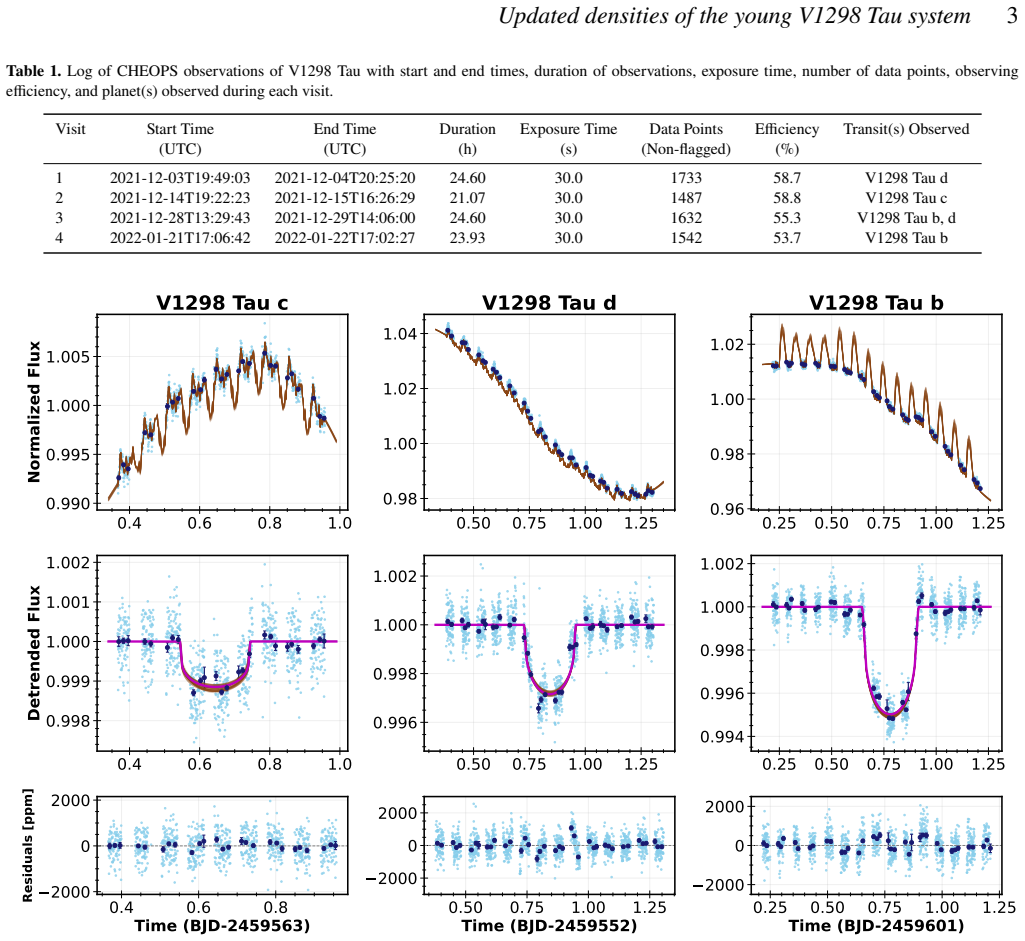
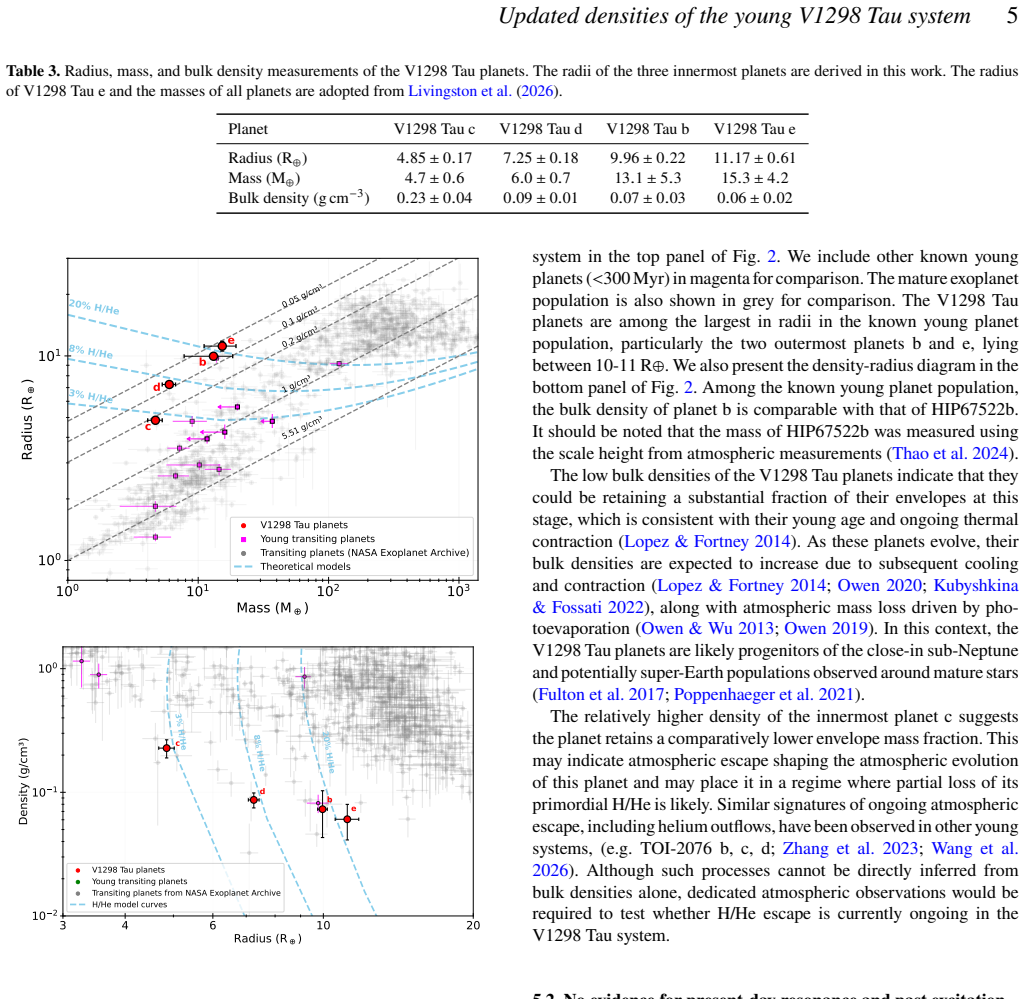
The young (10-30 Myr) multi-planet system V1298 Tau presents a unique opportunity to probe the early formation and evolution of young systems. We present new CHEOPS observations of the three innermost planets, yielding high-precision planetary radii ($\sim$5-11 $R_\oplus$ ) and improving the radius ratios (Rp/Rs) by 30-71% compared to previous multiple TESS observations. Combined with refined period and mass determinations from transit-timing variation (TTV) measurements, we derive revised bulk densities (0.06-0.23 g/cm$^3$) for these planets. We find that the innermost planet c is denser compared to the outermost planet at the 3.4-$\sigma$ level, while the bulk densities of the three outermost planets are consistent within the reported uncertainties. These bulk densities suggest differing envelope mass fraction across the system, indicating differential atmospheric evolution in the young system. We further assess the early dynamical state of the V1298 Tau system and find that within the range of simulations performed we find no evidence for present-day mean-motion resonance trapping. As an independent diagnostic, we compute the forced eccentricities and low Normalized Angular Momentum Deficit (NAMD) exhibited by the system. Our simulations suggest that no past dynamical excitation is required to explain the present orbital architecture.
Editorial analysis
A structured set of objections, weighed in public.
Referee Report
Summary. The manuscript reports new CHEOPS photometry for the three innermost planets in the young (10-30 Myr) V1298 Tau system. These data improve the radius ratios Rp/Rs by 30-71% relative to prior TESS observations, yielding planetary radii of ~5-11 R⊕. Combined with TTV-derived periods and masses, the authors compute revised bulk densities (0.06-0.23 g cm⁻³) and report that the innermost planet c is denser than the outermost planet at the 3.4-σ level while the three outermost planets have consistent densities. The density differences are interpreted as evidence for differential envelope mass fractions and atmospheric evolution. Dynamically, the authors find no evidence for present-day mean-motion resonance trapping within their simulation suite, report low normalized angular momentum deficit (NAMD), and conclude that no past dynamical excitation is required to explain the current architecture.
Significance. If the reported density contrast and dynamical conclusions hold after full propagation of mass uncertainties, the work supplies direct observational constraints on early atmospheric evolution in a multi-planet system and on the prevalence of resonance trapping at young ages. The new high-precision CHEOPS radii constitute a clear observational advance; the dynamical diagnostics (NAMD and forced eccentricities) are independent of the density results and add value.
major comments (1)
- [Abstract] Abstract: The 3.4-σ density contrast between planet c and the outermost planet is obtained by combining the new radii with masses taken directly from prior TTV analyses. No re-derivation of the TTV solution is described, and no additional systematic error floor is introduced to account for possible correlated timing noise from the high stellar activity expected at 10-30 Myr. Because bulk density scales linearly with mass, any unaccounted 15-30 % systematic in the TTV masses directly scales both the density ratio and its quoted significance; the central claim therefore inherits the completeness of the original TTV error budget without re-examination.
Simulated Author's Rebuttal
We thank the referee for their careful review and constructive feedback on our manuscript. We address the major comment below, outlining our response and planned revisions.
read point-by-point responses
-
Referee: The 3.4-σ density contrast between planet c and the outermost planet is obtained by combining the new radii with masses taken directly from prior TTV analyses. No re-derivation of the TTV solution is described, and no additional systematic error floor is introduced to account for possible correlated timing noise from the high stellar activity expected at 10-30 Myr. Because bulk density scales linearly with mass, any unaccounted 15-30 % systematic in the TTV masses directly scales both the density ratio and its quoted significance; the central claim therefore inherits the completeness of the original TTV error budget without re-examination.
Authors: We thank the referee for this important observation. The masses (and their uncertainties) are indeed adopted directly from the published TTV analysis of the system without a new joint re-derivation in the present work; the manuscript text will be revised to state this explicitly and to cite the source paper more clearly in the abstract and methods. The original TTV study incorporated timing uncertainties derived from TESS photometry, which already includes some contribution from stellar variability. Nevertheless, we agree that an additional systematic floor for correlated activity noise at the young stellar age is a reasonable concern that was not re-examined here. In the revised manuscript we will (i) add an explicit statement that the quoted 3.4-σ significance assumes the published mass uncertainties are complete, and (ii) include a sensitivity test in which the mass uncertainties are inflated by 15–30 % before recomputing the density ratio and its significance. The outcome of this test will be reported so that readers can assess the robustness of the central claim. revision: yes
Circularity Check
New CHEOPS radii + external TTV masses; densities computed directly with no internal reduction to fitted inputs
full rationale
The derivation chain adds independent CHEOPS radius measurements to masses and periods taken from prior TTV analyses (cited as external inputs). Bulk densities follow from the standard formula ρ = 3M/(4πR³) with no re-fitting or re-derivation of masses inside this work. The 3.4σ density contrast is a direct statistical comparison of the resulting values. No equation or claim reduces by construction to a self-fit, self-definition, or load-bearing self-citation chain; the TTV masses remain externally falsifiable. This is the normal case of combining new data with literature values and receives the default low circularity score.
Axiom & Free-Parameter Ledger
axioms (1)
- domain assumption Transit timing variation masses from prior literature are accurate and free of significant unaccounted systematics due to stellar activity.
Reference graph
Works this paper leans on
-
[1]
Resonant Repulsion of Kepler Planet Pairs
Resonant Repulsion of Kepler Planet Pairs. , keywords =. doi:10.1088/2041-8205/756/1/L11 , archivePrefix =. 1204.2555 , primaryClass =
work page internal anchor Pith review Pith/arXiv arXiv doi:10.1088/2041-8205/756/1/l11 2041
-
[2]
Understanding the Mass-Radius Relation for Sub-Neptunes: Radius as a Proxy for Composition
Understanding the Mass-Radius Relation for Sub-neptunes: Radius as a Proxy for Composition. , keywords =. doi:10.1088/0004-637X/792/1/1 , archivePrefix =. 1311.0329 , primaryClass =
work page internal anchor Pith review Pith/arXiv arXiv doi:10.1088/0004-637x/792/1/1
-
[3]
Detection of Atmospheric Escape from Four Young Mini-Neptunes. , keywords =. doi:10.3847/1538-3881/aca75b , archivePrefix =. 2207.13099 , primaryClass =
-
[4]
An adolescent and near-resonant planetary system near the end of photoevaporation. Nature Astronomy , keywords =. doi:10.1038/s41550-026-02795-9 , archivePrefix =. 2603.02550 , primaryClass =
-
[5]
The Featherweight Giant: Unraveling the Atmosphere of a 17 Myr Planet with JWST. , keywords =. doi:10.3847/1538-3881/ad81d7 , archivePrefix =. 2409.16355 , primaryClass =
-
[6]
Kepler planets: a tale of evaporation
Kepler Planets: A Tale of Evaporation. , keywords =. doi:10.1088/0004-637X/775/2/105 , archivePrefix =. 1303.3899 , primaryClass =
work page internal anchor Pith review Pith/arXiv arXiv doi:10.1088/0004-637x/775/2/105
-
[7]
Atmospheric Escape and the Evolution of Close-in Exoplanets
Atmospheric Escape and the Evolution of Close-In Exoplanets. Annual Review of Earth and Planetary Sciences , keywords =. doi:10.1146/annurev-earth-053018-060246 , archivePrefix =. 1807.07609 , primaryClass =
work page internal anchor Pith review Pith/arXiv arXiv doi:10.1146/annurev-earth-053018-060246
-
[8]
The California-Kepler Survey. III. A Gap in the Radius Distribution of Small Planets. , keywords =. doi:10.3847/1538-3881/aa80eb , archivePrefix =. 1703.10375 , primaryClass =
work page internal anchor Pith review Pith/arXiv arXiv doi:10.3847/1538-3881/aa80eb
-
[9]
X-ray irradiation and evaporation of the four young planets around V1298 Tau. , keywords =. doi:10.1093/mnras/staa1462 , archivePrefix =. 2005.10240 , primaryClass =
-
[10]
Updated Planetary Mass Constraints of the Young V1298 Tau System Using MAROON-X. , keywords =. doi:10.3847/1538-3881/acc865 , archivePrefix =. 2304.00797 , primaryClass =
-
[11]
V1298 Tau with TESS: Updated Ephemerides, Radii, and Period Constraints from a Second Transit of V1298 Tau e. , keywords =. doi:10.3847/2041-8213/ac4745 , archivePrefix =. 2111.08660 , primaryClass =
-
[12]
Four Newborn Planets Transiting the Young Solar Analog V1298 Tau. , keywords =. doi:10.3847/2041-8213/ab4c99 , archivePrefix =. 1910.04563 , primaryClass =
-
[13]
A Warm Jupiter-sized Planet Transiting the Pre-main-sequence Star V1298 Tau. , keywords =. doi:10.3847/1538-3881/ab290f , archivePrefix =. 1902.09670 , primaryClass =
-
[14]
Photometric follow-up of the 20 Myr old multi-planet host star V1298 Tau with CHEOPS and ground-based telescopes. , keywords =. doi:10.1051/0004-6361/202346840 , archivePrefix =. 2309.14131 , primaryClass =
-
[15]
TESS Hunt for Young and Maturing Exoplanets (THYME). IV. Three Small Planets Orbiting a 120 Myr Old Star in the Pisces-Eridanus Stream. , keywords =. doi:10.3847/1538-3881/abccc6 , archivePrefix =. 2102.06049 , primaryClass =
-
[16]
A possibly inflated planet around the bright young star DS Tucanae A. , keywords =. doi:10.1051/0004-6361/201935598 , archivePrefix =. 1904.01591 , primaryClass =
-
[17]
Characterization of exoplanets from their formation. II. The planetary mass-radius relationship. , keywords =. doi:10.1051/0004-6361/201118464 , archivePrefix =. 1206.3303 , primaryClass =
work page internal anchor Pith review Pith/arXiv arXiv doi:10.1051/0004-6361/201118464
-
[18]
A planet within the debris disk around the pre-main-sequence star AU Microscopii. , keywords =. doi:10.1038/s41586-020-2400-z , archivePrefix =. 2006.13248 , primaryClass =
-
[19]
Planetary Radii across Five Orders of Magnitude in Mass and Stellar Insolation: Application to Transits. , keywords =. doi:10.1086/512120 , archivePrefix =. astro-ph/0612671 , primaryClass =
work page internal anchor Pith review Pith/arXiv arXiv doi:10.1086/512120
-
[20]
Structure and evolution of super-Earth to super-Jupiter exoplanets. I. Heavy element enrichment in the interior. , keywords =. doi:10.1051/0004-6361:20079321 , archivePrefix =. 0802.1810 , primaryClass =
work page internal anchor Pith review Pith/arXiv arXiv doi:10.1051/0004-6361:20079321
-
[21]
Make Super-Earths, Not Jupiters: Accreting Nebular Gas onto Solid Cores at 0.1 AU and Beyond
Make Super-Earths, Not Jupiters: Accreting Nebular Gas onto Solid Cores at 0.1 AU and Beyond. , keywords =. doi:10.1088/0004-637X/797/2/95 , archivePrefix =. 1409.3578 , primaryClass =
work page internal anchor Pith review Pith/arXiv arXiv doi:10.1088/0004-637x/797/2/95
-
[22]
Breeding Super-Earths and Birthing Super-Puffs in Transitional Disks
Breeding Super-Earths and Birthing Super-puffs in Transitional Disks. , keywords =. doi:10.3847/0004-637X/817/2/90 , archivePrefix =. 1510.08855 , primaryClass =
work page internal anchor Pith review Pith/arXiv arXiv doi:10.3847/0004-637x/817/2/90
-
[23]
Constraining the entropy of formation from young transiting planets. , keywords =. doi:10.1093/mnras/staa2784 , archivePrefix =. 2009.03919 , primaryClass =
-
[24]
Monthly Notices of the Royal Astronomical Society , author=
Analysis of Early Science observations with the CHaracterising ExOPlanets Satellite (CHEOPS) using pycheops , volume=. Monthly Notices of the Royal Astronomical Society , author=. 2022 , month=. doi:10.1093/mnras/stab3371 , abstractNote=
-
[25]
Data reduction pipeline: architecture and simulated performances , volume=
Expected performances of the Characterising Exoplanet Satellite (CHEOPS): III. Data reduction pipeline: architecture and simulated performances , volume=. Astronomy & Astrophysics , author=. 2020 , month=. doi:10.1051/0004-6361/201936325 , abstractNote=
-
[26]
Experimental Astronomy , keywords =
The CHEOPS mission. Experimental Astronomy , keywords =. doi:10.1007/s10686-020-09679-4 , archivePrefix =. 2009.11633 , primaryClass =
-
[27]
PIPE: Extracting PSF photometry from CHEOPS data
-
[28]
On detecting terrestrial planets with timing of giant planet transits. , keywords =. doi:10.1111/j.1365-2966.2005.08922.x , adsurl =
-
[29]
The GAPS programme at TNG. XLVIII. The unusual formation history of V1298 Tau. , keywords =. doi:10.1051/0004-6361/202244752 , adsurl =
-
[30]
Rapid contraction of giant planets orbiting the 20-million-year-old star V1298 Tau. Nature Astronomy , keywords =. doi:10.1038/s41550-021-01533-7 , archivePrefix =. 2111.09193 , primaryClass =
-
[31]
Stability Constrained Characterization of the 23 Myr Old V1298 Tau System: Do Young Planets Form in Mean Motion Resonance Chains?. , keywords =. doi:10.3847/2041-8213/ac70e0 , archivePrefix =. 2203.02805 , primaryClass =
-
[32]
New Constraints on the Future Evaporation of the Young Exoplanets in the V1298 Tau System. , keywords =. doi:10.3847/1538-4357/ac4040 , archivePrefix =. 2112.03739 , primaryClass =
-
[33]
, keywords =
Tidal evolution in close binary systems. , keywords =
-
[34]
Tidal evolution of hierarchical and inclined systems
Tidal evolution of hierarchical and inclined systems. Celestial Mechanics and Dynamical Astronomy , keywords =. doi:10.1007/s10569-011-9368-9 , archivePrefix =. 1107.0736 , primaryClass =
work page internal anchor Pith review Pith/arXiv arXiv doi:10.1007/s10569-011-9368-9
-
[35]
Updating the theoretical tidal evolution constants: Apsidal motion and the moment of inertia. , keywords =. doi:10.1051/0004-6361/201936007 , archivePrefix =. 1907.11538 , primaryClass =
-
[36]
Dynamics of Planetary Systems
-
[37]
Tidal dissipation within hot Jupiters: a new appraisal
Tidal dissipation within hot Jupiters: a new appraisal. , keywords =. doi:10.1051/0004-6361:20066487 , archivePrefix =. astro-ph/0612044 , primaryClass =
work page internal anchor Pith review Pith/arXiv arXiv doi:10.1051/0004-6361:20066487
-
[38]
The Prevalence of Resonance Among Young, Close-in Planets. , keywords =. doi:10.3847/1538-3881/ad83a6 , archivePrefix =. 2406.06885 , primaryClass =
-
[39]
The formation of the TRAPPIST-1 system in two steps during the recession of the disk inner edge. Nature Astronomy , keywords =. doi:10.1038/s41550-024-02342-4 , archivePrefix =. 2406.08677 , primaryClass =
-
[40]
Constraining Tidal Dissipation in Stars from The Destruction Rates of Exoplanets
Constraining Tidal Dissipation in Stars from the Destruction Rates of Exoplanets. , keywords =. doi:10.1088/0004-637X/751/2/96 , archivePrefix =. 1205.1803 , primaryClass =
work page internal anchor Pith review Pith/arXiv arXiv doi:10.1088/0004-637x/751/2/96
-
[41]
Dynamical evolution of the Uranian satellite system I.: From the 5/3 Ariel Umbriel mean motion resonance to the present. , keywords =. doi:10.1016/j.icarus.2024.116282 , archivePrefix =. 2403.17896 , primaryClass =
-
[42]
Celestial Mechanics and Dynamical Astronomy , keywords =
Tidal evolution for any rheological model using a vectorial approach expressed in Hansen coefficients. Celestial Mechanics and Dynamical Astronomy , keywords =. doi:10.1007/s10569-022-10079-3 , archivePrefix =. 2306.03449 , primaryClass =
-
[43]
Deformation and tidal evolution of close-in planets and satellites using a Maxwell viscoelastic rheology. , keywords =. doi:10.1051/0004-6361/201424211 , archivePrefix =. 1411.1860 , primaryClass =
work page internal anchor Pith review Pith/arXiv arXiv doi:10.1051/0004-6361/201424211
-
[44]
Planetary migration and the origin of the 2:1 and 3:2 (near)-resonant population of close-in exoplanets. , keywords =. doi:10.1051/0004-6361/201629642 , archivePrefix =. 1704.06459 , primaryClass =
work page internal anchor Pith review Pith/arXiv arXiv doi:10.1051/0004-6361/201629642
-
[45]
doi:10.1017/CBO9781139174817 , adsurl =
Solar System Dynamics. doi:10.1017/CBO9781139174817 , adsurl =
-
[46]
Journal of Geophysical Research: Solid Earth , volume =
Kushiro, Ikuo , title =. Journal of Geophysical Research: Solid Earth , volume =. doi:https://doi.org/10.1029/JB091iB09p09343 , url =. https://agupubs.onlinelibrary.wiley.com/doi/pdf/10.1029/JB091iB09p09343 , abstract =
-
[47]
Ab Initio Simulations for Material Properties along the Jupiter Adiabat. , keywords =. doi:10.1088/0067-0049/202/1/5 , adsurl =
-
[48]
Determination of the Interior Structure of Transiting Planets in Multiple-Planet Systems
Determination of the Interior Structure of Transiting Planets in Multiple-Planet Systems. , keywords =. doi:10.1088/0004-637X/704/1/L49 , archivePrefix =. 0907.5019 , primaryClass =
work page internal anchor Pith review Pith/arXiv arXiv doi:10.1088/0004-637x/704/1/l49
-
[49]
The GAPS Programme with HARPS-N at TNG . XIV. Investigating giant planet migration history via improved eccentricity and mass determination for 231 transiting planets. , keywords =. doi:10.1051/0004-6361/201629882 , archivePrefix =. 1704.00373 , primaryClass =
work page internal anchor Pith review Pith/arXiv arXiv doi:10.1051/0004-6361/201629882
-
[50]
Tidal response of rocky and ice-rich exoplanets. , keywords =. doi:10.1051/0004-6361/201935297 , adsurl =
-
[51]
Love numbers for Io with a magma ocean. , keywords =. doi:10.1016/j.icarus.2025.116567 , adsurl =
-
[52]
, year = 2009, month = jun, volume =
Strong tidal dissipation in Io and Jupiter from astrometric observations. , year = 2009, month = jun, volume =. doi:10.1038/nature08108 , adsurl =
-
[53]
The K2 Mission: Characterization and Early results
The K2 Mission: Characterization and Early Results. , keywords =. doi:10.1086/676406 , archivePrefix =. 1402.5163 , primaryClass =
work page internal anchor Pith review Pith/arXiv arXiv doi:10.1086/676406
-
[54]
Monthly Notices of the Royal Astronomical Society , author =
Monitoring the young planet host. Monthly Notices of the Royal Astronomical Society , author =. 2023 , note =. doi:10.1093/mnras/stad3012 , abstract =
-
[55]
Breaking the chains: hot super-Earth systems from migration and disruption of compact resonant chains. , keywords =. doi:10.1093/mnras/stx1232 , archivePrefix =. 1703.03634 , primaryClass =
work page internal anchor Pith review Pith/arXiv arXiv doi:10.1093/mnras/stx1232
-
[56]
Hot super-Earth systems from breaking compact resonant chains
Formation of planetary systems by pebble accretion and migration. Hot super-Earth systems from breaking compact resonant chains. , keywords =. doi:10.1051/0004-6361/201935336 , archivePrefix =. 1902.08772 , primaryClass =
-
[57]
The metal-poor atmosphere of a potential sub-Neptune progenitor. Nature Astronomy , keywords =. doi:10.1038/s41550-024-02257-0 , archivePrefix =. 2312.16924 , primaryClass =
-
[58]
First comparative exoplanetology within a transiting multi-planet system: Comparing the atmospheres of V1298 Tau b and c. , keywords =. doi:10.1051/0004-6361/202451127 , archivePrefix =. 2407.14995 , primaryClass =
-
[59]
A Metal-poor Atmosphere with a Hot Interior for a Young Sub-Neptune Progenitor: JWST/NIRSpec Transmission Spectrum of V1298 Tau b. , keywords =. doi:10.3847/1538-3881/adec89 , archivePrefix =. 2507.08837 , primaryClass =
-
[60]
A young progenitor for the most common planetary systems in the Galaxy , volume=. Nature , author=. 2026 , month=jan, pages=. doi:10.1038/s41586-025-09840-z , abstractNote=
-
[61]
The Role of Magnetospheric Rebound in Breaking Resonant Chains of Super-Earths and Mini-Neptunes. arXiv e-prints , keywords =. doi:10.48550/arXiv.2509.07866 , archivePrefix =. 2509.07866 , primaryClass =
-
[62]
Disk Frequencies and Lifetimes in Young Clusters
Disk Frequencies and Lifetimes in Young Clusters. , keywords =. doi:10.1086/320685 , archivePrefix =. astro-ph/0104347 , primaryClass =
work page internal anchor Pith review Pith/arXiv arXiv doi:10.1086/320685
-
[63]
Initial Conditions of Planet Formation: Lifetimes of Primordial Disks
Initial Conditions of Planet Formation: Lifetimes of Primordial Disks. Exoplanets and Disks: Their Formation and Diversity , year = 2009, editor =. doi:10.1063/1.3215910 , archivePrefix =. 0906.5011 , primaryClass =
work page internal anchor Pith review Pith/arXiv arXiv doi:10.1063/1.3215910 2009
-
[64]
Overstable Librations can account for the Paucity of Mean Motion Resonances among Exoplanet Pairs
Overstable Librations can Account for the Paucity of Mean Motion Resonances among Exoplanet Pairs. , keywords =. doi:10.1088/0004-6256/147/2/32 , archivePrefix =. 1308.4688 , primaryClass =
work page internal anchor Pith review Pith/arXiv arXiv doi:10.1088/0004-6256/147/2/32
-
[65]
Dissipation in planar resonant planetary systems
Dissipation in planar resonant planetary systems. , keywords =. doi:10.1051/0004-6361/201220001 , archivePrefix =. 1207.3171 , primaryClass =
work page internal anchor Pith review Pith/arXiv arXiv doi:10.1051/0004-6361/201220001
-
[66]
Resonance breaking due to dissipation in planar planetary systems
Resonance breaking due to dissipation in planar planetary systems. , keywords =. doi:10.1051/0004-6361/201423676 , archivePrefix =. 1404.4861 , primaryClass =
work page internal anchor Pith review Pith/arXiv arXiv doi:10.1051/0004-6361/201423676
-
[67]
Analytical model of multi-planetary resonant chains and constraints on migration scenarios
Analytical model of multi-planetary resonant chains and constraints on migration scenarios. , keywords =. doi:10.1051/0004-6361/201730857 , archivePrefix =. 1706.09613 , primaryClass =
work page internal anchor Pith review Pith/arXiv arXiv doi:10.1051/0004-6361/201730857
-
[68]
Resonant Chains and the Convergent Migration of Planets in Protoplanetary Disks. , keywords =. doi:10.3847/1538-3881/ad1f60 , archivePrefix =. 2402.05183 , primaryClass =
-
[69]
Planetesimal Interactions Can Explain the Mysterious Period Ratios of Small Near-Resonant Planets
Planetesimal Interactions Can Explain the Mysterious Period Ratios of Small Near-Resonant Planets. , keywords =. doi:10.1088/0004-637X/803/1/33 , archivePrefix =. 1406.0521 , primaryClass =
work page internal anchor Pith review Pith/arXiv arXiv doi:10.1088/0004-637x/803/1/33
-
[70]
Early Solar System instability triggered by dispersal of the gaseous disk. , keywords =. doi:10.1038/s41586-022-04535-1 , archivePrefix =. 2205.02026 , primaryClass =
-
[71]
The Open Journal of Astrophysics , keywords =
Widespread disruption of resonant chains during protoplanetary disk dispersal. The Open Journal of Astrophysics , keywords =. doi:10.33232/001c.121410 , archivePrefix =. 2405.12388 , primaryClass =
-
[72]
Ultra-short-period planets from secular chaos
Ultra-short-period Planets from Secular Chaos. , keywords =. doi:10.3847/1538-3881/ab0e0a , archivePrefix =. 1804.05065 , primaryClass =
work page internal anchor Pith review Pith/arXiv arXiv doi:10.3847/1538-3881/ab0e0a
-
[73]
Architectures of Compact Super-Earth Systems Shaped by Instabilities. , keywords =. doi:10.3847/1538-3881/ac5961 , archivePrefix =. 2203.00801 , primaryClass =
-
[74]
Spacing of Kepler Planets: Sculpting by Dynamical Instability
Spacing of Kepler Planets: Sculpting by Dynamical Instability. , keywords =. doi:10.1088/0004-637X/807/1/44 , archivePrefix =. 1502.05449 , primaryClass =
work page internal anchor Pith review Pith/arXiv arXiv doi:10.1088/0004-637x/807/1/44
-
[75]
Breaking long-period resonance chains with stellar flybys. , keywords =. doi:10.1051/0004-6361/202553710 , archivePrefix =. 2503.10914 , primaryClass =
-
[76]
A criterion for the stability of planets in chains of resonances. , keywords =. doi:10.1016/j.icarus.2022.115206 , archivePrefix =. 2207.13833 , primaryClass =
-
[77]
Evolutionary models of cold and low-mass planets: Cooling curves, magnitudes, and detectability
Evolutionary models of cold and low-mass planets: cooling curves, magnitudes, and detectability. , keywords =. doi:10.1051/0004-6361/201833873 , archivePrefix =. 1812.02027 , primaryClass =
work page internal anchor Pith review Pith/arXiv arXiv doi:10.1051/0004-6361/201833873
-
[78]
The mass-radius relation of intermediate-mass planets outlined by hydrodynamic escape and thermal evolution. , keywords =. doi:10.1051/0004-6361/202244916 , archivePrefix =. 2211.10166 , primaryClass =
-
[79]
Validating AU Microscopii d with Transit Timing Variations. , keywords =. doi:10.3847/1538-3881/acfda8 , archivePrefix =. 2302.04922 , primaryClass =
-
[80]
The HR 8799 debris disk: Shaped by planetary migration and a possible fifth outermost planet. , keywords =. doi:10.1051/0004-6361/202554802 , archivePrefix =. 2507.01589 , primaryClass =
discussion (0)
Sign in with ORCID, Apple, or X to comment. Anyone can read and Pith papers without signing in.