Symmetry conservation with Trotterization and Quantum Phase Estimation
Pith reviewed 2026-07-03 00:36 UTC · model grok-4.3
The pith
Hermitian excitation operators let Trotterized evolution conserve Abelian symmetries such as electron number for any qubit encoding.
A machine-rendered reading of the paper's core claim, the machinery that carries it, and where it could break.
Core claim
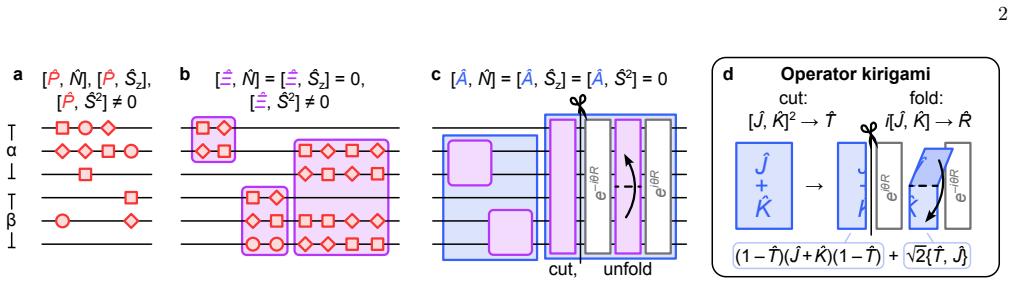
We show that we can express the Hamiltonian in terms of Hermitian excitation operators which map to sums of commuting Pauli strings for any encoding and conserve symmetries corresponding to Abelian groups of symmetry operators. Symmetries corresponding to non-Abelian groups are not fully conserved by Trotterized Hermitian excitation operators, so we developed operator kirigami to cut the sum of non-commuting operators by orthogonal projection and to fold terms together using unitary rotations.
What carries the argument
Hermitian excitation operators that map to sums of commuting Pauli strings while spanning the relevant space and conserving Abelian symmetries, together with operator kirigami (orthogonal projection plus unitary rotations) for non-Abelian cases.
If this is right
- Trotterized time evolution and quantum phase estimation preserve electron number and total spin without additional enforcement steps.
- Symmetry-breaking errors decrease with molecular size and are eliminated by second-order Trotterization.
- Operator pools built from these excitations can be validated on classical computers using existing electronic-structure symmetry tools.
- The same construction applies to any qubit encoding of fermionic systems that respect Abelian symmetries.
Where Pith is reading between the lines
- The method may reduce the need for symmetry-projected ansatzes in variational algorithms that also use Trotterized operators.
- Operator kirigami could be applied to other Trotter decompositions outside chemistry, such as lattice gauge theories with non-Abelian groups.
- If the commuting-Pauli property holds for larger bases, the approach scales to systems where full symmetry projection becomes costly.
Load-bearing premise
Hermitian excitation operators can always be chosen to map to commuting Pauli sums, span the necessary space, and conserve Abelian symmetries for arbitrary encodings without further restrictions on basis or molecule size.
What would settle it
A first-order Trotterized simulation on a molecule and encoding where the chosen Hermitian excitation operators produce observable breaking of electron number or spin symmetry.
Figures
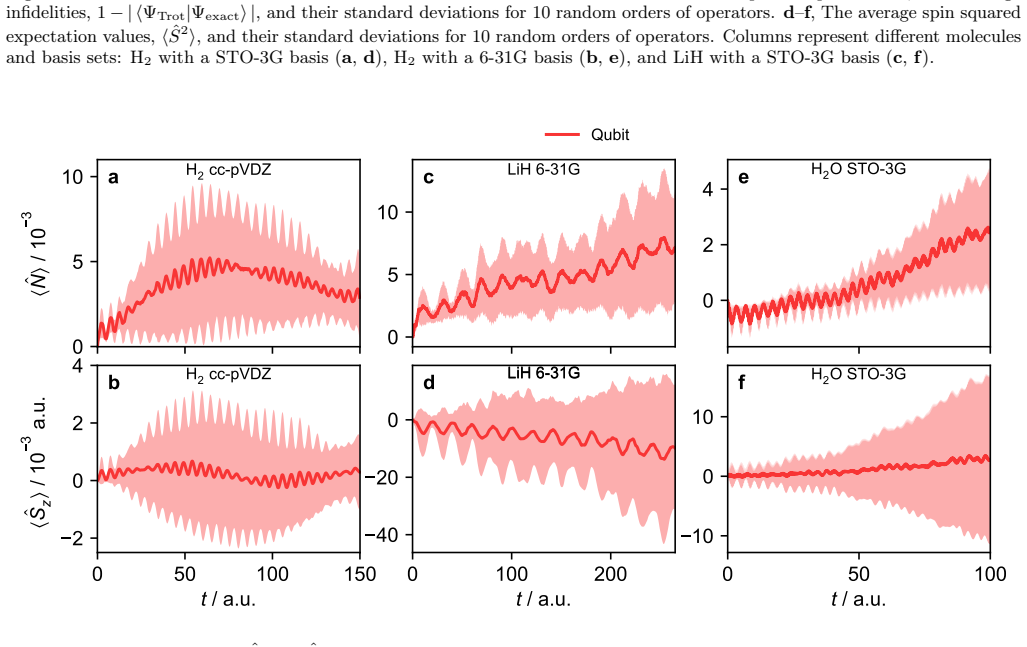
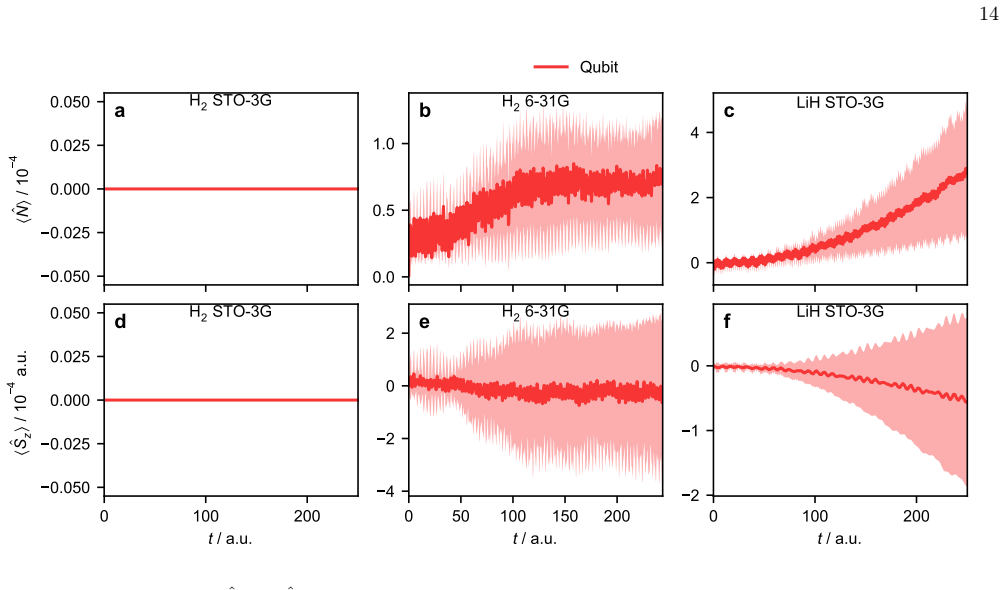
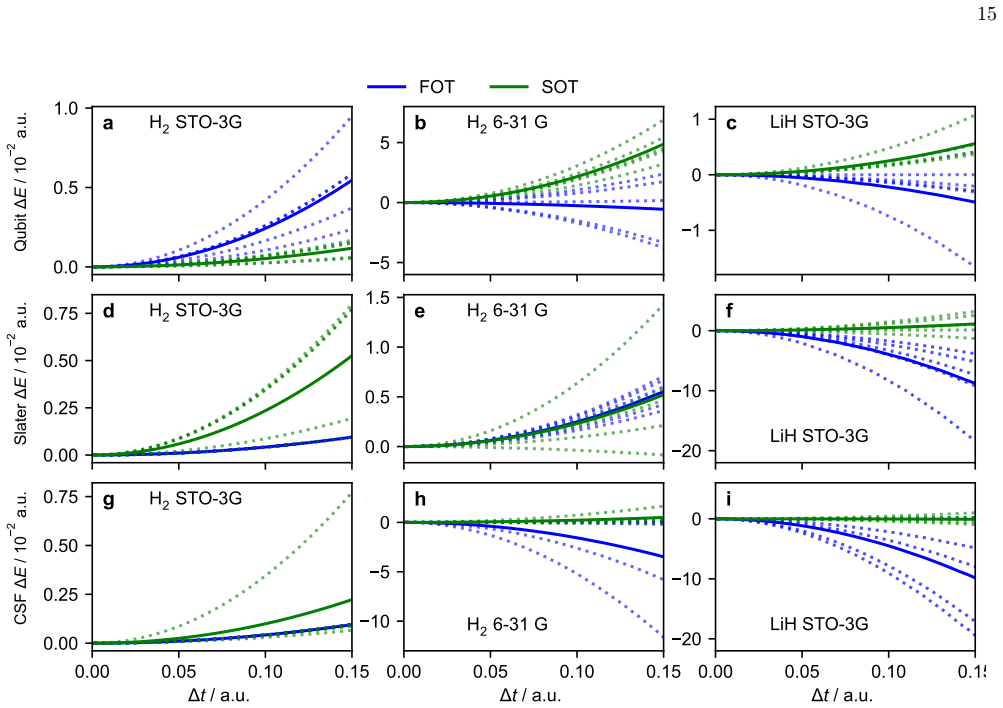
read the original abstract
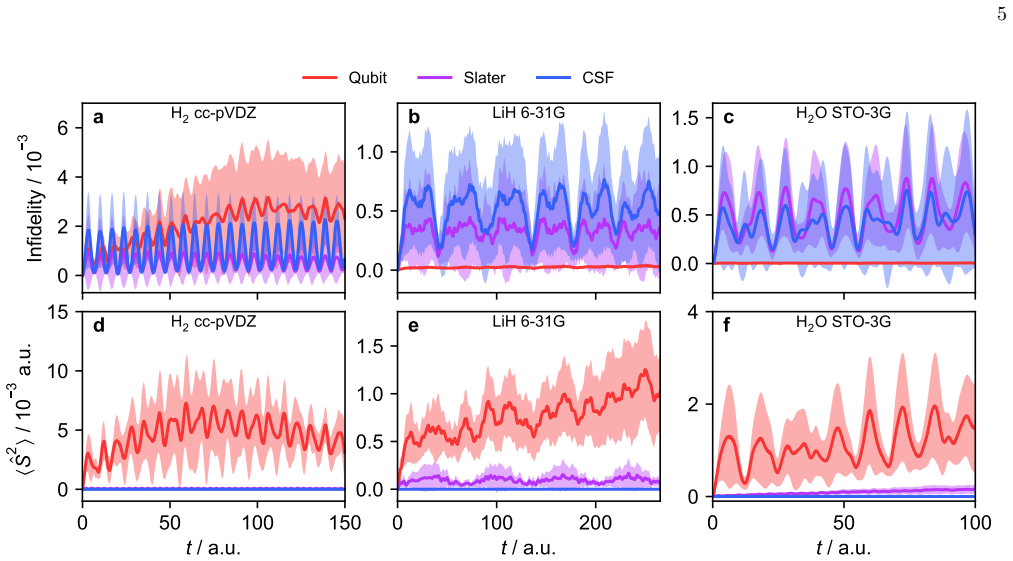
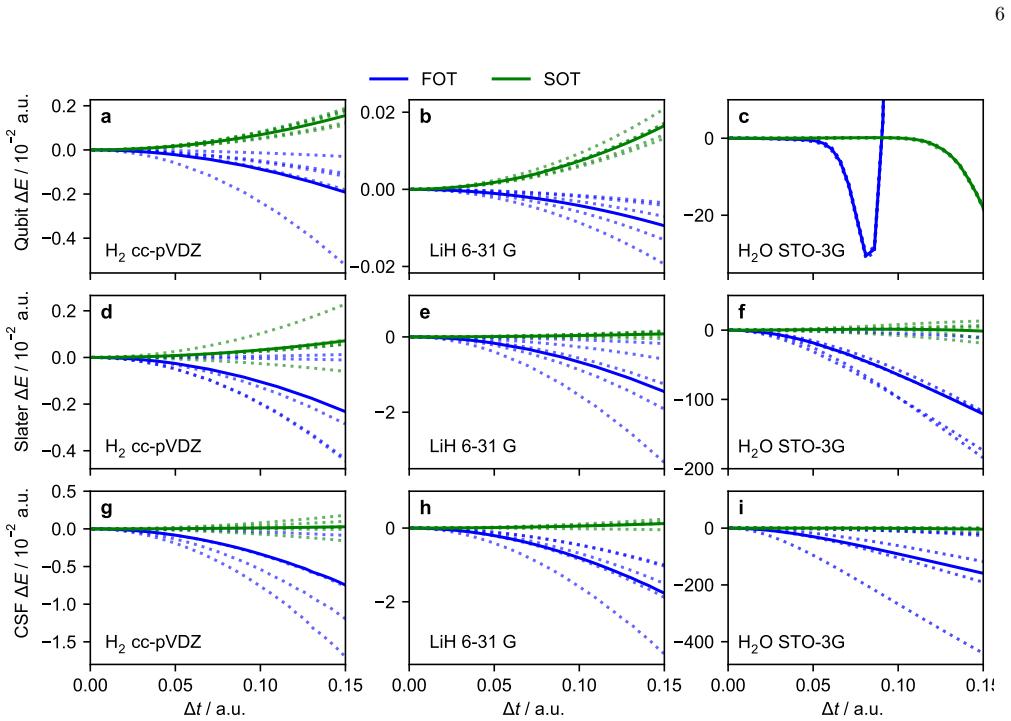
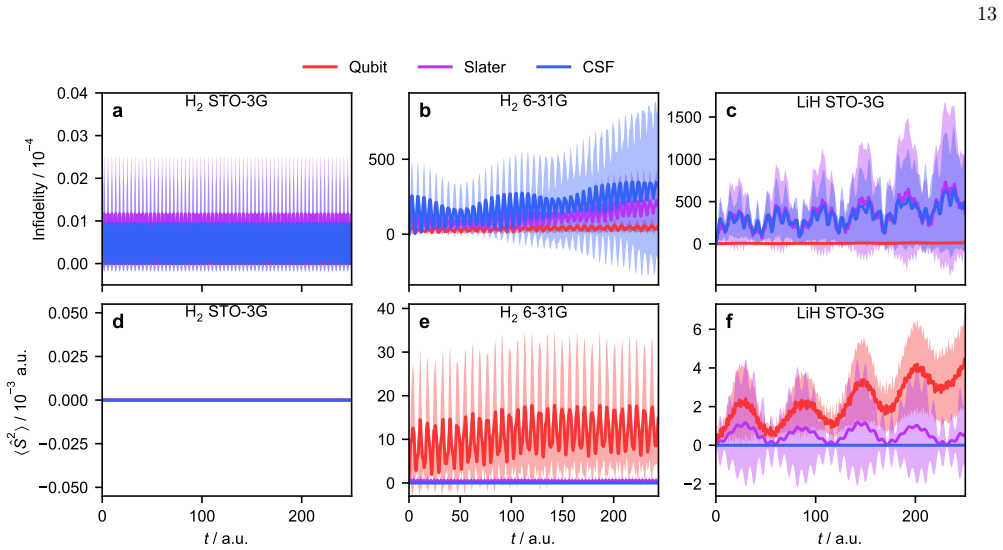
Quantum algorithms for quantum chemistry and other many-body fermionic systems work by expressing the Hamiltonian in a basis of qubits and fragmenting the Hamiltonian into a sum of products of Pauli operators whose exponentials are easily encoded on a quantum device. Applying the product of exponentials, known as Trotterization, leads to an error associated with the non-commutativity of operators. This error can lead to breaking the symmetries of the Hamiltonian because the fragments are not symmetry conserving in general. Nonetheless, many algorithms for time evolution rely on Trotterization, including time evolution and quantum phase estimation. We show that we can express the Hamiltonian in terms of Hermitian excitation operators which map to sums of commuting Pauli strings for any encoding and conserve symmetries corresponding to Abelian groups of symmetry operators. Symmetries corresponding to non-Abelian groups, on the other hand, are not fully conserved by Trotterized Hermitian excitation operators, so we developed ``operator kirigami'' to cut the sum of non-commuting operators by orthogonal projection and to fold terms together using unitary rotations. We tested pools of operators for small molecules and basis sets, and found that electron number and spin symmetry conserving pools led to greater errors that decreased for larger molecules and were negated with second-order Trotterization. Our work shows the potential for testing quantum computing algorithms on classical computers by adapting tools used in electronic structure theory with conserved symmetries.
Editorial analysis
A structured set of objections, weighed in public.
Referee Report
Summary. The paper claims that the molecular Hamiltonian can be expressed using Hermitian excitation operators mapping to sums of commuting Pauli strings for any qubit encoding, thereby conserving Abelian symmetries under Trotterization for time evolution and QPE. For non-Abelian symmetries it introduces 'operator kirigami' (orthogonal projection plus unitary rotations) to restore conservation. Tests on small molecules with symmetry-conserving operator pools show larger Trotter errors that decrease with system size and vanish under second-order Trotterization.
Significance. If the general construction is valid, the method would allow symmetry-preserving Trotterized evolution without sacrificing the ability to represent the full Hamiltonian, which is valuable for quantum chemistry simulations on near-term devices. The kirigami technique is a concrete contribution for handling non-Abelian cases.
major comments (2)
- [Abstract / construction sections] Abstract and main construction (likely §2–3): the central claim that Hermitian excitation operators exist 'for any encoding' such that each is a sum of mutually commuting Paulis, the set spans the full encoded Hamiltonian, and Abelian symmetries are conserved, is asserted without a general proof or counter-example search. Only numerical tests on small molecules with standard encodings are mentioned; if the commuting-Pauli constraint restricts the linear span for encodings that mix parity sectors or introduce non-local strings, the exact representation fails.
- [Results / testing paragraph] Results / testing paragraph: the statement that 'electron number and spin symmetry conserving pools led to greater errors that decreased for larger molecules' is given only qualitatively, with no error metrics, baselines, molecule sizes, or tables of Trotter errors versus order or pool size. This prevents quantitative assessment of whether the symmetry benefit outweighs the reported error increase.
minor comments (2)
- [Method / kirigami subsection] The term 'operator kirigami' is introduced without a precise algorithmic definition or pseudocode; a short subsection or appendix spelling out the projection and folding steps would improve reproducibility.
- [Introduction / notation] Notation for the Hermitian excitation operators E and their mapping to Pauli sums should be introduced with an explicit equation early in the text rather than only in the abstract.
Simulated Author's Rebuttal
We thank the referee for their thoughtful review and constructive feedback on our manuscript. We address each major comment below and outline revisions that will strengthen the presentation while preserving the core claims.
read point-by-point responses
-
Referee: [Abstract / construction sections] Abstract and main construction (likely §2–3): the central claim that Hermitian excitation operators exist 'for any encoding' such that each is a sum of mutually commuting Paulis, the set spans the full encoded Hamiltonian, and Abelian symmetries are conserved, is asserted without a general proof or counter-example search. Only numerical tests on small molecules with standard encodings are mentioned; if the commuting-Pauli constraint restricts the linear span for encodings that mix parity sectors or introduce non-local strings, the exact representation fails.
Authors: The construction proceeds by defining Hermitian excitation operators that change particle number by an even integer (or preserve other Abelian quantum numbers) and then mapping each such operator to its Pauli-string representation under an arbitrary encoding. Because the operator is Hermitian and the encoding is a linear isometry from the fermionic Fock space, the resulting Pauli strings within each operator necessarily commute; their sum therefore generates a symmetry-preserving unitary. The full Hamiltonian is recovered because the chosen pool is complete by construction—it is the image of the standard fermionic excitation basis under the encoding map. We acknowledge that the manuscript presents this argument at a high level rather than as a formal theorem. In revision we will add a concise general argument (including why the linear span remains full for any encoding that respects the underlying algebra) together with an explicit check on one non-standard encoding that mixes parity sectors. revision: yes
-
Referee: [Results / testing paragraph] Results / testing paragraph: the statement that 'electron number and spin symmetry conserving pools led to greater errors that decreased for larger molecules' is given only qualitatively, with no error metrics, baselines, molecule sizes, or tables of Trotter errors versus order or pool size. This prevents quantitative assessment of whether the symmetry benefit outweighs the reported error increase.
Authors: We agree that the results paragraph is too terse. The revised manuscript will include a new table (or expanded figure) reporting Trotter errors for first- and second-order decompositions, explicit molecule sizes and basis sets (H_{2}, LiH, BeH_{2}, etc.), direct comparisons against non-symmetry-conserving pools, and the dependence on pool size. These quantitative data will allow readers to evaluate the trade-off between symmetry preservation and Trotter error. revision: yes
Circularity Check
No significant circularity: central claims rest on explicit operator constructions and tests, not self-definition or fitted inputs
full rationale
The paper asserts existence of Hermitian excitation operators that are sums of commuting Paulis, conserve Abelian symmetries, and span the Hamiltonian for arbitrary encodings. This is presented as a direct algebraic construction rather than a fit or renaming; the non-Abelian handling via 'operator kirigami' is introduced as a new projection/rotation technique. No equations reduce a claimed prediction to a fitted parameter by construction, and no load-bearing uniqueness theorem or ansatz is imported solely via self-citation. Empirical tests on small molecules serve as verification, not the derivation itself. The derivation chain is therefore self-contained against external benchmarks.
Axiom & Free-Parameter Ledger
axioms (1)
- domain assumption Hermitian excitation operators can be expressed as sums of commuting Pauli strings for any encoding while conserving Abelian symmetries.
invented entities (1)
-
operator kirigami
no independent evidence
Reference graph
Works this paper leans on
-
[1]
Each fermion-to-qubit encoding adopts different sets of indices forµ(p), π(p)and ϕ(p)
of occupations of orbitals with indices less thanp [40]. Each fermion-to-qubit encoding adopts different sets of indices forµ(p), π(p)and ϕ(p). If we write two Hermitian excitation operators, ˆΞp q = ˆΞq p = ˆa† pˆaq + ˆa† qˆap = 1 2 ˆγ+ p ˆγ+ q + ˆγ− p ˆγ− q ,(5) ˆΣp q =− ˆΣq p =i(ˆa† pˆaq −ˆa† qˆap) = 1 2 ˆγ− p ˆγ+ q −ˆγ+ p ˆγ− q ,(6) 3 then the operato...
-
[2]
operator kirigami
Without spin-orbit coupling or an external magnetic field, the electronic Hamiltonian can be written as ˆH= 1 2 X pq ˜kp q X σ ˆΞpσ qσ + 1 16 X pqrs ˜vpq rs X σσ ′ {ˆΞpσ rσ , ˆΞqσ ′ sσ′ },(7) where ˜kp q and ˜vpq rs are coefficients given by integrals over spatial orbitals (provided in Appendix A). The Hamil- tonian has several symmetries corresponding to...
-
[3]
V. Murg, F. Verstraete, R. Schneider, P. R. Nagy, and Ö. Legeza, J. of Chem. Theory Comput.11, 1027 (2015), pMID: 25844072
2015
-
[4]
Schollwöck, Rev
U. Schollwöck, Rev. Mod. Phys.77, 259 (2005)
2005
-
[5]
Schirmer, Phys
J. Schirmer, Phys. Chem. Chem. Phys.27, 4992 (2025)
2025
-
[6]
Pederson, B
R. Pederson, B. Kalita, and K. Burke, Nat. Rev. Phys. 4, 357 (2022)
2022
-
[7]
M. A. Nielsen and I. L. Chuang,Quantum Computation and Quantum Information: 10th Anniversary Edition (Cambridge University Press, 2011)
2011
-
[8]
García-Pérez, M
G. García-Pérez, M. A. Rossi, B. Sokolov, F. Tacchino, P. K. Barkoutsos, G. Mazzola, I. Tavernelli, and S. Man- iscalco, PRX Quantum2, 040342 (2021)
2021
-
[9]
Noh and D
C. Noh and D. G. Angelakis, Rep. Prog. Phys.80, 016401 (2016)
2016
-
[10]
A. J. Daley, I. Bloch, C. Kokail, S. Flannigan, N. Pearson, M. Troyer, and P. Zoller, Nature607, 667 (2022)
2022
-
[11]
A. M. Childs, D. Maslov, Y. Nam, N. J. Ross, and Y. Su, Proc. Natl. Acad. Sci.115, 9456 (2018)
2018
-
[12]
S. Lee, J. Lee, H. Zhai, Y. Tong, A. M. Dalzell, A. Kumar, P. Helms, J. Gray, Z.-H. Cui, W. Liua, M. Kastoryano, R. Babbush, J. Preskill, D. R. Reichman, E. T. Campbell, E. F. Valeev, L. Lin, and G. K.-L. Chan, Nat. Commun. 14, 1952 (2023)
1952
-
[13]
Miessen, P
A. Miessen, P. J. Ollitrault, F. Tacchino, and I. Tavernelli, Nat. Comput. Sci.3, 25 (2023)
2023
-
[14]
Peruzzo, J
A. Peruzzo, J. McClean, P. Shadbolt, M.-H. Yung, X.-Q. Zhou, P. J. Love, A. Aspuru-Guzik, and J. L. O’Brien, Nat. Commun.5, 4213 (2014)
2014
-
[15]
Cerezo, A
M. Cerezo, A. Arrasmith, R. Babbush, S. C. Benjamin, S. Endo, K. Fujii, J. R. McClean, K. Mitarai, X. Yuan, L. Cincio, and P. J. Coles, Nat. Rev. Phys.3, 625 (2021)
2021
-
[16]
H. R. Grimsley, S. E. Economou, E. Barnes, and N. J. Mayhall, Nat. Commun.10, 3007 (2019)
2019
-
[17]
Tilly, H
J. Tilly, H. Chen, S. Cao, D. Picozzi, K. Setia, Y. Li, E. Grant, L. Wossnig, I. Rungger, G. H. Booth, and J. Tennyson, Phys. Rep.986, 1 (2022), the Variational Quantum Eigensolver: a review of methods and best practices
2022
-
[18]
J. F. Gonthier, M. D. Radin, C. Buda, E. J. Doskocil, C. M. Abuan, and J. Romero, Phys. Rev. Res.4, 033154 (2022)
2022
-
[19]
W. J. Huggins, J. R. McClean, N. C. Rubin, Z. Jiang, N. Wiebe, K. B. Whaley, and R. Babbush, npj Quantum Inf.7, 23 (2021)
2021
-
[20]
Verteletskyi, T.-C
V. Verteletskyi, T.-C. Yen, and A. F. Izmaylov, J. Chem. Phys.152(2020). 8
2020
-
[21]
Aspuru-Guzik, A
A. Aspuru-Guzik, A. D. Dutoi, P. J. Love, and M. Head- Gordon, Science309, 1704 (2005)
2005
-
[22]
McArdle, S
S. McArdle, S. Endo, A. Aspuru-Guzik, S. C. Benjamin, and X. Yuan, Rev. Mod. Phys.92, 015003 (2020)
2020
-
[23]
Babbush, N
R. Babbush, N. Wiebe, J. McClean, J. McClain, H. Neven, and G. K.-L. Chan, Phys. Rev. X8, 011044 (2018)
2018
-
[24]
H. F. Trotter, Proc. Amer. Math. Soc.10, 545 (1959)
1959
-
[25]
D. S. Abrams and S. Lloyd, Phys. Rev. Lett.79, 2586 (1997)
1997
-
[26]
Lloyd, Science273, 1073 (1996)
S. Lloyd, Science273, 1073 (1996)
1996
-
[27]
Jordan and E
P. Jordan and E. Wigner, Z. Phys.47, 631 (1928)
1928
-
[28]
S. B. Bravyi and A. Y. Kitaev, Ann. Phys.298, 210 (2002)
2002
-
[29]
J. T. Seeley, M. J. Richard, and P. J. Love, J. Chem. Phys.137, 224109 (2012)
2012
-
[30]
S. B. Bravyi and A. Y. Kitaev, Annals of Physics298, 210 (2002)
2002
-
[31]
Setia and J
K. Setia and J. D. Whitfield, J. Chem. Phys.148, 164104 (2018)
2018
-
[32]
Helgaker, P
T. Helgaker, P. Jørgensen, and J. Olsen,Molecular Electronic-Structure Theory(John Wiley & Sons, Ltd, 2000)
2000
-
[33]
Szabo and N
A. Szabo and N. S. Ostlund,Modern Quantum Chemistry. Introduction to Advanced Electronic Structure Theory, 2nd ed. (Dover, New York, USA, 1989)
1989
-
[34]
P. Jain, A. F. Izmaylov, and E. R. Kjellgren, J. Chem. Phys.164(2026)
2026
-
[35]
Magoulas, M
I. Magoulas, M. Zhang, and F. A. Evangelista, J. Chem. Phys.164(2026)
2026
-
[36]
K. J. Sung, I. Choi, M. Amico, B. Andrews, E. Ayan- tuna, Y. Kawashima, W.-H. Lin, D. Omanovic, S. Pic- cinelli, J. R. Moreno, A. A. Saki, J. Shee, S. Shin, M. C. Tran, K. Ueda, H. Zhang, and M. Motta, arXiv (2026), 2605.03123 [quant-ph]
work page internal anchor Pith review Pith/arXiv arXiv 2026
-
[37]
Picozzi and J
D. Picozzi and J. Tennyson, Quantum Sci. Technol.8, 035026 (2023)
2023
-
[38]
B. Harrison, D. Nelson, D. Adamiak, and J. Whitfield, arXiv (2022), 2211.04501 [quant-ph]
-
[39]
S. G. Mehendale, L. A. Martínez-Martínez, P. D. Kamath, and A. F. Izmaylov, Digit. Discov.4, 3540 (2025)
2025
-
[40]
A. M. Childs, Y. Su, M. C. Tran, N. Wiebe, and S. Zhu, Phys. Rev. X11, 011020 (2021)
2021
-
[41]
Campbell, Phys
E. Campbell, Phys. Rev. Lett.123, 070503 (2019)
2019
-
[42]
Loaiza, A
I. Loaiza, A. Sankar Brahmachari, and A. F. Izmaylov, Quantum Science and Technology10, 035035 (2025)
2025
-
[43]
Q. Sun, X. Zhang, S. Banerjee, P. Bao, M. Barbry, N. S. Blunt, N. A. Bogdanov, G. H. Booth, J. Chen, Z.-H. Cui, J. J. Eriksen, Y. Gao, S. Guo, J. Hermann, M. R. Hermes, K. Koh, P. Koval, S. Lehtola, Z. Li, J. Liu, N. Mardirossian, J. D. McClain, M. Motta, B. Mus- sard, H. Q. Pham, A. Pulkin, W. Purwanto, P. J. Robin- son, E. Ronca, E. R. Sayfutyarova, M. ...
2020
-
[44]
Wang and C
L.-P. Wang and C. Song, J. Chem. Phys.144(2016)
2016
-
[45]
operator kirigami
J. R. McClean, N. C. Rubin, K. J. Sung, I. D. Kivlichan, X. Bonet-Monroig, Y. Cao, C. Dai, E. S. Fried, C. Gidney, B. Gimby, P. Gokhale, T. Häner, T. Hardikar, V. Havlíček, O. Higgott, C. Huang, J. Izaac, Z. Jiang, X. Liu, S. McAr- dle, M. Neeley, T. O’Brien, B. O’Gorman, I. Ozfidan, M. D. Radin, J. Romero, N. P. D. Sawaya, B. Senjean, K. Setia, S. Sim, D...
2020
-
[46]
Evaluate the Trotter product at a given−i∆t
-
[47]
Diagonalizeexp(−i ˆHeff∆t)to obtainUexp(−iθ k(∆t))U †
-
[48]
When∆ t→ 0the eigenvalue of the exact Hamiltonian,|φk⟩ can be used as reference
Select the eigenstate |ϕk,∆t⟩ as the one with the highest overlap with the k-th eigenvalue ofexp(−i ˆHeff∆t′), |ϕk,∆t′⟩, where∆ t′ < ∆t. When∆ t→ 0the eigenvalue of the exact Hamiltonian,|φk⟩ can be used as reference
-
[49]
13 0.00 0.01 0.02 0.03 0.04 Infidelity / 10 4 H2 STO-3Ga 0 500 H2 6-31Gb Qubit Slater CSF 0 500 1000 1500 LiH STO-3Gc 0 100 200 t / a.u
Multiplyexp(−iθ k(∆t)) exp(i∆tEk(∆t′))whereE k(∆t′)is the eigenvalue corresponding to|ϕk,∆t′⟩. 13 0.00 0.01 0.02 0.03 0.04 Infidelity / 10 4 H2 STO-3Ga 0 500 H2 6-31Gb Qubit Slater CSF 0 500 1000 1500 LiH STO-3Gc 0 100 200 t / a.u. 0.050 0.025 0.000 0.025 0.050 S2 / 10 3 a.u. H2 STO-3Gd 0 50 100 150 200 t / a.u. 0 10 20 30 40 H2 6-31Ge 0 100 200 t / a.u. ...
-
[50]
In Python it is suggested to usenumpy.angle to find the argument in the correct quadrant
Calculate Ek(∆t) = Ek(∆t′) − 1 ∆tArg(e−iθk(∆t)ei∆tEk(∆t′)). In Python it is suggested to usenumpy.angle to find the argument in the correct quadrant
-
[51]
It is always necessary to have a reference energy and eigenstate, since the value∆tEk determines the branch of the logarithm
Repeat the procedure until the desired time interval is covered. It is always necessary to have a reference energy and eigenstate, since the value∆tEk determines the branch of the logarithm. For small time steps, thek-th eigenstate of the exact Hamiltonian can be used for the steps 3-5 of the procedure. However, for larger time steps, this value can lead ...
discussion (0)
Sign in with ORCID, Apple, or X to comment. Anyone can read and Pith papers without signing in.