Bolometric correction factor and radiative efficiency for the super-Eddington accretion flow in tidal disruption events
Pith reviewed 2026-07-03 08:17 UTC · model grok-4.3
The pith
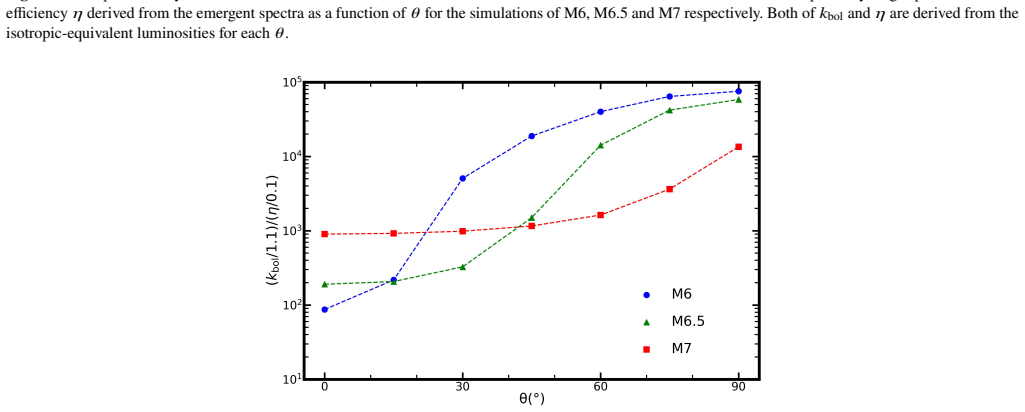
Radiation hydrodynamic simulations show that the X-ray bolometric correction factor and radiative efficiency for super-Eddington flows in tidal disruption events depend on black hole mass and viewing angle.
A machine-rendered reading of the paper's core claim, the machinery that carries it, and where it could break.
Core claim
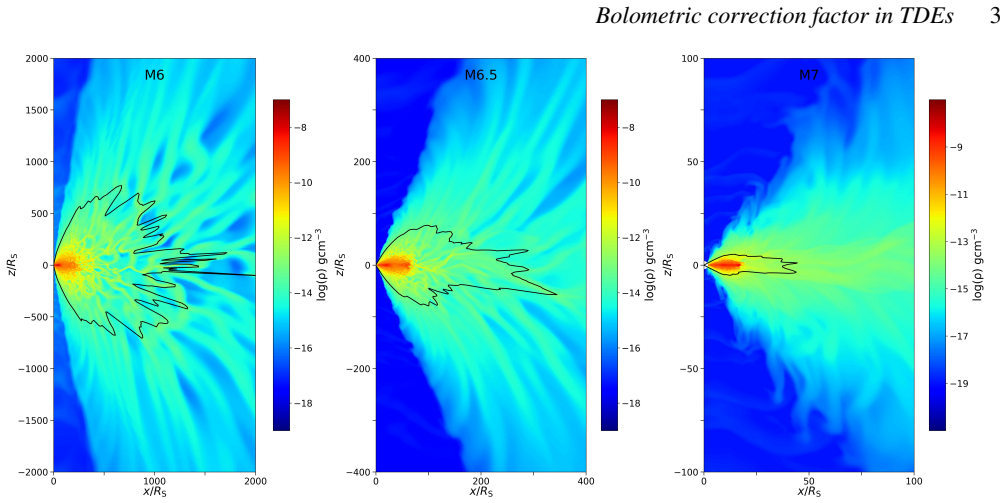
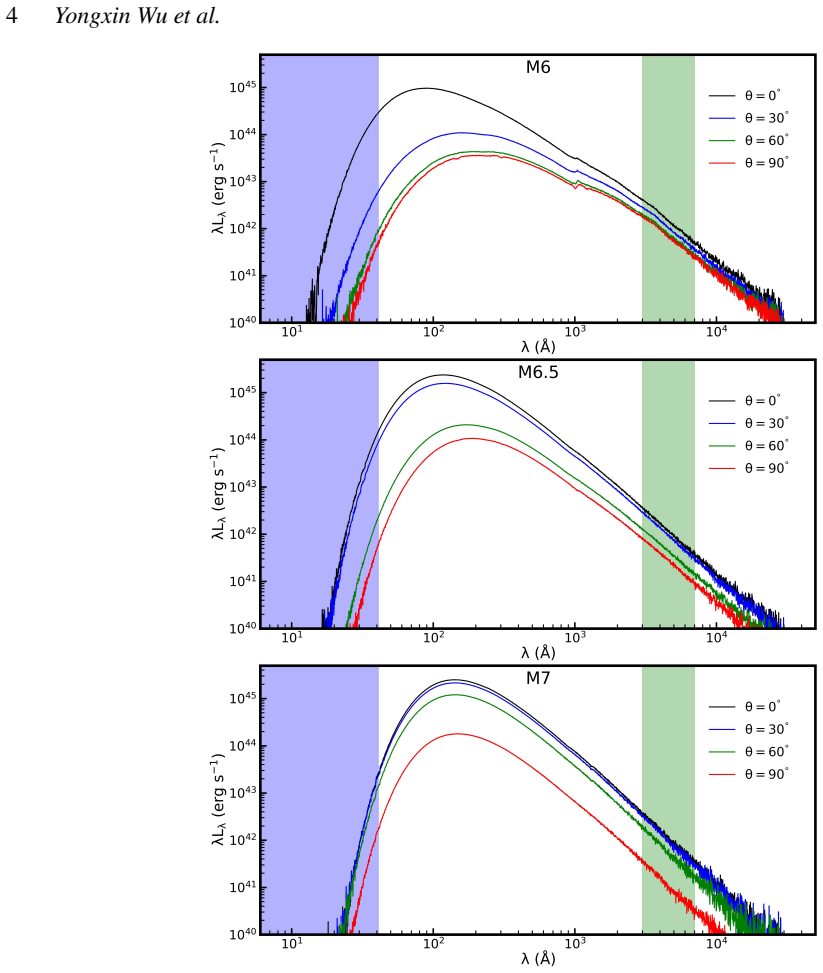
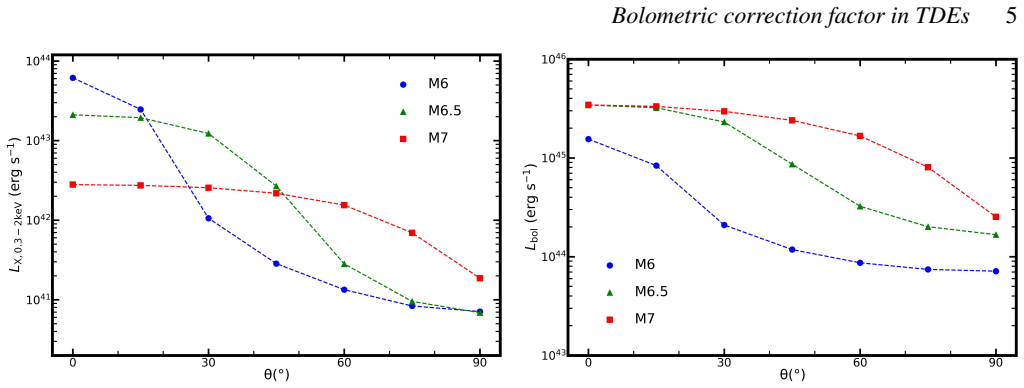
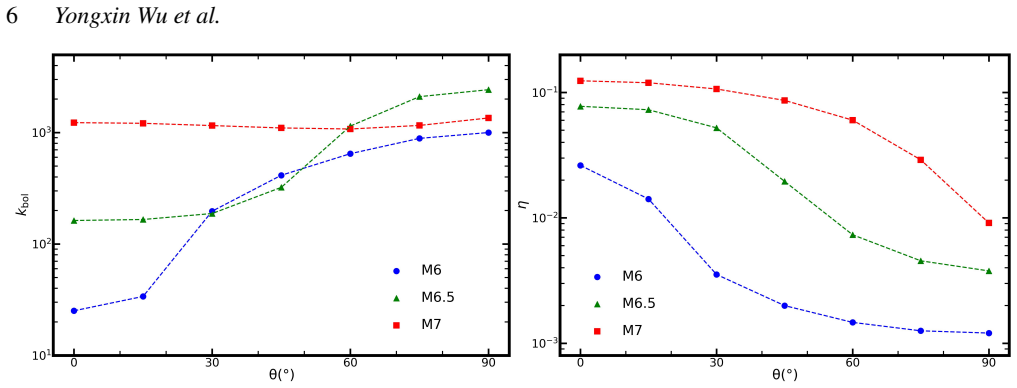
Both k_bol and η are black hole mass and viewing-angle dependent, with k_bol ranging from a few tens to a few thousands and η ranging from ∼10^{-3} to 10^{-1} for black hole masses of 10^{6-7} solar masses and viewing angles of 0°-90°. Applying the derived k_bol and η to specific tidal disruption events yields estimates of accreted mass that can significantly alleviate the missing energy problem.
What carries the argument
Radiation hydrodynamic simulations of the super-Eddington accretion flow followed by spectral post-processing to compute the emergent spectra used for k_bol and η.
If this is right
- k_bol and η both vary with black hole mass and viewing angle within the stated ranges.
- The derived k_bol values convert observed X-ray luminosities into bolometric luminosities for super-Eddington phases.
- The derived η values convert observed luminosities into estimates of accreted mass.
- These conversions applied to observed events reduce the missing energy discrepancy.
Where Pith is reading between the lines
- Orientation dependence implies that the same intrinsic flow can appear very different when viewed from different angles.
- The same simulation-plus-post-processing pipeline could be rerun for other parameter combinations to map a wider region of black hole mass and accretion rate space.
- If the missing energy problem is largely solved by these corrections, earlier claims of low radiative efficiency in tidal disruption events would need re-examination.
Load-bearing premise
The radiation hydrodynamic simulations and subsequent spectral post-processing accurately capture the emergent radiation field and its angular dependence for super-Eddington flows in the tidal disruption event environment.
What would settle it
An observation of a tidal disruption event that supplies an independent measurement of total bolometric luminosity together with an estimate of accreted mass lying outside the k_bol range predicted for the event's black hole mass and viewing angle.
Figures
read the original abstract
The estimate of the bolometric luminosity and the radiative efficiency are two key aspects for understanding the properties of the accretion flow around a supermassive black hole (BH). In this paper, we focus on the estimate of the bolometric luminosity and the radiative efficiency of the early super-Eddington accretion flow in tidal disruption events (TDEs). Specifically, we first perform radiation hydrodynamic simulations of super-Eddington accretion flow in TDE environment, and then calculate the corresponding emergent spectra with the method of post processing for the simulation data. Based on the emergent spectra, we calculate the isotropic-equivalent X-ray bolometric correction factor $k_\mathrm{bol}$ and the radiative efficiency $\eta$ of the super-Eddington accretion flow. We find that both $k_\mathrm{bol}$ and $\eta$ are BH mass and viewing-angle dependent. $k_\mathrm{bol}$ is in the range of about a few tens to a few thousands, and $\eta$ is in the range of $\sim 10^{-3}-10^{-1}$ for BH mass in the range of $10^{6-7}M_\odot$ and the viewing angle in the range of $0^{\rm o}-90^{\rm o}$. Finally, we apply the derived $k_\mathrm{bol}$ and $\eta$ to some specific TDEs to estimate the accreted mass during an event, which can significantly alleviate the so-called missing energy problem in TDEs.
Editorial analysis
A structured set of objections, weighed in public.
Referee Report
Summary. The paper performs radiation hydrodynamic simulations of super-Eddington accretion flows in the TDE environment, followed by spectral post-processing to derive the isotropic-equivalent X-ray bolometric correction factor k_bol and radiative efficiency η. It reports that both quantities are dependent on black hole mass (in 10^{6-7} M_⊙) and viewing angle (0°-90°), with k_bol ranging from tens to thousands and η from ∼10^{-3} to 10^{-1}, and applies these values to observed TDEs to estimate accreted masses and address the missing-energy problem.
Significance. If the numerical results hold, the work supplies concrete, viewing-angle-dependent estimates of k_bol and η for super-Eddington TDE flows that could quantitatively resolve the missing-energy discrepancy by implying lower accreted masses than inferred from observed luminosities alone. The explicit mass and angle dependence is a potentially useful result for interpreting multi-wavelength TDE data.
major comments (2)
- [Methods / simulation description] The radiation-hydrodynamic simulations and spectral post-processing (described in the methods and invoked in the abstract): no information is supplied on the hydro code, grid resolution, radiation-transport scheme, opacity treatment, initial conditions, or convergence/validation tests. These details are load-bearing because the reported ranges and dependencies for k_bol and η are direct numerical outputs of these steps; without them the central claims cannot be assessed for robustness or reproducibility.
- [Results / application section] Application to specific TDEs (final paragraph): the claim that the derived k_bol and η 'significantly alleviate' the missing-energy problem rests entirely on the unvalidated simulation outputs; the manuscript provides no error estimates, sensitivity tests, or comparison against analytic expectations that would support this conclusion.
Simulated Author's Rebuttal
We thank the referee for their careful reading of the manuscript and for the constructive comments. We agree that additional details are needed and will revise the manuscript accordingly.
read point-by-point responses
-
Referee: [Methods / simulation description] The radiation-hydrodynamic simulations and spectral post-processing (described in the methods and invoked in the abstract): no information is supplied on the hydro code, grid resolution, radiation-transport scheme, opacity treatment, initial conditions, or convergence/validation tests. These details are load-bearing because the reported ranges and dependencies for k_bol and η are direct numerical outputs of these steps; without them the central claims cannot be assessed for robustness or reproducibility.
Authors: We agree that the current manuscript does not provide sufficient detail on the numerical setup. In the revised version we will expand the methods section to specify the hydro code, grid resolution, radiation-transport scheme, opacity treatment, initial conditions, and results of convergence and validation tests. This will allow readers to evaluate the robustness of the reported k_bol and η ranges. revision: yes
-
Referee: [Results / application section] Application to specific TDEs (final paragraph): the claim that the derived k_bol and η 'significantly alleviate' the missing-energy problem rests entirely on the unvalidated simulation outputs; the manuscript provides no error estimates, sensitivity tests, or comparison against analytic expectations that would support this conclusion.
Authors: We acknowledge that the application paragraph would be strengthened by quantitative support. In the revision we will add error estimates on the derived quantities, sensitivity tests to variations in simulation parameters, and comparisons with analytic expectations for radiative efficiency. These additions will better substantiate the statement that the values alleviate the missing-energy problem. revision: yes
Circularity Check
No circularity; results are forward outputs of radiation-hydrodynamic simulations
full rationale
The paper derives k_bol and η via radiation hydrodynamic simulations of super-Eddington TDE flows followed by spectral post-processing on the simulation data to obtain emergent spectra, from which the quantities are computed as functions of BH mass and viewing angle. These steps constitute independent forward modeling; the reported ranges are simulation outputs rather than quantities defined in terms of fitted parameters or reduced by the paper's own equations. No self-definitional relations, fitted-input predictions, or load-bearing self-citations appear in the derivation chain. The approach is self-contained against external benchmarks of simulation accuracy.
Axiom & Free-Parameter Ledger
Reference graph
Works this paper leans on
-
[1]
Possible power source of Seyfert galaxies and QSOs. , keywords =. doi:10.1038/254295a0 , adsurl =
-
[2]
Tidal disruption of stars by black holes of 10 ^ 6 - 10 ^ 8 solar masses in nearby galaxies. , keywords =. doi:10.1038/333523a0 , adsurl =
-
[3]
The Tidal Disruption of a Star by a Massive Black Hole. , keywords =. doi:10.1086/185567 , adsurl =
-
[4]
The Center of the Galaxy , year = 1989, editor =
Manifestations of a Massive Black Hole in the Galactic Center. The Center of the Galaxy , year = 1989, editor =
1989
-
[5]
Hydrodynamical Simulations to Determine the Feeding Rate of Black Holes by the Tidal Disruption of Stars: The Importance of the Impact Parameter and Stellar Structure. , keywords =. doi:10.1088/0004-637X/767/1/25 , archivePrefix =. 1206.2350 , primaryClass =
work page internal anchor Pith review Pith/arXiv arXiv doi:10.1088/0004-637x/767/1/25
-
[6]
The Disk Accretion of a Tidally Disrupted Star onto a Massive Black Hole. , keywords =. doi:10.1086/168442 , adsurl =
-
[7]
Tidal Disruption Events. , keywords =. doi:10.1146/annurev-astro-111720-030029 , archivePrefix =. 2104.14580 , primaryClass =
-
[8]
, keywords =
Detection of an extremely soft X-ray outburst in the HII-like nucleus of NGC 5905. , keywords =
-
[9]
The giant X-ray outbursts in NGC 5905 and IC 3599: Follow-up observations and outburst scenarios
The giant X-ray outbursts in NGC 5905 and IC 3599:() hfill Follow-up observations and outburst scenarios. , keywords =. doi:10.48550/arXiv.astro-ph/9901141 , archivePrefix =. astro-ph/9901141 , primaryClass =
work page internal anchor Pith review Pith/arXiv arXiv doi:10.48550/arxiv.astro-ph/9901141
-
[10]
Discovery of a giant and luminous X-ray outburst from the optically inactive galaxy pair RX J1242.6-1119. , keywords =. doi:10.48550/arXiv.astro-ph/9908216 , archivePrefix =. astro-ph/9908216 , primaryClass =
work page internal anchor Pith review Pith/arXiv arXiv doi:10.48550/arxiv.astro-ph/9908216
-
[11]
New bright soft X-ray selected ROSAT AGN. II. Optical emission line properties. , keywords =. doi:10.48550/arXiv.astro-ph/9908347 , archivePrefix =. astro-ph/9908347 , primaryClass =
work page internal anchor Pith review Pith/arXiv arXiv doi:10.48550/arxiv.astro-ph/9908347
-
[12]
doi:10.1007/s11214-020-00759-7 , archivePrefix =
Correction to: X-Ray Properties of TDEs. doi:10.1007/s11214-020-00759-7 , archivePrefix =. 2103.15442 , primaryClass =
-
[13]
Flares from the Tidal Disruption of Stars by Massive Black Holes. , keywords =. doi:10.1086/306909 , adsurl =
-
[14]
Ultraviolet Detection of the Tidal Disruption of a Star by a Supermassive Black Hole
Ultraviolet Detection of the Tidal Disruption of a Star by a Supermassive Black Hole. , keywords =. doi:10.1086/509918 , archivePrefix =. astro-ph/0612069 , primaryClass =
work page internal anchor Pith review Pith/arXiv arXiv doi:10.1086/509918
-
[15]
UV/Optical Detections of Candidate Tidal Disruption Events by GALEX and CFHTLS
UV/Optical Detections of Candidate Tidal Disruption Events by GALEX and CFHTLS. , keywords =. doi:10.1086/529008 , archivePrefix =. 0712.4149 , primaryClass =
work page internal anchor Pith review Pith/arXiv arXiv doi:10.1086/529008
-
[16]
Luminous Thermal Flares from Quiescent Supermassive Black Holes
Luminous Thermal Flares from Quiescent Supermassive Black Holes. , keywords =. doi:10.1088/0004-637X/698/2/1367 , archivePrefix =. 0904.1596 , primaryClass =
work page internal anchor Pith review Pith/arXiv arXiv doi:10.1088/0004-637x/698/2/1367
-
[17]
Discovery of Superstrong, Fading, Iron Line Emission and Double-peaked Balmer Lines of the Galaxy SDSS J095209.56+214313.3: The Light Echo of a Huge Flare. , keywords =. doi:10.1086/588281 , archivePrefix =. 0804.2670 , primaryClass =
work page internal anchor Pith review Pith/arXiv arXiv doi:10.1086/588281
-
[18]
Optical discovery of probable stellar tidal disruption flares
Optical Discovery of Probable Stellar Tidal Disruption Flares. , keywords =. doi:10.1088/0004-637X/741/2/73 , archivePrefix =. 1009.1627 , primaryClass =
work page internal anchor Pith review Pith/arXiv arXiv doi:10.1088/0004-637x/741/2/73
-
[19]
An ultraviolet-optical flare from the tidal disruption of a helium-rich stellar core
An ultraviolet-optical flare from the tidal disruption of a helium-rich stellar core. , keywords =. doi:10.1038/nature10990 , archivePrefix =. 1205.0252 , primaryClass =
work page internal anchor Pith review Pith/arXiv arXiv doi:10.1038/nature10990
-
[20]
A Continuum of H- to He-Rich Tidal Disruption Candidates With a Preference for E+A Galaxies
A Continuum of H- to He-rich Tidal Disruption Candidates With a Preference for E+A Galaxies. , keywords =. doi:10.1088/0004-637X/793/1/38 , archivePrefix =. 1405.1415 , primaryClass =
work page internal anchor Pith review Pith/arXiv arXiv doi:10.1088/0004-637x/793/1/38
-
[21]
ASASSN-14ae: A Tidal Disruption Event at 200 Mpc
ASASSN-14ae: a tidal disruption event at 200 Mpc. , keywords =. doi:10.1093/mnras/stu1922 , archivePrefix =. 1405.1417 , primaryClass =
work page internal anchor Pith review Pith/arXiv arXiv doi:10.1093/mnras/stu1922
-
[22]
Optical-Ultraviolet Tidal Disruption Events. , keywords =. doi:10.1007/s11214-020-00753-z , archivePrefix =. 2008.05461 , primaryClass =
-
[23]
"Circularization" vs. Accretion -- What Powers Tidal Disruption Events?
‧Disk Formation Versus Disk Accretion What Powers Tidal Disruption Events?. , keywords =. doi:10.1088/0004-637X/806/2/164 , archivePrefix =. 1502.05792 , primaryClass =
work page internal anchor Pith review Pith/arXiv arXiv doi:10.1088/0004-637x/806/2/164
-
[24]
Stream-disk shocks as the origins of peak light in tidal disruption events. , keywords =. doi:10.1038/s41586-023-06875-y , archivePrefix =. 2206.10641 , primaryClass =
-
[25]
Measuring Stellar and Black Hole Masses of Tidal Disruption Events. , keywords =. doi:10.3847/1538-4357/abbf4d , archivePrefix =. 2007.13765 , primaryClass =
-
[26]
Prompt Radiation and Mass Outflows from the Stream-Stream Collisions of Tidal Disruption Events
Prompt Radiation and Mass Outflows from the Stream-Stream Collisions of Tidal Disruption Events. , keywords =. doi:10.3847/0004-637X/830/2/125 , archivePrefix =. 1603.07733 , primaryClass =
work page internal anchor Pith review Pith/arXiv arXiv doi:10.3847/0004-637x/830/2/125
-
[27]
Optical Appearance of the Debris of a Star Disrupted by a Massive Black Hole
Optical Appearance of the Debris of a Star Disrupted by a Massive Black Hole. , keywords =. doi:10.1086/304814 , archivePrefix =. astro-ph/9703079 , primaryClass =
work page internal anchor Pith review Pith/arXiv arXiv doi:10.1086/304814
-
[28]
Optical flares from the tidal disruption of stars by massive black holes. , keywords =. doi:10.1111/j.1365-2966.2009.15599.x , archivePrefix =. 0905.3735 , primaryClass =
-
[29]
First light from tidal disruption events. , keywords =. doi:10.1093/mnras/stab398 , archivePrefix =. 2012.12271 , primaryClass =
-
[30]
A Bright Year for Tidal Disruptions?
A bright year for tidal disruptions. , keywords =. doi:10.1093/mnras/stw1394 , archivePrefix =. 1506.03453 , primaryClass =
work page internal anchor Pith review Pith/arXiv arXiv doi:10.1093/mnras/stw1394
-
[31]
The X-ray through Optical Fluxes and Line Strengths of Tidal Disruption Events
The X-Ray through Optical Fluxes and Line Strengths of Tidal Disruption Events. , keywords =. doi:10.3847/0004-637X/827/1/3 , archivePrefix =. 1510.08454 , primaryClass =
work page internal anchor Pith review Pith/arXiv arXiv doi:10.3847/0004-637x/827/1/3
-
[32]
What Sets the Line Profiles in Tidal Disruption Events?
What Sets the Line Profiles in Tidal Disruption Events?. , keywords =. doi:10.3847/1538-4357/aaaec6 , archivePrefix =. 1707.02993 , primaryClass =
work page internal anchor Pith review Pith/arXiv arXiv doi:10.3847/1538-4357/aaaec6
-
[33]
Dynamical Unification of Tidal Disruption Events. , keywords =. doi:10.3847/2041-8213/ac911f , archivePrefix =. 2206.02804 , primaryClass =
-
[34]
A unified model for tidal disruption events
A Unified Model for Tidal Disruption Events. , keywords =. doi:10.3847/2041-8213/aab429 , archivePrefix =. 1803.03265 , primaryClass =
work page internal anchor Pith review Pith/arXiv arXiv doi:10.3847/2041-8213/aab429 2041
-
[35]
Optical line spectra of tidal disruption events from reprocessing in optically thick outflows. , keywords =. doi:10.1093/mnras/stac027 , archivePrefix =. 2201.01535 , primaryClass =
-
[36]
A multidimensional view of a unified model for TDEs. , keywords =. doi:10.1093/mnras/staf880 , archivePrefix =. 2408.16371 , primaryClass =
-
[37]
Radiative hydrodynamical simulations of super-Eddington accretion flow in tidal disruption event: the origin of optical/UV emission. , keywords =. doi:10.1093/mnras/stac2399 , adsurl =
-
[38]
GRRMHD simulations of tidal disruption event accretion discs around supermassive black holes: jet formation, spectra, and detectability. , keywords =. doi:10.1093/mnras/sty3134 , archivePrefix =. 1811.06971 , primaryClass =
work page internal anchor Pith review Pith/arXiv arXiv doi:10.1093/mnras/sty3134
-
[39]
A Systematic Analysis of the X-Ray Emission in Optically Selected Tidal Disruption Events: Observational Evidence for the Unification of the Optically and X-Ray-selected Populations. , keywords =. doi:10.3847/1538-4357/ad2f9f , archivePrefix =. 2308.13019 , primaryClass =
-
[40]
Early evolution of super-Eddington accretion flow in tidal disruption events. , keywords =. doi:10.1093/mnras/staf719 , archivePrefix =. 2505.02434 , primaryClass =
-
[41]
Pre-peak Emission in Tidal Disruption Events. , keywords =. doi:10.3847/1538-4357/ad6c39 , archivePrefix =. 2404.18446 , primaryClass =
-
[42]
Observational appearance
Black holes in binary systems. Observational appearance. , year = 1973, month = jan, volume =
1973
-
[43]
Self-similar Solution of Optically Thick Advection-dominated Flows. , keywords =. doi:10.1086/307080 , adsurl =
-
[44]
Slim Accretion Disks. , keywords =. doi:10.1086/166683 , adsurl =
-
[45]
New Analytical Formula for Supercritical Accretion Flows
New Analytical Formulae for Supercritical Accretion Flows. , keywords =. doi:10.1086/505854 , archivePrefix =. astro-ph/0605248 , primaryClass =
work page internal anchor Pith review Pith/arXiv arXiv doi:10.1086/505854
-
[46]
Bolometric correction factors for active galactic nuclei. , keywords =. doi:10.1093/mnras/stz2016 , archivePrefix =. 1907.09534 , primaryClass =
-
[47]
The Giant X-Ray Flare of NGC 5905: Tidal Disruption of a Star, a Brown Dwarf, or a Planet?
The Giant X-Ray Flare of NGC 5905: Tidal Disruption of a Star, a Brown Dwarf, or a Planet?. , keywords =. doi:10.1086/341890 , archivePrefix =. astro-ph/0203191 , primaryClass =
work page internal anchor Pith review Pith/arXiv arXiv doi:10.1086/341890
-
[48]
A Huge Drop in the X-Ray Luminosity of the Nonactive Galaxy RX J1242.6-1119A, and the First Postflare Spectrum: Testing the Tidal Disruption Scenario. , keywords =. doi:10.1086/382046 , archivePrefix =. astro-ph/0402468 , primaryClass =
work page internal anchor Pith review Pith/arXiv arXiv doi:10.1086/382046
-
[49]
A Tidal Disruption Flare in Abell 1689 from an Archival X-ray Survey of Galaxy Clusters
A Tidal Disruption Flare in A1689 from an Archival X-ray Survey of Galaxy Clusters. , keywords =. doi:10.1088/0004-637X/722/2/1035 , archivePrefix =. 1008.4140 , primaryClass =
work page internal anchor Pith review Pith/arXiv arXiv doi:10.1088/0004-637x/722/2/1035
-
[50]
The Athena++ Adaptive Mesh Refinement Framework: Design and Magnetohydrodynamic Solvers. , keywords =. doi:10.3847/1538-4365/ab929b , archivePrefix =. 2005.06651 , primaryClass =
-
[51]
Testing Quasar Unification: Radiative Transfer in Clumpy Winds
Testing quasar unification: radiative transfer in clumpy winds. , keywords =. doi:10.1093/mnras/stw323 , archivePrefix =. 1602.02765 , primaryClass =
work page internal anchor Pith review Pith/arXiv arXiv doi:10.1093/mnras/stw323
-
[52]
Modeling the Spectral Signatures of Accretion Disk Winds: A New Monte Carlo Approach
Modeling the Spectral Signatures of Accretion Disk Winds: A New Monte Carlo Approach. , keywords =. doi:10.1086/342879 , archivePrefix =. astro-ph/0208011 , primaryClass =
work page internal anchor Pith review Pith/arXiv arXiv doi:10.1086/342879
-
[53]
The Impact of Accretion Disk Winds on the Optical Spectra of Cataclysmic Variables
The impact of accretion disc winds on the optical spectra of cataclysmic variables. , keywords =. doi:10.1093/mnras/stv867 , archivePrefix =. 1504.05590 , primaryClass =
work page internal anchor Pith review Pith/arXiv arXiv doi:10.1093/mnras/stv867
-
[54]
A Simple Disk Wind Model for Broad Absorption Line Quasars
A simple disc wind model for broad absorption line quasars. , keywords =. doi:10.1093/mnras/stt1658 , archivePrefix =. 1308.5973 , primaryClass =
work page internal anchor Pith review Pith/arXiv arXiv doi:10.1093/mnras/stt1658
-
[55]
Line-driven Disk Winds in Active Galactic Nuclei: The Critical Importance of Ionization and Radiative Transfer. , keywords =. doi:10.1088/0004-637X/789/1/19 , archivePrefix =. 1402.1849 , primaryClass =
work page internal anchor Pith review Pith/arXiv arXiv doi:10.1088/0004-637x/789/1/19
-
[56]
Revisiting the Scaling Relations of Black Hole Masses and Host Galaxy Properties
Revisiting the Scaling Relations of Black Hole Masses and Host Galaxy Properties. , keywords =. doi:10.1088/0004-637X/764/2/184 , archivePrefix =. 1211.2816 , primaryClass =
work page internal anchor Pith review Pith/arXiv arXiv doi:10.1088/0004-637x/764/2/184
-
[57]
Unification of the Fundamental Plane and Super-Massive Black Holes Masses
Unification of the fundamental plane and Super Massive Black Hole Masses. , keywords =. doi:10.3847/0004-637X/831/2/134 , archivePrefix =. 1606.01246 , primaryClass =
work page internal anchor Pith review Pith/arXiv arXiv doi:10.3847/0004-637x/831/2/134
-
[58]
Relations Between Central Black Hole Mass and Total Galaxy Stellar Mass in the Local Universe
Relations between Central Black Hole Mass and Total Galaxy Stellar Mass in the Local Universe. , keywords =. doi:10.1088/0004-637X/813/2/82 , archivePrefix =. 1508.06274 , primaryClass =
work page internal anchor Pith review Pith/arXiv arXiv doi:10.1088/0004-637x/813/2/82
-
[59]
A Fundamental Relation Between Supermassive Black Holes and Their Host Galaxies
A Fundamental Relation between Supermassive Black Holes and Their Host Galaxies. , keywords =. doi:10.1086/312838 , archivePrefix =. astro-ph/0006053 , primaryClass =
work page internal anchor Pith review Pith/arXiv arXiv doi:10.1086/312838
-
[60]
A Relationship Between Nuclear Black Hole Mass and Galaxy Velocity Dispersion
A Relationship between Nuclear Black Hole Mass and Galaxy Velocity Dispersion. , keywords =. doi:10.1086/312840 , archivePrefix =. astro-ph/0006289 , primaryClass =
work page internal anchor Pith review Pith/arXiv arXiv doi:10.1086/312840
-
[61]
Evolution of tidal disruption candidates discovered by XMM-Newton
Evolution of tidal disruption candidates discovered by XMM-Newton. , keywords =. doi:10.1051/0004-6361:200810110 , archivePrefix =. 0807.4452 , primaryClass =
work page internal anchor Pith review Pith/arXiv arXiv doi:10.1051/0004-6361:200810110
-
[62]
A candidate tidal disruption event in the Galaxy cluster Abell 3571
A candidate tidal disruption event in the Galaxy cluster Abell 3571. , keywords =. doi:10.1051/0004-6361/200811479 , archivePrefix =. 0901.3357 , primaryClass =
work page internal anchor Pith review Pith/arXiv arXiv doi:10.1051/0004-6361/200811479
-
[63]
XMMSL1 J074008.2-853927: a tidal disruption event with thermal and non-thermal components
XMMSL1 J074008.2-853927: a tidal disruption event with thermal and non-thermal components. , keywords =. doi:10.1051/0004-6361/201629015 , archivePrefix =. 1610.01788 , primaryClass =
work page internal anchor Pith review Pith/arXiv arXiv doi:10.1051/0004-6361/201629015
-
[64]
Six months of multiwavelength follow-up of the tidal disruption candidate ASASSN-14li and implied TDE rates from ASAS-SN. , keywords =. doi:10.1093/mnras/stv2486 , archivePrefix =. 1507.01598 , primaryClass =
work page internal anchor Pith review Pith/arXiv arXiv doi:10.1093/mnras/stv2486
-
[65]
The Long Term Evolution of ASASSN-14li
The Long Term Evolution of ASASSN-14li. , keywords =. doi:10.1093/mnras/stx033 , archivePrefix =. 1609.04403 , primaryClass =
work page internal anchor Pith review Pith/arXiv arXiv doi:10.1093/mnras/stx033
-
[66]
Self-intersection of the fallback stream in tidal disruption events. , keywords =. doi:10.1093/mnras/stz3405 , archivePrefix =. 1904.12018 , primaryClass =
-
[67]
Black holes in radiation-dominated gas: an analogue of the Bondi accretion problem. , keywords =. doi:10.1093/mnras/184.1.53 , adsurl =
-
[68]
Three-dimensional simulations of supercritical black hole accretion discs - luminosities, photon trapping and variability. , keywords =. doi:10.1093/mnras/stv2941 , archivePrefix =. 1509.03168 , primaryClass =
work page internal anchor Pith review Pith/arXiv arXiv doi:10.1093/mnras/stv2941
-
[69]
Global Structure of Three Distinct Accretion Flows and Outflows around Black Holes from Two-dimensional Radiation-magnetohydrodynamic Simulations. , keywords =. doi:10.1088/0004-637X/736/1/2 , archivePrefix =. 1105.5474 , primaryClass =
work page internal anchor Pith review Pith/arXiv arXiv doi:10.1088/0004-637x/736/1/2
-
[70]
Numerical simulations of super-critical black hole accretion flows in general relativity
Numerical simulations of super-critical black hole accretion flows in general relativity. , keywords =. doi:10.1093/mnras/stt2479 , archivePrefix =. 1311.5900 , primaryClass =
work page internal anchor Pith review Pith/arXiv arXiv doi:10.1093/mnras/stt2479
-
[71]
Supercritical Accretion Flows around Black Holes: Two-dimensional, Radiation Pressure-dominated Disks with Photon Trapping. , keywords =. doi:10.1086/430728 , archivePrefix =. astro-ph/0504168 , primaryClass =
work page internal anchor Pith review Pith/arXiv arXiv doi:10.1086/430728
-
[72]
The masses of black holes in the nuclei of spirals. , keywords =. doi:10.1046/j.1365-8711.2000.03622.x , archivePrefix =. astro-ph/9812485 , primaryClass =
-
[73]
X-ray Evidence for Supermassive Black Holes at the Centers of Nearby Galaxies
Ludwig Biermann Award Lecture: X-ray Evidence for Supermassive Black Holes at the Centers of Nearby, Non-Active Galaxies. Reviews in Modern Astronomy , keywords =. doi:10.48550/arXiv.astro-ph/0209007 , archivePrefix =. astro-ph/0209007 , primaryClass =
work page internal anchor Pith review Pith/arXiv arXiv doi:10.48550/arxiv.astro-ph/0209007
-
[74]
The Centers of Early-Type Galaxies with Hubble Space Telescope. VI. Bimodal Central Surface Brightness Profiles. , keywords =. doi:10.1086/519229 , archivePrefix =. astro-ph/0609762 , primaryClass =
work page internal anchor Pith review Pith/arXiv arXiv doi:10.1086/519229
-
[75]
Supermassive Black Holes in Galactic Nuclei: Past, Present and Future Research
Supermassive Black Holes in Galactic Nuclei: Past, Present and Future Research. , keywords =. doi:10.1007/s11214-005-3947-6 , archivePrefix =. astro-ph/0411247 , primaryClass =
work page internal anchor Pith review Pith/arXiv arXiv doi:10.1007/s11214-005-3947-6
-
[76]
Flows of X-ray gas reveal the disruption of a star by a massive black hole
Flows of X-ray gas reveal the disruption of a star by a massive black hole. , keywords =. doi:10.1038/nature15708 , archivePrefix =. 1510.06348 , primaryClass =
work page internal anchor Pith review Pith/arXiv arXiv doi:10.1038/nature15708
-
[77]
Light curves of time-dependent accretion disk in tidal disruption events. arXiv e-prints , keywords =. doi:10.48550/arXiv.2509.16544 , archivePrefix =. 2509.16544 , primaryClass =
-
[78]
Super-Eddington Accretion Disks around Supermassive Black Holes. , keywords =. doi:10.3847/1538-4357/ab29ff , archivePrefix =. 1709.02845 , primaryClass =
-
[79]
Systematic two-dimensional radiation-hydrodynamic simulations of super-Eddington accretion flow and outflow: Comparison with the slim disk model. , keywords =. doi:10.1093/pasj/psy110 , archivePrefix =. 1809.01151 , primaryClass =
work page internal anchor Pith review Pith/arXiv arXiv doi:10.1093/pasj/psy110
-
[80]
doi:10.5281/zenodo.4455880 , url =
Athena++ development team , title =. doi:10.5281/zenodo.4455880 , url =
discussion (0)
Sign in with ORCID, Apple, or X to comment. Anyone can read and Pith papers without signing in.