Architecture and Validation of the CRS F-Engine for the CHORD Radio Telescope
Pith reviewed 2026-07-03 05:33 UTC · model grok-4.3
The pith
The CRS F-Engine uses 128 RFSoC boards and chFPGA firmware to digitize and channelize 1024 signals from the CHORD radio telescope.
A machine-rendered reading of the paper's core claim, the machinery that carries it, and where it could break.
Core claim
The CRS F-Engine directly digitizes and channelizes 1024 individual RF signals from the CHORD core array using an array of 128 CRS boards based on AMD Zynq Ultrascale+ RFSoC devices. The chFPGA firmware performs 3.2 GSPS digitization of eight signals per board followed by CASPER-based PFB/FFT channelization into 8192 bins of approximately 195 kHz resolution, then requantizes the data to 4+4i bits for offload. The design incorporates rack-mountable crates with backplanes for power, clock, and time synchronization plus a full-mesh network, and supports interchangeable post-channelization processing through separate bitstreams including a 100 GbE assembler and both single-board and multi-board
What carries the argument
chFPGA firmware implementing 3.2 GSPS digitization and CASPER-based PFB/FFT channelization into 8192 frequency bins per input signal.
If this is right
- Channelized data can be sent to an external GPU X-Engine over 100 GbE links using the packet assembler firmware.
- The same hardware supports an on-board N=8 Pocket Correlator via a separate bitstream.
- A half-crate (N=64) correlator can be implemented with the multi-board corner-turn firmware.
- The crate backplane distributes common clock and time signals to maintain synchronization across up to 16 boards per crate.
Where Pith is reading between the lines
- The modular firmware approach could allow the same boards to serve other radio arrays that need similar digitization and channelization rates.
- Scaling from one board to 128 will require verifying that inter-board data transmission and synchronization do not introduce additional phase or amplitude errors.
- The requantization to 4+4i bits sets a dynamic-range limit that future firmware revisions could relax if higher bit-depth processing is needed downstream.
Load-bearing premise
Results from a single-board noise-injection test will hold without degradation when the full 128-board system processes real astronomical signals from the CHORD array.
What would settle it
Comparison of channelized power spectra or correlation products from the full 128-board system on actual CHORD dish signals against the noise-test expectations or against independent verification measurements.
Figures


read the original abstract
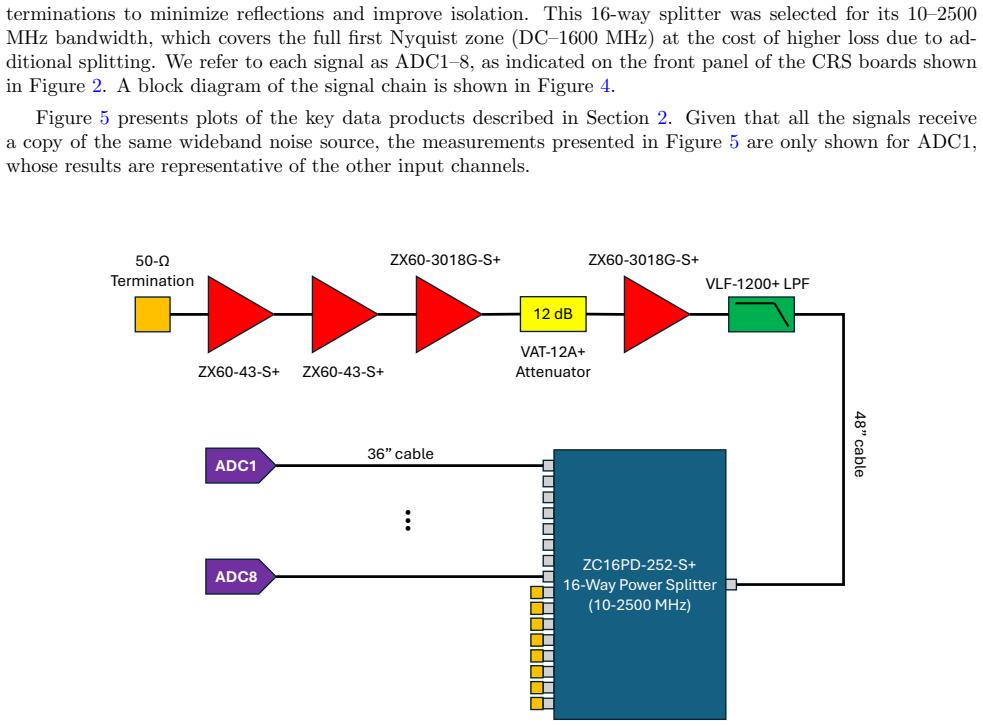
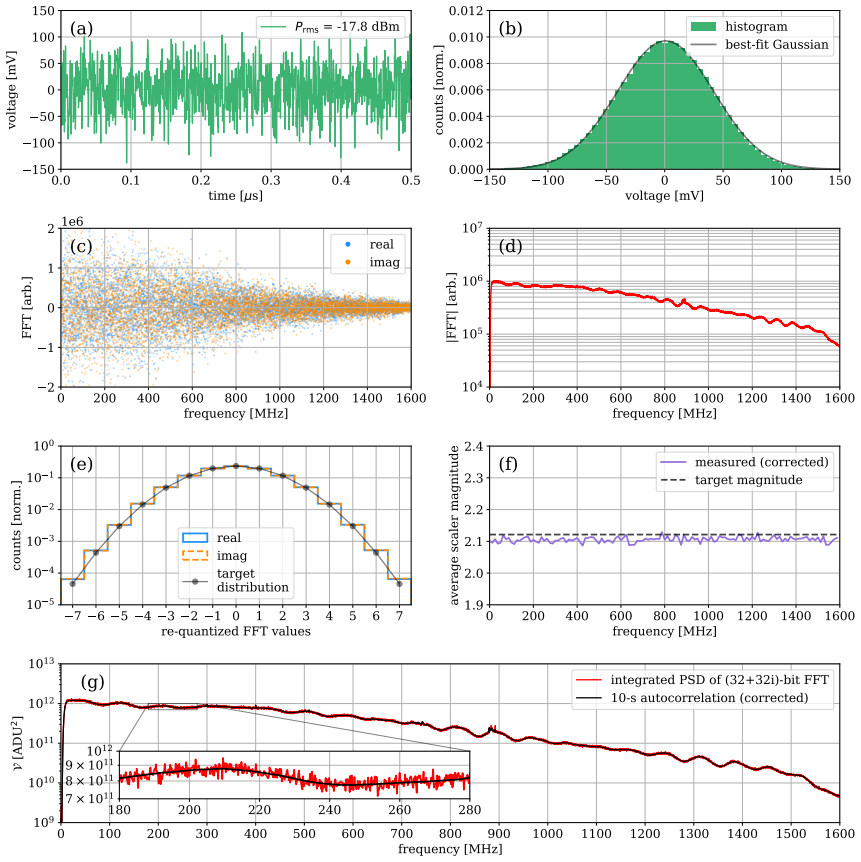
We introduce the design of the t0.technology Control and Readout System (CRS) F-Engine that will be used for the Canadian Hydrogen Observatory and Radio transient Detector (CHORD), a new radio interferometer currently being commissioned at the Dominion Radio Astrophysical Observatory (DRAO) in Canada. The CRS F-Engine will directly digitize and channelize 1024 individual RF signals from the 512 dual-polarized dishes of the core array using an array of 128 CRS boards, a multi-purpose microwave readout platform using an AMD Zynq Ultrascale+ RF-System-on-Chip (RFSoC) architecture. The CRS supports the required analog and digital signal processing and is appropriately scalable, with rack-mountable crates each supporting up to 16 CRS boards, equipped with a backplane for distribution of power, common clock and time synchronization signals, and a full-mesh network for intra-crate data transmission. Implemented on the CRS boards is the chFPGA firmware which supports the digitization of 8 analog signals at 3.2 GSPS and channelizes them with a CASPER-based PFB/FFT into 8,192 frequency bins with ~195 kHz of resolution, which are then re-quantized into (4 + 4i) bits for data offload to an external X-Engine. chFPGA supports multiple post-channelization signal processing options through separate bitstream files for different applications, such as a 100 GbE packet assembler-transmitter for CHORD to feed channelized data to its external GPU-based X-Engine, as well as FPGA-based N^2 correlators, including a single-board (N = 8) correlator (the ``Pocket Correlator"), and a multi-board corner-turn engine coupled with a half-CRS crate (N = 64) correlator. We demonstrate the performance of chFPGA by injecting a wideband Gaussian noise source into a CRS board running the Pocket Correlator firmware, and find that recovered digitized timestream and channelized data are in excellent agreement with expectations.
Editorial analysis
A structured set of objections, weighed in public.
Referee Report
Summary. The paper describes the architecture of the CRS F-Engine for the CHORD radio interferometer, which uses 128 CRS boards based on AMD Zynq Ultrascale+ RFSoC to digitize 1024 RF signals at 3.2 GSPS and channelize them via a CASPER PFB/FFT into 8192 bins. It details the chFPGA firmware supporting multiple post-channelization bitstreams (including a 100 GbE packet assembler for CHORD and the Pocket Correlator), the crate backplane for clock/time distribution, and a validation test in which wideband Gaussian noise was injected into a single CRS board running the Pocket Correlator firmware, with recovered timestreams and channelized data reported to agree with expectations.
Significance. If the single-board results extend to the full 128-board CHORD deployment on astronomical signals, the work would document a scalable, reconfigurable F-engine platform suitable for large-N interferometers. The manuscript provides a clear engineering description of the hardware and firmware options, but the validation evidence is narrow in scope.
major comments (2)
- [Abstract] Abstract and validation paragraph: the performance demonstration uses only a single CRS board running the Pocket Correlator firmware; no data are presented for the 100 GbE packet-assembler bitstream that will be used for CHORD, nor for inter-board clock distribution, packet loss, or synchronization across the full-mesh backplane or multiple crates. This makes the claim that the architecture is validated for CHORD rest on an untested extrapolation.
- [Abstract] Validation section (implied by abstract): the test injects wideband Gaussian noise and reports qualitative agreement, but the abstract supplies no quantitative metrics (e.g., RMS residuals, power-spectrum deviation, bit-error rates, or test conditions such as input power level or integration time). Without these, it is impossible to judge whether the observed agreement meets CHORD requirements.
minor comments (2)
- [Abstract] The abstract states that recovered data are in 'excellent agreement with expectations' without defining the expectations or providing error bars; a short quantitative summary would strengthen the claim.
- The manuscript would benefit from a table or diagram explicitly mapping the different post-channelization bitstreams (Pocket Correlator, 100 GbE assembler, N=64 correlator) to their intended use cases and tested configurations.
Simulated Author's Rebuttal
We thank the referee for their careful review and constructive comments. We address each major comment below, indicating where revisions have been made to the manuscript.
read point-by-point responses
-
Referee: [Abstract] Abstract and validation paragraph: the performance demonstration uses only a single CRS board running the Pocket Correlator firmware; no data are presented for the 100 GbE packet-assembler bitstream that will be used for CHORD, nor for inter-board clock distribution, packet loss, or synchronization across the full-mesh backplane or multiple crates. This makes the claim that the architecture is validated for CHORD rest on an untested extrapolation.
Authors: We agree that the presented validation uses a single board and the Pocket Correlator firmware only. The core PFB/FFT channelization is common to all bitstreams, but no data are shown for the 100 GbE assembler or multi-board synchronization. The manuscript describes the full architecture but the validation section is limited in scope. We have revised the abstract and added clarifying text in the discussion to state explicitly that the demonstration validates the digitization and channelization stages on a single board, without claiming full-system validation for the CHORD deployment. Full inter-board and CHORD-bitstream tests remain for future commissioning work. revision: partial
-
Referee: [Abstract] Validation section (implied by abstract): the test injects wideband Gaussian noise and reports qualitative agreement, but the abstract supplies no quantitative metrics (e.g., RMS residuals, power-spectrum deviation, bit-error rates, or test conditions such as input power level or integration time). Without these, it is impossible to judge whether the observed agreement meets CHORD requirements.
Authors: We agree that the abstract reports only qualitative agreement and omits quantitative metrics and test conditions. We have revised the abstract to include the key quantitative results and test parameters already present in the validation section of the manuscript (e.g., RMS residuals between measured and expected spectra, input power level, and integration time). revision: yes
Circularity Check
No circularity: direct engineering description and experimental validation with no derivations or self-referential claims
full rationale
The paper describes the CRS F-Engine hardware architecture, firmware options (including chFPGA and Pocket Correlator bitstream), and reports results from a single-board wideband Gaussian noise injection test. No equations, fitted parameters, predictions, uniqueness theorems, or ansatzes are present. Validation consists of direct comparison of digitized timestreams and 8192-channel PFB output to expectations, with no reduction of any claim to its own inputs by construction. Self-citations are absent from any load-bearing step. This matches the default expectation for an engineering report that is self-contained against external benchmarks.
Axiom & Free-Parameter Ledger
axioms (1)
- domain assumption The AMD Zynq Ultrascale+ RFSoC and CASPER PFB/FFT implementation can sustain 3.2 GSPS digitization and 8192-bin channelization per the stated bit widths and data rates.
Reference graph
Works this paper leans on
-
[1]
The Canadian Hydrogen Observatory and Radio-transient Detector (CHORD),
Vanderlinde, K., Liu, A., Gaensler, B., Bond, D., Hinshaw, G., Ng, C., Chiang, C., Stairs, I., Brown, J.-A., Sievers, J., Mena, J., Smith, K., Bandura, K., Masui, K., Spekkens, K., Belostotski, L., Dobbs, M., Turok, N., Boyle, P., Rupen, M., Landecker, T., Pen, U.-L., and Kaspi, V., “The Canadian Hydrogen Observatory and Radio-transient Detector (CHORD),”...
work page 2020
-
[2]
Overview of the Canadian Hydrogen Observatory and Radio-Transient Detector (CHORD) Project,
Dobbs, M., “Overview of the Canadian Hydrogen Observatory and Radio-Transient Detector (CHORD) Project,” in [Ground-based and Airborne Telescopes IX],Proceedings of SPIE14153, 14153–51, SPIE (2026). Conference presentation, SPIE Astronomical Telescopes + Instrumentation 2026, Copenhagen, Denmark
work page 2026
-
[3]
Detection of cosmological 21 cm emission with the canadian hydrogen intensity mapping experiment,
The CHIME Collaboration, Amiri, M., Bandura, K., Chen, T., Deng, M., Dobbs, M., Fandino, M., Foreman, S., Halpern, M., Hill, A. S., Hinshaw, G., H¨ ofer, C., Kania, J., Landecker, T. L., MacEachern, J., Masui, K., Mena-Parra, J., Milutinovic, N., Mirhosseini, A., Newburgh, L., Ordog, A., Pen, U.-L., Pinsonneault- Marotte, T., Polzin, A., Reda, A., Renard,...
work page 2023
-
[4]
The CHIME Collaboration, Amiri, M., Bandura, K., Chakraborty, A., Cliche, J.-F., Dobbs, M., Foreman, S., Gray, L., Halpern, M., Hill, A. S., Hinshaw, G., H¨ ofer, C., Joseph, A., Kruger, N., Landecker, T. L., van Lieshout, R., MacEachern, J., Masui, K. W., Mena-Parra, J., Miller, K., Milutinovic, N., Mirhosseini, A., Newburgh, L., Ordog, A., Pen, U.-L., P...
-
[5]
The First CHIME/FRB Fast Radio Burst Catalog,
The CHIME/FRB Collaboration, Amiri, M., Andersen, B. C., Bandura, K., Berger, S., Bhardwaj, M., Boyce, M. M., Boyle, P. J., Brar, C., Breitman, D., Cassanelli, T., Chawla, P., Chen, T., Cliche, J.-F., Cook, A., Cubranic, D., Curtin, A. P., Deng, M., Dobbs, M., (Adam) Dong, F., Eadie, G., Fandino, M., Fonseca, E., Gaensler, B. M., Giri, U., Good, D. C., Ha...
work page 2021
-
[6]
The Second CHIME/FRB Catalog of Fast Radio Bursts,
The CHIME/FRB Collaboration, Abbott, T., Andersen, B. C., Andrew, S., Bandura, K., Bhardwaj, M., Bhusare, Y., Brar, C., Cassanelli, T., Chatterjee, S., Cliche, J.-F., Cook, A. M., Curtin, A., Dobbs, M., Dong, F. A., Eadie, G., Eftekhari, T., Fonseca, E., Gaensler, B. M., Good, D., Halpern, M., Hessels, J. W. T., Ibik, A., Jain, N., Joseph, R. C., Kader, Z...
work page 2026
-
[7]
Hoff, B., Wulf, D., Islam, M., Dueck, T., and Hellyer, R., “Dish Working Group Progress Toward the CHORD 512-Dish Core Array: Completion of the 64-Dish Pathfinder,” in [Radio Telescopes, Technologies, and Methods],Proceedings of SPIE14153, 14153–62 (2026)
work page 2026
-
[8]
ICE: A Scalable, Low-Cost FPGA-Based Telescope Signal Processing and Networking System,
Bandura, K., Bender, A. N., Cliche, J. F., de Haan, T., Dobbs, M. A., Gilbert, A. J., Griffin, S., Hsyu, G., Ittah, D., Parra, J. M., Montgomery, J., Pinsonneault-Marotte, T., Siegel, S., Smecher, G., Tang, Q. Y., Vanderlinde, K., and Whitehorn, N., “ICE: A Scalable, Low-Cost FPGA-Based Telescope Signal Processing and Networking System,”Journal of Astrono...
work page 2016
-
[9]
The CRS: a scalable full-stack control system for Microwave Kinetic Inductance Detectors,
Montgomery, J., Avelino, W., Dobbs, M., Letang, J., Rouble, M., Savchyn, S., and Smecher, G., “The CRS: a scalable full-stack control system for Microwave Kinetic Inductance Detectors,” in [Millimeter, Submillimeter, and Far-Infrared Detectors and Instrumentation for Astronomy XII],Proceedings of SPIE 13102, 131020R (2024)
work page 2024
-
[10]
Available athttps: //escholarship.mcgill.ca/concern/theses/2b88qj88r?locale=en
Hendricksen, I.,Observational, digital readout, and calibration techniques for studying the redshifted 21cm signal of hydrogen, Master’s thesis, McGill University, Montr´ eal, QC, Canada (2023). Available athttps: //escholarship.mcgill.ca/concern/theses/2b88qj88r?locale=en
work page 2023
-
[11]
Avelino, W., Montgomery, J., Cliche, J.-F., Smecher, G., and Dobbs, M., “A High-Bandwidth Backplane for Wideband Radio Interferometers and Integration with the CHORD Telescope Correlators.”https: //arxiv.org/abs/2606.02825(2026)
work page internal anchor Pith review Pith/arXiv arXiv 2026
-
[12]
Cliche, J.-F. et al., “chFPGA Firmware Documentation.”http://winterlandcosmology.bitbucket.io/ chfpga/(2025)
work page 2025
-
[13]
pychfpga Software Documentation
Cliche, J.-F. et al., “pychfpga Software Documentation.”http://winterlandcosmology.bitbucket.io/ pychfpga/(2025)
work page 2025
-
[14]
Advanced Micro Devices, Inc.,Zynq UltraScale+ RFSoC RF Data Converter v2.6 Gen 1/2/3/DFE Logi- CORE IP Product Guide (PG269). Advanced Micro Devices, Inc. (2025)
work page 2025
-
[15]
Data Analysis for Precision 21 cm Cosmology,
Liu, A. and Shaw, J. R., “Data Analysis for Precision 21 cm Cosmology,”Publications of the Astronomical Society of the Pacific132, 062001 (Apr. 2020)
work page 2020
-
[16]
CASPER: Collaboration for Astronomy Signal Processing and Electronics Research
Collaboration, C., “CASPER: Collaboration for Astronomy Signal Processing and Electronics Research.” https://casper.berkeley.edu/(2025)
work page 2025
-
[17]
An Overview of CHIME, the Canadian Hydrogen Intensity Mapping Experiment,
The CHIME Collaboration, Amiri, M., Bandura, K., Boskovic, A., Chen, T., Cliche, J.-F., Deng, M., Denman, N., Dobbs, M., Fandino, M., Foreman, S., Halpern, M., Hanna, D., Hill, A. S., Hinshaw, G., H¨ ofer, C., Kania, J., Klages, P., Landecker, T. L., MacEachern, J., Masui, K., Mena-Parra, J., Milutinovic, N., Mirhosseini, A., Newburgh, L., Nitsche, R., Or...
work page 2022
-
[18]
Condon, J. J. and Ransom, S. M., [Essential Radio Astronomy], Princeton University Press, Princeton, NJ, USA (2016)
work page 2016
-
[19]
Quantization Bias for Digital Correlators,
Mena-Parra, J., Bandura, K., Dobbs, M. A., Shaw, J. R., and Siegel, S., “Quantization Bias for Digital Correlators,”Journal of Astronomical Instrumentation07(02n03), 1850008 (2018)
work page 2018
-
[20]
Development of composite reflector tech- nology for the Deep Dish Development Array,
Islam, M. N., Hellyer, R., Chiang, H. C., and Vanderlinde, K., “Development of composite reflector tech- nology for the Deep Dish Development Array,” in [Ground-based and Airborne Telescopes VIII],Proceedings of SPIE11445, 1144523 (2020)
work page 2020
-
[21]
Errors in Deep Dish Development Array (6m) construction and metrology steps,
Islam, M. N., ¨Ol¸ cek, D., Lacy, G., Chiang, H. C., and Hellyer, R., “Errors in Deep Dish Development Array (6m) construction and metrology steps,” in [Ground-based and Airborne Telescopes IX],Proceedings of SPIE12182, 121820F (2022)
work page 2022
-
[22]
Innovation, Science and Economic Development Canada (ISED), “SRSP-503 — Technical Requirements for Cellular Systems, Including Flexible Use Broadband Systems, in the Bands 824–849 MHz and 869–894 MHz,” Tech. Rep. Issue 9, Government of Canada (July 2024)
work page 2024
-
[23]
Innovation, Science and Economic Development Canada (ISED), “SRSP-518 — Technical Requirements in the Bands 617–652 MHz, 663–698 MHz, 698–756 MHz and 777–787 MHz,” Tech. Rep. Issue 2, Government of Canada (February 2019)
work page 2019
discussion (0)
Sign in with ORCID, Apple, or X to comment. Anyone can read and Pith papers without signing in.