AI Virtue: What is "Good" Knowledge in the Age of Artificial Intelligence?
Pith reviewed 2026-07-03 06:18 UTC · model grok-4.3
The pith
Mapping epistemic virtues in 553 AI articles points toward a generativity-based framework for judging good knowledge.
A machine-rendered reading of the paper's core claim, the machinery that carries it, and where it could break.
Core claim
Through digital humanities mapping of epistemic virtues in the 2024 AI article corpus, with special attention to creativity, the discourse of value can serve as the basis for developing a framework to evaluate the knowledge-worth of AI that is less bound to pre-AI knowledge work paradigms and more attuned to the future values of generativity.
What carries the argument
Digital humanities mapping of epistemic virtues across the 553-article corpus, using creativity as the focal example, to ground consideration of a new evaluative framework.
If this is right
- AI knowledge could be judged primarily by its generative capacity rather than by alignment with traditional accuracy or truth standards alone.
- Individual human knowledge workers would lose their central position as the reference point for evaluating knowledge quality.
- Creativity in AI contexts would be reinterpreted as a property of generative processes rather than solely of human insight.
- Digital tools for corpus analysis would become standard for refining value frameworks as AI discourse evolves.
Where Pith is reading between the lines
- The same mapping technique could be applied to other domains such as biotechnology or climate modeling to surface shifts in what counts as valuable knowledge.
- Institutions might adopt generativity-oriented criteria when setting guidelines for AI use in research or education.
- Empirical tests could check whether AI outputs rated high in generativity produce greater downstream societal effects than those rated by older virtues.
Load-bearing premise
The chosen corpus of 553 articles together with the digital humanities mapping of their epistemic virtues supplies an adequate foundation for building an evaluative framework that departs from pre-AI values.
What would settle it
Evidence that the virtues appearing in the 2024 AI articles are essentially the same as those in pre-AI discussions of knowledge production would show that the mapping does not enable a meaningfully new framework.
Figures
read the original abstract
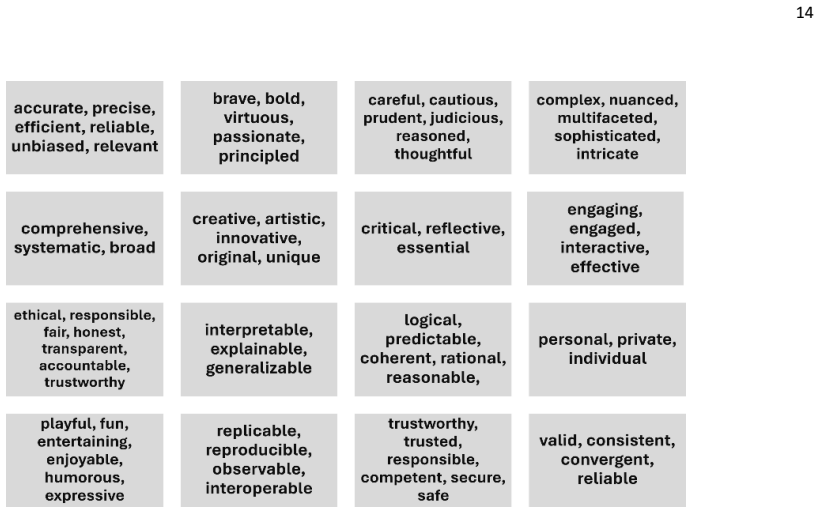
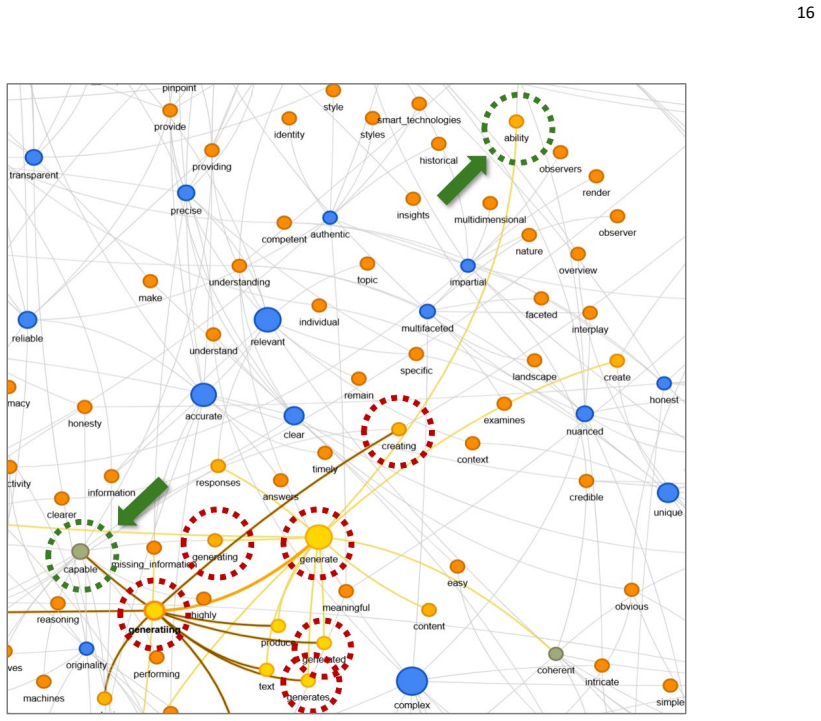
In the age of AI, what will be good knowledge? This article, which is accepted and forthcoming in a special issue of Modern Fiction Studies on "Cultural AI" in 2027, applies digital humanities methods to map epistemic virtues (like "true," "accurate," "creative") used in a corpus of 553 journal articles on AI published in 2024. "Creativity" comes in for special attention as an example. Exploring this discourse of value, the article considers how a framework might be developed for evaluating the knowledge-worth of AI -- one less locked into values formed around pre-AI "knowledge work" agents or structures, and more open to the future values of "generativity." The essay is supported by an online digital kit for exploring data models of the corpus of articles on AI it studies.
Editorial analysis
A structured set of objections, weighed in public.
Referee Report
Summary. The paper applies digital humanities methods to map epistemic virtues (e.g., 'true,' 'accurate,' 'creative') across a corpus of 553 journal articles on AI published in 2024, with focused discussion of 'creativity.' It then considers how such mappings could support development of an evaluative framework for 'good' knowledge in AI—one oriented toward future 'generativity' values rather than pre-AI knowledge-work norms—and supplies an accompanying online digital kit for data exploration.
Significance. If the virtue mapping proves robust and the generativity framework is explicitly derived with clear, falsifiable criteria, the work could contribute to AI ethics and epistemology by providing an empirical basis for shifting evaluative standards. The digital kit is a positive feature that supports reproducibility and community extension of the analysis.
major comments (2)
- [Methods / Corpus description] The manuscript supplies no details on corpus construction (selection criteria for the 553 articles), coding procedures for epistemic virtues, validation steps, or inter-coder reliability. This absence directly undermines the reliability of the mapped virtue distributions that are intended to ground the proposed framework.
- [Discussion / Framework proposal] No control corpus from a pre-AI period is analyzed, and no explicit construction or re-weighting procedure is given to show how the observed 2024 virtues would be transformed into a 'generativity' criterion. The central claim that the mapping enables a framework departing from pre-AI values therefore rests on an unsupported interpretive move rather than demonstrated evidence.
minor comments (1)
- The abstract states that the essay is supported by an online digital kit, but the main text should include a dedicated subsection describing the kit's contents, data models, and how users can reproduce or extend the virtue mappings.
Simulated Author's Rebuttal
We thank the referee for their constructive report, which identifies key areas where greater transparency and explicitness would strengthen the manuscript. We address each major comment below, indicating planned revisions where appropriate.
read point-by-point responses
-
Referee: [Methods / Corpus description] The manuscript supplies no details on corpus construction (selection criteria for the 553 articles), coding procedures for epistemic virtues, validation steps, or inter-coder reliability. This absence directly undermines the reliability of the mapped virtue distributions that are intended to ground the proposed framework.
Authors: We agree that the current manuscript provides insufficient methodological detail on corpus construction and coding. Although the piece was written for a humanities journal special issue that favors interpretive narrative, the referee is correct that this limits assessment of the virtue mappings. In revision we will add a dedicated Methods subsection specifying the databases and search strings used to assemble the 553 articles, the procedure for extracting epistemic-virtue terms, the coding protocol (including whether it was manual or tool-assisted), and any validation or reliability checks performed. If single-coder coding was used, we will state the rationale and any supplementary checks. This addition will be made without altering the paper’s core argument. revision: yes
-
Referee: [Discussion / Framework proposal] No control corpus from a pre-AI period is analyzed, and no explicit construction or re-weighting procedure is given to show how the observed 2024 virtues would be transformed into a 'generativity' criterion. The central claim that the mapping enables a framework departing from pre-AI values therefore rests on an unsupported interpretive move rather than demonstrated evidence.
Authors: The manuscript does not present a comparative empirical study with a pre-AI control corpus, nor does it supply a formal re-weighting algorithm; the generativity framework is offered as a conceptual proposal derived from the observed 2024 distributions rather than a fully operationalized transformation. We therefore accept the referee’s observation that the interpretive step is not demonstrated with quantitative evidence. In revision we will (a) explicitly acknowledge the absence of a control corpus as a limitation and (b) add a short subsection that articulates the proposed generativity criteria in more falsifiable terms (e.g., how virtues such as creativity might be re-weighted toward future-oriented production). These clarifications will be added while preserving the paper’s primarily interpretive character. revision: partial
Circularity Check
No circularity: corpus mapping is descriptive; framework is proposed without reduction to inputs
full rationale
The paper applies digital humanities methods to map epistemic virtues (true, accurate, creative, etc.) across 553 2024 AI articles and then considers how a framework open to 'generativity' might be developed. This is an interpretive and exploratory exercise, not a derivation, prediction, or first-principles result that reduces to its own inputs by construction. No equations, fitted parameters renamed as predictions, self-citation load-bearing uniqueness theorems, or ansatzes smuggled via citation are present. The mapping step stands as independent description of the corpus; the framework suggestion is explicitly tentative and does not claim to be forced by the data or prior self-work. The analysis is self-contained against external benchmarks of corpus description.
Axiom & Free-Parameter Ledger
Reference graph
Works this paper leans on
-
[1]
Homogenization Effects of Large Language Models on Human Creative Ideation
Anderson, Barrett R., et al. “Homogenization Effects of Large Language Models on Human Creative Ideation.” Creativity and Cognition, 2024, pp. 413–25, https://doi.org/10.1145/3635636.3656204. Anthony, Laurence. AntConc (Version 4.3.1). Waseda University, 29 July 2024, https://www.laurenceanthony.net/software/antconc/. ———. WordFamilyFinder, Ver. 1.0.1. n....
-
[2]
Attention (to Virtuosity) Is All You Need: Religious Studies Pedagogy and Generative AI
Barlow, Jonathan, and Lynn Holt. “Attention (to Virtuosity) Is All You Need: Religious Studies Pedagogy and Generative AI.” Religions, vol. 15, no. 9.1059, 2024, https://doi.org/10.3390/rel15091059. Barnard, Joel. “What Are Word Embeddings?” IBM, n. d., https://www.ibm.com/think/topics/word-embeddings. Bauer, Laurie, and Paul Nation. “Word Families.” Inte...
-
[4]
On the Opportunities and Risks of Foundation Models
arXiv.org, http://arxiv.org/abs/2108.07258. Bratton, Benjamin H. The Stack: On Software and Sovereignty. MIT Press,
work page internal anchor Pith review Pith/arXiv arXiv
-
[5]
H2 2025 Innovation Economy Update
Software Studies. Candy, Nick, and Vincent Harrison. “H2 2025 Innovation Economy Update.” J. P. Morgan, 28 Jan. 2026, https://www.jpmorgan.com/insights/markets-and-economy/economy/innovation- economy-outlook. Clanchy, M. T. From Memory to Written Record: England, 1066-1307. 3rd ed, Wiley,
2025
-
[6]
Introduction: Epistemic Virtues in the Sciences and the Humanities
www.wired.com, https://www.wired.com/story/tiktok-platforms-cory-doctorow/. Dongen, Jeroen van, and Herman Paul. “Introduction: Epistemic Virtues in the Sciences and the Humanities.” Epistemic Virtues in the Sciences and the Humanities, edited by Jeroen van Dongen 18 and Herman Paul, Springer International Publishing, 2017, pp. 1–10, https://doi.org/10.10...
-
[7]
Foucault, Michel. “What Is an Author?” Language Counter-Memory, Practice: Selected Essays and Interviews, edited by Donald F. Bouchard, translated by Donald F. Bouchard and Sherry Simon, Cornell University Press, 1977, pp. 113–38. Franceschelli, Giorgio, and Mirco Musolesi. “On the Creativity of Large Language Models.” AI & Society, vol. 40, Nov. 2024, pp...
-
[8]
AI Is Changing the World: For Better or for Worse?
Grewal, Dhruv, et al. “AI Is Changing the World: For Better or for Worse?” Journal of Macromarketing, vol. 44, no. 4, 2024, pp. 870–82, https://doi.org/10.1177/02761467241254450. Griffith, Erin. “A.I. Is Changing How Silicon Valley Builds Start-Ups.” New York Times, 20 Feb. 2025, https://www.nytimes.com/2025/02/20/technology/ai-silicon-valley-start-ups.ht...
-
[9]
Using the Fractal Enterprise Model for Inter-Organizational Business Processes
Henkel, Martin, et al. “Using the Fractal Enterprise Model for Inter-Organizational Business Processes.” Proceedings of the ER Forum and Poster & Demos Session 2019 on Publishing Papers with CEUR-WS Co-Located with 38th International Conference on Conceptual Modeling (ER 2019), Salvador, Brazil, November 4, 2019, edited by José Ignacio Panach et al., vol....
2019
-
[10]
Networks of Power: Electrification in Western Society, 1880-1930
Hughes, Thomas P. Networks of Power: Electrification in Western Society, 1880-1930. Johns Hopkins University Press,
1930
-
[11]
Smaller Is Better in Silicon Valley’s ‘Tiny Team’ Moment
Kelley, Lora. “Smaller Is Better in Silicon Valley’s ‘Tiny Team’ Moment.” New York Times, 28 Mar. 2026, https://www.nytimes.com/2026/03/28/business/silicon-valley-tiny-team-two- slice.html. 19 Kleinberg, Jon, and Manish Raghavan. “Algorithmic Monoculture and Social Welfare.” Proceedings of the National Academy of Sciences, vol. 118, no. 22, June 2021, p. ...
-
[12]
16 Oct. 2025, JavaScript, HTML, Python. 2026, GitHub, https://github.com/scottkleinman/dfr-browser2. Kommers, Cody, et al. “Why Slop Matters.” ACM AI Letters, vol. 1, no. 1 Article 3, Mar. 2026, pp. 1–6, https://doi.org/10.1145/3786777. Latour, Bruno. “An Attempt at a ‘Compositionist Manifesto.’” New Literary History, vol. 41, no. 3, 2010, pp. 471–90. ———...
-
[13]
Li, Wenxiu, et al. “Artificial Intelligence Auxiliary Diagnosis and Treatment System for Breast Cancer in Developing Countries.” Journal of X-Ray Science and Technology, vol. 32, no. 2, Mar. 2024, pp. 395–413, https://doi.org/10.3233/XST-230194. Liu, Alan. “Kit for Exploring Articles on AI Published in 2024.” Alan Liu, 2025, https://alanyliu.org/citation/...
-
[14]
Thinking Destruction: Creativity, Rational Choice, Emergence, and Destruction Theory
———. “Thinking Destruction: Creativity, Rational Choice, Emergence, and Destruction Theory.” Occasion, vol. 1, 2009, https://shc.stanford.edu/arcade/publications/occasion/rational- choice-theory-and-humanities/thinking-destruction-creativity. ———. “What Is Good Writing in the Age of ChatGPT?” Alan Liu , 18 June 2023, https://liu.english.ucsb.edu/what-is-g...
-
[15]
Project Gutenberg, https://www.gutenberg.org/ebooks/1200. Ramaul, Laavanya, et al. “Creational and Conversational AI Affordances: How the New Breed of Chatbots Is Revolutionizing Knowledge Industries.” Business Horizons, vol. 67, no. 5, 2024, pp. 615–27, https://doi.org/10.1016/j.bushor.2024.05.006. Rockmore, Dan. “What It’s Like to Brainstorm with a Bot....
-
[16]
Agent Harness: The Infrastructure for Reliable AI
www.newyorker.com, https://www.newyorker.com/culture/the-weekend-essay/what-its-like- to-brainstorm-with-a-bot. Salesforce, Inc. “Agent Harness: The Infrastructure for Reliable AI.” Agentforce, n. d., https://www.salesforce.com/agentforce/ai-agents/agent-harness/. Schindler, Samuel. “Theoretical Virtues: Do Scientists Think What Philosophers Think They Ou...
-
[17]
Who Are the Publics Engaging in AI?
Sieber, Renée, et al. “Who Are the Publics Engaging in AI?” Public Understanding of Science, vol. 33, no. 5, July 2024, pp. 634–53, https://doi.org/10.1177/09636625231219853. Stiegler, Bernard. Technics and Time. Translated by Richard Beardsworth and George Colins, vol. 1, Stanford University Press,
-
[18]
Digital Writing with AI Platforms: The Role of Fun with/in Generative AI
Stornaiuolo, Amy, et al. “Digital Writing with AI Platforms: The Role of Fun with/in Generative AI.” English Teaching: Practice & Critique, vol. 23, no. 1, 2024, pp. 83–103, https://doi.org/10.1108/ETPC-08-2023-0103. Sui, Peiqi, Eamon Duede, Sophie Wu, et al. “Confabulation: The Surprising Value of Large Language Model Hallucinations.” arXiv:2406.04175, a...
-
[19]
Critical Confabulation: Can LLMs Hallucinate for Social Good?
arXiv.org, https://doi.org/10.48550/arXiv.2406.04175. Sui, Peiqi, Eamon Duede, Hoyt Long, et al. “Critical Confabulation: Can LLMs Hallucinate for Social Good?” arXiv:2511.07722, arXiv, 11 Nov
-
[20]
The Agentic Organization: Contours of the Next Paradigm for the AI Era
arXiv.org, https://doi.org/10.48550/arXiv.2511.07722. 21 Sukharevsky, Alexander, et al. “The Agentic Organization: Contours of the Next Paradigm for the AI Era.” McKinsey & Company, 26 Sept. 2025, https://www.mckinsey.com/capabilities/people-and-organizational-performance/our- insights/the-agentic-organization-contours-of-the-next-paradigm-for-the-ai-era....
-
[21]
Advancing Human-Machine Teaming: Definitions, Challenges, Future Directions
Stanford Encyclopedia of Philosophy, https://plato.stanford.edu/archives/win2021/entries/epistemology-virtue/. University of California. Report of the Academic Senate Workgroup on Artificial Intelligence. 10 Dec. 2025, pp. 1–20, https://senate.universityofcalifornia.edu/_files/reports/council-chair-to-senate- divisions-senate-ai-workgroup-report.pdf. Verh...
-
[22]
The Role of AI in Changing Company Structures and Dynamics
Williamson, Dael, and Fabian Lanz. “The Role of AI in Changing Company Structures and Dynamics.” Databricks, 12 Nov. 2024, https://www.databricks.com/blog/role-ai-changing- company-structures-and-dynamics. Zhang, Yan, and Barbara M. Wildemuth. “Qualitative Analysis of Content.” Applications of Social Research Methods to Questions in Information and Librar...
2024
discussion (0)
Sign in with ORCID, Apple, or X to comment. Anyone can read and Pith papers without signing in.