Uniqueness and Analytic Structures of Bosonic String Effective Amplitudes
Pith reviewed 2026-07-03 08:56 UTC · model grok-4.3
The pith
Imposing gauge invariance, locality, and cyclicity uniquely fixes operators that reconstruct bosonic string amplitudes recursively from Yang-Mills amplitudes.
A machine-rendered reading of the paper's core claim, the machinery that carries it, and where it could break.
Core claim
Imposing gauge invariance, locality, and cyclicity under minimal assumptions uniquely fixes a set of dimension-raising operators and leads to a recursive construction of amplitudes from Yang-Mills amplitudes in the α'→0 limit. At finite α', inverse operators reconstruct the full bosonic string effective amplitudes, yielding compact expressions that universally factorize into tachyon-pole coefficients times Yang-Mills-Scalar amplitudes. This structure holds at arbitrary multiplicity and also extends to the amplitudes of the pure (DF)^2, (DF)^2+φ³ and (DF)^2+YM+φ³ theories.
What carries the argument
The set of dimension-raising operators fixed by gauge invariance, locality and cyclicity, along with their inverse versions that include α'-dependent gauge-invariant factors.
Load-bearing premise
The zero-transcendentality sector with spin-1 states matches the mass-deformed (DF)^2 + YM theory exactly, and that gauge invariance, locality, and cyclicity under minimal assumptions are sufficient to fix the operators without more input from string theory.
What would settle it
An explicit five-point amplitude computation in the bosonic string effective field theory that fails to match the predicted factorization into a tachyon pole term times a Yang-Mills-scalar amplitude obtained from the inverse operators.
Figures
read the original abstract
We revisit the zero-transcendentality sector of bosonic string effective amplitudes with spin-1 external states, conjectured to correspond to a mass-deformed $(DF)^2$ theory, known as the $(DF)^2{+}\text{YM}$ theory. Imposing gauge invariance, locality, and cyclicity under minimal assumptions uniquely fixes a set of dimension-raising operators and leads to a recursive construction of amplitudes from Yang-Mills amplitudes in the $\alpha'{\to}0$ limit. At finite $\alpha'$, certain derivative operators dressed with gauge invariant and $\alpha'$-dependent factors, what we call $\textit{inverse operators}$, reconstruct the full bosonic string effective amplitudes, yielding compact expressions that universally factorize into tachyon-pole coefficients times Yang-Mills-Scalar amplitudes. This structure holds at arbitrary multiplicity and also extends to the amplitudes of the pure $(DF)^2$, $(DF)^2{+}\phi^{3}$ and $(DF)^2{+}\text{YM}{+}\phi^{3}$ theories.
Editorial analysis
A structured set of objections, weighed in public.
Referee Report
Summary. The paper claims that in the zero-transcendentality sector of bosonic string effective amplitudes with spin-1 external states (conjectured to match mass-deformed (DF)^2 + YM theory), the conditions of gauge invariance, locality, and cyclicity under minimal assumptions uniquely fix a set of dimension-raising operators. This yields a recursive construction of amplitudes from Yang-Mills amplitudes as α' → 0. At finite α', inverse operators (derivative operators dressed with gauge-invariant, α'-dependent factors) reconstruct the full bosonic-string amplitudes, producing compact expressions that factorize universally into tachyon-pole coefficients times Yang-Mills-Scalar amplitudes. The structure holds at arbitrary multiplicity and extends to the pure (DF)^2, (DF)^2 + φ³, and (DF)^2 + YM + φ³ theories.
Significance. If the uniqueness and reconstruction hold, the work supplies a symmetry-based route to string effective amplitudes that bypasses direct string-theory input beyond the initial sector conjecture, delivering recursive relations and compact factorized forms useful for higher-multiplicity calculations. The extension across related theories is a positive feature. No machine-checked proofs or parameter-free derivations are reported.
major comments (1)
- [The recursive ansatz and linear-system solution for the dimension-raising operators] The uniqueness result rests on solving a linear system obtained from a recursive ansatz for the dimension-raising operators that is compatible with gauge invariance, locality, and cyclicity. No completeness argument is supplied showing that this ansatz exhausts the full space of local, gauge-invariant, cyclic operators of the required dimension. Without such an argument (e.g., via generating functions or explicit basis enumeration), the claim that the three conditions alone uniquely determine the operators does not follow, and the subsequent reconstruction of bosonic-string amplitudes from the stated assumptions is not guaranteed. This is load-bearing for the central claim.
Simulated Author's Rebuttal
We thank the referee for their careful reading and for identifying this important point about the completeness of the ansatz. We address the major comment below.
read point-by-point responses
-
Referee: The uniqueness result rests on solving a linear system obtained from a recursive ansatz for the dimension-raising operators that is compatible with gauge invariance, locality, and cyclicity. No completeness argument is supplied showing that this ansatz exhausts the full space of local, gauge-invariant, cyclic operators of the required dimension. Without such an argument (e.g., via generating functions or explicit basis enumeration), the claim that the three conditions alone uniquely determine the operators does not follow, and the subsequent reconstruction of bosonic-string amplitudes from the stated assumptions is not guaranteed. This is load-bearing for the central claim.
Authors: We agree that an explicit completeness argument demonstrating that the recursive ansatz spans the full space of local, gauge-invariant, cyclic operators is not supplied in the manuscript. The ansatz was assembled by including every independent monomial structure with the requisite number of derivatives and field insertions that cannot be eliminated by integration by parts, gauge transformations, or cyclicity at the given mass dimension; the resulting linear system is overdetermined yet possesses a unique solution at each recursive step. While explicit verification for low multiplicities and the pattern of uniqueness support the claim, a formal proof that no extraneous operators lie outside this basis is absent. In the revised version we will add a dedicated subsection that (i) enumerates the independent structures entering the ansatz, (ii) shows by dimension counting and symmetry reduction that any additional local cyclic gauge-invariant term is either redundant or reducible to the ansatz, and (iii) explains why the overconstrained linear system therefore fixes the operators uniquely under the stated minimal assumptions. This addition will make the uniqueness statement fully rigorous. revision: yes
Circularity Check
Uniqueness of operators tied to initial conjecture of (DF)^2 + YM correspondence
specific steps
-
self definitional
[Abstract]
"We revisit the zero-transcendentality sector of bosonic string effective amplitudes with spin-1 external states, conjectured to correspond to a mass-deformed (DF)^2 theory, known as the (DF)^2 + YM theory. Imposing gauge invariance, locality, and cyclicity under minimal assumptions uniquely fixes a set of dimension-raising operators and leads to a recursive construction of amplitudes from Yang-Mills amplitudes in the α'→0 limit."
The paper first posits the correspondence to (DF)^2 + YM as a conjecture, then claims the three conditions uniquely determine the operators and produce the string amplitudes via recursion from YM. The uniqueness and reconstruction are therefore defined inside the conjectured theory, so the result is equivalent to the input assumption by construction.
full rationale
The derivation begins by conjecturing that the zero-transcendentality sector matches the mass-deformed (DF)^2 + YM theory, then asserts that gauge invariance, locality and cyclicity uniquely fix the operators and enable recursive reconstruction of the bosonic-string amplitudes. Because the uniqueness statement and the recursive construction are performed inside the framework defined by that conjecture, the central claim reduces to properties already built into the assumed equivalence rather than being derived independently from string theory. No completeness proof for the ansatz is supplied in the given text, so the uniqueness is internal to the conjectured setup.
Axiom & Free-Parameter Ledger
axioms (2)
- domain assumption The zero-transcendentality sector of bosonic string amplitudes with spin-1 states corresponds to the mass-deformed (DF)^2 + YM theory
- domain assumption Gauge invariance, locality, and cyclicity under minimal assumptions are sufficient to uniquely fix the dimension-raising operators
invented entities (1)
-
inverse operators
no independent evidence
Reference graph
Works this paper leans on
-
[1]
Universality in string interactions
Y.-t. Huang, O. Schlotterer, and C. Wen, JHEP09, 155 (2016), arXiv:1602.01674 [hep-th]
work page internal anchor Pith review Pith/arXiv arXiv 2016
-
[2]
Open & Closed vs. Pure Open String Disk Amplitudes
S. Stieberger, (2009), arXiv:0907.2211 [hep-th]
work page internal anchor Pith review Pith/arXiv arXiv 2009
-
[3]
Heterotic and bosonic string amplitudes via field theory
T. Azevedo, M. Chiodaroli, H. Johansson, and O. Schlot- terer, JHEP10, 012 (2018), arXiv:1803.05452 [hep-th]
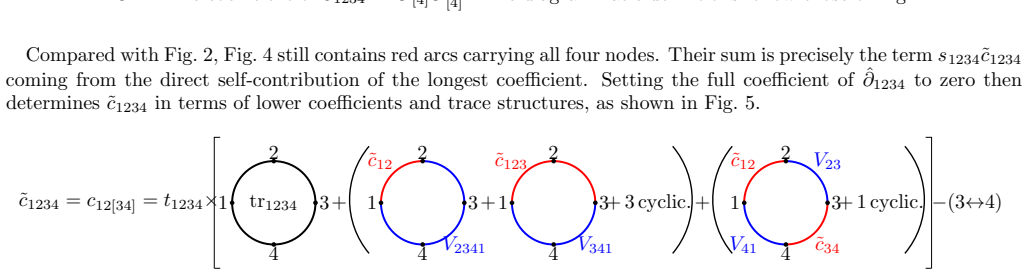
work page internal anchor Pith review Pith/arXiv arXiv 2018
-
[4]
Locality and Unitarity from Singularities and Gauge Invariance
N. Arkani-Hamed, L. Rodina, and J. Trnka, Phys. Rev. Lett.120, 231602 (2018), arXiv:1612.02797 [hep-th]
work page internal anchor Pith review Pith/arXiv arXiv 2018
-
[5]
Rodina, JHEP09, 084 (2019), arXiv:1612.06342 [hep- th]
L. Rodina, JHEP09, 084 (2019), arXiv:1612.06342 [hep- th]
-
[6]
Rodina, JHEP09, 078 (2019), arXiv:1612.03885 [hep- th]
L. Rodina, JHEP09, 078 (2019), arXiv:1612.03885 [hep- th]
-
[7]
Scattering Amplitudes from Soft Theorems and Infrared Behavior
L. Rodina, Phys. Rev. Lett.122, 071601 (2019), arXiv:1807.09738 [hep-th]
work page internal anchor Pith review Pith/arXiv arXiv 2019
-
[8]
Veneziano, Nuovo Cim
G. Veneziano, Nuovo Cim. A57, 190 (1968)
1968
-
[9]
M. A. Virasoro, Phys. Rev.177, 2309 (1969)
1969
-
[10]
J. A. Shapiro, Phys. Lett. B33, 361 (1970)
1970
-
[11]
Strings from Massive Higher Spins: The Asymptotic Uniqueness of the Veneziano Amplitude
S. Caron-Huot, Z. Komargodski, A. Sever, and A. Zhi- boedov, JHEP10, 026 (2017), arXiv:1607.04253 [hep-th]
work page internal anchor Pith review Pith/arXiv arXiv 2017
-
[12]
Y.-t. Huang, J.-Y. Liu, L. Rodina, and Y. Wang, JHEP 04, 195 (2021), arXiv:2008.02293 [hep-th]
-
[13]
A. Guerrieri, J. Penedones, and P. Vieira, Phys. Rev. Lett.127, 081601 (2021), arXiv:2102.02847 [hep-th]
-
[14]
N. Geiser and L. W. Lindwasser, JHEP12, 112 (2022), arXiv:2207.08855 [hep-th]
-
[15]
N. Geiser and L. W. Lindwasser, JHEP04, 031 (2023), arXiv:2210.14920 [hep-th]
-
[16]
C. Cheung and G. N. Remmen, JHEP01, 122 (2023), arXiv:2210.12163 [hep-th]
-
[17]
C. Cheung and G. N. Remmen, Phys. Rev. D108, 026011 (2023), arXiv:2302.12263 [hep-th]
-
[18]
C. Cheung and G. N. Remmen, Phys. Rev. D108, 086009 (2023), arXiv:2308.03833 [hep-th]
-
[19]
K. H¨ aring and A. Zhiboedov, JHEP10, 075 (2024), arXiv:2311.13631 [hep-th]
- [20]
- [21]
- [22]
-
[23]
C. Cheung, G. N. Remmen, F. Sciotti, and M. Tarquini, Phys. Rev. Lett.136, 251601 (2026), arXiv:2508.09246 [hep-th]
work page internal anchor Pith review Pith/arXiv arXiv 2026
-
[24]
Analytic Bootstrap of the Veneziano Amplitude
S.-L. Wan and S.-Y. Zhou, (2026), arXiv:2605.11084 [hep-th]
work page internal anchor Pith review Pith/arXiv arXiv 2026
-
[25]
Berkovits, JHEP04, 018 (2000), arXiv:hep- th/0001035
N. Berkovits, JHEP04, 018 (2000), arXiv:hep- th/0001035
-
[26]
Berkovits, JHEP09, 047 (2004), arXiv:hep- th/0406055
N. Berkovits, JHEP09, 047 (2004), arXiv:hep- th/0406055
-
[27]
Berkovits, JHEP10, 089 (2005), arXiv:hep- th/0509120
N. Berkovits, JHEP10, 089 (2005), arXiv:hep- th/0509120
-
[28]
C. R. Mafra, O. Schlotterer, and S. Stieberger, Nucl. Phys. B873, 419 (2013), arXiv:1106.2645 [hep-th]
work page internal anchor Pith review Pith/arXiv arXiv 2013
-
[29]
C. R. Mafra, O. Schlotterer, and S. Stieberger, Nucl. Phys. B873, 461 (2013), arXiv:1106.2646 [hep-th]
work page internal anchor Pith review Pith/arXiv arXiv 2013
-
[30]
All order alpha'-expansion of superstring trees from the Drinfeld associator
J. Broedel, O. Schlotterer, S. Stieberger, and T. Tera- soma, Phys. Rev. D89, 066014 (2014), arXiv:1304.7304 [hep-th]
work page internal anchor Pith review Pith/arXiv arXiv 2014
-
[31]
Polylogarithms, Multiple Zeta Values and Superstring Amplitudes
J. Broedel, O. Schlotterer, and S. Stieberger, Fortsch. Phys.61, 812 (2013), arXiv:1304.7267 [hep-th]
work page internal anchor Pith review Pith/arXiv arXiv 2013
-
[32]
Conformal Gravity from Gauge Theory
H. Johansson and J. Nohle, (2017), arXiv:1707.02965 [hep-th]
work page internal anchor Pith review Pith/arXiv arXiv 2017
-
[33]
S. He, F. Teng, and Y. Zhang, Phys. Rev. Lett.122, 211603 (2019), arXiv:1812.03369 [hep-th]
work page internal anchor Pith review Pith/arXiv arXiv 2019
- [34]
- [35]
-
[36]
Unifying Relations for Scattering Amplitudes
C. Cheung, C.-H. Shen, and C. Wen, JHEP02, 095 (2018), arXiv:1705.03025 [hep-th]
work page internal anchor Pith review Pith/arXiv arXiv 2018
-
[37]
Kleiss and H
R. Kleiss and H. Kuijf, Nucl. Phys.B312, 616 (1989)
1989
-
[38]
F. A. Berends and W. T. Giele, Nucl. Phys. B306, 759 (1988)
1988
-
[39]
A Periodic Table of Effective Field Theories
C. Cheung, K. Kampf, J. Novotny, C.-H. Shen, and J. Trnka, JHEP02, 020 (2017), arXiv:1611.03137 [hep- th]
work page internal anchor Pith review Pith/arXiv arXiv 2017
-
[40]
Note that our definition of insertion operator is differ a signature form the one in [36]
-
[41]
Scattering of Massless Particles: Scalars, Gluons and Gravitons
F. Cachazo, S. He, and E. Y. Yuan, JHEP07, 033 (2014), arXiv:1309.0885 [hep-th]
work page internal anchor Pith review Pith/arXiv arXiv 2014
-
[42]
Z. Bern, J. J. M. Carrasco, and H. Johansson, Phys. Rev. D78, 085011 (2008), arXiv:0805.3993 [hep-ph]
work page internal anchor Pith review Pith/arXiv arXiv 2008
-
[43]
Z. Bern, J. J. M. Carrasco, and H. Johansson, Phys. Rev. Lett.105, 061602 (2010), arXiv:1004.0476 [hep-th]
work page internal anchor Pith review Pith/arXiv arXiv 2010
- [44]
-
[45]
Kawai, D
H. Kawai, D. C. Lewellen, and S. H. H. Tye, Nucl. Phys. B269, 1 (1986). 7
1986
-
[46]
Ambitwistor formulations of $R^2$ gravity and $(DF)^2$ gauge theories
T. Azevedo and O. T. Engelund, JHEP11, 052 (2017), arXiv:1707.02192 [hep-th]
work page internal anchor Pith review Pith/arXiv arXiv 2017
-
[47]
Scattering Equations and Matrices: From Einstein To Yang-Mills, DBI and NLSM
F. Cachazo, S. He, and E. Y. Yuan, JHEP07, 149 (2015), arXiv:1412.3479 [hep-th]
work page internal anchor Pith review Pith/arXiv arXiv 2015
-
[48]
A. Edison and F. Teng, JHEP12, 138 (2020), arXiv:2005.03638 [hep-th]
- [49]
-
[50]
We have checked (28) up to seven points
-
[51]
Disk Scattering of Open and Closed Strings (I)
S. Stieberger and T. R. Taylor, Nucl. Phys. B903, 104 (2016), arXiv:1510.01774 [hep-th]
work page internal anchor Pith review Pith/arXiv arXiv 2016
- [52]
-
[53]
C. R. Mafra and O. Schlotterer, Phys. Rev. Lett.121, 011601 (2018), arXiv:1711.09104 [hep-th]
work page internal anchor Pith review Pith/arXiv arXiv 2018
- [54]
-
[55]
Stieberger, (2022), arXiv:2212.06816 [hep-th]
S. Stieberger, (2022), arXiv:2212.06816 [hep-th]
-
[56]
S. Stieberger, Phys. Rev. Lett.132, 191602 (2024), arXiv:2310.07755 [hep-th]
- [57]
- [58]
-
[59]
L. M. Garozzo and A. Guevara, JHEP07, 002 (2024), arXiv:2402.19430 [hep-th]. Appendix A: Short introduction to the(DF) 2 family We briefly review the (DF)2 gauge-theory family following Refs. [3, 32]. These theories are useful because their tree amplitudes obey color–kinematics duality and can therefore serve as gauge-theory factors in double-copy constru...
-
[60]
Since these operators obey Kleiss–Kuijf relations, the ordinary coefficients ˜cρ must transform dually under a change of KK basis
Kleiss–Kuijf transformations of the coefficients The ansatz for ˆO−1 is written in terms of transmutation operators. Since these operators obey Kleiss–Kuijf relations, the ordinary coefficients ˜cρ must transform dually under a change of KK basis. This is a linear basis-independence property of ˜cρ; it should not be confused with the nonlinear recursion f...
-
[61]
For convenience, we fix the adjoint ordering of each ˆ∂ρ as (ρ|ρ|ρ1
Recursive blocks from transmutation Let us expand ˆO−1 [n−1] ˆO[n−1] and focus on the terms contributing to a longest single-cycle transmutation operator, for instance ˆ∂12...(n−1). For convenience, we fix the adjoint ordering of each ˆ∂ρ as (ρ|ρ|ρ1 . . . ρ|ρ|−1). Since the longest single-cycle transmutation operator contains only one trace operator, all ...
-
[62]
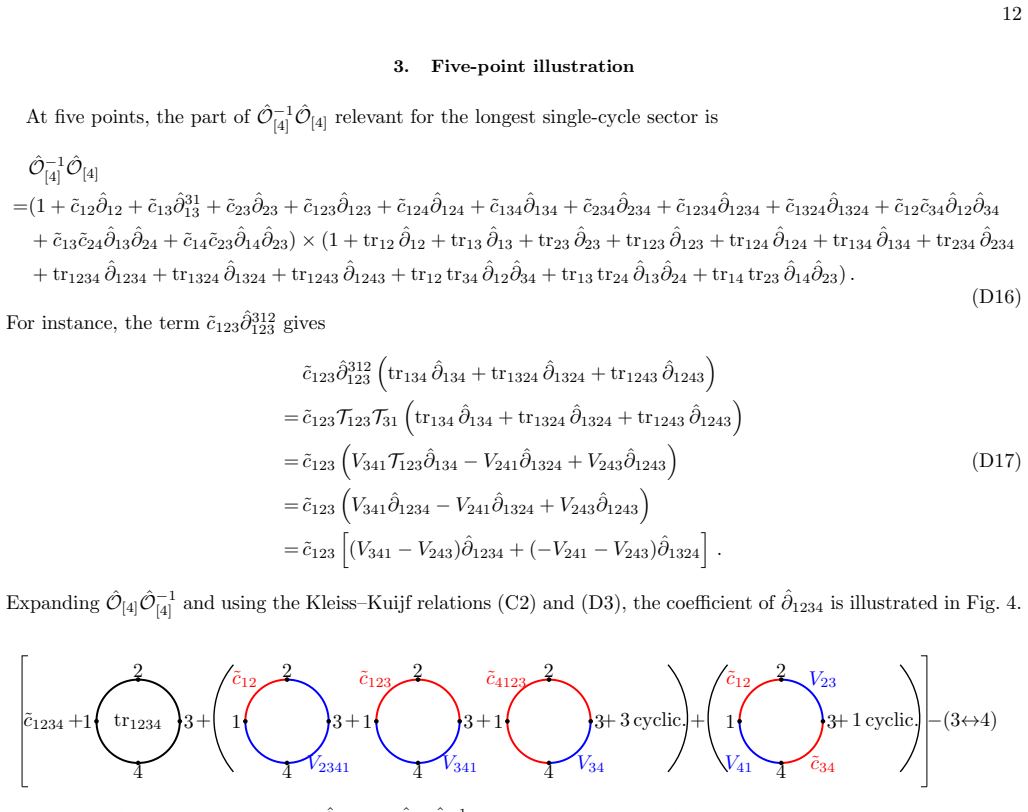
Five-point illustration At five points, the part of ˆO−1 [4] ˆO[4] relevant for the longest single-cycle sector is ˆO−1 [4] ˆO[4] =(1 + ˜c12 ˆ∂12 + ˜c13 ˆ∂31 13 + ˜c23 ˆ∂23 + ˜c123 ˆ∂123 + ˜c124 ˆ∂124 + ˜c134 ˆ∂134 + ˜c234 ˆ∂234 + ˜c1234 ˆ∂1234 + ˜c1324 ˆ∂1324 + ˜c12˜c34 ˆ∂12 ˆ∂34 + ˜c13˜c24 ˆ∂13 ˆ∂24 + ˜c14˜c23 ˆ∂14 ˆ∂23)×(1 + tr 12 ˆ∂12 + tr13 ˆ∂13 + tr...
-
[63]
and using the Kleiss–Kuijf relations (C2) and (D3), the coefficient of ˆ∂1234 is illustrated in Fig. 4. ˜c1234 + −(3↔4)tr1234 + + + 3 cyclic.+ + 1 cyclic.+ V2341 ˜c12 V341 ˜c123 ˜c34 V23˜c12 V41V34 ˜c4123 4 1 2 3 4 1 2 3 4 1 2 3 4 1 2 3 4 1 2 3 FIG. 4: The coefficient of ˆ∂1234 in ˆO[4] ˆO−1
-
[64]
The diagrammatic definitions follow those of Fig. 2. Compared with Fig. 2, Fig. 4 still contains red arcs carrying all four nodes. Their sum is precisely the terms1234˜c1234 coming from the direct self-contribution of the longest coefficient. Setting the full coefficient of ˆ∂1234 to zero then determines ˜c1234 in terms of lower coefficients and trace str...
discussion (0)
Sign in with ORCID, Apple, or X to comment. Anyone can read and Pith papers without signing in.