Neutron stars with primary scalar hair
Pith reviewed 2026-07-03 08:31 UTC · model grok-4.3
The pith
Neutron stars carrying primary scalar hair in a DHOST subfamily become more compact than in general relativity, developing singularities above a critical charge.
A machine-rendered reading of the paper's core claim, the machinery that carries it, and where it could break.
Core claim
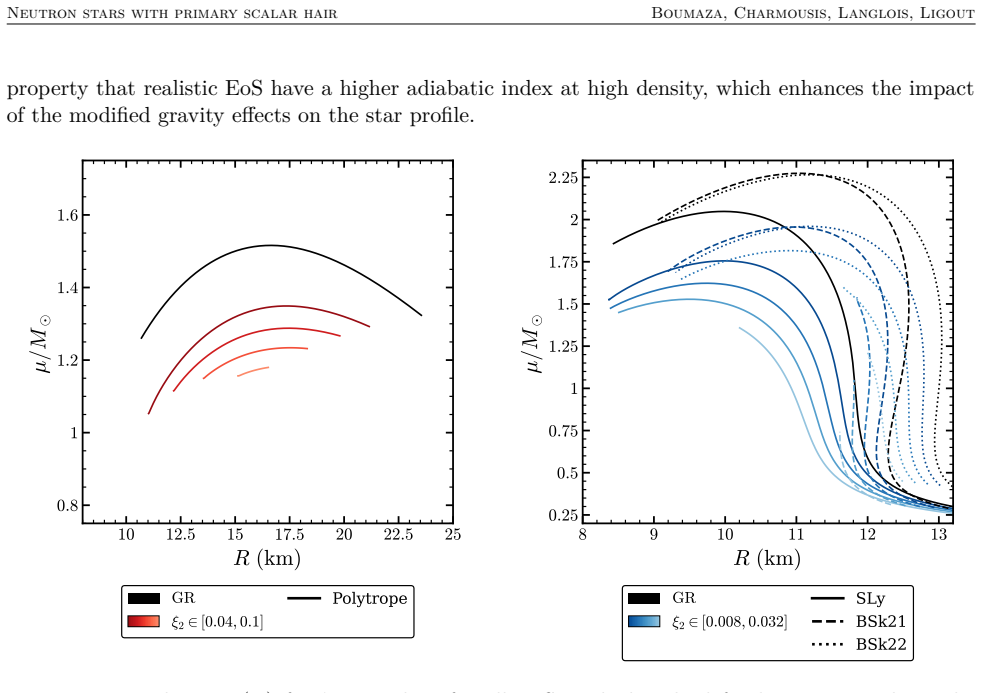
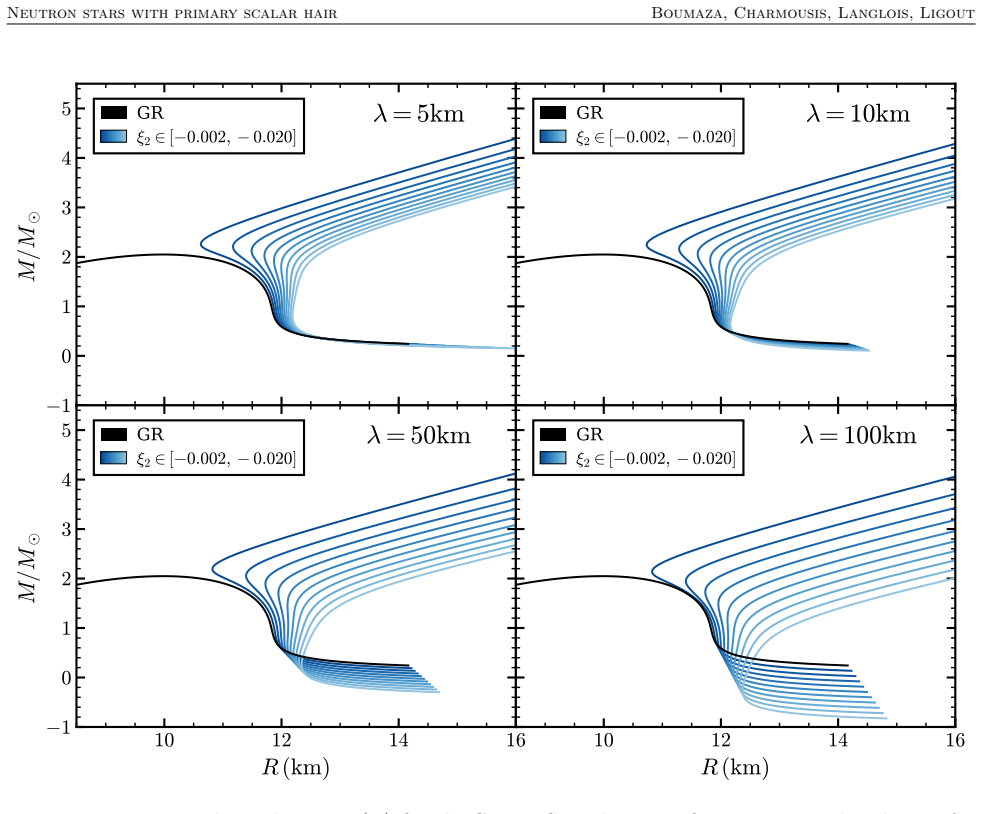
In the selected DHOST subfamily, equilibrium neutron star configurations exist that carry primary scalar hair. The modified TOV equations yield more compact stars for positive scalar charges than their GR counterparts; above a critical charge value the configurations develop singularities. The resulting mass-radius relations deviate measurably from GR predictions for both polytropic and realistic equations of state.
What carries the argument
Primary scalar hair implemented via the modified Tolman-Oppenheimer-Volkoff equations obtained from the DHOST action under static spherical symmetry.
If this is right
- Positive scalar charges produce systematically smaller radii at fixed mass than in GR.
- A critical scalar-charge threshold exists beyond which no regular stellar solution remains.
- Mass-radius relations for both polytropic and realistic equations of state deviate from GR in a charge-dependent way.
- Astrophysical measurements of compactness or maximum mass can therefore bound the DHOST parameters that control the hair.
Where Pith is reading between the lines
- Tidal deformability measurements from gravitational-wave events could further constrain the allowed range of scalar charges.
- The singularity threshold may indicate where the effective-field-theory description breaks down and higher-order operators become necessary.
- If realistic equations of state already saturate the compactness limit in GR, the additional compaction from hair could exclude entire families of DHOST models.
Load-bearing premise
The modified Tolman-Oppenheimer-Volkoff equations derived from the chosen DHOST subfamily correctly describe static spherically symmetric equilibrium configurations that carry primary scalar hair.
What would settle it
An observed neutron-star mass-radius pair that lies outside the family of more-compact curves predicted for any allowed scalar charge, or the detection of a highly compact star without the expected singularity, would falsify the central claim.
Figures
read the original abstract
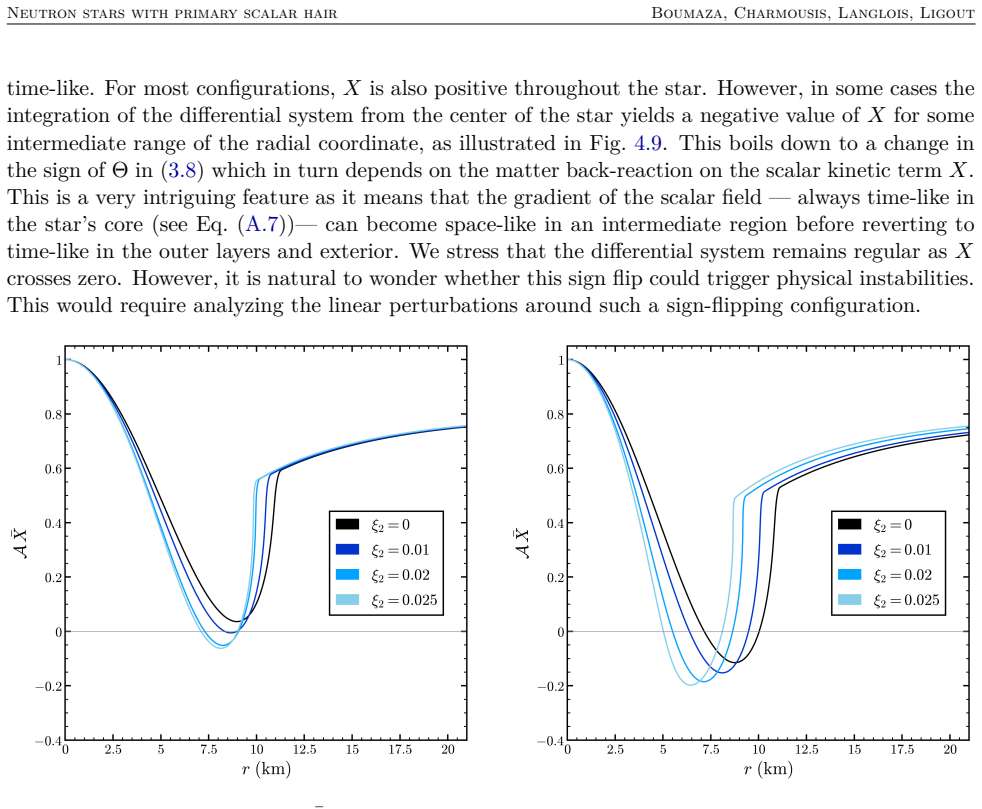
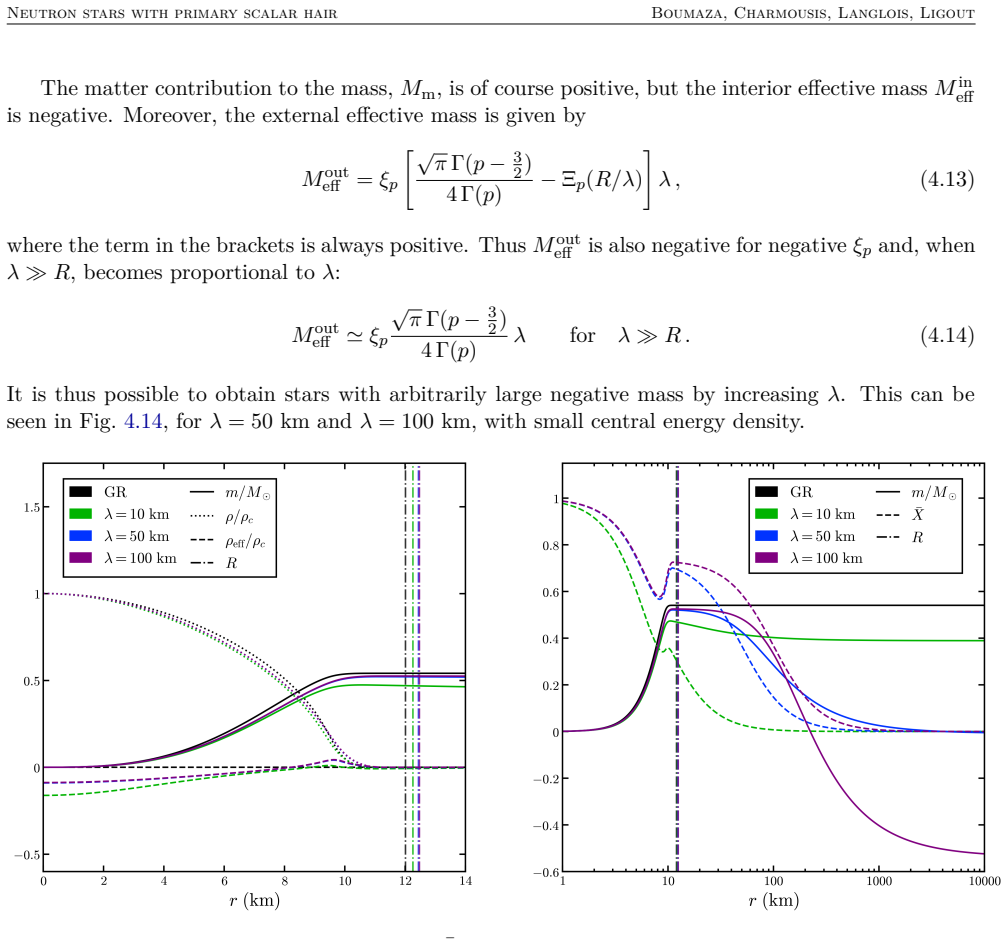
We investigate static and spherically symmetric neutron star solutions endowed with primary scalar hair in a subfamily of Degenerate-Higher-Order-Scalar-Tensor (DHOST) theories of gravity. By solving the modified Tolman-Oppenheimer-Volkoff (TOV) equations, we construct equilibrium configurations for polytropic and realistic equations of state and analyse the impact of the scalar hair on the stellar structure. We examine the resulting metric and scalar field profiles as well as the mass-radius relation, showing deviations from the predictions of General Relativity (GR). Positive scalar charges lead to more compact stars than in GR and, above a critical threshold, to singularities. Observations could therefore put stringent constraints on the parameters characterising the beyond-GR effects in these theories and their potential scalar hair.
Editorial analysis
A structured set of objections, weighed in public.
Referee Report
Summary. The paper constructs families of static, spherically symmetric neutron-star solutions carrying primary scalar hair in a chosen subfamily of DHOST theories. Modified Tolman-Oppenheimer-Volkoff equations are integrated numerically for both polytropic and realistic equations of state; the resulting metric and scalar profiles, mass-radius relations, and compactness are compared with GR. The central finding is that positive scalar charge increases compactness relative to GR and produces singularities above a critical threshold, with the implication that observations can constrain the theory parameters.
Significance. If the modified field equations and boundary conditions for primary hair are correctly implemented, the work supplies explicit, falsifiable examples of how primary scalar hair alters neutron-star structure in DHOST gravity. The use of both polytropic and realistic EOS, together with the reported singularity threshold, supplies a concrete mechanism for placing bounds on beyond-GR parameters from mass-radius data. The reduction to the GR limit when the scalar charge vanishes is a necessary consistency check that strengthens the result.
minor comments (3)
- [§2] §2: the precise functional form of the DHOST Lagrangian (the functions A_i, B_i, etc.) and the values of the free parameters retained in the subfamily should be written explicitly so that the modified TOV system can be reproduced without ambiguity.
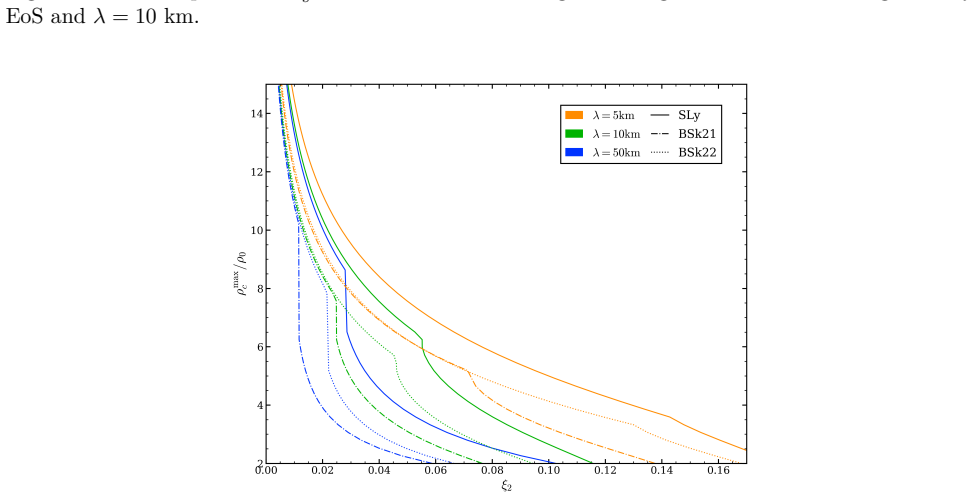
- [§4.1] §4.1 and Fig. 2: the numerical integration scheme (shooting method, radial step size, convergence criterion) and the precise location of the reported singularities (coordinate vs. curvature) are not stated; adding this information would allow independent verification of the compactness increase and the critical-charge threshold.
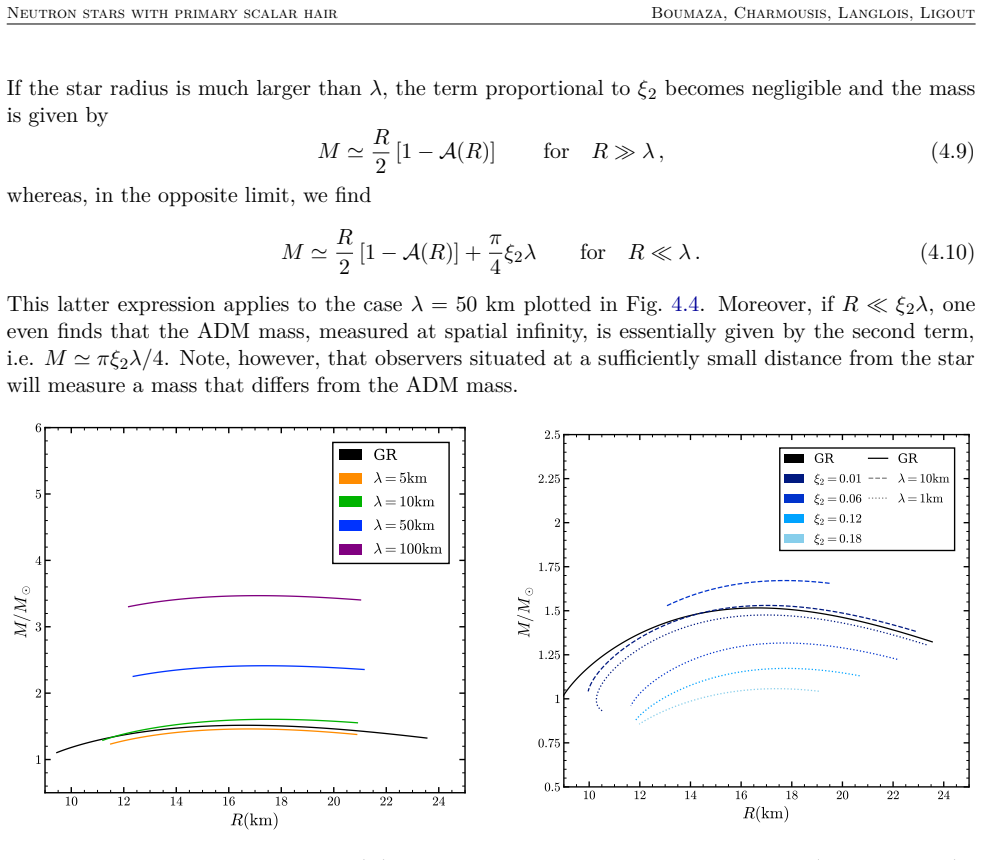
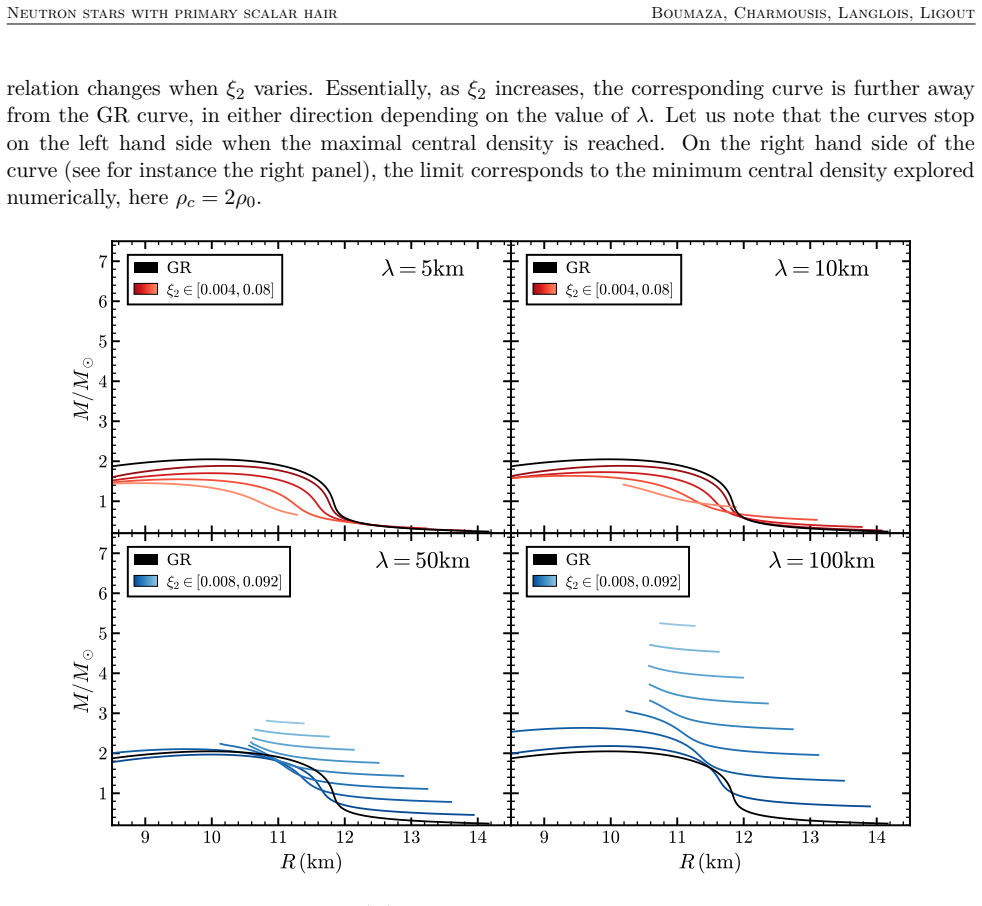
- The mass-radius curves for varying scalar charge should be accompanied by a table of central densities, radii, and compactness values so that the quantitative deviation from GR can be assessed directly.
Simulated Author's Rebuttal
We thank the referee for their positive assessment of our work on neutron-star solutions with primary scalar hair in DHOST theories. The report correctly identifies the key results, including the increased compactness for positive scalar charge, the singularity threshold, and the recovery of the GR limit. No major comments were raised, so we have no point-by-point rebuttals. We will incorporate any minor suggestions in the revised manuscript.
Circularity Check
No significant circularity identified
full rationale
The derivation proceeds by obtaining the modified TOV equations from the chosen DHOST subfamily action under static spherical symmetry, imposing boundary conditions that allow primary scalar hair (vanishing at infinity, nonzero central value), and numerically integrating for given EOS to obtain metric and scalar profiles. Mass-radius relations and compactness trends are direct outputs of these integrations; no parameter is fitted to a subset of the target data and then relabeled as a prediction, no self-citation supplies a uniqueness theorem that forces the result, and the GR limit is recovered by construction when the scalar charge vanishes without circular redefinition. The central claims therefore remain independent of the inputs.
Axiom & Free-Parameter Ledger
free parameters (1)
- scalar charge / theory parameters
axioms (1)
- domain assumption The chosen DHOST subfamily admits static spherically symmetric solutions with non-trivial primary scalar hair.
Reference graph
Works this paper leans on
-
[1]
G. Raaijmakerset al., “Constraining the dense matter equation of state with joint analysis of NICER and LIGO/Virgo measurements,”Astrophys. J. Lett.893no. 1, (2020) L21, arXiv:1912.11031 [astro-ph.HE]. (cit. on p. 2) [5]ETCollaboration, A. Abacet al., “The Science of the Einstein Telescope,”JCAP03(2026) 081,arXiv:2503.12263 [gr-qc]. (cit. on p. 2) [6]LISA...
-
[2]
The possibility of the secondary object in GW190814 as a neutron star,
K. Huang, J. Hu, Y. Zhang, and H. Shen, “The possibility of the secondary object in GW190814 as a neutron star,”Astrophys. J.904no. 1, (2020) 39,arXiv:2008.04491 [nucl-th]. (cit. on p. 2)
-
[3]
Was GW190814 a Black Hole–Strange Quark Star System?,
I. Bombaci, A. Drago, D. Logoteta, G. Pagliara, and I. Vidaña, “Was GW190814 a Black Hole–Strange Quark Star System?,”Phys. Rev. Lett.126no. 16, (2021) 162702, arXiv:2010.01509 [nucl-th]. (cit. on p. 2)
-
[4]
R-mode Stability of GW190814’s Secondary Component as a Supermassive and Superfast Pulsar,
X. Zhou, A. Li, and B.-A. Li, “R-mode Stability of GW190814’s Secondary Component as a Supermassive and Superfast Pulsar,”Astrophys. J.910no. 1, (2021) 62,arXiv:2011.11934 [astro-ph.HE]. (cit. on p. 2) 28 Neutron stars with primary scalar hair Boumaza, Charmousis, Langlois, Ligout
-
[5]
E. R. Most, L. J. Papenfort, L. R. Weih, and L. Rezzolla, “A lower bound on the maximum mass if the secondary in GW190814 was once a rapidly spinning neutron star,”Mon. Not. Roy. Astron. Soc.499no. 1, (2020) L82–L86,arXiv:2006.14601 [astro-ph.HE]. (cit. on p. 2)
-
[6]
A. Kanakis-Pegios, P. S. Koliogiannis, and C. C. Moustakidis, “Probing the Nuclear Equation of State from the Existence of a∼2.6M⊙Neutron Star: The GW190814 Puzzle,”Symmetry13 no. 2, (2021) 183,arXiv:2012.09580 [astro-ph.HE]. (cit. on p. 2)
-
[7]
GW170817 and GW190814: tension on the maximum mass,
A. Nathanail, E. R. Most, and L. Rezzolla, “GW170817 and GW190814: tension on the maximum mass,”Astrophys. J. Lett.908no. 2, (2021) L28,arXiv:2101.01735 [astro-ph.HE]. (cit. on p. 2)
-
[8]
Degenerate higher derivative theories beyond Horndeski: evading the Ostrogradski instability
D. Langlois and K. Noui, “Degenerate higher derivative theories beyond Horndeski: evading the Ostrogradski instability,”JCAP1602no. 02, (2016) 034,arXiv:1510.06930 [gr-qc]. (cit. on pp. 3 and 4)
work page internal anchor Pith review Pith/arXiv arXiv 2016
-
[9]
Hamiltonian analysis of higher derivative scalar-tensor theories
D. Langlois and K. Noui, “Hamiltonian analysis of higher derivative scalar-tensor theories,” JCAP1607no. 07, (2016) 016,arXiv:1512.06820 [gr-qc]. (cit. on p. 3)
work page internal anchor Pith review Pith/arXiv arXiv 2016
-
[10]
Degenerate higher order scalar-tensor theories beyond Horndeski up to cubic order
J. Ben Achour, M. Crisostomi, K. Koyama, D. Langlois, K. Noui, and G. Tasinato, “Degenerate higher order scalar-tensor theories beyond Horndeski up to cubic order,”JHEP12(2016) 100, arXiv:1608.08135 [hep-th]. (cit. on p. 3)
work page internal anchor Pith review Pith/arXiv arXiv 2016
-
[11]
Dark Energy and Modified Gravity in Degenerate Higher-Order Scalar-Tensor (DHOST) theories: a review
D. Langlois, “Dark energy and modified gravity in degenerate higher-order scalar–tensor (DHOST) theories: A review,”Int. J. Mod. Phys. D28no. 05, (2019) 1942006, arXiv:1811.06271 [gr-qc]. (cit. on p. 3)
work page internal anchor Pith review Pith/arXiv arXiv 2019
-
[12]
Horndeski theory and beyond: a review
T. Kobayashi, “Horndeski theory and beyond: a review,”Rept. Prog. Phys.82no. 8, (2019) 086901,arXiv:1901.07183 [gr-qc]. (cit. on p. 3)
work page internal anchor Pith review Pith/arXiv arXiv 2019
-
[13]
Black holes with primary scalar hair,
A. Bakopoulos, C. Charmousis, P. Kanti, N. Lecoeur, and T. Nakas, “Black holes with primary scalar hair,”Phys. Rev. D109no. 2, (2024) 024032,arXiv:2310.11919 [gr-qc]. (cit. on pp. 3, 5, 10, 24, and 25)
-
[14]
O. Baake, A. Cisterna, M. Hassaine, and U. Hernandez-Vera, “Endowing black holes with beyond-Horndeski primary hair: An exact solution framework for scalarizing in every dimension,”Phys. Rev. D109no. 6, (2024) 064024,arXiv:2312.05207 [hep-th]. (cit. on pp. 3, 5, 6, and 24)
-
[15]
Compact objects with primary hair in shift and parity symmetric beyond Horndeski gravities,
A. Bakopoulos, N. Chatzifotis, and T. Nakas, “Compact objects with primary hair in shift and parity symmetric beyond Horndeski gravities,”Phys. Rev. D110no. 2, (2024) 024044, arXiv:2312.17198 [gr-qc]. (cit. on pp. 3, 4, 5, 6, and 24)
-
[16]
Dressing a black hole with a time-dependent Galileon
E. Babichev and C. Charmousis, “Dressing a black hole with a time-dependent Galileon,”JHEP 08(2014) 106,arXiv:1312.3204 [gr-qc]. (cit. on p. 3)
work page internal anchor Pith review Pith/arXiv arXiv 2014
-
[17]
Slowly rotating Black Holes in DHOST Theories,
H. Candan, K. Noui, and D. Langlois, “Slowly rotating Black Holes in DHOST Theories,” arXiv:2512.17614 [gr-qc]. (cit. on p. 3)
-
[18]
Thermodynamics of black holes featuring primary scalar hair,
A. Bakopoulos, N. Chatzifotis, and T. Karakasis, “Thermodynamics of black holes featuring primary scalar hair,”Phys. Rev. D110no. 10, (2024) L101502,arXiv:2404.07522 [hep-th]. (cit. on p. 3) 29 Neutron stars with primary scalar hair Boumaza, Charmousis, Langlois, Ligout
-
[19]
Thermodynamics of stealth black holes,
A. Bakopoulos, T. Karakasis, and E. Papantonopoulos, “Thermodynamics of stealth black holes,”Phys. Rev. D111no. 2, (2025) 024065,arXiv:2410.14451 [hep-th]. (cit. on p. 3)
-
[20]
C. Erices and M. Fathi, “Thermodynamic and observational constraints on black holes with primary hair in Beyond Horndeski gravity: Stability and shadows,”JCAP01(2025) 016, arXiv:2409.07312 [gr-qc]. (cit. on p. 3)
-
[21]
Effect of primary scalar hair on black hole’s strong lensing in Beyond Horndeski gravity,
M. Fathi, “Effect of primary scalar hair on black hole’s strong lensing in Beyond Horndeski gravity,”Phys. Dark Univ.50(2025) 102069,arXiv:2502.19155 [gr-qc]. (cit. on p. 3)
-
[22]
Rotating Black Holes with Primary Scalar Hair: Shadow Signatures in Beyond Horndeski Gravity
K. Nozari, M. Hajebrahimi, S. Saghafi, G. Mustafa, and E. N. Saridakis, “Rotating Black Holes with Primary Scalar Hair: Shadow Signatures in Beyond Horndeski Gravity,” arXiv:2602.16237 [gr-qc]. (cit. on p. 3)
work page internal anchor Pith review Pith/arXiv arXiv
-
[23]
Stability and quasinormal modes for black holes with time-dependent scalar hair,
S. Sirera and J. Noller, “Stability and quasinormal modes for black holes with time-dependent scalar hair,”Phys. Rev. D111no. 4, (2025) 044067,arXiv:2408.01720 [gr-qc]. (cit. on p. 3)
-
[24]
Greybody factors in scalar-tensor gravity and beyond,
G. Antoniou, T. D. Pappas, and P. Kanti, “Greybody factors in scalar-tensor gravity and beyond,”Phys. Rev. D112no. 8, (2025) 084013,arXiv:2507.17329 [gr-qc]. (cit. on p. 3)
-
[25]
Montagnon,Quasi-Normal Modes of Black Holes in Quantum Gravity
C. Montagnon,Quasi-Normal Modes of Black Holes in Quantum Gravity. PhD thesis, Lyon, Ecole Normale Superieure, 2025. (cit. on p. 3)
2025
- [26]
-
[27]
Quasinormal Modes and Hawking Radiation of Black Holes with Primary Scalar Hair,
R. Konoplya, O. Stashko, and Z. Stuchlík, “Quasinormal Modes and Hawking Radiation of Black Holes with Primary Scalar Hair,”arXiv:2606.16125 [gr-qc]. (cit. on p. 3)
-
[28]
Axial perturbations of black holes with primary scalar hair,
C. Charmousis, S. Iteanu, D. Langlois, and K. Noui, “Axial perturbations of black holes with primary scalar hair,”JCAP05(2025) 102,arXiv:2503.22348 [gr-qc]. (cit. on pp. 3, 4, 5, 6, 7, and 24)
-
[29]
Radial Perturbations of Black Holes in DHOST Theories
C. Charmousis, S. Iteanu, D. Langlois, and K. Noui, “Radial Perturbations of Black Holes in DHOST Theories,”arXiv:2606.25972 [gr-qc]. (cit. on pp. 3 and 4)
work page internal anchor Pith review Pith/arXiv arXiv
-
[30]
Nonperturbative strong field effects in tensor - scalar theories of gravitation,
T. Damour and G. Esposito-Farese, “Nonperturbative strong field effects in tensor - scalar theories of gravitation,”Phys. Rev. Lett.70(1993) 2220–2223. (cit. on p. 3)
1993
-
[31]
A. Cisterna, T. Delsate, and M. Rinaldi, “Neutron stars in general second order scalar-tensor theory: The case of nonminimal derivative coupling,”Phys. Rev. D92no. 4, (2015) 044050, arXiv:1504.05189 [gr-qc]. (cit. on p. 3)
work page internal anchor Pith review Pith/arXiv arXiv 2015
-
[32]
Slowly rotating neutron stars in the nonminimal derivative coupling sector of Horndeski gravity
A. Cisterna, T. Delsate, L. Ducobu, and M. Rinaldi, “Slowly rotating neutron stars in the nonminimal derivative coupling sector of Horndeski gravity,”Phys. Rev. D93no. 8, (2016) 084046,arXiv:1602.06939 [gr-qc]. (cit. on p. 3)
work page internal anchor Pith review Pith/arXiv arXiv 2016
-
[33]
Relativistic Stars in Beyond Horndeski Theories
E. Babichev, K. Koyama, D. Langlois, R. Saito, and J. Sakstein, “Relativistic Stars in Beyond Horndeski Theories,”Class. Quant. Grav.33no. 23, (2016) 235014,arXiv:1606.06627 [gr-qc]. (cit. on p. 3)
work page internal anchor Pith review Pith/arXiv arXiv 2016
-
[34]
Towards Strong Field Tests of Beyond Horndeski Gravity Theories
J. Sakstein, E. Babichev, K. Koyama, D. Langlois, and R. Saito, “Towards Strong Field Tests of Beyond Horndeski Gravity Theories,”Phys. Rev.D95no. 6, (2017) 064013,arXiv:1612.04263 [gr-qc]. (cit. on p. 3) 30 Neutron stars with primary scalar hair Boumaza, Charmousis, Langlois, Ligout
work page internal anchor Pith review Pith/arXiv arXiv 2017
-
[35]
Black holes and stars in Horndeski theory
E. Babichev, C. Charmousis, and A. Lehbel, “Black holes and stars in Horndeski theory,”Class. Quant. Grav.33no. 15, (2016) 154002,arXiv:1604.06402 [gr-qc]. (cit. on pp. 3 and 5)
work page internal anchor Pith review Pith/arXiv arXiv 2016
-
[36]
A no-hair theorem for stars in Horndeski theories
A. Lehébel, E. Babichev, and C. Charmousis, “A no-hair theorem for stars in Horndeski theories,”JCAP1707no. 07, (2017) 037,arXiv:1706.04989 [gr-qc]. (cit. on p. 3)
work page internal anchor Pith review Pith/arXiv arXiv 2017
-
[37]
Compact objects in scalar-tensor theories after GW170817
J. Chagoya and G. Tasinato, “Compact objects in scalar-tensor theories after GW170817,” JCAP1808no. 08, (2018) 006,arXiv:1803.07476 [gr-qc]. (cit. on p. 3)
work page internal anchor Pith review Pith/arXiv arXiv 2018
-
[38]
Relativistic stars in degenerate higher-order scalar-tensor theories after GW170817
T. Kobayashi and T. Hiramatsu, “Relativistic stars in degenerate higher-order scalar-tensor theories after GW170817,”Phys. Rev.D97no. 10, (2018) 104012,arXiv:1803.10510 [gr-qc]. (cit. on pp. 3 and 12)
work page internal anchor Pith review Pith/arXiv arXiv 2018
-
[39]
Relativistic stars in a cubic Galileon Universe,
H. Ogawa, T. Kobayashi, and K. Koyama, “Relativistic stars in a cubic Galileon Universe,” Phys. Rev. D101no. 2, (2020) 024026,arXiv:1911.01669 [gr-qc]. (cit. on p. 3)
-
[40]
Neutron star scalarization with Gauss-Bonnet and Ricci scalar couplings,
G. Ventagli, G. Antoniou, A. Lehébel, and T. P. Sotiriou, “Neutron star scalarization with Gauss-Bonnet and Ricci scalar couplings,”arXiv:2111.03644 [gr-qc]. (cit. on p. 3)
-
[41]
Stability of neutron stars in Horndeski theories with Gauss-Bonnet couplings,
M. Minamitsuji and S. Tsujikawa, “Stability of neutron stars in Horndeski theories with Gauss-Bonnet couplings,”Phys. Rev. D106no. 6, (2022) 064008,arXiv:2207.04461 [gr-qc]. (cit. on p. 3)
-
[42]
Neutron stars in 4D Einstein-Gauss-Bonnet gravity,
A. Saavedra, G. Rubilar, O. Fierro, M. Gammon, and R. B. Mann, “Neutron stars in 4D Einstein-Gauss-Bonnet gravity,”Phys. Rev. D111no. 6, (2025) 064071,arXiv:2412.15459 [gr-qc]. (cit. on p. 3)
-
[43]
Tidal Love numbers of neutron stars in Horndeski theories,
R. F. Diedrichs, S. Tsujikawa, and K. Yagi, “Tidal Love numbers of neutron stars in Horndeski theories,”Phys. Rev. D112no. 4, (2025) 044023,arXiv:2501.07998 [gr-qc]. (cit. on p. 3)
-
[44]
Gravitomagnetic tidal response of relativistic stars in partially screened scalar-tensor theories,
T. Kobayashi, “Gravitomagnetic tidal response of relativistic stars in partially screened scalar-tensor theories,”Phys. Rev. D111no. 8, (2025) 084053,arXiv:2501.10659 [gr-qc]. (cit. on pp. 3 and 12)
- [45]
-
[46]
On taking the D→4 limit of Gauss-Bonnet gravity: theory and solutions,
R. A. Hennigar, D. Kubizňák, R. B. Mann, and C. Pollack, “On taking the D→4 limit of Gauss-Bonnet gravity: theory and solutions,”JHEP07(2020) 027,arXiv:2004.09472 [gr-qc]. (cit. on p. 3)
-
[47]
The 4D Einstein–Gauss–Bonnet theory of gravity: a review,
P. G. S. Fernandes, P. Carrilho, T. Clifton, and D. J. Mulryne, “The 4D Einstein–Gauss–Bonnet theory of gravity: a review,”Class. Quant. Grav.39no. 6, (2022) 063001,arXiv:2202.13908 [gr-qc]. (cit. on p. 3)
-
[48]
Astrophysical constraints on compact objects in 4D Einstein-Gauss-Bonnet gravity,
C. Charmousis, A. Lehébel, E. Smyrniotis, and N. Stergioulas, “Astrophysical constraints on compact objects in 4D Einstein-Gauss-Bonnet gravity,”JCAP02no. 02, (2022) 033, arXiv:2109.01149 [gr-qc]. (cit. on p. 3)
-
[49]
Degenerate higher order scalar-tensor theories beyond Horndeski and disformal transformations
J. Ben Achour, D. Langlois, and K. Noui, “Degenerate higher order scalar-tensor theories beyond Horndeski and disformal transformations,”Phys. Rev. D93no. 12, (2016) 124005, arXiv:1602.08398 [gr-qc]. (cit. on p. 4) 31 Neutron stars with primary scalar hair Boumaza, Charmousis, Langlois, Ligout
work page internal anchor Pith review Pith/arXiv arXiv 2016
-
[50]
Healthy theories beyond Horndeski
J. Gleyzes, D. Langlois, F. Piazza, and F. Vernizzi, “Healthy theories beyond Horndeski,”Phys. Rev. Lett.114no. 21, (2015) 211101,arXiv:1404.6495 [hep-th]. (cit. on p. 4)
work page internal anchor Pith review Pith/arXiv arXiv 2015
-
[51]
Exploring gravitational theories beyond Horndeski
J. Gleyzes, D. Langlois, F. Piazza, and F. Vernizzi, “Exploring gravitational theories beyond Horndeski,”JCAP1502(2015) 018,arXiv:1408.1952 [astro-ph.CO]. (cit. on p. 4)
work page internal anchor Pith review Pith/arXiv arXiv 2015
-
[52]
Second-order scalar-tensor field equations in a four-dimensional space,
G. W. Horndeski, “Second-order scalar-tensor field equations in a four-dimensional space,”Int. J. Theor. Phys.10(1974) 363–384. (cit. on p. 4)
1974
-
[53]
A no-hair theorem for the galileon
L. Hui and A. Nicolis, “No-Hair Theorem for the Galileon,”Phys. Rev. Lett.110(2013) 241104, arXiv:1202.1296 [hep-th]. (cit. on p. 5)
work page internal anchor Pith review Pith/arXiv arXiv 2013
-
[54]
Schutz,A first course in general relativity
B. Schutz,A first course in general relativity. Cambridge university press, 2022. (cit. on p. 9)
2022
-
[55]
Analytical representations of unified equations of state of neutron-star matter
P. Haensel and A. Y. Potekhin, “Analytical representations of unified equations of state of neutron-star matter,”Astron. Astrophys.428(2004) 191–197,arXiv:astro-ph/0408324. (cit. on pp. 16 and 27)
work page internal anchor Pith review Pith/arXiv arXiv 2004
-
[56]
Analytical representations of unified equations of state for neutron-star matter
A. Potekhin, A. Fantina, N. Chamel, J. Pearson, and S. Goriely, “Analytical representations of unified equations of state for neutron-star matter,”Astron. Astrophys.560(2013) A48, arXiv:1310.0049 [astro-ph.SR]. (cit. on pp. 16 and 27)
work page internal anchor Pith review Pith/arXiv arXiv 2013
-
[57]
J. M. Pearson, N. Chamel, A. Y. Potekhin, A. F. Fantina, C. Ducoin, A. K. Dutta, and S. Goriely, “Unified equations of state for cold non-accreting neutron stars with Brussels–Montreal functionals – I. Role of symmetry energy,”Mon. Not. Roy. Astron. Soc.481 no. 3, (2018) 2994–3026,arXiv:1903.04981 [astro-ph.HE]. [Erratum: Mon.Not.Roy.Astron.Soc. 486, 768 ...
-
[58]
E. Babichev and A. Lehébel, “The sound of DHOST,”JCAP12(2018) 027,arXiv:1810.09997 [gr-qc]. (cit. on p. 25)
work page internal anchor Pith review Pith/arXiv arXiv 2018
-
[59]
Obtaining Precision Constraints on Modified Gravity with Helioseismology,
I. D. Saltas and I. Lopes, “Obtaining Precision Constraints on Modified Gravity with Helioseismology,”Phys. Rev. Lett.123no. 9, (2019) 091103,arXiv:1909.02552 [astro-ph.CO]. (cit. on p. 25)
-
[60]
Neutron stars and the cosmological constant problem,
G. Ventagli, P. G. S. Fernandes, A. Maselli, A. Padilla, and T. P. Sotiriou, “Neutron stars and the cosmological constant problem,”Phys. Rev. D111no. 2, (2025) 024001,arXiv:2404.19012 [gr-qc]. (cit. on p. 25)
-
[61]
Proca theory of four-dimensional regularized Gauss-Bonnet gravity and black holes with primary hair,
C. Charmousis, P. G. S. Fernandes, and M. Hassaine, “Proca theory of four-dimensional regularized Gauss-Bonnet gravity and black holes with primary hair,”Phys. Rev. D111no. 12, (2025) 124008,arXiv:2504.13084 [gr-qc]. (cit. on p. 25)
-
[62]
Exact analytic rotating black-hole solutions with primary hair,
P. G. S. Fernandes, “Exact analytic rotating black-hole solutions with primary hair,” arXiv:2601.21163 [gr-qc]. (cit. on p. 25)
-
[63]
Effective cosmological constant as black hole primary hair,
C. Charmousis, P. G. S. Fernandes, and M. Hassaine, “Effective cosmological constant as black hole primary hair,”Phys. Rev. D113no. 12, (2026) 124063,arXiv:2603.25598 [gr-qc]. (cit. on p. 25)
-
[64]
L. Heisenberg, “Generalised Proca Theories,” in52nd Rencontres de Moriond on Gravitation, pp. 233–241. 2017.arXiv:1705.05387 [hep-th]. (cit. on p. 25) 32 Neutron stars with primary scalar hair Boumaza, Charmousis, Langlois, Ligout
work page internal anchor Pith review Pith/arXiv arXiv 2017
-
[65]
Extended Gauss-Bonnet gravities in Weyl geometry
J. Beltran Jimenez and T. S. Koivisto, “Extended Gauss-Bonnet gravities in Weyl geometry,” Class. Quant. Grav.31(2014) 135002,arXiv:1402.1846 [gr-qc]. (cit. on p. 25)
work page internal anchor Pith review Pith/arXiv arXiv 2014
-
[66]
An exact five dimensional Weyl-geometry Gauss-Bonnet black hole,
S. Bahamonde and M. Bañados, “An exact five dimensional Weyl-geometry Gauss-Bonnet black hole,”Phys. Lett. B869(2025) 139869,arXiv:2504.02230 [gr-qc]. (cit. on p. 25) 33
discussion (0)
Sign in with ORCID, Apple, or X to comment. Anyone can read and Pith papers without signing in.