On a Rosenzweig-Porter-type model
Pith reviewed 2026-07-03 03:34 UTC · model grok-4.3
The pith
Local laws for the resolvent of H = H0 + λW hold uniformly in arbitrary Hermitian H0 and all λ.
A machine-rendered reading of the paper's core claim, the machinery that carries it, and where it could break.
Core claim
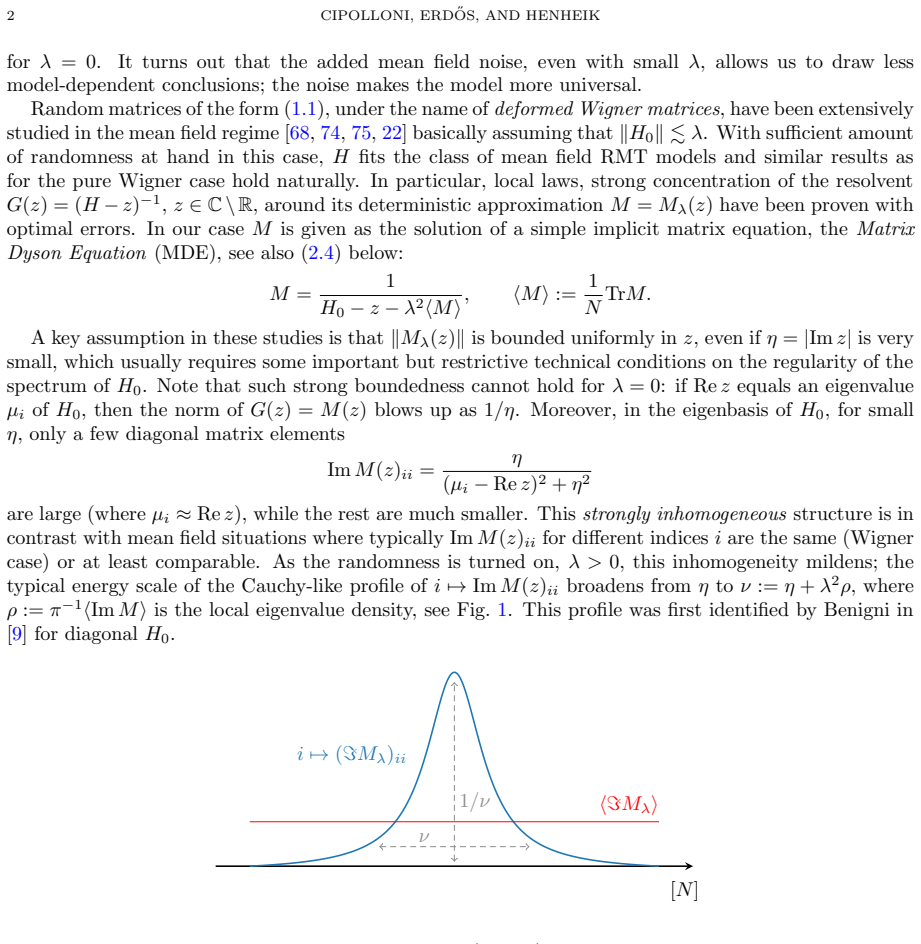
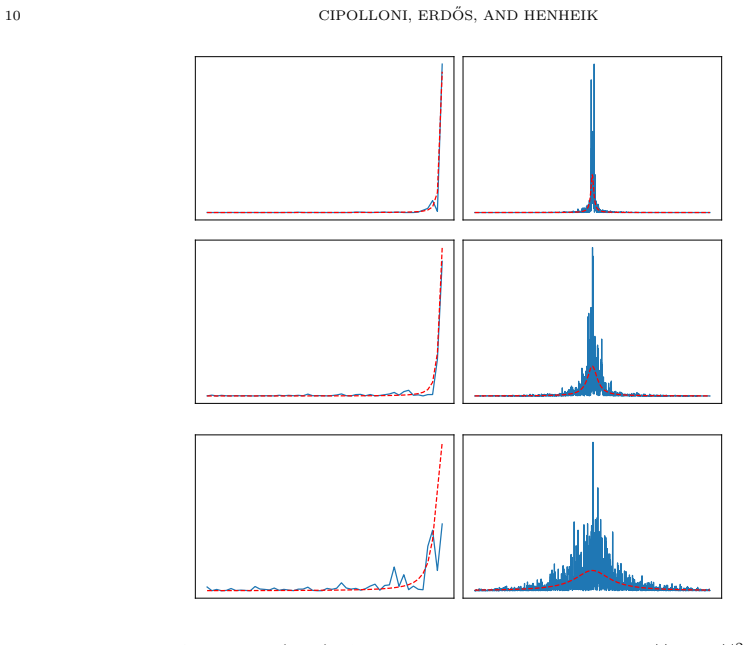
We consider a very general Rosenzweig-Porter-type model, H = H0 + λW, where H0 is an arbitrary Hermitian matrix and W is a standard Wigner matrix. We precisely trace the localization properties of the eigenvectors and the eigenstate thermalisation hypothesis (ETH) as the coupling constant λ interpolates between the trivial λ = 0 case and the fully mean field regime of large λ. Our results hold uniformly in H0 and λ, substantially generalising all previous local laws on deformed Wigner matrices even in the mean field regime. Our proof precisely captures the deterministic approximation to the resolvent which exhibits a strongly inhomogeneous structure. As a byproduct, we conclude the emergence
What carries the argument
The deterministic approximation to the resolvent, which has a strongly inhomogeneous structure determined by the spectrum of H0.
If this is right
- Eigenvector localization lengths vary continuously with λ and can be read off from the local laws.
- The eigenstate thermalization hypothesis holds once λ exceeds a threshold determined by the spectrum of H0.
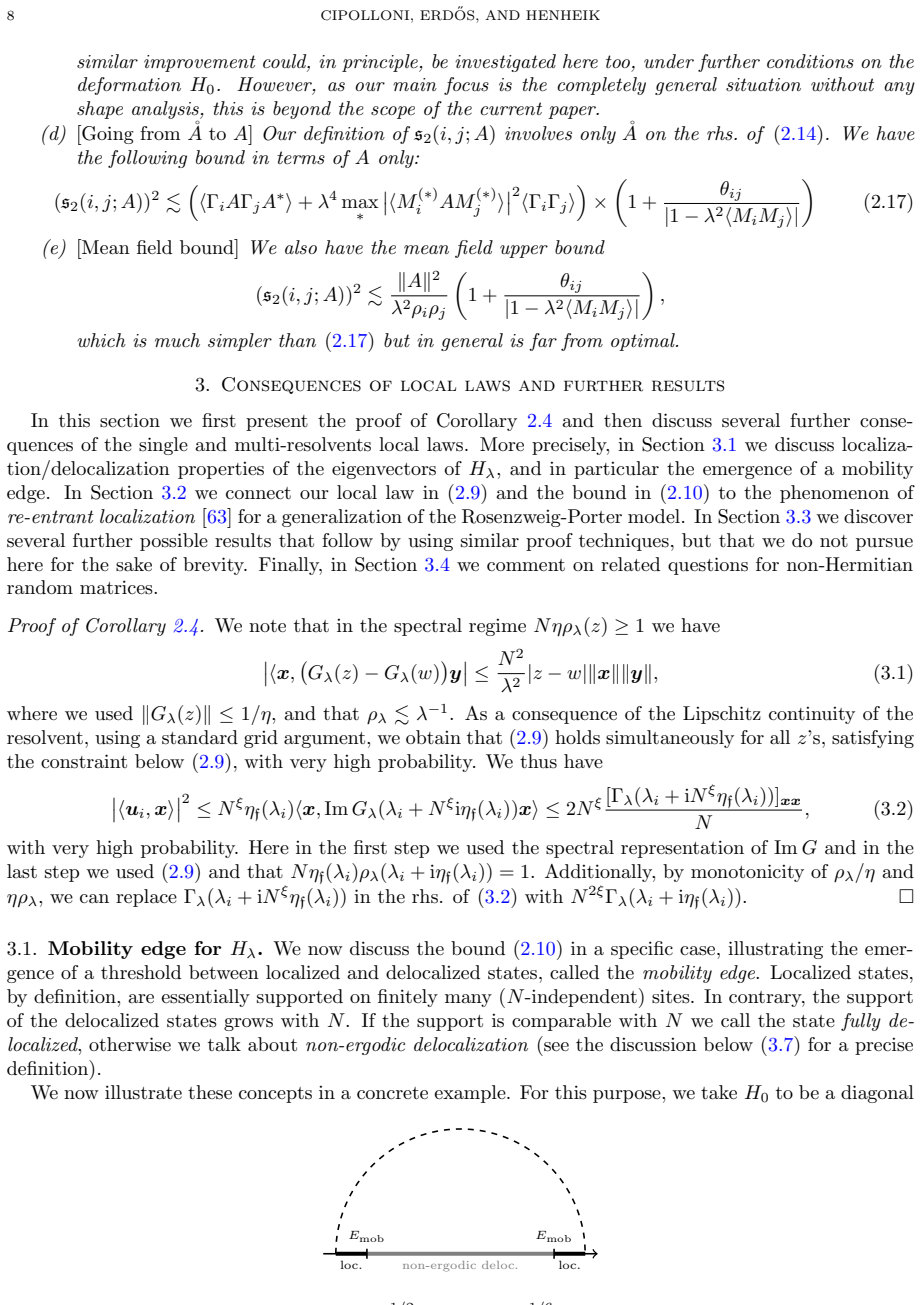
- A mobility edge appears in the spectrum separating localized and extended eigenvectors.
- Re-entrant localization occurs for certain ranges of λ and eigenvalue locations.
Where Pith is reading between the lines
- The uniformity in H0 suggests the same approximation can be used for any fixed base Hamiltonian without re-deriving constants.
- The inhomogeneous resolvent structure may appear in other models where a deterministic part is added to a random matrix.
- The mobility-edge result supplies a concrete prediction for the transition point that could be checked in finite-N simulations of structured perturbations.
Load-bearing premise
The deterministic approximation to the resolvent exhibits a strongly inhomogeneous structure that the proof can capture precisely.
What would settle it
A direct numerical computation of the resolvent entries for a fixed diagonal H0 at an intermediate λ that deviates from the predicted inhomogeneous deterministic approximation by more than the claimed error bound.
Figures
read the original abstract
We consider a very general Rosenzweig-Porter-type model, $H=H_0+\lambda W$, where $H_0$ is an arbitrary Hermitian matrix and $W$ is a standard Wigner matrix. We precisely trace the localization properties of the eigenvectors and the eigenstate thermalisation hypothesis (ETH) as the coupling constant $\lambda$ interpolates between the trivial $\lambda=0$ case and the fully mean field regime of large $\lambda$. Our results hold uniformly in $H_0$ and $\lambda$, substantially generalising all previous local laws on deformed Wigner matrices even in the mean field regime. Our proof precisely captures the deterministic approximation to the resolvent which exhibits a strongly inhomogeneous structure. As a byproduct, we conclude the emergence of a mobility edge and study the phenomenon of re-entrant localization.
Editorial analysis
A structured set of objections, weighed in public.
Referee Report
Summary. The manuscript analyzes the generalized Rosenzweig-Porter model H = H0 + λW, with H0 an arbitrary Hermitian matrix and W a standard Wigner matrix. It establishes local laws and eigenvector localization properties, including the eigenstate thermalization hypothesis (ETH), that hold uniformly in both H0 and λ. The results trace the interpolation from the λ=0 localized regime to the large-λ mean-field regime, capture the strongly inhomogeneous deterministic resolvent approximation, and derive the emergence of a mobility edge together with re-entrant localization as byproducts.
Significance. If the uniformity and resolvent control hold, the work substantially extends existing local laws for deformed Wigner matrices into the mean-field regime and arbitrary H0, providing a precise description of localization transitions that could inform studies of many-body localization and ETH. The emphasis on the inhomogeneous structure of the deterministic approximation is a potential technical strength.
major comments (2)
- [Theorem 1.1 and §3 (resolvent approximation)] The abstract and main theorems claim uniformity in arbitrary H0, but no explicit dependence on the minimal eigenvalue spacing of H0 is stated in the error bounds for the resolvent approximation. When eigenvalues of H0 cluster (gap → 0), the local stability analysis around the quadratic vector equation can produce gap-dependent error terms that are not controlled, precisely where the claimed inhomogeneity is strongest.
- [§6, mobility edge statement] The derivation of the mobility edge in §6 relies on the uniform resolvent control without additional arguments showing that the edge location remains stable under spectral clustering of H0; the transition point may shift or the re-entrant localization claim may fail when the deterministic approximation's inhomogeneity interacts with small gaps.
minor comments (2)
- [§2 (notation)] Notation for the entries of the deterministic resolvent approximation versus the random resolvent could be made more explicit to avoid confusion in the proof sections.
- [Introduction] A few references to recent works on re-entrant localization in related ensembles are missing from the introduction.
Simulated Author's Rebuttal
We thank the referee for the thorough reading and constructive comments on our manuscript. We address each major comment below, providing clarifications on the uniformity claims and the stability of the derived quantities.
read point-by-point responses
-
Referee: [Theorem 1.1 and §3 (resolvent approximation)] The abstract and main theorems claim uniformity in arbitrary H0, but no explicit dependence on the minimal eigenvalue spacing of H0 is stated in the error bounds for the resolvent approximation. When eigenvalues of H0 cluster (gap → 0), the local stability analysis around the quadratic vector equation can produce gap-dependent error terms that are not controlled, precisely where the claimed inhomogeneity is strongest.
Authors: We appreciate the referee highlighting this potential subtlety in the uniformity. Our analysis in §3 establishes the resolvent approximation via a bootstrap argument combining the Schur complement with stability estimates for the quadratic vector equation. These estimates are constructed to be independent of the eigenvalue gaps in H0: the Wigner perturbation dominates at the relevant scales, and the deterministic approximation is chosen precisely to absorb the inhomogeneity induced by H0 without introducing gap-dependent factors into the error terms. The resulting bounds (of order N^{-1/2+ε} in the appropriate norms) hold with constants independent of the minimal spacing, as verified through the a priori bounds that remain controlled even under clustering. Thus the claimed uniformity in arbitrary H0 is justified without explicit gap dependence in the error bounds. revision: no
-
Referee: [§6, mobility edge statement] The derivation of the mobility edge in §6 relies on the uniform resolvent control without additional arguments showing that the edge location remains stable under spectral clustering of H0; the transition point may shift or the re-entrant localization claim may fail when the deterministic approximation's inhomogeneity interacts with small gaps.
Authors: The mobility edge and re-entrant localization statements in §6 are direct consequences of the uniform resolvent and eigenvector delocalization/localization bounds established in the main theorems, which hold for arbitrary H0. Because the control is already uniform over all Hermitian H0 (including those with arbitrarily small gaps), the location of the mobility edge—determined by the zeros or singularities of the deterministic approximation—remains stable under spectral clustering. The re-entrant phenomenon likewise follows from the same uniform estimates on the resolvent entries and does not require separate gap-stability arguments. We are happy to add a short clarifying remark in §6 emphasizing that the uniformity already guarantees this stability. revision: partial
Circularity Check
No circularity: derivation from model definition via resolvent analysis
full rationale
The paper derives local laws, eigenvector localization, and ETH for the Rosenzweig-Porter model H = H0 + λW from the model definition using resolvent methods. No step reduces a claimed prediction or uniqueness result to a fitted input, self-citation chain, or definitional tautology. Uniformity over arbitrary H0 is presented as a technical output of the inhomogeneous deterministic approximation, not presupposed by it. External benchmarks (prior local laws on deformed Wigners) are generalized rather than presupposed. This is the expected outcome for a self-contained rigorous proof in the field.
Axiom & Free-Parameter Ledger
axioms (2)
- domain assumption W is a standard Wigner matrix with appropriate entry distributions (mean zero, variance 1/N, subgaussian tails or similar).
- domain assumption H0 is an arbitrary Hermitian matrix.
Reference graph
Works this paper leans on
-
[1]
Adhikari and J
A. Adhikari and J. Huang. Dyson Brownian motion for general β and potential at the edge. In: Probab. Theory Related Fields 178 (2020), pp. 893–950
2020
-
[2]
Adhikari and B
A. Adhikari and B. Landon. Local law and rigidity for unitary Brownian motion. In: Probab. Theory Related Fields 187 (2023), pp. 753–815
2023
-
[3]
Aggarwal and J
A. Aggarwal and J. Huang. Edge rigidity of Dyson Brownian motion with general initial data. In: Electron. J. Probab. 29 (2024), pp. 1–62
2024
-
[4]
O. H. Ajanki, L. Erd˝ os, and T. Kr¨ uger. Stability of the matrix Dyson equation and random matrices with correlations. In: Probab. Theory Related Fields 173 (2019), pp. 293–373
2019
-
[5]
J. Alt, L. Erd˝ os, and T. Kr¨ uger. Spectral radius of random matrices with independent entries. In: Probab. Math. Phys. 2 (2021), pp. 221–280
2021
-
[6]
J. Alt, L. Erd˝ os, T. Kr¨ uger, and D. Schr¨ oder. Correlated random matrices: band rigidity and edge universality. In: Ann. Probab. 48 (2020), pp. 963–1001
2020
-
[7]
J. Alt, L. Erd˝ os, and T. Kr¨ uger. The Dyson equation with linear self-energy: spectral bands, edges and cusps. In: Doc. Math. 25 (2020), pp. 1421–1539
2020
-
[8]
Z. Bao, L. Erd˝ os, and K. Schnelli. Equipartition principle for Wigner matrices. In: Forum Math. Sigma 9 (2021), e44
2021
-
[9]
L. Benigni. Eigenvectors distribution and quantum unique ergodicity for deformed Wigner matrices. In: Ann. Inst. Henri Poincar´ e Probab. Stat.56 (2020), pp. 2822–2867
2020
-
[10]
Benigni and G
L. Benigni and G. Cipolloni. Fluctuations of eigenvector overlaps and the Berry conjecture for Wigner matrices. In: Electron. J. Probab. 29 (2024), pp. 1–19
2024
-
[11]
Benigni and P
L. Benigni and P. Lopatto. Optimal delocalization for generalized Wigner matrices. In: Adv. Math. 396 (2022), p. 108109
2022
-
[12]
Bourgade
P. Bourgade. Extreme gaps between eigenvalues of Wigner matrices. In: J. Eur. Math. Soc. 24 (2021), pp. 2823–2873
2021
-
[13]
P. Bourgade and H. Falconet. Liouville quantum gravity from random matrix dynamics. In: arXiv:2206.03029 (2022)
-
[14]
Bourgade, J
P. Bourgade, J. Huang, and H.-T. Yau. Eigenvector statistics of sparse random matrices. In: Electron. J. Probab. 22 (2017)
2017
-
[15]
Bourgade and H.-T
P. Bourgade and H.-T. Yau. The eigenvector moment flow and local quantum unique ergodicity. In: Comm. Math. Phys. 350 (2017), pp. 231–278
2017
-
[16]
Byun and P
S.-S. Byun and P. J. Forrester. Progress on the Study of the Ginibre Ensembles. Springer Nature, 2025
2025
-
[17]
Campbell, G
A. Campbell, G. Cipolloni, L. Erd˝ os, and H. C. Ji. On the spectral edge of non-Hermitian random matrices. In: Ann. Probab. 53 (2025), pp. 2256–2308
2025
-
[18]
N. Chen and C. K. Smart. Random band matrix localization by scalar fluctuations. In: arXiv:2206.06439 (2022)
-
[19]
Cipolloni, R
G. Cipolloni, R. Peled, J. Schenker, and J. Shapiro. Dynamical Localization for Random Band Matrices Up to W ≪ N 1/4. In: Comm. Math. Phys. 405 (2024), p. 82
2024
-
[20]
Cipolloni, L
G. Cipolloni, L. Erd˝ os, and Y. Xu. Optimal decay of eigenvector overlap for non-Hermitian random matrices. In: J. Func. Anal. 290 (1 2026), p. 111180
2026
-
[21]
Cipolloni, L
G. Cipolloni, L. Erd˝ os, and J. Henheik. Out-of-time-ordered correlators for Wigner matrices. In: Adv. Theor. Math. Phys. 28 (2024), pp. 2025–2083
2024
-
[22]
Cipolloni, L
G. Cipolloni, L. Erd˝ os, J. Henheik, and O. Kolupaiev. Gaussian fluctuations in the equipartition principle for Wigner matrices. In: Forum Math. Sigma 11 (2023), e74
2023
-
[23]
Cipolloni, L
G. Cipolloni, L. Erd˝ os, J. Henheik, and D. Schr¨ oder. Optimal lower bound on eigenvector overlaps for non-Hermitian random matrices. In: J. Func. Anal. 287 (2024), p. 110495
2024
-
[24]
Cipolloni, L
G. Cipolloni, L. Erd˝ os, and H. C. Ji. Non–Hermitian spectral universality at critical points. In:Probab. Theory Related Fields (2025), pp. 1–52
2025
-
[25]
Cipolloni, L
G. Cipolloni, L. Erd˝ os, T. Kr¨ uger, and D. Schr¨ oder. Cusp universality for random matrices, II: The real symmetric case. In: Pure Appl. Anal. 1 (2019), pp. 615–707
2019
-
[26]
Cipolloni, L
G. Cipolloni, L. Erd˝ os, and D. Schr¨ oder. Edge universality for non-Hermitian random matrices. In: Probab. Theory and Related Fields 179 (2021), pp. 1–28
2021
-
[27]
Cipolloni, L
G. Cipolloni, L. Erd˝ os, and D. Schr¨ oder. Eigenstate thermalization hypothesis for Wigner matrices. In:Comm. Math. Phys. 388 (2021), pp. 1005–1048
2021
-
[28]
Cipolloni, L
G. Cipolloni, L. Erd˝ os, and D. Schr¨ oder. Mesoscopic central limit theorem for non-Hermitian random matrices. In: Probab. Theory Related Fields 188 (2024), pp. 1131–1182
2024
-
[29]
Cipolloni, L
G. Cipolloni, L. Erd˝ os, and D. Schr¨ oder. Normal fluctuation in quantum ergodicity for Wigner matrices. In: Ann. Probab. 50 (2022), pp. 984–1012
2022
-
[30]
Cipolloni, L
G. Cipolloni, L. Erd˝ os, and D. Schr¨ oder. On the spectral form factor for random matrices. In: Comm. Math. Phys. 401 (2023), pp. 1665–1700
2023
-
[31]
Cipolloni, L
G. Cipolloni, L. Erd˝ os, and D. Schr¨ oder. Optimal multi-resolvent local laws for Wigner matrices. In: Electron. J. Probab. 27 (2022), pp. 1–38
2022
-
[32]
Cipolloni, L
G. Cipolloni, L. Erd˝ os, and D. Schr¨ oder. Rank-uniform local law for Wigner matrices. In: Forum Math. Sigma 10 (2022), e96
2022
-
[33]
Cipolloni, L
G. Cipolloni, L. Erd˝ os, and D. Schr¨ oder. Thermalisation for Wigner matrices. In: J. Funct. Anal. 282 (8 2022)
2022
-
[34]
Cipolloni, L
G. Cipolloni, L. Erd˝ os, D. Schr¨ oder, and Y. Xu. On the rightmost eigenvalue of non-Hermitian random matrices. In: Ann. Probab. 51 (2023), pp. 2192–2242
2023
-
[35]
G. Cipolloni, L. Erd˝ os, J. Henheik, and O. Kolupaiev. Eigenvector decorrelation for random matrices. In:arXiv:2410.10718, to appear in Ann. Appl. Probab. (2026+). 54 REFERENCES
-
[36]
G. Cipolloni, L. Erd˝ os, and J. Henheik. Eigenstate thermalisation at the edge for Wigner matrices. In:arXiv:2309.05488, to appear in Ann. Inst. Henri Poincar´ e Probab. Stat.(2026+)
-
[37]
Cipolloni and B
G. Cipolloni and B. Landon. Maximum of the characteristic polynomial of iid matrices. In: Comm. Pure Appl. Math. (2025)
2025
-
[38]
G. Cipolloni and B. Landon. Optimal Delocalization for Non–Hermitian Eigenvectors. In: arXiv:2509.15189 (2025)
-
[39]
N. Cook, W. Hachem, J. Najim, and D. Renfrew. Non-Hermitian random matrices with a variance profile (I): deter- ministic equivalents and limiting ESDs. In: Electron. J. Probab 23 (2018), pp. 1–61
2018
-
[40]
De Tomasi and I
G. De Tomasi and I. M. Khaymovich. Non-Hermitian Rosenzweig-Porter random-matrix ensemble: Obstruction to the fractal phase. In: Phys. Rev. B 106 (2022), p. 094204
2022
-
[41]
The wishart–rosenzweig–porter random matrix ensemble
V. Delapalme, L. F. Cugliandolo, G. Schehr, M. Tarzia, and D. Venturelli. The Wishart–Rosenzweig–Porter random matrix ensemble. In: arXiv:2510.15764 (2025)
- [42]
- [43]
- [44]
-
[45]
Dubova and K
S. Dubova and K. Yang. Quantum diffusion and delocalization in one-dimensional band matrices via the flow method. In: J. Math. Phys. 67 (2026)
2026
-
[46]
L. Erd˝ os and V. Riabov. The Zigzag Strategy for Random Band Matrices. In: arXiv:2506.06441 (2025)
-
[47]
Erd˝ os, J
L. Erd˝ os, J. Henheik, and O. Kolupaiev. Loschmidt echo for deformed Wigner matrices. In: Lett. Math. Phys. 115 (2025), p. 14
2025
-
[48]
Erd˝ os, J
L. Erd˝ os, J. Henheik, J. Reker, and V. Riabov. Prethermalization for Deformed Wigner Matrices. In: Ann. Henri Poincar´ e26 (2025), pp. 1991–2033
2025
-
[49]
Erd˝ os, J
L. Erd˝ os, J. Henheik, and V. Riabov. Cusp Universality for Correlated Random Matrices. In: Comm. Math. Phys. 406 (2025), p. 253
2025
-
[50]
Erd˝ os and H
L. Erd˝ os and H. C. Ji. Wegner estimate and upper bound on the eigenvalue condition number of non-Hermitian random matrices. In: Comm. Pure Appl. Math. 77 (2024), pp. 3785–3840
2024
-
[51]
Erd˝ os and A
L. Erd˝ os and A. Knowles. Quantum diffusion and eigenfunction delocalization in a random band matrix model. In: Comm. Math. Phys. 303 (2011), pp. 509–554
2011
-
[52]
Erd˝ os, A
L. Erd˝ os, A. Knowles, H.-T. Yau, and J. Yin. Delocalization and diffusion profile for random band matrices. In: Comm. Math. Phys. 323 (2013), pp. 367–416
2013
-
[53]
Erd˝ os, B
L. Erd˝ os, B. Schlein, and H.-T. Yau. Local semicircle law and complete delocalization for Wigner random matrices. In: Comm. Math. Phys. 287 (2009), pp. 641–655
2009
-
[54]
Erd˝ os, B
L. Erd˝ os, B. Schlein, and H.-T. Yau. Universality of random matrices and local relaxation flow. In: Inv. Math. 185 (2011), pp. 75–119
2011
-
[55]
Erd˝ os, H.-T
L. Erd˝ os, H.-T. Yau, and J. Yin. Bulk universality for generalized Wigner matrices. In: Probab. Theory Related Fields 154 (2012), pp. 341–407
2012
-
[56]
Erd˝ os, H.-T
L. Erd˝ os, H.-T. Yau, and J. Yin. Rigidity of eigenvalues of generalized Wigner matrices. In: Adv. Math. 229 (2012), pp. 1435–1515
2012
-
[57]
Erd˝ os, J
L. Erd˝ os, J. Henheik, and V. Riabov. Anomalous rate of eigenstate thermalisation at singularities of the density of states. In: arXiv preprint (2026)
2026
-
[58]
Erd˝ os, A
L. Erd˝ os, A. Knowles, H.-T. Yau, and J. Yin. The local semicircle law for a general class of random matrices. In: Electron. J. Probab. 18(59) (2013), pp. 1–58
2013
-
[59]
Erd˝ os, T
L. Erd˝ os, T. Kr¨ uger, and D. Schr¨ oder. Random matrices with slow correlation decay. In:For. Math., Sigma 7 (2019)
2019
-
[60]
Erd˝ os and H.-T
L. Erd˝ os and H.-T. Yau. A dynamical approach to random matrix theory. Vol. 28. American Mathematical Soc., 2017
2017
- [61]
-
[62]
Y. V. Fyodorov and A. D. Mirlin. Scaling properties of localization in random band matrices: a σ-model approach. In: Phys. Rev. Lett. 67 (1991), p. 2405
1991
-
[63]
Ghosh, M
R. Ghosh, M. Sarkar, and I. M. Khaymovich. Reentrant localization induced by short-range hopping in the fractal Rosenzweig-Porter model. In: Phys. Rev. B 111 (2025), p. L220102
2025
-
[64]
J. W. Helton, R. Rashidi Far, and R. Speicher. Operator-valued semicircular elements: solving a quadratic matrix equation with positivity constraints. In: Int. Math. Res. Not. IMRN 22 (2007), Art. ID rnm086, 15
2007
-
[65]
J. Huang. Mesoscopic perturbations of large random matrices. In: Random Matrices: Theory and Appl. 7 (2018), p. 1850004
2018
-
[66]
Huang and B
J. Huang and B. Landon. Rigidity and a mesoscopic central limit theorem for Dyson Brownian motion for general β and potentials. In: Probab. Theory Related Fields 175 (2019), pp. 209–253
2019
-
[67]
Knowles and J
A. Knowles and J. Yin. Eigenvector distribution of Wigner matrices. In: Probab. Theory Related Fields 155 (2013), pp. 543–582
2013
-
[68]
Knowles and J
A. Knowles and J. Yin. The outliers of a deformed Wigner matrix. In: Ann. Probab. 42 (2014), pp. 1980–2031
2014
-
[69]
Landon, P
B. Landon, P. Lopatto, and P. Sosoe. Single eigenvalue fluctuations of general Wigner-type matrices. In: Probab. Theory Related Fields 188 (2024), pp. 1–62
2024
-
[70]
B. Landon and P. Sosoe. Almost-optimal bulk regularity conditions in the CLT for Wigner matrices. In: arXiv:2204.03419 (2022)
-
[71]
Landon, P
B. Landon, P. Sosoe, and H.-T. Yau. Fixed energy universality of Dyson Brownian motion. In: Adv. Math. 346 (2019), pp. 1137–1332. REFERENCES 55
2019
-
[72]
Landon and H.-T
B. Landon and H.-T. Yau. Convergence of local statistics of Dyson Brownian motion. In: Comm. Math. Phys. 355 (2017), pp. 949–1000
2017
-
[73]
Edge statistics of Dyson Brownian motion
B. Landon and H.-T. Yau. Edge statistics of Dyson Brownian motion. In: arXiv:1712.03881 (2017)
work page internal anchor Pith review Pith/arXiv arXiv 2017
-
[74]
J. O. Lee and K. Schnelli. Edge universality for deformed Wigner matrices. In: Rev. Math. Phys. 27 (2015), p. 1550018
2015
-
[75]
J. O. Lee, K. Schnelli, B. Stetler, and H.-T. Yau. Bulk universality for deformed Wigner matrices. In: Ann. Probab. 44 (2016), pp. 2349–2425
2016
- [76]
-
[77]
Marcinek and H.-T
J. Marcinek and H.-T. Yau. High dimensional normality of noisy eigenvectors. In: Comm. Math. Phys. 395 (2022), pp. 1007–1096
2022
-
[78]
M. L. Mehta. Random matrices. In: Pure and Applied Mathematics (Amsterdam) 142 (2004)
2004
- [79]
-
[80]
P´ ech´ e
S. P´ ech´ e. The largest eigenvalue of small rank perturbations of Hermitian random matrices. In:Prob. Theory Related Fields 134 (2006), pp. 127–173
2006
discussion (0)
Sign in with ORCID, Apple, or X to comment. Anyone can read and Pith papers without signing in.