A Quantum-Walk Representation of Color-Ordered MHV Scattering Amplitudes
Pith reviewed 2026-07-03 11:35 UTC · model grok-4.3
The pith
Quantum walks on permutation trees reproduce the Parke-Taylor structure of color-ordered MHV amplitudes.
A machine-rendered reading of the paper's core claim, the machinery that carries it, and where it could break.
Core claim
Color-ordered maximally helicity violating scattering amplitudes are represented by coined quantum walks on permutation trees, with root-to-terminal paths corresponding to distinct color orderings, local transition amplitudes assigned according to the spinor-product structure of the Parke-Taylor formula, and a quantum Fourier transform on the coin space yielding the color-decomposed amplitude, as verified numerically for low-point cases.
What carries the argument
Coined quantum walks on permutation trees, in which each path encodes a color ordering and local transitions follow Parke-Taylor spinor products; the walk evolves in coherent superposition and is combined by a quantum Fourier transform to recover the amplitude.
If this is right
- The walk supplies a dynamical picture of the combinatorics underlying the amplitudes.
- A quantum-channel formulation with Kraus operators tracks sector-resolved contributions.
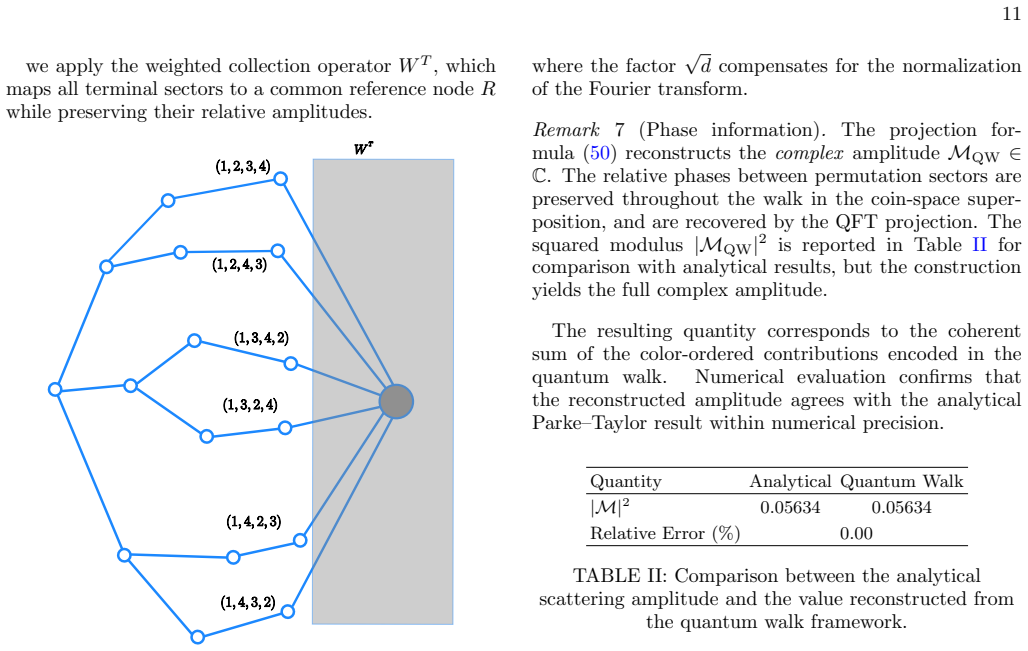
- A weighted collection operator combines terminal sectors at a common reference node.
- The framework unifies permutation trees, quantum walks, and open quantum systems.
- It supplies a concrete basis for quantum algorithms that simulate scattering processes in quantum field theory.
Where Pith is reading between the lines
- The representation suggests that quantum hardware could evaluate higher-multiplicity amplitudes whose classical cost grows rapidly.
- Similar graph constructions may apply to non-MHV helicity sectors or to other gauge-theory processes.
- The link between coin-space Fourier transforms and amplitude combinatorics may reveal new algebraic identities.
Load-bearing premise
Transition amplitudes assigned locally from spinor products will, through coherent superposition and a final quantum Fourier transform, exactly recover the full amplitude without needing extra global rules.
What would settle it
Numerical execution of the quantum-walk procedure for the five-gluon MHV amplitude produces a value that differs from the known Parke-Taylor expression after the Fourier step.
Figures


read the original abstract
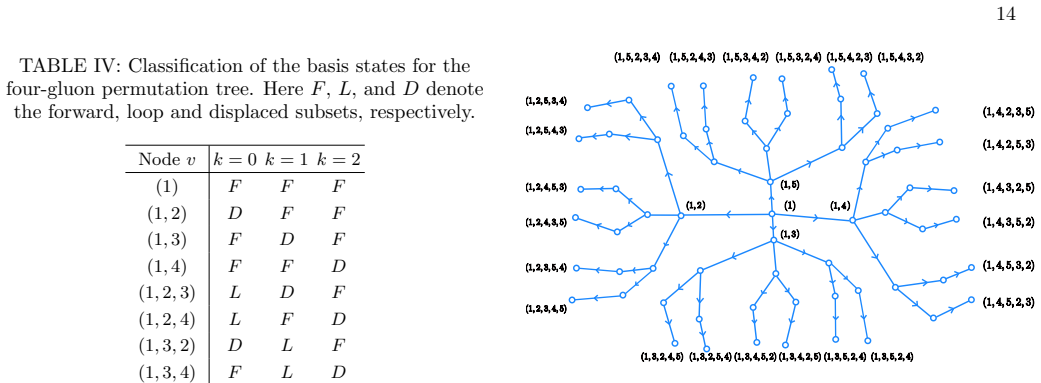
We introduce a graph-theoretic framework for representing color-ordered maximally helicity violating (MHV) scattering amplitudes in quantum chromodynamics using coined quantum walks on permutation trees. Each root-to-terminal path corresponds to a distinct color ordering of the external gluons, while local transition amplitudes are assigned according to the spinor-product structure of the Parke--Taylor amplitudes. The walk evolves in coherent superpositions over permutation sectors, giving a dynamical picture of the underlying combinatorics. A quantum-channel formulation based on Kraus operators is also introduced to describe sector-resolved contributions, while a weighted collection operator coherently combines the terminal sectors at a common reference node. A quantum Fourier transform on the coin space is then employed to combine the encoded contributions into the corresponding color-decomposed amplitude. Together, these constructions establish a unified graph-based framework connecting permutation trees, quantum walks, and open quantum systems providing a framework for quantum algorithms to simulate scattering processes in quantum field theory. As an example, numerical results for low-point gluon amplitudes demonstrate that the proposed representation faithfully captures the characteristic Parke--Taylor structure and is consistent with analytical results.
Editorial analysis
A structured set of objections, weighed in public.
Referee Report
Summary. The paper proposes a graph-theoretic framework representing color-ordered MHV gluon scattering amplitudes via coined quantum walks on permutation trees. Each root-to-terminal path encodes a color ordering, with local transition amplitudes assigned from the spinor products appearing in the Parke-Taylor formula. The evolution proceeds through coherent superpositions, a Kraus-operator quantum-channel description of sector contributions, a weighted collection operator at a reference node, and a final quantum Fourier transform on the coin space that assembles the color-decomposed amplitude. Numerical checks on low-point amplitudes are presented as evidence that the construction reproduces the Parke-Taylor structure.
Significance. If the local transition rules can be shown to generate the global Parke-Taylor product without embedding the full amplitude by construction, the work would supply a dynamical quantum-walk picture of the combinatorics underlying MHV amplitudes and a concrete route toward quantum algorithms for scattering processes. The explicit connection between permutation trees, open-system channels, and the QFT step is a potentially useful organizing principle even if the immediate numerical agreement is modest.
major comments (2)
- [Abstract] Abstract: Transition amplitudes are assigned directly according to the spinor-product structure of the Parke-Taylor amplitudes. Because the final QFT step then recombines quantities whose values are already fixed by this assignment, the construction recovers the known amplitude by design rather than deriving it from independent walk dynamics. The manuscript must demonstrate that the global rational function (product over all adjacent pairs) emerges automatically from the coherent superposition under the stated local rules, or else clarify the additional global constraints required.
- [Abstract] Abstract: Consistency is asserted via numerical results for low-point gluon amplitudes, yet the text supplies neither the explicit data, the precise definition of the transition amplitudes in terms of spinors, error bars, nor the quantitative comparison metric. Without these, it is impossible to determine whether agreement is non-trivial or arranged by the choice of local weights.
minor comments (1)
- The abstract introduces a Kraus-operator channel and a weighted collection operator without equations; both should be written explicitly (with Kraus operators and the collection map defined) in the main text to allow reproducibility.
Simulated Author's Rebuttal
We thank the referee for the careful reading and constructive comments. We address each point below and will revise the manuscript to improve clarity on the dynamical aspects and to supply the requested numerical details.
read point-by-point responses
-
Referee: [Abstract] Abstract: Transition amplitudes are assigned directly according to the spinor-product structure of the Parke-Taylor amplitudes. Because the final QFT step then recombines quantities whose values are already fixed by this assignment, the construction recovers the known amplitude by design rather than deriving it from independent walk dynamics. The manuscript must demonstrate that the global rational function (product over all adjacent pairs) emerges automatically from the coherent superposition under the stated local rules, or else clarify the additional global constraints required.
Authors: We agree that the transition amplitudes are assigned according to the spinor-product structure. The framework is intended as a representation in which the global Parke-Taylor product arises from the product of local edge weights along each root-to-leaf path, with the coherent sum over paths and the subsequent Kraus-channel and QFT steps assembling the full amplitude. We will revise the text to include an explicit step-by-step derivation showing how the local rules generate the global rational function from the tree structure and coherent superposition, without additional global constraints beyond the permutation-tree definition. If this cannot be shown to the referee's satisfaction, we will clarify the constraints explicitly. revision: yes
-
Referee: [Abstract] Abstract: Consistency is asserted via numerical results for low-point gluon amplitudes, yet the text supplies neither the explicit data, the precise definition of the transition amplitudes in terms of spinors, error bars, nor the quantitative comparison metric. Without these, it is impossible to determine whether agreement is non-trivial or arranged by the choice of local weights.
Authors: We apologize for the insufficient detail in the numerical section. In the revised manuscript we will add the explicit spinor definitions of all transition amplitudes, the full numerical values obtained for the checked low-point cases (n=4,5,6), any simulation error bars, and the precise comparison metric (e.g., relative difference to the analytic Parke-Taylor result). This will make the verification fully transparent. revision: yes
Circularity Check
Local transition amplitudes defined from Parke-Taylor spinor products make the final QFT output tautological by construction
specific steps
-
self definitional
[Abstract]
"local transition amplitudes are assigned according to the spinor-product structure of the Parke--Taylor amplitudes. The walk evolves in coherent superpositions over permutation sectors... A quantum Fourier transform on the coin space is then employed to combine the encoded contributions into the corresponding color-decomposed amplitude."
The Parke-Taylor factors are inserted by definition into the local rules; the subsequent coherent sum plus QFT therefore recovers a quantity whose value is fixed by those inputs, rendering the representation equivalent to the known amplitude by construction rather than derived from the quantum-walk evolution.
full rationale
The paper assigns local transition amplitudes directly from the known Parke-Taylor spinor-product structure, then uses coherent superposition and a final QFT to recover the color-ordered amplitude. This reduces the central claim to a re-expression of the input rather than an independent derivation from the walk dynamics. No external uniqueness theorem or self-citation is invoked, but the construction itself embeds the target result at the outset.
Axiom & Free-Parameter Ledger
Reference graph
Works this paper leans on
-
[1]
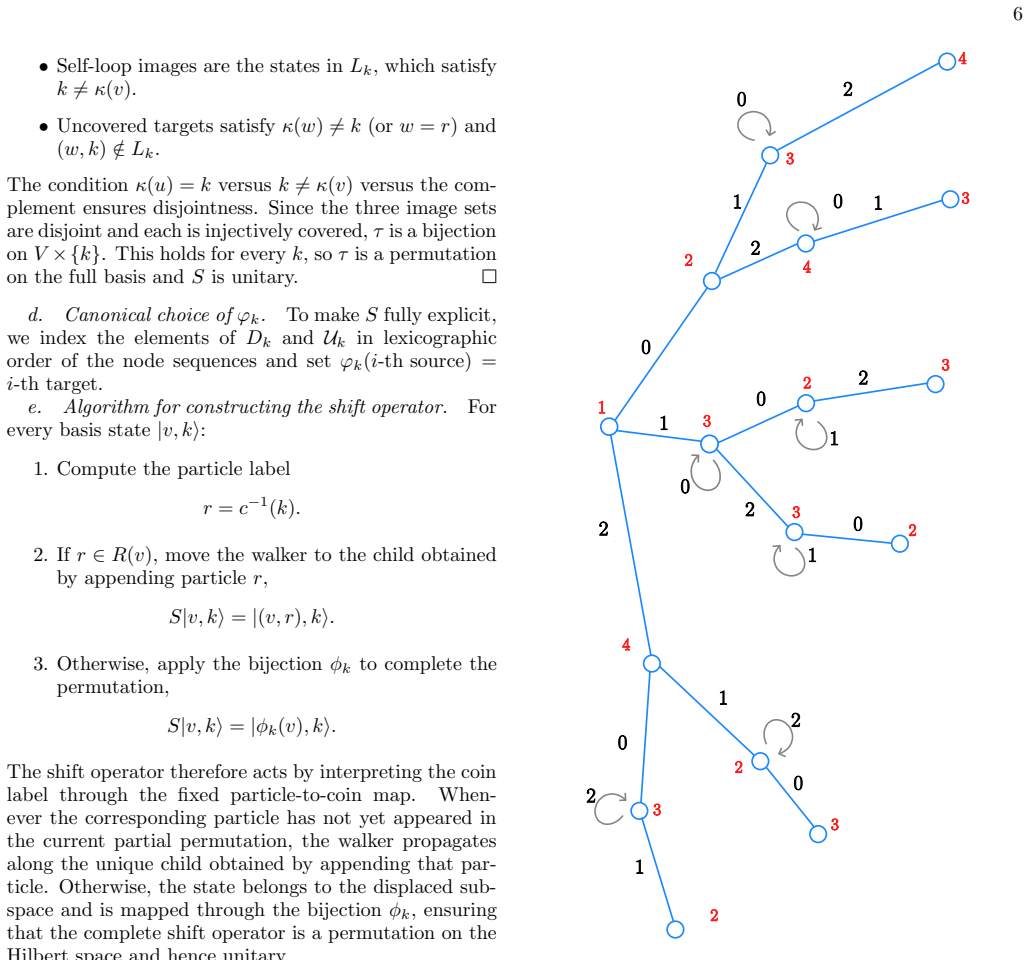
Compute the particle label r=c −1(k)
-
[2]
Ifr∈R(v), move the walker to the child obtained by appending particler, S|v, k⟩=|(v, r), k⟩
-
[3]
The shift operator therefore acts by interpreting the coin label through the fixed particle-to-coin map
Otherwise, apply the bijectionϕ k to complete the permutation, S|v, k⟩=|ϕ k(v), k⟩. The shift operator therefore acts by interpreting the coin label through the fixed particle-to-coin map. When- ever the corresponding particle has not yet appeared in the current partial permutation, the walker propagates along the unique child obtained by appending that p...
-
[4]
M. E. Peskin, D. V. Schroeder, An Introduction to Quan- tum Field Theory, Addison-Wesley (1995)
1995
-
[5]
I, Cambridge University Press (1995)
Steven Weinberg, The Quantum Theory of Fields, Vol. I, Cambridge University Press (1995)
1995
-
[6]
Schwartz, Quantum Field Theory and the Standard Model, Cambridge University Press (2014)
Matthew D. Schwartz, Quantum Field Theory and the Standard Model, Cambridge University Press (2014)
2014
-
[7]
R. K. Ellis, W. J. Stirling, B. R. Webber, QCD and Col- lider Physics, Cambridge University Press (1996)
1996
-
[8]
Parke, Thomas R
Stephen J. Parke, Thomas R. Taylor, An amplitude forn- gluon scattering, Phys. Rev. Lett.56, 2459–2460 (1986)
1986
-
[9]
Mangano, Stephen J
Michel L. Mangano, Stephen J. Parke, Multiparton am- plitudes in gauge theories, Phys. Rept.200, 301–367 (1991)
1991
-
[10]
Dixon, Frederick Maltoni, New color decompositions for gauge amplitudes at tree and loop level, Nucl
Vittorio Del Duca, Lance J. Dixon, Frederick Maltoni, New color decompositions for gauge amplitudes at tree and loop level, Nucl. Phys. B571, 51–70 (2000)
2000
-
[11]
Z. Xu, D. Zhang, L. Chang, Helicity amplitudes for mul- tiple bremsstrahlung, Nucl. Phys. B291, 392–428 (1987)
1987
-
[12]
F. A. Berends, W. T. Giele, Recursive calculations for processes withngluons, Nucl. Phys. B306, 759–808 (1988)
1988
-
[13]
Calculating Scattering Amplitudes Efficiently
Lance J. Dixon, Calculating scattering amplitudes effi- ciently, TASI Lectures, hep-ph/9601359 (1996)
work page internal anchor Pith review Pith/arXiv arXiv 1996
-
[14]
Henriette Elvang, Yu-tin Huang, Scattering Amplitudes in Gauge Theory and Gravity, Cambridge University Press (2015)
2015
-
[15]
Edward Witten, Perturbative gauge theory as a string theory in twistor space, Commun. Math. Phys.252, 189– 258 (2004)
2004
-
[16]
Ruth Britto, Freddy Cachazo, Bo Feng, Edward Witten, Direct proof of tree-level recursion relation in Yang–Mills theory, Phys. Rev. Lett.94, 181602 (2005)
2005
-
[17]
Freddy Cachazo, Song He, Ellis Ye Yuan, Scattering of massless particles: scalars, gluons and gravitons, JHEP 07, 033 (2014)
2014
-
[18]
Jordan, Keith S
Stephen P. Jordan, Keith S. M. Lee, John Preskill, Quan- tum algorithms for quantum field theories, Science336, 1130–1133 (2012)
2012
-
[19]
John Preskill, Quantum computing in the NISQ era and beyond, Quantum2, 79 (2018)
2018
-
[20]
Natalie Klco et al., Quantum-classical computation of Schwinger model dynamics, Phys. Rev. A98, 032331 (2018)
2018
-
[21]
Bauer et al., Quantum simulation for high- energy physics, PRX Quantum4, 027001 (2023)
Christian W. Bauer et al., Quantum simulation for high- energy physics, PRX Quantum4, 027001 (2023)
2023
-
[22]
Eric Bashore, Caleb Bashore et al., Quantum Algorithm for MHV Scattering Amplitudes, SciPost Phys.,114-20 ,SciPost , (2026)
2026
-
[23]
Yakir Aharonov, Luiz Davidovich, Nicim Zagury, Quan- tum random walks, Phys. Rev. A48, 1687–1690 (1993)
1993
-
[24]
Meyer, From quantum cellular automata to quantum lattice gases, J
David A. Meyer, From quantum cellular automata to quantum lattice gases, J. Stat. Phys.85, 551–574 (1996)
1996
-
[25]
Andris Ambainis, Quantum walks and their algorithmic applications, Int. J. Quantum Inf.1, 507–518 (2003)
2003
-
[26]
Phys.44, 307–327 (2003)
Julia Kempe, Quantum random walks: an introductory overview, Contemp. Phys.44, 307–327 (2003)
2003
-
[27]
Venegas-Andraca, Quantum walks: a com- prehensive review, Quantum Inf
Salvador E. Venegas-Andraca, Quantum walks: a com- prehensive review, Quantum Inf. Process.11, 1015–1106 (2012)
2012
-
[28]
Renato Portugal, Quantum Walks and Search Algo- rithms, Springer (2013)
2013
-
[29]
Dirac Cellular Automa- ton from Split-step Quantum Walk.Sci Rep 6, 25779 (2016)
Mallick, A., Chandrashekar, C. Dirac Cellular Automa- ton from Split-step Quantum Walk.Sci Rep 6, 25779 (2016)
2016
-
[30]
Two-component Dirac-like Hamilto- nian for generating quantum walk on one-, two- and three-dimensional lattices.Sci Rep 3, 2829 (2013)
Chandrashekar, C. Two-component Dirac-like Hamilto- nian for generating quantum walk on one-, two- and three-dimensional lattices.Sci Rep 3, 2829 (2013)
2013
-
[31]
Arindam Mallick, Sanjoy Mandal, Anirban Karan and C M Chandrashekar , Simulating Dirac Hamiltonian in curved space-time by split-step quantum walk,Journal of Physics Communications 2399-6528 (2019)
2019
-
[32]
& Chandrashekar, C.M
Mallick, A., Mandal, S. & Chandrashekar, C.M. Neu- trino oscillations in discrete-time quantum walk frame- work,Eur. Phys. J. C 77, 85 (2017)
2017
-
[33]
Open system approach to neutrino oscillations in a quantum walk framework
Sahu, H., Chandrashekar, C.M. Open system approach to neutrino oscillations in a quantum walk framework. Quantum Inf Process 23, 7 (2024)
2024
-
[34]
Huerta Alderete, C., Singh, S., Nguyen, N.H. et al. Quantum walks and Dirac cellular automata on a pro- grammable trapped-ion quantum computer, Nat Com- mun 11, 3720 (2020)
2020
-
[35]
Pradeep and Balu, Radhakrishnan and Laflamme, Raymond and Chandrashekar, C
Kumar, N. Pradeep and Balu, Radhakrishnan and Laflamme, Raymond and Chandrashekar, C. M., Bounds on the dynamics of periodic quantum walks and emer- gence of the gapless and gapped Dirac equation, Phys. Rev. A.97.012116 (2018)
2018
-
[36]
and Shafi, K
Sengupta, Kanad and Dinesh, S.P. and Shafi, K. Muhammed and Asokan, Soumya and Chandrashekar, C.M, Experimental realization of universal quantum gates and a six-qubit entangled state using a photonic quantum walk, Phys. Rev. Appl. (2025)
2025
-
[37]
Karl Kraus, States, Effects and Operations, Springer (1983)
1983
-
[38]
Breuer, Heinz-Peter, and Francesco Petruccione, The Theory of Open Quantum Systems (Oxford, 2007; on- line edn, Oxford Academic, 1 Feb. 2010)
2007
-
[39]
Nielsen, Isaac L
Michael A. Nielsen, Isaac L. Chuang, Quantum Compu- tation and Quantum Information, Cambridge University Press (2010)
2010
-
[40]
Stephane Attal, Francesco Petruccione, Christophe Sabot, Ilya Sinayskiy, Open quantum random walks, J. Stat. Phys.147, 832–852 (2012)
2012
-
[41]
Ilya Sinayskiy, Francesco Petruccione, Open quantum walks: a short introduction, Int. J. Quantum Inf.10, 1240004 (2012)
2012
-
[42]
Shor, Algorithms for quantum computation: discrete logarithms and factoring, Proc
Peter W. Shor, Algorithms for quantum computation: discrete logarithms and factoring, Proc. FOCS, 124–134 (1994)
1994
-
[43]
Don Coppersmith, An approximate Fourier transform useful in quantum factoring, IBM Research Report RC 19642 (1994); arXiv:quant-ph/0201067 13 SUPPLEMENTARY MATERIAL This supplementary material provides additional im- plementation details and numerical data supporting the results presented in the main text. In particular, we present the bijectivity proof f...
work page internal anchor Pith review Pith/arXiv arXiv 1994
discussion (0)
Sign in with ORCID, Apple, or X to comment. Anyone can read and Pith papers without signing in.