Quantum mutual information as a robust probe of integrability in open quantum systems
Pith reviewed 2026-07-03 11:31 UTC · model grok-4.3
The pith
The temporal fluctuations of the averaged sum of total correlations distinguish integrable from chaotic dynamics in open quantum systems.
A machine-rendered reading of the paper's core claim, the machinery that carries it, and where it could break.
Core claim
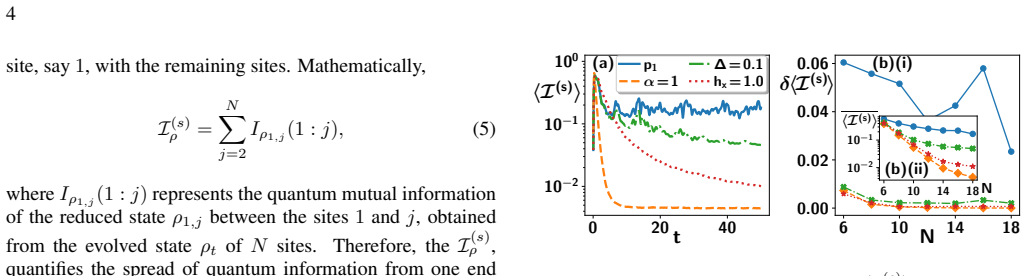
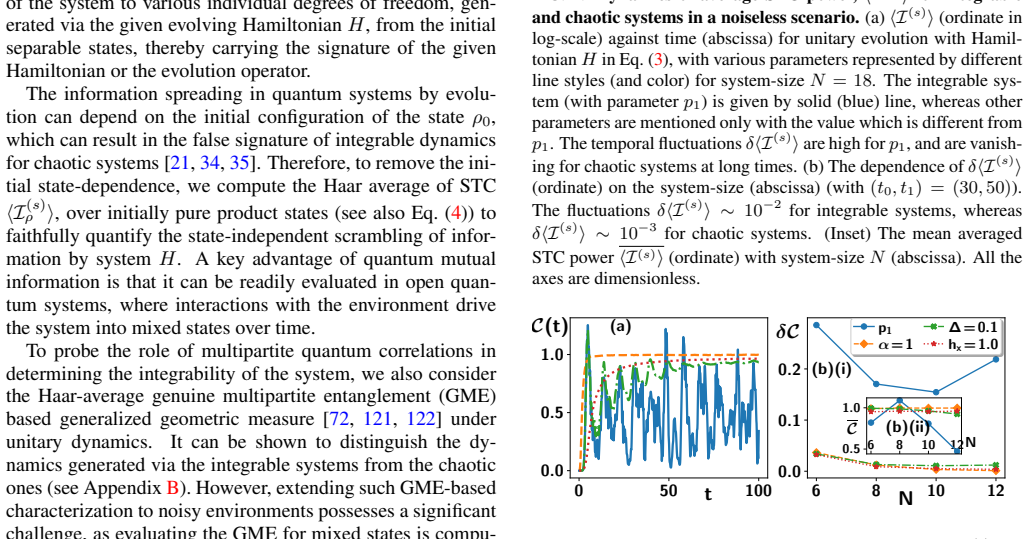
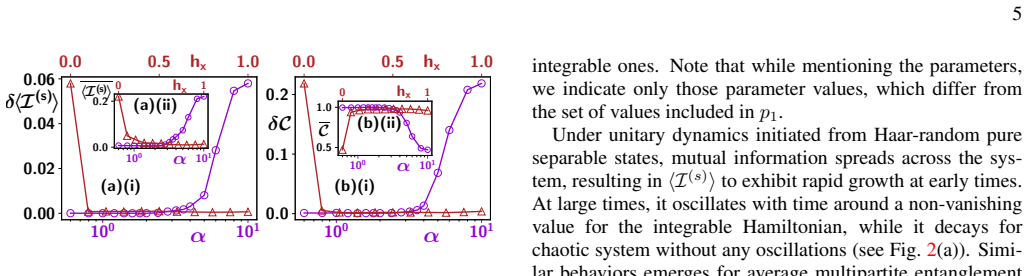
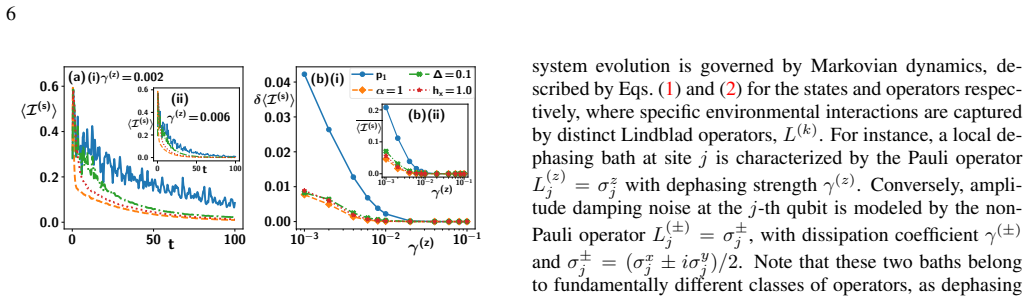
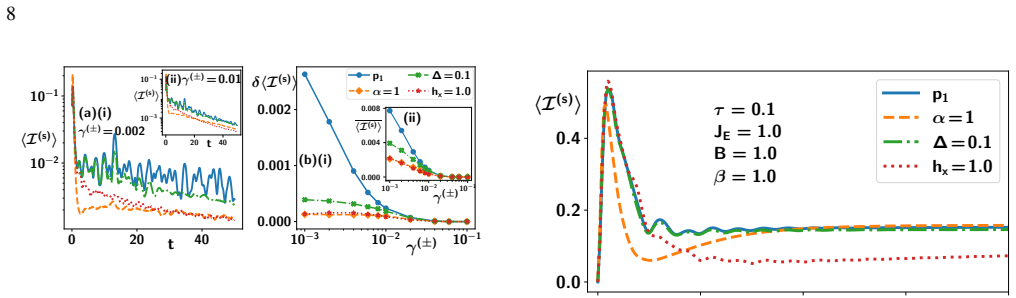
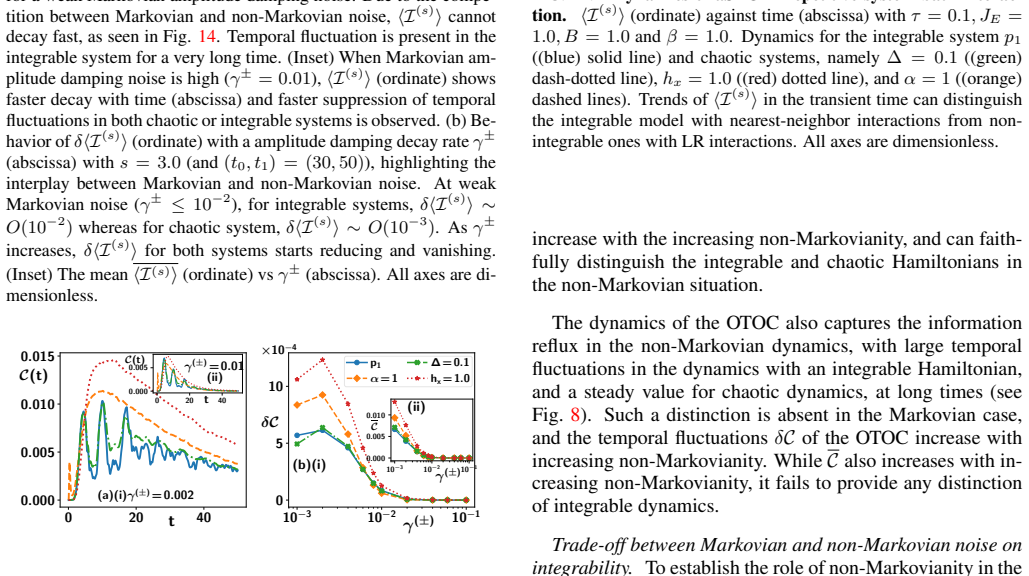
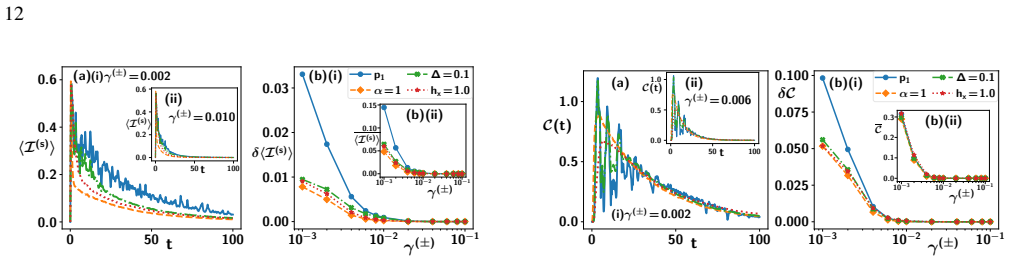
Using the long-range quantum XYZ spin model with an integrable limit given by the nearest-neighbor transverse XY model, the long-time average and temporal fluctuations of the aSTC, defined as the Haar-averaged sum of total correlations, serve as faithful signatures of integrable versus chaotic dynamics. This signature remains effective in the presence of system-bath coupling, with non-Markovian dynamics restoring the distinction at long times through information backflow, and under specific Markovian and non-Markovian noises where it outperforms the OTOC.
What carries the argument
The Haar-averaged sum of total correlations (aSTC), which measures the average quantum mutual information generated from initially separable states across all partitions.
If this is right
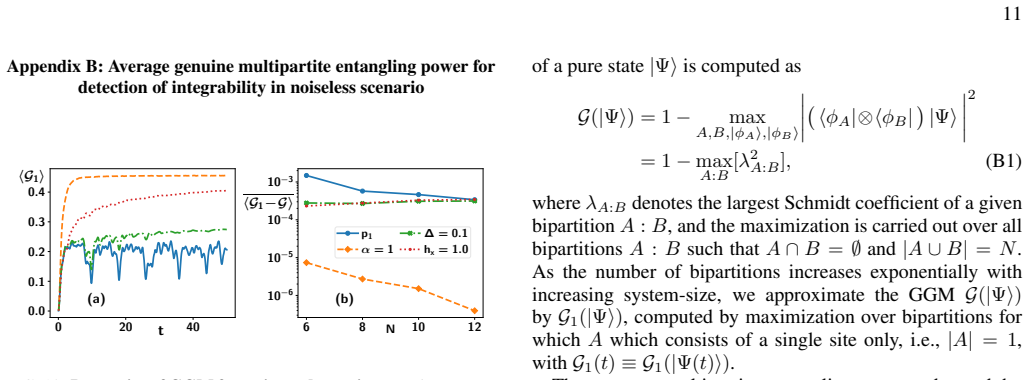
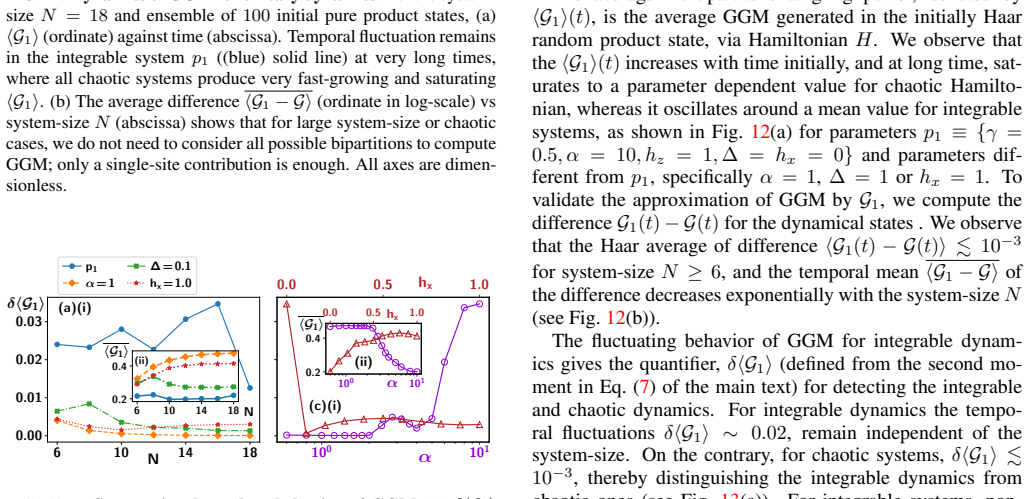
- The distinction via aSTC fluctuations holds independently of system size in closed systems.
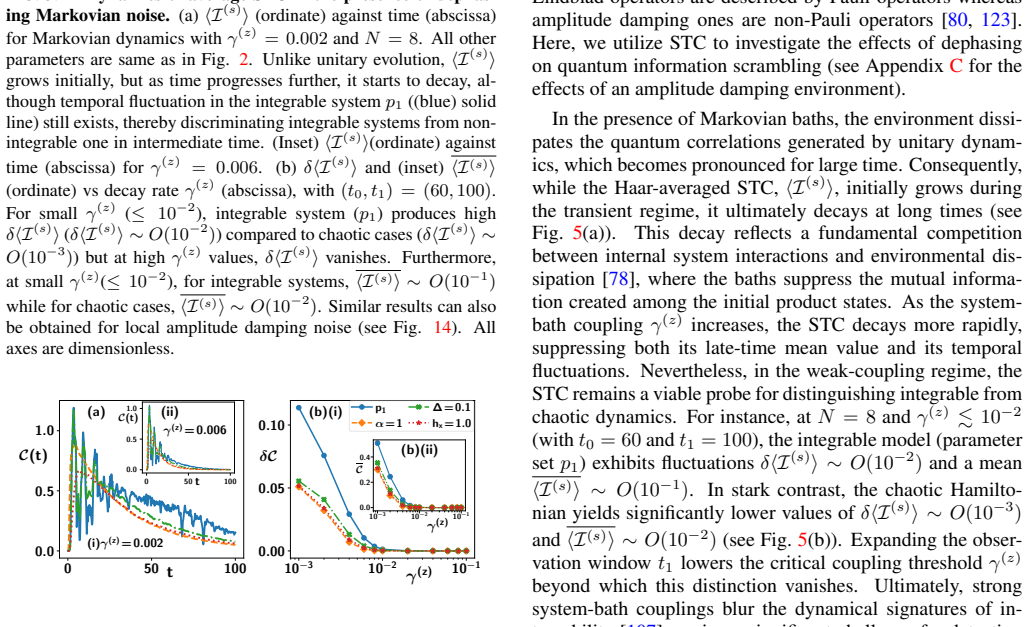
- In Markovian open quantum systems, the distinguishing power is limited to intermediate times.
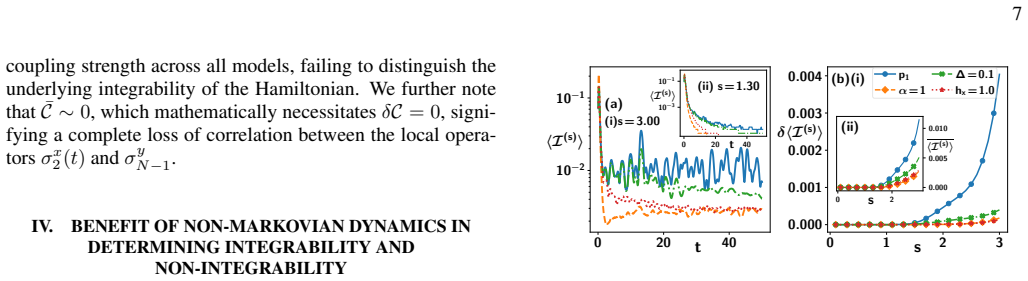
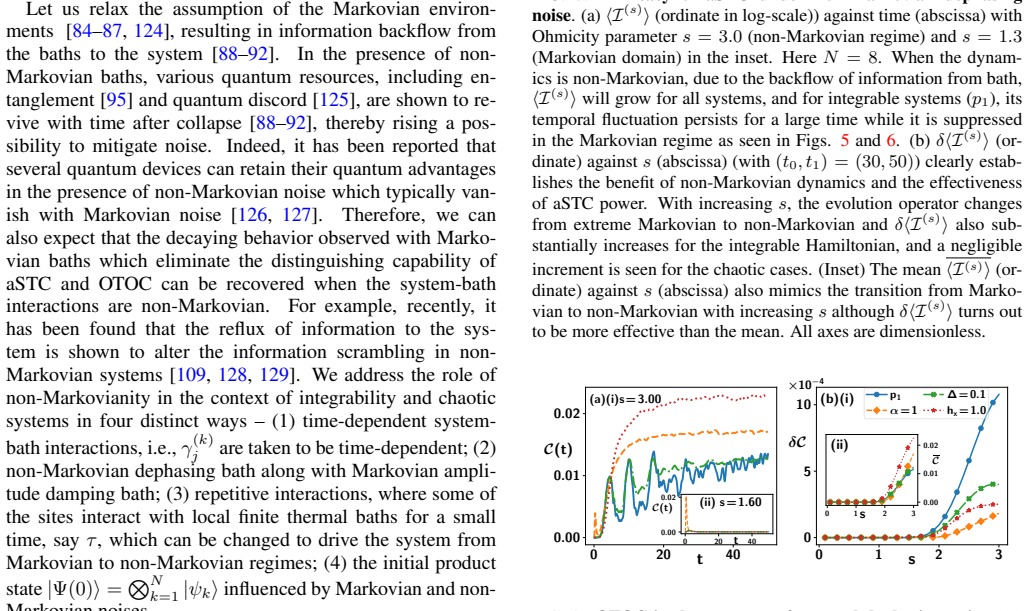
- Non-Markovian information backflow extends the utility of aSTC to long times.
- Under weak Markovian amplitude damping, aSTC fluctuations can identify integrability even when OTOC cannot.
Where Pith is reading between the lines
- The method may apply to experimental platforms with controllable noise to study many-body integrability.
- Since it relies on mutual information, it could connect to other entanglement-based diagnostics in open systems.
- Testing in models beyond the XYZ family would confirm the generality of the probe.
Load-bearing premise
The qualitative distinction observed in the long-range XYZ model generalizes to other systems with integrable-to-chaotic transitions.
What would settle it
Observing whether the temporal fluctuations of aSTC fail to separate integrable and chaotic regimes in a different model, such as the Ising chain with transverse field, at long times in closed systems.
Figures
read the original abstract
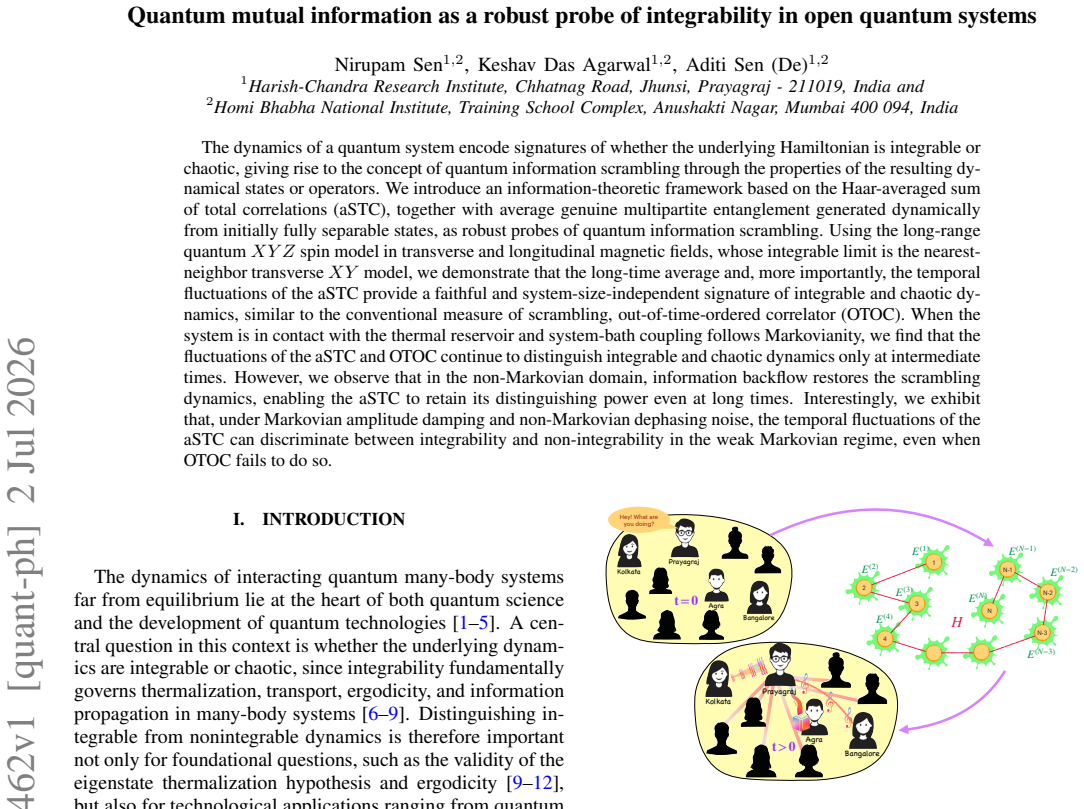
The dynamics of a quantum system encode signatures of whether the underlying Hamiltonian is integrable or chaotic, giving rise to the concept of quantum information scrambling through the properties of the resulting dynamical states or operators. We introduce an information-theoretic framework based on the Haar-averaged sum of total correlations (aSTC), together with average genuine multipartite entanglement generated dynamically from initially fully separable states, as robust probes of quantum information scrambling. Using the long-range quantum XYZ spin model in transverse and longitudinal magnetic fields, whose integrable limit is the nearest-neighbor transverse XY model, we demonstrate that the long-time average and, more importantly, the temporal fluctuations of the aSTC provide a faithful and system-size-independent signature of integrable and chaotic dynamics, similar to the conventional measure of scrambling, out-of-time-ordered correlator (OTOC). When the system is in contact with the thermal reservoir and system-bath coupling follows Markovianity, we find that the fluctuations of the aSTC and OTOC continue to distinguish integrable and chaotic dynamics only at intermediate times. However, we observe that in the non-Markovian domain, information backflow restores the scrambling dynamics, enabling the aSTC to retain its distinguishing power even at long times. Interestingly, we exhibit that, under Markovian amplitude damping and non-Markovian dephasing noise, the temporal fluctuations of the aSTC can discriminate between integrability and non-integrability in the weak Markovian regime, even when OTOC fails to do so.
Editorial analysis
A structured set of objections, weighed in public.
Referee Report
Summary. The manuscript introduces the Haar-averaged sum of total correlations (aSTC), based on quantum mutual information, and average genuine multipartite entanglement as information-theoretic probes of scrambling and integrability. Using numerical simulations on the long-range quantum XYZ spin model (whose integrable point is the nearest-neighbor transverse XY model), it claims that the long-time average and temporal fluctuations of aSTC distinguish integrable from chaotic dynamics in a system-size-independent way, comparable to the out-of-time-ordered correlator (OTOC). In open systems coupled to thermal baths, the work examines Markovian and non-Markovian regimes and reports that aSTC fluctuations retain distinguishing power at long times in the non-Markovian case and can succeed under certain weak Markovian noise channels where OTOC fails.
Significance. If the numerical results hold under scrutiny, the work supplies a potentially practical alternative to OTOC for diagnosing integrability and scrambling that appears more robust to dissipation and information backflow. The focus on temporal fluctuations rather than solely averages, together with the reported system-size independence, would be a useful addition to the toolkit for open quantum systems if the supporting evidence is made fully reproducible.
major comments (2)
- [Abstract] The central claim that aSTC fluctuations furnish a 'faithful and system-size-independent signature of integrable and chaotic dynamics' (abstract) rests exclusively on demonstrations within the long-range XYZ family. No other integrable-to-chaotic transitions (e.g., XXZ chain or Floquet models) are examined, so the reported distinction and size independence may be specific to the chosen long-range interactions or the particular crossover rather than a general feature of the measure.
- [Abstract] The abstract asserts numerical demonstrations of system-size independence and distinguishing power of long-time averages and fluctuations, yet provides no information on the range of system sizes examined, the presence or absence of error bars, the precise definition of the long-time window, or the numerical procedure for the Haar average. These omissions prevent verification that the reported behavior is not an artifact of post-hoc choices or finite-size effects.
minor comments (1)
- [Title/Abstract] The title emphasizes 'quantum mutual information' while the abstract centers on the derived quantity aSTC; a short clarifying sentence relating the two would improve accessibility.
Simulated Author's Rebuttal
We thank the referee for the careful reading and constructive comments. Below we provide a point-by-point response to the major comments and indicate the changes we will implement.
read point-by-point responses
-
Referee: [Abstract] The central claim that aSTC fluctuations furnish a 'faithful and system-size-independent signature of integrable and chaotic dynamics' (abstract) rests exclusively on demonstrations within the long-range XYZ family. No other integrable-to-chaotic transitions (e.g., XXZ chain or Floquet models) are examined, so the reported distinction and size independence may be specific to the chosen long-range interactions or the particular crossover rather than a general feature of the measure.
Authors: We acknowledge that all numerical results are obtained within the long-range XYZ family, selected because it possesses a well-defined integrable limit (nearest-neighbor transverse XY model) while allowing tunable long-range interactions. The abstract phrasing is therefore tied to this concrete setting rather than asserted as universal. To prevent overgeneralization we will revise the abstract to state that the signatures are demonstrated for long-range XYZ spin chains. revision: partial
-
Referee: [Abstract] The abstract asserts numerical demonstrations of system-size independence and distinguishing power of long-time averages and fluctuations, yet provides no information on the range of system sizes examined, the presence or absence of error bars, the precise definition of the long-time window, or the numerical procedure for the Haar average. These omissions prevent verification that the reported behavior is not an artifact of post-hoc choices or finite-size effects.
Authors: The main text and methods section already specify the system sizes (N = 4–12), the long-time averaging window after saturation, statistical error bars obtained from multiple disorder realizations, and the explicit Haar-averaging protocol over random unitaries. Because the abstract is length-limited we will add a concise clause indicating the range of system sizes examined and will ensure the methods section contains all numerical parameters for full reproducibility. revision: yes
Circularity Check
No circularity: aSTC defined from standard mutual information and benchmarked externally against OTOC
full rationale
The paper defines the Haar-averaged sum of total correlations (aSTC) directly from quantum mutual information on dynamically generated states, without any parameter fitting or self-referential construction. It then numerically compares long-time averages and fluctuations of aSTC to the independent, externally established OTOC benchmark in the long-range XYZ model. No step reduces a claimed prediction to a fitted input by construction, no uniqueness theorem is imported via self-citation, and the model choice is presented as an illustrative family rather than a definitional input. The derivation chain is therefore self-contained against external benchmarks.
Axiom & Free-Parameter Ledger
Reference graph
Works this paper leans on
-
[1]
Polkovnikov, K
A. Polkovnikov, K. Sengupta, A. Silva, and M. Vengalattore, Colloquium: Nonequilibrium dynamics of closed interacting quantum systems, Rev. Mod. Phys.83, 863 (2011)
2011
-
[2]
D. J. Luitz and Y . Bar Lev, Information propagation in isolated quantum systems, Phys. Rev. B96, 020406 (2017)
2017
-
[3]
R. J. Lewis-Swan, A. Safavi-Naini, A. M. Kaufman, and A. M. Rey, Dynamics of quantum information, Nature Re- views Physics1, 627–634 (2019)
2019
-
[4]
Styliaris, N
G. Styliaris, N. Anand, and P. Zanardi, Information scrambling over bipartitions: Equilibration, entropy production, and typi- cality, Phys. Rev. Lett.126, 030601 (2021)
2021
-
[5]
Harris, B
J. Harris, B. Yan, and N. A. Sinitsyn, Benchmarking informa- tion scrambling, Phys. Rev. Lett.129, 050602 (2022)
2022
-
[6]
J. M. Deutsch, Quantum statistical mechanics in a closed sys- tem, Phys. Rev. A43, 2046 (1991)
2046
-
[7]
Srednicki, Chaos and quantum thermalization, Phys
M. Srednicki, Chaos and quantum thermalization, Phys. Rev. E50, 888 (1994)
1994
-
[8]
Haake,Quantum Signatures of Chaos(Springer Berlin Hei- delberg, 2010)
F. Haake,Quantum Signatures of Chaos(Springer Berlin Hei- delberg, 2010)
2010
-
[9]
From quantum chaos and eigenstate thermalization to statistical mechanics and thermodynamics,
L. D’Alessio, Y . Kafri, A. Polkovnikov, and M. Rigol, From quantum chaos and eigenstate thermalization to statistical me- chanics and thermodynamics, Advances in Physics65, 239 (2016), https://doi.org/10.1080/00018732.2016.1198134
-
[10]
Larson, Integrability versus quantum thermalization, Jour- nal of Physics B: Atomic, Molecular and Optical Physics46, 224016 (2013)
J. Larson, Integrability versus quantum thermalization, Jour- nal of Physics B: Atomic, Molecular and Optical Physics46, 224016 (2013)
2013
-
[11]
Rigol, V
M. Rigol, V . Dunjko, and M. Olshanii, Thermalization and its mechanism for generic isolated quantum systems, Nature452, 854–858 (2008)
2008
-
[12]
F. H. L. Essler and M. Fagotti, Quench dynamics and relax- 13 ation in isolated integrable quantum spin chains, Journal of Statistical Mechanics: Theory and Experiment2016, 064002 (2016)
2016
-
[13]
ˇZnidariˇc, U
M. ˇZnidariˇc, U. Duh, and L. Zadnik, Integrability is generic in homogeneous u(1)-invariant nearest-neighbor qubit circuits, Phys. Rev. B112, L020302 (2025)
2025
-
[14]
O. Shtanko, D. S. Wang, H. Zhang, N. Harle, A. Seif, R. Movassagh, and Z. Minev, Uncovering local integrability in quantum many-body dynamics, Nature Communications16, 10.1038/s41467-025-57623-x (2025)
-
[15]
Bianchi, L
E. Bianchi, L. Hackl, M. Kieburg, M. Rigol, and L. Vidmar, V olume-law entanglement entropy of typical pure quantum states, PRX Quantum3, 030201 (2022)
2022
-
[16]
Ghosh, C
S. Ghosh, C. M. Langlett, N. Hunter-Jones, and J. F. Rodriguez-Nieva, Late-time ensembles of quantum states in quantum chaotic systems, Phys. Rev. B112, 094302 (2025)
2025
-
[17]
Hayden and J
P. Hayden and J. Preskill, Black holes as mirrors: quantum information in random subsystems, Journal of High Energy Physics2007, 120 (2007)
2007
-
[18]
Sekino and L
Y . Sekino and L. Susskind, Fast scramblers, Journal of High Energy Physics2008, 065 (2008)
2008
-
[19]
P. Hosur, X.-L. Qi, D. A. Roberts, and B. Yoshida, Chaos in quantum channels, Journal of High Energy Physics2016, 10.1007/jhep02(2016)004 (2016)
-
[20]
J. Maldacena, S. H. Shenker, and D. Stanford, A bound on chaos, Journal of High Energy Physics2016, 10.1007/jhep08(2016)106 (2016)
-
[21]
Iyoda and T
E. Iyoda and T. Sagawa, Scrambling of quantum information in quantum many-body systems, Phys. Rev. A97, 042330 (2018)
2018
-
[22]
A. Y . Guo, M. C. Tran, A. M. Childs, A. V . Gorshkov, and Z.- X. Gong, Signaling and scrambling with strongly long-range interactions, Phys. Rev. A102, 010401 (2020)
2020
-
[23]
Bertini and L
B. Bertini and L. Piroli, Scrambling in random unitary circuits: Exact results, Phys. Rev. B102, 064305 (2020)
2020
-
[24]
B. Yan, L. Cincio, and W. H. Zurek, Information scrambling and loschmidt echo, Phys. Rev. Lett.124, 160603 (2020)
2020
-
[25]
Xu and B
S. Xu and B. Swingle, Scrambling dynamics and out-of-time- ordered correlators in quantum many-body systems, PRX Quantum5, 010201 (2024)
2024
-
[26]
S. Choi, Y . Bao, X.-L. Qi, and E. Altman, Quantum error correction in scrambling dynamics and measurement-induced phase transition, Phys. Rev. Lett.125, 030505 (2020)
2020
-
[27]
M. A. Rampp and P. W. Claeys, Hayden-preskill recovery in chaotic and integrable unitary circuit dynamics, Quantum8, 1434 (2024)
2024
-
[28]
R. J. Garcia, K. Bu, and A. Jaffe, Resource theory of quantum scrambling, Proceedings of the National Academy of Sciences 120, 10.1073/pnas.2217031120 (2023)
-
[29]
Nahum, S
A. Nahum, S. Vijay, and J. Haah, Operator spreading in ran- dom unitary circuits, Phys. Rev. X8, 021014 (2018)
2018
-
[30]
C. W. von Keyserlingk, T. Rakovszky, F. Pollmann, and S. L. Sondhi, Operator hydrodynamics, otocs, and entanglement growth in systems without conservation laws, Phys. Rev. X 8, 021013 (2018)
2018
-
[31]
E. P. Wigner, On the statistical distribution of the widths and spacings of nuclear resonance levels, Mathematical Proceed- ings of the Cambridge Philosophical Society47, 790–798 (1951)
1951
-
[32]
M. L. Mehta,Random Matrices(Elsevier, 1991)
1991
-
[33]
P. Kos, M. Ljubotina, and T. c. v. Prosen, Many-body quantum chaos: Analytic connection to random matrix theory, Phys. Rev. X8, 021062 (2018)
2018
-
[34]
T. Xu, T. Scaffidi, and X. Cao, Does scrambling equal chaos?, Phys. Rev. Lett.124, 140602 (2020)
2020
-
[35]
Dowling, P
N. Dowling, P. Kos, and K. Modi, Scrambling is necessary but not sufficient for chaos, Phys. Rev. Lett.131, 180403 (2023)
2023
-
[36]
I. L. Aleiner, L. Faoro, and L. B. Ioffe, Microscopic model of quantum butterfly effect: Out-of-time-order correlators and traveling combustion waves, Annals of Physics375, 378 (2016)
2016
-
[37]
E. B. Rozenbaum, S. Ganeshan, and V . Galitski, Lyapunov exponent and out-of-time-ordered correlator’s growth rate in a chaotic system, Phys. Rev. Lett.118, 086801 (2017)
2017
-
[38]
K. Hashimoto, K. Murata, and R. Yoshii, Out-of-time-order correlators in quantum mechanics, Journal of High Energy Physics2017, 10.1007/jhep10(2017)138 (2017)
-
[39]
T. c. v. Prosen and I. Piˇzorn, Operator space entanglement en- tropy in a transverse ising chain, Phys. Rev. A76, 032316 (2007)
2007
-
[40]
Bertini, P
B. Bertini, P. Kos, and T. Prosen, Operator Entanglement in Local Quantum Circuits I: Chaotic Dual-Unitary Circuits, Sci- Post Phys.8, 067 (2020)
2020
-
[41]
D. E. Parker, X. Cao, A. Avdoshkin, T. Scaffidi, and E. Alt- man, A universal operator growth hypothesis, Phys. Rev. X9, 041017 (2019)
2019
-
[42]
Nandy, A
P. Nandy, A. S. Matsoukas-Roubeas, P. Mart ´ınez-Azcona, A. Dymarsky, and A. del Campo, Quantum dynamics in krylov space: Methods and applications, Physics Reports 1125-1128, 1 (2025), quantum dynamics in Krylov space: Methods and applications
2025
-
[43]
Liu, Spectral form factors and late time quantum chaos, Phys
J. Liu, Spectral form factors and late time quantum chaos, Phys. Rev. D98, 086026 (2018)
2018
-
[44]
Bertini, P
B. Bertini, P. Kos, and T. c. v. Prosen, Exact spectral form factor in a minimal model of many-body quantum chaos, Phys. Rev. Lett.121, 264101 (2018)
2018
-
[45]
H. Dong, P. Zhang, C. B. Da ˘g, Y . Gao, N. Wang, J. Deng, X. Zhang, J. Chen, S. Xu, K. Wang, Y . Wu, C. Zhang, F. Jin, X. Zhu, A. Zhang, Y . Zou, Z. Tan, Z. Cui, Z. Zhu, F. Shen, T. Li, J. Zhong, Z. Bao, H. Li, Z. Wang, Q. Guo, C. Song, F. Liu, A. Chan, L. Ying, and H. Wang, Measuring the spec- tral form factor in many-body chaotic and localized phases o...
2025
-
[46]
Garc ´ıa-Mata, M
I. Garc ´ıa-Mata, M. Saraceno, R. A. Jalabert, A. J. Roncaglia, and D. A. Wisniacki, Chaos signatures in the short and long time behavior of the out-of-time ordered correlator, Phys. Rev. Lett.121, 210601 (2018)
2018
-
[47]
E. M. Fortes, I. Garc ´ıa-Mata, R. A. Jalabert, and D. A. Wisni- acki, Gauging classical and quantum integrability through out- of-time-ordered correlators, Phys. Rev. E100, 042201 (2019)
2019
-
[48]
Yoshida and N
B. Yoshida and N. Y . Yao, Disentangling scrambling and de- coherence via quantum teleportation, Phys. Rev. X9, 011006 (2019)
2019
-
[49]
Omanakuttan, K
S. Omanakuttan, K. Chinni, P. D. Blocher, and P. M. Poggi, Scrambling and quantum chaos indicators from long-time properties of operator distributions, Phys. Rev. A107, 032418 (2023)
2023
- [50]
-
[51]
Duarte, I
J. Duarte, I. Garc ´ıa-Mata, and D. A. Wisniacki, Ruelle- pollicott decay of out-of-time-order correlators in many-body systems, Phys. Rev. E113, 024209 (2026)
2026
-
[52]
Swingle, G
B. Swingle, G. Bentsen, M. Schleier-Smith, and P. Hayden, Measuring the scrambling of quantum information, Phys. Rev. A94, 040302 (2016)
2016
-
[53]
G. Zhu, M. Hafezi, and T. Grover, Measurement of many-body 14 chaos using a quantum clock, Phys. Rev. A94, 062329 (2016)
2016
-
[54]
K. A. Landsman, C. Figgatt, T. Schuster, N. M. Linke, B. Yoshida, N. Y . Yao, and C. Monroe, Verified quantum in- formation scrambling, Nature567, 61–65 (2019)
2019
-
[55]
M. S. Blok, V . V . Ramasesh, T. Schuster, K. O’Brien, J. M. Kreikebaum, D. Dahlen, A. Morvan, B. Yoshida, N. Y . Yao, and I. Siddiqi, Quantum information scrambling on a super- conducting qutrit processor, Phys. Rev. X11, 021010 (2021)
2021
-
[56]
Vermersch, A
B. Vermersch, A. Elben, L. M. Sieberer, N. Y . Yao, and P. Zoller, Probing scrambling using statistical correlations be- tween randomized measurements, Phys. Rev. X9, 021061 (2019)
2019
-
[57]
G. C. Toga, S. Darbha, E. Rrapaj, P. L. S. Lopes, and A. F. Kemper, Information propagation in rydberg arrays via analog otoc calculations (2026), arXiv:2604.05038 [quant-ph]
work page internal anchor Pith review Pith/arXiv arXiv 2026
-
[58]
Kim and D
H. Kim and D. A. Huse, Ballistic spreading of entanglement in a diffusive nonintegrable system, Phys. Rev. Lett.111, 127205 (2013)
2013
-
[59]
Y . O. Nakagawa, M. Watanabe, H. Fujita, and S. Sugiura, Uni- versality in volume-law entanglement of scrambled pure quan- tum states, Nature Communications9, 10.1038/s41467-018- 03883-9 (2018)
-
[60]
Madhok, V
V . Madhok, V . Gupta, D.-A. Trottier, and S. Ghose, Signatures of chaos in the dynamics of quantum discord, Phys. Rev. E91, 032906 (2015)
2015
-
[61]
Anand, G
N. Anand, G. Styliaris, M. Kumari, and P. Zanardi, Quantum coherence as a signature of chaos, Phys. Rev. Res.3, 023214 (2021)
2021
-
[62]
Rangamani and M
M. Rangamani and M. Rota, Entanglement structures in qubit systems, Journal of Physics A: Mathematical and Theoretical 48, 385301 (2015)
2015
-
[63]
Rota, Tripartite information of highly entangled states, Journal of High Energy Physics2016, 1–16 (2016)
M. Rota, Tripartite information of highly entangled states, Journal of High Energy Physics2016, 1–16 (2016)
2016
-
[64]
Pappalardi, A
S. Pappalardi, A. Russomanno, B. ˇZunkoviˇc, F. Iemini, A. Silva, and R. Fazio, Scrambling and entanglement spread- ing in long-range spin chains, Phys. Rev. B98, 134303 (2018)
2018
-
[65]
Bera and S
A. Bera and S. Singha Roy, Growth of genuine multipartite entanglement in random unitary circuits, Phys. Rev. A102, 062431 (2020)
2020
-
[66]
G. Hu, W. Zhang, Z. Chen, L. Zhong, J. Zhao, C. Liu, Z. Liu, Y . Xu, Y . Lin, Y . Ri, G. Xie, M. Liu, H. Yuan, Y . Zhou, Y . Zhang, C.-K. Hu, S. Liu, D. Tan, and D. Yu, Quantum-enhanced sensing enabled by scrambling-induced genuine multipartite entanglement, Phys. Rev. Lett.136, 210801 (2026)
2026
-
[67]
M. A. Nielsen and I. L. Chuang,Quantum Computation and Quantum Information: 10th Anniversary Edition(Cambridge University Press, 2010)
2010
-
[68]
N. J. Cerf and C. Adami, Negative entropy and information in quantum mechanics, Phys. Rev. Lett.79, 5194 (1997)
1997
-
[69]
Groisman, S
B. Groisman, S. Popescu, and A. Winter, Quantum, classical, and total amount of correlations in a quantum state, Phys. Rev. A72, 032317 (2005)
2005
-
[70]
D. A. Chisholm, L. Innocenti, and G. M. Palma, Importance of using the averaged mutual information when quantifying quantum objectivity, Phys. Rev. A110, 012218 (2024)
2024
-
[71]
Mondal, S
S. Mondal, S. K. Hazra, and A. Sen(De), Imperfect entangling power of quantum gates, Phys. Rev. A112, 012417 (2025)
2025
-
[72]
Samanta, S
M. Samanta, S. Mondal, S. K. Hazra, and A. Sen (De), Hier- archies among genuine multipartite entangling capabilities of quantum gates, Phys. Rev. A113, 012612 (2026)
2026
-
[73]
Zanardi, Entanglement of quantum evolutions, Phys
P. Zanardi, Entanglement of quantum evolutions, Phys. Rev. A 63, https://doi.org/10.1103/PhysRevA.63.040304 (2001)
-
[74]
Zanardi, C
P. Zanardi, C. Zalka, and L. Faoro, Entangling power of quan- tum evolutions, Phys. Rev. A62, 030301(R) (2000)
2000
-
[75]
Islam, R
R. Islam, R. Ma, P. M. Preiss, M. Eric Tai, A. Lukin, M. Rispoli, and M. Greiner, Measuring entanglement entropy in a quantum many-body system, Nature528, 77–83 (2015)
2015
-
[76]
Tajik, I
M. Tajik, I. Kukuljan, S. Sotiriadis, B. Rauer, T. Schweigler, F. Cataldini, J. Sabino, F. Møller, P. Sch ¨uttelkopf, S.-C. Ji, D. Sels, E. Demler, and J. Schmiedmayer, Verification of the area law of mutual information in a quantum field simulator, Nature Physics19, 1022–1026 (2023)
2023
-
[77]
Brydges, A
T. Brydges, A. Elben, P. Jurcevic, B. Vermersch, C. Maier, B. P. Lanyon, P. Zoller, R. Blatt, and C. F. Roos, Probing r´enyi entanglement entropy via randomized measurements, Science 364, 260 (2019)
2019
-
[78]
Breuer and F
H.-P. Breuer and F. Petruccione,The Theory of Open Quantum Systems(2006)
2006
-
[79]
Rivas and S
A. Rivas and S. F. Huelga,Open Quantum Systems: An Intro- duction(Springer Berlin Heidelberg, 2012)
2012
- [80]
discussion (0)
Sign in with ORCID, Apple, or X to comment. Anyone can read and Pith papers without signing in.