REVIEW 3 major objections 5 minor 35 references
All fourteen tested text-to-image models still produce recognizable intellectual property; private models refuse some prompts but rates and coverage vary sharply by provider and by IP category.
Reviewed by Pith at T0; open to challenge. T0 means a machine referee read the full paper against a public rubric. the ladder, T0–T4 →
T0 review · grok-4.5
2026-07-12 09:36 UTC pith:NWHUDEMR
load-bearing objection Solid comparative snapshot of IP guardrails across 14 T2I systems; the rates are useful even with an imperfect detector and coarse API proxies. the 3 major comments →
Evaluating Intellectual Property Guardrails of Generative Image Models: A Technical Report
The pith
A machine-rendered reading of the paper's core claim, the machinery that carries it, and where it could break.
Core claim
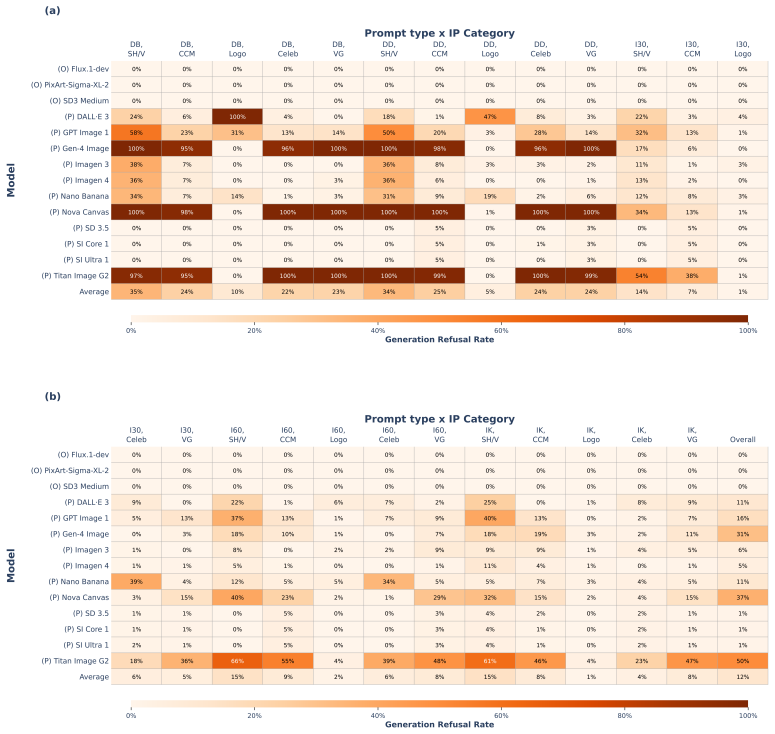
As of March 2026, every one of the fourteen text-to-image models tested—three open-weight and eleven private—readily generates images containing recognizable IP; private models activate IP guardrails at some level, but refusal frequency varies substantially by provider and by category, with commercial logos refused least often and successfully generated at the highest average rate.
What carries the argument
The IP Generation Benchmark plus automated pipeline: 1,809 structured direct and indirect prompts over 201 entities, API content-filter error codes as the refusal signal (Generation Refusal Rate), and a Qwen3-VL vision-language model as binary IP detector (IP Occurrence Rate).
Load-bearing premise
The API content-moderation error code is treated as a clean proxy for IP-specific guardrails, and a single vision-language model with modest F1 is treated as a faithful stand-in for human recognition of IP across popularity and region.
What would settle it
Re-run the same 1,809 prompts after a provider updates its IP guardrails or after human annotators re-label a large random sample of the generated images; a large drop in IP Occurrence Rate or a large mismatch with the VLM detector would overturn the March 2026 snapshot.
Editorial analysis
A structured set of objections, weighed in public.
Referee Report
Summary. This technical report introduces an IP Generation Benchmark (201 entities, 1,809 prompts, five prompt types) and an automated pipeline to measure inference-time IP guardrails and IP generation propensity in fourteen text-to-image models (three open-weights, eleven proprietary). Outcomes are summarized by Generation Refusal Rate (GRR), inferred from API content-moderation error codes, and IP Occurrence Rate (IOR), inferred from a VLM (Qwen3-VL-30B-A3B) binary detector selected after a 14-model bake-off on a separately labeled 14,809-image set. Stratified results by prompt directness, IP category, region, and popularity support three main empirical claims: private models refuse at highly variable rates; commercial logos are refused least and generated most on average; and, as of March 2026, all tested models still produce recognizable IP at non-trivial rates.
Significance. If the measurements hold under stronger validation, the work provides a timely, comparative snapshot of IP guardrail coverage across widely used T2I systems and a reusable taxonomy/prompt design that goes beyond prior character-only studies. Strengths include the multi-axis taxonomy, explicit GRR/IOR definitions, a documented VLM detector bake-off with precision/recall reporting, open discussion of limitations, and clear legal/ethical disclaimers. The contribution is primarily empirical and infrastructural rather than theoretical; its value to the community is as a reproducible measurement protocol and a March 2026 baseline against which future guardrail changes can be compared.
major comments (3)
- [§5.3, §7, §7.4] Section 5.3 and Section 7: IOR is defined entirely by Qwen3-VL-30B-A3B (F1 71.3%, accuracy 67.7% on the separate labeled set). No human labels are collected on the actual evaluation images produced by the 14 T2I models (explicitly noted in §7.4). Given moderate precision and the paper’s own observation of over-prediction and likely popularity/region bias (§8.2), the absolute IOR levels and the claim that all models “readily” generate recognizable IP are not yet sufficiently grounded. A stratified human audit (even on a few hundred images spanning categories, popularity, and models) is needed to calibrate or bound IOR before the quantitative rates can support the strongest comparative claims.
- [§4.5, Appendix B] Section 4.5 and Appendix B: GRR treats CONTENT_FILTERED (and UNKNOWN for Nano Banana) as a proxy for IP guardrail activation. The APIs only expose generic content-moderation codes; non-IP filters could contribute. The manuscript argues that prompts lack overtly violent/sexual content, but this is not demonstrated with a controlled contrast (e.g., matched non-IP prompts, or provider documentation that the code is IP-specific). Without that, cross-model GRR differences and the “IP guardrails” interpretation remain only partially identified. A sensitivity analysis or provider-level clarification is load-bearing for Q1.
- [§3.3, §4.2, §8.2] Section 3.3, 4.2, and 8.2: Eastern/Western and more/less-mainstream strata are produced primarily by Llama 3.1-8B, and the same VLM detector is known to be more reliable on mainstream entities. The reported ~1.7× higher IOR for more popular entities may therefore partly reflect detector coverage rather than true generation propensity. The popularity and region claims in Q3 need either human verification on those strata or an explicit bias audit of the detector before they can be treated as model behavior rather than measurement artifact.
minor comments (5)
- [Figs. 8–10] Figures 8–10 omit model names “for sensitivity purposes,” which reduces interpretability of the galleries relative to the named models in Figs. 4–7. Consider anonymized but consistent column IDs that map to Table 5 in an appendix.
- [§4.5, Eq. (1)] Equation (1) defines IOR over |P| (all prompts) while summing only over generated images; this is intentional but easy to misread as conditioning on non-refusal. A one-sentence clarification next to Eq. (1) would help.
- [Table 1] Table 1 comparison to prior work is useful; adding approximate entity counts and whether human vs automatic labeling was used would make the scope claim sharper.
- [§4.5] Typo: “IP Occurence rate” should be “Occurrence” in §4.5.
- [Abstract, §6.1] The abstract and conclusion state “as of March 2026”; ensure all date stamps (evaluation month, arXiv header) are consistent in the camera-ready version.
Circularity Check
No circularity: empirical measurements of external T2I APIs/open-weights under a fixed prompt set; detector selected on a separate labeled set, not on evaluation outcomes.
full rationale
The paper is a technical report of observed rates (GRR via API CONTENT_FILTERED/UNKNOWN codes; IOR via binary VLM ip_present decisions) on 1,809 fixed prompts across 14 external models. There is no claimed first-principles derivation, uniqueness theorem, fitted parameter renamed as prediction, or self-definitional identity. The IP detector (Qwen3-VL-30B-A3B) was chosen by F1/accuracy on an independently constructed and human-QA'd labeled set of 14,809 real+synthetic images (Sec. 5.1–5.3); that selection set is disjoint from the main evaluation images. Metrics G and R are defined by simple proportions over external outcomes (Eqs. 1–2), not by construction from fitted inputs. Self-citations are ordinary background references and do not load-bear any uniqueness or ansatz that forces the reported rates. Limitations of the proxy signals are disclosed (Sec. 8.2, App. B) rather than hidden. The derivation chain is therefore self-contained empirical measurement; score 0 is the correct outcome.
Axiom & Free-Parameter Ledger
free parameters (5)
- CLIP token length cap (MAX_TOKENS=75)
- Indirect description length targets (30 vs 60 words) and keyword cap (50)
- VLM detector selection (Qwen3-VL-30B-A3B by max F1)
- Entity retention thresholds for detector eval set (≥10 IP-positive; ≤50 IP-negative per entity)
- Two images per non-refused prompt
axioms (5)
- domain assumption API CONTENT_FILTERED (or UNKNOWN for Nano Banana) indicates IP-related guardrail refusal rather than unrelated moderation.
- domain assumption A VLM binary judgment of 'recognizable IP' is a valid operationalization of human-recognizable IP for comparative model ranking.
- ad hoc to paper Eastern/Western and more/less mainstream strata produced by Llama 3.1-8B (plus multi-LLM alias QA) adequately represent geographic and popularity diversity.
- domain assumption The five IP categories (celebrities, CCM, superheroes/villains, video-game characters, commercial logos) are sufficient for the stated claims about IP guardrail coverage within scope.
- standard math Standard classification metrics (precision/recall/F1/accuracy/name-match) on a mixed web+synthetic labeled set validate detector fitness.
invented entities (3)
-
IP Generation Benchmark (201 entities / 1,809 prompts with five prompt types)
no independent evidence
-
Generation Refusal Rate (GRR) and IP Occurrence Rate (IOR)
no independent evidence
-
Four-dimension IP taxonomy (user intent, category, geography, popularity)
no independent evidence
read the original abstract
Generative image models are capable of producing images that bear a strong resemblance to, or replicate, recognizable intellectual property (IP). In this technical report, we present a benchmark and automated evaluation pipeline to test for evidence of IP guardrails in generative image models along with the propensity for these models to generate images with recognizable IP. The IP categories we tested include fictional characters, celebrity likeness, and commercial logos and do not encompass the full range of IP which may be implicated by image generation models. We evaluated fourteen widely used text-to-image models, including three self-hosted open weights models and eleven private models. While all of the private models were observed to refuse generations at some level due to IP guardrails, the frequency of generation refusals varied substantially among models. The refusal rates also varied considerably across the different IP categories tested. Commercial logos were refused least frequently and were successfully generated at the highest rate, on average. Though the rate varies, all models tested readily generated images containing recognizable IP as of March 2026.
Figures




Reference graph
Works this paper leans on
-
[1]
Andrea Bartz, Kirk Wallace Johnson, and Charles Graeber. Bartz v. anthropic pbc. https: //www.courtlistener.com/docket/69058235/bartz-v-anthropic-pbc/ , 2024. Case No. 3:24-cv-05417, U.S. District Court, Northern District of California
arXiv 2024
-
[2]
Getty images and others v stability ai
Mrs Justice Joanna Smith DBE. Getty images and others v stability ai. https:// www.judiciary.uk/judgments/getty-images-and-others-v-stability-ai/ , 2025
2025
-
[3]
IL-2023-000007, High Court of Justice, Business and Property Courts of England and Wales, Chancery Division
EWHC 38 (Ch), Case No. IL-2023-000007, High Court of Justice, Business and Property Courts of England and Wales, Chancery Division
2023
-
[4]
The New York Times Company. The new york times company v. mi- crosoft corporation. https://www.courtlistener.com/docket/68117049/ the-new-york-times-company-v-microsoft-corporation/ , 2023. Case No. 1:23-cv-11195, U.S. District Court, Southern District of New York
arXiv 2023
-
[5]
Disney Enterprises, Inc. and others. Disney enterprises, inc. et al. v. midjourney, inc. https://www.courtlistener.com/docket/70513159/ disney-enterprises-inc-v-midjourney-inc/ , 2025. Case No. 2:25-cv-04872, U.S. District Court, Central District of California
arXiv 2025
-
[6]
Disney cease-and-desist to bytedance over seedance 2.0.https: //www.aol.com/articles/lawsuits-billion-dollar-deals-disney-183659024
The Walt Disney Company. Disney cease-and-desist to bytedance over seedance 2.0.https: //www.aol.com/articles/lawsuits-billion-dollar-deals-disney-183659024. html, 2025. Cease-and-desist letter alleging unauthorized use of Disney, Star Wars, and Marvel characters in Seedance 2.0 AI video generator
2025
-
[7]
code ann
Tenn. code ann. § 47-25-1101 – ensuring likeness, voice, and image security act. https: //www.capitol.tn.gov/Bills/113/Bill/HB2091.pdf, 2024
2024
-
[8]
Extracting training data from diffusion models
Nicolas Carlini, Jamie Hayes, Milad Nasr, Matthew Jagielski, Vikash Sehwag, Florian Tramer, Borja Balle, Daphne Ippolito, and Eric Wallace. Extracting training data from diffusion models. In32nd USENIX security symposium (USENIX Security 23), pages 5253–5270, 2023
2023
-
[9]
Detecting, explaining, and mitigat- ing memorization in diffusion models.The Twelfth International Conference on Learning Representations, 2024
Yuxin Wen, Yuchen Liu, Chen Chen, and Lingjuan Lyu. Detecting, explaining, and mitigat- ing memorization in diffusion models.The Twelfth International Conference on Learning Representations, 2024
2024
-
[10]
PromptShield: A hybrid framework for copyright-safe text-to-image generation
Shreya Garg. PromptShield: A hybrid framework for copyright-safe text-to-image generation. InWorkshop on Generative AI for Recommender Systems and Personalization (GenAIRecP) at KDD’25, Toronto, ON, Canada, 2025. August 4, 2025
2025
-
[11]
How to evaluate and mitigate IP infringement in visual generative AI? InForty-second International Conference on Machine Learning, 2025
Zhenting Wang, Chen Chen, Vikash Sehwag, Minzhou Pan, and Lingjuan Lyu. How to evaluate and mitigate IP infringement in visual generative AI? InForty-second International Conference on Machine Learning, 2025
2025
-
[12]
Fantastic copyrighted beasts and how (not) to generate them
Luxi He, Yangsibo Huang, et al. Fantastic copyrighted beasts and how (not) to generate them. InThe Thirteenth International Conference on Learning Representations, 2025. 21
2025
-
[13]
Responsible ai and usage guidelines for imagen
Google Cloud. Responsible ai and usage guidelines for imagen. https://docs.cloud. google.com/vertex-ai/generative-ai/docs/image/responsible-ai-imagen/ ,
-
[14]
Accessed: 2026-05-14
2026
-
[15]
Dall·e 3 system card
OpenAI. Dall·e 3 system card. https://openai.com/index/dall-e-3-system-card/ ,
-
[16]
Huggingface: Building the ai community that builds ai
HuggingFace Team. Huggingface: Building the ai community that builds ai. https:// huggingface.co/, 2025
2025
-
[17]
Diffu- sion art or digital forgery? investigating data replication in diffusion models
Gowthami Somepalli, Vasu Singla, Micah Goldblum, Jonas Geiping, and Tom Goldstein. Diffu- sion art or digital forgery? investigating data replication in diffusion models. InProceedings of the IEEE/CVF conference on computer vision and pattern recognition, pages 6048–6058, 2023
2023
-
[18]
Red-teaming the stable diffusion safety filter.arXiv preprint arXiv:2210.04610, 2022
Javier Rando, Daniel Paleka, David Lindner, Lennart Heim, and Florian Tramèr. Red-teaming the stable diffusion safety filter.arXiv preprint arXiv:2210.04610, 2022. ML Safety Workshop, NeurIPS 2022
Pith/arXiv arXiv 2022
-
[19]
Qipan Xu, Zhenting Wang, Xiaoxiao He, Ligong Han, and Ruixiang Tang. Can large vision-language models detect images copyright infringement from genai?arXiv preprint arXiv:2502.16618, 2025
Pith/arXiv arXiv 2025
-
[20]
T2i-riskyprompt: A benchmark for safety evaluation, attack, and defense on text-to-image model.The Fortieth AAAI Conference on Artificial Intelligence (AAAI-26), 2026
Zhang C., Zhang T., Wang L., Chen R., Li W., and Liu A. T2i-riskyprompt: A benchmark for safety evaluation, attack, and defense on text-to-image model.The Fortieth AAAI Conference on Artificial Intelligence (AAAI-26), 2026
2026
-
[21]
On copyright risks of text-to-image diffusion models.arXiv preprint arXiv:2311.12803, 2024
Yang Zhang, Teoh Tze Tzun, Lim Wei Hern, Haonan Wang, and Kenji Kawaguchi. On copyright risks of text-to-image diffusion models.arXiv preprint arXiv:2311.12803, 2024
Pith/arXiv arXiv 2024
-
[22]
Measuring style similarity in diffusion models.arXiv preprint arxiv:2404.01292
Gowthami Somepalli, Anubhav Gupta, Kamal Gupta, Shramay Palta, Micah Goldblum, Jonas Geiping, Abhinav Shrivastava, and Tom Goldstein. Measuring style similarity in diffusion models.arXiv preprint arxiv:2404.01292
-
[23]
The llama 3 herd of models.arXiv preprint arXiv:2407.21783, 2024
Aaron Grattafiori, Abhimanyu Dubey, et al. The llama 3 herd of models.arXiv preprint arXiv:2407.21783, 2024
Pith/arXiv arXiv 2024
-
[24]
Jiang, Alexandre Sablayrolles, et al
Albert Q. Jiang, Alexandre Sablayrolles, et al. Mixtral of experts.arXiv preprint arXiv:2401.04088, 2024
Pith/arXiv arXiv 2024
-
[25]
DeepSeek-R1 incentivizes reasoning in LLMs through reinforce- ment learning.Nature, 645(8081):633–638, sep 2025
Daya Guo, Dejian Yang, et al. DeepSeek-R1 incentivizes reasoning in LLMs through reinforce- ment learning.Nature, 645(8081):633–638, sep 2025
2025
-
[26]
Gemma 3 technical report, 2025
Gemma Team, Aishwarya Kamath, et al. Gemma 3 technical report, 2025
2025
-
[27]
Learning transferable visual models from natural language supervision
Alec Radford, Jong Wook Kim, Chris Hallacy, Aditya Ramesh, Gabriel Goh, Sandhini Agar- wal, Girish Sastry, Amanda Askell, Pamela Mishkin, Jack Clark, Gretchen Krueger, and Ilya Sutskever. Learning transferable visual models from natural language supervision. In Marina Meila and Tong Zhang, editors,Proceedings of the 38th International Conference on Machin...
2021
-
[28]
Qwen3-vl technical report.arXiv preprint arXiv:2511.21631, 2025
Shuai Bai, Yuxuan Cai, et al. Qwen3-vl technical report.arXiv preprint arXiv:2511.21631, 2025
Pith/arXiv arXiv 2025
-
[29]
High-resolution image synthesis with latent diffusion models.Proceedings of the IEEE/CVF Conference on Computer Vision and Pattern Recognition (CVPR), 2022
Robin Rombach, Andreas Blattmann, Dominik Lorenz, Patrick Esser, and Björn Ommer. High-resolution image synthesis with latent diffusion models.Proceedings of the IEEE/CVF Conference on Computer Vision and Pattern Recognition (CVPR), 2022
2022
-
[30]
Stable diffusion 3 medium
Stability AI. Stable diffusion 3 medium. https://huggingface.co/stabilityai/ stable-diffusion-3-medium, 2024
2024
-
[31]
Qwen2.5-vl technical report.arXiv preprint arXiv:2502.13923, 2025
Shuai Bai, Keqin Chen, et al. Qwen2.5-vl technical report.arXiv preprint arXiv:2502.13923, 2025
Pith/arXiv arXiv 2025
-
[32]
Jinguo Zhu, Weiyun Wang, et al. Internvl3: Exploring advanced training and test-time recipes for open-source multimodal models.arXiv preprint arXiv:2504.10479, 2025
Pith/arXiv arXiv 2025
-
[33]
Flux.1-dev
Black Forest Labs. Flux.1-dev. https://huggingface.co/black-forest-labs/flux. 1-dev, 2025
2025
-
[34]
Pixart-sigma-xl-2
PixArt-alpha. Pixart-sigma-xl-2. https://huggingface.co/PixArt-alpha/ PixArt-Sigma-XL-2-1024-MS, 2025. 22 Figure 11: Generation Refusal rate for each T2I model aggregated by the intersection of IP category and prompt type. The plot is split into two rows for readability. Prompt type abbreviations: BD = basic direct, DD = direct dilution, ID = indirect des...
2025
-
[35]
out of frame, 24 low quality, bad anatomy, watermark
Amazon Web Services. Overview - responsible AI - Amazon Titan Image Generator. https://docs.aws.amazon.com/ai/responsible-ai/titan-image-generator/overview.html, 2024. Ac- cessed: 2026-05-08. A Per-Model Detailed Results Here we show generation refusal rate (GRR) and IP occurrence rate (IOR) plots for the intersections of attributes in our prompt dataset....
2024
discussion (0)
Sign in with ORCID, Apple, or X to comment. Anyone can read and Pith papers without signing in.