REVIEW 3 major objections 6 minor 69 references
A single spectral measurement of the Heisenberg work operator can report coherent work without erasing the coherences that produce it.
Reviewed by Pith at T0; open to challenge. T0 means a machine referee read the full paper against a public rubric. the ladder, T0–T4 →
T0 review · grok-4.5
2026-07-12 07:55 UTC pith:KZRUQ254
load-bearing objection Clean operational fix for coherent work statistics: modified fluctuation relations and concrete engine/demon examples that actually matter. the 3 major comments →
Minimally invasive measurement of work in coherent quantum systems
The pith
A machine-rendered reading of the paper's core claim, the machinery that carries it, and where it could break.
Core claim
The spectral measurement of the Heisenberg work operator Ω = U†H′U − H is the unique state-independent protocol that reproduces the unmeasured average work for every input state while still yielding ordinary positive probabilities; the associated instruments can be chosen so that measurement back-action is minimal, and the resulting statistics obey modified fluctuation theorems whose correction terms quantify residual non-commutativity.
What carries the argument
The variation-operator measurement (VOM): projective spectral measurement of Ω = U†H′U − H (implemented by Kraus operators K_k^Ω = U|ω_k⟩⟨ω_k| or the time-advanced version at the final time), which forces the outcome average to equal Tr(ρΩ) for every ρ.
Load-bearing premise
The scheme assumes one already knows the full unitary U and final Hamiltonian well enough to implement a projective measurement of Ω itself (or of its unitarily rotated version) before or after the drive.
What would settle it
In a coherent qubit engine or the four-stroke heat engine of the paper, compare measured work and engine output under VOM versus two-point energy measurement: if VOM fails to recover the linear-in-coherence work that the unmeasured process produces, or if the modified Jarzynski correction vanishes when [Ω,H]≠ 0, the central claim is false.
If this is right
- Coherence-assisted engines can be diagnosed without first dephasing the working medium, so reported work tracks actual performance rather than a measurement-modified process.
- Feedback demons that condition a unitary on a VOM outcome can extract more work than energy-basis demons for the same drive, at the price of a nonzero measurement energy cost.
- Standard Jarzynski and Crooks equalities are replaced by inequalities whose positive correction Ξ_Ω bounds the enhanced probability of negative-work outcomes.
- A thermodynamic uncertainty relation continues to hold for odd observables under time reversal, now expressed solely in terms of VOM outcome distributions.
Where Pith is reading between the lines
- Approximate or coarse-grained measurements of Ω could make the scheme usable when exact knowledge of U is unavailable, trading uniqueness for experimental accessibility.
- The same construction applied to a joint system-plus-bath Hamiltonian would give an operational work observable for open coherent processes without requiring full system-bath tomography.
- Comparing the size of the Jarzynski correction Ξ_Ω with the energetic back-action of the optimal Kraus operators would quantify how much “invasiveness” is paid for each retained coherence contribution.
Editorial analysis
A structured set of objections, weighed in public.
Referee Report
Summary. The manuscript introduces the variation-operator measurement (VOM) scheme for work statistics in closed, coherently driven quantum systems: a projective measurement of the Heisenberg work operator Ω = U†H′U − H. Imposing that the measured average work equal the unmeasured energy change for every input state selects this spectral measure (with uniqueness imported from Ref. [30]). The authors refine the instruments to Kraus operators K_k^Ω = U|ω_k⟩⟨ω_k| that minimize state and energetic back-action, derive a Jarzynski-like equality with a non-negative Golden–Thompson correction Ξ_Ω, a Crooks-like irreversibility measure bounded by the TPM entropy production, and a forward–backward TUR for odd observables. They illustrate the scheme on a driven qubit, a four-stroke coherence-assisted heat engine (where VOM captures the leading O(γτ) work while TPM suppresses it), and a Maxwell-demon feedback protocol that can outperform energy-basis feedback in a limited high-temperature regime.
Significance. If the operational framing is accepted, the paper supplies a coherent, state-independent alternative to TPM that keeps ordinary positive probabilities while reproducing unmeasured average work. The modified fluctuation relations are derived from standard tools (Golden–Thompson, relative-entropy data processing, Cauchy–Schwarz) and are therefore robust; the qubit example is fully analytic; the engine numerics are consistent with the known weak-action expansion of Ref. [5]; and the Maxwell-demon construction is a concrete operational payoff of the single-shot predictive character of Ω. Code availability is stated. These contributions are of clear interest to the quantum-thermodynamics community working on coherent engines and work definitions, even though uniqueness is taken from prior work and experimental realization requires full a-priori knowledge of U.
major comments (3)
- [Sec. II and Suppl. S1] Sec. II and Suppl. S1: The minimal-back-action claim is correctly scoped to instruments realizing the same POVM {Π_k}, and the coincidence of the kinematical and energetic optima is a nice result. However, the operational narrative (abstract, Introduction, Discussion) repeatedly presents VOM as “minimally invasive” relative to the unmeasured process without always making explicit that this minimality is only within that instrument class, and that any projective measurement of Ω still requires complete knowledge of U (and H′) already at t_i, or an equivalent final-time measurement of UΩU†. A short, prominent caveat in the abstract or at the end of Sec. II would prevent over-reading of the invasiveness claim.
- [Sec. V, Fig. 4] Sec. V and Fig. 4: The engine comparison is the main performance claim. The qualitative ordering (VOM ∝ γτ vs TPM ∝ (γτ)²) follows from Ref. [5], but the manuscript does not list the numerical parameters (γ, g, eta_h, eta_c, ΔE_h, ΔE_c, duty cycle) used to generate the three panels, nor does it overlay the analytic weak-action asymptotics. Without that, the figure cannot be independently reproduced from the text alone, and the quantitative size of the VOM–TPM gap remains hard to assess. Please add a parameter table or explicit values and, if possible, the leading-order analytic curves.
- [Sec. VI, Fig. 5] Sec. VI and Fig. 5: The abstract states that the VOM demon “can outperform energy-based feedback engines.” Panel (a) shows this only for small etaΔ at fixed θ=π/3; at larger etaΔ the standard demon is more efficient because of the extra measurement cost ⟨W⟩_meas. The claim is therefore regime-dependent. The text should state the conditions of advantage more sharply (e.g., high-T / small rotation angle) and clarify whether ⟨W⟩_meas is treated as an unavoidable thermodynamic cost or as an idealization that may be larger in a concrete implementation (cf. Refs. [48,68] already cited).
minor comments (6)
- [Acknowledgments] Acknowledgments: “F unding” and “Data A vailability” contain spurious spaces; fix before production.
- [Fig. 4] Fig. 4 caption: “stationnary” → “stationary”; also “First-stroke extraced work” → “extracted”.
- [Sec. II] Sec. II: the adjective “proleptic” is uncommon in this literature; a brief gloss (“requires knowledge of the future unitary”) would help readability.
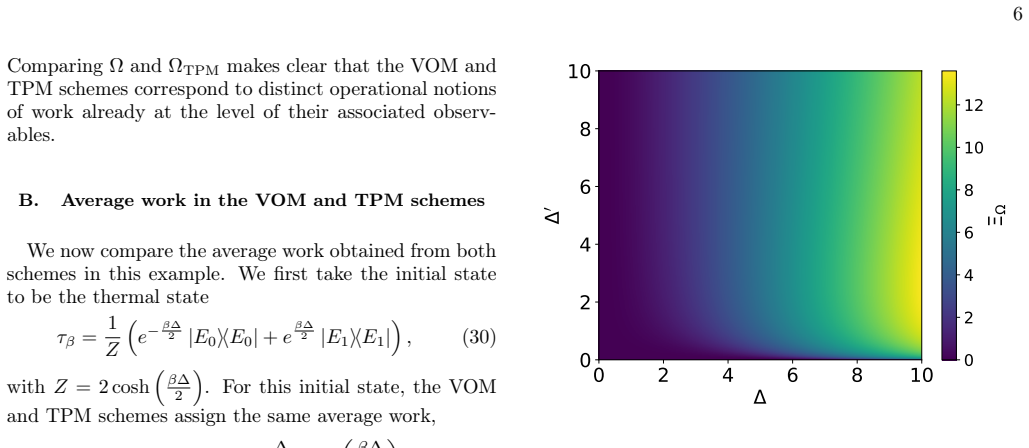
- [Sec. IV.A] Eq. (29) and surrounding text: Ω_TPM = −(Δ/2)σ_z is specific to this protocol; a one-line reminder that this is not a general TPM work operator would avoid confusion for readers skimming.
- [Appendix A] Appendix A: the open-system reduction to Ω_SB is standard and useful; a short remark on whether a reduced system-only VOM can be defined under Born–Markov assumptions (even approximately) would strengthen the experimental outlook already mentioned in the Discussion.
- [Refs. / Sec. II] References: Ref. [30] (arXiv:2502.12905) carries the uniqueness load; if it remains unpublished at acceptance, consider adding a short self-contained statement of the three axioms used so the present paper is readable standalone.
Circularity Check
No significant circularity: average-work matching is an imposed operational requirement, uniqueness is imported from external Ref. [30], and fluctuation corrections are derived (Golden–Thompson, relative entropy), not fitted or forced by self-citation.
specific steps
-
self citation load bearing
[Sec. IIIA, Eqs. (7)–(9); citations [29], [34]]
"It was shown in Ref. [29] that, whenever [U†H′U, H] ≠ 0, any scheme satisfying the standard Jarzynski equality for all inverse temperatures β cannot simultaneously reproduce the untouched average work for all input states. … Instead, for such schemes (including the VOM) the exponential work average satisfies a modified, Jarzynski-like relation with a nonnegative correction term [34]."
Background lemmas on incompatibility and existence of a correction are cited from overlapping-author papers. This is not load-bearing for the paper’s own derivation of Ξ_Ω (Golden–Thompson on Tr(e^{-βH}e^{-βΩ})), so it is only a minor self-citation, not a forced reduction of the central claim.
full rationale
The paper’s load-bearing chain is: (i) require ⟨W⟩_meas = Tr(ρΩ) for all ρ, which forces ∑_a w_a M_a = Ω; (ii) take the spectral POVM of Ω (VOM); (iii) derive modified Jarzynski/Crooks/TUR from that spectral measure; (iv) apply to engines and feedback. Step (i)–(ii) is definitional setup of an operational scheme, not a prediction that reduces to a fit. Uniqueness of VOM among state-independent schemes is attributed to external Ref. [30] (Pinto Silva & Gelbwaser-Klimovsky), not re-derived or smuggled from the present authors. The Jarzynski-like correction Ξ_Ω is obtained in-paper via the Golden–Thompson inequality on Tr(τ_β e^{-βΩ}); Crooks-like and TUR bounds follow from KL divergence and a standard forward–backward TUR template applied to VOM outcomes. Self-citations [29, 34] supply background (incompatibility of exact Jarzynski with untouched average work; existence of nonnegative corrections) but are not needed to force the new relations by construction—the derivations stand alone. Engine and Maxwell-demon sections are explicit calculations comparing VOM vs TPM, not fitted “predictions.” Minor self-citation of background lemmas warrants at most score 1; the central claims are not circular.
Axiom & Free-Parameter Ledger
axioms (5)
- domain assumption For a closed driven system the average work equals the average energy change Tr(ρΩ) with Ω = U†H′U − H.
- domain assumption Any work-measurement scheme is a POVM {M_a} with real outcomes {w_a} satisfying ∑ w_a M_a = Ω for all states.
- domain assumption The VOM POVM is uniquely selected by energy conservation, reality and no-signaling (Ref. [30]).
- standard math Golden–Thompson inequality Tr(e^{A+B}) ≤ Tr(e^A e^B) with equality iff [A,B]=0.
- standard math Time-reversal is implemented by an anti-unitary Θ with ˜U = Θ U† Θ†.
invented entities (1)
-
Variation-operator measurement (VOM) scheme with minimal-back-action Kraus operators K_k^Ω = U |ω_k⟩⟨ω_k|
no independent evidence
read the original abstract
A central challenge in quantum thermodynamics is to access work fluctuations in coherent processes without distorting the energetics of the unmeasured evolution. In standard two-point schemes, the initial energy measurement dephases coherent inputs, causing the measured average work to differ from that of the unmeasured evolution. Here, we develop an operational scheme for accessing work statistics for closed quantum systems based on the abstract notion of variation in the Heisenberg picture Hamiltonian. This scheme preserves energetically relevant coherences, thereby faithfully reproducing unmeasured work, while still producing positive probabilities. We derive modified Jarzynski and Crooks relations, as well as a thermodynamic uncertainty relation, identifying coherence-induced correction terms. Furthermore, we show that this scheme can reliably quantify the performance of a coherent engine in situations where the two-point energy measurement would suppress work output. In addition, the scheme requires only a single measurement and can predict the work associated with a subsequent unitary transformation. We exploit this feature to construct a Maxwell-demon protocol that can outperform energy-based feedback engines for coherent work extraction. Our results establish this scheme as a framework for accessing coherent work fluctuations without erasing the coherence that drives quantum thermodynamic performance.
Figures


Reference graph
Works this paper leans on
-
[1]
The VOM estimate grows linearly over the displayed range, while the TPM estimate remains much smaller, reflecting the loss of the leading coherence- assisted contribution under TPM
10 12 a) First-stroke extraced work b) Back-action on the second work stroke c) Repeated measurements and stationnary operation Untouched steady state VOM VOM steady state VOM TPM steady state TPM TPM 1st stroke, VOM 2nd stroke Figure4.Workextractioninthefour-strokeengineun- der VOM and TPM schemes.a) Average extracted work during the first unitary stroke...
-
[2]
Streltsov, G
A. Streltsov, G. Adesso, and M. B. Plenio, Colloquium: Quantum coherence as a resource, Rev. Mod. Phys.89, 041003 (2017). 12
2017
-
[3]
M.Lostaglio, K.Korzekwa, D.Jennings,andT.Rudolph, Quantum coherence, time-translation symmetry, and thermodynamics, Phys. Rev. X5, 021001 (2015)
2015
-
[4]
Kammerlander and J
P. Kammerlander and J. Anders, Coherence and mea- surement in quantum thermodynamics, Sci. Rep.5, 22174 (2016)
2016
-
[5]
Kosloff and A
R. Kosloff and A. Levy, Quantum heat engines and re- frigerators: Continuous devices, Annu. Rev. Phys. Chem. 65, 365 (2014)
2014
-
[6]
Uzdin, A
R. Uzdin, A. Levy, and R. Kosloff, Equivalence of quan- tum heat machines, and quantum-thermodynamic signa- tures, Phys. Rev. X5, 031044 (2015)
2015
-
[7]
Maslennikov, S
G. Maslennikov, S. Ding, R. Hablützel, J. Gan, A. Roulet, S. Nimmrichter, J. Dai, V. Scarani, and D. Matsukevich, Quantum absorption refrigerator with trapped ions, Nat. Commun.10, 202 (2019)
2019
-
[8]
Zhang, J.-Q
J.-W. Zhang, J.-Q. Zhang, G.-Y. Ding, J.-C. Li, J.-T. Bu, B. Wang, L.-L. Yan, S.-L. Su, L. Chen, F. Nori, S.K.Özdemir, F.Zhou, H.Jing,andM.Feng,Dynamical control of quantum heat engines using exceptional points, Nat. Commun.13, 6225 (2022)
2022
-
[9]
L. M. Cangemi, C. Bhadra, and A. Levy, Quantum en- gines and refrigerators, Phys. Reps.1087, 1 (2024)
2024
-
[10]
Kurchan, A quantum fluctuation theorem (2000), arXiv:cond-mat/0007360
J. Kurchan, A quantum fluctuation theorem (2000), arXiv:cond-mat/0007360
Pith/arXiv arXiv 2000
-
[11]
Tasaki, Jarzynski relations for quantum systems and some applications (2000), arXiv:cond-mat/0009244
H. Tasaki, Jarzynski relations for quantum systems and some applications (2000), arXiv:cond-mat/0009244
Pith/arXiv arXiv 2000
-
[12]
Talkner, E
P. Talkner, E. Lutz, and P. Hänggi, Fluctuation theo- rems: Workisnotanobservable,Phys.Rev.E75,050102 (2007)
2007
-
[13]
Esposito, U
M. Esposito, U. Harbola, and S. Mukamel, Nonequilib- rium fluctuations, fluctuation theorems, and counting statistics in quantum systems, Rev. Mod. Phys.81, 1665 (2009)
2009
-
[14]
Campisi, P
M. Campisi, P. Hänggi, and P. Talkner, Colloquium: Quantum fluctuation relations: Foundations and appli- cations, Rev. Mod. Phys.83, 771 (2011)
2011
-
[15]
Jarzynski, Nonequilibrium equality for free energy dif- ferences, Phys
C. Jarzynski, Nonequilibrium equality for free energy dif- ferences, Phys. Rev. Lett.78, 2690 (1997)
1997
-
[16]
G. E. Crooks, Entropy production fluctuation theorem and the nonequilibrium work relation for free energy dif- ferences, Phys. Rev. E60, 2721 (1999)
1999
-
[17]
Piechocinska, Information erasure, Phys
B. Piechocinska, Information erasure, Phys. Rev. A61, 062314 (2000)
2000
-
[18]
Jarzynski, Rare events and the convergence of expo- nentially averaged work values, Phys
C. Jarzynski, Rare events and the convergence of expo- nentially averaged work values, Phys. Rev. E73, 046105 (2006)
2006
-
[19]
Jarzynski, Equalities and inequalities: Irreversibility and the second law of thermodynamics at the nanoscale, Annu
C. Jarzynski, Equalities and inequalities: Irreversibility and the second law of thermodynamics at the nanoscale, Annu. Rev. Cond. Mat. Phys.2, 329 (2011)
2011
-
[20]
Lostaglio, Quantum fluctuation theorems, contextu- ality, and work quasiprobabilities, Phys
M. Lostaglio, Quantum fluctuation theorems, contextu- ality, and work quasiprobabilities, Phys. Rev. Lett.120, 040602 (2018)
2018
-
[21]
A. E. Allahverdyan and T. M. Nieuwenhuizen, Fluctu- ations of work from quantum subensembles: The case against quantum work-fluctuation theorems, Phys. Rev. E71, 066102 (2005)
2005
-
[22]
Horodecki and J
M. Horodecki and J. Oppenheim, Fundamental limita- tions for quantum and nanoscale thermodynamics, Nat. Commun.4, 2059 (2013)
2059
-
[23]
Skrzypczyk, A
P. Skrzypczyk, A. Short, and S. Popescu, Work extrac- tion and thermodynamics for individual quantum sys- tems, Nat. Commun.5, 4185 (2014)
2014
-
[24]
A. E. Allahverdyan, Nonequilibrium quantum fluctua- tions of work, Phys. Rev. E90, 032137 (2014)
2014
-
[25]
Solinas and S
P. Solinas and S. Gasparinetti, Full distribution of work done on a quantum system for arbitrary initial states, Phys. Rev. E92, 042150 (2015)
2015
-
[26]
Talkner and P
P. Talkner and P. Hänggi, Aspects of quantum work, Phys. Rev. E93, 022131 (2016)
2016
-
[27]
Perarnau-Llobet, E
M. Perarnau-Llobet, E. Bäumer, K. V. Hovhannisyan, M.Huber,andA.Acin,No-gotheoremforthecharacteri- zation of work fluctuations in coherent quantum systems, Phys. Rev. Lett.118, 070601 (2017)
2017
-
[28]
Bäumer, M
E. Bäumer, M. Lostaglio, M. Perarnau-Llobet, and R. Sampaio, Fluctuating work in coherent quantum sys- tems: Proposals and limitations, inThermodynamics in the Quantum Regime: Fundamental Aspects and New Di- rections, edited by F. Binder, L. A. Correa, C. Gogolin, J. Anders, and G. Adesso (Springer International Pub- lishing, 2018) pp. 275–300
2018
-
[29]
Pei, J.-F
J.-H. Pei, J.-F. Chen, and H. T. Quan, Explor- ing quasiprobability approaches to quantum work in the presence of initial coherence: Advantages of the Margenau–Hill distribution, Phys. Rev. E108, 054109 (2023)
2023
-
[30]
K. V. Hovhannisyan and A. Imparato, Energy conserva- tion and fluctuation theorem are incompatible for quan- tum work, Quantum8, 1336 (2024)
2024
-
[31]
T. A. B. Pinto Silva and D. Gelbwaser-Klimovsky, On the consistency of measurement protocols for quantum processes fluctuations (2025), arXiv:2502.12905 [quant- ph]
arXiv 2025
-
[32]
G. N. Bochkov and Y. B. Kuzovlev, General theory of thermal fluctuations in nonlinear systems, Zh. Eksp. Teor. Fiz.72, 238 (1977)
1977
-
[33]
Chernyak and S
V. Chernyak and S. Mukamel, Effect of quantum collapse on the distribution of work in driven single molecules, Phys. Rev. Lett.93, 048302 (2004)
2004
-
[34]
T. A. B. Pinto Silva and D. Gelbwaser-Klimovsky, Quan- tum work: Reconciling quantum mechanics and thermo- dynamics, Phys. Rev. Res.6, L022036 (2024)
2024
-
[35]
Rubino, K
G. Rubino, K. V. Hovhannisyan, and P. Skrzypczyk, Re- vising the quantum work fluctuation framework to en- compass energy conservation, npj Quantum Inf.11, 102 (2025). 13
2025
-
[36]
Lüders, Über die Zustandsänderung durch den Meßprozeß, Ann
G. Lüders, Über die Zustandsänderung durch den Meßprozeß, Ann. Phys. (Leipzig)8, 322 (1951)
1951
-
[37]
Bhatia,Positive Definite Matrices(Princeton Univer- sity Press, Princeton, 2007)
R. Bhatia,Positive Definite Matrices(Princeton Univer- sity Press, Princeton, 2007)
2007
-
[38]
Petz, A variational expression for the relative entropy, Commun
D. Petz, A variational expression for the relative entropy, Commun. Math. Phys.114, 345 (1988)
1988
-
[39]
Petz, A survey of certain trace inequalities, Banach Cent
D. Petz, A survey of certain trace inequalities, Banach Cent. Publ.30, 287 (1994)
1994
-
[40]
Durrett,Probability: Theory and Examples, 5th ed
R. Durrett,Probability: Theory and Examples, 5th ed. (Cambridge University Press, 2019)
2019
-
[41]
Messiah,Quantum Mechanics(North-Holland, Ams- terdam, 1962)
A. Messiah,Quantum Mechanics(North-Holland, Ams- terdam, 1962)
1962
-
[42]
Andrieux and P
D. Andrieux and P. Gaspard, Quantum work relations and response theory, Phys. Rev. Lett.100, 230404 (2008)
2008
-
[43]
G. E. Crooks, Quantum operation time reversal, Phys. Rev. A77, 034101 (2008)
2008
-
[44]
M. A. Nielsen and I. L. Chuang,Quantum Computation and Quantum Information(Cambridge University Press, 2010)
2010
-
[45]
Proesmans and C
K. Proesmans and C. Van den Broeck, Discrete-time thermodynamic uncertainty relation, Europhys. Lett. 119, 20001 (2017)
2017
-
[46]
Hasegawa and T
Y. Hasegawa and T. Van Vu, Fluctuation theorem un- certainty relation, Phys. Rev. Lett.123, 110602 (2019)
2019
-
[47]
P. P. Potts and P. Samuelsson, Thermodynamic uncer- tainty relations including measurement and feedback, Phys. Rev. E100, 052137 (2019)
2019
-
[48]
A. M. Timpanaro, A family of thermodynamic uncer- tainty relations valid for general fluctuation theorems (2024), arXiv:2407.10390 [quant-ph]
arXiv 2024
-
[49]
C. L. Latune and C. Elouard, A thermodynamically con- sistent approach to the energy costs of quantum measure- ments, Quantum9, 1614 (2025)
2025
-
[50]
H. J. D. Miller and J. Anders, Time-reversal symmetric work distributions for closed quantum dynamics in the histories framework, New J. Phys.19, 062001 (2017)
2017
-
[51]
B.-M. Xu, J. Zou, L.-S. Guo, and X.-M. Kong, Effects of quantum coherence on work statistics, Phys. Rev. A97, 052122 (2018)
2018
-
[52]
Brodier, K
O. Brodier, K. Mallick, and A. M. Ozorio de Almeida, Semiclassical work and quantum work identities in Weyl representation, J. Phys. A53, 325001 (2020)
2020
-
[53]
Gherardini and G
S. Gherardini and G. De Chiara, Quasiprobabilities in quantumthermodynamicsandmany-bodysystems,PRX Quantum5, 030201 (2024)
2024
-
[54]
Micadei, G
K. Micadei, G. T. Landi, and E. Lutz, Quantum fluctu- ation theorems beyond two-point measurements, Phys. Rev. Lett.124, 090602 (2020)
2020
-
[55]
Micadei, J
K. Micadei, J. P. S. Peterson, A. M. Souza, R. S. Sarthour, I. S. Oliveira, G. T. Landi, R. M. Serra, and E. Lutz, Experimental validation of fully quantum fluctu- ation theorems using dynamic Bayesian networks, Phys. Rev. Lett.127, 180603 (2021)
2021
-
[56]
Micadei, G
K. Micadei, G. T. Landi, and E. Lutz, Extracting Bayesian networks from multiple copies of a quantum system, Europhys. Lett.144, 60002 (2024)
2024
-
[57]
Gherardini, A
S. Gherardini, A. Belenchia, M. Paternostro, and A. Trombettoni, End-point measurement approach to assess quantum coherence in energy fluctuations, Phys. Rev. A104, L050203 (2021)
2021
-
[58]
Rubino, VOM-scheme (2026), gitHub repository
G. Rubino, VOM-scheme (2026), gitHub repository
2026
-
[59]
Alicki, The quantum open system as a model of the heat engine, J
R. Alicki, The quantum open system as a model of the heat engine, J. Phys. A12, L103 (1979)
1979
-
[60]
G.Lindblad,Non-Equilibrium Entropy and Irreversibility (Reidel, Dordrecht, 1983)
1983
-
[61]
Breuer and F
H.-P. Breuer and F. Petruccione,The theory of open quantum systems(Oxford University Press, New York, 2002)
2002
-
[62]
Bengtsson and K
I. Bengtsson and K. Życzkowski,Geometry of Quan- tum States: An Introduction to Quantum Entanglement (Cambridge University Press, New York, 2006)
2006
-
[63]
Jamiołkowski, Linear transformations which preserve trace and positive semidefiniteness of operators, Rep
A. Jamiołkowski, Linear transformations which preserve trace and positive semidefiniteness of operators, Rep. Math. Phys.3, 275 (1972)
1972
-
[64]
Choi, Completely positive linear maps on complex matrices, Linear Algebra Appl.10, 285 (1975)
M.-D. Choi, Completely positive linear maps on complex matrices, Linear Algebra Appl.10, 285 (1975)
1975
-
[65]
D’Abbruzzo, D
A. D’Abbruzzo, D. Farina, and V. Giovannetti, Recov- ering complete positivity of non-markovian quantum dy- namics with choi-proximity regularization, Phys. Rev. X 14, 031010 (2024)
2024
-
[66]
V. I. Paulsen and F. Shultz, Complete positivity of the map from a basis to its dual basis, J. Math. Phys.54, 072201 (2013)
2013
-
[67]
Kye, Choi matrices revisited, J
S.-H. Kye, Choi matrices revisited, J. Math. Phys.63, 092202 (2022)
2022
-
[68]
Jacobs, Second law of thermodynamics and quantum feedback control: Maxwell’s demon with weak measure- ments, Phys
K. Jacobs, Second law of thermodynamics and quantum feedback control: Maxwell’s demon with weak measure- ments, Phys. Rev. A80, 012322 (2009)
2009
-
[69]
unitary work
Y. Guryanova, N. Friis, and M. Huber, Ideal projective measurements have infinite resource costs, Quantum4, 222 (2020). APPENDIX A. CAN WORK BE AN OBSERVABLE? A common objection to treating work as an observable stems from the fact that, in general, work is a property of a process rather than of a state. Consequently, its mea- surement is usually envisage...
2020
discussion (0)
Sign in with ORCID, Apple, or X to comment. Anyone can read and Pith papers without signing in.