REVIEW 2 major objections 5 minor 51 references
Adding a real scalar singlet to the general two-Higgs-doublet model yields a stable dark-matter candidate that talks to the Standard Model mainly through the top quark, and a flavor-violating top tag for otherwise invisible dark-matter sign
Reviewed by Pith at T0; open to challenge. T0 means a machine referee read the full paper against a public rubric. the ladder, T0–T4 →
T0 review · grok-4.5
2026-07-12 07:53 UTC pith:4O6WN6XM
load-bearing objection Solid, tool-driven G2HDM+S phenomenology that cleanly maps viable top-window DM and flags a distinctive ρ_tc mono-top channel; the ad-hoc Z2 is standard and the deferred ATLAS reinterp is already flagged by the authors. the 2 major comments →
Dark Matter in the General 2HDM with Extra Top Yukawa Couplings
The pith
A machine-rendered reading of the paper's core claim, the machinery that carries it, and where it could break.
Core claim
Within the parameter space allowed by Higgs signal-strength measurements, direct LHC searches, relic density, LZ direct detection and AMS-02/Fermi-LAT indirect detection, the G2HDM+S realizes viable top-window dark matter and a distinct flavor-violating production channel cg to tH followed by H to SS, so that a top quark tags an otherwise invisible dark-matter final state.
What carries the argument
The real scalar singlet S stabilized by a dark Z2, coupled to the two Higgs doublets through the portal lambda12 S squared (H1 dagger H2 + h.c.); together with the extra top Yukawa matrix rho (especially rho_tt and rho_tc) this portal controls both the thermal freeze-out of S and the collider production and decay patterns of the heavy CP-even Higgs H.
Load-bearing premise
Dark-matter stability is imposed by hand through an ad-hoc dark Z2 that acts only on the singlet S; if that discrete symmetry is broken or absent, S is no longer stable and the whole dark-sector phenomenology collapses.
What would settle it
A dedicated reinterpretation or new search for the mono-top plus missing-energy signature arising from cg to tH to tSS (using existing ATLAS top-plus-MET selections or HL-LHC data) that either excludes the BP1-prime benchmark region or fails to find any excess consistent with the predicted cross section.
Editorial analysis
A structured set of objections, weighed in public.
Referee Report
Summary. The paper extends the general two-Higgs-doublet model by a real scalar singlet S stabilized by an ad-hoc dark Z2, yielding the G2HDM+S framework as a UV completion of top-window dark matter. After imposing theoretical constraints (perturbativity, unitarity) and experimental bounds on the visible sector (HiggsSignals/HiggsBounds, oblique parameters) and on the dark sector (relic density via micrOMEGAs, LZ spin-independent direct detection, AMS-02/Fermi-LAT indirect detection), the authors map the surviving (mS, λ12) space for two representative values of the CP-even mixing cγ. They then present six benchmark points (BP1–BP5 and the flavor-violating BP1′) that illustrate singlet-portal, bosonic-cascade, fermiophilic and ρtc-driven regimes, and they highlight the mono-top channel cg o tH o tSS as a distinctive collider signature of the non-NFC Yukawa structure.
Significance. If the results hold, the work supplies a concrete, tool-validated embedding of top-window DM inside a model already motivated by electroweak baryogenesis. The explicit benchmarks and the two-dimensional maps of B(H o SS) and related cascade cross sections (Fig. 5) give experimental groups ready-to-use targets. The flavor-violating mono-top mode is a genuine novelty relative to NFC 2HDM+S constructions and is correctly identified as such. Strengths include the consistent use of public codes (SARAH/SPheno, HiggsTools, micrOMEGAs) against published limits and the transparent separation of visible-sector and dark-sector scans.
major comments (2)
- Section V and the discussion surrounding BP1′ and Fig. 5 assert that cg o tH o tSS is a distinctive, experimentally accessible signature, yet no signal-to-background estimate, acceptance, or reinterpretation of the existing ATLAS mono-top search [49] is provided. The authors themselves defer this analysis. Without at least a parton-level estimate of the expected yield or a statement of the luminosity at which the channel becomes competitive with the gg o H o SS rate, the claim that the mode “allows the top quark to serve as a trigger” remains qualitative and weakens the central phenomenological selling point of the paper.
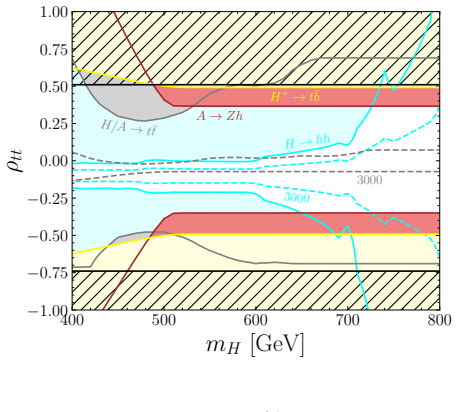
- The numerical scans of Sec. IV D and the benchmarks of Table II are performed almost exclusively at |ρtt|=0.1 and with λ11=λ22=0. While the restriction is motivated, the abstract and introduction present G2HDM+S as a general UV completion of top-window DM. A short additional scan (or a clear statement of the domain of validity) showing how the relic-density and direct-detection contours deform when |ρtt| is varied within the HiggsSignals-allowed window of Fig. 1 would strengthen the claim that the viable region is robust rather than tuned to a single coupling value.
minor comments (5)
- Abstract and first paragraph of the Introduction: “This setup provide a viable UV completion” → “provides”.
- Fig. 1 caption and surrounding text: the HL-LHC projection is described as “naive”; a one-sentence clarification of the scaling assumption (luminosity only, or also systematic improvements) would help the reader.
- Table II: the column header “BP1′” is easy to miss; a short note in the caption that BP1′ differs from BP1 only by ρtc=0.1 and a reduced λ12 would improve readability.
- Appendix B: the statement that a complex phase of ρtt changes the annihilation cross section by less than 5 % is useful; quoting the numerical range of φ that was scanned would make the check fully reproducible.
- References [37] and [42] are listed as arXiv preprints without journal information; updating them if published versions exist would be desirable.
Circularity Check
No significant circularity: viable DM and collider signatures are obtained from external experimental constraints and public tools, not by construction from the paper's own inputs.
specific steps
-
self citation load bearing
[§I (Introduction) and §II (G2HDM+S setup)]
"Motivated by these studies, we extend the G2HDM by a scalar DM candidate S... This can be, for example, achieved through either a flavor-diagonal top coupling or a flavor-nondiagonal top-charm coupling. This model for EWBG can accommodate sub-TeV exotic scalars... [5–11]."
The motivation for large complex ρtt and sub-TeV scalars is drawn from the authors’ (and collaborators’) prior G2HDM/EWBG papers. Those citations set the stage for the parameter choices but do not enter the micrOMEGAs or HiggsTools calculations that produce the relic-density, DD or collider results; the circularity is therefore only motivational and non-load-bearing.
full rationale
The paper extends G2HDM by a real singlet S stabilized by an explicit ad-hoc dark Z2 (Table I, §II), then scans the remaining free parameters (mS, λ12 and fixed visible-sector benchmarks) against external data: HiggsSignals/HiggsBounds (HiggsTools), LZ SI limits, AMS-02/Fermi-LAT indirect limits, and the observed relic density via micrOMEGAs. Benchmarks BP1–BP5 and BP1′ are selected after the scan to illustrate distinct decay topologies; they do not define the allowed region. Self-citations to prior G2HDM/EWBG work supply motivation and the allowed range of ρtt, but the DM annihilation, direct-detection and production cross sections are computed independently and are not forced by those citations. The distinctive cg→tH→tSS mono-top mode follows directly from turning on ρtc=0.1 in BP1′ and is not a fitted or self-defined quantity. The only minor self-reference is the use of earlier G2HDM papers for context; it is not load-bearing for the DM or collider claims. Score 1 reflects that single non-load-bearing self-citation chain; the central results remain externally constrained and non-circular.
Axiom & Free-Parameter Ledger
free parameters (7)
- λ12 (singlet-doublet portal)
- mS (dark-matter mass)
- cγ (CP-even mixing)
- ρ_tt (extra top Yukawa)
- ρ_tc (flavor-violating top-charm Yukawa)
- mH, mA, mH+ (heavy scalar masses)
- η2, η7, μ22
axioms (5)
- ad hoc to paper An exact dark Z2 under which only S is odd, guaranteeing absolute DM stability.
- domain assumption CP-invariant scalar potential (all ηi, λij real).
- domain assumption Thermal freeze-out with standard cosmology computes the relic density via micrOMEGAs.
- domain assumption Tree-level unitarity and |ηi|<4π suffice for theoretical consistency.
- ad hoc to paper λ11=λ22=0, so the only portal is λ12.
invented entities (2)
-
Real scalar singlet S (Z2-odd dark-matter candidate)
no independent evidence
-
G2HDM+S model (G2HDM + real singlet + dark Z2)
no independent evidence
read the original abstract
We extend the general two Higgs doublet model (G2HDM), which introduces extra Yukawa couplings, by an additional real scalar singlet (G2HDM+S), providing a viable scalar dark matter (DM) candidate. This setup provide a viable UV completion of top-window dark matter scenarios, in which DM communicates with the standard model predominantly through the top quark. We analyze the constraints on the visible scalar sector from Higgs signal strength measurements and direct searches for additional Higgs bosons at the LHC, and those on the dark sector from cosmological observables, including the observed DM relic density and spin-independent direct-detection as well as indirect detection. Within the surviving parameter space, we identify a rich and diverse LHC phenomenology governed by the interplay between the singlet portal, the extended Yukawa sector, and the heavy scalar mass hierarchy. To facilitate experimental investigation, we propose six benchmark scenarios spanning the singlet-portal, bosonic-cascade, fermiophilic, and flavor-violating regimes. In the latter, the nondiagonal top-charm coupling $\rho_{tc}$ induces the production channel $cg \to tH$, allowing the top quark to serve as a trigger for an otherwise invisible $H\to SS$ signal. This flavor-violating DM production is a distinct feature of the G2HDM+S.
Figures


Reference graph
Works this paper leans on
-
[1]
V. C. Rubin, N. Thonnard, and W. K. Ford, Jr., Astrophys. J.238, 471 (1980)
1980
-
[2]
D. Clowe, M. Bradac, A. H. Gonzalez, M. Markevitch, S. W. Randall, C. Jones, and D. Zaritsky, Astrophys. J. Lett.648, L109 (2006), arXiv:astro-ph/0608407
Pith/arXiv arXiv 2006
-
[3]
N. Aghanimet al.(Planck), Astron. Astrophys.641, A6 (2020), [Erratum: Astron.Astrophys. 652, C4 (2021)], arXiv:1807.06209 [astro-ph.CO]
Pith/arXiv arXiv 2020
-
[4]
A. D. Sakharov, Pisma Zh. Eksp. Teor. Fiz.5, 32 (1967)
1967
-
[5]
K. Fuyuto, W.-S. Hou, and E. Senaha, Phys. Lett. B776, 402 (2018), arXiv:1705.05034 [hep-ph]
Pith/arXiv arXiv 2018
-
[6]
M. Kohda, T. Modak, and W.-S. Hou, Phys. Lett. B776, 379 (2018), arXiv:1710.07260 [hep-ph]
Pith/arXiv arXiv 2018
-
[7]
D. K. Ghosh, W.-S. Hou, and T. Modak, Phys. Rev. Lett.125, 221801 (2020), arXiv:1912.10613 [hep-ph]
Pith/arXiv arXiv 2020
-
[8]
W.-S. Hou and M. Krab, Phys. Rev. D110, L011702 (2024), arXiv:2405.19190 [hep-ph]
Pith/arXiv arXiv 2024
-
[9]
K. Fuyuto, W.-S. Hou, and E. Senaha, Phys. Rev. D101, 011901 (2020), arXiv:1910.12404 [hep-ph]
Pith/arXiv arXiv 2020
-
[10]
W.-S. Hou, G. Kumar, and S. Teunissen, JHEP01, 092 (2022), arXiv:2109.08936 [hep-ph]
Pith/arXiv arXiv 2022
-
[11]
W.-S. Hou, G. Kumar, and S. Teunissen, Phys. Rev. D109, L011703 (2024), arXiv:2308.04841 [hep-ph]
Pith/arXiv arXiv 2024
-
[12]
N. F. Bell, G. Busoni, and I. W. Sanderson, JCAP01, 015 (2018), arXiv:1710.10764 [hep-ph]
Pith/arXiv arXiv 2018
-
[13]
M. E. Cabrera, J. A. Casas, A. Delgado, and S. Robles, JHEP01, 123 (2021), arXiv:2011.09101 [hep-ph]
Pith/arXiv arXiv 2021
-
[14]
G. Arcadi, G. Busoni, T. Hugle, and V. T. Tenorth, JHEP06, 098 (2020), arXiv:2001.10540 [hep-ph]
Pith/arXiv arXiv 2020
-
[15]
G. Arcadi, D. Cabo-Almeida, M. Dutra, P. Ghosh, M. Lindner, Y. Mambrini, J. P. Neto, M. Pierre, S. Profumo, and F. S. Queiroz, Eur. Phys. J. C85, 152 (2025), arXiv:2403.15860 [hep-ph]
Pith/arXiv arXiv 2025
-
[16]
P. Athronet al.(GAMBIT), Eur. Phys. J. C77, 568 (2017), arXiv:1705.07931 [hep-ph] . 20
Pith/arXiv arXiv 2017
-
[17]
M. Escudero Abenza and T. Hambye, Phys. Lett. B868, 139696 (2025), arXiv:2505.02408 [hep-ph]
Pith/arXiv arXiv 2025
-
[18]
A. Crivellin, A. Kokulu, and C. Greub, Phys. Rev. D87, 094031 (2013), arXiv:1303.5877 [hep-ph]
Pith/arXiv arXiv 2013
-
[19]
K. Cheung, K. Mawatari, E. Senaha, P.-Y. Tseng, and T.-C. Yuan, JHEP10, 081 (2010), arXiv:1009.0618 [hep-ph]
Pith/arXiv arXiv 2010
-
[20]
G. Demetriou, G. Isidori, G. Piazza, and E. Pinsard, Eur. Phys. J. C85, 865 (2025), arXiv:2505.04708 [hep-ph]
Pith/arXiv arXiv 2025
-
[21]
S. Davidson and H. E. Haber, Phys. Rev. D72, 035004 (2005), [Erratum: Phys.Rev.D 72, 099902 (2005)], arXiv:hep-ph/0504050
Pith/arXiv arXiv 2005
-
[22]
F. Staub, Comput. Phys. Commun.185, 1773 (2014), arXiv:1309.7223 [hep-ph]
Pith/arXiv arXiv 2014
-
[23]
W. Porod, Comput. Phys. Commun.153, 275 (2003), arXiv:hep-ph/0301101
Pith/arXiv arXiv 2003
-
[24]
W. Porod and F. Staub, Comput. Phys. Commun.183, 2458 (2012), arXiv:1104.1573 [hep-ph]
Pith/arXiv arXiv 2012
-
[25]
M. E. Peskin and T. Takeuchi, Phys. Rev. Lett.65, 964 (1990)
1990
-
[26]
W. Grimus, L. Lavoura, O. M. Ogreid, and P. Osland, J. Phys. G35, 075001 (2008), arXiv:0711.4022 [hep-ph]
Pith/arXiv arXiv 2008
-
[27]
W. Grimus, L. Lavoura, O. M. Ogreid, and P. Osland, Nucl. Phys. B801, 81 (2008), arXiv:0802.4353 [hep-ph]
Pith/arXiv arXiv 2008
-
[28]
Navaset al.(Particle Data Group), Phys
S. Navaset al.(Particle Data Group), Phys. Rev. D110, 030001 (2024)
2024
-
[29]
P. Bechtle, S. Heinemeyer, O. St˚ al, T. Stefaniak, and G. Weiglein, Eur. Phys. J. C74, 2711 (2014), arXiv:1305.1933 [hep-ph]
Pith/arXiv arXiv 2014
-
[30]
P. Bechtle, S. Heinemeyer, T. Klingl, T. Stefaniak, G. Weiglein, and J. Wittbrodt, Eur. Phys. J. C81, 145 (2021), arXiv:2012.09197 [hep-ph]
Pith/arXiv arXiv 2021
-
[31]
H. Bahl, T. Biek¨ otter, S. Heinemeyer, C. Li, S. Paasch, G. Weiglein, and J. Wittbrodt, Comput. Phys. Commun.291, 108803 (2023), arXiv:2210.09332 [hep-ph]
Pith/arXiv arXiv 2023
-
[32]
P. Bechtle, O. Brein, S. Heinemeyer, G. Weiglein, and K. E. Williams, Comput. Phys. Commun. 181, 138 (2010), arXiv:0811.4169 [hep-ph]
Pith/arXiv arXiv 2010
-
[33]
H. Bahl, V. M. Lozano, T. Stefaniak, and J. Wittbrodt, Eur. Phys. J. C82, 584 (2022), arXiv:2109.10366 [hep-ph]
Pith/arXiv arXiv 2022
-
[34]
G. Aadet al.(ATLAS), Phys. Rev. Lett.132, 231801 (2024), arXiv:2311.15956 [hep-ex] . 21
Pith/arXiv arXiv 2024
-
[35]
Aadet al.(ATLAS), JHEP07, 040 (2023), arXiv:2209.10910 [hep-ex]
G. Aadet al.(ATLAS), JHEP07, 040 (2023), arXiv:2209.10910 [hep-ex]
Pith/arXiv arXiv 2023
-
[36]
A. Hayrapetyanet al.(CMS), Phys. Rept.1115, 368 (2025), arXiv:2403.16926 [hep-ex]
Pith/arXiv arXiv 2025
-
[37]
A. Hayrapetyanet al.(CMS), “Search for heavy pseudoscalar and scalar bosons decaying to a top quark pair in proton–proton collisions at √s = 13 TeV,” (2025), arXiv:2507.05119 [hep-ex]
arXiv 2025
-
[38]
Aadet al.(ATLAS), JHEP06, 016 (2023), arXiv:2207.00230 [hep-ex]
G. Aadet al.(ATLAS), JHEP06, 016 (2023), arXiv:2207.00230 [hep-ex]
Pith/arXiv arXiv 2023
-
[39]
Aadet al.(ATLAS), JHEP06, 145 (2021), arXiv:2102.10076 [hep-ex]
G. Aadet al.(ATLAS), JHEP06, 145 (2021), arXiv:2102.10076 [hep-ex]
Pith/arXiv arXiv 2021
-
[40]
Aadet al.(ATLAS), JHEP12, 081 (2023), arXiv:2307.14759 [hep-ex]
G. Aadet al.(ATLAS), JHEP12, 081 (2023), arXiv:2307.14759 [hep-ex]
Pith/arXiv arXiv 2023
-
[41]
A. Hayrapetyanet al.(CMS), Phys. Lett. B850, 138478 (2024), arXiv:2311.03261 [hep-ex]
Pith/arXiv arXiv 2024
-
[42]
Hayrapetyanet al.(CMS), (2025), arXiv:2512.24471 [hep-ex]
A. Hayrapetyanet al.(CMS), (2025), arXiv:2512.24471 [hep-ex]
arXiv 2025
-
[43]
G. Alguero, G. Belanger, F. Boudjema, S. Chakraborti, A. Goudelis, S. Kraml, A. Mjallal, and A. Pukhov, Comput. Phys. Commun.299, 109133 (2024), arXiv:2312.14894 [hep-ph]
Pith/arXiv arXiv 2024
-
[44]
F. Bishara, J. Brod, B. Grinstein, and J. Zupan, JCAP02, 009 (2017), arXiv:1611.00368 [hep-ph]
Pith/arXiv arXiv 2017
-
[45]
J. Aalberset al.(LZ), Phys. Rev. Lett.135, 011802 (2025), arXiv:2410.17036 [hep-ex]
Pith/arXiv arXiv 2025
-
[46]
A. Cuoco, J. Heisig, M. Korsmeier, and M. Kr¨ amer, JCAP04, 004 (2018), arXiv:1711.05274 [hep-ph]
Pith/arXiv arXiv 2018
-
[47]
Ackermannet al.(Fermi-LAT), Phys
M. Ackermannet al.(Fermi-LAT), Phys. Rev. Lett.115, 231301 (2015), arXiv:1503.02641 [astro-ph.HE]
Pith/arXiv arXiv 2015
-
[48]
J. F. Kamenik and J. Zupan, Phys. Rev. D84, 111502 (2011), arXiv:1107.0623 [hep-ph]
Pith/arXiv arXiv 2011
-
[49]
Aadet al.(ATLAS), JHEP05, 263 (2024), arXiv:2402.16561 [hep-ex]
G. Aadet al.(ATLAS), JHEP05, 263 (2024), arXiv:2402.16561 [hep-ex]
Pith/arXiv arXiv 2024
- [50]
-
[51]
W.-S. Hou, M. Kohda, and T. Modak, Phys. Rev. D98, 075007 (2018), arXiv:1806.06018 [hep-ph] . 22
Pith/arXiv arXiv 2018
discussion (0)
Sign in with ORCID, Apple, or X to comment. Anyone can read and Pith papers without signing in.