REVIEW 4 minor 120 references
Local quench spectroscopy on a superconducting processor extracts magnon, bound-state and two-spinon spectra of 101-spin XXZ chains, including from product states without ground-state preparation.
Reviewed by Pith at T0; open to challenge. T0 means a machine referee read the full paper against a public rubric. the ladder, T0–T4 →
T0 review · grok-4.5
2026-07-12 07:48 UTC pith:BBI5A55H
load-bearing objection Solid L=101 hardware demo of quench spectroscopy that recovers exact XXZ spectra, including from product states in the gapless phase; the soft spot is already closed by the SI.
Quench Spectroscopy of Magnetic Excitations on a Superconducting Quantum Processor
The pith
A machine-rendered reading of the paper's core claim, the machinery that carries it, and where it could break.
Core claim
Local quench spectroscopy on digital quantum hardware extracts the elementary excitation spectra of open XXZ chains of length L=101. By matching the quench operator and the measured observable to the desired excitation sector, free magnons, two-magnon bound states and two-spinon continua are resolved in quantitative agreement with Bethe-ansatz formulas. In the gapless regime the same spectra are recovered from the dynamics of easily prepared product states, without any approximate ground-state preparation.
What carries the argument
The quench spectral function (QSF): the space-time Fourier transform of a single local observable after a local quench. Its peaks sit at energy and momentum differences between eigenstates provided the post-quench density matrix and the observable have non-zero matrix elements between those manifolds.
Load-bearing premise
In the gapless regime the moderate excess energy left by a product-state quench is still low enough that the long-lived quasiparticles remain close to the ground-state dispersions, so the measured spectrum matches the elementary one.
What would settle it
Repeat the gapless-protocol experiment while systematically increasing the excess energy density of the initial product state (or the system size at fixed energy density) and check whether the extracted branches continue to coincide with the Bethe-ansatz ground-state formulas; a clear mismatch would falsify the claim that ground-state preparation can be skipped.
If this is right
- Quench spectroscopy becomes a practical, ground-state-free probe of collective excitations on present-day digital processors.
- The same protocol can be applied to two-dimensional lattices or models with long-range couplings once connectivity and coherence improve.
- Lightweight, size-independent error mitigation is already sufficient to resolve sharp and continuum spectral features on chains of a hundred spins.
- Spectral measurements on quantum hardware can serve as non-trivial benchmarks that the device realises the intended many-body Hamiltonian.
Where Pith is reading between the lines
- If the moderate-energy-density assumption holds more generally, product-state quenches could replace costly variational ground-state preparation for spectroscopy of other gapless or critical models.
- The method may extend to dimerised spin systems whose excitations map to hard-core bosons, offering a digital route to magnetic Bose-Einstein condensates.
- Classical tensor-network simulations of the same double-quench protocol could map the precise energy-density threshold beyond which the extracted spectrum departs from the ground-state branches.
Editorial analysis
A structured set of objections, weighed in public.
Referee Report
Summary. The manuscript demonstrates local quench spectroscopy on the ibm_boston superconducting processor to extract elementary excitation spectra of open XXZ spin-1/2 chains of length L=101 across the ferromagnetic (Δ>1), antiferromagnetic (Δ<−1) and gapless XY (|Δ|<1) phases. Tailored single- or two-site Ry(π/2) quenches combined with local observables yield quench spectral functions G(k,ω) that quantitatively match exact Bethe-ansatz single-magnon dispersions (Eq. 5), two-magnon bound-state branches (Eq. 7) and two-spinon continuum bounds (Eq. 10). In the gapless regime the same spectral features are recovered from easily prepared product states (global+local quench) without ground-state preparation, relying only on non-vanishing matrix elements (Eqs. 2–3/16–17) and moderate excess energy density. Lightweight error mitigation (dynamical decoupling, Pauli twirling, TREX) and fixed-depth Trotter evolution suffice; classical MPS/TDVP benchmarks and symmetry arguments in the SI corroborate the hardware results.
Significance. If the results hold, the work establishes quench spectroscopy as a practical, reconstruction-free spectroscopic tool on present-day digital quantum hardware, capable of selectively resolving free magnons, multi-magnon bound states and fractionalized continua on systems of size L=101. The product-state protocol in the gapless phase is a genuine methodological advance that removes the need for costly approximate ground-state preparation, while the quantitative agreement with parameter-free Bethe-ansatz formulas and the extensive classical validation (SI Secs. I–VIII) provide a high-confidence hardware benchmark. The approach is immediately extensible to two-dimensional or long-range models where classical simulation becomes intractable, and the open data/code further strengthen its utility.
minor comments (4)
- Several section headings and figure captions contain residual spacing artefacts (e.g. “F erromagnetic”, “RESUL TS”, “Trotterised”, “F ourier analysis”). These should be cleaned for the final version.
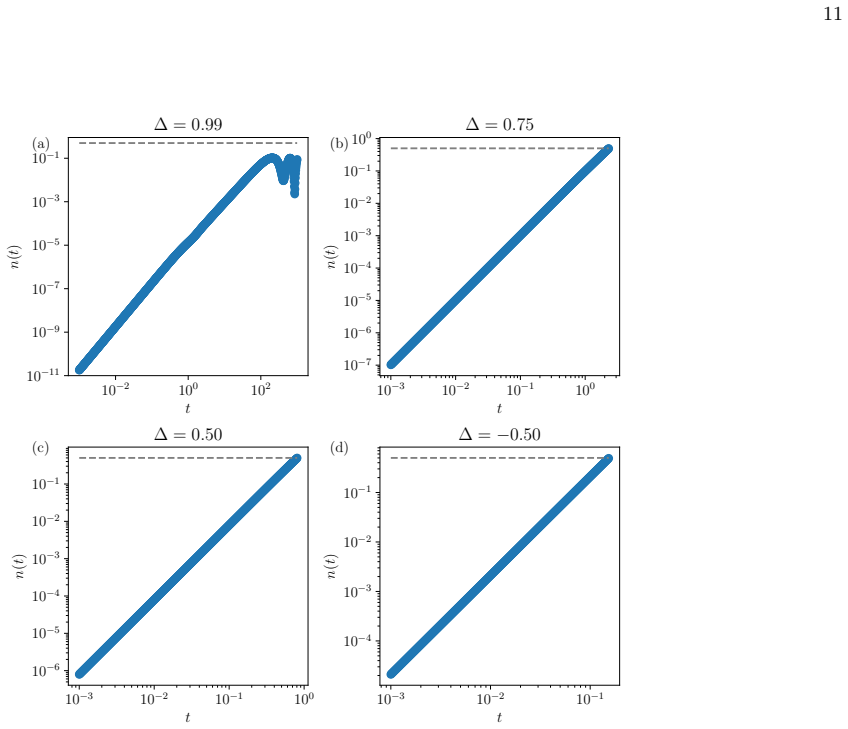
- In the XY-regime discussion (p. 7 and SI Sec. VII) the excess energies ΔE ≈ 2.475 J (Δ = 0.5) and 12.625 J (Δ = −0.5) are quoted for L = 101; a short explicit statement of the corresponding energy densities and the time window over which the quasiparticle description remains valid would improve readability.
- Figure 2(b) light-cone bending is correctly attributed to the variable Trotter step size, but a brief cross-reference to the analytic Floquet correction derived in SI Sec. VI would help the reader locate the supporting calculation.
- The Methods section mentions AQC-Tensor and quimb/adam but does not list the precise hyper-parameters (learning rate, number of epochs, final cost) used for the Δ = −2.5 and Δ = −5 compilations; adding these to the SI would aid reproducibility.
Circularity Check
No significant circularity: measured QSFs are compared to independent, parameter-free Bethe-ansatz dispersions; the product-state protocol is justified by external symmetry/Lieb-Robinson arguments plus classical checks, not by redefinition of the target spectrum.
full rationale
The paper's central results are experimental space-time signals G(r,t) Fourier-transformed into QSFs G(k,ω) (Eqs. 1/15) that are then overlaid on exact, pre-existing Bethe-ansatz formulas for single-magnon (Eq. 5), two-magnon bound-state (Eq. 7), two-spinon continuum bounds (Eqs. 9-10), and magnon-like string (Eq. 12) dispersions. These formulas are external, parameter-free, and not derived or fitted inside the present work. The QSF definition and selection rules (Eqs. 2-3/16-17) are taken from the prior literature [17-19] and applied without modification. In the gapless XY regime the claim that a product-state global+local quench still recovers the ground-state elementary spectrum rests on (i) a moderate excess energy density that is computed independently from the known ground-state energy density, (ii) an explicit symmetry argument under global Rx(π) that isolates the odd sector coupled by the local quench (SI Sec. II), (iii) a Lieb-Robinson reduced-density-matrix argument showing that only the light-cone region contributes (SI Sec. I), and (iv) classical MPS benchmarks (SI Figs. 7-13) that reproduce the same branches from both product and approximate ground states and that open a gap under XY anisotropy. None of these steps redefine the target spectrum in terms of the measured signal or import a uniqueness theorem; they are independent consistency checks. Self-citations are limited to the authors' own SI and to earlier methodological papers; they are not load-bearing for the spectral identification. There are no fitted parameters presented as predictions, no ansatz smuggled via citation into the final dispersions, and no renaming of a known empirical pattern. The derivation chain is therefore self-contained against external benchmarks.
Axiom & Free-Parameter Ledger
free parameters (2)
- Trotter step count M and variable Δt schedule
- AQC brickwork depth (4 layers / CNOT depth 24 for Δ=−2.5; 2 layers / depth 12 for Δ=−5)
axioms (4)
- domain assumption The quench spectral function G(k,ω) exhibits peaks at eigenstate energy and momentum differences whenever the post-quench density matrix and the measured operator have non-zero matrix elements between those eigenstates (Eqs. 1–3 / 15–17).
- domain assumption Exact single-magnon, two-magnon bound-state and two-spinon continuum dispersions of the infinite XXZ chain are given by the Bethe-ansatz formulas (Eqs. 5, 7, 9–12).
- domain assumption Second-order Suzuki–Trotter decomposition with fixed M and variable Δt approximates the continuous-time evolution sufficiently well that residual Floquet corrections only produce the analytically predicted light-cone bending.
- domain assumption Pauli-twirled noise plus dynamical decoupling yields an approximately white Fourier spectrum that is filtered by the 2-D FFT, leaving the coherent spectral features intact.
read the original abstract
The elementary excitation spectrum of a many-body quantum system encodes many key properties, including phenomena as diverse as transport, thermalisation and ground state structure. Excitation spectra of strongly correlated systems are typically encoded in dynamical structure factors, which are demanding to measure experimentally and challenging to compute classically. Here we use quench spectroscopy on a superconducting quantum processor to extract excitation spectra of spin chains of $L=101$ spins. By tailoring the combination of quench protocol and observable, we selectively access distinct excitation sectors across several phases of the spin-$1/2$ XXZ chain, resolving free magnons, multi-magnon bound states, and two-spinon continua. Notably, we demonstrate that the protocol does not rely on ground state preparation: in the classically challenging gapless regime, we extract spectra directly from the quench dynamics of easily prepared product states, a procedure that is natural and straightforward on quantum hardware. Our work establishes quench spectroscopy as a fast and flexible probe of many-body excitation spectra on digital quantum hardware, introduces a novel quench protocol that does not require costly state preparation routines, and provides a scalable route towards regimes where classical simulation may become intractable.
Figures




Reference graph
Works this paper leans on
-
[1]
Prepare an initial state|ψ 0⟩
-
[2]
Apply a local quenchL
-
[3]
Evolve underHfor timet
-
[4]
Measure a local observableO
-
[5]
Fourier transform (r, t)→(k, ω) The quench prepares a superposition of eigenstates with different energies and momenta. Under time evolu- tion, their relative phases give rise to oscillatory contribu- tions to local observables at frequencies and wavevectors set by eigenstate energy and momentum differences. The Fourier transform resolves these contributi...
-
[6]
Sturm, Zeitschrift f¨ ur Naturforschung A48, 233 (1993)
K. Sturm, Zeitschrift f¨ ur Naturforschung A48, 233 (1993)
1993
-
[7]
C. J. Jia, E. A. Nowadnick, K. Wohlfeld, Y. F. Kung, C. C. Chen, S. Johnston, T. Tohyama, B. Moritz, and T. P. Devereaux, Nature Communications5, 3314 (2014)
2014
-
[8]
Gao, L.-F
S. Gao, L.-F. Lin, P. Laurell, Q. Chen, Q. Huang, C. d. Cruz, K. V. Vemuru, M. D. Lumsden, S. E. Nagler, G. Alvarez, E. Dagotto, H. Zhou, A. D. Christianson, and M. B. Stone, Phys. Rev. B109, L020402 (2024)
2024
-
[9]
M. L. Baez, M. Goihl, J. Haferkamp, J. Bermejo-Vega, M. Gluza, and J. Eisert, Proceedings of the National Academy of Sciences117, 26123 (2020)
2020
-
[10]
Schollw¨ ock, Annals of Physics326, 96 (2011), jan- uary 2011 Special Issue
U. Schollw¨ ock, Annals of Physics326, 96 (2011), jan- uary 2011 Special Issue
2011
-
[11]
J. C. Bridgeman and C. T. Chubb, Journal of Physics A: Mathematical and Theoretical50, 223001 (2017)
2017
-
[12]
A. K. Bera, B. Lake, F. H. L. Essler, L. Vanderstraeten, C. Hubig, U. Schollw¨ ock, A. T. M. N. Islam, A. Schnei- dewind, and D. L. Quintero-Castro, Phys. Rev. B96, 054423 (2017)
2017
-
[13]
Tindall, M
J. Tindall, M. Fishman, E. M. Stoudenmire, and D. Sels, PRX Quantum5, 010308 (2024)
2024
-
[14]
J. Tindall, A. Mello, M. Fishman, M. Stoudenmire, and D. Sels, (2025), arXiv:2503.05693
Pith/arXiv arXiv 2025
-
[15]
Carleo and M
G. Carleo and M. Troyer, Science355, 602 (2017)
2017
-
[16]
S. J. Thomson and J. Eisert, Nature Physics20, 1401 (2024)
2024
-
[17]
Landig, F
R. Landig, F. Brennecke, R. Mottl, T. Donner, and T. Esslinger, Nature Communications6, 7046 (2015)
2015
-
[18]
M. Knap, A. Kantian, T. Giamarchi, I. Bloch, M. D. Lukin, and E. Demler, Phys. Rev. Lett.111, 147205 (2013)
2013
-
[19]
Y.-T. Lee, K. Kumaran, B. Pokharel, A. Scheie, C. L. Sarkis, D. A. Tennant, T. Humble, A. Schleife, A. Kan- 12 dala, and A. Banerjee, (2026), arXiv:2603.15608 [quant- ph]
Pith/arXiv arXiv 2026
-
[20]
Gritsev, E
V. Gritsev, E. Demler, M. Lukin, and A. Polkovnikov, Phys. Rev. Lett.99, 200404 (2007)
2007
-
[21]
Menu and T
R. Menu and T. Roscilde, Phys. Rev. B98, 205145 (2018)
2018
-
[23]
Villa, J
L. Villa, J. Despres, S. J. Thomson, and L. Sanchez- Palencia, Phys. Rev. A102, 033337 (2020)
2020
-
[24]
Villa,Out-of-equilibrium dynamics and quench spec- troscopy of ultracold many-body quantum systems, Ph.D
L. Villa,Out-of-equilibrium dynamics and quench spec- troscopy of ultracold many-body quantum systems, Ph.D. thesis, Institut Polytechnique de Paris (2021)
2021
-
[25]
Fr´ erot, P
I. Fr´ erot, P. Naldesi, and T. Roscilde, Phys. Rev. Lett. 120, 050401 (2018)
2018
-
[26]
Cevolani, J
L. Cevolani, J. Despres, G. Carleo, L. Tagliacozzo, and L. Sanchez-Palencia, Phys. Rev. B98, 024302 (2018)
2018
-
[27]
Despres, L
J. Despres, L. Villa, and L. Sanchez-Palencia, Scientific Reports9, 4135 (2019)
2019
-
[28]
More generally, this form holds for any initial state which breaks translation invariance
-
[29]
Villa, S
L. Villa, S. J. Thomson, and L. Sanchez-Palencia, Phys. Rev. A104, L021301 (2021)
2021
-
[30]
Villa, S
L. Villa, S. J. Thomson, and L. Sanchez-Palencia, Phys. Rev. A104, 023323 (2021)
2021
-
[31]
Chanda, M
T. Chanda, M. Dalmonte, M. Lewenstein, J. Za- krzewski, and L. Tagliacozzo, Phys. Rev. B109, 045103 (2024)
2024
-
[32]
Bocini, F
S. Bocini, F. Caleca, F. Mezzacapo, and T. Roscilde, Phys. Rev. B111, L121114 (2025)
2025
-
[33]
Despres, Phys
J. Despres, Phys. Rev. A112, 033320 (2025)
2025
-
[34]
C. Chen, G. Emperauger, G. Bornet, F. Caleca, B. G´ ely, M. Bintz, S. Chatterjee, V. Liu, D. Barredo, N. Y. Yao, T. Lahaye, F. Mezzacapo, T. Roscilde, and A. Browaeys, Science389, 483 (2025)
2025
-
[35]
J. Sun, L. Vilchez-Estevez, V. Vedral, A. T. Boothroyd, and M. S. Kim, Nature Communications16, 1403 (2025)
2025
-
[36]
Vilchez-Estevez, R
L. Vilchez-Estevez, R. A. Santos, S. Y. Wang, and F. M. Gambetta, Phys. Rev. B112, 045143 (2025)
2025
-
[37]
J. Yu, Y. Hu, W. Chen, J. Yang, X. Chen, and H. Yao, Phys. Rev. Res.7, L042066 (2025)
2025
-
[38]
Korepin, N
V. Korepin, N. Bogoliubov, and A. Izergin,Quan- tum Inverse Scattering Method and Correlation Func- tions, Cambridge Monographs on Mathematical Physics (Cambridge University Press, 1993)
1993
-
[40]
Gaudin,The Bethe Wavefunction(Cambridge Uni- versity Press, 2014)
M. Gaudin,The Bethe Wavefunction(Cambridge Uni- versity Press, 2014)
2014
-
[41]
Bonnes, F
L. Bonnes, F. H. L. Essler, and A. M. L¨ auchli, Phys. Rev. Lett.113, 187203 (2014)
2014
-
[42]
F. H. L. Essler and M. Fagotti, Journal of Statistical Me- chanics: Theory and Experiment2016, 064002 (2016)
2016
-
[44]
Foldager and B
J. Foldager and B. Koczor, Journal of Physics A: Math- ematical and Theoretical57, 015306 (2023)
2023
-
[45]
A. M. Dalzell, N. Hunter-Jones, and F. G. S. L. Brand˜ ao, Communications in Mathematical Physics 405, 78 (2024)
2024
-
[46]
See Supplementary Information, which contains Refs [72, 99–105]
-
[47]
Ganahl, E
M. Ganahl, E. Rabel, F. H. L. Essler, and H. G. Evertz, Phys. Rev. Lett.108, 077206 (2012)
2012
-
[48]
Morvanet al., Nature612, 240–245 (2022)
A. Morvanet al., Nature612, 240–245 (2022)
2022
-
[49]
Hudomal, R
A. Hudomal, R. Smith, A. Hallam, and Z. Papi´ c, PRX Quantum5, 010316 (2024)
2024
-
[50]
Sch¨ on, E
C. Sch¨ on, E. Solano, F. Verstraete, J. I. Cirac, and M. M. Wolf, Phys. Rev. Lett.95, 110503 (2005)
2005
-
[51]
Sch¨ on, K
C. Sch¨ on, K. Hammerer, M. M. Wolf, J. I. Cirac, and E. Solano, Phys. Rev. A75, 032311 (2007)
2007
-
[52]
Ran, Phys
S.-J. Ran, Phys. Rev. A101, 032310 (2020)
2020
-
[53]
S.-H. Lin, R. Dilip, A. G. Green, A. Smith, and F. Poll- mann, PRX Quantum2, 010342 (2021)
2021
-
[54]
D. A. Millar, G. W. Pennington, N. T. M. Siow, and S. J. Thomson, qiskit-community/mps-to-circuit (2025)
2025
-
[55]
N. F. Robertson, A. Akhriev, J. Vala, and S. Zhuk, ACM Transactions on Quantum Computing6, 10.1145/3731251 (2025)
doi:10.1145/3731251 2025
-
[56]
J. R. Garrison, K. Marshall, I. Shehzad, K. J. Sung, C. Johnson, M. Rossmannek, B. Fuller, J. R. Glick, A. Akhriev, S. Zhuk, and N. F. Robertson,https: //github.com/Qiskit/qiskit-addon-aqc-tensor (2024)
2024
-
[57]
G. Pennington, K. C. Smith, J. R. Garrison, L. P. Lindoy, J. Crain, and B. Jaderberg, (2026), arXiv:2603.06325
arXiv 2026
-
[58]
S. K. Satija, G. Shirane, Y. Yoshizawa, and K. Hi- rakawa, Phys. Rev. Lett.44, 1548 (1980)
1980
-
[59]
Yoshizawa, K
H. Yoshizawa, K. Hirakawa, S. K. Satija, and G. Shi- rane, Phys. Rev. B23, 2298 (1981)
1981
-
[60]
J. P. Goff, D. A. Tennant, and S. E. Nagler, Phys. Rev. B52, 15992 (1995)
1995
-
[61]
A. L. de Paula, H. Bragan¸ ca, R. G. Pereira, R. C. Dru- mond, and M. C. O. Aguiar, Phys. Rev. B95, 045125 (2017)
2017
-
[62]
For odd-length chains this ought to be possible, see e.g
-
[63]
for the construction of the corresponding excita- tion spectrum for the Heisenberg model
-
[64]
Kulka, M
T. Kulka, M. Panfil, M. Berciu, and K. Wohlfeld, Phys. Rev. Lett.134, 236504 (2025)
2025
-
[65]
Vidal, J
G. Vidal, J. I. Latorre, E. Rico, and A. Kitaev, Phys. Rev. Lett.90, 227902 (2003)
2003
-
[66]
J. I. Latorre, E. Rico, and G. Vidal, Quant. Inf. Comput. 1, 48 (2004)
2004
-
[67]
Barmettler, M
P. Barmettler, M. Punk, V. Gritsev, E. Demler, and E. Altman, Phys. Rev. Lett.102, 130603 (2009)
2009
-
[68]
Barmettler, M
P. Barmettler, M. Punk, V. Gritsev, E. Demler, and E. Altman, New Journal of Physics12, 055017 (2010)
2010
-
[69]
Fagotti, M
M. Fagotti, M. Collura, F. H. L. Essler, and P. Cal- abrese, Phys. Rev. B89, 125101 (2014)
2014
-
[70]
Collura, P
M. Collura, P. Calabrese, and F. H. L. Essler, Phys. Rev. B92, 125131 (2015)
2015
-
[71]
Collura and F
M. Collura and F. H. L. Essler, Phys. Rev. B101, 041110(R) (2020)
2020
-
[72]
Fagotti and F
M. Fagotti and F. H. L. Essler, Journal of Statistical Me- chanics: Theory and Experiment2013, P07012 (2013)
2013
-
[73]
Wouters, J
B. Wouters, J. De Nardis, M. Brockmann, D. Fioretto, M. Rigol, and J.-S. Caux, Phys. Rev. Lett.113, 117202 (2014)
2014
-
[74]
Pozsgay, M
B. Pozsgay, M. Mesty´ an, M. A. Werner, M. Kormos, G. Zar´ and, and G. Tak´ acs, Phys. Rev. Lett.113, 117203 (2014). 13
2014
-
[75]
Mesty´ an, B
M. Mesty´ an, B. Pozsgay, G. Tak´ acs, and M. A. Werner, Journal of Statistical Mechanics: Theory and Experi- ment2015, P04001 (2015)
2015
-
[76]
Ilievski, J
E. Ilievski, J. De Nardis, B. Wouters, J.-S. Caux, F. H. L. Essler, and T. Prosen, Phys. Rev. Lett.115, 157201 (2015)
2015
-
[77]
Fagotti, Phys
M. Fagotti, Phys. Rev. Lett.128, 110602 (2022)
2022
-
[79]
Haegeman, B
J. Haegeman, B. Pirvu, D. J. Weir, J. I. Cirac, T. J. Osborne, H. Verschelde, and F. Verstraete, Phys. Rev. B85, 100408(R) (2012)
2012
-
[80]
Haegeman, S
J. Haegeman, S. Michalakis, B. Nachtergaele, T. J. Os- borne, N. Schuch, and F. Verstraete, Phys. Rev. Lett. 111, 080401 (2013)
2013
-
[81]
Vanderstraeten, J
L. Vanderstraeten, J. Haegeman, and F. Verstraete, Phys. Rev. B99, 165121 (2019)
2019
-
[82]
L. Leclerc, S. Juli` a-Farr´ e, G. S. Freitas, G. Villaret, B. Albrecht, L. B´ eguin, L. Bourachot, C. Briosne- Frejaville, D. Claveau, A. Cornillot, J. de Hond, D. Di- allo, C. Dupays, R. Dupont, T. Eritzpokhoff, E. Got- tlob, L. Henriet, M. Kaicher, L. Lassabli` ere, A. Lind- berg, Y. Machu, H. Mamann, T. Pansiot, J. Ripoll, E. S. Choi, A. Signoles, J. ...
Pith/arXiv arXiv 2026
-
[83]
Scheie, P
A. Scheie, P. Laurell, W. Simeth, E. Dagotto, and D. A. Tennant, Materials Today Quantum5, 100020 (2025)
2025
-
[84]
Savary and L
L. Savary and L. Balents, Reports on Progress in Physics80, 016502 (2016)
2016
discussion (0)
Sign in with ORCID, Apple, or X to comment. Anyone can read and Pith papers without signing in.