REVIEW 2 major objections 5 minor 297 references
A probabilistic matching of optical groups to eROSITA X-ray contours recovers low-mass systems more completely than red-sequence methods while letting purity be set by the user.
Reviewed by Pith at T0; open to challenge. T0 means a machine referee read the full paper against a public rubric. the ladder, T0–T4 →
T0 review · grok-4.5
2026-07-12 07:35 UTC pith:OXGLADOA
load-bearing objection Solid multi-wavelength catalog paper that carefully maps purity–completeness trade-offs for S-PLUS + eRASS1 groups and shows PZWav+AME recovers more low-mass systems than identically matched redMaPPer. the 2 major comments →
S-PLUS Clusters And Large-scale Environments (SCALE): II. PZWav versus redMaPPer identification of eRosita groups
The pith
A machine-rendered reading of the paper's core claim, the machinery that carries it, and where it could break.
Core claim
Probabilistic modified-Hausdorff matching of PZWav+AME optical systems to eRASS1 X-ray contours yields multi-wavelength catalogs whose X-ray luminosity functions agree with prior work and that recover low-mass groups more completely than an identically matched redMaPPer sample, while giving explicit control of purity (80–95 %) versus completeness.
What carries the argument
The probabilistic modified Hausdorff distance that associates X-ray surface-brightness contours with galaxy membership probabilities drawn from photometric-redshift PDFs; purity is defined as one minus the ratio of random (RA-shifted) to real matches and is sampled over a grid of membership thresholds and contour-coverage fractions.
Load-bearing premise
The claim that shifting every optical system by ten degrees in right ascension produces a random catalog free of residual large-scale-structure bias, so that the quoted purity levels truly measure chance superpositions.
What would settle it
Recompute the purity fractions with an independent randomization (for example, random sky rotations or mock light-cones that preserve clustering) and check whether the X-ray luminosity functions and group recovery fractions remain unchanged within the quoted uncertainties.
If this is right
- Users can select magnitude cut and purity level to optimize a catalog for either group-scale galaxy evolution or high-mass cosmological probes.
- Inclusion of blue members systematically raises completeness below ~10^43 erg s^{-1} relative to red-sequence finders.
- The released eSCALE and eRedMaPPer catalogs supply a ready multi-wavelength sample for weak-lensing mass calibration and environmental studies inside the S-PLUS footprint.
- Deeper eROSITA releases can reuse the same matching pipeline without redesign.
Where Pith is reading between the lines
- The same purity-tunable Hausdorff machinery could be applied to any photometric survey that supplies galaxy PDFs, not only S-PLUS.
- If residual large-scale-structure bias in the RA-shift randoms is non-negligible, the true purity of the lowest-luminosity bins may be lower than reported, affecting cosmological number counts.
- Combining PZWav and redMaPPer memberships before matching may yield a still more complete group catalog without sacrificing the purity dial.
Editorial analysis
A structured set of objections, weighed in public.
Referee Report
Summary. The paper constructs multi-wavelength group/cluster catalogs by probabilistically matching PZWav+AME optical systems from S-PLUS (0.08<z<0.25) to eRASS1 extended X-ray contours via a modified Hausdorff-distance framework that incorporates photometric-redshift PDFs and membership probabilities. It systematically varies absolute-magnitude cuts (Mr < −18.5 to −20) and purity thresholds (80–95 %), quantifies the resulting completeness–purity trade-offs, derives purity-corrected X-ray luminosity functions and logN–logS distributions that agree with COSMOS/RASS benchmarks, and shows that the same matching applied to redMaPPer yields consistent high-mass trends while PZWav+AME recovers more low-mass, blue-member systems.
Significance. If the purity control and XLF agreement hold, the work supplies a practical, tunable multi-wavelength catalog (eSCALE) and a reusable matching pipeline for eROSITA–optical studies of groups, where AGN feedback is expected to be most efficient. Strengths include explicit random-catalog purity definition, purity-corrected XLFs, dual matching of an independent redMaPPer sample, and appendices testing full versus cleaned luminosities and an independent Klein-style random-superposition cut. The catalogs are released at CDS, supporting immediate follow-up.
major comments (2)
- Section 3 defines purity as 1 − N_random/N_real from a +10° RA-shifted catalog and states that residual clustering enhancement is only ~0.0005. While Appendix B applies an independent P(λ/z) cut that removes the ~1.7 excess at LX ~ 10^43 erg s^−1, the main-text XLFs (Fig. 5) and incompleteness thresholds still rest on the primary randoms. A short quantitative test (e.g., alternative shifts or a shuffled-redshift random) would confirm that the reported purity levels and the group-scale completeness gain versus eRedMaPPer are robust to residual large-scale-structure bias.
- Section 4.2 and Fig. 3 convert richness to a group/cluster boundary using mass–richness relations fitted only on the 95 % purity subsample. Because the same relations are then applied to the 80 % and 90 % samples, any purity-dependent change in the richness–mass scatter could bias the reported group fractions. Reporting the scatter or refitting per purity level would strengthen the claim that the group fraction is stable.
minor comments (5)
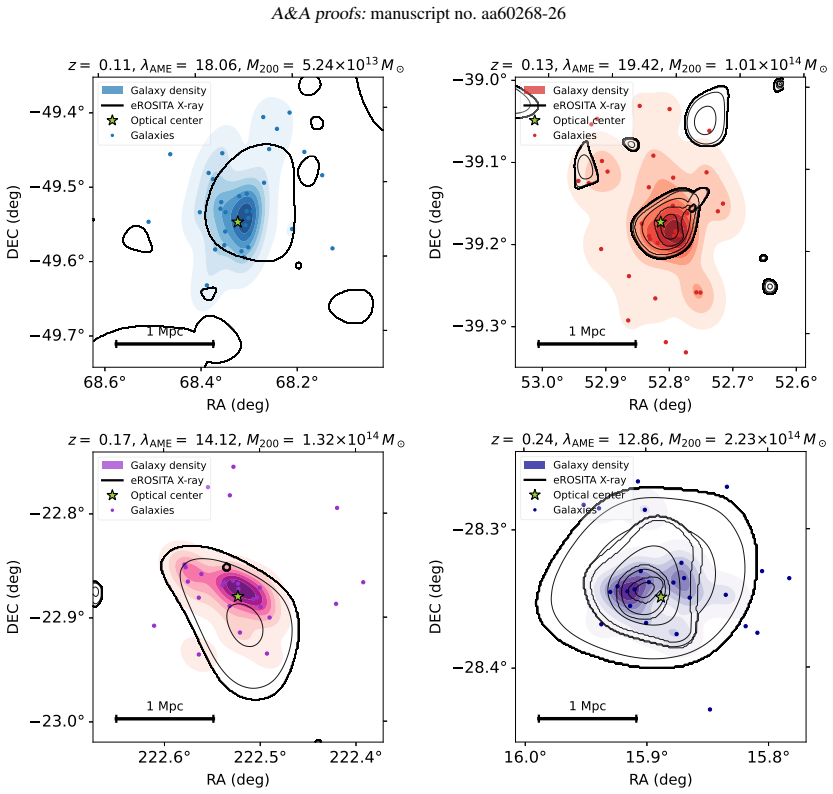
- Fig. 1 caption and color legend: the four absolute-magnitude cuts are listed but the mapping of light-blue/red/purple/dark-blue is easy to misread; a single legend panel would help.
- Section 2.2.1: the S/N threshold of 4 and the cylindrical volume (dr_lim = 1500 kpc, dz_m = 0.03) are stated without a brief justification or reference to the forthcoming Doubrawa et al. catalog paper; a sentence on how these choices affect purity would aid reproducibility.
- Appendix A, Fig. A.1: the “Purity 70 %” label appears inconsistent with the main-text 80/90/95 % grid; clarify whether this is a different selection or a typographical remnant.
- Throughout: “eRosita” / “eROSITA” capitalization is inconsistent in the title and abstract; standardize to the official eROSITA spelling.
- Section 4.5: the redshift cut for eRedMaPPer is stated as z < 0.2 while the parent optical sample extends to 0.25; a one-sentence note on why the stricter cut is required (catalog volume) would avoid confusion.
Circularity Check
No significant circularity: purity is measured against an independent RA-shifted random catalog, XLFs are compared to external literature, and redMaPPer is an independent optical finder; self-citations supply the optical catalog but do not force the X-ray matching results.
specific steps
-
self citation load bearing
[Section 2.2.1–2.2.2 and Introduction (optical catalog construction)]
"The S-PLUS cluster and group catalog (Doubrawa et al., in prep.) was constructed using the cluster-finder algorithm PZWav. ... To further characterize the detected systems, we employ the Adaptive Membership Estimator (AME) algorithm (Doubrawa et al. 2023)."
The optical systems and membership probabilities that enter the matching are taken from the authors’ own prior/in-prep work. This is ordinary self-citation of the input catalog; it does not force the subsequent X-ray matching purity, completeness, or XLF results, which are measured against independent randoms and external literature. Score contribution is therefore minimal (1).
full rationale
The paper constructs multi-wavelength catalogs by matching PZWav+AME optical systems to eRASS1 X-ray contours via a probabilistic modified-Hausdorff procedure. Purity is defined operationally as 1 minus the ratio of random-to-real identifications, where the random catalog is generated by shifting RA by +10° (modulo 360°) and is corrected for the 15% area difference; the paper quantifies residual clustering enhancement as ~0.0005. Completeness and XLF results are then reported at fixed purity levels (80/90/95%) and compared to external benchmarks (Finoguenov et al. 2007 COSMOS XLF; Vikhlinin et al. 1998 ROSAT logN–logS). The redMaPPer comparison uses an identically matched independent optical catalog (eRedMaPPer). Self-citations to prior PZWav/AME papers (Doubrawa et al. 2023, 2024; Werner et al. 2023) merely supply the input optical catalog and membership probabilities; they do not define the matching criteria or the purity metric. Masses use the published Leauthaud et al. (2010) Lx–M200 relation (validated externally by Pederneiras et al. 2025). Appendix B applies an independent Klein-style P(λ/z) cut that removes the low-luminosity excess while preserving the same incompleteness thresholds and the group-scale completeness gain. No step reduces a claimed prediction or first-principles result to its own fitted inputs by construction. The single minor self-citation dependence is not load-bearing for the central claims.
Axiom & Free-Parameter Ledger
free parameters (4)
- summed membership-probability threshold =
typically 2–5 depending on purity
- fraction of X-ray contour points required for a match =
50–100 %
- target purity levels =
80/90/95 %
- absolute-magnitude cuts =
−18.5, −19, −19.5, −20
axioms (4)
- domain assumption Flat ΛCDM cosmology with H0 = 70 km s−1 Mpc−1, Ωm = 0.3
- domain assumption Lx–M200 relation of Leauthaud et al. (2010) and L–T relation of Markevitch (1998) remain valid for the eRASS1 sample
- ad hoc to paper RA +10° shift produces an unbiased random catalog of chance superpositions
- domain assumption Photometric-redshift PDFs and AME membership probabilities correctly represent galaxy association probabilities
read the original abstract
We present the construction and characterization of a multi-wavelength catalog of galaxy groups and clusters by matching optical detections from the Southern Photometric Local Universe Survey (S-PLUS) with extended X-ray emission from the first eROSITA all-sky survey data release (eRASS1). We employ a probabilistic matching framework, based on the modified Hausdorff distance, to associate galaxy systems identified by the PZWav cluster finder and characterized by the AME membership estimator with X-ray surface brightness contours. This method explicitly accounts for the photometric redshift probability distribution of galaxies and allows us to explore the critical trade-off between catalog completeness and purity. We investigate how the matched sample changes with different optical selection depths, defined by absolute magnitude cuts of $M_r$ < -18.5, -19, -19.5, and -20 sampling redshifts within 0.08 < z < 0.25, and across purity levels of 80%, 90%, and 95%. We find that fainter optical cuts enhance the recovery of low-mass, low-luminosity groups, while brighter cuts favor more massive clusters and increase the effective survey volume at higher redshifts. Stricter purity requirements reduce contamination but systematically lower completeness, particularly for low-luminosity systems. The derived X-ray luminosity functions agree well with previous determinations, and the logN-logS distributions confirm the high recovery rate of luminous clusters. Comparisons with the redMaPPer cluster catalog validate our approach, showing consistent trends and significant overlap, while our method offers improved completeness at the group scale. This work demonstrates a robust, flexible methodology for creating reliable multi-wavelength cluster catalogs, essential for cosmological studies and investigations of galaxy evolution in dense environments.
Figures


Reference graph
Works this paper leans on
-
[1]
and Cardoso, N
Mendes de Oliveira, C. and Cardoso, N. M. and Lopes, P. A. A. and Ribeiro, A. L. B. and Olave-Rojas, D. E. and Krabbe, A. and Sodr. S-PLUS Clusters And Large-scale Environments (SCALE): I. A catalog of known clusters and groups in DR5 and a pilot study of Abell 4038 , note =
-
[2]
and Oliveira Schwarz, Gustavo and Herpich, Fabio R
Rodrigues de Lima, Erik V. and Oliveira Schwarz, Gustavo and Herpich, Fabio R. and Almeida-Fernandes, Felipe D. and Nakazono, Lilianne and Lacerda, Eduardo A. and Santos, Andr. The S-PLUS Fifth Data-Release: Over 4500 square degrees of the Southern Sky and a multicolor view of the Hydra and Antlia galaxy clusters , note =
-
[3]
and Mendes de Oliveira, Claudia and Krabbe, Angela C
Cardoso, Natanael M. and Mendes de Oliveira, Claudia and Krabbe, Angela C. and Castelli, Analía V. Smith and Oliveira Schwarz, Gustavo B. and Nakazono, Lilianne and Demarco, Ricardo and Carvalho, Maiara S. and Schoenell, William and Ribeiro, Tiago and Kanaan, Antonio and Saraiva, Antonio M. , title =. 2026 , month =. doi:10.3847/1538-3881/ae4fb1 , url =
-
[4]
The Lx-T Relation and Temperature Function for Nearby Clusters Revisited
The L _ X -T Relation and Temperature Function for Nearby Clusters Revisited. , keywords =. doi:10.1086/306080 , archivePrefix =. astro-ph/9802059 , primaryClass =
work page internal anchor Pith review Pith/arXiv arXiv doi:10.1086/306080
-
[5]
MNRAS , volume=
Cosmological constraints from CODEX galaxy clusters spectroscopically confirmed by SDSS-IV/SPIDERS DR16 , author=. MNRAS , volume=. 2020 , publisher=
2020
-
[6]
AJ , volume=
Overview of the DESI legacy imaging surveys , author=. AJ , volume=. 2019 , publisher=
2019
-
[7]
The SRG/eROSITA All-Sky Survey. Optical identification and properties of galaxy clusters and groups in the western galactic hemisphere. , keywords =. doi:10.1051/0004-6361/202349031 , archivePrefix =. 2402.08453 , primaryClass =
-
[8]
AXES-2MRS: A new all-sky catalogue of extended X-ray galaxy groups
AXES-2MRS: A new all-sky catalogue of extended X-ray galaxy groups. , keywords =. doi:10.1051/0004-6361/202450060 , archivePrefix =. 2403.17061 , primaryClass =
work page internal anchor Pith review Pith/arXiv arXiv doi:10.1051/0004-6361/202450060
-
[9]
AXES-SDSS: comparison of SDSS galaxy groups with all-sky X-ray extended sources
AXES-SDSS: Comparison of SDSS galaxy groups with all-sky X-ray extended sources. , keywords =. doi:10.1051/0004-6361/202449591 , archivePrefix =. 2403.17055 , primaryClass =
work page internal anchor Pith review Pith/arXiv arXiv doi:10.1051/0004-6361/202449591
-
[10]
First X-ray catalogues and data release of the western Galactic hemisphere
The SRG/eROSITA all-sky survey. First X-ray catalogues and data release of the western Galactic hemisphere. , keywords =. doi:10.1051/0004-6361/202347165 , archivePrefix =. 2401.17274 , primaryClass =
-
[11]
Handbook of X-ray and Gamma-ray Astrophysics , year = 2023, eid =
X-Ray Cluster Cosmology. Handbook of X-ray and Gamma-ray Astrophysics , year = 2023, eid =. doi:10.1007/978-981-16-4544-0_117-1 , adsurl =
-
[12]
MNRAS , fjournal=
Sereno, Mauro , title=. MNRAS , fjournal=
-
[13]
A Universal Density Profile from Hierarchical Clustering. , keywords =. doi:10.1086/304888 , archivePrefix =. astro-ph/9611107 , primaryClass =
-
[14]
2019 , publisher=
Introduction to Research Methods 5th Edition: A Practical Guide for Anyone Undertaking a Research Project , author=. 2019 , publisher=
2019
-
[15]
2017 , publisher=
Statistics , author=. 2017 , publisher=
2017
-
[16]
Cosmic variance of the galaxy cluster weak lensing signal. , keywords =. doi:10.1093/mnras/stv532 , archivePrefix =. 1501.01632 , primaryClass =
-
[17]
A Bayesian approach to linear regression in astronomy
A Bayesian approach to linear regression in astronomy. , keywords =. doi:10.1093/mnras/stv2374 , archivePrefix =. 1509.05778 , primaryClass =
work page internal anchor Pith review Pith/arXiv arXiv doi:10.1093/mnras/stv2374
-
[18]
Weak Lensing Calibrated M-T Scaling Relation of Galaxy Groups in the COSMOS Field ^ sstarf. , keywords =. doi:10.1088/0004-637X/778/1/74 , archivePrefix =. 1309.3891 , primaryClass =
-
[20]
Testing the Low-Mass End of X-Ray Scaling Relations with a Sample of Chandra Galaxy Groups
Testing the low-mass end of X-ray scaling relations with a sample of Chandra galaxy groups. , keywords =. doi:10.1051/0004-6361/201116734 , archivePrefix =. 1109.6498 , primaryClass =
work page internal anchor Pith review Pith/arXiv arXiv doi:10.1051/0004-6361/201116734
-
[21]
Some Aspects of Measurement Error in Linear Regression of Astronomical Data. , keywords =. doi:10.1086/519947 , archivePrefix =. 0705.2774 , primaryClass =
-
[22]
Evolution and clustering of rich clusters. , keywords =. doi:10.1093/mnras/222.2.323 , adsurl =
-
[23]
The Impact of Galaxy Formation on the Sunyaev-Zel'dovich Effect of Galaxy Clusters. , keywords =. doi:10.1086/506467 , archivePrefix =. astro-ph/0512208 , primaryClass =
-
[24]
Galaxy cluster X-ray luminosity scaling relations from a representative local sample (REXCESS). , keywords =. doi:10.1051/0004-6361/200810994 , archivePrefix =. 0809.3784 , primaryClass =
-
[25]
Large-Scale Structure Formation: From the First Non-linear Objects to Massive Galaxy Clusters. , keywords =. doi:10.1007/s11214-014-0045-7 , archivePrefix =. 1404.3956 , primaryClass =
-
[26]
, year = 1974, month = feb, volume =
Formation of Galaxies and Clusters of Galaxies by Self-Similar Gravitational Condensation. , year = 1974, month = feb, volume =. doi:10.1086/152650 , adsurl =
doi:10.1086/152650 1974
-
[27]
Statistics of X-ray observables for the cooling-core and non-cooling core galaxy clusters. , keywords =. doi:10.1051/0004-6361:20066471 , archivePrefix =. astro-ph/0702482 , primaryClass =
-
[28]
X-Ray Properties of SPT-selected Galaxy Clusters at 0.2 < z < 1.5 Observed with XMM-Newton. , keywords =. doi:10.3847/1538-4357/aaf230 , archivePrefix =. 1807.02556 , primaryClass =
-
[29]
X-Ray Scaling Relations for a Representative Sample of Planck-selected Clusters Observed with XMM-Newton. , keywords =. doi:10.3847/1538-4357/ab7997 , archivePrefix =. 2002.11740 , primaryClass =
work page internal anchor Pith review Pith/arXiv arXiv doi:10.3847/1538-4357/ab7997 2002
-
[30]
and Babu, J
Feigelson, E. and Babu, J. , title =. 2012 , publisher =
2012
-
[31]
Formation of Galaxy Clusters. , keywords =. doi:10.1146/annurev-astro-081811-125502 , archivePrefix =. 1205.5556 , primaryClass =
-
[32]
The Astrophysical Journal , abstract =
Yutaka Fujita and Han Aung , title =. The Astrophysical Journal , abstract =. 2019 , month =. doi:10.3847/1538-4357/ab0e02 , url =
-
[33]
Chandra Cluster Cosmology Project. II. Samples and X-Ray Data Reduction. , keywords =. doi:10.1088/0004-637X/692/2/1033 , archivePrefix =. 0805.2207 , primaryClass =
-
[34]
Lectures on Gravitational Lensing. arXiv e-prints , keywords =. doi:10.48550/arXiv.astro-ph/9606001 , archivePrefix =. astro-ph/9606001 , primaryClass =
-
[35]
Formation of galaxies and large-scale structure with cold dark matter. , keywords =. doi:10.1038/311517a0 , adsurl =
-
[36]
Core condensation in heavy halos: a two-stage theory for galaxy formation and clustering. , keywords =. doi:10.1093/mnras/183.3.341 , adsurl =
-
[37]
The FLAMINGO Project: Galaxy clusters in comparison to X-ray observations. arXiv e-prints , keywords =. doi:10.48550/arXiv.2312.08277 , archivePrefix =. 2312.08277 , primaryClass =
-
[38]
, title =
Gregory, P. , title =. 2005 , publisher =
2005
-
[39]
CODEX: Role of velocity substructure in the scaling relations of galaxy clusters
CODEX: Role of velocity substructure in the scaling relations of galaxy clusters. , keywords =. doi:10.1051/0004-6361/202245308 , archivePrefix =. 2307.08749 , primaryClass =
work page internal anchor Pith review Pith/arXiv arXiv doi:10.1051/0004-6361/202245308
-
[40]
CODEX Weak Lensing Mass Catalogue and implications on the mass-richness relation
CODEX weak lensing mass catalogue and implications on the mass-richness relation. , keywords =. doi:10.1093/mnras/staa3936 , archivePrefix =. 2101.02257 , primaryClass =
work page internal anchor Pith review Pith/arXiv arXiv doi:10.1093/mnras/staa3936
-
[41]
Scaling Properties of Galaxy Groups
Scaling Properties of Galaxy Groups. Universe , keywords =. doi:10.3390/universe7050139 , archivePrefix =. 2106.13256 , primaryClass =
work page internal anchor Pith review Pith/arXiv arXiv doi:10.3390/universe7050139
-
[42]
CODEX clusters. The Survey, the Catalog, and Cosmology of the X-ray Luminosity Function
CODEX clusters. Survey, catalog, and cosmology of the X-ray luminosity function. , keywords =. doi:10.1051/0004-6361/201937283 , archivePrefix =. 1912.03262 , primaryClass =
work page internal anchor Pith review Pith/arXiv arXiv doi:10.1051/0004-6361/201937283 1912
-
[43]
Mass calibration of the CODEX cluster sample using SPIDERS spectroscopy - I. The richness-mass relation. , keywords =. doi:10.1093/mnras/stz931 , archivePrefix =. 1812.06094 , primaryClass =
work page internal anchor Pith review Pith/arXiv arXiv doi:10.1093/mnras/stz931
-
[44]
CODEX weak lensing: concentration of galaxy clusters at z 0.5. , keywords =. doi:10.1093/mnras/stx484 , archivePrefix =. 1612.06871 , primaryClass =
-
[45]
CCCP and MENeaCS: (updated) weak-lensing masses for 100 galaxy clusters
CCCP and MENeaCS: (updated) weak-lensing masses for 100 galaxy clusters. , keywords =. doi:10.1093/mnras/staa2303 , archivePrefix =. 1912.04414 , primaryClass =
work page internal anchor Pith review Pith/arXiv arXiv doi:10.1093/mnras/staa2303 1912
-
[46]
The Canadian Cluster Comparison Project: detailed study of systematics and updated weak lensing masses. , keywords =. doi:10.1093/mnras/stv275 , archivePrefix =. 1502.01883 , primaryClass =
-
[47]
Adiabatic scaling relations of galaxy clusters. , keywords =. doi:10.1111/j.1365-2966.2006.10596.x , archivePrefix =. astro-ph/0605720 , primaryClass =
-
[48]
The first catalog of galaxy clusters and groups in the Western Galactic Hemisphere
The SRG/eROSITA All-Sky Survey. The first catalog of galaxy clusters and groups in the Western Galactic Hemisphere. , keywords =. doi:10.1051/0004-6361/202348264 , archivePrefix =. 2402.08452 , primaryClass =
-
[49]
L. R. Jones and C. Scharf and H. Ebeling and E. Perlman and G. Wegner and M. Malkan and D. Horner , title =. The Astrophysical Journal , abstract =. 1998 , month =. doi:10.1086/305283 , url =
-
[50]
Accurate Universal Models for the Mass Accretion Histories and Concentrations of Dark Matter Halos. , keywords =. doi:10.1088/0004-637X/707/1/354 , archivePrefix =. 0811.0828 , primaryClass =
-
[51]
The ROSAT all-sky survey bright source catalogue. , keywords =. doi:10.48550/arXiv.astro-ph/9909315 , archivePrefix =. astro-ph/9909315 , primaryClass =
-
[52]
A Catalog of 200 Galaxy Clusters Serendipitously Detected in the ROSAT PSPC Pointed Observations
A Catalog of 200 Galaxy Clusters Serendipitously Detected in the ROSAT PSPC Pointed Observations. , keywords =. doi:10.1086/305951 , archivePrefix =. astro-ph/9803099 , primaryClass =
work page internal anchor Pith review Pith/arXiv arXiv doi:10.1086/305951
-
[53]
Annual Review of Astronomy and Astrophysics , volume =
Veilleux, Sylvain and Cecil, Gerald and Bland-Hawthorn, Joss , title =. Annual Review of Astronomy and Astrophysics , volume =. 2005 , doi =. https://doi.org/10.1146/annurev.astro.43.072103.150610 , abstract =
Pith/arXiv arXiv doi:10.1146/annurev.astro.43.072103.150610 2005
-
[54]
redMaPPer. I. Algorithm and SDSS DR8 Catalog. , keywords =. doi:10.1088/0004-637X/785/2/104 , archivePrefix =. 1303.3562 , primaryClass =
-
[55]
A Weak Lensing Study of X-ray Groups in the Cosmos Survey: Form and Evolution of the Mass-Luminosity Relation. , keywords =. doi:10.1088/0004-637X/709/1/97 , archivePrefix =. 0910.5219 , primaryClass =
-
[56]
CFHTLenS: weak lensing calibrated scaling relations for low-mass clusters of galaxies. , keywords =. doi:10.1093/mnras/stv923 , archivePrefix =. 1410.8769 , primaryClass =
-
[57]
The Sloan Digital Sky Survey: Technical Summary. , keywords =. doi:10.1086/301513 , archivePrefix =. astro-ph/0006396 , primaryClass =
-
[58]
Brightest X-ray clusters of galaxies in the CFHTLS wide fields: Catalog and optical mass estimator
Brightest X-Ray Clusters of Galaxies in the CFHTLS Wide Fields: Catalog and Optical Mass Estimator. , keywords =. doi:10.1088/0004-637X/799/1/60 , archivePrefix =. 1411.3326 , primaryClass =
work page internal anchor Pith review Pith/arXiv arXiv doi:10.1088/0004-637x/799/1/60
-
[59]
Toward a Halo Mass Function for Precision Cosmology: The Limits of Universality. , keywords =. doi:10.1086/591439 , archivePrefix =. 0803.2706 , primaryClass =
-
[60]
Communications in Applied Mathematics and Computational Science , keywords =
Ensemble samplers with affine invariance. Communications in Applied Mathematics and Computational Science , keywords =. doi:10.2140/camcos.2010.5.65 , adsurl =
-
[61]
emcee: The MCMC Hammer. , keywords =. doi:10.1086/670067 , archivePrefix =. 1202.3665 , primaryClass =
-
[62]
Hundreds of weak lensing shear-selected clusters from the Hyper Suprime-Cam Subaru Strategic Program S19A data. , keywords =. doi:10.1093/pasj/psab047 , archivePrefix =. 2103.15016 , primaryClass =
-
[64]
Unified Weak Lensing Constraints on the Evolution of the Mass X-Ray Luminosity Relation for Galaxy Clusters. , keywords =. doi:10.3847/1538-4357/ade793 , archivePrefix =. 2505.21659 , primaryClass =
work page internal anchor Pith review Pith/arXiv arXiv doi:10.3847/1538-4357/ade793
-
[66]
MAR: A Multiband Astronomical Reduction package. Astron. Comput. , keywords =. doi:10.1016/j.ascom.2024.100899 , adsurl =
-
[67]
The ROSAT all-sky survey. ASR , keywords =. doi:10.1016/0273-1177(93)90147-4 , adsurl =
-
[68]
, year = 1968, month = feb, volume =
Space Distribution and Luminosity Functions of Quasi-Stellar Radio Sources. , year = 1968, month = feb, volume =. doi:10.1086/149446 , adsurl =
doi:10.1086/149446 1968
-
[69]
doi:10.5281/zenodo.12728524 , url =
Erik Vinicius Rodrigues de Lima , title =. doi:10.5281/zenodo.12728524 , url =
-
[70]
Feedback from Active Galactic Nuclei in Galaxy Groups
Feedback from Active Galactic Nuclei in Galaxy Groups. Universe , keywords =. doi:10.3390/universe7050142 , archivePrefix =. 2106.13259 , primaryClass =
work page internal anchor Pith review Pith/arXiv arXiv doi:10.3390/universe7050142
-
[71]
AXES-SDSS: Solving the puzzle of X-ray emission of optical galaxy groups via a modified Hausdorff distance , DOI= "10.1051/0004-6361/202453464", url= "https://doi.org/10.1051/0004-6361/202453464", journal =
-
[72]
Galaxy groups and clusters and their brightest galaxies within the cosmic web
Galaxy groups and clusters and their brightest galaxies within the cosmic web. , keywords =. doi:10.1051/0004-6361/202347504 , archivePrefix =. 2311.01868 , primaryClass =
work page internal anchor Pith review Pith/arXiv arXiv doi:10.1051/0004-6361/202347504
-
[73]
Bulge-disc decomposition of the Hydra cluster galaxies in 12 bands
Bulge-disc decomposition of the Hydra cluster galaxies in 12 bands. , keywords =. doi:10.1093/mnras/stad3571 , archivePrefix =. 2311.09313 , primaryClass =
work page internal anchor Pith review Pith/arXiv arXiv doi:10.1093/mnras/stad3571
-
[74]
Structure and large scale environment of galaxy pairs in the S-PLUS DR4
Structure and large-scale environment of galaxy pairs in the S-PLUS DR4. , keywords =. doi:10.1093/mnras/stae334 , archivePrefix =. 2402.00120 , primaryClass =
work page internal anchor Pith review Pith/arXiv arXiv doi:10.1093/mnras/stae334
-
[75]
CALSAGOS: Clustering algorithms applied to galaxies in overdense systems. , keywords =. doi:10.1093/mnras/stac3762 , archivePrefix =. 2212.09451 , primaryClass =
-
[76]
The XXL Survey - XX. The 365 cluster catalogue★★★ , DOI= "10.1051/0004-6361/201731606", url= "https://doi.org/10.1051/0004-6361/201731606", journal =
-
[77]
The XXL Survey. I. Scientific motivations - XMM-Newton observing plan - Follow-up observations and simulation programme. , keywords =. doi:10.1051/0004-6361/201526766 , archivePrefix =. 1512.04317 , primaryClass =
-
[78]
The DESI Experiment Part II: Instrument Design. arXiv e-prints , keywords =. doi:10.48550/arXiv.1611.00037 , archivePrefix =. 1611.00037 , primaryClass =
-
[79]
, year = 1936, month = jan, volume =
The Mass of the Virgo Cluster. , year = 1936, month = jan, volume =. doi:10.1086/143697 , adsurl =
doi:10.1086/143697 1936
-
[80]
, year = 1937, month = oct, volume =
On the Masses of Nebulae and of Clusters of Nebulae. , year = 1937, month = oct, volume =. doi:10.1086/143864 , adsurl =
doi:10.1086/143864 1937
-
[81]
The Chandra X-Ray Observatory (CXO): An Overview
The Chandra X-Ray Observatory (CXO): An Overview. arXiv e-prints , keywords =. doi:10.48550/arXiv.astro-ph/9912097 , archivePrefix =. astro-ph/9912097 , primaryClass =
work page internal anchor Pith review Pith/arXiv arXiv doi:10.48550/arxiv.astro-ph/9912097
-
[82]
Space Optics 1994: Earth Observation and Astronomy , year = 1994, editor =
X-ray spectroscopy mission (XMM) telescope development. Space Optics 1994: Earth Observation and Astronomy , year = 1994, editor =. doi:10.1117/12.185278 , adsurl =
-
[83]
The eROSITA X-ray telescope on SRG. , keywords =. doi:10.1051/0004-6361/202039313 , archivePrefix =. 2010.03477 , primaryClass =
discussion (0)
Sign in with ORCID, Apple, or X to comment. Anyone can read and Pith papers without signing in.