REVIEW 3 major objections 63 references
Provable Pruning for Efficient 3D Gaussian Splatting via Coresets
T0 review · 3 major / 0 minor · reviewed 2026-07-12 · grok-4.5
Pith's one-line read A 3D Gaussian scene can be replaced by a much smaller weighted subset that provably preserves rendering quality once the target resolution is fixed.
desk verdict First real coreset theorems for 3DGS, with solid prune-only empirics; the rendered transfer still hangs on unmeasured transmittance stability. read the letter →
The pith
A machine-rendered reading of the paper's core claim, the machinery that carries it, and where it could break.
The reading
What carries the argument
Gaussian sensitivity: each Gaussian’s maximum relative contribution max_q a(G,g_i,q)/A(G,q) over the representative queries. Sampling proportional to these scores, then reweighting by inverse probability, yields an unbiased estimator of the frozen full-scene objective and, after a Chernoff-plus-union-bound argument, the coreset size bound.
What would settle it
On a standard 3DGS scene, measure the realized max |log T − log T_w| after the sensitivity prune; if it is large while image metrics still match the coreset prediction, or if a uniform or heuristic prune of equal size systematically beats the coreset on prune-only PSNR/SSIM/LPIPS at 90–99 percent pruning, the central transfer claim fails.
Extended reading notes
Core claim
No non-trivial multiplicative coreset exists for unrestricted 3DGS rendering, but for any prescribed finite representative query family induced by a target rendering resolution, sensitivity sampling produces a weighted subset whose size scales only logarithmically with the number of queries and that multiplicatively approximates the full-scene objective; under validity and log-transmittance stability this fixed-objective guarantee becomes a true rendering guarantee.
Load-bearing premise
After pruning and reweighting, the remaining Gaussians must not drastically change the occlusion and transmittance along the representative rays; if that log-transmittance gap grows large, the fixed-objective guarantee no longer controls true re-rendering.
Editorial analysis
A structured set of objections, weighed in public.
Referee Report
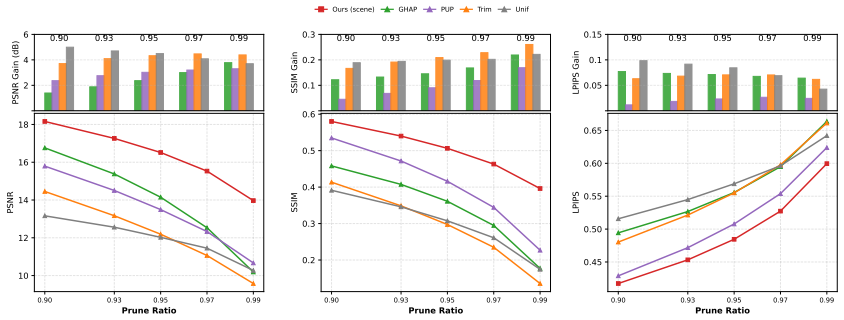
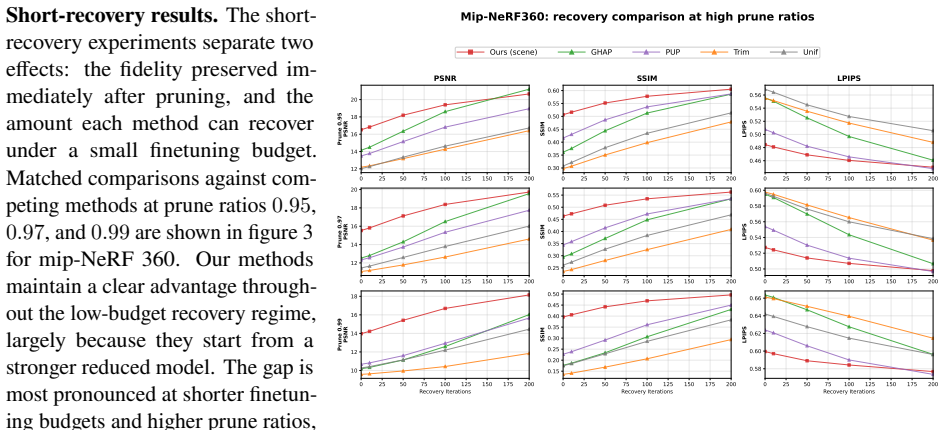
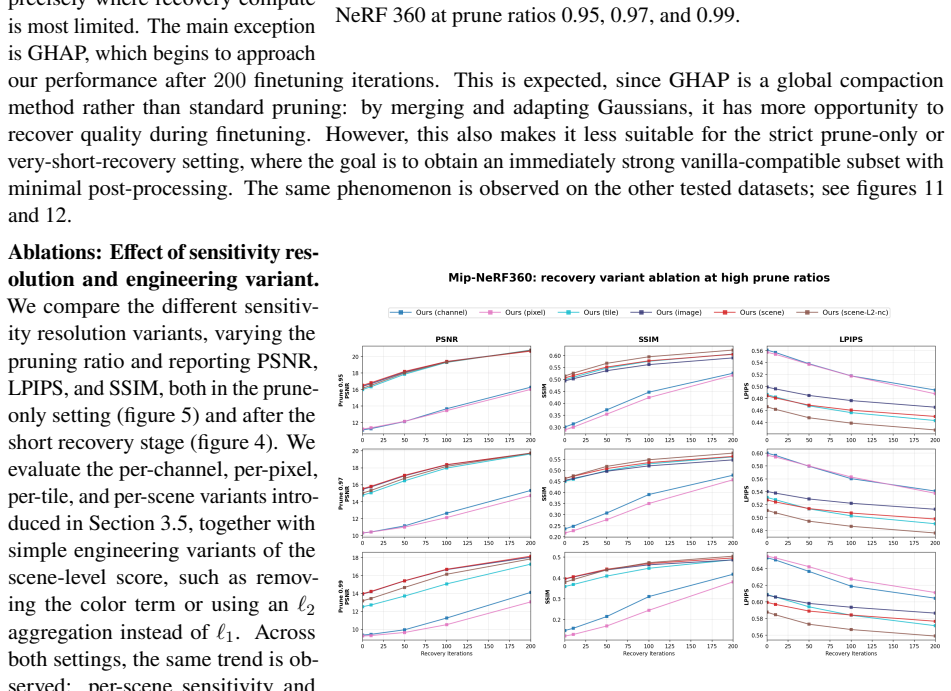
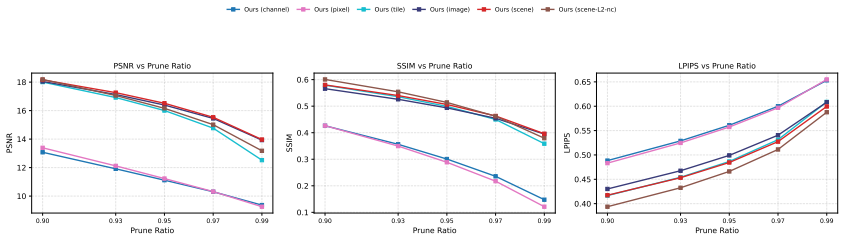
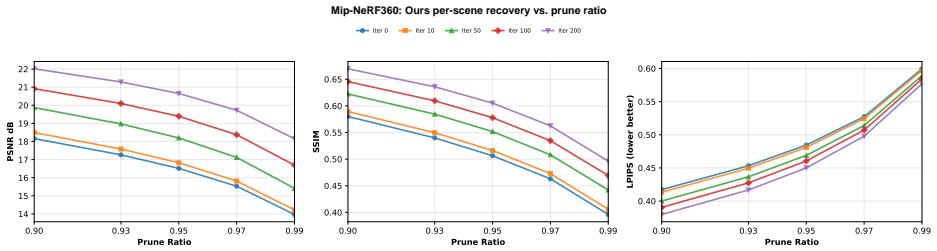
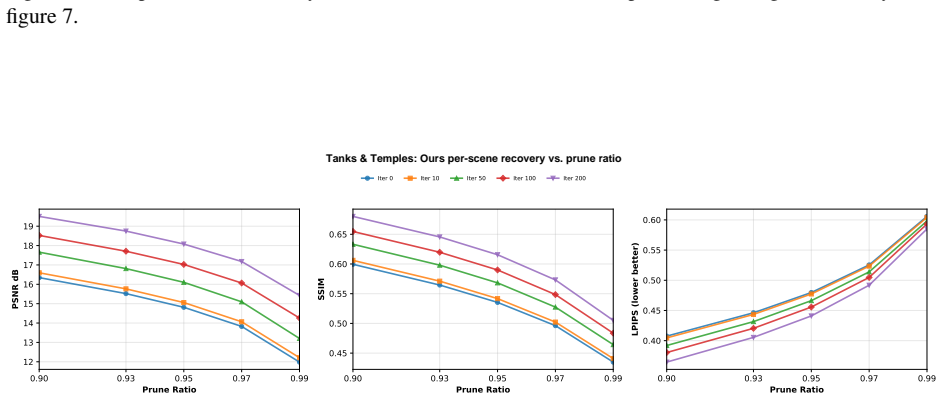
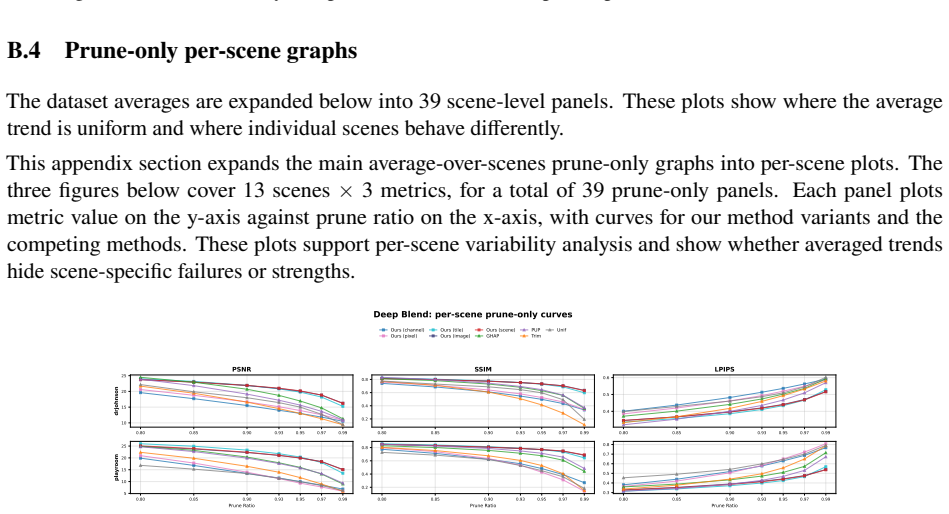
Summary. The paper develops a coreset framework for pruning 3D Gaussian Splatting scenes. It proves that no non-trivial multiplicative coreset exists for unrestricted query families that can isolate individual Gaussians (Theorem 1), then gives a positive result for finite representative query sets: sensitivity sampling with m ≥ (3S/ε_c²) log(2|Q'|/δ) yields, w.h.p., an ε_c-coreset for a fixed-objective relaxation Ath that freezes full-scene itemwise contributions (Theorem 2 / Algorithm 1). Under validity and log-transmittance stability |log T − log T_w| ≤ γ, this transfers to a multiplicative guarantee for true front-to-back rendering Aw with an explicit ε_r (Theorem 3); a Lipschitz ρ-net argument extends the guarantee to compact query regions (Theorem 4). Empirically, sensitivity-based pruning is evaluated on 13 standard scenes in prune-only and short-recovery (≤200 iterations) regimes at aggressive ratios (0.80–0.99), with ablations over aggregation levels, and is reported to outperform GHAP, PUP, Trimming the Fat, and uniform sampling especially without long finetuning. Code is released.
Significance. If the results hold as stated, this is a meaningful first step toward approximation-theoretic 3DGS compression: an impossibility result that clarifies the role of query restriction, a standard sensitivity/Chernoff coreset for a well-defined fixed objective, and an explicit (if conditional) bridge to true compositing. The open-source pipeline and extensive prune-only / short-recovery tables on the usual 13 scenes are real strengths for a systems-facing theory paper, and the practical gains in the low-recovery regime are the right evaluation target for deployment-oriented pruning. The work is not a universal continuous-rendering coreset theorem—and does not claim to be—but it supplies a clean layered structure (impossibility → finite Ath → transfer under γ → covers) that future compression methods can build on.
major comments (3)
- §3.3, Assumption 1 and Theorem 3: the transfer from Ath to true rendered Aw is the paper’s load-bearing “rendering guarantee,” and it rests entirely on |log T(G,g_i,q) − log T_w(G,g_i,q)| ≤ γ for every retained Gaussian and every q ∈ Q′, plus validity (Def. 2). The manuscript never reports empirical γ, max |log(T/T_w)|, the fraction of (Gaussian, query) pairs violating a small γ, or the fraction of invalid factors after pruning at the advertised ratios 0.90–0.99 (Tables 1–4, Figs. 2–3). At 99% pruning, prefix products of (1−w_j ρ_j) can change substantially, so γ may be large; without measurement, Theorem 3 remains a conditional implication rather than a verified guarantee for the experimental regime. Please add these diagnostics (even on a subset of scenes/views) and discuss how ε_r behaves for the observed γ, or clearly demote the experimental claim to “theory-inspired pruning with Ath
- §3.5 and §4 (per-scene variant used as “Ours”): the finite-query theorem guarantees the chosen aggregated objective over Q′. The main experiments use the coarsest per-scene aggregation (one global objective over all selected views/pixels/channels), so the formal guarantee is only for that scalar scene-level sum, not for per-pixel or novel-view RGB fidelity reported via PSNR/SSIM/LPIPS. The ablations (Figs. 4–5, 22–23) show coarser aggregation works better in practice, which is useful, but the paper should state explicitly that image metrics are outside the proved objective and are empirical evidence of transfer, not instances of Theorem 2/3. Aligning at least one experiment with a denser Q′ (e.g., per-tile) and reporting both the coreset objective error and image metrics would close this theory–practice gap.
- Algorithm 1 and Definition 1: the coreset is a weighted vector w with wi = n_i/(m p(g_i)), and Aw uses reweighted opacities in the transmittance product. Confirm in the experimental protocol (Appendix A) that these inverse-probability weights are applied at render time in the prune-only setting, not only used for sampling then discarded in favor of unweighted support. If experiments effectively hard-prune without weights, the Ath unbiasedness and concentration analysis do not apply as stated; either implement the weighted renderer or restate the practical method as importance sampling for subset selection with a separate (weaker) analysis.
Circularity Check
No significant circularity: classical sensitivity sampling + Chernoff for a fixed-itemwise relaxation, with an explicit (non-fitted) transfer assumption to true rendering.
full rationale
The derivation chain is self-contained and non-circular. Theorem 1 is a direct constructive impossibility via isolating queries. Theorem 2 defines sensitivity from the full-scene terms a(G,gi,q)/A(G,q), samples with inverse-probability weights, and obtains a multiplicative guarantee for the auxiliary fixed-objective Ath_w by standard multiplicative Chernoff + union bound over finite Q' (Appendix C.3); Ath is an explicit relaxation, not a quantity fitted to the target error, so the guarantee is not forced by construction of a data fit. Theorem 3 transfers Ath to true Aw only under the stated validity and log-transmittance stability assumptions (Assumption 1 / Def. 2), which are external conditions rather than self-referential definitions or fitted constants; the paper does not claim an unconditional rendering guarantee. Compact-region extension (Theorem 4) is a standard Lipschitz cover argument. Related-work citations to prior coreset/sensitivity papers (including some by an author) supply background technique but are not load-bearing uniqueness claims that force the 3DGS result; the proofs are written out fully. Empirical prune-only gains are separate from the formal claims and do not retroactively define the theorems. No self-definitional loop, no fitted-input-called-prediction, and no ansatz smuggled as derivation.
Assumptions & free parameters
free parameters (4)
- coreset sample size m (or prune ratio)
- ε_c, δ (relative error and failure probability)
- log-transmittance stability radius γ
- query aggregation level (channel/pixel/tile/scene) and L1/L2/color variants
assumptions (6)
- standard math Standard multiplicative Chernoff / sensitivity-sampling coreset framework for nonnegative objectives
- domain assumption 3DGS front-to-back compositing model with projected kernels, opacities, and prefix transmittance
- domain assumption Finite representative query family Q' induced by target resolution (views/rays/pixels/tiles)
- domain assumption Weighted rendering validity: 0 ≤ w_i ρ(g_i,q) < 1 on Q'
- ad hoc to paper Log-transmittance stability |log T − log T_w| ≤ γ on retained Gaussians and Q'
- domain assumption Lipschitz continuity of full and reduced renders on compact query regions (for Theorem 4)
invented entities (2)
-
Fixed-objective relaxation Ath_w (frozen full-scene itemwise contributions)
-
Gaussian sensitivity s(g_i) for 3DGS rendering objectives
independent evidence
Cite this review
Pith. "Pith review of Provable Pruning for Efficient 3D Gaussian Splatting via Coresets." pith.science (2026). https://pith.science/paper/CTY2IAFK
@misc{pith2026260702721,
  author       = {Pith},
  title        = {Pith review of: Provable Pruning for Efficient 3D Gaussian Splatting via Coresets},
  year         = {2026},
  howpublished = {\url{https://pith.science/paper/CTY2IAFK}},
  note         = {Machine review of arXiv:2607.02721}
}
read the original abstract
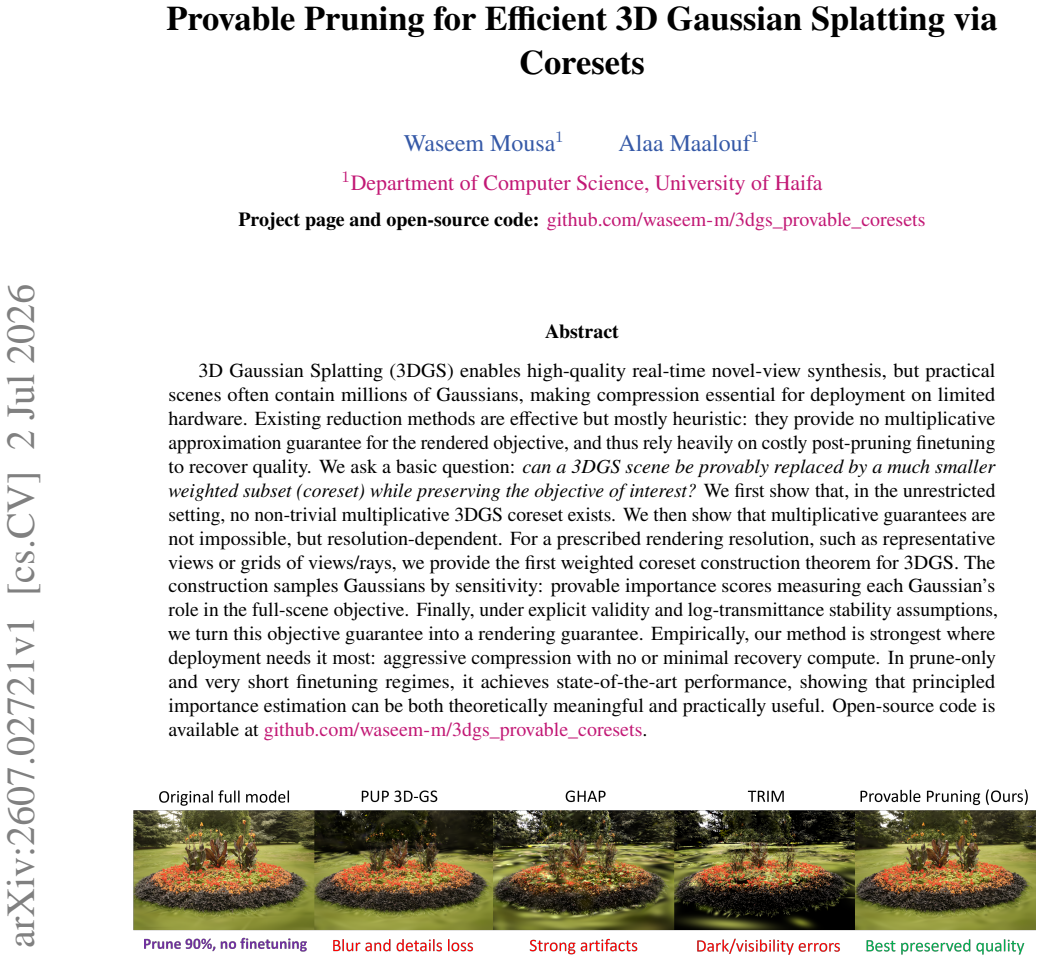
3D Gaussian Splatting (3DGS) enables high-quality real-time novel-view synthesis, but practical scenes often contain millions of Gaussians, making compression essential for deployment on limited hardware. Existing reduction methods are effective but mostly heuristic: they provide no multiplicative approximation guarantee for the rendered objective, and thus rely heavily on costly post-pruning finetuning to recover quality. We ask a basic question: can a 3DGS scene be provably replaced by a much smaller weighted subset (coreset) while preserving the objective of interest? We first show that, in the unrestricted setting, no non-trivial multiplicative 3DGS coreset exists. We then show that multiplicative guarantees are not impossible, but resolution-dependent. For a prescribed rendering resolution, such as representative views or grids of views/rays, we provide the first weighted coreset construction theorem for 3DGS. The construction samples Gaussians by sensitivity: provable importance scores measuring each Gaussian's role in the full-scene objective. Finally, under explicit validity and log-transmittance stability assumptions, we turn this objective guarantee into a rendering guarantee. Empirically, our method is strongest where deployment needs it most: aggressive compression with no or minimal recovery compute. In prune-only and very short finetuning regimes, it achieves state-of-the-art performance, showing that principled importance estimation can be both theoretically meaningful and practically useful. Open-source code is available at https://github.com/waseem-m/3dgs_provable_coresets.
Figures
Figures from the paper (20 more)






Reference graph
Works this paper leans on
-
[1]
Bernhard Kerbl, Georgios Kopanas, Thomas Leimkühler, and George Drettakis. 3D gaussian splatting for real-time radiance field rendering.ACM Transactions on Graphics, 42(4):139:1–139:14, 2023. doi: 10.1145/3592433
doi:10.1145/3592433 2023
-
[2]
Mip-Splatting: Alias-free 3D gaussian splatting
Zehao Yu, Anpei Chen, Binbin Huang, Torsten Sattler, and Andreas Geiger. Mip-Splatting: Alias-free 3D gaussian splatting. InProceedings of the IEEE/CVF Conference on Computer Vision and Pattern Recognition (CVPR), pages 19447–19456, 2024. doi: 10.1109/CVPR52733.2024.01839
-
[3]
Scaffold-GS: Structured 3D gaussians for view-adaptive rendering
Tao Lu, Mulin Yu, Linning Xu, Yuanbo Xiangli, Limin Wang, Dahua Lin, and Bo Dai. Scaffold-GS: Structured 3D gaussians for view-adaptive rendering. InProceedings of the IEEE/CVF Conference on Computer Vision and Pattern Recognition (CVPR), pages 20654–20664, 2024. doi: 10.1109/ CVPR52733.2024.01952
arXiv 2024
-
[4]
2D gaussian splatting for geometrically accurate radiance fields
Binbin Huang, Zehao Yu, Anpei Chen, Andreas Geiger, and Shenghua Gao. 2D gaussian splatting for geometrically accurate radiance fields. InSIGGRAPH 2024 Conference Papers, pages 32:1–32:11,
2024
-
[5]
doi: 10.1145/3641519.3657428
-
[6]
Analytic-Splatting: Anti-aliased 3D gaussian splatting via analytic integration
Zhihao Liang, Qi Zhang, Wenbo Hu, Lei Zhu, Ying Feng, and Kui Jia. Analytic-Splatting: Anti-aliased 3D gaussian splatting via analytic integration. InComputer Vision – ECCV 2024, pages 281–297, 2024. doi: 10.1007/978-3-031-72643-9_17
-
[7]
3D gaussian splatting as markov chain monte carlo
Shakiba Kheradmand, Daniel Rebain, Gopal Sharma, Weiwei Sun, Yang-Che Tseng, Hossam Isack, Abhishek Kar, Andrea Tagliasacchi, and Kwang Moo Yi. 3D gaussian splatting as markov chain monte carlo. InAdvances in Neural Information Processing Systems, 2024. doi: 10.52202/079017-2573
-
[8]
Yanqi Bao, Tianyu Ding, Jing Huo, Yaoli Liu, Yuxin Li, Wenbin Li, Yang Gao, and Jiebo Luo. 3D gaussian splatting: Survey, technologies, challenges, and opportunities.IEEE Transactions on Circuits and Systems for Video Technology, 35(7):6832–6852, 2025. doi: 10.1109/TCSVT.2025.3538684
Show all 63 references
-
[9]
Bagdasarian, Paul Knoll, Yi-Hsin Li, Florian Barthel, Anna Hilsmann, Peter Eisert, and Wieland Morgenstern
Milena T. Bagdasarian, Paul Knoll, Yi-Hsin Li, Florian Barthel, Anna Hilsmann, Peter Eisert, and Wieland Morgenstern. 3DGS.zip: A survey on 3D gaussian splatting compression methods.Computer Graphics Forum, 44(2):e70078, 2025. doi: 10.1111/cgf.70078
2025 doi
-
[10]
Mini-Splatting: Representing scenes with a constrained number of gaussians
Guangchi Fang and Bing Wang. Mini-Splatting: Representing scenes with a constrained number of gaussians. InComputer Vision – ECCV 2024, pages 165–181, 2024. doi: 10.1007/978-3-031-72980-5_ 10
2024 doi
-
[11]
Taming3DGS:High-qualityradiancefieldswithlimitedresources
Saswat Subhajyoti Mallick, Rahul Goel, Bernhard Kerbl, Markus Steinberger, Francisco Vicente Carrasco,andFernandoDeLaTorre. Taming3DGS:High-qualityradiancefieldswithlimitedresources. InSIGGRAPH Asia 2024 Conference Papers, pages 2:1–2:11, 2024. doi: 10.1145/3680528.3687694
2024 doi
-
[12]
LightGaussian: Unbounded 3D gaussian compression with 15x reduction and 200+ FPS
Zhiwen Fan, Kevin Wang, Kairun Wen, Zehao Zhu, Dejia Xu, and Zhangyang Wang. LightGaussian: Unbounded 3D gaussian compression with 15x reduction and 200+ FPS. InAdvances in Neural Information Processing Systems, 2024. doi: 10.52202/079017-4447
2024 doi
-
[13]
EAGLES: Efficient accelerated 3D gaussians with lightweight EncodingS
Sharath Girish, Kamal Gupta, and Abhinav Shrivastava. EAGLES: Efficient accelerated 3D gaussians with lightweight EncodingS. InComputer Vision – ECCV 2024, pages 54–71, 2024. doi: 10.1007/ 978-3-031-73036-8_4. 12
2024
-
[14]
Compact 3D gaussian representation for radiance field
Joo Chan Lee, Daniel Rho, Xiangyu Sun, Jong Hwan Ko, and Eunbyung Park. Compact 3D gaussian representation for radiance field. InProceedings of the IEEE/CVF Conference on Computer Vision and Pattern Recognition (CVPR), pages 21719–21728, 2024. doi: 10.1109/CVPR52733.2024.02052
2024 doi
-
[15]
MesonGS:Post-trainingcompressionof3Dgaussiansviaefficientattributetransformation
Shuzhao Xie, Weixiang Zhang, Chen Tang, Yunpeng Bai, Rongwei Lu, Shijia Ge, and Zhi Wang. MesonGS:Post-trainingcompressionof3Dgaussiansviaefficientattributetransformation. InComputer Vision – ECCV 2024, pages 434–452, 2024. doi: 10.1007/978-3-031-73414-4_25
2024 doi
-
[16]
Trimming the fat: Efficientcompressionof3Dgaussiansplatsthroughpruning
Muhammad Salman Ali, Maryam Qamar, Sung-Ho Bae, and Enzo Tartaglione. Trimming the fat: Efficientcompressionof3Dgaussiansplatsthroughpruning. InProceedingsofthe35thBritishMachine Vision Conference (BMVC), 2024
2024
-
[17]
PUP 3D-GS: Principled uncertainty pruning for 3D gaussian splatting
Alex Hanson, Allen Tu, Vasu Singla, Mayuka Jayawardhana, Matthias Zwicker, and Tom Goldstein. PUP 3D-GS: Principled uncertainty pruning for 3D gaussian splatting. InProceedings of the IEEE/CVF Conference on Computer Vision and Pattern Recognition (CVPR), pages 5949–5958, 2025....
2025 doi
-
[18]
Gaussianherdingacrosspens: An optimaltransportperspectiveonglobalgaussianreductionfor3DGS
TaoWang,MengyuLi,GeduoZeng,ChengMeng,andQiongZhang. Gaussianherdingacrosspens: An optimaltransportperspectiveonglobalgaussianreductionfor3DGS. InAdvancesinNeuralInformation Processing Systems, 2025
2025
-
[19]
optimizing-sparsifying
Yangming Zhang, Wenqi Jia, Wei Niu, and Miao Yin. GaussianSpa: An “optimizing-sparsifying” simplification framework for compact and high-quality 3D gaussian splatting. InProceedings of the IEEE/CVF Conference on Computer Vision and Pattern Recognition (CVPR), pages 26673–26682,
-
[20]
doi: 10.1109/CVPR52734.2025.02484
2025 doi
-
[21]
PCGS: Progressive compression of 3D gaussian splatting.Proceedings of the AAAI Conference on Artificial Intelligence, 40(4):3111–3119, 2026
Yihang Chen, Mengyao Li, Qianyi Wu, Weiyao Lin, Mehrtash Harandi, and Jianfei Cai. PCGS: Progressive compression of 3D gaussian splatting.Proceedings of the AAAI Conference on Artificial Intelligence, 40(4):3111–3119, 2026. doi: 10.1609/aaai.v40i4.37304
2026 doi
-
[22]
Optimized minimal 3D gaussian splatting
Joo Chan Lee, Jong Hwan Ko, and Eunbyung Park. Optimized minimal 3D gaussian splatting. In Advances in Neural Information Processing Systems, 2025
2025
-
[23]
Compressing 3D gaussian splatting by noise-substituted vector quantization
Haishan Wang, Mohammad Hassan Vali, and Arno Solin. Compressing 3D gaussian splatting by noise-substituted vector quantization. InScandinavian Conference on Image Analysis (SCIA), pages 338–352, 2025. doi: 10.1007/978-3-031-95911-0_24
2025 doi
-
[24]
Compression in 3D gaussian splatting: A survey of methods, trends, and future directions.IEEE Transactions on Circuits and Systems for Video Technology, 2026
Muhammad Salman Ali, Chaoning Zhang, Marco Cagnazzo, Giuseppe Valenzise, Enzo Tartaglione, and Sung-Ho Bae. Compression in 3D gaussian splatting: A survey of methods, trends, and future directions.IEEE Transactions on Circuits and Systems for Video Technology, 2026. doi: 10.11...
2026
-
[25]
A unified framework for approximating and clustering data
Dan Feldman and Michael Langberg. A unified framework for approximating and clustering data. In Proceedings of the 43rd Annual ACM Symposium on Theory of Computing, pages 569–578, 2011. doi: 10.1145/1993636.1993712
2011 doi
-
[26]
New frameworks for offline and streaming coreset constructions.arXiv preprint arXiv:1612.00889, 2016
Vladimir Braverman, Dan Feldman, Harry Lang, Adiel Statman, and Samson Zhou. New frameworks for offline and streaming coreset constructions.arXiv preprint arXiv:1612.00889, 2016
2016 arXiv
-
[27]
Phillips
Jeff M. Phillips. Coresets and sketches. In Csaba D. Tóth, Joseph O’Rourke, and Jacob E. Goodman, editors,HandbookofDiscreteandComputationalGeometry,pages1269–1288.ChapmanandHall/CRC, 3rd edition, 2017. doi: 10.1201/9781315119601-48. 13
2017 doi
-
[28]
Core-sets: An updated survey.WIREs Data Mining and Knowledge Discovery, 10(1): e1335, 2020
Dan Feldman. Core-sets: An updated survey.WIREs Data Mining and Knowledge Discovery, 10(1): e1335, 2020. doi: 10.1002/widm.1335
2020 doi
-
[29]
Data-dependent coresets for compressing neural networks with applications to generalization bounds
Cenk Baykal, Lucas Liebenwein, Igor Gilitschenski, Dan Feldman, and Daniela Rus. Data-dependent coresets for compressing neural networks with applications to generalization bounds. InInternational Conference on Learning Representations, 2019
2019
-
[30]
Pruning neural networks via coresets and convex geometry: Towards no assumptions
Murad Tukan, Loay Mualem, and Alaa Maalouf. Pruning neural networks via coresets and convex geometry: Towards no assumptions. InAdvances in Neural Information Processing Systems, pages 38003–38019, 2022. doi: 10.52202/068431-2754
2022 doi
-
[31]
Provable filter pruning for efficient neural networks
Lucas Liebenwein, Cenk Baykal, Harry Lang, Dan Feldman, and Daniela Rus. Provable filter pruning for efficient neural networks. InInternational Conference on Learning Representations, 2020
2020
-
[32]
Pixel-GS: Density control with pixel-aware gradient for 3D gaussian splatting
Zheng Zhang, Wenbo Hu, Yixing Lao, Tong He, and Hengshuang Zhao. Pixel-GS: Density control with pixel-aware gradient for 3D gaussian splatting. InComputer Vision – ECCV 2024, pages 326–342, 2024. doi: 10.1007/978-3-031-72655-2_19
2024 doi
-
[33]
AbsGS: Recovering fine details in 3D gaussian splatting
Zongxin Ye, Wenyu Li, Sidun Liu, Peng Qiao, and Yong Dou. AbsGS: Recovering fine details in 3D gaussian splatting. InProceedings of the 32nd ACM International Conference on Multimedia, pages 1053–1061, 2024. doi: 10.1145/3664647.3681361
2024 doi
-
[34]
Geometricapproximationviacoresets
PankajK.Agarwal,SarielHar-Peled,andKasturiR.Varadarajan. Geometricapproximationviacoresets. InJacobE.Goodman,JánosPach,andEmoWelzl,editors,CombinatorialandComputationalGeometry, pages 1–30. Cambridge University Press, 2005. doi: 10.1017/9781009701259.002
2005 doi
-
[35]
Clarkson
Mihai Bădoiu and Kenneth L. Clarkson. Smaller core-sets for balls. InProceedings of the Fourteenth Annual ACM-SIAM Symposium on Discrete Algorithms (SODA), pages 801–802, 2003
2003
-
[36]
Alper Yıldırım
Piyush Kumar and E. Alper Yıldırım. Minimum-volume enclosing ellipsoids and core sets.Journal of Optimization Theory and Applications, 126(1):1–21, 2005. doi: 10.1007/s10957-005-2653-6
2005 doi
-
[37]
Fast and accurate least-mean-squares solvers
Alaa Maalouf, Ibrahim Jubran, and Dan Feldman. Fast and accurate least-mean-squares solvers. In Advances in Neural Information Processing Systems, pages 8307–8318, 2019
2019
-
[38]
AutoCoreset: An automatic practical coreset construction framework
Alaa Maalouf, Murad Tukan, Vladimir Braverman, and Daniela Rus. AutoCoreset: An automatic practical coreset construction framework. InProceedings of the 40th International Conference on Machine Learning, pages 23451–23466, 2023
2023
-
[39]
Tight sensitivity bounds for smaller coresets
Alaa Maalouf, Adiel Statman, and Dan Feldman. Tight sensitivity bounds for smaller coresets. In Proceedings of the 26th ACM SIGKDD International Conference on Knowledge Discovery & Data Mining, pages 2051–2061, 2020. doi: 10.1145/3394486.3403256
-
[40]
Scalable k-meansclusteringvialightweightcoresets
OlivierBachem,MarioLucic,andAndreasKrause. Scalable k-meansclusteringvialightweightcoresets. InProceedings of the 24th ACM SIGKDD International Conference on Knowledge Discovery & Data Mining, pages 1119–1127, 2018. doi: 10.1145/3219819.3219973
2018 doi
-
[41]
Practicalcoresetconstructionsformachinelearning
OlivierBachem,MarioLucic,andAndreasKrause. Practicalcoresetconstructionsformachinelearning. arXiv preprint arXiv:1703.06476, 2017
2017 arXiv
-
[42]
Sets clustering
Ibrahim Jubran, Murad Tukan, Alaa Maalouf, and Dan Feldman. Sets clustering. InProceedings of the 37th International Conference on Machine Learning, pages 4994–5005, 2020. 14
2020
-
[43]
Provable data subset selection for efficient neural networks training
Murad Tukan, Samson Zhou, Alaa Maalouf, Daniela Rus, Vladimir Braverman, and Dan Feldman. Provable data subset selection for efficient neural networks training. InProceedings of the 40th International Conference on Machine Learning, pages 34533–34555, 2023
2023
-
[44]
Activelearningforconvolutionalneuralnetworks: ACore-Setapproach
OzanSenerandSilvioSavarese. Activelearningforconvolutionalneuralnetworks: ACore-Setapproach. InInternational Conference on Learning Representations, 2018
2018
-
[45]
Coresets for data-efficient training of machine learning models
Baharan Mirzasoleiman, Jeff Bilmes, and Jure Leskovec. Coresets for data-efficient training of machine learning models. InProceedings of the 37th International Conference on Machine Learning, pages 6950–6960, 2020
2020
-
[46]
Towards sustainable learning: Coresets for data- efficient deep learning
Yu Yang, Hao Kang, and Baharan Mirzasoleiman. Towards sustainable learning: Coresets for data- efficient deep learning. InProceedings of the 40th International Conference on Machine Learning, pages 39314–39330, 2023
2023
-
[47]
Hybrid control and learning with coresets for autonomous vehicles
Guy Rosman, Liam Paull, and Daniela Rus. Hybrid control and learning with coresets for autonomous vehicles. In2017 IEEE/RSJ International Conference on Intelligent Robots and Systems (IROS), pages 6894–6901, 2017. doi: 10.1109/IROS.2017.8206612
2017 doi
-
[48]
Overviewofaccuratecoresets.WileyInterdisciplinary Reviews: Data Mining and Knowledge Discovery, 11(6):e1429, 2021
IbrahimJubran,AlaaMaalouf,andDanFeldman. Overviewofaccuratecoresets.WileyInterdisciplinary Reviews: Data Mining and Knowledge Discovery, 11(6):e1429, 2021. doi: 10.1002/widm.1429
2021 doi
-
[49]
DataS3: Dataset subset selection for specialization.arXiv preprint arXiv:2504.16277, 2025
NehaHulkund,AlaaMaalouf,LeviCai,DanielYang,Tsun-HsuanWang,AbigailO’Neil,TimmHaucke, Sandeep Mukherjee, Vikram Ramaswamy, Judy Hansen Shen, Gabriel Tseng, Mike Walmsley, Daniela Rus, Ken Goldberg, Hannah Kerner, Irene Chen, Yogesh Girdhar, and Sara Beery. DataS3: Dataset subset...
2025 arXiv
-
[50]
Efficient test-time finetuning of LLMs via convex reconstruction and gradient caching.arXiv preprint arXiv:2605.30337, 2026
Alaa Khamis and Alaa Maalouf. Efficient test-time finetuning of LLMs via convex reconstruction and gradient caching.arXiv preprint arXiv:2605.30337, 2026
2026 arXiv
-
[51]
A unified approach to coresetlearning.IEEETransactionsonNeuralNetworksandLearningSystems, 35(5):6893–6905, 2024
Alaa Maalouf, Gilad Eini, Ben Mussay, Dan Feldman, and Margarita Osadchy. A unified approach to coresetlearning.IEEETransactionsonNeuralNetworksandLearningSystems, 35(5):6893–6905, 2024. doi: 10.1109/TNNLS.2022.3213169
2024 doi
-
[52]
Coresets for near-convex functions
Murad Tukan, Alaa Maalouf, and Dan Feldman. Coresets for near-convex functions. InAdvances in Neural Information Processing Systems, pages 997–1009, 2020
2020
-
[53]
Data- independent neural pruning via coresets
Ben Mussay, Margarita Osadchy, Vladimir Braverman, Samson Zhou, and Dan Feldman. Data- independent neural pruning via coresets. InInternational Conference on Learning Representations, 2020
2020
-
[54]
Barron, Ben Mildenhall, Dor Verbin, Pratul P
Jonathan T. Barron, Ben Mildenhall, Dor Verbin, Pratul P. Srinivasan, and Peter Hedman. Mip-NeRF 360: Unbounded anti-aliased neural radiance fields. InProceedings of the IEEE/CVF Conference on Computer Vision and Pattern Recognition (CVPR), pages 5470–5479, 2022
2022
-
[55]
Tanks and temples: Benchmarking large-scale scene reconstruction.ACM Transactions on Graphics, 36(4):78:1–78:13, 2017
Arno Knapitsch, Jaesik Park, Qian-Yi Zhou, and Vladlen Koltun. Tanks and temples: Benchmarking large-scale scene reconstruction.ACM Transactions on Graphics, 36(4):78:1–78:13, 2017. doi: 10.1145/3072959.3073599
2017 doi
-
[56]
Deep blending for free-viewpoint image-based rendering.ACM Transactions on Graphics, 37(6): 257:1–257:15, 2018
Peter Hedman, Julien Philip, True Price, Jan-Michael Frahm, George Drettakis, and Gabriel Brostow. Deep blending for free-viewpoint image-based rendering.ACM Transactions on Graphics, 37(6): 257:1–257:15, 2018. doi: 10.1145/3272127.3275084. 15 A Reproducibility and Experimenta...
2018 doi
-
[57]
the full rendered objectiveq7→A(G, q)is Lipschitz onQr with constantLfull
-
[58]
the reduced rendered objectiveq7→Aw(G, q)is Lipschitz onQr with constantLw
-
[59]
the full rendered objective is bounded away from zero: A(G, q)≥A min >0for everyq∈ Q r. Proposition 1(Why the Lipschitz assumption is reasonable).Suppose on a regionQr: (i) the relevant set of Gaussians is finite; (ii) the front-to-back order does not jump discontinuously insi...
-
[60]
impossibility in the unrestricted general case
-
[61]
existence on a finite representative family for a fixed objective
-
[62]
transfer to true rendering under explicit transmittance stability; and
-
[63]
extension to compact regions by representative covers. This formulation is intentionally conservative, but it makes the logical structure of the proof transparent and leaves no hidden gap between the negative and positive parts of the claim. 39
Reviewed July 12, 2026 · model on record in the stance chip above.
Discussion (0). Sign in to comment.