REVIEW 2 major objections 6 minor 21 references
Induction heads do not merely count exact matches; at finite attention scale they implement soft n-gram interpolation and, with a BOS token, additive Dirichlet-style smoothing.
Reviewed by Pith at T0; open to challenge. T0 means a machine referee read the full paper against a public rubric. the ladder, T0–T4 →
T0 review · grok-4.5
2026-07-12 06:57 UTC pith:A2FTISJW
load-bearing objection Clean constructive characterization of induction heads as soft n-gram interpolators plus BOS pseudo-counts; solid math and matching experiments on the synthetic tasks they claim. the 2 major comments →
Induction Heads Interpolate N-Grams
The pith
A machine-rendered reading of the paper's core claim, the machinery that carries it, and where it could break.
Core claim
A two-layer induction-head circuit realises the soft context-matching estimator that mixes exact and partial context matches with weights exponential in overlap; at large attention scale it recovers hard k-gram counting, while finite scale yields Jelinek-Mercer-style interpolation and a BOS token adds the constant that produces add-α smoothing.
What carries the argument
The soft context-matching estimator of Proposition 3.1: T(x)(m) equals the normalised sum of mask-conditioned transition counts N_M^{(T)}(m) each multiplied by e^{|β|_M}, plus an optional BOS pseudo-count e^κ/|V|. The free parameters β control the interpolation across match masks and κ controls the additive prior.
Load-bearing premise
The constructive proof and the claim that trained models implement the same estimator both rest on two-layer disentangled (or equivalent) architectures whose first-layer heads stay pure lag-specific copy heads, verified only on synthetic order-2 chains with a five-token vocabulary.
What would settle it
Train a standard two-layer transformer on order-2 Markov sequences drawn from an independent Dirichlet prior without a BOS token; if the layer-2 attention from the final position concentrates only on exact matches and never spreads mass onto partial-overlap contexts, the soft-matching claim fails.
If this is right
- When exact high-order matches are rare, the same induction-head circuit automatically backs off to lower-order and unigram evidence without any hand-designed backoff rule.
- The BOS token is not merely an architectural convenience; it is the circuit-level realisation of additive pseudo-count regularisation.
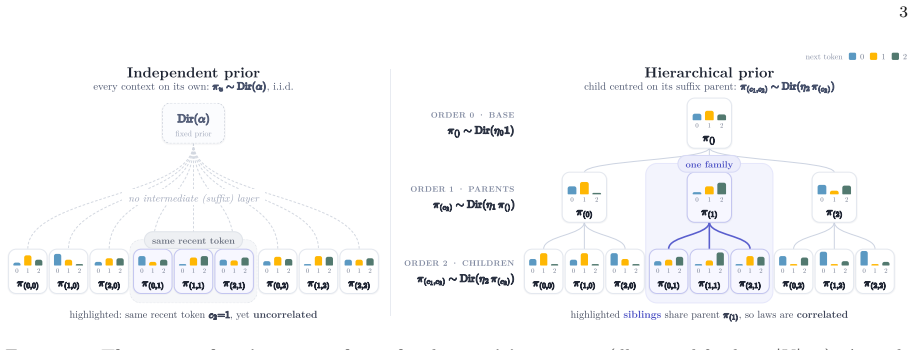
- Under hierarchical priors that couple sibling contexts, soft matching outperforms every fixed add-α baseline, so the mechanism is useful precisely when lower-order contexts carry structured information.
- The attention-weight scale β is a single scalar knob that interpolates continuously between Katz hard back-off and smooth Jelinek-Mercer mixing.
Where Pith is reading between the lines
- The same soft-matching construction may explain why induction heads remain useful in natural language even though true exact k-gram repeats are vanishingly rare.
- If deeper stacks preserve the same lag-copy plus soft-match motif, classical n-gram smoothing theory could supply principled regularisers for multi-layer in-context learners.
- Asymmetric lag weights learned under hierarchical priors suggest the circuit can discover which suffix positions are most informative, opening a route to data-dependent feature selection inside attention.
Editorial analysis
A structured set of objections, weighed in public.
Referee Report
Summary. The paper studies two-layer induction-head circuits on order-k Markov chains and gives a constructive characterization of the estimator they implement beyond the hard-attention limit. Proposition 3.1 exhibits explicit weights for a disentangled transformer realizing a soft context-matching estimator: successor tokens are aggregated with weights exponential in the Hamming overlap of query and candidate contexts, with a free scale β and an optional BOS-induced offset κ. Finite β yields a data-dependent interpolation over exact and partial matches, rewritten as a Jelinek–Mercer-style mixture over cumulative mask counts (Lemma 4.1, Corollary 4.2); BOS recovers add-α Dirichlet smoothing in the hard-attention limit (Corollary 4.1). Experiments on independent and hierarchical Dirichlet priors (k=2, |V|=5) show that both disentangled and standard trained transformers recover the predicted Layer-1 copy / Layer-2 match circuit, match or beat classical count-based baselines, and use soft matching when lower-order contexts are informative.
Significance. The work cleanly bridges mechanistic interpretability of induction heads with classical n-gram smoothing. The central contribution is a fully constructive weight assignment (Layer-1 lag-specific RPE copy heads; Layer-2 block-shift WA producing scores |β|_M; BOS sink for κ; successor readout), not a post-hoc fit, together with algebraic rewrites that identify the estimator with known smoothing families. Empirical recovery of the same attention patterns in both disentangled and standard two-layer models, plus KL curves that track the predicted estimators, makes the claim falsifiable and reproducible on the stated synthetic tasks. If the characterization continues to hold more broadly, it reframes induction heads as regularized in-context estimators rather than pure counters—an important conceptual shift for ICL theory.
major comments (2)
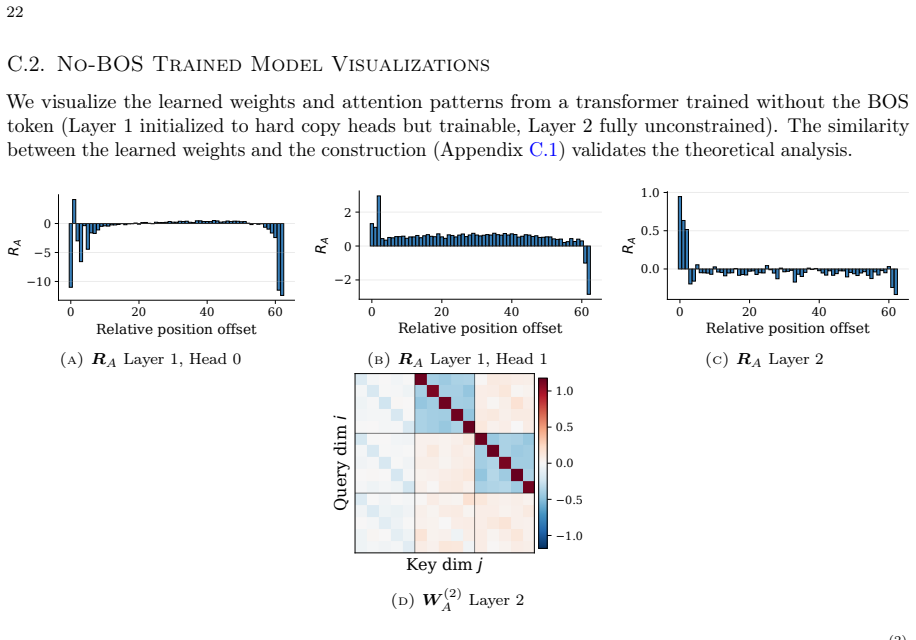
- Section 5 and Figures 3–5 support the claim that trained models implement the Prop. 3.1 estimator primarily via KL-to-truth curves and qualitative attention heatmaps / WA structure. A tighter check would fit free parameters (β, κ) of Eq. (8) on held-out sequences and report the KL or total-variation distance between the trained model’s next-token distribution and the fitted soft-matching estimator (construction vs. trained, with and without BOS). Without this, “implements the same estimator” remains one step short of quantitative identification, even though the mechanistic evidence is already strong.
- Appendix E, Corollary E.1: label-permutation symmetry only forces token-equality comparisons and allows general (r1,r2) lag pairs, not only the aligned super-diagonal blocks used in Prop. 3.1. The main text and Fig. 4 report that trained WA recovers the aligned block-shift structure, but do not quantify residual mass on off-diagonal comparison blocks. Reporting the relative Frobenius mass (aligned vs. non-aligned blocks) for trained disentangled and standard models would confirm that the restricted construction is the one selected by training, rather than a more general symmetry-compatible matcher.
minor comments (6)
- Lemma 4.2 and Appendix D.3: the approximate β for add-constant smoothing relies on independence and concentration assumptions that are coarse for k>1. A short numerical check (empirical E[α̃] vs. target α for the stated T, |V|, k) in the appendix would calibrate how good the approximation is in the experimental regime.
- Figure 2 is dense; the Layer-2 soft-matching panel would be clearer with an explicit legend for arrow thickness = e^{β|M|} and a callout that the final mixture includes the BOS uniform term only when BOS is present.
- Section 5: state explicitly that the hierarchical Bayes-optimal predictor has no closed form (already noted in §2.2) and that the dashed add-α curves are therefore suboptimal baselines rather than the Bayes target; this avoids a possible misreading of the right panel of Fig. 3.
- Notation: |β|_M is used for the sum of β_i over i∈M; a one-line definition near Def. 3.1 would help readers who jump to Prop. 3.1.
- Related work (Appendix B) is thorough; a brief pointer in the main-text introduction to MacKay & Peto (1995) and Chen & Goodman (1999) when first mentioning hierarchical Dirichlet / JM smoothing would orient non-LM readers earlier.
- Limitations (A.1) correctly flag synthetic Markov sources and two-layer depth; consider also noting that the last-token-only training objective (Eq. 5) isolates ICL but differs from full-sequence LM training, so transfer to natural-language induction heads remains an open empirical question.
Circularity Check
No significant circularity: the soft context-matching estimator is obtained by explicit weight construction, not by fitting or self-referential definition.
full rationale
Proposition 3.1 and its proof construct Layer-1 lag-specific hard-copy heads via RPE and a Layer-2 block-shift attention matrix W_A whose scores equal |β|_M (plus a BOS sink for κ); the resulting next-token map is exactly the displayed estimator by algebra of the softmax and residual concatenation. The subsequent rewrites (Lemma 4.1, Corollaries 4.1–4.2) are pure identities under the stated conventions (γ = e^β − 1, cumulative counts K_M, etc.) and do not import the target functional form. Empirical recovery of the same attention patterns and W_A structure by trained models is an independent check against the construction, not a fit of the estimator itself. Citations (Nichani et al. for disentangled–standard equivalence, classical JM/Katz references) supply background or architectural justification and are not load-bearing for the derivation of the estimator. No step reduces the claimed result to its own inputs by construction, fit, or self-citation chain.
Axiom & Free-Parameter Ledger
free parameters (2)
- attention-scale vector β ∈ R^k
- BOS pseudo-count offset κ
axioms (4)
- domain assumption Disentangled transformers (concatenation residual, no MLP) are equivalent to standard attention-only transformers (Nichani et al. 2024).
- standard math Dirichlet–Categorical conjugacy yields the closed-form posterior mean (add-α) under independent priors.
- domain assumption Relative positional encodings can implement hard lag-specific copy attention in the large-δ limit.
- standard math Label-permutation symmetry of the Markov prior forces content-based attention blocks to be scalar multiples of the identity (Appendix E).
read the original abstract
Induction heads are attention circuits believed to underlie in-context learning in transformers, yet a precise characterization of the estimators they implement remains elusive. We study transformers trained on order-$k$ Markov chains and identify two complementary smoothing mechanisms. First, at finite attention-weight scale, the circuit implements a soft context-matching estimator: it aggregates contributions from exact and partial context matches, weighted exponentially by their overlap, and induces a data-dependent interpolation across context orders analogous to Jelinek-Mercer smoothing. Second, a beginning-of-sequence (BOS) token induces additive pseudo-counts, recovering Dirichlet-style smoothing. We construct a disentangled transformer implementing both mechanisms and show that trained transformers recover the predicted attention patterns. Across settings where pseudo-count smoothing is optimal or lower-order contexts provide structured evidence, trained transformers match or outperform classical count-based baselines. Our results bridge mechanistic interpretability of induction heads with classical statistical smoothing, revealing that transformers learn to regularize in-context estimation rather than simply count.
Figures




Reference graph
Works this paper leans on
-
[1]
Language models are few-shot learners.Advances in neural information processing systems, 33:1877–1901,
Tom Brown, Benjamin Mann, Nick Ryder, Melanie Subbiah, Jared D Kaplan, Prafulla Dhariwal, Arvind Neelakantan, Pranav Shyam, Girish Sastry, Amanda Askell, et al. Language models are few-shot learners.Advances in neural information processing systems, 33:1877–1901,
1901
-
[2]
Sébastien Bubeck, Varun Chandrasekaran, Ronen Eldan, Johannes Gehrke, Eric Horvitz, Ece Kamar, Peter Lee, Yin Tat Lee, Yuanzhi Li, Scott Lundberg, et al. Sparks of artificial general intelligence: Early experiments with gpt-4.arXiv preprint arXiv:2303.12712,
-
[3]
Dan Friedman, Alexander Wettig, and Danqi Chen
https://transformer- circuits.pub/2021/framework/index.html. Dan Friedman, Alexander Wettig, and Danqi Chen. Learning transformer programs. InThirty-seventh Conference on Neural Information Processing Systems,
2021
-
[4]
Reddi, Stefanie Jegelka, and Sanjiv Kumar
Khashayar Gatmiry, Nikunj Saunshi, Sashank J. Reddi, Stefanie Jegelka, and Sanjiv Kumar. Can looped transformers learn to implement multi-step gradient descent for in-context learning? In Ruslan Salakhutdinov, Zico Kolter, Katherine A. Heller, Adrian Weller, Nuria Oliver, Jonathan Scarlett, and Felix Berkenkamp, editors,Forty-first International Conferenc...
2024
-
[5]
Jiachen Hu, Qinghua Liu, and Chi Jin
URLhttps://proceedings.mlr.press/v235/gatmiry24b.html. Jiachen Hu, Qinghua Liu, and Chi Jin. On limitation of transformer for learning hmms.arXiv preprint arXiv:2406.04089,
-
[6]
Jiacheng Liu, Sewon Min, Luke Zettlemoyer, Yejin Choi, and Hannaneh Hajishirzi
doi: 10.1109/TASSP.1987.1165125. Jiacheng Liu, Sewon Min, Luke Zettlemoyer, Yejin Choi, and Hannaneh Hajishirzi. Infini-gram: Scaling unbounded n-gram language models to a trillion tokens. InFirst Conference on Language Modeling,
-
[7]
Ashok Vardhan Makkuva, Marco Bondaschi, Adway Girish, Alliot Nagle, Martin Jaggi, Hyeji Kim, and Michael Gastpar. Attention with markov: A framework for principled analysis of transformers via markov chains.arXiv preprint arXiv:2402.04161,
-
[8]
Sewon Min, Xinxi Lyu, Ari Holtzman, Mikel Artetxe, Mike Lewis, Hannaneh Hajishirzi, and Luke Zettlemoyer. Rethinking the role of demonstrations: What makes in-context learning work? In Yoav Goldberg, Zornitsa Kozareva, and Yue Zhang, editors,Proceedings of the 2022 Conference on Empirical Methods in Natural Language Processing, pages 11048–11064, Abu Dhab...
2022
-
[9]
Timothy Nguyen
Association for Computational Linguistics. Timothy Nguyen. Understanding transformers via n-gram statistics. In Amir Globersons, Lester Mackey, Danielle Belgrave, Angela Fan, Ulrich Paquet, Jakub M. Tomczak, and Cheng Zhang, editors, 16 Advances in Neural Information Processing Systems 37: Annual Conference on Neural Information Processing Systems 2024, N...
2024
-
[10]
Eshaan Nichani, Alex Damian, and Jason D
URL http://papers.nips.cc/paper_files/paper/2024/hash/b1c446eebd9a317dd0e96b16908c821a-A bstract-Conference.html. Eshaan Nichani, Alex Damian, and Jason D. Lee. How transformers learn causal structure with gradient descent. InForty-first International Conference on Machine Learning,
2024
-
[11]
Transformers on markov data: Constant depth suffices
Nived Rajaraman, Marco Bondaschi, Ashok Vardhan Makkuva, Kannan Ramchandran, and Michael Gastpar. Transformers on markov data: Constant depth suffices. In Amir Globersons, Lester Mackey, Danielle Belgrave, Angela Fan, Ulrich Paquet, Jakub M. Tomczak, and Cheng Zhang, editors,Advances in Neural Information Processing Systems 37: Annual Conference on Neural...
2024
-
[12]
Allan Raventos, Mansheej Paul, Feng Chen, and Surya Ganguli
URLhttp: //papers.nips.cc/paper_files/paper/2024/hash/f8a2070082ad05b4deeff4ffb4312a6f-Abstr act-Conference.html. Allan Raventos, Mansheej Paul, Feng Chen, and Surya Ganguli. Pretraining task diversity and the emergence of non-bayesian in-context learning for regression. InThirty-seventh Conference on Neural Information Processing Systems,
2024
-
[13]
Anej Svete and Ryan Cotterell
URLhttps://openreview.net/f orum?id=O8rrXl71D5. Anej Svete and Ryan Cotterell. Transformers can represent n-gram language models. In Kevin Duh, Helena Gómez-Adorno, and Steven Bethard, editors,Proceedings of the 2024 Conference of the North American Chapter of the Association for Computational Linguistics: Human Language Technologies (Volume 1: Long Paper...
2024
-
[14]
URL https://doi.org/10.18653/v1/2024.naacl-long.381
doi: 10.18653/V1/2024.NAACL-LONG.381. URL https://doi.org/10.18653/v1/2024.naacl-long.381. Aditya Varre, Gizem Yüce, and Nicolas Flammarion. Learning in-context $n$-grams with transformers: Sub-$n$-grams are near-stationary points. InForty-second International Conference on Machine Learning,
-
[15]
URLhttps://openreview.net/forum?id=os7OLubIMI. Johannes Von Oswald, Eyvind Niklasson, Ettore Randazzo, João Sacramento, Alexander Mordvintsev, Andrey Zhmoginov, and Max Vladymyrov. Transformers learn in-context by gradient descent. In 17 International Conference on Machine Learning, pages 35151–35174. PMLR, 2023a. Johannes Von Oswald, Eyvind Niklasson, Ma...
-
[16]
Steve Yadlowsky, Lyric Doshi, and Nilesh Tripuraneni. Pretraining data mixtures enable narrow model selection capabilities in transformer models.arXiv preprint arXiv:2311.00871,
-
[17]
Generalization bounds for autoregressive processes and in-context learning
Oğuz Kaan Yüksel and Nicolas Flammarion. Generalization bounds for autoregressive processes and in-context learning. InEurIPS 2025 Workshop on Principles of Generative Modeling (PriGM), 2025a. URLhttps://openreview.net/forum?id=wZfHBjoa9D. Oğuz Kaan Yüksel and Nicolas Flammarion. On the sample complexity of next-token prediction. In The 28th International...
2025
-
[18]
led to several complementary explanations of how transformers adapt from prompts. One line of work studies ICL through the lens of algorithm learning: transformers trained on families of regression problems can learn procedures resembling gradient descent, least squares, or higher-order optimization methods (Garg et al., 2022; Akyürek et al., 2022; Von Os...
2022
-
[19]
and causal-structure selection (D’Angelo et al., 2025). For continuous autoregressive sequences, trained transformers can first infer a linear transition map in context and then apply it for prediction, with one-layer linear models implementing a gradient-descent step in structured settings (Sander et al., 2024); for noisy linear dynamical systems, an opt...
2025
-
[20]
and near-stationaryn-gram solutions (Varre et al., 2025). Our work differs in emphasis: instead of treating the learned predictor as hard transition-count estimation, we characterize the soft context-matching estimator induced by attention and show that it interpolates among exact and partial context matches. Transformers as sequential models.A broader th...
2025
-
[21]
and can be computationally powerful models of sequence processing (Pérez et al., 2021; Sanford et al., 2024). For language-model-like distributions, sparse-attention transformers can representn-gram models exactly (Svete and Cotterell, 2024), though other sequential families such as hidden Markov models can expose limitations relative to recurrent archite...
2021
discussion (0)
Sign in with ORCID, Apple, or X to comment. Anyone can read and Pith papers without signing in.