REVIEW 2 major objections 6 minor 67 references
Online fine-tuning of discrete diffusion models finds better molecules when acquisition, reward shaping, and debiasing work together.
Reviewed by Pith at T0; open to challenge. T0 means a machine referee read the full paper against a public rubric. the ladder, T0–T4 →
T0 review · grok-4.5
2026-07-12 06:43 UTC pith:4EAAVY6V
load-bearing objection Solid empirical design-space study with a usable recipe; the cheap density estimator is a real but contained soft spot, not a collapse of the claim. the 2 major comments →
On the Design Space of Discrete Diffusion Online Adaptation for Molecular Optimization
The pith
A machine-rendered reading of the paper's core claim, the machinery that carries it, and where it could break.
Core claim
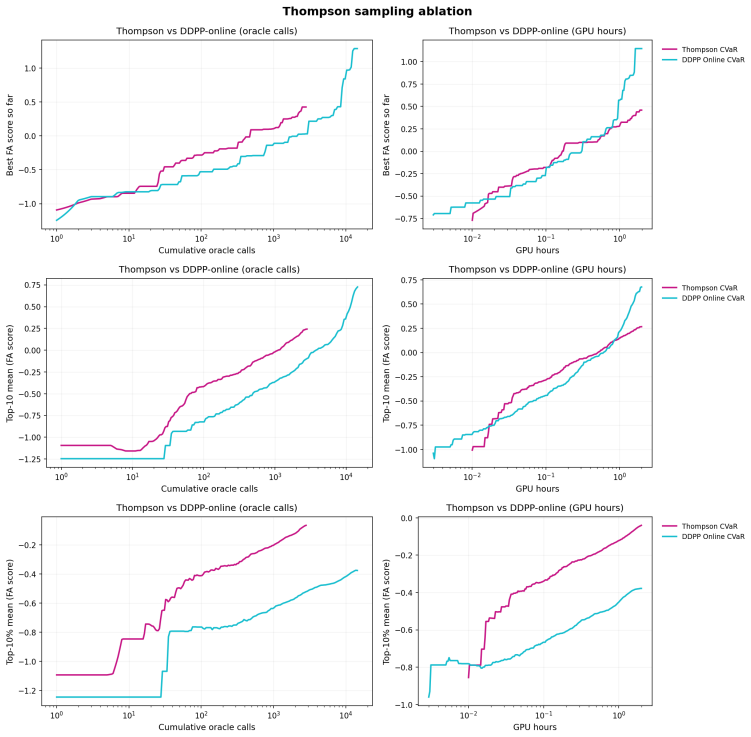
Inside a full online adaptation loop for discrete diffusion molecular generators, acquisition (Thompson sampling), CVaR reward shaping, and Density Entropy Regularization provide complementary routes to higher reward, while replay and invalid-output penalties act mainly as stabilizers; the resulting combined recipe outperforms offline fine-tuning and inference-time search under matched oracle and compute budgets, and the advantage is largest when high-reward candidates lie far from the pretrained prior.
What carries the argument
The online active-loop harness: each round samples candidates from the current discrete diffusion model, selects a batch via Thompson sampling over a reward-model ensemble, converts oracle scores into CVaR-shaped and density-debiased log-rewards (with an optional invalid-SMILES penalty), updates from a stratified replay buffer, and fine-tunes with a plug-in objective such as DDPP-LB or VIDD.
Load-bearing premise
The cheap single-pass likelihood estimate used for density-entropy debiasing is treated as a faithful enough proxy for the intended model-density penalty that the observed off-prior shifts and reward gains can be attributed to true debiasing.
What would settle it
On a held-out small-molecule target where high-affinity ligands are known to lie far from the pretrained prior, replace the cheap single-pass density estimator with a multi-sample unbiased estimator throughout training and check whether the top-1 and top-10% reward curves and the final anchor-NLL shift still match the paper's reported gains; a collapse of either would undermine the claim that the cheap estimator is doing real debiasing.
Editorial analysis
A structured set of objections, weighed in public.
Referee Report
Summary. The paper studies online test-time adaptation of pretrained discrete diffusion generators for molecular optimization under fixed oracle and wall-clock budgets. It frames the loop as a finetuner-agnostic harness with five plug-in components—Thompson sampling acquisition, CVaR reward shaping, Density Entropy Regularization (model debiasing), replay, and invalid-output penalties—and runs controlled leave-one-out and multi-knob ablations with DDPP-LB and VIDD on six small-molecule binding-affinity tasks and three protein-fitness tasks. The main claim is that acquisition, CVaR, and debiasing provide complementary reward gains (especially on small molecules that require larger shifts from the prior), while replay and validity penalties stabilize exploration; the combined recipe outperforms offline fine-tuning and inference-time search under matched oracle-call and GPU-hour accounting. Supporting analyses include secondary validity/diversity/QED/SA metrics, anchor-NLL distribution shifts, compute breakdowns, and selected Boltz-2 re-runs.
Significance. If the empirical conclusions hold, this is a useful design-space map for a setting that is increasingly common: expensive oracles, pretrained discrete diffusion priors, and limited online feedback. The work’s strengths include dual finetuners, dual evaluation axes (oracle calls and GPU hours), leave-one-out plus multi-knob ablations, secondary manifold metrics, and public code/results. The domain contrast (broad small-molecule prior vs family-specific protein priors) is a clear, falsifiable organizing principle. The practical recipe is actionable even if some mechanistic attributions remain approximate. The contribution is primarily empirical and systems-level rather than a new theoretical guarantee, but that is appropriate for the stated question.
major comments (2)
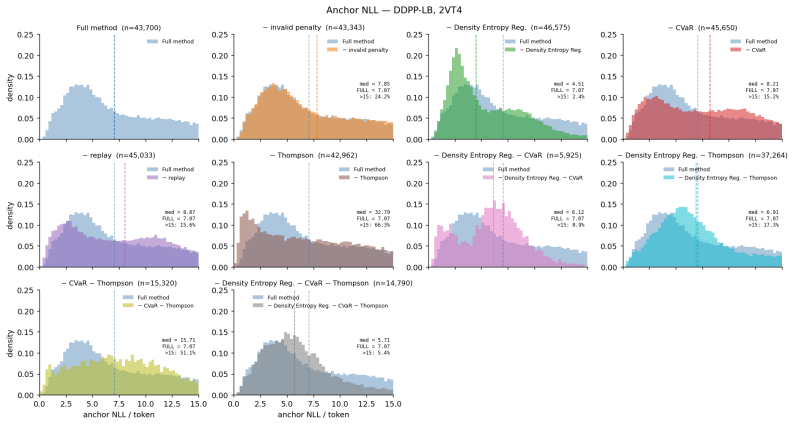
- [§2.2, Eq. (2); Figs. 5, 7, 35–36] §2.2 and Eq. (2): Density Entropy Regularization is implemented with a detached single-pass masked-token estimator log p_θ(x0|xt), which the paper correctly states is not equivalent to the continuous negative-score regularizer or the LLaDA-Alg. 3 ELBO. The central complementarity narrative (especially Fig. 5 and Fig. 7, where removing DER causes the largest small-molecule drop and the strongest prior collapse) attributes gains to mode debiasing. Supporting evidence is mainly post-hoc NLL histograms on FA/2VT4 (Figs. 35–36) and oracle-call curves vs LLaDA n_mc variants. That shows similar off-prior mass and efficiency, not that the online gradient direction matches the intended density penalty. Please either (i) run the leave-one-out / full-loop comparison with an unbiased (or higher-n_mc) estimator inside training on at least one small-molecule and one protein task, or (ii) substantially
- [Table 2; §B.7; Fig. 5] Table 2 and §B.7: free parameters (τ/q, γ, r_inv, M/K/G, ensemble size) are fixed at reference defaults without a systematic sensitivity study except for r_inv (Fig. 40). The claim that components “complement one another” rather than “work at these defaults” is load-bearing for the design-space conclusion. At minimum, report one-dimensional sweeps or a small grid for γ and the CVaR quantile on a representative small-molecule target (and note whether ordering of leave-one-out drops is stable). Without this, readers cannot separate knob identity from a lucky operating point, especially for DER where γ=1.0 is strong.
minor comments (6)
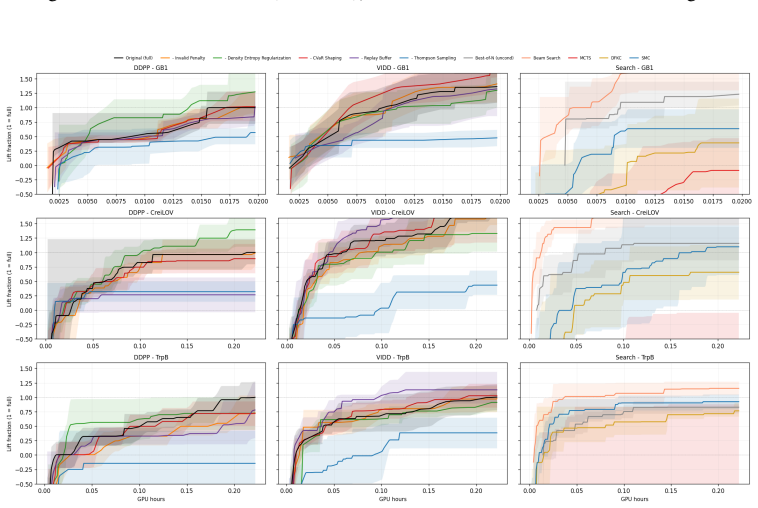
- [Eq. (3); Figs. 5–6] Eq. (3) / §B.1: normalized “lift” rescales by per-target min/max over the methods shown in each figure. This is fine for within-figure comparison but can inflate apparent gaps when the method set changes. State this limitation next to Fig. 5–6 and prefer raw reward panels (or a fixed reference set) in the appendix for absolute scale.
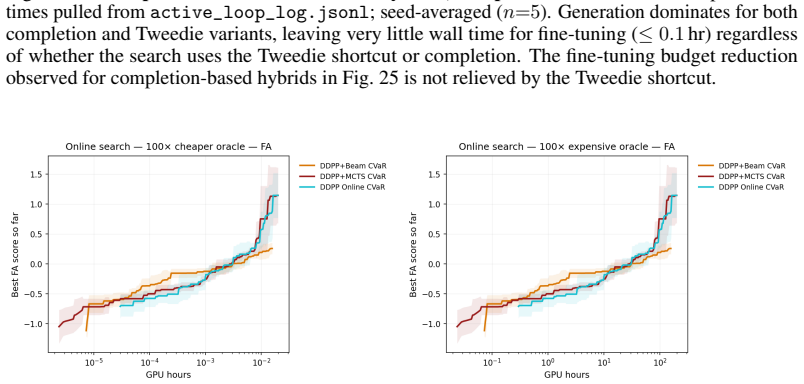
- [§4.1; Figs. 24–26] §4.1: inference-time search hybrids are argued to fail mainly because generation consumes the wall budget (Figs. 25–26). Consider one matched-gradient-step or matched-candidate-pool control so the conclusion is not solely compute-allocation dependent.
- [Abstract; Fig. 5; §5] Protein results are weaker and more acquisition-driven; the abstract and conclusion already note this, but Fig. 5’s pooled bars can still over-sell “complementary routes” as domain-general. A one-sentence domain-conditional summary in the abstract would help.
- [§2.2] Notation: logp vs log p, and the cheap estimator \logp, are easy to miss. Define the estimator once in a displayed equation and reuse a single symbol.
- [Throughout] Typos / polish: “intop θt+1”, “2VT4R” vs 2VT4, mixed “Density Entropy” / “model debiasing” naming, and occasional doubled words (“we find empirically that it… we find empirically”).
- [Appendices G, M] Appendix is very long relative to the main text; consider moving multi-knob and Boltz-2 highlights into the main body if space allows, since they support the transfer and complementarity claims.
Circularity Check
No significant circularity: empirical ablation study against external oracles and baselines; no derivation reduces to its inputs by construction.
full rationale
This paper is a controlled empirical design-space study of online fine-tuning loops for discrete diffusion molecular optimization. Its central claims are comparative performance results under matched oracle-call and GPU-hour budgets (full recipe vs. leave-one-out ablations, offline fine-tuning, and inference-time search), measured against external oracles (FlashAffinity, Boltz-2, family fitness surrogates) and pretrained generators. There is no first-principles derivation chain whose conclusion is forced by its premises. The composable knobs (Thompson acquisition, CVaR shaping, Density Entropy Regularization, replay, invalid penalty) are taken from prior literature and ablated; self-citations to coauthors (e.g., De Santi et al. on density-entropy / CVaR-style objectives) supply the component definitions but do not uniqueness-force the complementarity claim, which is established by leave-one-out reward and distribution-shift measurements. The cheap single-pass density estimator is an explicit computational approximation with post-hoc NLL checks, not a circular redefinition of the objective. Normalized reward (Eq. 3) rescales per-target scores to [0,1] using figure-specific min/max for cross-target averaging; this is standard presentation scaling and does not determine method rankings or invent the performance gains. The study is self-contained against external benchmarks. Score 0.
Axiom & Free-Parameter Ledger
free parameters (5)
- CVaR quantile τ (q) =
0.8
- Density-entropy weight γ =
1.0
- Invalid-SMILES penalty r_inv =
−5
- Active-loop sizes M, K, G and buffer capacity =
M=1000, K=25, G=50, buffer=10000
- Thompson ensemble size J and architecture =
J=10, width=256
axioms (4)
- domain assumption Learned oracles (FlashAffinity primary; family fitness surrogates; selected Boltz-2 checks) are adequate proxies for ranking molecular quality under the design objective.
- ad hoc to paper The single-pass masked-token estimator log p_θ(x0|xt) is a usable stand-in for the intractable model density in Density Entropy Regularization.
- domain assumption Holding all non-ablated hyperparameters at shared defaults isolates the causal effect of each knob.
- domain assumption Top-1 / top-k reward under a fixed oracle budget is the right primary success criterion for molecular optimization.
invented entities (2)
-
Composable online-adaptation harness for discrete diffusion (five plug-in knobs + finetuner-agnostic loop)
no independent evidence
-
Cheap single-pass density estimator for discrete Density Entropy Regularization
no independent evidence
read the original abstract
Molecular optimization often starts from a pretrained generative model that captures a broad prior over valid molecular structures. At test time, however, the goal is not to sample from this prior, but to use a limited oracle budget to shift generation toward task-specific high-reward molecules. We study this adaptation problem for discrete diffusion models. Each online round couples several choices. The loop must decide which candidates to evaluate, how rewards become model updates, which feedback to reuse, and how far to move beyond the pretrained prior. These choices have mostly been studied in isolation, leaving open whether they complement one another, become redundant, or interfere inside a full online adaptation loop. We conduct controlled studies across six small-molecule binding-affinity tasks and three protein-fitness tasks. We find that acquisition, reward shaping, and model debiasing provide complementary routes to higher reward, especially for small molecules. Replay further stabilizes learning, while validity penalties keep small-molecule exploration on the valid molecular manifold. Together, these findings point to a practical recipe for feedback-efficient molecular optimization: online fine-tuning with acquisition, reward shaping, debiasing, replay, and validity control. This recipe outperforms offline fine-tuning and inference-time search baselines under matched oracle-call budgets and GPU-hour accounting. The gains are largest when high-reward candidates require larger shifts from the pretrained prior.
Figures










Reference graph
Works this paper leans on
-
[1]
GenMol: A Drug Discovery Generalist with Discrete Diffusion, January 2025
Seul Lee, Karsten Kreis, Srimukh Prasad Veccham, Meng Liu, Danny Reidenbach, Yuxing Peng, Saee Paliwal, Weili Nie, and Arash Vahdat. GenMol: A Drug Discovery Generalist with Discrete Diffusion, January 2025. URL http://arxiv.org/abs/2501.06158. arXiv:2501.06158 [cs]
Pith/arXiv arXiv 2025
-
[2]
de Almeida, Alexander Rush, Thomas Pierrot, and V olodymyr Kuleshov
Yair Schiff, Subham Sekhar Sahoo, Hao Phung, Guanghan Wang, Sam Boshar, Hugo Dalla- torre, Bernardo P. de Almeida, Alexander Rush, Thomas Pierrot, and V olodymyr Kuleshov. Simple Guidance Mechanisms for Discrete Diffusion Models. InThirteenth International Conference on Learning Representations, 2025. doi: 10.48550/arXiv.2412.10193. URL http://arxiv.org/a...
-
[3]
Diffusion Language Models Are Versatile Protein Learners
Xinyou Wang, Zaixiang Zheng, Fei Ye, Dongyu Xue, Shujian Huang, and Quanquan Gu. Diffusion Language Models Are Versatile Protein Learners. InProceedings of the 41st In- ternational Conference on Machine Learning, pages 52309 – 52333, February 2024. doi: 10.1126/sciadv.adj3786. URL http://arxiv.org/abs/2402.18567. arXiv:2402.18567 [cs, q-bio]
-
[4]
Songlin Jiang, Yifan Chen, Ze Cao, and Wengong Jin. FlashAffinity: Bridging the Accuracy- Speed Gap in Protein-Ligand Binding Affinity Prediction.bioRxiv, 2025. doi: 10.64898/ 2025.12.22.695983. URL https://www.biorxiv.org/content/10.64898/2025.12.22. 695983v1. bioRxiv preprint, December 2025
-
[5]
Boltz-2: Towards accurate and efficient binding affinity prediction.bioRxiv, 2025
Saro Passaro, Gabriele Corso, Jeremy Wohlwend, Mateo Reveiz, Stephan Thaler, Vignesh Ram Somnath, Noah Getz, Tally Portnoi, Julien Roy, Hannes Stark, David Kwabi-Addo, Dominique Beaini, Tommi Jaakkola, and Regina Barzilay. Boltz-2: Towards accurate and efficient binding affinity prediction.bioRxiv, 2025. doi: 10.1101/2025.06.14.659707. URL https://www. bi...
-
[6]
Cambridge University Press, 2020
Tor Lattimore and Csaba Szepesvári.Bandit Algorithms. Cambridge University Press, 2020. doi: 10.1017/9781108571401
-
[7]
Con- strained molecular generation via sequential flow model fine-tuning
Sven Gutjahr, Riccardo De Santi, Luca Schaufelberger, Kjell Jorner, and Andreas Krause. Con- strained molecular generation via sequential flow model fine-tuning. InICML 2025 Generative AI and Biology (GenBio) Workshop, 2025
2025
-
[8]
How artificial intelligence is reengineering protein engi- neering.Science, April 2026
Jennifer Listgarten and Hanlun Jiang. How artificial intelligence is reengineering protein engi- neering.Science, April 2026. doi: 10.1126/science.aec8444. URL https://www.science. org/doi/10.1126/science.aec8444
-
[9]
Masatoshi Uehara, Yulai Zhao, Chenyu Wang, Xiner Li, Aviv Regev, Sergey Levine, and Tommaso Biancalani. Inference-Time Alignment in Diffusion Models with Reward-Guided Generation: Tutorial and Review, January 2025. URL http://arxiv.org/abs/2501.09685. arXiv:2501.09685 [cs]
Pith/arXiv arXiv 2025
-
[10]
Jason Yang, Wenda Chu, Daniel Khalil, Raul Astudillo, Bruce J. Wittmann, Frances H. Arnold, and Yisong Yue. Steering Generative Models with Experimental Data for Protein Fitness Optimization. InAdvances in Neural Information Processing Systems, May 2025. doi: https: //doi.org/10.48550/arXiv.2505.15093. URLhttp://arxiv.org/abs/2505.15093
-
[11]
Guiding Generative Models for Protein Design: Prompting, Steering and Aligning, November 2025
Filippo Stocco, Michele Garibbo, and Noelia Ferruz. Guiding Generative Models for Protein Design: Prompting, Steering and Aligning, November 2025. URL http://arxiv.org/abs/ 2511.21476. arXiv:2511.21476 [q-bio]
arXiv 2025
-
[12]
Tseng, Sergey Levine, and Tommaso Biancalani
Masatoshi Uehara, Yulai Zhao, Kevin Black, Ehsan Hajiramezanali, Gabriele Scalia, Nathaniel Lee Diamant, Alex M. Tseng, Sergey Levine, and Tommaso Biancalani. Feed- back Efficient Online Fine-Tuning of Diffusion Models, July 2024. URL http://arxiv.org/ abs/2402.16359. arXiv:2402.16359 [cs]
Pith/arXiv arXiv 2024
-
[13]
Jarrid Rector-Brooks, Mohsin Hasan, Zhangzhi Peng, Zachary Quinn, Chenghao Liu, Sarthak Mittal, Nouha Dziri, Michael Bronstein, Yoshua Bengio, Pranam Chatterjee, Alexander Tong, and Avishek Joey Bose. Steering Masked Discrete Diffusion Models via Discrete 10 Denoising Posterior Prediction, October 2024. URL http://arxiv.org/abs/2410.08134. arXiv:2410.08134 [cs]
Pith/arXiv arXiv 2024
-
[14]
Xingyu Su, Xiner Li, Masatoshi Uehara, Sunwoo Kim, Yulai Zhao, Gabriele Scalia, Ehsan Hajiramezanali, Tommaso Biancalani, Degui Zhi, and Shuiwang Ji. Iterative Distillation for Reward-Guided Fine-Tuning of Diffusion Models in Biomolecular Design, August 2025. URL http://arxiv.org/abs/2507.00445. arXiv:2507.00445 [cs]
arXiv 2025
-
[15]
Masatoshi Uehara, Xingyu Su, Yulai Zhao, Xiner Li, Aviv Regev, Shuiwang Ji, Sergey Levine, and Tommaso Biancalani. Reward-Guided Iterative Refinement in Diffusion Models at Test- Time with Applications to Protein and DNA Design, February 2025. URL http://arxiv. org/abs/2502.14944. arXiv:2502.14944 [q-bio]
Pith/arXiv arXiv 2025
-
[16]
Guiding Generative Protein Language Models with Reinforcement Learning
Filippo Stocco, Maria Artigues-Lleixà, Andrea Hunklinger, Talal Widatalla, Marc Güell, and Noelia Ferruz. Guiding Generative Protein Language Models with Reinforcement Learning. arXiv, 2025. doi: https://doi.org/10.48550/arXiv.2412.12979. URL http://arxiv.org/abs/ 2412.12979
-
[17]
CAGenMol: Condition-Aware Diffusion Language Model for Goal-Directed Molecular Generation, April
Yanting Li, Zhuoyang Jiang, Enyan Dai, Lei Wang, Wen-Cai Ye, and Li Liu. CAGenMol: Condition-Aware Diffusion Language Model for Goal-Directed Molecular Generation, April
- [18]
-
[19]
Molecular De Novo Design through Deep Reinforcement Learning, August 2017
Marcus Olivecrona, Thomas Blaschke, Ola Engkvist, and Hongming Chen. Molecular De Novo Design through Deep Reinforcement Learning, August 2017. URL http://arxiv.org/abs/ 1704.07555. arXiv:1704.07555 [cs]
Pith/arXiv arXiv 2017
-
[20]
Nathaniel Blalock, Srinath Seshadri, Agrim Babber, Sarah Fahlberg, and Philip Romero. Functional Alignment of Protein Language Models via Reinforcement Learning with Ex- perimental Feedback.bioRxiv, 2025. doi: https://doi.org/10.1101/2025.05.02.651993. URL https://www.biorxiv.org/content/10.1101/2025.05.02.651993
-
[21]
Riccardo De Santi, Marin Vlastelica, and Ya-Ping Hsieh. Flow Density Control: Generative Optimization Beyond Entropy-Regularized Fine-Tuning.Advances in Neural Information Processing Systems (NeurIPS 2025), 2025. doi: 10.48550/arXiv.2511.22640. URL http: //arxiv.org/abs/2511.22640. arXiv:2511.22640 [cs]
-
[22]
Zifan Wang, Riccardo De Santi, Xiaoyu Mo, Michael M Zavlanos, Andreas Krause, and Karl H Johansson. Efficient tail-aware generative optimization via flow model fine-tuning.arXiv preprint arXiv:2602.16796, 2026
arXiv 2026
-
[23]
Provable maximum entropy manifold exploration via diffusion models
Riccardo De Santi*, Marin Vlastelica*, Ya-Ping Hsieh, Zebang Shen, Niao He, and Andreas Krause. Provable maximum entropy manifold exploration via diffusion models. InProc. International Conference on Machine Learning (ICML), June 2025
2025
-
[24]
Verifier- Constrained Flow Expansion for Discovery Beyond the Data, February 2026
Riccardo De Santi, Kimon Protopapas, Ya-Ping Hsieh, and Andreas Krause. Verifier- Constrained Flow Expansion for Discovery Beyond the Data, February 2026. URL http: //arxiv.org/abs/2602.15984. arXiv:2602.15984 [cs]
arXiv 2026
-
[25]
William R. Thompson. On the likelihood that one unknown probability exceeds another in view of the evidence of two samples.Biometrika, 25(3-4):285–294, 1933. doi: 10.1093/biomet/25. 3-4.285
-
[26]
An empirical evaluation of Thompson sampling
Olivier Chapelle and Lihong Li. An empirical evaluation of Thompson sampling. InAdvances in Neural Information Processing Systems 24 (NeurIPS), pages 2249–2257, 2011. URL https:// papers.nips.cc/paper/4321-an-empirical-evaluation-of-thompson-sampling
2011
-
[27]
V olodymyr Mnih, Koray Kavukcuoglu, David Silver, Andrei A. Rusu, Joel Veness, Marc G. Bellemare, Alex Graves, Martin Riedmiller, Andreas K. Fidjeland, Georg Ostrovski, Stig Pe- tersen, Charles Beattie, Amir Sadik, Ioannis Antonoglou, Helen King, Dharshan Kumaran, Daan Wierstra, Shane Legg, and Demis Hassabis. Human-level control through deep reinforcemen...
-
[28]
Chenyu Wang, Masatoshi Uehara, Yichun He, Amy Wang, Tommaso Biancalani, Avantika Lal, Tommi Jaakkola, Sergey Levine, Hanchen Wang, and Aviv Regev. Fine-Tuning Discrete Diffusion Models via Reward Optimization with Applications to DNA and Protein Design, October 2024. URLhttp://arxiv.org/abs/2410.13643. arXiv:2410.13643 [cs]
Pith/arXiv arXiv 2024
-
[29]
Masatoshi Uehara, Yulai Zhao, Kevin Black, Ehsan Hajiramezanali, Gabriele Scalia, Nathaniel L. Diamant, Alex M. Tseng, Tommaso Biancalani, and Sergey Levine. Fine-tuning of continuous- time diffusion models as entropy-regularized control, 2024. URL https://arxiv.org/abs/ 2402.15194
Pith/arXiv arXiv 2024
-
[30]
A tutorial on Thompson sampling.F oundations and Trends in Machine Learning, 11(1):1–96, 2018
Daniel Russo, Benjamin Van Roy, Abbas Kazerouni, Ian Osband, and Zheng Wen. A tutorial on Thompson sampling.F oundations and Trends in Machine Learning, 11(1):1–96, 2018. doi: 10.1561/2200000070. URLhttps://arxiv.org/abs/1707.02038
-
[31]
Tyrrell Rockafellar and Stanislav Uryasev
R. Tyrrell Rockafellar and Stanislav Uryasev. Optimization of conditional value-at-risk.Journal of Risk, 2(3):21–41, 2000. doi: 10.21314/JOR.2000.038
-
[32]
Tyrrell Rockafellar and Stanislav Uryasev
R. Tyrrell Rockafellar and Stanislav Uryasev. Conditional value-at-risk for general loss distribu- tions.Journal of Banking and Finance, 26(7):1443–1471, 2002. doi: 10.1016/S0378-4266(02) 00271-6
-
[33]
Large language diffusion models.arXiv preprint arXiv:2502.09992, 2025
Shen Nie, Fengqi Zhu, Zebin You, Xiaolu Zhang, Jingyang Ou, Jun Hu, Jun Zhou, Yankai Lin, Ji-Rong Wen, and Chongxuan Li. Large language diffusion models.arXiv preprint arXiv:2502.09992, 2025
Pith/arXiv arXiv 2025
-
[34]
Prioritized experience replay
Tom Schaul, John Quan, Ioannis Antonoglou, and David Silver. Prioritized experience replay. InInternational Conference on Learning Representations (ICLR), 2016
2016
-
[35]
RDKit: Open-source cheminformatics software
Greg Landrum and RDKit Contributors. RDKit: Open-source cheminformatics software. https://www.rdkit.org, 2024. Software release; canonical Zenodo DOI: https://doi. org/10.5281/zenodo.10099869
-
[36]
ODesign: A World Model for Biomolecular Interaction Design, October 2025
Odin Zhang, Xujun Zhang, Haitao Lin, Cheng Tan, Qinghan Wang, Yuanle Mo, Qiantai Feng, Gang Du, Yuntao Yu, Zichang Jin, Ziyi You, Peicong Lin, Yijie Zhang, Yuyang Tao, Shicheng Chen, Jack Xiaoyu Chen, Chenqing Hua, Weibo Zhao, Runze Ma, Yunpeng Xia, Kejun Ying, Jun Li, Yundian Zeng, Lijun Lang, Peichen Pan, Hanqun Cao, Zihao Song, Bo Qiang, Jiaqi Wang, Pe...
arXiv 2025
-
[37]
Cheng Zeng, Jirui Jin, Connor Ambrose, George Karypis, Mark Transtrum, Ellad B. Tadmor, Richard G. Hennig, Adrian Roitberg, Stefano Martiniani, and Mingjie Liu. PropMolFlow: property-guided molecule generation with geometry-complete flow matching.Nature Computa- tional Science, pages 1–10, January 2026. ISSN 2662-8457. doi: 10.1038/s43588-025-00946-y. URL...
-
[38]
Structure-based Drug Design with Equivariant Diffusion Models, October 2022
Arne Schneuing, Yuanqi Du, Charles Harris, Arian Jamasb, Ilia Igashov, Weitao Du, Tom Blundell, Pietro Lió, Carla Gomes, Max Welling, Michael Bronstein, and Bruno Correia. Structure-based Drug Design with Equivariant Diffusion Models, October 2022. URL http: //arxiv.org/abs/2210.13695. arXiv:2210.13695 [cs, q-bio]
Pith/arXiv arXiv 2022
-
[39]
3D Equivariant Diffusion for Target-Aware Molecule Generation and Affinity Prediction, March
Jiaqi Guan, Wesley Wei Qian, Xingang Peng, Yufeng Su, Jian Peng, and Jianzhu Ma. 3D Equivariant Diffusion for Target-Aware Molecule Generation and Affinity Prediction, March
-
[40]
URLhttp://arxiv.org/abs/2303.03543. arXiv:2303.03543 [q-bio]
-
[41]
Batey, Mike Tyers, Michał Koziarski, and Cheng-Hao Liu
Andrei Rekesh, Miruna Cretu, Dmytro Shevchuk, Vignesh Ram Somnath, Pietro Liò, Robert A. Batey, Mike Tyers, Michał Koziarski, and Cheng-Hao Liu. SynCoGen: Synthesizable 3D Molecule Generation via Joint Reaction and Coordinate Modeling, July 2025. URL http: //arxiv.org/abs/2507.11818. arXiv:2507.11818 [cs]
arXiv 2025
-
[42]
Keir Adams, Kento Abeywardane, Jenna Fromer, and Connor W. Coley. ShEPhERD: Diffusing shape, electrostatics, and pharmacophores for bioisosteric drug design, March 2025. URL http://arxiv.org/abs/2411.04130. arXiv:2411.04130 [q-bio]. 12
Pith/arXiv arXiv 2025
-
[44]
Dávid Bajusz, Anita Rácz, and Károly Héberger. Why is tanimoto index an appropriate choice for fingerprint-based similarity calculations?Journal of Cheminformatics, 7:20, 2015. doi: 10.1186/s13321-015-0069-3
-
[45]
Richard Bickerton, Gaia V
G. Richard Bickerton, Gaia V . Paolini, Jeremy Besnard, Sorel Muresan, and Andrew L. Hopkins. Quantifying the chemical beauty of drugs.Nature Chemistry, 4(2):90–98, 2012. doi: 10.1038/ nchem.1243
2012
-
[46]
Peter Ertl and Ansgar Schuffenhauer. Estimation of synthetic accessibility score of drug-like molecules based on molecular complexity and fragment contributions.Journal of Cheminfor- matics, 1:8, 2009. doi: 10.1186/1758-2946-1-8
-
[47]
Test-time scaling of diffusion models via noise trajectory search, 2025
Vinith Ramesh et al. Test-time scaling of diffusion models via noise trajectory search, 2025. URLhttps://arxiv.org/abs/2506.03164
Pith/arXiv arXiv 2025
-
[48]
TR2-D2: Tree Search Guided Trajectory-Aware Fine-Tuning for Discrete Diffusion, September 2025
Sophia Tang, Yuchen Zhu, Molei Tao, and Pranam Chatterjee. TR2-D2: Tree Search Guided Trajectory-Aware Fine-Tuning for Discrete Diffusion, September 2025. URL http://arxiv. org/abs/2509.25171. arXiv:2509.25171 [cs]
arXiv 2025
-
[49]
Discrete Feynman-Kac Correctors, January
Mohsin Hasan, Viktor Ohanesian, Artem Gazizov, Yoshua Bengio, Alán Aspuru-Guzik, Roberto Bondesan, Marta Skreta, and Kirill Neklyudov. Discrete Feynman-Kac Correctors, January
- [50]
-
[51]
Feynman-Kac Correctors in Diffusion: Annealing, Guidance, and Product of Experts, June 2025
Marta Skreta, Tara Akhound-Sadegh, Viktor Ohanesian, Roberto Bondesan, Alán Aspuru- Guzik, Arnaud Doucet, Rob Brekelmans, Alexander Tong, and Kirill Neklyudov. Feynman-Kac Correctors in Diffusion: Annealing, Guidance, and Product of Experts, June 2025. URL http://arxiv.org/abs/2503.02819. arXiv:2503.02819 [cs]
Pith/arXiv arXiv 2025
-
[52]
Bronstein, Martin Steinegger, Emine Kucukbenli, Arash Vahdat, and Karsten Kreis
Kieran Didi, Zuobai Zhang, Guoqing Zhou, Danny Reidenbach, Zhonglin Cao, Sooyoung Cha, Tomas Geffner, Christian Dallago, Jian Tang, Michael M. Bronstein, Martin Steinegger, Emine Kucukbenli, Arash Vahdat, and Karsten Kreis. Scaling atomistic protein binder design with generative pretraining and test-time compute. InThe F ourteenth International Conference...
2026
-
[53]
A General Framework for Inference-time Scaling and Steering of Diffu- sion Models, January 2025
Raghav Singhal, Zachary Horvitz, Ryan Teehan, Mengye Ren, Zhou Yu, Kathleen McKeown, and Rajesh Ranganath. A General Framework for Inference-time Scaling and Steering of Diffu- sion Models, January 2025. URL http://arxiv.org/abs/2501.06848. arXiv:2501.06848 [cs]
Pith/arXiv arXiv 2025
-
[54]
Xiner Li, Yulai Zhao, Chenyu Wang, Gabriele Scalia, Gokcen Eraslan, Surag Nair, Tommaso Biancalani, Aviv Regev, Sergey Levine, and Masatoshi Uehara. Derivative-Free Guidance in Continuous and Discrete Diffusion Models with Soft Value-Based Decoding, October 2024. URLhttp://arxiv.org/abs/2408.08252. arXiv:2408.08252 [cs]
Pith/arXiv arXiv 2024
-
[55]
Unlocking Guidance for Discrete State-Space Diffusion and Flow Models
Hunter Nisonoff, Junhao Xiong, Stephan Allenspach, and Jennifer Listgarten. Unlocking Guidance for Discrete State-Space Diffusion and Flow Models. In13th International Conference on Learning Representations, 2025. doi: https://doi.org/10.48550/arXiv.2406.01572. URL http://arxiv.org/abs/2406.01572. arXiv:2406.01572 [cs]
-
[56]
Frey, Tim G
Nate Gruver, Samuel Stanton, Nathan C. Frey, Tim G. J. Rudner, Isidro Hotzel, Julien Lafrance- Vanasse, Arvind Rajpal, Kyunghyun Cho, and Andrew Gordon Wilson. Protein Design with Guided Discrete Diffusion. InAdvances in Neural Information Processing Systems 36, May
-
[57]
doi: https://doi.org/10.48550/arXiv.2305.20009. URL http://arxiv.org/abs/2305. 20009. arXiv:2305.20009 [cs, q-bio]
-
[58]
Junhao Xiong, Ishan Gaur, Maria Lukarska, Hunter Nisonoff, Luke M. Oltrogge, David F. Savage, and Jennifer Listgarten. ProteinGuide: On-the-fly property guidance for protein sequence generative models, January 2026. URL http://arxiv.org/abs/2505.04823. arXiv:2505.04823 [cs]. 13
arXiv 2026
-
[59]
Gao, and Wing Hung Wong
Wenhui Sophia Lu, Xiaowei Zhang, Luis Santiago Mille-Fragoso, Haoyu Dai, Xiaojing J. Gao, and Wing Hung Wong. ProV ADA: Generation of Subcellular Protein Variants via Ensemble- Guided Test-Time Steering, July 2025. URL https://www.biorxiv.org/content/10. 1101/2025.07.11.664238v1. ISSN: 2692-8205 Pages: 2025.07.11.664238 Section: New Results
2025
-
[60]
Dynamic Search for Inference-Time Alignment in Diffusion Models, June 2025
Xiner Li, Masatoshi Uehara, Xingyu Su, Gabriele Scalia, Tommaso Biancalani, Aviv Regev, Sergey Levine, and Shuiwang Ji. Dynamic Search for Inference-Time Alignment in Diffusion Models, June 2025. URLhttp://arxiv.org/abs/2503.02039. arXiv:2503.02039 [cs]
Pith/arXiv arXiv 2025
-
[61]
Yue Jian, Curtis Wu, Danny Reidenbach, and Aditi S. Krishnapriyan. General Binding Affinity Guidance for Diffusion Models in Structure-Based Drug Design.Journal of Chemical Infor- mation and Modeling, 66(3):1342–1352, February 2026. ISSN 1549-9596, 1549-960X. doi: 10.1021/acs.jcim.5c01166. URL http://arxiv.org/abs/2406.16821. arXiv:2406.16821 [cs]
-
[62]
Hit and Lead Discovery with Explorative RL and Fragment-based Molecule Generation
Soojung Yang, Doyeong Hwang, Seul Lee, Seongok Ryu, and Sung Ju Hwang. Hit and Lead Discovery with Explorative RL and Fragment-based Molecule Generation.Advances in Neural Information Processing Systems 34 (NeurIPS 2021), 2021. doi: 10.48550/arXiv.2110.01219. URLhttp://arxiv.org/abs/2110.01219. arXiv:2110.01219 [cs]
work page internal anchor Pith review Pith/arXiv arXiv doi:10.48550/arxiv.2110.01219 2021
-
[63]
Sophia Tang, Yinuo Zhang, and Pranam Chatterjee. PepTune: De Novo Generation of Ther- apeutic Peptides with Multi-Objective-Guided Discrete Diffusion, December 2024. URL http://arxiv.org/abs/2412.17780. arXiv:2412.17780 [q-bio]
Pith/arXiv arXiv 2024
-
[64]
Emmanuel Noutahi, Cristian Gabellini, Michael Craig, Jonathan S. C. Lim, and Prudencio Tossou. Gotta be SAFE: A New Framework for Molecular Design, December 2023. URL http://arxiv.org/abs/2310.10773. arXiv:2310.10773 [cs]
Pith/arXiv arXiv 2023
-
[65]
Rush, Yair Schiff, Justin T
Subham Sekhar Sahoo, Marianne Arriola, Aaron Gokaslan, Edgar Mariano Marroquin, Alexan- der M. Rush, Yair Schiff, Justin T. Chiu, and V olodymyr Kuleshov. Simple and effective masked diffusion language models. InAdvances in Neural Information Processing Systems (NeurIPS),
-
[66]
URLhttps://arxiv.org/abs/2406.07524
-
[67]
Bradley Efron. Tweedie’s formula and selection bias.Journal of the American Statistical Association, 106(496):1602–1614, 2011. doi: 10.1198/jasa.2011.tm11181
-
[68]
Hyungjin Chung, Jeongsol Kim, Michael T. McCann, Marc L. Klasky, and Jong Chul Ye. Diffusion posterior sampling for general noisy inverse problems. InInternational Conference on Learning Representations (ICLR), 2023. URLhttps://arxiv.org/abs/2209.14687. 14 A Declaration of LLM Usage LLMs were used to write code, interpret results, assist with writing, and...
Pith/arXiv arXiv 2023
discussion (0)
Sign in with ORCID, Apple, or X to comment. Anyone can read and Pith papers without signing in.