REVIEW 5 major objections 6 minor 12 references
EEG emotion models can be made readable by turning neural signals into identity-free facial emojis, and the same training also lifts EEG-only accuracy.
Reviewed by Pith at T0; open to challenge. T0 means a machine referee read the full paper against a public rubric. the ladder, T0–T4 →
EEG can be mapped to identity-anonymized facial emojis that act as a semantic regularizer, yielding SOTA EEG-only emotion accuracy and human-interpretable animations.
T0 review reviewed 2026-07-12 challenge →
load-bearing objection Solid multi-task EEG–emoji system that delivers real accuracy gains and a usable privacy-preserving visualization; the “brain’s emotional evolution” framing is stronger than the motor-proxy evidence fully supports. the 5 major comments →
See the Emotion: A Facial Emoji Proxy Modeling for EEG Emotion Recognition
The pith
A machine-rendered reading of the paper's core claim, the machinery that carries it, and where it could break.
The reading
Core claim
Facial Emoji Proxy Modeling—pairing an expression-aware EEG backbone (FMENet) with a frozen emoji decoder (FELB)—turns EEG-to-emoji reconstruction into a semantic regularizer that simultaneously raises EEG-only emotion accuracy to state-of-the-art levels and yields identity-anonymized facial animations that let a user watch the emotion unfold directly from neural signals.
What carries the argument
Facial Emoji Learning Branch (FELB): a multi-task head that projects EEG features into a pre-trained emoji VAE latent space, reconstructs binary facial landmarks, and feeds the latent code back into the emotion classifier so that classification is conditioned on the behavioral manifold.
Load-bearing premise
The paper assumes that the coupling between EEG patterns and facial muscle geometry is strong and stable enough that emoji reconstruction both regularizes the emotion classifier and faithfully visualizes the brain’s emotional evolution rather than merely a correlated motor proxy.
What would settle it
On a held-out subject set, mask the motor-cortex and prefrontal channels that the model’s own attention highlights; if emoji reconstruction quality and human-readable emotion accuracy collapse while classification accuracy stays high, the claimed neural–facial semantic bridge is broken.
Editorial analysis
A structured set of objections, weighed in public.
Referee Report
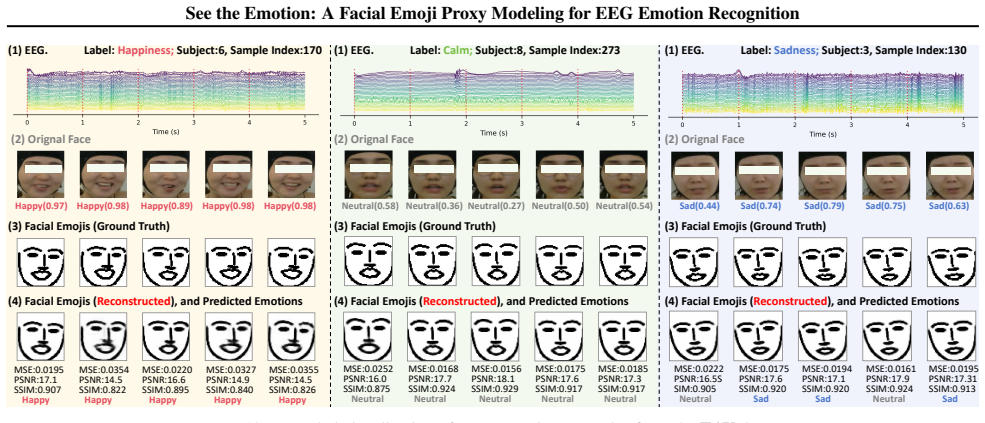
Summary. The paper proposes Facial Emoji Proxy Modeling for EEG emotion recognition: an EEG encoder (FMENet: Expression-Relevant Spatial Merger + Multi-Scale Temporal Capturer) is trained multi-task with a Facial Emoji Learning Branch (FELB) that maps EEG to a frozen VAE latent space of identity-anonymized binary facial-landmark emojis. At inference only EEG is used, yielding both an emotion label and a dynamic emoji sequence. On EAV the full model reports 77.13% accuracy / 77.02% F1 (EEG-only inference), competitive with multimodal baselines; on MMER it reports 69.73% / 64.28%. Ablations, backbone compatibility, reconstruction metrics (SSIM ≈0.91 on EAV), a small user study (n=10, 76% 5-way), region-masking, and zero-shot transfer to SEED (~60% 3-way via an emoji ResNet) are provided. The central claim is that emoji reconstruction is both a semantic regularizer that improves EEG-only accuracy and a privacy-preserving visualization of the brain’s emotional evolution.
Significance. If the accuracy and reconstruction results hold under broader scrutiny, the work offers a useful paradigm shift for EEG interpretability: from saliency maps to identity-stripped behavioral proxies that non-experts can read. Strengths include a clear multi-stage training recipe (Algorithm 1), extensive backbone comparisons (Tables 1–2, 6–7), architectural ablations (Table 3), hyperparameter grids (Tables 9–10), efficiency numbers (Tables 11–12), cross-subject splits (Table 8), a user study, zero-shot SEED transfer, and an unusually thorough ethics appendix. Code is promised. The privacy-by-design emoji abstraction is a genuine practical contribution for affective BCI. The significance is therefore real for affective computing and explainable BCI, provided the authors carefully bound what the emojis actually visualize (facial-motor geometry correlated with labels, not a direct readout of subjective affect).
major comments (5)
- [§1, abstract, §4.7, Fig. 4, Tab. 5, §5] The load-bearing interpretability claim—that generated emojis give a “transparent window into the brain’s emotional evolution” (abstract, §1, §5)—is stronger than the evidence. Fig. 4 and Table 5 show ESM attention and SSIM drops concentrated on motor cortex for mouth-corner actions and prefrontal for brow-related negatives; this is consistent with decoding expression-related motor/premotor patterns that co-vary with emotion labels, not necessarily internal affective state. Frame-level Emo. Acc. (Table 4) and the user study (Fig. 5) evaluate face-derived geometry with face-trained classifiers/humans. Please reframe claims throughout as privacy-preserving EEG→facial-geometry visualization that is emotion-consistent, and discuss the motor-proxy alternative explicitly (e.g., in §4.7 and §5).
- [§4.2–4.3, Tab. 4, App. E, Eq. 5] Semantic-fidelity evaluation is partially circular. Training uses synchronized face video to supervise emoji reconstruction (Eq. 5, FELB); “Emo. Acc.” then scores reconstructed emojis with a ResNet-18 trained on the same emoji corpus against frame-level pseudo-labels from an external face emotion model (§4.2–4.3, App. E, Tabs. 14–15). Emotion classification itself uses video-level labels and is not circular, but the claim of “semantically faithful” visualization is. Report at least one face-independent check (e.g., correlation of emoji trajectories with EEG spectral markers known a priori, or human ratings against video-level labels only) and state clearly that Emo. Acc. measures geometric–label consistency, not independent affective ground truth.
- [§4.5, Tab. 1, Tab. 8, App. C.3] SOTA claims are driven by subject-dependent splits; cross-subject performance is much weaker and under-emphasized in the main narrative. Table 1 / FMENet+FELB: 77.13% Acc (subject-dependent EAV); Table 8 leave-subject-out: only 39.05% Acc / 38.17% F1 on EAV (and ~69% on the small MMER hold-out). Please put cross-subject numbers in the main results section, qualify “state-of-the-art among EEG-only models” as subject-dependent unless cross-subject SOTA is demonstrated, and discuss inter-subject variability (already visible in Tabs. 6–7).
- [§4.1, MMER protocol] MMER subject selection introduces selection bias that is not stress-tested. §4.1 retains only 14 of the available subjects with ≥95% landmark detection success. This favors easy-to-track faces and may inflate both reconstruction quality and multi-task gains. Provide results (or a sensitivity analysis) on a less filtered subject set, or at minimum report how many subjects/videos were excluded and whether accuracy/SSIM degrade when lower-quality landmarks are included.
- [Tab. 2, §4.6, Figs. 11–12, App. B/C.2] Table 2 shows that attaching FELB degrades accuracy for nearly every non-FMENet backbone (often by 1–3 points) while only FMENet gains slightly (76.96→77.13 on EAV). Combined with the video-level vs. frame-level label mismatch documented in Figs. 11–12 and App. B, this suggests the multi-task objective is fragile and architecture-specific rather than a general “semantic regularizer.” Please analyze when and why FELB helps vs. hurts (e.g., conflict between frame-level emoji dynamics and video-level labels), and temper language that presents FELB as a drop-in regularizer for arbitrary EEG encoders.
minor comments (6)
- [Tab. 3, §3.2.2] Notation inconsistency: Multi-Scale Temporal Capturer is MTC in §3.2.2 / Fig. 3 but “MEC module” in Table 3; unify.
- [Figs. 2, 8, 13–14; App. D] Typos / naming: “EA V” spacing throughout; “Clam” in Fig. 2; “Orignal Face” in Figs. 13–14; “incomprehensiblet” in Fig. 8 caption; “EV A” in App. D.
- [§4.7, Fig. 5] User study (n=10, Fig. 5) is useful but under-specified: report clip selection, inter-rater agreement, and whether participants saw ground-truth faces. Move key protocol details into the main text.
- [§4.8, App. D] SEED zero-shot uses a 28-channel common subset and a face-trained ResNet for scoring (App. D, Tab. 13). State channel mapping and evaluation protocol more clearly in the main §4.8 so readers do not over-read the ~60% figure.
- [§4.4, Tab. 10] λ grid (Tab. 10) and architectural ablations (Tab. 9) are thorough; a short sentence in §4.4 on why EAV prefers λ=5 and MMER λ=0.2 (active vs. passive elicitation) would help non-specialists.
- [§2.2] Related work on EEG–face coupling (Soleymani et al., Du et al.) is cited; a brief comparison to prior EEG-to-face or AU regression work would better position the emoji abstraction choice.
Circularity Check
No definitional circularity; mild partial dependence of semantic-fidelity metrics on face-derived emojis used only at training/eval, not for the EEG-only accuracy claim.
full rationale
This is an empirical multi-task ML paper, not a first-principles derivation. Emotion labels Y supervise L_cls independently of the emoji reconstruction branch (Eq. 5); FMENet+FELB accuracy (Tabs. 1–3, 6–8) is measured against those video-level labels under EEG-only inference and is therefore not forced by the face targets. Emoji reconstruction quality (MSE/PSNR/SSIM in Tab. 4) and Emo. Acc. are evaluated against ground-truth emojis / a ResNet trained on the same emoji corpus, which is the ordinary supervised reconstruction objective rather than a self-definitional loop or fitted-input-as-prediction. Frame-level pseudo-labels are explicitly withheld from training and model selection (§4.2, App. B). No uniqueness theorems, self-citation chains, or ansatz smuggling appear; related-work citations are external. The only mild circularity-adjacent element is rhetorical over-claim that generated emojis visualize “the brain’s emotional evolution” when the regularizer is facial-motor geometry; this does not reduce any reported number by construction. Score 1 reflects that single non-load-bearing evaluation dependence; central SOTA accuracy claim remains independent.
Axiom & Free-Parameter Ledger
free parameters (5)
- multi-task weight λ =
5 (EAV), 0.2 (MMER)
- spatial merger heads O =
8 / 6
- MTC depth K and dilation period D* =
K=5/3, D*=5
- emoji VAE latent dim L =
64 / 32
- emoji temporal interval Δt =
1.0 s / 0.5 s
axioms (3)
- domain assumption Affective states are systematically expressed in coordinated facial muscle activity that is partially decodable from EEG (neural–facial association).
- ad hoc to paper Binary landmark rasterizations (56×56) preserve expression geometry while removing identity.
- ad hoc to paper A frozen VAE decoder trained on all emojis supplies a stable behavioral manifold that EEG can be aligned to.
invented entities (3)
-
Facial Emoji Proxy
no independent evidence
-
FMENet (Expression-Relevant Spatial Merger + Multi-Scale Temporal Capturer)
no independent evidence
-
Facial Emoji Learning Branch (FELB)
no independent evidence
Cite this review
Pith. "Pith review of See the Emotion: A Facial Emoji Proxy Modeling for EEG Emotion Recognition." pith.science (2026). https://pith.science/paper/XZS5N5WM
@misc{pith2026260702912,
  author       = {Pith},
  title        = {Pith review of: See the Emotion: A Facial Emoji Proxy Modeling for EEG Emotion Recognition},
  year         = {2026},
  howpublished = {\url{https://pith.science/paper/XZS5N5WM}},
  note         = {Machine review of arXiv:2607.02912}
}
read the original abstract
Despite the high accuracy of EEG-based emotion recognition, existing models remain opaque "black boxes", lacking semantic grounding between abstract neural features and human-interpretable states. In this paper, we reframe EEG explainability as a cross-modal generation task, shifting the paradigm from feature attribution to behavioral visualization. We introduce Facial Emoji Proxy Modeling, a novel framework that translates high-dimensional EEG signals into identity-anonymized facial emojis. Guided by the neuroscientific inspiration of neural-facial association, this approach grounds neural representations in the manifold of observable facial dynamics. Technically, our framework integrates FMENet, a specialized backbone modeling expression-relevant spatial synergies, and the Facial Emoji Learning Branch (FELB), which treats emoji reconstruction as a structured semantic regularizer. Extensive experiments on EAV and MMER benchmarks demonstrate that our method achieves state-of-the-art accuracy among EEG-only models. Crucially, it generates semantically faithful facial animations that provide a transparent, privacy-preserving window into the brain's emotional evolution, effectively allowing users to "see the emotion" directly from neural signals. Code is available at https://github.com/xian-sh/SeeEmotion
Figures



Reference graph
Works this paper leans on
-
[1]
doi: 10.1109/TII.2022.3197419. Bouazizi, S. and Ltifi, H. Explainable grouped deep echo state network for eeg-based emotion recognition.Soft Computing, pp. 1–18,
-
[2]
Feng, L., Cheng, C., Zhao, M., Deng, H., and Zhang, Y
URL https://arxiv.org/abs/ 2404.08472. Feng, L., Cheng, C., Zhao, M., Deng, H., and Zhang, Y . Eeg-based emotion recognition using spatial-temporal graph convolutional lstm with attention mechanism.IEEE Journal of Biomedical and Health Informatics, 26(11): 5406–5417,
-
[3]
Kang, Z., Li, Y ., Gong, S., Zeng, W., Yan, H., Bian, L., Zhang, Z., Siok, W. T., and Wang, N. Hypergraph multi- modal learning for eeg-based emotion recognition in con- versation.arXiv preprint arXiv:2502.21154,
-
[4]
Lai-Tan, N., Gu, X., Philiastides, M
URL https://arxiv.org/ abs/1312.6114. Lai-Tan, N., Gu, X., Philiastides, M. G., and Deligianni, F. Cross-subject and cross-montage eeg transfer learning with individual tangent space alignment. InWomen in Machine Learning Workshop@ NeurIPS 2025,
Pith/arXiv arXiv 2025
-
[5]
doi: https://doi.org/10.1016/j.neuroimage.2023.120209
ISSN 1053-8119. doi: https://doi.org/10.1016/j.neuroimage.2023.120209. URL https://www.sciencedirect.com/ science/article/pii/S1053811923003609. Mohsan, M. M., Akram, M. U., Rasool, G., Alghamdi, N. S., Baqai, M. A. A., and Abbas, M. Vision transformer and language model based radiology report generation.IEEE Access, 11:1814–1824,
-
[6]
ISSN 1097-0193. doi: 10.1002/hbm.23730. URL http: //dx.doi.org/10.1002/hbm.23730. 10 See the Emotion: A Facial Emoji Proxy Modeling for EEG Emotion Recognition Scotti, P., Banerjee, A., Goode, J., Shabalin, S., Nguyen, A., Dempster, A., Verlinde, N., Yundler, E., Weisberg, D., Norman, K., et al. Reconstructing the mind’s eye: fmri- to-image with contrasti...
-
[7]
sub01_train_sample0_frame0
B.1.2. DATASTATISTICS ANDANNOTATION EA V Datasetcontains 42 subjects with balanced distribution across five emotion categories: Neutral, Anger, Happiness, Sadness, and Calmness. The original video-level emotion annotation distribution is shown in Fig. 11(a), demonstrating well-balanced class representation. After processing, we obtained approximately 400K...
2024
-
[8]
is a time series lightweight adaptive network that divides input sequences into patches and employs transformer-like architecture for temporal representation learning. 15 See the Emotion: A Facial Emoji Proxy Modeling for EEG Emotion Recognition Table 6.Supplement to Tab.2 in the main paper. Performance (%) of different backbones onEA Vdataset. Subject Sy...
arXiv 1953
-
[9]
Consistent with the default settings in § 4.4, the best-performing weights are λ=5 for EA V and λ=0.2 for MMER, respectively
The search is performed over a unified gridλ∈[0,10] for both datasets. Consistent with the default settings in § 4.4, the best-performing weights are λ=5 for EA V and λ=0.2 for MMER, respectively. Importantly, the performance curves exhibit broad plateaus (within3.5% relative variation) rather than sharp peaks, suggesting that FMENet is reasonably robust ...
2023
-
[10]
The introduced FELB module incurs negligible overhead (0.7K parameters and less than 0.001 GLOPS) and the 15.83 MB frozen V AE decoder only requires initialisation once offline
The computational cost of our model is within the acceptable range for practical deployment. The introduced FELB module incurs negligible overhead (0.7K parameters and less than 0.001 GLOPS) and the 15.83 MB frozen V AE decoder only requires initialisation once offline. On a single A5000 GPU, the end-to-end inference latency for producing both the emotion...
1983
-
[11]
in our generalisation experiments, to ensure compatibility between the EV A/MMER and SEED datasets. Taking the generalization validation from the EA V dataset to the SEED dataset as an example, we identified 28 electrodes that are physically shared between the two datasets based on the International 10–20 System (Lee et al., 2024; Zheng & Lu, 2015). The m...
2024
-
[12]
Table 14.Per-class Precision, Recall, and F1 of the ResNet-18 classifier on the EA V test set (126k frames)
These supplementary visualizations encompass a wider range of emotional states and subject variations, consistently showing high-quality emoji generation with semantically meaningful emotional labels. Table 14.Per-class Precision, Recall, and F1 of the ResNet-18 classifier on the EA V test set (126k frames). Class Support Precision Recall F1 Neutral 25,65...
1976
This paper was first reviewed by grok-4.5 on July 12, 2026.
discussion (0)
Sign in with ORCID, Apple, or X to comment. Anyone can read and Pith papers without signing in.