REVIEW 3 major objections 7 minor 67 references
CL-Anomaly keeps private LoRA experts isolated while layer-adaptive shared experts transfer anomaly knowledge, so one MLLM can keep learning new AD tasks without semantic entanglement.
Reviewed by Pith at T0; open to challenge. T0 means a machine referee read the full paper against a public rubric. the ladder, T0–T4 →
T0 review · grok-4.5
2026-07-12 06:01 UTC pith:DDB474QM
load-bearing objection Solid first cut at continual MLLM anomaly detection: isolation–sharing plus cheap layer-adaptive expert merge works, with one acknowledged routing soft spot. the 3 major comments →
CL-Anomaly: Layer-Adaptive Mixture-of-Experts with Multimodal Large Language Model for Continual Learning in Anomaly Detection
The pith
A machine-rendered reading of the paper's core claim, the machinery that carries it, and where it could break.
Core claim
An isolation-sharing dual-path MoE of LoRA experts, combined with zero-cost layer-wise key-expert selection and momentum merging, lets an MLLM continually learn anomaly detection tasks while preventing semantic entanglement and still enabling positive forward and backward knowledge transfer, outperforming prior PEFT continual-learning methods across class-incremental, cross-domain and cross-modal regimes.
What carries the argument
Layer-Adaptive Knowledge Transfer (LAKT): accumulate per-layer gating probabilities to identify the top-K key shared experts for the current task, partition experts into key-only-current, key-only-previous and rest, then apply a three-valued momentum coefficient so key knowledge is preferentially retained while non-key knowledge fades.
Load-bearing premise
At inference the correct private expert is chosen by cosine similarity between the input image’s visual anchor and stored task anchors; if that routing is wrong the isolation path fails.
What would settle it
Replace the visual-anchor router with an oracle that always activates only the true task’s PrivLoRA (or measure routing accuracy on a held-out set of visually similar but semantically different tasks) and check whether the reported Avg/Last/BWT gains collapse or remain.
If this is right
- A single frozen-backbone MLLM can be kept current on new product lines, medical imaging domains and 3D modalities without joint retraining or data replay.
- Class-incremental industrial inspection can improve previously learned categories as later categories are added (positive backward transfer).
- Cross-domain jumps (industrial o medical) and cross-modal jumps (2D o multi-view 3D) no longer force a choice between forgetting and isolation.
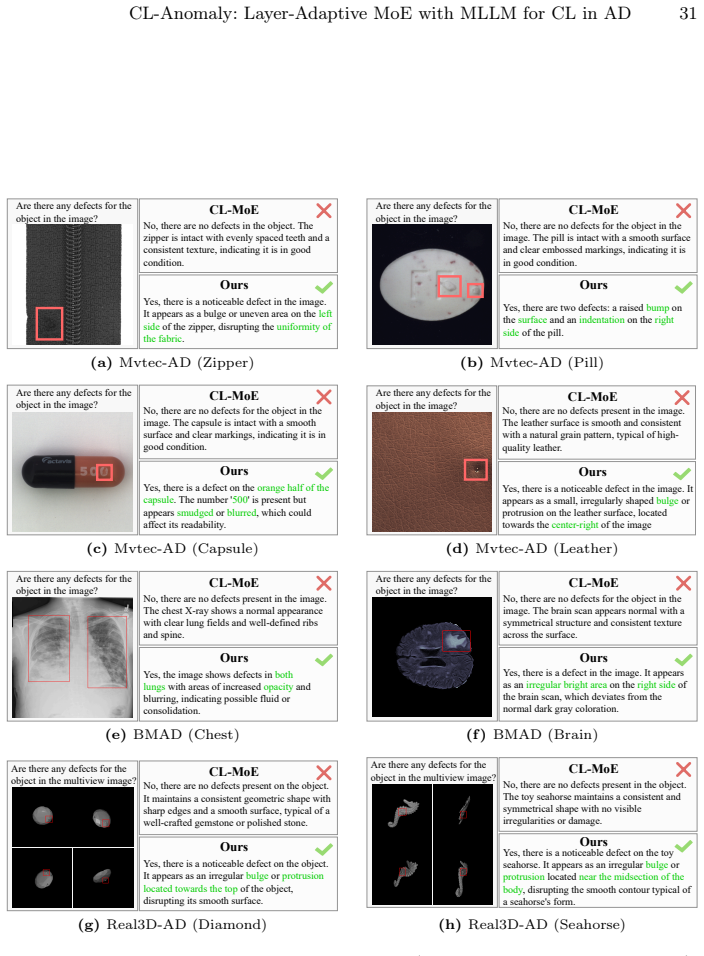
- Anomaly reasoning quality (ROUGE-L, SBERT, LLM-Score) after multi-stage training stays competitive with joint multi-task upper bounds.
Where Pith is reading between the lines
- If visual-anchor routing remains the bottleneck, replacing it with a lightweight text-or-instruction-conditioned router could raise the private-path ceiling without increasing storage.
- The same layer-adaptive key-expert idea may transfer to other heterogeneous continual instruction-tuning settings (e.g., medical report generation or multi-sensor robotics) where domain gaps are large.
- Because only ~1.4 % extra parameters are added, the method is a practical candidate for edge or on-prem AD deployments that cannot host multiple full models.
Editorial analysis
A structured set of objections, weighed in public.
Referee Report
Summary. The paper proposes CL-Anomaly, a parameter-efficient continual-learning framework for anomaly detection with MLLMs. It combines task-private PrivLoRA experts (physically isolated LoRA adapters selected by visual-anchor cosine routing) with a shared MoE-LoRA path whose layer-wise key experts are identified from gating statistics and updated by momentum merging (Layer-Adaptive Knowledge Transfer, LAKT). The dual-path design is intended to avoid semantic entanglement while still allowing positive transfer. Experiments on Anomaly-Instruct-125K cover class-incremental (WebAD subsets), cross-domain (industrial→medical BMAD), and cross-modal (2D→3D) sequences, plus a traditional single-category CIL setting on MVTec-AD. Against LoRA, MoELoRA, CL-MoE and HiDe-LLaVA, CL-Anomaly reports large gains in Avg/Last/BWT (Table 1) and in Accuracy/Precision/Recall/F1 (Table 2), with ablations (Table 3), hyper-parameter sweeps (λ, β, expert count), task-order randomization, and qualitative reasoning metrics.
Significance. If the reported gains hold under multi-seed evaluation, the work is a useful and timely contribution: it is among the first systematic treatments of continual MLLM-based anomaly detection under the triple heterogeneity of modality, domain and defect scale, and it supplies a concrete isolation–sharing recipe that approaches multi-task joint training while remaining parameter-efficient (~1.4% overhead). Strengths include a clear dual-path architecture, zero-extra-cost key-expert selection (Eq. 8), multi-scenario evaluation with both CL metrics and AD-appropriate F1-style metrics, component ablations, and an explicit limitation analysis of PrivLoRA routing in Appendix E. Code is promised at a public repository. These elements make the paper of practical interest to industrial/medical AD and to the broader continual-instruction-tuning community.
major comments (3)
- [§4.2 Eqs. (3)–(5); Appendix E] Section 4.2, Eqs. (3)–(5) and Appendix E: the isolation path depends on cosine similarity between an instance visual anchor and stored task anchors to weight PrivLoRAs. Appendix E shows that tasks with similar visual distributions (same WebAD source; 3D multi-view tasks) form high-response clusters, so routing is imperfect; an oracle one-hot routing still improves Last accuracy. Because PrivLoRA is load-bearing in the dual-path claim (Table 3: w/o PrivLoRA drops Avg 86.34→83.58 and BWT −0.96→−3.70), the main text should (i) report routing accuracy / confusion across the three scenarios, (ii) quantify how much of the Table 1 margin over CL-MoE survives under noisy routing, and (iii) either propose a lightweight fix (e.g., text+vision anchors, temperature calibration) or clearly bound the regimes where private experts help. Leaving this only in the appendix understates a central assumption
- [Table 1; Table 3; Table 7] Tables 1–2 and Fig. 4 report single-run point estimates with no standard deviations, no multi-seed averages, and no statistical tests, yet the central claim is a multi-point margin over CL-MoE (+5.68 Avg / +7.44 Last / +4.94 BWT). Continual-learning rankings are known to be seed- and order-sensitive (the paper itself shows order effects in Table 7). At least 3 seeds (or bootstrap over task orders) for the main Avg/Last/BWT comparison, and error bars on the ablation in Table 3, are needed before the SOTA claim can be treated as settled for a journal audience.
- [§5.1; Appendix C.2–C.3] Section 5.1 / Appendix C.2: baseline expert budgets are matched at a total of 12 experts for MoELoRA/CL-MoE, while CL-Anomaly uses 4 shared + one private per task (growing with T). For T=8 this is comparable, but the private experts are never updated after their task and are selected by a separate router; a controlled comparison that freezes the same total trainable parameter count (or the same number of active experts at inference) would strengthen the claim that the isolation–sharing design, rather than extra capacity, drives the gains. Please add a capacity-matched row or a brief parameter-matched ablation.
minor comments (7)
- [§4.1 Eq. (2); Fig. 6] Eq. (2) fixes λ=0.5; Fig. 6 shows sensitivity. State the default explicitly in the method section and note that λ is not learned.
- [Fig. 2; §4.3] Fig. 2 heatmaps motivate layer-wise preferences but are only qualitative. A short quantitative summary (e.g., entropy of expert usage per layer, or overlap of top-1 experts across tasks) would better justify LAKT.
- [§5.1 Evaluation Metrics] Appendix C.1 correctly explains why AUROC is not used (discrete Yes/No outputs). A one-sentence pointer in the main Evaluation Metrics paragraph would help AD readers who expect AUROC.
- [Abstract; throughout] Several extracted passages show missing spaces (e.g., abstract “asreal-worldknowledgeevolves”). Clean typesetting and consistent hyphenation of “Layer-Adaptive” / “task-private” throughout.
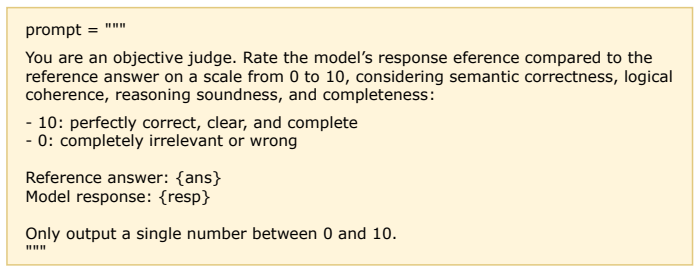
- [Table 4; Appendix D.2] Table 4 LLM-Score uses Qwen-3-Max as judge; report the exact prompt (already in Appendix) and, if possible, inter-judge agreement or a second judge to reduce single-model bias.
- [§4.2; Appendix B] Clarify whether visual anchors (Eq. 3) are computed once after each task and frozen, or refreshed; and whether 3D multi-view images use mean pooling over views for the anchor.
- [§2] Related Work could briefly position against recent continual AD prompt methods (e.g., UCAD, IUF) beyond the MLLM baselines, even if they are not MLLM-based, to help AD specialists.
Circularity Check
No significant circularity: empirical PEFT method whose claims rest on held-out sequential-training metrics, not on any equation that reduces a prediction to its own fitted inputs.
full rationale
CL-Anomaly is a parameter-efficient fine-tuning architecture (PrivLoRA isolation path + Layer-Adaptive Shared Experts + momentum LAKT) whose sole load-bearing claims are comparative numbers (Avg/Last/BWT, Accuracy/Precision/Recall/F1) measured after sequential training on held-out splits of Anomaly-Instruct-125K subsets. Equations 2–10 define the dual-path forward pass, visual-anchor routing, gating, and layer-wise momentum merge; none of them is later re-used as a “prediction” of a quantity already fixed by construction. Hyper-parameters (λ=0.5, β=0.75, n=4, k=1, r=36) are chosen by explicit sweeps (Figs. 6–7, Table 6) and reported, not hidden inside the claim. Ablations (Table 3) and the authors’ own Appendix E routing analysis further expose, rather than conceal, the method’s assumptions. Self-citations to the authors’ prior AD work appear only as ordinary related-work pointers and do not supply a uniqueness theorem, ansatz, or fitted constant that forces the reported ranking. Consequently the derivation chain contains no self-definitional step, no fitted-input-called-prediction, and no load-bearing self-citation circularity.
Axiom & Free-Parameter Ledger
free parameters (4)
- λ (private/shared path weight) =
0.5
- β (momentum merge coefficient for key experts) =
0.75
- n (number of shared experts) and k (key experts per layer) =
n=4, k=1
- LoRA rank r and scaling α =
r=36, α=72
axioms (4)
- domain assumption Layer-wise LoRA experts exhibit distinct task preferences that can be recovered from accumulated gating probabilities without extra forward/backward passes.
- domain assumption Visual anchors extracted by the frozen LLaVA encoder are sufficiently discriminative to route an input to the correct PrivLoRA expert via cosine similarity.
- domain assumption Historical data cannot be replayed (privacy constraint typical of real AD systems), so parameter isolation plus momentum merge must suffice.
- standard math Standard LoRA low-rank update form (Eq. 1) and frozen backbone preserve pre-trained knowledge.
invented entities (2)
-
PrivLoRA (task-private LoRA expert)
no independent evidence
-
Layer-Adaptive Knowledge Transfer (LAKT) / Layer-Adaptive Shared Experts
no independent evidence
read the original abstract
Multimodal Large Language Models (MLLMs) excel in diverse vision tasks, but full-parameter retraining is computationally expensive as real-world knowledge evolves. Existing continual learning methods often suffer from semantic entanglement in parameter spaces across tasks, impeding the continuous deployment of models. This challenge is especially pronounced in Anomaly Detection (AD), which exhibits triple heterogeneity across modalities, domains, and defect scale variability, significantly complicating multi-task knowledge transfer. In this paper, we propose CL-Anomaly, a parameter-efficient fine-tuning framework based on an isolation-sharing collaboration to enable continual learning for anomaly detection with MLLMs. We introduce the task-private expert PrivLoRA, which physically isolates task-specific subspaces in the parameter space to prevent semantic entanglement of anomaly knowledge in diverse scenarios. The Layer-Adaptive Shared Experts maintain cross-task representations within a unified feature space, enabling knowledge sharing between previous and new tasks. Furthermore, we propose a Layer-Adaptive Knowledge Transfer strategy that automatically selects and dynamically updates the layer-wise key shared experts of each task via a momentum-based mechanism, promoting effective knowledge transfer across related anomaly detection tasks. Extensive experiments across three continual learning scenarios for anomaly detection, including class-incremental, cross-domain, and cross-modal, demonstrate that CL-Anomaly outperforms state-of-the-art methods. Code is available at https://github.com/WenDongyp/CL-Anomaly.
Figures






Reference graph
Works this paper leans on
-
[1]
arXiv preprint arXiv:2303.08774 (2023)
Achiam, J., Adler, S., Agarwal, S., Ahmad, L., Akkaya, I., Aleman, F.L., Almeida, D., Altenschmidt, J., Altman, S., Anadkat, S., et al.: Gpt-4 technical report. arXiv preprint arXiv:2303.08774 (2023)
Pith/arXiv arXiv 2023
-
[2]
arXiv preprint arXiv:2309.16609 (2023) 16 W
Bai, J., Bai, S., Chu, Y., Cui, Z., Dang, K., Deng, X., Fan, Y., Ge, W., Han, Y., Huang, F., et al.: Qwen technical report. arXiv preprint arXiv:2309.16609 (2023) 16 W. Dong et al
Pith/arXiv arXiv 2023
-
[3]
Bai, S., Chen, K., Liu, X., Wang, J., Ge, W., Song, S., Dang, K., Wang, P., Wang, S., Tang, J., et al.: Qwen2. 5-vl technical report. arXiv preprint arXiv:2502.13923 (2025)
Pith/arXiv arXiv 2025
-
[4]
In: Proceedings of the IEEE/CVF Conference on Computer Vision and Pattern Recognition
Bao,J.,Sun,H.,Deng,H.,He,Y.,Zhang,Z.,Li,X.:Bmad:Benchmarksformedical anomaly detection. In: Proceedings of the IEEE/CVF Conference on Computer Vision and Pattern Recognition. pp. 4042–4053 (2024)
2024
-
[5]
In: Proceedings of the IEEE/CVF conference on computer vision and pattern recognition
Bergmann, P., Fauser, M., Sattlegger, D., Steger, C.: Mvtec ad–a comprehen- sive real-world dataset for unsupervised anomaly detection. In: Proceedings of the IEEE/CVF conference on computer vision and pattern recognition. pp. 9592–9600 (2019)
2019
-
[6]
arXiv preprint arXiv:2112.09045 (2021)
Bergmann, P., Jin, X., Sattlegger, D., Steger, C.: The mvtec 3d-ad dataset for un- supervised 3d anomaly detection and localization. arXiv preprint arXiv:2112.09045 (2021)
Pith/arXiv arXiv 2021
-
[7]
Cao,T.,Zhu,J.,Pang,G.:Anomalydetectionunderdistributionshift.In:Proceed- ings of the IEEE/CVF International Conference on Computer Vision. pp. 6511– 6523 (2023)
2023
-
[8]
In: Euro- pean Conference on Computer Vision
Cao, Y., Zhang, J., Frittoli, L., Cheng, Y., Shen, W., Boracchi, G.: Adaclip: Adapt- ing clip with hybrid learnable prompts for zero-shot anomaly detection. In: Euro- pean Conference on Computer Vision. pp. 55–72. Springer (2024)
2024
-
[9]
arXiv preprint arXiv:2504.11914 (2025)
Chao, Y., Liu, J., Tang, J., Wu, G.: Anomalyr1: A grpo-based end-to-end mllm for industrial anomaly detection. arXiv preprint arXiv:2504.11914 (2025)
Pith/arXiv arXiv 2025
-
[10]
Advances in Neural Information Processing Systems37, 57817–57840 (2024)
Chen, C., Zhu, J., Luo, X., Shen, H.T., Song, J., Gao, L.: Coin: A benchmark of continual instruction tuning for multimodel large language models. Advances in Neural Information Processing Systems37, 57817–57840 (2024)
2024
-
[11]
In: Proceedings of the IEEE/CVF Conference on Computer Vision and Pattern Recognition
Chen, G., Shen, L., Shao, R., Deng, X., Nie, L.: Lion: Empowering multimodal large language model with dual-level visual knowledge. In: Proceedings of the IEEE/CVF Conference on Computer Vision and Pattern Recognition. pp. 26540– 26550 (2024)
2024
-
[12]
In: Proceedings of the IEEE/CVF conference on computer vision and pattern recognition
Chen, Z., Wu, J., Wang, W., Su, W., Chen, G., Xing, S., Zhong, M., Zhang, Q., Zhu, X., Lu, L., et al.: Internvl: Scaling up vision foundation models and aligning for generic visual-linguistic tasks. In: Proceedings of the IEEE/CVF conference on computer vision and pattern recognition. pp. 24185–24198 (2024)
2024
-
[13]
In: Proceedings of the IEEE/CVF conference on computer vision and pat- tern recognition
Dhar, P., Singh, R.V., Peng, K.C., Wu, Z., Chellappa, R.: Learning without mem- orizing. In: Proceedings of the IEEE/CVF conference on computer vision and pat- tern recognition. pp. 5138–5146 (2019)
2019
-
[14]
In: ECAI 2025, pp
Dong, W., Chu, G., Pan, Z., Xie, G.S., Shan, C., Zhao, F.: Region-aware compo- sitional context prompting for zero-shot anomaly detection. In: ECAI 2025, pp. 82–89. IOS Press (2025)
2025
-
[15]
Feng, W., Hao, C., Zhang, Y., Han, Y., Wang, H.: Mixture-of-loras: An efficient multitasktuningforlargelanguagemodels.arXivpreprintarXiv:2403.03432(2024)
Pith/arXiv arXiv 2024
-
[16]
arXiv preprint arXiv:2501.01957 (2025)
Fu, C., Lin, H., Wang, X., Zhang, Y.F., Shen, Y., Liu, X., Cao, H., Long, Z., Gao, H., Li, K., et al.: Vita-1.5: Towards gpt-4o level real-time vision and speech interaction. arXiv preprint arXiv:2501.01957 (2025)
Pith/arXiv arXiv 2025
-
[17]
Gao,J.,Li,Y.,Cao,Z.,Li,W.:Interleaved-modalchain-of-thought.In:Proceedings of the Computer Vision and Pattern Recognition Conference. pp. 19520–19529 (2025)
2025
-
[18]
arXiv preprint arXiv:2304.15010 (2023) CL-Anomaly: Layer-Adaptive MoE with MLLM for CL in AD 17
Gao, P., Han, J., Zhang, R., Lin, Z., Geng, S., Zhou, A., Zhang, W., Lu, P., He, C., Yue, X., et al.: Llama-adapter v2: Parameter-efficient visual instruction model. arXiv preprint arXiv:2304.15010 (2023) CL-Anomaly: Layer-Adaptive MoE with MLLM for CL in AD 17
Pith/arXiv arXiv 2023
-
[19]
arXiv preprint arXiv:2506.11672 (2025)
Ge, C., Wang, X., Zhang, Z., Chen, H., Fan, J., Huang, L., Xue, H., Zhu, W.: Dynamic mixture of curriculum lora experts for continual multimodal instruction tuning. arXiv preprint arXiv:2506.11672 (2025)
Pith/arXiv arXiv 2025
-
[20]
Sensors22(9), 3166 (2022)
Givnan, S., Chalmers, C., Fergus, P., Ortega-Martorell, S., Whalley, T.: Anomaly detection using autoencoder reconstruction upon industrial motors. Sensors22(9), 3166 (2022)
2022
-
[21]
arXiv preprint arXiv:2503.12941 (2025)
Guo, H., Zeng, F., Xiang, Z., Zhu, F., Wang, D.H., Zhang, X.Y., Liu, C.L.: Hide- llava: Hierarchical decoupling for continual instruction tuning of multimodal large language model. arXiv preprint arXiv:2503.12941 (2025)
Pith/arXiv arXiv 2025
-
[22]
Advances in Neural Information Processing Systems37, 71162– 71187 (2024)
He, H., Bai, Y., Zhang, J., He, Q., Chen, H., Gan, Z., Wang, C., Li, X., Tian, G., Xie, L.: Mambaad: Exploring state space models for multi-class unsupervised anomaly detection. Advances in Neural Information Processing Systems37, 71162– 71187 (2024)
2024
-
[23]
In: International conference on machine learning
Houlsby, N., Giurgiu, A., Jastrzebski, S., Morrone, B., De Laroussilhe, Q., Ges- mundo, A., Attariyan, M., Gelly, S.: Parameter-efficient transfer learning for nlp. In: International conference on machine learning. pp. 2790–2799. PMLR (2019)
2019
-
[24]
ICLR1(2), 3 (2022)
Hu, E.J., Shen, Y., Wallis, P., Allen-Zhu, Z., Li, Y., Wang, S., Wang, L., Chen, W., et al.: Lora: Low-rank adaptation of large language models. ICLR1(2), 3 (2022)
2022
-
[25]
In: Proceedings of the Computer Vision and Pattern Recognition Conference
Huai, T., Zhou, J., Wu, X., Chen, Q., Bai, Q., Zhou, Z., He, L.: Cl-moe: Enhanc- ing multimodal large language model with dual momentum mixture-of-experts for continual visual question answering. In: Proceedings of the Computer Vision and Pattern Recognition Conference. pp. 19608–19617 (2025)
2025
-
[26]
In: Pro- ceedings of the IEEE/CVF Conference on Computer Vision and Pattern Recogni- tion
Huang, C., Jiang, A., Feng, J., Zhang, Y., Wang, X., Wang, Y.: Adapting visual- language models for generalizable anomaly detection in medical images. In: Pro- ceedings of the IEEE/CVF Conference on Computer Vision and Pattern Recogni- tion. pp. 11375–11385 (2024)
2024
-
[27]
In: Proceedings of the IEEE/CVF Conference on Computer Vision and Pattern Recognition
Jeong, J., Zou, Y., Kim, T., Zhang, D., Ravichandran, A., Dabeer, O.: Winclip: Zero-/few-shot anomaly classification and segmentation. In: Proceedings of the IEEE/CVF Conference on Computer Vision and Pattern Recognition. pp. 19606– 19616 (2023)
2023
-
[28]
Proceedings of the national academy of sciences114(13), 3521–3526 (2017)
Kirkpatrick, J., Pascanu, R., Rabinowitz, N., Veness, J., Desjardins, G., Rusu, A.A., Milan, K., Quan, J., Ramalho, T., Grabska-Barwinska, A., et al.: Overcoming catastrophic forgetting in neural networks. Proceedings of the national academy of sciences114(13), 3521–3526 (2017)
2017
-
[29]
arXiv preprint arXiv:2104.08691 (2021)
Lester, B., Al-Rfou, R., Constant, N.: The power of scale for parameter-efficient prompt tuning. arXiv preprint arXiv:2104.08691 (2021)
Pith/arXiv arXiv 2021
-
[30]
arXiv preprint arXiv:2408.03326 (2024)
Li, B., Zhang, Y., Guo, D., Zhang, R., Li, F., Zhang, H., Zhang, K., Zhang, P., Li, Y., Liu, Z., et al.: Llava-onevision: Easy visual task transfer. arXiv preprint arXiv:2408.03326 (2024)
Pith/arXiv arXiv 2024
-
[31]
In: Proceedings of the IEEE/CVF conference on com- puter vision and pattern recognition
Li, W., Xu, X., Gu, Y., Zheng, B., Gao, S., Wu, Y.: Towards scalable 3d anomaly detection and localization: A benchmark via 3d anomaly synthesis and a self- supervised learning network. In: Proceedings of the IEEE/CVF conference on com- puter vision and pattern recognition. pp. 22207–22216 (2024)
2024
-
[32]
arXiv preprint arXiv:2101.00190 (2021)
Li, X.L., Liang, P.: Prefix-tuning: Optimizing continuous prompts for generation. arXiv preprint arXiv:2101.00190 (2021)
Pith/arXiv arXiv 2021
-
[33]
In: Proceedings of the IEEE/CVF Conference on Computer Vision and Pattern Recognition
Li, X., Zhang, Z., Tan, X., Chen, C., Qu, Y., Xie, Y., Ma, L.: Promptad: Learning prompts with only normal samples for few-shot anomaly detection. In: Proceedings of the IEEE/CVF Conference on Computer Vision and Pattern Recognition. pp. 16838–16848 (2024) 18 W. Dong et al
2024
-
[34]
arXiv preprint arXiv:2508.09178 (2025)
Li, Y., Cao, Y., Liu, C., Xiong, Y., Dong, X., Huang, C.: Iad-r1: Reinforcing con- sistent reasoning in industrial anomaly detection. arXiv preprint arXiv:2508.09178 (2025)
Pith/arXiv arXiv 2025
-
[35]
In: Proceedings of the AAAI Conference on Artificial Intelligence
Li, Y., Cao, Y., Liu, C., Xiong, Y., Dong, X., Huang, C.: Iad-r1: Reinforcing con- sistent reasoning in industrial anomaly detection. In: Proceedings of the AAAI Conference on Artificial Intelligence. vol. 40, pp. 6583–6591 (2026)
2026
-
[36]
IEEE transactions on pattern anal- ysis and machine intelligence40(12), 2935–2947 (2017)
Li, Z., Hoiem, D.: Learning without forgetting. IEEE transactions on pattern anal- ysis and machine intelligence40(12), 2935–2947 (2017)
2017
-
[37]
In: Proceedings of the 2024 Conference on Empirical Methods in Natural Language Processing
Lin, B., Ye, Y., Zhu, B., Cui, J., Ning, M., Jin, P., Yuan, L.: Video-llava: Learning united visual representation by alignment before projection. In: Proceedings of the 2024 Conference on Empirical Methods in Natural Language Processing. pp. 5971–5984 (2024)
2024
-
[38]
Applied Intelligence53(20), 23628–23640 (2023)
Lin, J., He, Y., Xu, W., Guan, J., Zhang, J., Zhou, S.: Latent feature reconstruc- tion for unsupervised anomaly detection. Applied Intelligence53(20), 23628–23640 (2023)
2023
-
[39]
Advances in Neural Information Processing Systems35, 16165–16177 (2022)
Lin, S., Yang, L., Fan, D., Zhang, J.: Beyond not-forgetting: Continual learning with backward knowledge transfer. Advances in Neural Information Processing Systems35, 16165–16177 (2022)
2022
-
[40]
Sensors23(21), 8750 (2023)
Liu, F., Zhu, X., Feng, P., Zeng, L.: Anomaly detection via progressive reconstruc- tion and hierarchical feature fusion. Sensors23(21), 8750 (2023)
2023
-
[41]
Advances in neural information processing systems36, 34892–34916 (2023)
Liu, H., Li, C., Wu, Q., Lee, Y.J.: Visual instruction tuning. Advances in neural information processing systems36, 34892–34916 (2023)
2023
-
[42]
In: Proceedings of the AAAI conference on artificial intelligence
Liu, J., Wu, K., Nie, Q., Chen, Y., Gao, B.B., Liu, Y., Wang, J., Wang, C., Zheng, F.: Unsupervised continual anomaly detection with contrastively-learned prompt. In: Proceedings of the AAAI conference on artificial intelligence. vol. 38, pp. 3639– 3647 (2024)
2024
-
[43]
Advances in Neural Information Processing Systems36, 30402–30415 (2023)
Liu, J., Xie, G., Chen, R., Li, X., Wang, J., Liu, Y., Wang, C., Zheng, F.: Real3d- ad: A dataset of point cloud anomaly detection. Advances in Neural Information Processing Systems36, 30402–30415 (2023)
2023
-
[44]
In: Proceedings of the IEEE/CVF conference on computer vision and pattern recognition
Liu, Z., Zhou, Y., Xu, Y., Wang, Z.: Simplenet: A simple network for image anomaly detection and localization. In: Proceedings of the IEEE/CVF conference on computer vision and pattern recognition. pp. 20402–20411 (2023)
2023
-
[45]
Advances in neural information processing systems30(2017)
Lopez-Paz, D., Ranzato, M.: Gradient episodic memory for continual learning. Advances in neural information processing systems30(2017)
2017
-
[46]
arXiv preprint arXiv:1711.05101 (2017)
Loshchilov, I., Hutter, F.: Decoupled weight decay regularization. arXiv preprint arXiv:1711.05101 (2017)
Pith/arXiv arXiv 2017
-
[47]
Piao, H., Wu, Y., Wu, D., Wei, Y.: Federated continual learning via prompt-based dualknowledgetransfer.In:Forty-firstInternationalConferenceonMachineLearn- ing (2024)
2024
-
[48]
Advances in Neural Information Processing Systems37, 97476–97498 (2024)
Qiao, F., Mahdavi, M.: Learn more, but bother less: parameter efficient continual learning. Advances in Neural Information Processing Systems37, 97476–97498 (2024)
2024
-
[49]
Advances in neural information processing systems32(2019)
Rolnick, D., Ahuja, A., Schwarz, J., Lillicrap, T., Wayne, G.: Experience replay for continual learning. Advances in neural information processing systems32(2019)
2019
-
[50]
In: Proceedings of the IEEE/CVF conference on computer vision and pattern recognition
Roth, K., Pemula, L., Zepeda, J., Schölkopf, B., Brox, T., Gehler, P.: Towards total recall in industrial anomaly detection. In: Proceedings of the IEEE/CVF conference on computer vision and pattern recognition. pp. 14318–14328 (2022)
2022
-
[51]
In: European conference on computer vision
Tang, J., Lu, H., Xu, X., Wu, R., Hu, S., Zhang, T., Cheng, T.W., Ge, M., Chen, Y.C., Tsung, F.: An incremental unified framework for small defect inspection. In: European conference on computer vision. pp. 307–324. Springer (2024) CL-Anomaly: Layer-Adaptive MoE with MLLM for CL in AD 19
2024
-
[52]
In: Proceedings of the AAAI Conference on Artificial Intelligence
Tao, F., Xie, G.S., Zhao, F., Shu, X.: Kernel-aware graph prompt learning for few-shot anomaly detection. In: Proceedings of the AAAI Conference on Artificial Intelligence. vol. 39, pp. 7347–7355 (2025)
2025
-
[53]
In: Proceedings of the IEEE/CVF conference on computer vision and pattern recognition
Tien, T.D., Nguyen, A.T., Tran, N.H., Huy, T.D., Duong, S., Nguyen, C.D.T., Truong, S.Q.: Revisiting reverse distillation for anomaly detection. In: Proceedings of the IEEE/CVF conference on computer vision and pattern recognition. pp. 24511–24520 (2023)
2023
-
[54]
arXiv preprint arXiv:2302.13971 (2023)
Touvron, H., Lavril, T., Izacard, G., Martinet, X., Lachaux, M.A., Lacroix, T., Rozière, B., Goyal, N., Hambro, E., Azhar, F., et al.: Llama: Open and efficient foundation language models. arXiv preprint arXiv:2302.13971 (2023)
Pith/arXiv arXiv 2023
-
[55]
arXiv preprint arXiv:2103.04257 (2021)
Wang, G., Han, S., Ding, E., Huang, D.: Student-teacher feature pyramid matching for anomaly detection. arXiv preprint arXiv:2103.04257 (2021)
Pith/arXiv arXiv 2021
-
[56]
Visual Intelligence4(1), 7 (2026)
Wang, H., Yan, W., Lai, Q., Geng, X.: Temporal consistency-aware text-to-motion generation. Visual Intelligence4(1), 7 (2026)
2026
-
[57]
In: Findings of the Association for Computational Linguistics: EMNLP 2023
Wang, X., Chen, T., Ge, Q., Xia, H., Bao, R., Zheng, R., Zhang, Q., Gui, T., Huang, X.J.: Orthogonal subspace learning for language model continual learning. In: Findings of the Association for Computational Linguistics: EMNLP 2023. pp. 10658–10671 (2023)
2023
-
[58]
In: Pro- ceedings of the IEEE/CVF International Conference on Computer Vision
Wang, Z., Che, C., Wang, Q., Li, Y., Shi, Z., Wang, M.: Smolora: Exploring and defying dual catastrophic forgetting in continual visual instruction tuning. In: Pro- ceedings of the IEEE/CVF International Conference on Computer Vision. pp. 177– 186 (2025)
2025
-
[59]
In: Medical Imaging 2018: Computer- Aided Diagnosis
Wei, Q., Ren, Y., Hou, R., Shi, B., Lo, J.Y., Carin, L.: Anomaly detection for medi- cal images based on a one-class classification. In: Medical Imaging 2018: Computer- Aided Diagnosis. vol. 10575, pp. 375–380. SPIE (2018)
2018
-
[60]
Advances in Neural Information Pro- cessing Systems37, 69925–69975 (2024)
Wu, J., Zhong, M., Xing, S., Lai, Z., Liu, Z., Chen, Z., Wang, W., Zhu, X., Lu, L., Lu, T., et al.: Visionllm v2: An end-to-end generalist multimodal large language model for hundreds of vision-language tasks. Advances in Neural Information Pro- cessing Systems37, 69925–69975 (2024)
2024
-
[61]
In: Proceedings of the Computer Vision and Pattern Recognition Conference
Xu, J., Lo, S.Y., Safaei, B., Patel, V.M., Dwivedi, I.: Towards zero-shot anomaly detection and reasoning with multimodal large language models. In: Proceedings of the Computer Vision and Pattern Recognition Conference. pp. 20370–20382 (2025)
2025
-
[62]
In: International Conference on Medical Image Computing and Computer-Assisted Intervention
Zhang, X., Xu, M., Qiu, D., Yan, R., Lang, N., Zhou, X.: Mediclip: Adapting clip for few-shot medical image anomaly detection. In: International Conference on Medical Image Computing and Computer-Assisted Intervention. pp. 458–468. Springer (2024)
2024
-
[63]
IEEE Transactions on Medical Imaging40(12), 3641–3651 (2021)
Zhao, H., Li, Y., He, N., Ma, K., Fang, L., Li, H., Zheng, Y.: Anomaly detection for medical images using self-supervised and translation-consistent features. IEEE Transactions on Medical Imaging40(12), 3641–3651 (2021)
2021
-
[64]
arXiv preprint arXiv:2506.05453 (2025)
Zhao, H., Zhu, F., Guo, H., Wang, M., Wang, R., Meng, G., Zhang, Z.: Mllm- cl: Continual learning for multimodal large language models. arXiv preprint arXiv:2506.05453 (2025)
arXiv 2025
-
[65]
arXiv preprint arXiv:2411.12591 (2024)
Zheng, H., Xu, T., Sun, H., Pu, S., Chen, R., Sun, L.: Thinking before look- ing: Improving multimodal llm reasoning via mitigating visual hallucination. arXiv preprint arXiv:2411.12591 (2024)
Pith/arXiv arXiv 2024
-
[66]
arXiv preprint arXiv:2310.18961 (2023)
Zhou, Q., Pang, G., Tian, Y., He, S., Chen, J.: Anomalyclip: Object-agnostic prompt learning for zero-shot anomaly detection. arXiv preprint arXiv:2310.18961 (2023)
arXiv 2023
-
[67]
In: Proceedings of the IEEE/CVF con- ference on computer vision and pattern recognition
Zhu, F., Zhang, X.Y., Wang, C., Yin, F., Liu, C.L.: Prototype augmentation and self-supervision for incremental learning. In: Proceedings of the IEEE/CVF con- ference on computer vision and pattern recognition. pp. 5871–5880 (2021) 20 W. Dong et al. Appendix for CL-Anomaly: Layer-Adaptive Mixture-of-Experts with Multimodal Large Language Model for Continu...
arXiv 2021
discussion (0)
Sign in with ORCID, Apple, or X to comment. Anyone can read and Pith papers without signing in.