REVIEW 3 major objections 6 minor 70 references
MambaLIE: Scene Light Intensity-Boosted Low-Light Image Enhancement with State Space Model
T0 review · 3 major / 6 minor · reviewed 2026-07-12 · grok-4.5
Pith's one-line read A mean-filter light prior plus a hybrid state-space block can enhance low-light photos better than CNNs or Transformers while staying linear in cost.
desk verdict Solid engineering adaptation of Mamba to LIE with competitive numbers and clear ablations; the joint SOTA accuracy+speed+size claim is overstated relative to the tables. read the letter →
The pith
A machine-rendered reading of the paper's core claim, the machinery that carries it, and where it could break.
The reading
What carries the argument
Locally Enhanced State Space Model (LESSM): a dual-branch block that splits features into a bidirectional selective SSM path (linear long-range modeling) and a convolutional local-enhancement path, then concatenates and residual-adds them; the block is further guided by a mean-filter light-intensity prior used as a multiplicative gate.
What would settle it
Replace the 5 imes5 mean prior with a learned illumination estimator or with no prior on the same LOLv1/MIT-Adobe FiveK splits; if the reported PSNR/SSIM gains disappear or reverse while model size stays comparable, the claim that the fixed mean-gate is essential collapses.
Extended reading notes
Core claim
MambaLIE shows that gating a low-light image by a mean-filtered scene-light intensity prior, then processing the gated input with a hybrid Locally Enhanced State Space Model that jointly models long-range illumination and local detail under linear complexity, yields higher accuracy and lower computational cost than both CNN and Transformer low-light enhancers on the standard synthetic and real-world benchmarks.
Load-bearing premise
That a fixed-size mean filter followed by simple convolutions produces a reliable enough scene-light map that, when used only as a multiplicative gate, correctly reveals structure without introducing bias under strongly non-uniform or extreme darkness.
Editorial extensions
If this is right
- Consumer camera pipelines can replace heavier Transformer LIE modules with a linear-complexity SSM block without sacrificing measured quality.
- The same mean-gate + LESSM pattern can be dropped into other low-level restoration U-Nets that need global illumination consistency.
- Real-time mobile or edge inference of low-light enhancement becomes feasible at the reported parameter and FLOP counts.
- Downstream detectors and segmenters that fail on dark frames should improve once the enhanced output is used as input, as the paper illustrates for object detection.
Reading between the lines
- Because the prior is purely spatial and fixed-scale, adaptive or multi-scale light estimation may be needed before the method can handle mixed flash/ambient or very high-dynamic-range night scenes.
- The bidirectional SSM scan is currently applied after a simple channel split; inserting content-aware routing or frequency-aware state selection could further reduce residual color shifts noted in the limitations.
- The architecture’s linear scaling suggests it could be extended to video low-light enhancement by treating time as an additional selective dimension without quadratic memory growth.
Editorial analysis
A structured set of objections, weighed in public.
Referee Report
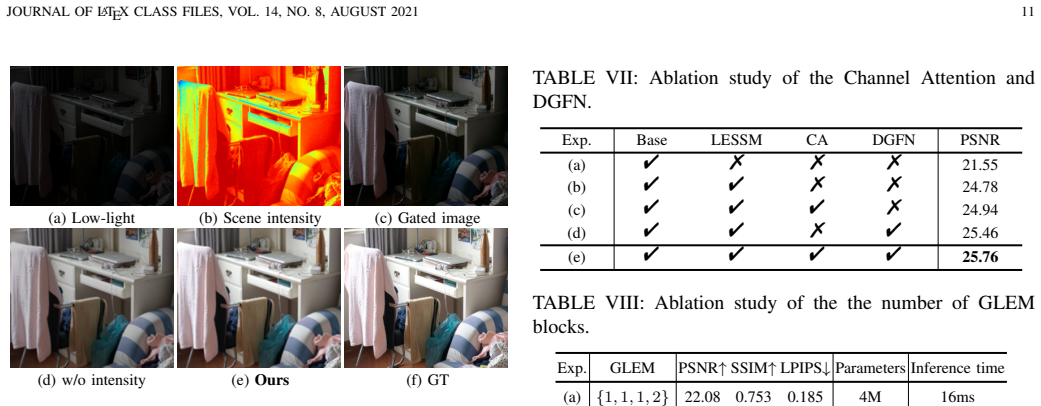
Summary. The paper proposes MambaLIE, a U-Net-style low-light image enhancement network that (i) multiplies the input by a scene light-intensity prior obtained from a mean filter plus depthwise/pointwise convolutions, and (ii) replaces self-attention with a Locally Enhanced State Space Model (LESSM) that combines bidirectional selective SSM scans and a local convolutional branch inside Global Light Enhancement Mamba (GLEM) blocks. The authors claim superior accuracy, speed, and model size versus recent CNN and Transformer LIE methods on four paired synthetic benchmarks and five unpaired real-world sets, with ablations on the prior, LESSM branches, channel attention, DGFN, and GLEM depth.
Significance. Adapting selective state-space models to low-light enhancement with an explicit illumination gate and a hybrid global–local block is a timely and practically motivated contribution. Linear-complexity global modeling is attractive for consumer-device imaging, the design is ablated in reasonable detail (Tables V–X), and code is released. If the efficiency claims are fully substantiated and the accuracy claims are stated more carefully, the work would be a useful addition to the LIE literature and a concrete low-level vision use case for vision Mamba variants.
major comments (3)
- The abstract and conclusion assert that MambaLIE “outperforms state-of-the-art CNN-based and Transformer-based LIE methods … in terms of accuracy, speed, and model size.” Accuracy is competitive but not uniformly superior. On LOLv1 (Table I) PSNR is only +0.05 dB over PPformer while LPIPS is worse (0.153 vs 0.120); on LOLv2-Real (Table II) PSNR trails LLEMamba (22.06 vs 22.20) and LPIPS is substantially worse (0.187 vs 0.054). The joint SOTA claim should be revised to match the tables (e.g., “competitive or best on most metrics”) or the weaker metrics should be explained.
- Speed and model-size superiority rest almost entirely on the qualitative FLOPs–PSNR scatter in Fig. 15. The manuscript does not report a head-to-head table of parameters, FLOPs, and measured latency (same resolution, same hardware) against the main Transformer baselines cited in the claim—Retinexformer, LLFormer, and PPformer. Ablation Tables V and VIII give internal timings only. Without those numbers the “accuracy + speed + size” claim is not fully supported; please add a quantitative comparison table or narrow the claim.
- Section III-B, Eqs. (3)–(4) and Table V: the scene light-intensity prior is a fixed-size mean filter (default 5×5) used only as a multiplicative gate. The Limitations section and Fig. 16 already show color shifts and under-/over-exposure under extreme non-uniform lighting. Given that this prior is presented as a core contribution, the paper should either quantify failure modes (e.g., NIQE/PSNR stratified by darkness or non-uniformity) or more clearly bound the operating regime in which the prior is reliable, rather than treating the 5×5 choice as generally sufficient.
minor comments (6)
- Notation inconsistency: Eq. (1) writes Ic = N(I) while the surrounding text uses Ie for the enhanced image; align symbols.
- Typos: “BorwardSSM” (should be BackwardSSM), “nder-/over-exposed”, “severrly degarded”, “Attention Fusion Block Cross-layer” capitalization, and “Yangyu Li” vs “Xiangyu Li” in the author block.
- The manuscript ends with duplicated and partially unrelated author biographies (including people not listed as authors). Clean the back matter before camera-ready.
- Fig. 1 and Fig. 15 would benefit from absolute parameter counts and a short caption note on the resolution used for FLOPs so readers can compare fairly to Retinexformer/LLFormer.
- No error bars or multi-seed statistics are reported for the main tables; even a brief note on run-to-run variance would strengthen confidence in the small PSNR margins (e.g., +0.05 dB).
- Related-work discussion of LLEMamba is brief relative to the direct numerical comparison in Table II; a short architectural contrast would help readers place LESSM.
Circularity Check
No circularity: purely empirical architecture + supervised training on public paired data; no derivation reduces to its inputs by construction.
full rationale
MambaLIE is a standard supervised low-light enhancement network. The scene-light prior (Eq. 3–4) is a fixed mean-filter + depthwise/pointwise convolution used only as a multiplicative gate; it is not fitted to any target metric and is ablated (Table V). LESSM (Eq. 5–15) is an architectural block whose parameters are learned end-to-end under an ordinary L1 loss (Eq. 2, 16). All quantitative claims are obtained by training on public paired sets (LOL-v1/v2, FiveK) and evaluating on held-out or real-world benchmarks; no parameter is fitted to a subset and then re-presented as a prediction of a related quantity. Self-citations are ordinary method papers and do not supply uniqueness theorems or load-bearing lemmas. Hyper-parameter choices (filter size, GLEM counts) are explicitly ablated rather than smuggled in. Consequently the derivation chain never collapses to its own inputs, and the circularity score is zero.
Assumptions & free parameters
free parameters (4)
- GLEM block counts per stage =
{1,2,4,8}
- scene-light mean-filter size =
5×5
- learning-rate schedule and epoch counts =
1e-4 to 1e-6, 1000/4000 epochs
- patch size and batch size =
128×128, batch 12
assumptions (3)
- domain assumption A spatially smoothed mean-filter map is a useful proxy for scene illumination that can be multiplicatively gated onto the input.
- ad hoc to paper Bidirectional selective state-space layers plus a local conv branch capture the long-range and local dependencies needed for LIE better than pure CNN or MHSA under linear complexity.
- domain assumption Public paired LOL/FiveK splits and no-reference metrics (NIQE, PI, MUSIQ) are adequate proxies for real-world enhancement quality.
invented entities (3)
-
Locally Enhanced State Space Model (LESSM)
-
Global Light Enhancement Mamba (GLEM)
-
Scene light intensity prior (mean-filter gated input)
Cite this review
Pith. "Pith review of MambaLIE: Scene Light Intensity-Boosted Low-Light Image Enhancement with State Space Model." pith.science (2026). https://pith.science/paper/WAMADCSX
@misc{pith2026260703013,
  author       = {Pith},
  title        = {Pith review of: MambaLIE: Scene Light Intensity-Boosted Low-Light Image Enhancement with State Space Model},
  year         = {2026},
  howpublished = {\url{https://pith.science/paper/WAMADCSX}},
  note         = {Machine review of arXiv:2607.03013}
}
read the original abstract
Images captured by consumer electronic devices, such as mobile phones and digital cameras, often suffer from low-light degradation due to sensor limitations and imaging pipelines, which degrades visual quality and affects downstream vision tasks. Existing methods based on Convolutional Neural Networks (CNNs) and Transformers have dominated current low-light image enhancement (LIE) due to their excellent ability to model hierarchical features. However, CNNs operate in local receptive fields that cannot model long-range dependencies, while Transformers overcome this problem but incur substantial computational costs. To address these challenges, we propose MambaLIE, a Scene Light Intensity-Boosted Low-Light Image Enhancement method based on a State Space Model (SSM). We first introduce scene light intensity to improve the structural distribution of illumination, which is then gated with the low-light input to guide enhancement. To better model the illumination while maintaining computational efficiency, we propose the Locally Enhanced State Space Model (LESSM) for efficient light enhancement. Our LESSM contains two branches: an SSM branch and a Local Enhanced branch, where the former is used to model the long-range dependencies with linear time complexity, while the latter is used to enhance local feature representations. Extensive experiments demonstrate that MambaLIE outperforms state-of-the-art CNN-based and Transformer-based LIE methods on four widely used synthetic benchmarks and five publicly available real-world benchmarks in terms of accuracy, speed, and model size, making it suitable for practical deployment on resource-constrained devices.
Figures


Figures from the paper (13 more)




Reference graph
Works this paper leans on
-
[1]
Zero- reference deep curve estimation for low-light image enhancement,
C. Guo, C. Li, J. Guo, C. C. Loy, J. Hou, S. Kwong, and R. Cong, “Zero- reference deep curve estimation for low-light image enhancement,” in CVPR, 2020, pp. 1777–1786. JOURNAL OF LATEX CLASS FILES, VOL. 14, NO. 8, AUGUST 2021 13
2020
-
[2]
Retinex- former: One-stage retinex-based transformer for low-light image en- hancement,
Y . Cai, H. Bian, J. Lin, H. Wang, R. Timofte, and Y . Zhang, “Retinex- former: One-stage retinex-based transformer for low-light image en- hancement,” inICCV, 2023, pp. 12 470–12 479
2023
-
[3]
Design consider- ations of color image processing pipeline for digital cameras,
W.-c. Kao, S.-h. Wang, L.-y. Chen, and S.-y. Lin, “Design consider- ations of color image processing pipeline for digital cameras,”IEEE Transactions on Consumer Electronics, vol. 52, no. 4, pp. 1144–1152, 2006
2006
-
[4]
Unity makes strength: Coalition formation-based group-buying for timely UA V data collection,
N. Qi, Y . Huang, W. Sun, S. Jin, T. A. Tsiftsis, Q. Wu, and X. Su, “Unity makes strength: Coalition formation-based group-buying for timely UA V data collection,” inGLOBECOM, 2022, pp. 3712–3717
2022
-
[5]
Object detection in 20 years: A survey,
Z. Zou, K. Chen, Z. Shi, Y . Guo, and J. Ye, “Object detection in 20 years: A survey,”Proc. IEEE, vol. 111, no. 3, pp. 257–276, 2023
2023
-
[6]
Mseg3d: Multi-modal 3d semantic segmentation for autonomous driving,
J. Li, H. Dai, H. Han, and Y . Ding, “Mseg3d: Multi-modal 3d semantic segmentation for autonomous driving,” inCVPR, 2023, pp. 21 694– 21 704
2023
-
[7]
SRNMSM: A deep light-weight image super resolution network using multi-scale spatial and morphological feature generating residual blocks,
A. Esmaeilzehi, M. O. Ahmad, and M. N. S. Swamy, “SRNMSM: A deep light-weight image super resolution network using multi-scale spatial and morphological feature generating residual blocks,”IEEE Trans. Broadcast., vol. 68, no. 1, pp. 58–68, 2022
2022
-
[8]
Self-supervised pretraining for stereoscopic image super-resolution with parallax-aware masking,
Z. Zhang, J. Lei, B. Peng, J. Zhu, and Q. Huang, “Self-supervised pretraining for stereoscopic image super-resolution with parallax-aware masking,”IEEE Trans. Broadcast., vol. 70, no. 2, pp. 482–491, 2024
2024
Show all 70 references
-
[9]
Progressive domain translation defogging net- work for real-world fog images,
Q. Guo and M. Zhou, “Progressive domain translation defogging net- work for real-world fog images,”IEEE Trans. Broadcast., vol. 68, no. 4, pp. 876–885, 2022
2022
-
[10]
DMML: deep multi-prior and multi-discriminator learning for underwater image enhancement,
A. Esmaeilzehi, Y . Ou, M. O. Ahmad, and M. N. S. Swamy, “DMML: deep multi-prior and multi-discriminator learning for underwater image enhancement,”IEEE Trans. Broadcast., vol. 70, no. 2, pp. 637–653, 2024
2024
-
[11]
A simple and effective histogram equalization approach to image enhancement,
H. Cheng and X. J. Shi, “A simple and effective histogram equalization approach to image enhancement,”DSP, vol. 14, no. 2, pp. 158–170, 2004
2004
-
[12]
A real-time image processor with combining dynamic contrast ratio enhancement and inverse gamma correction for PDP,
Z. Wang, Z. Liang, and C. Liu, “A real-time image processor with combining dynamic contrast ratio enhancement and inverse gamma correction for PDP,”Displays, vol. 30, no. 3, pp. 133–139, 2009
2009
-
[13]
Ultra-high- definition low-light image enhancement: A benchmark and transformer- based method,
T. Wang, K. Zhang, T. Shen, W. Luo, B. Stenger, and T. Lu, “Ultra-high- definition low-light image enhancement: A benchmark and transformer- based method,” inAAAI, 2023, pp. 2654–2662
2023
-
[14]
Ppformer: Using pixel-wise and patch- wise cross-attention for low-light image enhancement,
J. Dang, Y . Zhong, and X. Qin, “Ppformer: Using pixel-wise and patch- wise cross-attention for low-light image enhancement,”CVIU, vol. 241, p. 103930, 2024
2024
-
[15]
Mamba: Linear-time sequence modeling with selective state spaces,
A. Gu and T. Dao, “Mamba: Linear-time sequence modeling with selective state spaces,”arXiv:2312.00752, 2023
2023 arXiv
-
[16]
Vmamba: Visual state space model,
Y . Liu, Y . Tian, Y . Zhao, H. Yu, L. Xie, Y . Wang, Q. Ye, J. Jiao, and Y . Liu, “Vmamba: Visual state space model,” inNeurIPS, 2024
2024
-
[17]
S4ND: modeling images and videos as multidimensional signals with state spaces,
E. Nguyen, K. Goel, A. Gu, G. W. Downs, P. Shah, T. Dao, S. Baccus, and C. R ´e, “S4ND: modeling images and videos as multidimensional signals with state spaces,” inNeurIPS, 2022
2022
-
[18]
Vision mamba: Efficient visual representation learning with bidirectional state space model,
L. Zhu, B. Liao, Q. Zhang, X. Wang, W. Liu, and X. Wang, “Vision mamba: Efficient visual representation learning with bidirectional state space model,” inICML, vol. 235, 2024, pp. 62 429–62 442
2024
-
[19]
Squeeze-and-excitation networks,
J. Hu, L. Shen, and G. Sun, “Squeeze-and-excitation networks,” in CVPR, 2018, pp. 7132–7141
2018
-
[20]
Attention is all you need,
A. Vaswani, N. Shazeer, N. Parmar, J. Uszkoreit, L. Jones, A. N. Gomez, L. Kaiser, and I. Polosukhin, “Attention is all you need,” inNeurIPS, 2017, pp. 5998–6008
2017
-
[21]
Contrast enhancement based on layered difference representation of 2d histograms,
C. Lee, C. Lee, and C. Kim, “Contrast enhancement based on layered difference representation of 2d histograms,”IEEE TIP, vol. 22, no. 12, pp. 5372–5384, 2013
2013
-
[22]
An adaptive gamma correction for image enhancement,
S. Rahman, M. Rahman, M. Abdullah-Al-Wadud, G. D. Al-Quaderi, and M. Shoyaib, “An adaptive gamma correction for image enhancement,” EJIVP, vol. 2016, p. 35, 2016
2016
-
[23]
Naturalness preserved enhance- ment algorithm for non-uniform illumination images,
S. Wang, J. Zheng, H. Hu, and B. Li, “Naturalness preserved enhance- ment algorithm for non-uniform illumination images,”IEEE TIP, vol. 22, no. 9, pp. 3538–3548, 2013
2013
-
[24]
RIRO: from retinex- inspired reconstruction optimization model to deep low-light image enhancement unfolding network,
L. Zhao, B. Chen, J. Zhang, A. Wang, and H. Bai, “RIRO: from retinex- inspired reconstruction optimization model to deep low-light image enhancement unfolding network,”IEEE TCI, vol. 10, pp. 969–983, 2024
2024
-
[25]
Pixel-wise gamma correction mapping for low-light image enhancement,
X. Li, M. Liu, and Q. Ling, “Pixel-wise gamma correction mapping for low-light image enhancement,”IEEE TCSVT, vol. 34, no. 2, pp. 681–694, 2024
2024
-
[26]
Learning a single convolutional layer model for low light image enhancement,
Y . Zhang, B. Teng, D. Yang, Z. Chen, H. Ma, G. Li, and W. Ding, “Learning a single convolutional layer model for low light image enhancement,”IEEE TCSVT, vol. 34, no. 7, pp. 5995–6008, 2024
2024
-
[27]
Lfienet: Light field image enhancement network by fusing exposures of lf-dslr image pairs,
W. Ye, T. Yan, J. Gao, and Y . Yang, “Lfienet: Light field image enhancement network by fusing exposures of lf-dslr image pairs,”IEEE TCI, vol. 9, pp. 620–635, 2023
2023
-
[28]
Snr-aware low-light image enhancement,
X. Xu, R. Wang, C. Fu, and J. Jia, “Snr-aware low-light image enhancement,” inCVPR, 2022, pp. 17 693–17 703
2022
-
[29]
Dual-stream adaptive convergent low-light image enhancement network based on frequency perception,
G. Han, K. Wu, F. Zeng, J. Liu, and S. Kwong, “Dual-stream adaptive convergent low-light image enhancement network based on frequency perception,”IEEE TCI, vol. 9, pp. 1152–1164, 2023
2023
-
[30]
On the parameterization and initialization of diagonal state space models,
A. Gu, K. Goel, A. Gupta, and C. R ´e, “On the parameterization and initialization of diagonal state space models,” inNeurIPS, 2022
2022
-
[31]
Efficiently modeling long sequences with structured state spaces,
A. Gu, K. Goel, and C. R ´e, “Efficiently modeling long sequences with structured state spaces,” inICLR, 2022
2022
-
[32]
Image super- resolution using very deep residual channel attention networks,
Y . Zhang, K. Li, K. Li, L. Wang, B. Zhong, and Y . Fu, “Image super- resolution using very deep residual channel attention networks,” in ECCV, vol. 11211, 2018, pp. 294–310
2018
-
[33]
Layer normalization,
L. J. Ba, J. R. Kiros, and G. E. Hinton, “Layer normalization,” arXiv:1607.06450, 2016
2016 arXiv
-
[34]
Kindling the darkness: A practical low-light image enhancer,
Y . Zhang, J. Zhang, and X. Guo, “Kindling the darkness: A practical low-light image enhancer,” inACM MM, 2019, pp. 1632–1640
2019
-
[35]
Deep retinex decomposition for low-light enhancement,
C. Wei, W. Wang, W. Yang, and J. Liu, “Deep retinex decomposition for low-light enhancement,” inBMVC, 2018, p. 155
2018
-
[36]
Learning photo- graphic global tonal adjustment with a database of input / output image pairs,
V . Bychkovsky, S. Paris, E. Chan, and F. Durand, “Learning photo- graphic global tonal adjustment with a database of input / output image pairs,” inCVPR, 2011, pp. 97–104
2011
-
[37]
A fusion-based enhancing method for weakly illuminated images,
X. Fu, D. Zeng, Y . Huang, Y . Liao, X. Ding, and J. W. Paisley, “A fusion-based enhancing method for weakly illuminated images,”Signal Process., vol. 129, pp. 82–96, 2016
2016
-
[38]
A weighted vari- ational model for simultaneous reflectance and illumination estimation,
X. Fu, D. Zeng, Y . Huang, X. S. Zhang, and X. Ding, “A weighted vari- ational model for simultaneous reflectance and illumination estimation,” inCVPR, 2016, pp. 2782–2790
2016
-
[39]
Learning to enhance low-light image via zero-reference deep curve estimation,
C. Li, C. Guo, and C. C. Loy, “Learning to enhance low-light image via zero-reference deep curve estimation,”IEEE TPAMI, vol. 44, no. 8, pp. 4225–4238, 2022
2022
-
[40]
Retinex-inspired unrolling with cooperative prior architecture search for low-light image enhancement,
R. Liu, L. Ma, J. Zhang, X. Fan, and Z. Luo, “Retinex-inspired unrolling with cooperative prior architecture search for low-light image enhancement,” inCVPR, 2021, pp. 10 561–10 570
2021
-
[41]
Enlightengan: Deep light enhancement without paired supervision,
Y . Jiang, X. Gong, D. Liu, Y . Cheng, C. Fang, X. Shen, J. Yang, P. Zhou, and Z. Wang, “Enlightengan: Deep light enhancement without paired supervision,”IEEE TIP, vol. 30, pp. 2340–2349, 2021
2021
-
[42]
Retinexdip: A unified deep framework for low-light image enhancement,
Z. Zhao, B. Xiong, L. Wang, Q. Ou, L. Yu, and F. Kuang, “Retinexdip: A unified deep framework for low-light image enhancement,”IEEE TCSVT, vol. 32, no. 3, pp. 1076–1088, 2022
2022
-
[43]
Efinet: Restoration for low-light images via enhancement-fusion iterative network,
C. Liu, F. Wu, and X. Wang, “Efinet: Restoration for low-light images via enhancement-fusion iterative network,”IEEE TCSVT, vol. 32, no. 12, pp. 8486–8499, 2022
2022
-
[44]
Uformer: A general u-shaped transformer for image restoration,
Z. Wang, X. Cun, J. Bao, W. Zhou, J. Liu, and H. Li, “Uformer: A general u-shaped transformer for image restoration,” inCVPR, 2022, pp. 17 662–17 672
2022
-
[45]
Restormer: Efficient transformer for high-resolution image restoration,
S. W. Zamir, A. Arora, S. Khan, M. Hayat, F. S. Khan, and M. Yang, “Restormer: Efficient transformer for high-resolution image restoration,” inCVPR. IEEE, 2022, pp. 5718–5729
2022
-
[46]
Lightendiffusion: Unsupervised low-light image enhancement with latent-retinex diffusion models,
H. Jiang, A. Luo, X. Liu, S. Han, and S. Liu, “Lightendiffusion: Unsupervised low-light image enhancement with latent-retinex diffusion models,” inECCV, 2024
2024
-
[47]
Low-light image enhancement with multi-scale attention and frequency-domain optimization,
Z. He, W. Ran, S. Liu, K. Li, J. Lu, C. Xie, Y . Liu, and H. Lu, “Low-light image enhancement with multi-scale attention and frequency-domain optimization,”IEEE TCSVT, vol. 34, no. 4, pp. 2861–2875, 2024
2024
-
[48]
Deep parametric retinex decomposition model for low-light image enhancement,
X. Li, W. Wang, X. Feng, and M. Li, “Deep parametric retinex decomposition model for low-light image enhancement,”CVIU, vol. 241, p. 103948, 2024
2024
-
[49]
Sparse gradient regularized deep retinex network for robust low-light image enhance- ment,
W. Yang, W. Wang, H. Huang, S. Wang, and J. Liu, “Sparse gradient regularized deep retinex network for robust low-light image enhance- ment,”IEEE TIP, vol. 30, pp. 2072–2086, 2021
-
[50]
Beyond brightening low-light images,
Y . Zhang, X. Guo, J. Ma, W. Liu, and J. Zhang, “Beyond brightening low-light images,”IJCV, vol. 129, no. 4, pp. 1013–1037, 2021
2021
-
[51]
Uretinex- net: Retinex-based deep unfolding network for low-light image enhance- ment,
W. Wu, J. Weng, P. Zhang, X. Wang, W. Yang, and J. Jiang, “Uretinex- net: Retinex-based deep unfolding network for low-light image enhance- ment,” inCVPR, 2022, pp. 5891–5900
2022
-
[52]
Fourllie: Boosting low-light image enhancement by fourier frequency information,
C. Wang, H. Wu, and Z. Jin, “Fourllie: Boosting low-light image enhancement by fourier frequency information,” inACM MM, 2023, pp. 7459–7469
2023
-
[53]
Low-light image enhancement via breaking down the darkness,
X. Guo and Q. Hu, “Low-light image enhancement via breaking down the darkness,”IJCV, vol. 131, no. 1, pp. 48–66, 2023
2023
-
[54]
Implicit neural representation for cooperative low-light image enhancement,
S. Yang, M. Ding, Y . Wu, Z. Li, and J. Zhang, “Implicit neural representation for cooperative low-light image enhancement,” inICCV, 2023, pp. 12 872–12 881
2023
-
[55]
Cspn: A category- specific processing network for low-light image enhancement,
H. Wu, C. Wang, L. Tu, C. Patsch, and Z. Jin, “Cspn: A category- specific processing network for low-light image enhancement,”IEEE TCSVT, pp. 1–1, 2024. JOURNAL OF LATEX CLASS FILES, VOL. 14, NO. 8, AUGUST 2021 14
2024
-
[56]
Pseudo-supervised low-light image enhancement with mutual learning,
Y . Luo, B. You, G. Yue, and J. Ling, “Pseudo-supervised low-light image enhancement with mutual learning,”IEEE TCSVT, vol. 34, no. 1, pp. 85–96, 2024
2024
-
[57]
DA-DRN: A degradation-aware deep retinex network for low-light image enhancement,
X. Wei, X. Lin, and Y . Li, “DA-DRN: A degradation-aware deep retinex network for low-light image enhancement,”DSP, vol. 144, p. 104256, 2024
2024
-
[58]
Llemamba: Low- light enhancement via relighting-guided mamba with deep unfolding network,
X. Zhang, H. Zeng, J. Pan, Q. Shen, and Y . Chen, “Llemamba: Low- light enhancement via relighting-guided mamba with deep unfolding network,”arXiv:2406.01028, 2024
2024 arXiv
-
[59]
LIME: low-light image enhancement via illumination map estimation,
X. Guo, Y . Li, and H. Ling, “LIME: low-light image enhancement via illumination map estimation,”IEEE TIP, vol. 26, no. 2, pp. 982–993, 2017
2017
-
[60]
Perceptual quality assessment for multi- exposure image fusion,
K. Ma, K. Zeng, and Z. Wang, “Perceptual quality assessment for multi- exposure image fusion,”IEEE TIP, vol. 24, no. 11, pp. 3345–3356, 2015
2015
-
[61]
Lednet: Joint low-light enhancement and deblurring in the dark,
S. Zhou, C. Li, and C. C. Loy, “Lednet: Joint low-light enhancement and deblurring in the dark,” inECCV, vol. 13666, 2022, pp. 573–589
2022
-
[62]
A high-quality denoising dataset for smartphone cameras,
A. Abdelhamed, S. Lin, and M. S. Brown, “A high-quality denoising dataset for smartphone cameras,” inCVPR, 2018, pp. 1692–1700
2018
-
[63]
Scope of validity of psnr in im- age/video quality assessment,
Q. Huynh-Thu and M. Ghanbari, “Scope of validity of psnr in im- age/video quality assessment,”Electronics Letters, vol. 44, no. 13, pp. 800–801, 2008
2008
-
[64]
Image quality assessment: from error visibility to structural similarity,
Z. Wang, A. C. Bovik, H. R. Sheikh, and E. P. Simoncelli, “Image quality assessment: from error visibility to structural similarity,”IEEE TIP, vol. 13, no. 4, pp. 600–612, 2004
2004
-
[65]
The unreasonable effectiveness of deep features as a perceptual metric,
R. Zhang, P. Isola, A. A. Efros, E. Shechtman, and O. Wang, “The unreasonable effectiveness of deep features as a perceptual metric,” in CVPR, 2018, pp. 586–595
2018
-
[66]
Making a
A. Mittal, R. Soundararajan, and A. C. Bovik, “Making a ”completely blind” image quality analyzer,”IEEE SPL, vol. 20, no. 3, pp. 209–212, 2013
2013
-
[67]
Learning a no-reference quality metric for single-image super-resolution,
C. Ma, C. Yang, X. Yang, and M. Yang, “Learning a no-reference quality metric for single-image super-resolution,”CVIU, vol. 158, pp. 1–16, 2017
2017
-
[68]
Adam: A method for stochastic optimization,
D. P. Kingma and J. Ba, “Adam: A method for stochastic optimization,” inICLR, 2015
2015
-
[69]
SGDR: stochastic gradient descent with warm restarts,
I. Loshchilov and F. Hutter, “SGDR: stochastic gradient descent with warm restarts,” inICLR, 2017
2017
-
[70]
Enhanced deep residual networks for single image super-resolution,
B. Lim, S. Son, H. Kim, S. Nah, and K. M. Lee, “Enhanced deep residual networks for single image super-resolution,” inCVPR, 2017, pp. 1132–1140. IEEE TRANSACTIONS ON EMERGING TOPICS IN COMPUTATIONAL INTELLIGENCE, VOL. XX, NO. XX, AUGUST 2023 14 Linwei Chen was born in Jiangsu,...
2017
Reviewed July 12, 2026 · model on record in the stance chip above.
Discussion (0). Sign in to comment.