REVIEW 3 major objections 5 minor 56 references
Seeing Through WiFi: Lightweight Human Pose Estimation with Dynamic Kernel Attention
T0 review · 3 major / 5 minor · reviewed 2026-07-12 · grok-4.5
Pith's one-line read A lightweight WiFi-only network estimates human poses by dynamically weighting channel and frequency kernels, matching or beating heavier camera-supervised models.
desk verdict Solid engineering paper: joint channel-frequency dynamic kernels give a real lightweight SOTA on two public WiFi-HPE sets, with the usual teacher-label and lab-CSI caveats. read the letter →
The pith
A machine-rendered reading of the paper's core claim, the machinery that carries it, and where it could break.
The reading
What carries the argument
CF-DyConv (channel-frequency dynamic convolution): for each short CSI frame the network computes separate attention scalars along the antenna axis and the subcarrier axis, multiplies them onto a small bank of basis kernels, and uses the resulting adaptive kernel for ordinary 2-D convolution.
What would settle it
Train and test the identical CF-DyConv architecture on a new indoor environment whose furniture, walls, and subject set differ from both MM-Fi and WiPose; if PCK50 falls below the previous best WiFi baseline while parameter count stays the same, the central claim fails.
Extended reading notes
Core claim
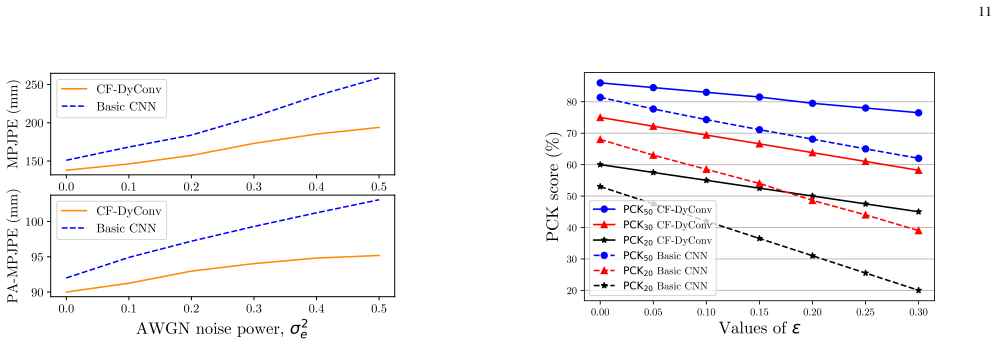
WiLHPE shows that a student network fed only raw multi-antenna CSI can recover human keypoints at state-of-the-art accuracy when its convolutional kernels are dynamically re-weighted by joint channel-frequency attention; the same lightweight architecture remains accurate under substantial additive noise and requires far fewer parameters than earlier WiFi pose models.
Load-bearing premise
The camera-derived keypoints used as training labels are assumed accurate enough that a CSI-only student can safely treat them as ground truth, and that the multipath statistics of the two laboratory setups transfer to real rooms.
Editorial analysis
A structured set of objections, weighed in public.
Referee Report
Summary. The paper proposes WiLHPE, a teacher-student framework for WiFi CSI-based 2D human pose estimation. A fixed vision teacher (HRNet-w48) supplies keypoint labels from RGB frames; the student processes raw CSI via a stack of CF-DyNet blocks whose core operator, CF-DyConv, generates dynamic kernels by multiplicative channel- and frequency-domain attention (Eqs. 3–7). Hyper-parameters (r, τ, n, architecture widths) are selected by TPE. On the public MM-Fi (P3-S1) and WiPose datasets the method reports 85.96 % / 94.27 % PCK50 with 1.78–3.49 M parameters, outperforming MetaFi++ and several earlier WiFi HPE baselines, and retains ~80 % PCK50 under AWGN (σ²=0.5) and moderate FGSM attacks.
Significance. If the relative gains hold under the same teacher-label protocol used by prior work, the paper supplies a practically useful lightweight architecture for privacy-preserving, camera-free pose estimation on commodity WiFi. Strengths that should be credited include: (i) explicit multi-protocol / multi-setting tables on two public datasets, (ii) controlled robustness curves (AWGN + FGSM) that isolate the benefit of CF-DyConv over plain CNN, (iii) ablations of kernel count n, reduction ratio r and temperature τ, and (iv) a complexity argument showing the extra Mult-Adds remain modest. These elements make the engineering contribution reproducible and immediately usable by the wireless-sensing community.
major comments (3)
- Section IV-B and all reported metrics (Tables II, III, IV; Figs. 6–11) evaluate the student exclusively against 2-D keypoints produced by a fixed HRNet-w48 teacher. No teacher-error audit, cross-teacher ablation, or independent geometric ground truth (mocap / multi-view triangulation) is supplied. Consequently the absolute PCK/MPJPE numbers and the claimed superiority over MetaFi++ measure fidelity to the teacher rather than to true pose; any systematic teacher bias (occlusion, depth ambiguity, upper-body motion noted in §V-B1) is inherited by every figure. This is load-bearing for the SOTA claim and should be quantified or at least bounded.
- Abstract and Table IIa list average PCK50 = 85.96 % on MM-Fi, yet Table IV reports 85.26 % for the identical WiLHPE entry under P3-S1. The 0.7-point discrepancy is never explained; it undermines numerical trustworthiness of the central comparison.
- No multi-seed statistics, standard deviations or confidence intervals accompany any table or figure. Given that TPE is used for hyper-parameter search and that CSI multipath is environment-dependent, single-run point estimates leave open the possibility that the reported margins over MetaFi++ (≈2–4 % PCK) are within run-to-run variance.
minor comments (5)
- Section heading “IV. PROPOSEDWILPHE FRAMEWORK” contains a typographical error (missing space and “WiLPHE” vs. “WiLHPE”).
- Eq. (1) uses φ for both phase and the argument of the Dirac delta; the time-delay variable should be distinguished.
- Fig. 3 caption and surrounding text refer to “CF-DyNet blocks” while the figure itself shows only the attention paths of CF-DyConv; a clearer separation of the two would help readers.
- Several places write “A WGN” or “A WGN noise”; consistent “AWGN” is preferable.
- Table I lists “314” subcarriers for MM-Fi while the text and MetaFi++ literature usually cite 114; a brief clarification of the CSI extraction pipeline would remove ambiguity.
Circularity Check
No circularity: empirical NN architecture and held-out metrics against external teacher labels; no derivation reduces to inputs by construction.
full rationale
WiLHPE is an engineering paper that defines a student network (CF-DyNet with CF-DyConv attention over channel/frequency) trained by MSE (Eq. 10) to 2-D keypoints produced by a fixed external vision teacher (HRNet-w48). Test PCK/MPJPE numbers (Tables II–IV, Figs. 6–11) are computed on held-out CSI frames from public datasets (MM-Fi, WiPose) under that same supervision. Hyperparameters (r, τ, n, batch size, kernel size) are selected by TPE on validation performance (Algorithm 1, Section IV-B), which is ordinary model selection and does not force the reported test scores by construction. Complexity claims follow directly from counting Mult-Adds of the attention and aggregation stages (Section IV-A). Self-citations ([1], [48]–[52]) refer to related prior systems by overlapping authors but are not load-bearing for the numerical superiority claims; those rest on the new architecture and the tabulated comparisons. No equation equates a claimed accuracy or uniqueness result to a fitted constant, no uniqueness theorem is imported, and no known empirical pattern is merely renamed. The derivation chain is therefore self-contained and non-circular.
Assumptions & free parameters
free parameters (4)
- reduction ratio r =
16
- temperature τ =
30
- number of kernels n =
3
- CF-DyNet depth M and channel widths n1/n2 =
M=3, n1=64, n2=128
assumptions (4)
- domain assumption CSI multipath amplitude/phase across antennas and subcarriers is sufficiently altered by human joint positions to allow fine-grained pose recovery.
- domain assumption 2D keypoints extracted by a pre-trained vision model (HRNet-w48) are accurate enough to serve as ground-truth supervision for the CSI student.
- ad hoc to paper Mean-squared error on keypoint coordinates is an adequate training objective for high-resolution CSI.
- standard math Standard convolution, ReLU, softmax and global-average-pooling operators behave as usual.
invented entities (2)
-
CF-DyConv (channel-frequency dynamic convolution)
-
WiLHPE / CF-DyNet student network
Cite this review
Pith. "Pith review of Seeing Through WiFi: Lightweight Human Pose Estimation with Dynamic Kernel Attention." pith.science (2026). https://pith.science/paper/NGBXZAXU
@misc{pith2026260703196,
  author       = {Pith},
  title        = {Pith review of: Seeing Through WiFi: Lightweight Human Pose Estimation with Dynamic Kernel Attention},
  year         = {2026},
  howpublished = {\url{https://pith.science/paper/NGBXZAXU}},
  note         = {Machine review of arXiv:2607.03196}
}
read the original abstract
WiFi-based human pose estimation (HPE) enables the detection and interpretation of human body positions and movements without the need for wearable devices while preserving individual privacy concerns. Implementing this solution requires enhancing model performance and maintaining efficiency, especially on resource-constrained devices. This paper introduces a novel framework, WiLHPE, for lightweight and efficient human pose estimation using WiFi CSI signals. Empowered by a camera-based model during training, WiLHPE processes raw WiFi signals directly to estimate human poses in the testing phase. It employs a novel neural network architecture to dynamically learn convolutional kernels and apply attention mechanisms across channel and frequency spaces. This innovative method diversifies the kernels to improve the recognition capabilities of WiFi signals without adding complexity, ensuring efficiency. Additionally, the Tree-Structured Parzen Estimator algorithm is employed to optimize the critical hyperparameters of the neural network efficiently, minimizing the time required for optimal hyperparameter search compared to heuristic methods. Results from experiments on both the MM-Fi and WiPose datasets highlight the superiority of WiLHPE over state-of-the-art approaches, achieving 85.96% and 94.27% at PCK50, respectively, with minimal computational overhead. Notably, WiLHPE performs impressively even under challenging conditions, maintaining around 80% at PCK50 under AWGN noise with an error variance of 0.5.
Figures


Figures from the paper (7 more)



Reference graph
Works this paper leans on
-
[1]
WiLHPE: WiFi-enabled lightweight channel frequency dynamic convolution for HPE tasks,
T. D. Gian, T.-H. Nguyen, N. T. Nguyen, and V .-D. Nguyen, “WiLHPE: WiFi-enabled lightweight channel frequency dynamic convolution for HPE tasks,” inInt. Conf. Commun. Elect. (ICCE), 2024, pp. 516–521
2024
-
[2]
Human activity recognition: A survey,
C. Jobanputra, J. Bavishi, and N. Doshi, “Human activity recognition: A survey,”Procedia Computer Science, vol. 155, pp. 698–703, 2019
2019
-
[3]
Human activity recognition: A review,
O. C. Ann and L. B. Theng, “Human activity recognition: A review,” inIEEE Int. Confe. Cont. Sys., Compu. and Engi. (ICCSCE), 2014, pp. 389–393
2014
-
[4]
A survey on human activity recognition using wearable sensors,
O. D. Lara and M. A. Labrador, “A survey on human activity recognition using wearable sensors,”IEEE Commun. Sur. Tut., vol. 15, no. 3, pp. 1192–1209, 2013
2013
-
[5]
Human activity recognition using wearable sensors by deep convolutional neural networks,
W. Jiang and Z. Yin, “Human activity recognition using wearable sensors by deep convolutional neural networks,” pp. 1307–1310, 2015
2015
-
[6]
A review on video-based human activity recognition,
S.-R. Ke, H. L. U. Thuc, Y .-J. Lee, J.-N. Hwang, J.-H. Yoo, and K.-H. Choi, “A review on video-based human activity recognition,”Computers, vol. 2, no. 2, pp. 88–131, 2013
2013
-
[7]
A survey on video-based human action recognition: recent updates, datasets, challenges, and applications,
P. Pareek and A. Thakkar, “A survey on video-based human action recognition: recent updates, datasets, challenges, and applications,”Artif. Intell. Rev., vol. 54, no. 3, pp. 2259–2322, mar 2021
2021
-
[8]
Through-wall human mesh recovery using radio signals,
M. Zhao, Y . Liu, A. Raghu, H. Zhao, T. Li, A. Torralba, and D. Katabi, “Through-wall human mesh recovery using radio signals,”Int. Conf. Comput. Vis., pp. 10 112–10 121, 2019
2019
Show all 56 references
-
[9]
RF-based 3D skeletons,
M. Zhaoet al., “RF-based 3D skeletons,”Proc. 2018 Conf. ACM Special Interest Group on Data Commun., 2018
2018
-
[10]
Pose estimation at night in infrared images using a lightweight multi-stage attention network,
Y . Zang, C.-N. Fan, Z. Zheng, and D. Yang, “Pose estimation at night in infrared images using a lightweight multi-stage attention network,” Signal, Image and Video Processing, vol. 15, pp. 1757 – 1765, 2021. 13
2021
-
[11]
Wireless sensing for human activity: A survey,
J. Liu, H. Liu, Y . Chen, Y . Wang, and C. Wang, “Wireless sensing for human activity: A survey,”IEEE Commun. Sur. & Tut., vol. 22, no. 3, pp. 1629–1645, 2020
2020
-
[12]
A survey on behavior recognition using WiFi channel state information,
S. Yousefi, H. Narui, S. Dayal, S. Ermon, and S. Valaee, “A survey on behavior recognition using WiFi channel state information,”IEEE Commun. Mag., vol. 55, no. 10, pp. 98–104, 2017
2017
-
[13]
Tool release: gathering 802.11n traces with channel state information,
D. Halperin, W. Hu, A. Sheth, and D. Wetherall, “Tool release: gathering 802.11n traces with channel state information,” vol. 41, no. 1, p. 53, Jan. 2011
2011
-
[14]
Human activity recognition across scenes and categories based on csi,
Y . Zhang, X. Wang, Y . Wang, and H. Chen, “Human activity recognition across scenes and categories based on csi,”IEEE Trans. Mobile Comput,, vol. 21, no. 7, pp. 2411–2420, 2022
2022
-
[15]
Towards 3D human pose construction using WiFi,
W. Jianget al., “Towards 3D human pose construction using WiFi,” Proc. 26th Annual Inter. Conf. Mobile Comput. and Net., 2020
2020
-
[16]
From signal to image: Capturing fine-grained human poses with commodity WiFi,
L. Guo, Z. Lu, X. Wen, S. Zhou, and Z. Han, “From signal to image: Capturing fine-grained human poses with commodity WiFi,”IEEE Commun. Lett., vol. 24, no. 4, pp. 802–806, 2020
2020
-
[17]
Can WiFi estimate person pose?
F. Wang, S. Panev, Z. Dai, J. Han, and D. Huang, “Can WiFi estimate person pose?”Clinical Orthopaedics and Related Research(CORR), vol. abs/1904.00277, 2019
1904 arXiv
-
[18]
MetaFi: Device-free pose estimation via commodity WiFi for metaverse avatar simulation,
J. Yang, Y . Zhou, H. Huang, H. Zou, and L. Xie, “MetaFi: Device-free pose estimation via commodity WiFi for metaverse avatar simulation,” inProc. IEEE 8th World Int. of Things (WF-IoT), 2022, pp. 1–6
2022
-
[19]
MetaFi++: WiFi-enabled transformer-based human pose estimation for metaverse avatar simulation,
Y . Zhou, H. Huang, S. Yuan, H. Zou, L. Xie, and J. Yang, “MetaFi++: WiFi-enabled transformer-based human pose estimation for metaverse avatar simulation,”IEEE Internet of Things J., vol. 10, no. 16, pp. 14 128–14 136, 2023
2023
-
[20]
MM-Fi: Multi-modal non-intrusive 4D human dataset for versatile wireless sensing,
J. Yang, H. Huang, Y . Zhou, X. Chen, Y . Xu, S. Yuan, H. Zou, C. X. Lu, and L. Xie, “MM-Fi: Multi-modal non-intrusive 4D human dataset for versatile wireless sensing,” inProc. Thirty-seventh Conf. Neural Infor. Process. Sys. Data. and Bench. Track, 2023. [Online]. Available: ...
2023
-
[21]
Algorithms for hyper- parameter optimization,
J. Bergstra, R. Bardenet, Y . Bengio, and B. Kégl, “Algorithms for hyper- parameter optimization,” inProc. Neural Infor. Process. Sys., 2011. [Online]. Available: https://api.semanticscholar.org/CorpusID:11688126
2011
-
[22]
Perunet: Deep signal channel attention in unet for WiFi-based human pose estimation,
Y . Zhou, A. Zhu, C. Xu, F. Hu, and Y . Li, “Perunet: Deep signal channel attention in unet for WiFi-based human pose estimation,”IEEE Sensors J., vol. 22, no. 20, pp. 19 750–19 760, 2022
2022
-
[23]
See through walls with WiFi!
F. Adib and D. Katabi, “See through walls with WiFi!” vol. 43, no. 4. New York, NY , USA: Asso. Comp. Mach., aug 2013, pp. 75–86
2013
-
[24]
SpotFi: Decimeter level localization using WiFi,
M. Kotaru, K. Joshi, D. Bharadia, and S. Katti, “SpotFi: Decimeter level localization using WiFi,” inProc. SIGCOMM Comput. Commun. Rev., vol. 45, no. 4. New York, NY , USA: Asso. Comp. Mach., aug 2015, pp. 269–282
2015
-
[25]
Extracting gait velocity and stride length from surrounding radio signals,
C.-Y . Hsu, Y . Liu, Z. Kabelac, R. Hristov, D. Katabi, and C. Liu, “Extracting gait velocity and stride length from surrounding radio signals,” inProc. CHI Conf. Hum. Fact. Compu. Sys., ser. CHI ’17. New York, NY , USA: Asso. Comp. Mach., 2017, pp. 2116–2126
2017
-
[26]
Gait recognition using WiFi signals,
W. Wanget al., “Gait recognition using WiFi signals,” inProc. ACM Int. Joint Conf. Perva. Ubi. Compu., ser. UbiComp ’16. New York, NY , USA: Asso. Comp. Mach., 2016, pp. 363–373
2016
-
[27]
Smart homes that monitor breathing and heart rate,
F. Adib, H. Mao, Z. Kabelac, D. Katabi, and R. C. Miller, “Smart homes that monitor breathing and heart rate,” inProc. 33rd Annual ACM Conf. Human Fact. Comput. Sys.New York, NY , USA: Asso. Comp. Mach., 2015, pp. 837–846
2015
-
[28]
From fresnel diffraction model to fine-grained human respiration sens- ing with commodity Wi-Fi devices,
F. Zhang, D. Zhang, J. Xiong, H. Wang, K. Niu, B. Jin, and Y . Wang, “From fresnel diffraction model to fine-grained human respiration sens- ing with commodity Wi-Fi devices,”Proc. ACM Interact. Mob. Wearable Ubiquitous Technol., vol. 2, no. 1, mar 2018
2018
-
[29]
WFID: Passive device-free human identification using WiFi signal,
F. Hong, X. Wang, Y . Yang, Y . Zong, Y . Zhang, and Z. Guo, “WFID: Passive device-free human identification using WiFi signal,” ser. MO- BIQUITOUS 2016. New York, NY , USA: Asso. Comp. Mach., 2016, pp. 47–56
2016
-
[30]
WiWho: WiFi-based person identification in smart spaces,
Y . Zeng, P. H. Pathak, and P. Mohapatra, “WiWho: WiFi-based person identification in smart spaces,” inProc. 15th ACM/IEEE Inter. Conf. Infor. Process. Sensor Netw. (IPSN), 2016, pp. 1–12
2016
-
[31]
Enabling contactless detection of moving humans with dynamic speeds using CSI,
K. Qian, C. Wu, Z. Yang, Y . Liu, F. He, and T. Xing, “Enabling contactless detection of moving humans with dynamic speeds using CSI,” vol. 17, no. 2, Jan. 2018
2018
-
[32]
PADS: Passive detection of moving targets with dynamic speed using PHY layer information,
K. Qian, C. Wu, Z. Yang, Y . Liu, and Z. Zhou, “PADS: Passive detection of moving targets with dynamic speed using PHY layer information,” in Proc. IEEE Inter. Conf. Para. Dist. Sys. (ICPADS), 2014, pp. 1–8
2014
-
[33]
WiFi CSI based passive human activity recognition using attention based BLSTM,
Z. Chen, L. Zhang, C. Jiang, Z. Cao, and W. Cui, “WiFi CSI based passive human activity recognition using attention based BLSTM,”IEEE Trans. Mobile Comput., vol. 18, no. 11, pp. 2714–2724, 2019
2019
-
[34]
Environment-robust device-free human activity recognition with channel-state-information enhancement and one-shot learning,
Z. Shi, J. A. Zhang, R. Y . Xu, and Q. Cheng, “Environment-robust device-free human activity recognition with channel-state-information enhancement and one-shot learning,”IEEE Trans. Mobile Comput., vol. 21, no. 2, pp. 540–554, 2022
2022
-
[35]
Openpose: Realtime multi-person 2D pose estimation using part affinity fields,
Z. Cao, G. Hidalgo, T. Simon, S.-E. Wei, and Y . Sheikh, “Openpose: Realtime multi-person 2D pose estimation using part affinity fields,” IEEE Trans. Patt. Ana. and Mach. Int., vol. 43, pp. 172–186, 2018
2018
-
[36]
Rmpe: Regional multi-person pose estimation,
H.-S. Fang, S. Xie, Y .-W. Tai, and C. Lu, “Rmpe: Regional multi-person pose estimation,” inInt. Conf. Comput. Vis., 2017, pp. 2353–2362
2017
-
[37]
HumanEva: Synchronized video and motion capture dataset and baseline algorithm for evaluation of articulated human motion,
L. Sigal, A. Balan, and M. J. Black, “HumanEva: Synchronized video and motion capture dataset and baseline algorithm for evaluation of articulated human motion,”Inter. J. Comp. Vis., vol. 87, no. 1, pp. 4–27, Mar. 2010
2010
-
[38]
Microsoft kinect sensor and its effect,
Z. Zhang, “Microsoft kinect sensor and its effect,”IEEE MultiMedia, vol. 19, no. 2, pp. 4–10, 2012
2012
-
[39]
Human sensing using visible light communication,
T. Li, C. An, T. Zhao, A. T. Campbell, and X. Zhou, “Human sensing using visible light communication,”Proc. Ann. Int. Conf. Mobi. Comp. Net., 2015. [Online]. Available: https://api.semanticscholar.org/ CorpusID:7473648
2015
-
[40]
V oxNet: A 3D convolutional neural network for real-time object recognition,
D. Maturana and S. Scherer, “V oxNet: A 3D convolutional neural network for real-time object recognition,” inProc. IEEE/RSJ Int. Confer. Intel. Rob. and Sys. (IROS), 2015, pp. 922–928
2015
-
[41]
Capturing the human figure through a wall,
F. Adib, C.-Y . Hsu, H. Mao, D. Katabi, and F. Durand, “Capturing the human figure through a wall,”ACM Trans. Graph., vol. 34, no. 6, 2015
2015
-
[42]
Through-wall human pose estimation using radio signals,
M. Zhao, T. Li, M. A. Alsheikh, Y . Tian, H. Zhao, A. Torralba, and D. Katabi, “Through-wall human pose estimation using radio signals,” IEEE Conf. Comput. Vis. Pattern Recog., pp. 7356–7365, 2018
2018
-
[43]
Squeeze-and-excitation networks,
J. Hu, L. Shen, and G. Sun, “Squeeze-and-excitation networks,” inIEEE Conf. Comput. Vis. Pattern Recog., 2018, pp. 7132–7141
2018
-
[44]
Dynamic convolution: Attention over convolution kernels,
Y . Chen, X. Dai, M. Liu, D. Chen, L. Yuan, and Z. Liu, “Dynamic convolution: Attention over convolution kernels,”IEEE Conf. Comput. Vis. Pattern Recog., pp. 11 027–11 036, 2019
2019
-
[45]
Omni-dimensional dynamic convolution,
C. Li, A. Zhou, and A. Yao, “Omni-dimensional dynamic convolution,” ArXiv, vol. abs/2209.07947, 2022
2022 arXiv
-
[46]
Frequency dynamic convolution: Frequency-adaptive pattern recognition for sound event detection,
H. Nam, S.-H. Kim, B. Ko, and Y .-H. Park, “Frequency dynamic convolution: Frequency-adaptive pattern recognition for sound event detection,” inInterspeech, 2022
2022
-
[47]
Selective kernel networks,
X. Li, W. Wang, X. Hu, and J. Yang, “Selective kernel networks,”CVPR, pp. 510–519, 2019
2019
-
[48]
Robust WiFi sensing-based human pose estimation using denoising autoencoder and CNN with dynamic subcarrier attention,
X. Hoang Nguyen, V .-D. Nguyen, Q.-T. Luu, T. Dinh Gian, and O.- S. Shin, “Robust WiFi sensing-based human pose estimation using denoising autoencoder and CNN with dynamic subcarrier attention,” IEEE Internet of Things J., vol. 12, no. 11, pp. 17 066–17 079, 2025
2025
-
[49]
Multi-modal human pose estimation: A Wi-Fi-driven approach with adaptive kernel selection,
T. D. Gian, D. T. Tran, Q.-V . Pham, L.-N. Tran, and V .-D. Nguyen, “Multi-modal human pose estimation: A Wi-Fi-driven approach with adaptive kernel selection,”IEEE Transactions on Artificial Intelligence, pp. 1–14, 2025
2025
-
[50]
WiLHPE: WiFi-enabled lightweight channel frequency dynamic convolution for HPE tasks,
T. D. Gian, T.-H. Nguyen, N. T. Nguyen, and V .-D. Nguyen, “WiLHPE: WiFi-enabled lightweight channel frequency dynamic convolution for HPE tasks,” in2024 Tenth Int. Conf. on Comm. and Elect. (ICCE), 2024, pp. 516–521
2024
-
[51]
HPE-Li: WiFi-enabled lightweight dual selective kernel convolution for human pose estimation,
T. D. Gian, T. Dac Lai, T. Van Luong, K.-S. Wong, and V .-D. Nguyen, “HPE-Li: WiFi-enabled lightweight dual selective kernel convolution for human pose estimation,” inEuro. Conf. Comput. Vision (ECCV). Springer, 2024, pp. 93–111
2024
-
[52]
TinySense: Effective CSI compression for scalable and accurate Wi-Fi sensing,
T. D. Gian, D. T. Tran, V . Q. Pham, F. Restuccia, and V .-D. Nguyen, “TinySense: Effective CSI compression for scalable and accurate Wi-Fi sensing,”IEEE Int. Conf. on Pervasive Comput. Comm., 2026
2026
-
[53]
Deep 3D human pose estimation: A review,
J. Wang, S. Tan, X. Zhen, S. Xu, F. Zheng, Z. He, and L. Shao, “Deep 3D human pose estimation: A review,”Computer Vision and Image Understanding, vol. 210, p. 103225, 2021
2021
-
[54]
From point to space: 3D moving human pose estimation using commodity WiFi,
Y . Wang, L. Guo, Z. Lu, X. Wen, S. Zhou, and W. Meng, “From point to space: 3D moving human pose estimation using commodity WiFi,” IEEE Commun. Lett., vol. 25, no. 7, pp. 2235–2239, 2021
2021
-
[55]
WiLDAR: WiFi signal-based lightweight deep learning model for human activity recognition,
F. Deng, E. Jovanov, H. Song, W. Shi, Y . Zhang, and W. Xu, “WiLDAR: WiFi signal-based lightweight deep learning model for human activity recognition,”IEEE Internet of Things J., vol. 11, no. 2, pp. 2899–2908, 2024
2024
-
[56]
On the robustness of 3D human pose estimation,
Z. Chen, Y . Huang, and L. Wang, “On the robustness of 3D human pose estimation,” inProc. 25th Inter. Conf. Patt. Recog. (ICPR), 2021, pp. 5326–5332
2021
Reviewed July 12, 2026 · model on record in the stance chip above.
Discussion (0). Sign in to comment.