REVIEW 4 major objections 5 minor 72 references
A new deterministic phonon-BTE solver reproduces reference device temperature and heat-flux fields while cutting runtime through a synthetic diffusion coupling and parallel band-direction task decomposition.
Reviewed by Pith at T0; open to challenge. T0 means a machine referee read the full paper against a public rubric. the ladder, T0–T4 →
T0 review · deepseek-v4-flash
2026-08-02 08:51 UTC pith:RASVN5AT
load-bearing objection Useful, public phonon-BTE solver with credible parallelization and performance data; accuracy claims rest on code-to-code agreement with GiftBTE and an unverified synthetic-scheme equivalence. the 4 major comments →
NanoBTE: Fast Iterative Solution of the Phonon Boltzmann Transport Equation for Nanoscale Heat Transport
The pith
A machine-rendered reading of the paper's core claim, the machinery that carries it, and where it could break.
Core claim
The central claim is that the synthetic iterative scheme and the band-direction task-parallel layout together make deterministic non-gray phonon BTE simulation of realistic three-dimensional device geometries practical without loss of accuracy. Concretely, the paper demonstrates on an in-plane two-dimensional material, a cross-plane diamond film, and three-dimensional FinFET and stacked-nanosheet gate-all-around structures that the converged temperature and heat-flux profiles match the reference solver, while iteration time drops with core count and with GPU offload of phase-space reductions. The retained non-Fourier correction is what lets the method stay accurate in the ballistic-to-diffus
What carries the argument
The key object is the synthetic iterative scheme, which splits the heat flux into a Fourier part −κbulk∇T and a non-Fourier correction q_nonF, and uses ∇·q_nonF as the source of a macroscopic diffusion equation that updates the lattice temperature between microscopic solves. Around it, the implementation precomputes and factorizes the sparse transport matrix of each band-direction pair once, then reuses the factorization; band-direction tasks are spread round-robin over parallel ranks, and the per-iteration moment reductions are offloaded to GPUs.
Load-bearing premise
The accuracy claim rests on the unproven equivalence of the synthetic and sequential iterations' fixed points, together with the correctness of the reference solver used for comparison.
What would settle it
Run both the sequential and the synthetic schemes on the same mesh, quadrature, and boundary conditions to tight convergence and compare the converged temperature fields; any difference beyond discretization error would show the acceleration changes the solution. A stronger test would compare quasi-ballistic temperature jumps in a thin film against an independent Monte Carlo phonon simulation.
If this is right
- Full-device self-heating simulations of scaled FinFETs and gate-all-around transistors become feasible with deterministic, noise-free phonon transport.
- The synthetic scheme keeps the runtime near the diffusive limit manageable, so Fourier-based approximations are no longer required just for cost reasons.
- The task decomposition makes wall-time drop as parallel ranks are added on unstructured meshes without spatial partitioning.
- Cached transport factorizations make repeated simulations with different heating or boundary conditions cheaper, enabling parameter sweeps.
Where Pith is reading between the lines
- The same synthetic coupling could be carried into transient BTE solvers, where the diffusion equation would provide a global temperature update at each time step; the paper only treats steady state.
- Because the validation compares two solvers that share the synthetic scheme, an independent test—say, a Monte Carlo phonon simulation or a thermoreflectance experiment in the quasi-ballistic regime—would more directly test the underlying transport physics.
- The band-direction task decomposition is general enough that it could accelerate other kinetic equations with separable phase space, such as radiative transfer or rarefied gas flow.
Editorial analysis
A structured set of objections, weighed in public.
Referee Report
Summary. This manuscript presents NanoBTE, a deterministic finite-volume solver for the steady-state, non-gray phonon Boltzmann transport equation under the relaxation-time approximation. The solver supports band-resolved phonon properties, discrete-ordinates angular quadrature, volumetric heat sources, thermalizing/diffuse/specular boundary conditions, and complex 2D/3D geometries. It implements both a sequential iteration and a synthetic iterative scheme that couples the microscopic transport solve with a macroscopic diffusion-type temperature equation. Parallelization is via round-robin band–direction task decomposition over MPI ranks, with an optional GPU offload for the moment reductions. Validation is presented for in-plane MoS2, cross-plane diamond, FinFET, and GAAFET benchmark structures, comparing temperature and heat-flux profiles against GiftBTE, and CPU/GPU performance is benchmarked. The central claim is that NanoBTE reproduces GiftBTE's distributions while substantially improving computational efficiency, establishing it as an accurate, efficient, and scalable framework for nanoscale phonon transport simulations.
Significance. If the central claim is fully substantiated, NanoBTE would be a genuinely useful open-source deterministic tool for nanoscale thermal simulation: it is public, supports realistic non-gray phonon data, handles complex device geometries and boundary conditions, and uses a sensible task-parallel strategy with a clear separation between cached linear solves and data-parallel reductions. The code-to-code agreement with GiftBTE is visually good, and the reported efficiency improvements are plausible. However, the accuracy claim currently rests on a consistency check with GiftBTE, a code that itself implements the same synthetic iterative scheme. The synthetic scheme's boundary conditions are unspecified, and its fixed-point equivalence with the sequential scheme is asserted rather than demonstrated. No quantitative error metrics, independent-reference comparisons, or discretization-convergence studies are provided. The framework is therefore promising and likely correct, but the paper does not yet justify the strong word 'accurate' in the conclusion.
major comments (4)
- [§II, Eq. (10) and Eq. (12)] The synthetic scheme is under-specified. Equation (10) is a second-order diffusion-type PDE and requires boundary conditions, but none are given. The thermalizing, diffuse, and specular conditions used in the microscopic transport solves cannot be directly translated into boundary conditions for T_L without additional modeling. Moreover, the paper asserts—via Refs. [16,27]—that the synthetic iteration and the sequential iteration converge to the same fixed point of the discretized BTE, but no proof or numerical demonstration is provided for the discrete scheme used here. Since the accuracy claim concerns the converged solution, please (i) state the boundary conditions for Eq. (10), and (ii) demonstrate the fixed-point equivalence numerically, e.g., by reporting the maximum/mean difference between converged T and q fields obtained with the sequential and synthetic schemes for representati
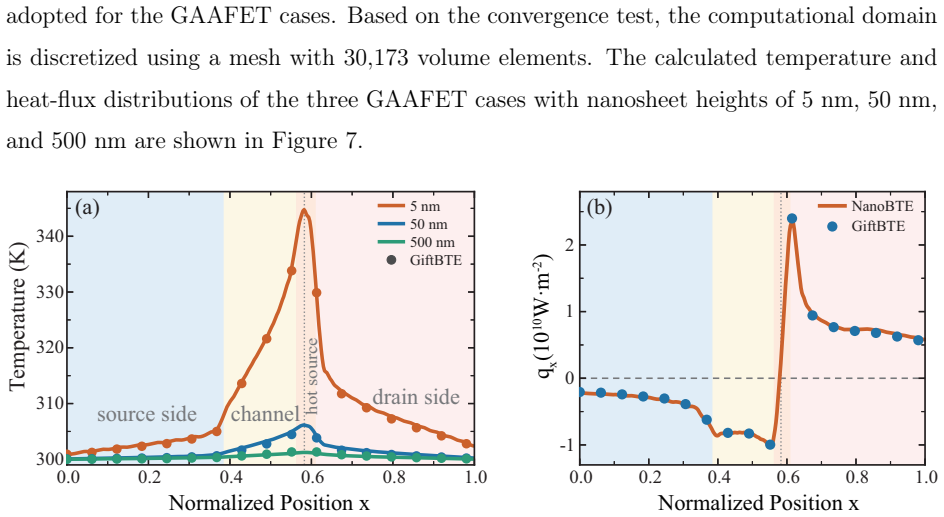
- [§III, Figs. 2, 5, 8] Validation is performed only by visual overlay with GiftBTE, with no quantitative error metric. GiftBTE itself implements the same synthetic iterative scheme (Refs. 18–20), so this comparison is a consistency check that cannot expose shared algorithmic assumptions or common-mode implementation errors. To support the claim that NanoBTE is 'accurate,' please provide numerical deviations (e.g., L2 or relative errors for temperature and heat flux), and ideally include an independent check—such as comparison with Monte Carlo, DUGKS, analytical ballistic/diffusive limits, or a manufactured-solution convergence/verification test.
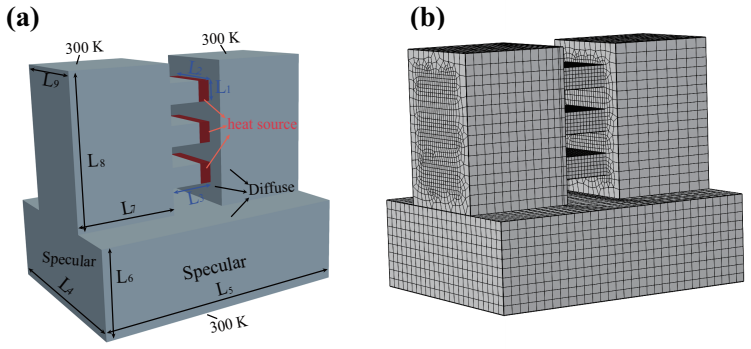
- [§III.B.1 and §III.B.2] The manuscript states that 'based on the convergence test,' 15 phonon bands, 64 directions, and 25,840 (FinFET) or 30,173 (GAAFET) meshes are used, but no convergence data are shown. Likewise, the MoS2/diamond benchmarks fix the mesh at 200×200 cells, 12 bands, and 32 directions without a convergence study. Without demonstrating that the reported peak temperatures and profiles are converged with respect to spatial mesh, angular quadrature, and band discretization, the quantitative conclusions—e.g., 410 K vs. 320 K for FinFET, 340 K vs. 310 K for GAAFET—are not firmly established. Please include a convergence table or figures showing the sensitivity/error of temperature and flux as these discretization parameters are refined.
- [§IV, Fig. 9] The efficiency comparison reports per-iteration wall-clock times but does not state convergence tolerances, total iteration counts, or the exact configuration of GiftBTE (version, solver settings, convergence criteria). If the two codes use different stopping tolerances or different linear solvers/preconditioners, the runtime comparison is not apples-to-apples. Please specify the convergence criteria for both codes, report total iteration counts or total wall time to reach the same tolerance, and describe the GiftBTE setup used.
minor comments (5)
- [Abstract] The abstract contains a nearly repeated sentence about 'both sequential and synthetic iterative options' being implemented for the steady-state solution; consider streamlining.
- [Fig. 2 caption] In Figure 2, the legend appears to label only GiftBTE, while the NanoBTE curves are not explicitly identified in the legend/caption. Please make the line styles/legend explicit for both solvers.
- [§III.A] Typo: 'Accumulant lattice thermal conductivity' should likely read 'Cumulative lattice thermal conductivity.'
- [Eq. (4)] The source term S_λi in Eq. (4) is not explicitly defined in the methods section; the text later describes how the heat source is distributed over bands and directions, but a formal definition in the notation of Eq. (4) would improve reproducibility.
- [References] Reference [1] appears malformed (missing author/title). Also, the bibliography formatting is inconsistent; please check journal style.
Circularity Check
No significant circularity: the solver algorithms are adopted from independent prior work and validated against an external code; remaining concerns are validation scope, not circular construction.
full rationale
The paper does not derive its predictions from fitted inputs. The sequential iteration (Eqs. 4-6) and synthetic iteration (Eqs. 7-11) are presented as implementations of the phonon BTE with a macro-micro coupling scheme taken from Refs. [16,27], which are independent prior works by other authors. No parameter is calibrated to match the benchmark temperature or heat-flux fields, and the only external comparison is a code-to-code check against GiftBTE (Refs. 18-20), also an independent implementation. The central claimed result, that NanoBTE reproduces GiftBTE distributions with better efficiency, is a consistency and performance claim rather than a derivation that presupposes its conclusion. The main limitation is that GiftBTE itself uses a similar synthetic iterative scheme, so common-mode modeling assumptions would not be exposed by the overlay comparison; this is a validation gap and a correctness risk, not a case of the result being true by construction. The paper is self-contained with respect to its stated algorithmic content, and no self-definitional, fitted-input-as-prediction, or self-citation-load-bearing circularity is present.
Axiom & Free-Parameter Ledger
free parameters (4)
- Phonon band count =
12 bands (MoS2/diamond), 15 bands (silicon devices)
- Angular quadrature order =
32 directions (MoS2/diamond), 64 directions (silicon devices)
- Spatial mesh size =
40,000 cells (MoS2/diamond), 25,840 cells (FinFET), 30,173 cells (GAAFET)
- Heat-source intensity scaling =
1.5e19, 1.5e17, 1.5e15 W/m^3 for 1x, 10x, 100x scaled geometries
axioms (6)
- domain assumption Phonon transport is described by the relaxation-time approximation; phonon-phonon interactions are represented by a mode-dependent relaxation time independent of the non-equilibrium distribution (Eq. 1).
- domain assumption Local equilibrium occupation is a Bose-Einstein distribution with a local temperature T(r) (Eq. 2).
- ad hoc to paper The heat flux can be decomposed as q = -kappa_bulk grad T_L + q_nonF in the diffusive limit (Eq. 8), with q_nonF extracted from the phonon distribution (Eq. 9).
- ad hoc to paper The synthetic and sequential iterative schemes converge to the same fixed point of the discretized BTE.
- domain assumption Device boundaries follow thermalizing, diffuse, and specular reflection models.
- domain assumption Heat generation is modeled as an equilibrium phonon source distributed across bands by modal heat capacities.
read the original abstract
Nanoscale heat dissipation has become a critical challenge in advanced semiconductor devices, where phonon transport can strongly deviate from the classical Fourier description due to the boundary scattering and ballistic effects. In this work, we propose NanoBTE, a deterministic finite-volume solver for the non-gray phonon Boltzmann transport equation under the relaxation-time approximation. The solver supports complex two- and three-dimensional geometries, band-resolved phonon properties, discrete-ordinates angular quadrature, volumetric heat generation, and multiple phonon boundary conditions, including thermalizing, diffuse, and specular reflections. %To improve the efficiency of multiscale simulations, both sequential and synthetic iterative schemes are implemented, where the latter couples the microscopic phonon transport equation with a macroscopic diffusion-type temperature equation to accelerate convergence in near-diffusive regimes. Both sequential and synthetic iterative options are implemented for the steady-state solution. Furthermore, NanoBTE adopts a band-direction task decomposition strategy, enabling efficient MPI-based CPU parallelization and GPU acceleration of the dominant sparse transport operations.
Figures






Reference graph
Works this paper leans on
-
[1]
, title =
Ziman, John M. , title =. 1960 , publisher =
1960
-
[2]
Nano Research , year =
Pop, Eric , title =. Nano Research , year =
-
[3]
Thermal conductivity of isotopically enriched 28Si: revisited , journal =. 2004 , issn =. doi:https://doi.org/10.1016/j.ssc.2004.06.022 , author =
-
[4]
ACS applied materials & interfaces , volume=
Measurement of lateral and interfacial thermal conductivity of single-and bilayer MoS2 and MoSe2 using refined optothermal Raman technique , author=. ACS applied materials & interfaces , volume=. 2015 , publisher=
2015
-
[5]
Computer Physics Communications , volume=
ShengBTE: A solver of the Boltzmann transport equation for phonons , author=. Computer Physics Communications , volume=. 2014 , publisher=
2014
-
[6]
Journal of Physics: Condensed Matter , volume=
GiftBTE: an efficient deterministic solver for non-gray phonon Boltzmann transport equation , author=. Journal of Physics: Condensed Matter , volume=. 2024 , publisher=
2024
-
[7]
npj Computational Materials , volume=
Physics-informed deep learning for solving phonon Boltzmann transport equation with large temperature non-equilibrium , author=. npj Computational Materials , volume=. 2022 , publisher=
2022
-
[8]
npj Computational Materials , volume=
JAX-BTE: a GPU-accelerated differentiable solver for phonon Boltzmann transport equations , author=. npj Computational Materials , volume=. 2025 , publisher=
2025
-
[9]
International Journal of Heat and Mass Transfer , volume=
A fast synthetic iterative scheme for the stationary phonon Boltzmann transport equation , author=. International Journal of Heat and Mass Transfer , volume=. 2021 , publisher=
2021
-
[10]
International Journal of Heat and Mass Transfer , volume=
Synthetic iterative scheme for thermal applications in hotspot systems with large temperature variance , author=. International Journal of Heat and Mass Transfer , volume=. 2025 , publisher=
2025
-
[11]
Annual Review of Heat Transfer , volume=
Boltzmann transport equation based modeling of phonon heat conduction: progress and challenges , author=. Annual Review of Heat Transfer , volume=. 2021 , publisher=
2021
-
[12]
1959 , publisher=
Conduction of Heat in Solids , author=. 1959 , publisher=
1959
-
[13]
Introduction to comsol multiphysics
Multiphysics, COMSOL , journal=. Introduction to comsol multiphysics
-
[14]
International journal for numerical methods in engineering , volume=
Gmsh: A 3-D finite element mesh generator with built-in pre-and post-processing facilities , author=. International journal for numerical methods in engineering , volume=. 2009 , publisher=
2009
-
[15]
Journal of the Physical Society of Japan , volume=
First-principles phonon calculations with phonopy and phono3py , author=. Journal of the Physical Society of Japan , volume=. 2023 , publisher=
2023
-
[16]
IEEE transactions on electron devices , volume=
FinFET-a self-aligned double-gate MOSFET scalable to 20 nm , author=. IEEE transactions on electron devices , volume=. 2000 , publisher=
2000
-
[17]
2017 symposium on VLSI technology , pages=
Stacked nanosheet gate-all-around transistor to enable scaling beyond FinFET , author=. 2017 symposium on VLSI technology , pages=. 2017 , organization=
2017
-
[18]
International Journal of Heat and Mass Transfer , volume=
An implicit kinetic scheme for multiscale heat transfer problem accounting for phonon dispersion and polarization , author=. International Journal of Heat and Mass Transfer , volume=. 2019 , publisher=
2019
-
[19]
International Journal of Heat and Mass Transfer , volume=
Radial thermal rectification in concentric silicon ring from ballistic to diffusive regime , author=. International Journal of Heat and Mass Transfer , volume=. 2020 , publisher=
2020
-
[20]
International Journal of Heat and Mass Transfer , volume=
Discrete unified gas kinetic scheme for multiscale heat transfer with arbitrary temperature difference , author=. International Journal of Heat and Mass Transfer , volume=. 2019 , publisher=
2019
-
[21]
Physical Review E , volume=
Unified implicit kinetic scheme for steady multiscale heat transfer based on the phonon Boltzmann transport equation , author=. Physical Review E , volume=. 2017 , publisher=
2017
-
[22]
Journal of Computational Physics , pages=
Monte Carlo physics-informed neural networks for multiscale heat conduction via phonon Boltzmann transport equation , author=. Journal of Computational Physics , pages=. 2025 , publisher=
2025
-
[23]
From MOSFET to FinFET to GAAFET: The evolution, challenges, and future prospects , author=. Appl. Comput. Eng , volume=
-
[24]
Proceedings of the 5th International Conference on Materials Chemistry and Environmental Engineering , pages=
Self-Heating Effect of Gate-All-Around FETs: A Review , author=. Proceedings of the 5th International Conference on Materials Chemistry and Environmental Engineering , pages=. 2025 , doi=
2025
-
[25]
Nature Reviews Physics , volume=
Non-Fourier phonon heat conduction at the microscale and nanoscale , author=. Nature Reviews Physics , volume=. 2021 , publisher=
2021
-
[26]
doi:https://doi.org/10.1002/9780470068328.ch6 , url =
MOSFETs , booktitle =. doi:https://doi.org/10.1002/9780470068328.ch6 , url =. https://onlinelibrary.wiley.com/doi/pdf/10.1002/9780470068328.ch6 , year =
-
[27]
2011 , publisher=
Operation and Modeling of the MOS Transistor , author=. 2011 , publisher=
2011
-
[28]
2022 , journal=
International Roadmap for Devices and Systems (IRDS™) 2022 Edition , author=. 2022 , journal=
2022
-
[29]
2008 , publisher=
FinFETs and other multi-gate transistors , author=. 2008 , publisher=
2008
-
[30]
2015 IEEE 15th International Conference on Nanotechnology (IEEE-NANO) , pages=
Tunneling: The major issue in ultra-scaled MOSFETs , author=. 2015 IEEE 15th International Conference on Nanotechnology (IEEE-NANO) , pages=. 2015 , organization=
2015
-
[31]
2019 IEEE 25th International Symposium on On-Line Testing and Robust System Design (IOLTS) , pages=
Reliability challenges with self-heating and aging in finfet technology , author=. 2019 IEEE 25th International Symposium on On-Line Testing and Robust System Design (IOLTS) , pages=. 2019 , organization=
2019
-
[32]
Nano Research , volume=
Energy dissipation and transport in nanoscale devices , author=. Nano Research , volume=. 2010 , publisher=
2010
-
[33]
Physical Review Letters , volume=
Ballistic-diffusive heat-conduction equations , author=. Physical Review Letters , volume=. 2001 , publisher=
2001
-
[34]
Nanoscale thermal transport. II. 2003--2012 , author=. Applied physics reviews , volume=. 2014 , publisher=
2003
-
[35]
Liu, S. E. and Wang, J. S. and Lu, Y. R. and Huang, D. S. and Huang, C. F. and Hsieh, W. H. and Lee, J. H. and Tsai, Y. S. and Shih, J. R. and Lee, Y.-H. and Wu, K. , booktitle=. Self-heating effect in FinFETs and its impact on devices reliability characterization , year=
-
[36]
Physical Review B , volume=
Heating-frequency-dependent thermal conductivity: An analytical solution from diffusive to ballistic regime and its relevance to phonon scattering measurements , author=. Physical Review B , volume=. 2015 , publisher=
2015
-
[37]
Diamond and Related Materials , volume=
The measurement of thermal properties of diamond , author=. Diamond and Related Materials , volume=. 1997 , publisher=
1997
-
[38]
Journal of Heat Transfer , volume =
Hu, Yue and Shen, Yongxing and Bao, Hua , title =. Journal of Heat Transfer , volume =. 2022 , publisher =
2022
-
[39]
Fundamental Research , volume =
Hu, Yue and Shen, Yongxing and Bao, Hua , title =. Fundamental Research , volume =. 2024 , publisher =
2024
-
[40]
John Wiley and Sons, Ltd, 2006
MOSFETs , pages 293--373. John Wiley and Sons, Ltd, 2006
2006
-
[41]
International roadmap for devices and systems (irds™) 2022 edition
IEEE. International roadmap for devices and systems (irds™) 2022 edition. IEEE IRDS , 2022
2022
-
[42]
Operation and Modeling of the MOS Transistor
Yannis Tsividis and Colin McAndrew. Operation and Modeling of the MOS Transistor . Oxford university press, 2011
2011
-
[43]
From mosfet to finfet to gaafet: The evolution, challenges, and future prospects
Haoyuan Duan. From mosfet to finfet to gaafet: The evolution, challenges, and future prospects. Appl. Comput. Eng , 50(1):113--120, 2024
2024
-
[44]
FinFETs and other multi-gate transistors , volume 73
Jean-Pierre Colinge et al. FinFETs and other multi-gate transistors , volume 73. Springer, 2008
2008
-
[45]
Tunneling: The major issue in ultra-scaled mosfets
Mehdi Salmani Jelodar, Hesameddin Ilatikhameneh, Prasad Sarangapani, Saumitra R Mehrotra, Gerhard Klimeck, SungGuen Kim, and Kwok Ng. Tunneling: The major issue in ultra-scaled mosfets. In 2015 IEEE 15th International Conference on Nanotechnology (IEEE-NANO) , pages 670--673. IEEE, 2015
2015
-
[46]
Energy dissipation and transport in nanoscale devices
Eric Pop. Energy dissipation and transport in nanoscale devices. Nano Research , 3(3):147--169, 2010
2010
-
[47]
Reliability challenges with self-heating and aging in finfet technology
Hussam Amrouch, Victor M van Santen, Om Prakash, Hammam Kattan, Sami Salamin, Simon Thomann, and J \"o rg Henkel. Reliability challenges with self-heating and aging in finfet technology. In 2019 IEEE 25th International Symposium on On-Line Testing and Robust System Design (IOLTS) , pages 68--71. IEEE, 2019
2019
-
[48]
Self-heating effect of gate-all-around fets: A review
Jiaxian Wu, Huidi Qi, and Quancheng Zhao. Self-heating effect of gate-all-around fets: A review. In Proceedings of the 5th International Conference on Materials Chemistry and Environmental Engineering , pages 127--138, 2025
2025
-
[49]
S. E. Liu, J. S. Wang, Y. R. Lu, D. S. Huang, C. F. Huang, W. H. Hsieh, J. H. Lee, Y. S. Tsai, J. R. Shih, Y.-H. Lee, and K. Wu. Self-heating effect in finfets and its impact on devices reliability characterization. In 2014 IEEE International Reliability Physics Symposium , pages 4A.4.1--4A.4.4, 2014
2014
-
[50]
Ballistic-diffusive heat-conduction equations
Gang Chen. Ballistic-diffusive heat-conduction equations. Physical Review Letters , 86(11):2297, 2001
2001
-
[51]
Nanoscale thermal transport
David G Cahill, Paul V Braun, Gang Chen, David R Clarke, Shanhui Fan, Kenneth E Goodson, Pawel Keblinski, William P King, Gerald D Mahan, Arun Majumdar, et al. Nanoscale thermal transport. ii. 2003--2012. Applied physics reviews , 1(1), 2014
2003
-
[52]
Discrete unified gas kinetic scheme for multiscale heat transfer with arbitrary temperature difference
Chuang Zhang and Zhaoli Guo. Discrete unified gas kinetic scheme for multiscale heat transfer with arbitrary temperature difference. International Journal of Heat and Mass Transfer , 134:1127--1136, 2019
2019
-
[53]
Unified implicit kinetic scheme for steady multiscale heat transfer based on the phonon boltzmann transport equation
Chuang Zhang, Zhaoli Guo, and Songze Chen. Unified implicit kinetic scheme for steady multiscale heat transfer based on the phonon boltzmann transport equation. Physical Review E , 96(6):063311, 2017
2017
-
[54]
An implicit kinetic scheme for multiscale heat transfer problem accounting for phonon dispersion and polarization
Chuang Zhang, Zhaoli Guo, and Songze Chen. An implicit kinetic scheme for multiscale heat transfer problem accounting for phonon dispersion and polarization. International Journal of Heat and Mass Transfer , 130:1366--1376, 2019
2019
-
[55]
A fast synthetic iterative scheme for the stationary phonon boltzmann transport equation
Chuang Zhang, Songze Chen, Zhaoli Guo, and Lei Wu. A fast synthetic iterative scheme for the stationary phonon boltzmann transport equation. International Journal of Heat and Mass Transfer , 174:121308, 2021
2021
-
[56]
Monte carlo physics-informed neural networks for multiscale heat conduction via phonon boltzmann transport equation
Qingyi Lin, Chuang Zhang, Xuhui Meng, and Zhaoli Guo. Monte carlo physics-informed neural networks for multiscale heat conduction via phonon boltzmann transport equation. Journal of Computational Physics , page 114364, 2025
2025
-
[57]
Giftbte: an efficient deterministic solver for non-gray phonon boltzmann transport equation
Yue Hu, Ru Jia, Jiaxuan Xu, Yufei Sheng, Minhua Wen, James Lin, Yongxing Shen, and Hua Bao. Giftbte: an efficient deterministic solver for non-gray phonon boltzmann transport equation. Journal of Physics: Condensed Matter , 36(2):025901, 2024
2024
-
[58]
Optimized phonon band discretization scheme for efficiently solving the nongray boltzmann transport equation
Yue Hu, Yongxing Shen, and Hua Bao. Optimized phonon band discretization scheme for efficiently solving the nongray boltzmann transport equation. Journal of Heat Transfer , 144(7):072501, 2022
2022
-
[59]
Ultra-efficient and parameter-free computation of submicron thermal transport with phonon boltzmann transport equation
Yue Hu, Yongxing Shen, and Hua Bao. Ultra-efficient and parameter-free computation of submicron thermal transport with phonon boltzmann transport equation. Fundamental Research , 4(4):907--915, 2024
2024
-
[60]
Jax-bte: a gpu-accelerated differentiable solver for phonon boltzmann transport equations
Wenjie Shang, Jiahang Zhou, JP Panda, Zhihao Xu, Yi Liu, Pan Du, Jian-Xun Wang, and Tengfei Luo. Jax-bte: a gpu-accelerated differentiable solver for phonon boltzmann transport equations. npj Computational Materials , 11(1):129, 2025
2025
-
[61]
John M. Ziman. Electrons and Phonons: The Theory of Transport Phenomena in Solids . Oxford University Press, Oxford, 1960
1960
-
[62]
Boltzmann transport equation based modeling of phonon heat conduction: progress and challenges
Sandip Mazumder. Boltzmann transport equation based modeling of phonon heat conduction: progress and challenges. Annual Review of Heat Transfer , 24, 2021
2021
-
[63]
Carslaw and J.C
H.S. Carslaw and J.C. Jaeger. Conduction of Heat in Solids . Oxford science publications. Clarendon Press, 1959
1959
-
[64]
Introduction to comsol multiphysics
COMSOL Multiphysics. Introduction to comsol multiphysics . COMSOL Multiphysics, Burlington, MA, accessed Feb , 9(2018):32, 1998
2018
-
[65]
Gmsh: A 3-d finite element mesh generator with built-in pre-and post-processing facilities
Christophe Geuzaine and Jean-Fran c ois Remacle. Gmsh: A 3-d finite element mesh generator with built-in pre-and post-processing facilities. International journal for numerical methods in engineering , 79(11):1309--1331, 2009
2009
-
[66]
Synthetic iterative scheme for thermal applications in hotspot systems with large temperature variance
Chuang Zhang, Qin Lou, and Hong Liang. Synthetic iterative scheme for thermal applications in hotspot systems with large temperature variance. International Journal of Heat and Mass Transfer , 236:126374, 2025
2025
-
[67]
Shengbte: A solver of the boltzmann transport equation for phonons
Wu Li, Jes \'u s Carrete, Nebil A Katcho, and Natalio Mingo. Shengbte: A solver of the boltzmann transport equation for phonons. Computer Physics Communications , 185(6):1747--1758, 2014
2014
-
[68]
First-principles phonon calculations with phonopy and phono3py
Atsushi Togo. First-principles phonon calculations with phonopy and phono3py. Journal of the Physical Society of Japan , 92(1):012001, 2023
2023
-
[69]
Heating-frequency-dependent thermal conductivity: An analytical solution from diffusive to ballistic regime and its relevance to phonon scattering measurements
Fan Yang and Chris Dames. Heating-frequency-dependent thermal conductivity: An analytical solution from diffusive to ballistic regime and its relevance to phonon scattering measurements. Physical Review B , 91(16):165311, 2015
2015
-
[70]
Non-fourier phonon heat conduction at the microscale and nanoscale
Gang Chen. Non-fourier phonon heat conduction at the microscale and nanoscale. Nature Reviews Physics , 3(8):555--569, 2021
2021
-
[71]
Finfet-a self-aligned double-gate mosfet scalable to 20 nm
Digh Hisamoto, Wen-Chin Lee, Jakub Kedzierski, Hideki Takeuchi, Kazuya Asano, Charles Kuo, Erik Anderson, Tsu-Jae King, Jeffrey Bokor, and Chenming Hu. Finfet-a self-aligned double-gate mosfet scalable to 20 nm. IEEE transactions on electron devices , 47(12):2320--2325, 2000
2000
-
[72]
Stacked nanosheet gate-all-around transistor to enable scaling beyond finfet
Nicolas Loubet, T Hook, P Montanini, C-W Yeung, S Kanakasabapathy, M Guillom, T Yamashita, J Zhang, X Miao, J Wang, et al. Stacked nanosheet gate-all-around transistor to enable scaling beyond finfet. In 2017 symposium on VLSI technology , pages T230--T231. IEEE, 2017
2017
discussion (0)
Sign in with ORCID, Apple, or X to comment. Anyone can read and Pith papers without signing in.