REVIEW 3 major objections 4 minor 51 references
A beam-search “road trip” of intermediate GPS targets turns tiny image noise into a far more reliable way to hide location from geolocalization models.
Reviewed by Pith at T0; open to challenge. T0 means a machine referee read the full paper against a public rubric. the ladder, T0–T4 →
T0 review · grok-4.5
2026-07-12 03:34 UTC pith:2RB3Z7GC
load-bearing objection Solid empirical attack that turns geographic intermediate targets + beam search into a clear win over PGD and GeoShield at low budgets. the 3 major comments →
Defending from GeoLocalization through Adversarial Road Trips
The pith
A machine-rendered reading of the paper's core claim, the machinery that carries it, and where it could break.
Core claim
Sampling intermediate geographic targets whose radius shrinks with remaining Haversine distance, then retaining only the top-K beam of adversarial candidates, yields optimization trajectories that systematically escape the poor local minima that trap ordinary PGD, producing higher target accuracy and lower residual ground-truth accuracy at the same tiny noise budget.
What carries the argument
RoadTrip Attack (Algorithm 1): an adaptive-radius beam search over intermediate GPS targets that interleaves projected-gradient steps with geographic pruning, turning a single targeted attack into a short sequence of easier sub-targets.
Load-bearing premise
The geometric heuristic that intermediate targets drawn uniformly inside a disk of radius half the remaining distance, kept by beam search, will reliably find better paths than direct gradient descent.
What would settle it
On the same GeoCLIP / Im2GPS3k setup with ε = 2/255, replace the adaptive geographic sampling by multi-start or random-restart PGD of equal wall-clock budget and show that target accuracy at 1 km and residual ground-truth accuracy at 2500 km become statistically indistinguishable from RTA.
Editorial analysis
A structured set of objections, weighed in public.
Referee Report
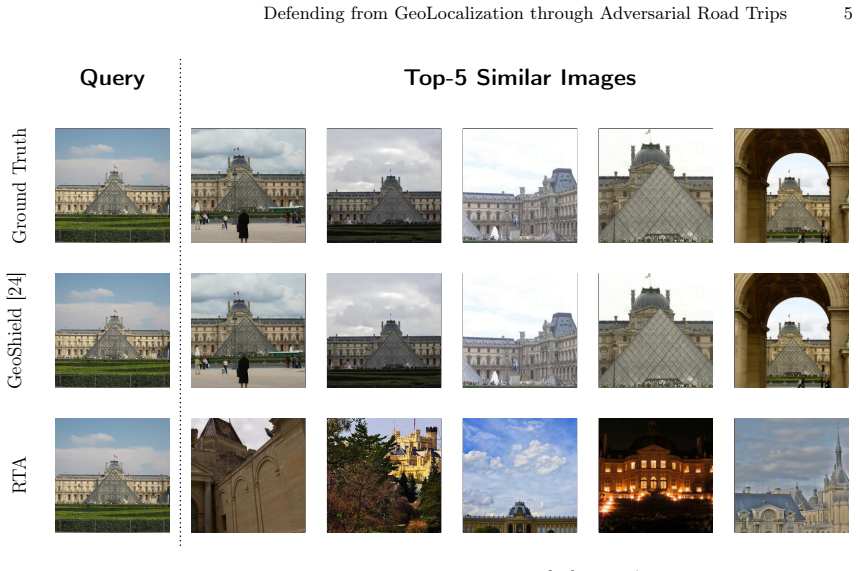
Summary. The paper introduces RoadTrip Attack (RTA), a targeted adversarial attack on retrieval-based image geolocalization. It frames the problem as constructing a sequence of intermediate geographic targets via beam search: at each step intermediate locations are sampled uniformly inside a disk of radius proportional to the remaining Haversine distance to a distant attacker-chosen target, PGD-style perturbations are optimized toward those locations under an L_inf budget, and only the top-K candidates (by distance to the final target) are retained. White-box experiments on GeoCLIP with Im2GPS3k and YFCC4k, plus black-box transfer to Img2Loc and G3, claim substantially higher target accuracy and lower ground-truth accuracy than FGSM, PGD, CW and the geolocalization-specific GeoShield baseline, especially at ε=2/255, while producing lower LPIPS / higher PSNR artifacts.
Significance. Privacy risks of modern geolocalization models are real and under-studied; only one prior dedicated attack (GeoShield) exists. If the reported gains hold, RTA supplies a practical, low-budget, transferable defense tool that is both more effective and less perceptible than existing alternatives. Strengths include the controlled PGD-variant ablations (Table 3) that isolate the geographic beam-search component, multi-threshold ACC_GT / ACC_Target metrics, black-box transfer across architectural paradigms, and the supplementary nearest-neighbor analysis of internal representations. The work is therefore a solid empirical contribution to adversarial geo-privacy.
major comments (3)
- §3.2 and Algorithm 1: intermediate targets are always drawn from a disk centered at the final target x_T (radius η·G(current,x_T)). Consequently the sequence of predicted locations is a successive refinement near x_T rather than a geographic path connecting the source to the target. The “road-trip / distractor journey” framing used in the abstract, introduction and Figure 1 is therefore somewhat misleading; a more precise geometric description would better match the actual procedure without diminishing the empirical results.
- §4.4 / Tables 4–5: only ACC_GT is reported for black-box transfer because GeoShield is untargeted. For RTA itself, ACC_Target (or at least the distribution of final predicted locations) should also be given; without it the claim of “highly transferable targeted attacks” rests solely on untargeted success rates and is harder to assess.
- §5: the privacy motivation is central, yet no evaluation against even the simplest defenses listed as future work (JPEG compression, feature squeezing, etc.) is provided. A minimal set of such experiments would make the practical claims more robust for a journal audience.
minor comments (4)
- Notation in Algorithm 1 is inconsistent (D_R(x_T,i) versus the surrounding prose that places the disk at x_T); unify.
- Table 6 and Figure 2: LPIPS/PSNR are reported only versus GeoShield; adding the same numbers for PGD at matched ε would complete the perceptibility comparison already begun in Tables 1–2.
- §4.5: wall-clock times are given for a single hardware configuration; a brief note on how the parallelization scales with available GPUs would help reproducibility.
- A few typographical slips remain (e.g., “theoptimizationlandscapeforadversarialattacks”, missing spaces after periods in the abstract).
Circularity Check
No significant circularity: purely empirical optimization procedure evaluated on held-out data and independent models.
full rationale
The paper introduces RoadTrip Attack as a beam-search + PGD procedure (Alg. 1) that samples intermediate geographic targets inside an adaptive Haversine disk and retains the top-K candidates. Success is measured solely by external metrics (ACC_GT, ACC_Target, LPIPS, PSNR) on Im2GPS3k/YFCC4k against GeoCLIP (white-box) and transfer to Img2Loc/G3 (black-box), with controlled ablations of PGD variants, beam size K and scaling factor η. No equation equates a claimed prediction to a fitted constant; hyperparameters are chosen by ablation and reported; no uniqueness theorem, self-citation chain or definitional identity underpins the central empirical claim that RTA outperforms PGD/FGSM/CW/GeoShield at low ε. The derivation chain is therefore self-contained and non-circular.
Axiom & Free-Parameter Ledger
free parameters (4)
- η (radius scaling factor) =
0.5
- beam size K =
4
- number of parallel targets J =
5
- PGD steps per intermediate target =
5
axioms (3)
- domain assumption Projected gradient descent on cross-entropy between query embedding and a chosen gallery embedding produces a valid adversarial example inside the l∞ ball of radius ε.
- domain assumption Haversine distance is the appropriate metric for both intermediate-target sampling and success evaluation.
- domain assumption A surrogate retrieval model (GeoCLIP) yields transferable adversarial examples against generation-based black-box systems (Img2Loc, G3).
invented entities (1)
-
RoadTrip Attack (RTA) procedure
no independent evidence
read the original abstract
Retrieval-based image geolocalization has emerged as a powerful technique for determining the location of a query image by matching it against a large, geotagged database. The success of deep learning based approaches has raised concerns regarding privacy and safety. A way to protect users from geolocalization is to design adversarial attacks for such methods. In this paper, we introduce RoadTrip Attack (RTA), a novel and highly effective targeted adversarial attack for geolocalization. RTA conceptualizes the adversarial process as finding an optimal distractor journey to a specific, attacker-chosen location. It employs a beam search algorithm to iteratively construct a sequence of incorrect geographic locations that form a path to the target. At each step, the attack generates subtle perturbations to the query image, guiding the geolocalization model toward the next location in this deceptive path. We show that our method is also strong in black-box settings, obtaining highly transferable attacks with less perceptible image artifacts.
Figures




Reference graph
Works this paper leans on
-
[1]
In: Proc
Andriushchenko, M., Croce, F., Flammarion, N., Hein, M.: Square attack: a query-efficient black-box adversarial attack via random search. In: Proc. of ECCV. pp. 484–501. Springer (2020)
2020
-
[2]
Astruc, G., Dufour, N., Siglidis, I., Aronssohn, C., Bouia, N., Fu, S., Loiseau, R., Nguyen, V.N., Raude, C., Vincent, E., Xu, L., Zhou, H., Landrieu, L.: OpenStreetView-5M: The many roads to global visual geolocation. Proc. of CVPR (2024)
2024
-
[3]
In: Proc
Athalye, A., Engstrom, L., Ilyas, A., Kwok, K.: Synthesizing robust adversarial examples. In: Proc. of ICML. pp. 284–293. PMLR (2018)
2018
-
[4]
In: Proceedings of the IEEE/CVF Conference on Computer Vision and Pattern Recognition
Berton, G., Mereu, R., Trivigno, G., Masone, C., Csurka, G., Sattler, T., Caputo, B.: Deep visual geo-localization benchmark. In: Proceedings of the IEEE/CVF Conference on Computer Vision and Pattern Recognition. pp. 5396–5407 (2022)
2022
-
[5]
In: 2017 ieee symposium on security and privacy (sp)
Carlini, N., Wagner, D.: Towards evaluating the robustness of neural networks. In: 2017 ieee symposium on security and privacy (sp). pp. 39–57. Ieee (2017)
2017
-
[6]
In: Proc
Chen, P.Y., Sharma, Y., Zhang, H., Yi, J., Hsieh, C.J.: Ead: elastic-net attacks to deep neural networks via adversarial examples. In: Proc. of AAAI. vol. 32 (2018)
2018
-
[7]
In: Proceedings of the IEEE/CVF Conference on Computer Vision and Pattern Recognition
Clark, B., Kerrigan, A., Kulkarni, P.P., Cepeda, V.V., Shah, M.: Where we are and what we’re looking at: Query based worldwide image geo-localization using hierarchies and scenes. In: Proceedings of the IEEE/CVF Conference on Computer Vision and Pattern Recognition. pp. 23182–23190 (2023)
2023
-
[8]
In: Proc
Croce,F.,Hein,M.:Reliableevaluationofadversarialrobustnesswithanensembleofdiverseparameter- free attacks. In: Proc. of ICML. PMLR (2020)
2020
-
[9]
Garg, S., Fischer, T., Milford, M.: Where is your place, visual place recognition? arXiv preprint arXiv:2103.06443 (2021)
Pith/arXiv arXiv 2021
-
[10]
Goodfellow, I.J., Shlens, J., Szegedy, C.: Explaining and harnessing adversarial examples. In: Bengio, Y., LeCun, Y. (eds.) 3rd Int’l Conference on Learning Representations, ICLR 2015, San Diego, CA, USA, May 7-9, 2015, Conference Track Proceedings (2015),http://arxiv.org/abs/1412.6572
Pith/arXiv arXiv 2015
-
[11]
In: Proc
Haas, L., Skreta, M., Alberti, S., Finn, C.: Pigeon: Predicting image geolocations. In: Proc. of CVPR. pp. 12893–12902 (2024)
2024
-
[12]
In: Proc
Hausler,S., Garg, S., Xu, M., Milford, M., Fischer, T.: Patch-netvlad: Multi-scalefusion of locally-global descriptors for place recognition. In: Proc. of CVPR. pp. 14141–14152 (2021)
2021
-
[13]
In: Proc
Hays, J., Efros, A.A.: Im2gps: estimating geographic information from a single image. In: Proc. of CVPR. pp. 1–8. IEEE (2008)
2008
-
[14]
Hays, J., Efros, A.A.: Large-scale image geolocalization. In: Choi, J., Friedland, G. (eds.) Multimodal Location Estimation of Videos and Images, pp. 41–62. Springer (2015).https://doi.org/10.1007/ 978-3-319-09861-6_3,https://doi.org/10.1007/978-3-319-09861-6_3
-
[15]
In: Proc
Izbicki, M., Papalexakis, E.E., Tsotras, V.J.: Exploiting the earth’s spherical geometry to geolocate images. In: Proc. of ECML-PKDD. pp. 3–19. Springer (2019)
2019
-
[16]
Jia, P., Liu, Y., Li, X., Zhao, X., Wang, Y., Du, Y., Han, X., Wei, X., Wang, S., Yin, D.: G3: an effective and adaptive framework for worldwide geolocalization using large multi-modality models. Proc. of NeurIPS37, 53198–53221 (2024)
2024
-
[17]
Jia, P., Park, S., Gao, S., Zhao, X., Li, S.: Georanker: Distance-aware ranking for worldwide image geolocalization. Proc. of NeurIPS38, 17673–17699 (2026)
2026
-
[18]
In: Proc
Jiang, W., Diao, Y., Wang, H., Sun, J., Wang, M., Hong, R.: Unlearnable examples give a false sense of security: Piercing through unexploitable data with learnable examples. In: Proc. of ACM MM. pp. 8910–8921 (2023)
2023
-
[19]
In: Proc
Kordopatis-Zilos, G., Galopoulos, P., Papadopoulos, S., Kompatsiaris, I.: Leveraging efficientnet and contrastive learning for accurate global-scale location estimation. In: Proc. of ICMR. pp. 155–163 (2021)
2021
-
[20]
In: Artificial intelligence safety and security, pp
Kurakin, A., Goodfellow, I.J., Bengio, S.: Adversarial examples in the physical world. In: Artificial intelligence safety and security, pp. 99–112. Chapman and Hall/CRC (2018)
2018
-
[21]
IEEE MultiMedia24(1), 93–96 (2017) Defending from GeoLocalization through Adversarial Road Trips 15
Larson, M., Soleymani, M., Gravier, G., Ionescu, B., Jones, G.J.: The benchmarking initiative for multimedia evaluation: Mediaeval 2016. IEEE MultiMedia24(1), 93–96 (2017) Defending from GeoLocalization through Adversarial Road Trips 15
2016
-
[22]
Li, C., Jiang, T., Wang, H., Yao, W., Wang, D.: Optimizing latent variables in integrating transfer and query based attack framework. IEEE Transactions on Pattern Analysis and Machine Intelligence47(1), 161–171 (2025).https://doi.org/10.1109/TPAMI.2024.3461686
-
[23]
arXiv preprint arXiv:2305.12683 (2023)
Liang, C., Wu, X.: Mist: Towards improved adversarial examples for diffusion models. arXiv preprint arXiv:2305.12683 (2023)
Pith/arXiv arXiv 2023
-
[24]
Liu, X., Jia, X., Xun, Y., Qin, S., Cao, X.: Geoshield: Safeguarding geolocation privacy from vision- language models via adversarial perturbations (2025),https://arxiv.org/abs/2508.03209
arXiv 2025
-
[25]
In: 6th Int’l Conference on Learning Representations, ICLR 2018, Vancouver, BC, Canada, April 30 - May 3, 2018, Conference Track Proceedings
Madry, A., Makelov, A., Schmidt, L., Tsipras, D., Vladu, A.: Towards deep learning models resistant to adversarial attacks. In: 6th Int’l Conference on Learning Representations, ICLR 2018, Vancouver, BC, Canada, April 30 - May 3, 2018, Conference Track Proceedings. OpenReview.net (2018),https: //openreview.net/forum?id=rJzIBfZAb
2018
-
[26]
In: Proc
Meng, D., Chen, H.: Magnet: a two-pronged defense against adversarial examples. In: Proc. of SIGSAC. pp. 135–147 (2017)
2017
-
[27]
In: Proc
Mistretta, M., Baldrati, A., Agnolucci, L., Bertini, M., Bagdanov, A.D.: Cross the gap: Exposing the intra-modal misalignment in clip via modality inversion. In: Proc. of ICLR (2025)
2025
-
[28]
In: Proc
Moosavi-Dezfooli, S.M., Fawzi, A., Frossard, P.: Deepfool: a simple and accurate method to fool deep neural networks. In: Proc. of CVPR (2016)
2016
-
[29]
In: Proc
Muller-Budack, E., Pustu-Iren, K., Ewerth, R.: Geolocation estimation of photos using a hierarchical model and scene classification. In: Proc. of ECCV. pp. 563–579 (2018)
2018
-
[30]
In: Proc
Nguyen, A., Yosinski, J., Clune, J.: Deep neural networks are easily fooled: High confidence predictions for unrecognizable images. In: Proc. of CVPR. pp. 427–436 (2015)
2015
-
[31]
In: Chaudhuri, K., Jegelka, S., Song, L., Szepesvari, C., Niu, G., Sabato, S
Nie, W., Guo, B., Huang, Y., Xiao, C., Vahdat, A., Anandkumar, A.: Diffusion models for adversarial purification. In: Chaudhuri, K., Jegelka, S., Song, L., Szepesvari, C., Niu, G., Sabato, S. (eds.) Proc. of ICML. vol. 162, pp. 16805–16827. PMLR (17–23 Jul 2022),https://proceedings.mlr.press/v162/ nie22a.html
2022
-
[32]
Progress in brain research155, 23–36 (2006),https://api.semanticscholar.org/CorpusID:2432623
Oliva, A., Torralba, A.: Building the gist of a scene: the role of global image features in recognition. Progress in brain research155, 23–36 (2006),https://api.semanticscholar.org/CorpusID:2432623
2006
-
[33]
In: Proc
Pramanick, S., Nowara, E.M., Gleason, J., Castillo, C.D., Chellappa, R.: Where in the world is this image? transformer-based geo-localization in the wild. In: Proc. of ECCV. pp. 196–215. Springer (2022)
2022
-
[34]
Salman, H., Khaddaj, A., Leclerc, G., Ilyas, A., Madry, A.: Raising the cost of malicious ai-powered image editing (2023),https://arxiv.org/abs/2302.06588
Pith/arXiv arXiv 2023
-
[35]
In: Proc
Samangouei, P., Kabkab, M., Chellappa, R.: Defense-gan: Protecting classifiers against adversarial attacks using generative models. In: Proc. of ICLR (2018)
2018
-
[36]
In: Proc
Seo, P.H., Weyand, T., Sim, J., Han, B.: Cplanet: Enhancing image geolocalization by combinatorial partitioning of maps. In: Proc. of ECCV. pp. 536–551 (2018)
2018
-
[37]
In: 32nd USENIX Security Symp
Shan, S., Cryan, J., Wenger, E., Zheng, H., Hanocka, R., Zhao, B.Y.: Glaze: Protecting artists from style mimicry by text-to-image models. In: 32nd USENIX Security Symp. (USENIX Security 23). pp. 2187–2204 (2023)
2023
-
[38]
In: Proc
Song, Y., Kim, T., Nowozin, S., Ermon, S., Kushman, N.: Pixeldefend: Leveraging generative models to understand and defend against adversarial examples. In: Proc. of ICLR (2018)
2018
-
[39]
IEEE Transactions on Evolutionary Computation23(5), 828–841 (2019)
Su, J., Vargas, D.V., Sakurai, K.: One pixel attack for fooling deep neural networks. IEEE Transactions on Evolutionary Computation23(5), 828–841 (2019)
2019
-
[40]
Szegedy, C., Zaremba, W., Sutskever, I., Bruna, J., Erhan, D., Goodfellow, I.J., Fergus, R.: Intriguing properties of neural networks. In: Bengio, Y., LeCun, Y. (eds.) 2nd Int’l Conference on Learning Rep- resentations, ICLR 2014, Banff, AB, Canada, April 14-16, 2014, Conference Track Proceedings (2014), http://arxiv.org/abs/1312.6199
Pith/arXiv arXiv 2014
-
[41]
In: Proceedings of the IEEE/CVF Winter Conference on Applications of Computer Vision
Theiner, J., Müller-Budack, E., Ewerth, R.: Interpretable semantic photo geolocation. In: Proceedings of the IEEE/CVF Winter Conference on Applications of Computer Vision. pp. 750–760 (2022)
2022
-
[42]
Communications of the ACM59(2), 64–73 (2016) 16 N
Thomee, B., Shamma, D.A., Friedland, G., Elizalde, B., Ni, K., Poland, D., Borth, D., Li, L.J.: Yfcc100m: The new data in multimedia research. Communications of the ACM59(2), 64–73 (2016) 16 N. Niccoli et al
2016
-
[43]
Trippodo, M., Becattini, F., Seidenari, L.: Immunizing images from text to image editing via adversarial cross-attention. p. 10535–10543. Proc. of ACM MM, Association for Computing Machinery, New York, NY, USA (2025)
2025
-
[44]
Vivanco Cepeda, V., Nayak, G.K., Shah, M.: Geoclip: Clip-inspired alignment between locations and images for effective worldwide geo-localization. Proc. of NeurIPS36, 8690–8701 (2023)
2023
-
[45]
In: Proc
Vo, N., Jacobs, N., Hays, J.: Revisiting im2gps in the deep learning era. In: Proc. of CVPR. pp. 2621– 2630 (2017)
2017
-
[46]
Weyand, T., Kostrikov, I., Philbin, J.: PlaNet - Photo Geolocation with Convolutional Neural Networks, p. 37–55. Springer International Publishing (2016).https://doi.org/10.1007/978-3-319-46484-8_3, http://dx.doi.org/10.1007/978-3-319-46484-8_3
-
[47]
arXiv preprint arXiv:1704.01155 (2017)
Xu, W., Evans, D., Qi, Y.: Feature squeezing: Detecting adversarial examples in deep neural networks. arXiv preprint arXiv:1704.01155 (2017)
Pith/arXiv arXiv 2017
-
[48]
In: Proceedings of the IEEE/CVF winter conference on applications of computer vision
Xu, Y., Shamsolmoali, P., Granger, E., Nicodeme, C., Gardes, L., Yang, J.: Transvlad: Multi-scale attention-based global descriptors for visual geo-localization. In: Proceedings of the IEEE/CVF winter conference on applications of computer vision. pp. 2840–2849 (2023)
2023
-
[49]
In: Proc
Yi, C., Ren, L., Zhan, D.C., Ye, H.J.: Leveraging cross-modal neighbor representation for improved clip classification. In: Proc. of CVPR. pp. 27402–27411 (2024)
2024
-
[50]
In: Proc
Zhang, R., Isola, P., Efros, A.A., Shechtman, E., Wang, O.: The unreasonable effectiveness of deep features as a perceptual metric. In: Proc. of CVPR. pp. 586–595 (2018)
2018
-
[51]
Zhou, Z., Zhang, J., Guan, Z., Hu, M., Lao, N., Mu, L., Li, S., Mai, G.: Img2loc: Revisiting image ge- olocalization using multi-modality foundation models and image-based retrieval-augmented generation. In: Proc. of SIGIR. p. 2749–2754. SIGIR 2024, ACM (Jul 2024).https://doi.org/10.1145/3626772. 3657673,http://dx.doi.org/10.1145/3626772.3657673 Defending...
doi:10.1145/3626772 2024
discussion (0)
Sign in with ORCID, Apple, or X to comment. Anyone can read and Pith papers without signing in.