REVIEW 3 major objections 5 minor 50 references
For joint bird species and call-type classification, the best loss balancer depends on the backbone, how deep you adapt it, and which task you care about; freezing the backbone often beats full fine-tuning.
Reviewed by Pith at T0; open to challenge. T0 means a machine referee read the full paper against a public rubric. the ladder, T0–T4 →
T0 review · grok-4.5
2026-07-12 03:23 UTC pith:YGH4BHRB
load-bearing objection Solid empirical map of loss balancing × backbone × probing on dual-label bird audio; the MTL-vs-STL ranking is overstated because the label spaces are not comparable. the 3 major comments →
Adaptive Loss Balancing for Multi-Task Bioacoustic Classification of Bird Species and Call Types
The pith
A machine-rendered reading of the paper's core claim, the machinery that carries it, and where it could break.
Core claim
The preferred loss-balancing strategy for joint bird species and call-type classification depends on the backbone, the adaptation regime, and the target task, while frozen-backbone adaptation can deliver a better performance–efficiency trade-off than end-to-end fine-tuning. The factorised multi-task formulation yields the most consistent gains over a combined single-task baseline for call-type recognition; its effect on species recognition is regime-dependent.
What carries the argument
A shared pretrained bird-domain encoder with two separate classification heads whose binary cross-entropy losses are combined by either a fixed weight, homoscedastic uncertainty weighting, Dynamic Weight Averaging, or GradNorm, evaluated under linear probing, attentive probing, and full fine-tuning.
Load-bearing premise
That class-masked average precision on the WiWa test segments remains a fair comparison even though the multi-task and combined single-task models operate on different label spaces.
What would settle it
On the same WiWa test-5s partition, recompute class-masked cmAP after forcing multi-task and combined single-task models onto identical output spaces (or after excluding all classes that never appear in the test set); if the ranking of multi-task over single-task and of frozen over full fine-tuning reverses for the leading backbones, the central claim fails.
Editorial analysis
A structured set of objections, weighed in public.
Referee Report
Summary. The paper extends BirdCallNet to joint species and call-type classification on the long-tailed WiWa forest-soundscape benchmark. It evaluates four bird-domain pretrained encoders (ConvNeXtBS, EAT, BirdMAE, ProtoCLR) under linear probing, attentive probing, and full fine-tuning, comparing a fixed weighted-sum multi-task objective against homoscedastic uncertainty weighting, Dynamic Weight Averaging, and (under FT only) GradNorm. The central claims are that factorised multi-task learning yields the most consistent gains over a combined single-task baseline for call-type recognition, that full fine-tuning is not uniformly optimal, that adaptive weighting helps species recognition more consistently than call-type recognition, and that the preferred balancing strategy depends on backbone, adaptation regime, and target task, with frozen-backbone adaptation often offering a favourable performance–efficiency trade-off.
Significance. If the comparative findings hold under matched evaluation, the work is a useful, carefully controlled empirical contribution to multi-task bioacoustics. It systematically maps how standard adaptive loss-balancing methods interact with modern bird-domain representations and probing regimes on a dual-label, long-tailed soundscape benchmark—an under-studied setting relative to pure species ID. Strengths include multi-seed reporting, explicit regime–strategy applicability (GradNorm restricted to FT), transparent hyperparameter tables, and an honest limitations discussion. The practical takeaway that frozen adaptation can outperform end-to-end fine-tuning for some backbones is actionable for passive acoustic monitoring pipelines. The study is incremental relative to the conference BirdCallNet version but substantially expands the optimisation analysis.
major comments (3)
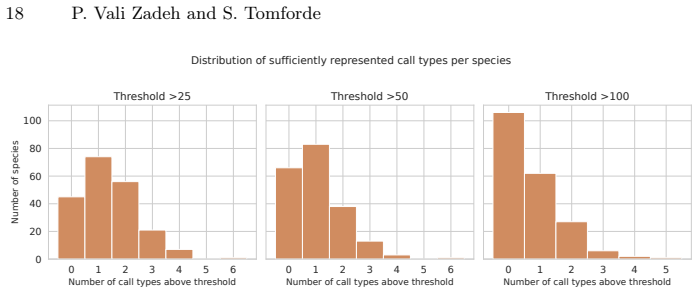
- Table 3 and §6.1 (also Abstract and §7): The claim that factorised multi-task learning yields the most consistent improvements over the combined single-task baseline for call-type recognition is not metric-equivalent. STL optimises and evaluates cmAP over the joint species#call-type vocabulary, while MTL reports separate class-masked cmAP on the call-type head alone (§5.1, §5.6). The paper itself notes the formulations “operate on different label spaces” and supply only “complementary evidence” (§6.6), yet still ranks MTL as superior. Because the combined space is far sparser and longer-tailed (561 observed combinations, median 26; Fig. 2c, Fig. 3), STL cmAP is structurally harder; apparent MTL gains may be an artifact of the easier marginal call-type space. A matched evaluation (e.g., projecting STL predictions onto the call-type marginal, or reporting joint metrics for both formulation
- Table 1 and Table 4: GradNorm under FT uses batch size 8 (vs 128 for all other strategies) because of per-task gradient memory overhead. This confounds the FT comparison: any under-performance of GradNorm on species (and its mixed call-type results) cannot be cleanly attributed to the weighting mechanism versus the reduced batch size and altered optimisation dynamics. Either re-run GradNorm at matched batch size (or with gradient accumulation) or explicitly qualify that the GradNorm numbers are not directly comparable and remove them from the main ranking statements.
- §5.6 and §6.6: Class-masked cmAP retains the original output space and assigns zero AP to classes without positive test examples. The paper acknowledges this can depress the macro-average, especially for call types. Given that the strongest claims rest on small absolute differences across weighting strategies (often <0.02 cmAP), the evaluation protocol should either exclude undefined classes from the average or report both masked and unmasked variants so that ranking stability can be assessed.
minor comments (5)
- Table 3: Score is defined as the mean of Naive/Unc./DWA only; GradNorm is excluded. This is reasonable given applicability, but the caption should state it explicitly so readers do not misread the FT Score column.
- §3.2 / Eq. (3)–(11): The fixed weights λ_sp=1.0, λ_ct=17.0 are carried over from the conference version without re-tuning under the new adaptive baselines. A short sensitivity check (or statement that they remain near-optimal) would strengthen the Naive baseline.
- Fig. 1 caption and §5.2: Attentive probing parameter count is given as 2d²+(C+1)d+C; a brief note on whether multi-head attention uses a single shared query or class-specific queries would aid reproducibility.
- Throughout: minor typographic inconsistencies (e.g., “multi-task” vs “multi-task”, “ConvNextBS” vs “ConvNeXtBS” in Table 3 header) should be normalised.
- §4.2: The train–test asymmetry (focal-style training clips vs multi-label soundscape test) is well described; adding a one-sentence reminder in the results discussion would help readers interpret absolute cmAP levels.
Circularity Check
Empirical multi-task benchmarking paper; results are measured on held-out data with standard adaptive-weighting formulas, not derived by construction from inputs.
full rationale
The paper is an experimental comparison of fixed and adaptive loss-balancing strategies (uncertainty weighting, DWA, GradNorm) across four pretrained encoders and three adaptation regimes on the WiWa benchmark. Claims about relative performance (e.g., factorised MTL vs combined STL for call-type, preferred weighting by regime) rest on class-masked cmAP tables computed from independent training runs on held-out test-5s segments. Fixed weights are taken from prior validation tuning and applied as a baseline; adaptive methods use published, parameter-light formulas that do not embed the target metrics. Mild self-extension from the authors' conference BirdCallNet paper supplies the dataset characterisation, architecture, and two of three seeds for the Naive/STL baselines, but the adaptive-weighting experiments and all new comparisons are freshly measured. No equation equates a claimed prediction to a fitted input, no uniqueness theorem is imported to force the result, and no ansatz is smuggled via self-citation. Label-space mismatch between STL and MTL is a fairness/correctness concern (acknowledged in §6.6) rather than circularity. Score 1 reflects only the ordinary self-extension of a conference-to-journal paper; the central empirical rankings do not reduce by construction.
Axiom & Free-Parameter Ledger
free parameters (5)
- Fixed task weights (lambda_sp, lambda_ct) =
1.0 / 17.0
- DWA temperature T =
2.0
- GradNorm asymmetry alpha =
1.5
- Learning rates and early-stopping deltas per regime =
see Table 1
- GradNorm FT batch size =
8
axioms (5)
- domain assumption Hard-parameter-sharing multi-task learning with separate species and call-type heads is an appropriate model of joint bioacoustic annotation.
- domain assumption Binary cross-entropy with logits on multi-hot labels is a suitable objective for segment-level multi-label evaluation.
- domain assumption Class-masked macro average precision (cmAP) is the primary figure of merit under long-tailed labels.
- standard math Homoscedastic uncertainty weighting, DWA, and GradNorm are valid adaptive balancers for two-task audio classification.
- domain assumption WiWa train/test construction after label harmonisation is a valid dual-label passive-monitoring benchmark despite train-test domain asymmetry.
invented entities (1)
-
BirdCallNet multi-task factorisation on WiWa
no independent evidence
read the original abstract
Reliable analysis of bird vocalisations in passive acoustic monitoring requires models handling multiple, imbalanced annotation targets. We extend BirdCallNet for joint species and call-type classification on the long-tailed WiWa dataset and investigate how task-loss balancing interacts with pretrained representations and adaptation depth. We evaluate four bird-domain encoders, ConvNeXtBS, EAT, BirdMAE, and ProtoCLR, with separate species and call-type heads under linear probing, attentive probing, and full fine-tuning. A manually tuned fixed objective is compared with homoscedastic uncertainty weighting and Dynamic Weight Averaging across all three adaptation regimes, while GradNorm is evaluated only under full fine-tuning. Results indicate that the factorised multi-task formulation yields the most consistent improvements over the combined single-task baseline for call-type recognition, while its effect on species recognition depends on the adaptation regime. Full fine-tuning is not consistently optimal: ConvNeXtBS achieves the highest mean species performance under linear probing, whereas BirdMAE provides the strongest call-type performance under attentive probing. Adaptive weighting benefits species recognition more consistently than call-type recognition. Uncertainty weighting is particularly effective for species recognition under attentive probing, whereas Dynamic Weight Averaging is generally stronger for the same task under full fine-tuning. GradNorm achieves competitive call-type performance for selected backbones but consistently underperforms other weighting strategies for species recognition and incurs higher computational and memory costs. Overall, the preferred loss-balancing strategy depends on the backbone, adaptation regime, and target task, while frozen-backbone adaptation can provide a more favourable performance-efficiency trade-off than end-to-end fine-tuning.
Figures


Reference graph
Works this paper leans on
-
[1]
https://doi.org/10.48550/arXiv.1610.01644, http://arxiv.org/ abs/1610.01644, arXiv:1610.01644 [stat]
Alain, G., Bengio, Y.: Understanding intermediate layers using linear classifier probes (Nov 2018). https://doi.org/10.48550/arXiv.1610.01644, http://arxiv.org/ abs/1610.01644, arXiv:1610.01644 [stat]
-
[2]
Ecological Informatics27, 21–25 (May 2015)
Arriaga, J.G., Cody, M.L., Vallejo, E.E., Taylor, C.E.: Bird-DB: A database for anno- tated bird song sequences. Ecological Informatics27, 21–25 (May 2015). https://doi. org/10.1016/j.ecoinf.2015.01.007, https://www.sciencedirect.com/science/article/ pii/S1574954115000151
-
[3]
In: Pro- ceedings of the 39th International Conference on Machine Learning
Baevski, A., Hsu, W.N., Xu, Q., Babu, A., Gu, J., Auli, M.: data2vec: A General Framework for Self-supervised Learning in Speech, Vision and Language. In: Pro- ceedings of the 39th International Conference on Machine Learning. pp. 1298–1312. PMLR (Jun 2022), https://proceedings.mlr.press/v162/baevski22a.html
2022
-
[4]
Scientific Reports11(1), 15733 (Aug 2021)
Bravo Sanchez, F.J., Hossain, M.R., English, N.B., Moore, S.T.: Bioacoustic classi- fication of avian calls from raw sound waveforms with an open-source deep learning architecture. Scientific Reports11(1), 15733 (Aug 2021). https://doi.org/10.1038/ s41598-021-95076-6, https://www.nature.com/articles/s41598-021-95076-6
2021
-
[5]
Conservation Biology39(5), e70058 (2025)
Brunk, K.M., Kramer, H.A., Peery, M.Z., Kahl, S., Wood, C.M.: Assess- ing spatial variability and efficacy of surrogate species at an ecosystem scale. Conservation Biology39(5), e70058 (2025). https://doi.org/10.1111/ cobi.70058, https://onlinelibrary.wiley.com/doi/abs/10.1111/cobi.70058, _eprint: https://conbio.onlinelibrary.wiley.com/doi/pdf/10.1111/cobi.70058
-
[6]
Machine Learning28(1), 41–75 (Jul 1997)
Caruana, R.: Multitask Learning. Machine Learning28(1), 41–75 (Jul 1997). https: //doi.org/10.1023/A:1007379606734, https://doi.org/10.1023/A:1007379606734
-
[7]
https://doi.org/10.48550/ arXiv.2212.09058, http://arxiv.org/abs/2212.09058, arXiv:2212.09058 [eess]
Chen, S., Wu, Y., Wang, C., Liu, S., Tompkins, D., Chen, Z., Wei, F.: BEATs: Audio Pre-Training with Acoustic Tokenizers (Dec 2022). https://doi.org/10.48550/ arXiv.2212.09058, http://arxiv.org/abs/2212.09058, arXiv:2212.09058 [eess]
Pith/arXiv arXiv 2022
-
[8]
https://doi.org/10.48550/arXiv.1711.02257, http://arxiv.org/abs/1711
Chen, Z., Badrinarayanan, V., Lee, C.Y., Rabinovich, A.: GradNorm: Gradi- ent Normalization for Adaptive Loss Balancing in Deep Multitask Networks (Jun 2018). https://doi.org/10.48550/arXiv.1711.02257, http://arxiv.org/abs/1711. 02257, arXiv:1711.02257 [cs]
-
[9]
Proceedings of the Royal Society B: Biological Sciences288(1947), 20210225 (Mar 2021)
Crates, R., Langmore, N., Ranjard, L., Stojanovic, D., Rayner, L., Ingwersen, D., Heinsohn, R.: Loss of vocal culture and fitness costs in a critically endangered song- bird. Proceedings of the Royal Society B: Biological Sciences288(1947), 20210225 (Mar 2021). https://doi.org/10.1098/rspb.2021.0225, https://doi.org/10.1098/rspb. 2021.0225
-
[10]
https://doi.org/10.48550/arXiv.2010.11929, http://arxiv.org/abs/2010
Dosovitskiy, A., Beyer, L., Kolesnikov, A., Weissenborn, D., Zhai, X., Unterthiner, T., Dehghani, M., Minderer, M., Heigold, G., Gelly, S., Uszkoreit, J., Houlsby, N.: An Image is Worth 16x16 Words: Transformers for Image Recognition at Scale (Jun 2021). https://doi.org/10.48550/arXiv.2010.11929, http://arxiv.org/abs/2010. 11929, arXiv:2010.11929 [cs]
-
[11]
Drewitt, A.L., Langston, R.H.: Collision Effects of Wind-power Genera- tors and Other Obstacles on Birds. Annals of the New York Academy Adaptive Loss Balancing for Bioacoustic Classification 27 of Sciences1134(1), 233–266 (2008). https://doi.org/10.1196/annals.1439. 015, https://onlinelibrary.wiley.com/doi/abs/10.1196/annals.1439.015, _eprint: https://ny...
-
[12]
https://doi.org/10.48550/arXiv.2401.08541, http://arxiv.org/abs/2401
El-Nouby, A., Klein, M., Zhai, S., Bautista, M.A., Toshev, A., Shankar, V., Susskind, J.M., Joulin, A.: Scalable Pre-training of Large Autoregressive Image Models (Jan 2024). https://doi.org/10.48550/arXiv.2401.08541, http://arxiv.org/abs/2401. 08541, arXiv:2401.08541 [cs]
-
[13]
https://doi.org/10.48550/arXiv.2204.11479, http://arxiv.org/ abs/2204.11479, arXiv:2204.11479 [cs]
Gazneli, A., Zimerman, G., Ridnik, T., Sharir, G., Noy, A.: End-to-End Audio Strikes Back: Boosting Augmentations Towards An Efficient Audio Classification Network (Jul 2022). https://doi.org/10.48550/arXiv.2204.11479, http://arxiv.org/ abs/2204.11479, arXiv:2204.11479 [cs]
-
[14]
Scientific Reports13(1), 22876 (Dec 2023)
Ghani, B., Denton, T., Kahl, S., Klinck, H.: Global birdsong embeddings enable su- perior transfer learning for bioacoustic classification. Scientific Reports13(1), 22876 (Dec 2023). https://doi.org/10.1038/s41598-023-49989-z, https://www.nature.com/ articles/s41598-023-49989-z
-
[15]
Methods in Ecology and Evolution10(2), 169–185 (2019)
Gibb, R., Browning, E., Glover-Kapfer, P., Jones, K.E.: Emerging opportunities and challenges for passive acoustics in ecological assessment and monitoring. Methods in Ecology and Evolution10(2), 169–185 (2019). https://doi.org/10.1111/2041-210X. 13101, https://onlinelibrary.wiley.com/doi/abs/10.1111/2041-210X.13101, _eprint: https://besjournals.onlinelib...
-
[16]
https://doi.org/10.48550/arXiv.2104.01778, http://arxiv.org/abs/2104
Gong, Y., Chung, Y.A., Glass, J.: AST: Audio Spectrogram Transformer (Jul 2021). https://doi.org/10.48550/arXiv.2104.01778, http://arxiv.org/abs/2104. 01778, arXiv:2104.01778 [cs]
-
[17]
Hagiwara, M.: AVES: Animal Vocalization Encoder Based on Self-Supervision. In: ICASSP 2023 - 2023 IEEE International Conference on Acoustics, Speech and Signal Processing (ICASSP). pp. 1–5 (Jun 2023). https://doi.org/10.1109/ICASSP49357. 2023.10095642, https://ieeexplore.ieee.org/abstract/document/10095642
-
[18]
Advances in Neural Information Processing Systems35, 28708–28720 (Dec 2022), https://proceedings.neurips
Huang, P.Y., Xu, H., Li, J., Baevski, A., Auli, M., Galuba, W., Metze, F., Feicht- enhofer, C.: Masked Autoencoders that Listen. Advances in Neural Information Processing Systems35, 28708–28720 (Dec 2022), https://proceedings.neurips. cc/paper_files/paper/2022/hash/b89d5e209990b19e33b418e14f323998-Abstract- Conference.html
2022
-
[19]
In: Ralph, C
Ii, A.M.M.: Bird strike and electrocutions at power lines, communication towers, and wind turbines: state of the art and state of the science - next steps toward mitigation. In: Ralph, C. John; Rich, Terrell D., editors 2005. Bird Conservation Implementation and Integration in the Americas: Proceedings of the Third International Partners in Flight Confere...
2005
-
[20]
Kahl, S., Denton, T., Klinck, H., Reers, H., Cherutich, F., Glotin, H., Goeau, H., Vellinga, W.P., Planqué, R., Joly, A.: Overview of BirdCLEF 2023: Automated bird species identification in Eastern Africa (2023), https://agritrop.cirad.fr/611094/
2023
-
[21]
Ecological Informatics61, 101236 (Mar 2021)
Kahl, S., Wood, C.M., Eibl, M., Klinck, H.: BirdNET: A deep learning solution for avian diversity monitoring. Ecological Informatics61, 101236 (Mar 2021). https: //doi.org/10.1016/j.ecoinf.2021.101236, https://www.sciencedirect.com/science/ article/pii/S1574954121000273
-
[22]
In: Proceedings of the IEEE Confer- ence on Computer Vision and Pattern Recognition (CVPR)
Kendall, A., Gal, Y., Cipolla, R.: Multi-task learning using uncertainty to weigh losses for scene geometry and semantics. In: Proceedings of the IEEE Confer- ence on Computer Vision and Pattern Recognition (CVPR). pp. 7482–7491 (Jun 28 P. Vali Zadeh and S. Tomforde 2018), https://openaccess.thecvf.com/content_cvpr_2018/html/Kendall_Multi- Task_Learning_U...
2018
-
[23]
Kim, D., Lee, Y., Ko, H.: Multi-task Learning for Animal Species and Group Category Classification. In: Proceedings of the 2019 7th International Conference on Information Technology: IoT and Smart City. pp. 435–438. ICIT ’19, Association for Computing Machinery, New York, NY, USA (Mar 2020). https://doi.org/10. 1145/3377170.3377259, https://dl.acm.org/do...
-
[24]
Conserva- tion Biology35(1), 50–63 (2021)
Lewis, R.N., Williams, L.J., Gilman, R.T.: The uses and impli- cations of avian vocalizations for conservation planning. Conserva- tion Biology35(1), 50–63 (2021). https://doi.org/10.1111/cobi.13465, https://onlinelibrary.wiley.com/doi/abs/10.1111/cobi.13465, _eprint: https://conbio.onlinelibrary.wiley.com/doi/pdf/10.1111/cobi.13465
-
[25]
In: Proceedings of the IEEE/CVF Conference on Computer Vision and Pattern Recognition (CVPR)
Liu, S., Johns, E., Davison, A.J.: End-to-end multi-task learning with attention. In: Proceedings of the IEEE/CVF Conference on Computer Vision and Pattern Recognition (CVPR). pp. 1871–1880 (Jun 2019), https://openaccess.thecvf.com/content_CVPR_2019/html/Liu_End-To- End_Multi-Task_Learning_With_Attention_CVPR_2019_paper.html
2019
-
[26]
In: 2022 IEEE/CVF Conference on Computer Vision and Pattern Recognition (CVPR)
Liu, Z., Mao, H., Wu, C.Y., Feichtenhofer, C., Darrell, T., Xie, S.: A ConvNet for the 2020s. In: 2022 IEEE/CVF Conference on Computer Vision and Pattern Recognition (CVPR). pp. 11966–11976 (Jun 2022). https://doi.org/10.1109/CVPR52688.2022. 01167, https://ieeexplore.ieee.org/document/9879745
-
[27]
https://doi.org/10.48550/arXiv.1711.05101, http://arxiv.org/abs/1711
Loshchilov, I., Hutter, F.: Decoupled Weight Decay Regularization (Jan 2019). https://doi.org/10.48550/arXiv.1711.05101, http://arxiv.org/abs/1711. 05101, arXiv:1711.05101 [cs]
-
[28]
The Condor: Ornithological Applications116(1), 8–23 (Feb 2014)
Loss, S.R., Will, T., Loss, S.S., Marra, P.P.: Bird–building collisions in the United States: Estimates of annual mortality and species vulnerability. The Condor: Ornithological Applications116(1), 8–23 (Feb 2014). https://doi.org/10.1650/ CONDOR-13-090.1, https://doi.org/10.1650/CONDOR-13-090.1
-
[29]
https://doi.org/10.5281/zenodo.1208080, https://zenodo.org/records/1208080
Lostanlen, V., Salamon, J., Farnsworth, A., Kelling, S., Bello, J.P.: BirdVox- DCASE-20k: a dataset for bird audio detection in 10-second clips (Mar 2018). https://doi.org/10.5281/zenodo.1208080, https://zenodo.org/records/1208080
-
[30]
https://www
Macaulay Library, Cornell Lab of Ornithology: Macaulay library. https://www. macaulaylibrary.org/, last accessed 2 July 2026
2026
-
[31]
Elsevier (Oct 2004), google-Books-ID: 2iFmsVSyV4gC
Marler, P.R., Slabbekoorn, H.: Nature’s Music: The Science of Birdsong. Elsevier (Oct 2004), google-Books-ID: 2iFmsVSyV4gC
2004
-
[32]
https://doi.org/10.5281/zenodo.20762099, https://zenodo.org/records/20762099
Martin, R., Reers, H., Abraham, M., Brauns, K., Haupt, J., Heinrich, R., Kahl, S., Raabe, J., Rauch, L., Schäfermeier, B., Scholz, C., Schwinger, R., Sick, B., Tomforde, S., Vali Zadeh, P., Wirth, M.: CEB: A collection of strongly-labeled bird soundscapes and Xeno-Canto recordings from Central Europe, with bounding boxes and vocalization types (Jun 2026)....
-
[33]
Frontiers in Bird Science3(Jul 2024)
van Merriënboer, B., Hamer, J., Dumoulin, V., Triantafillou, E., Denton, T.: Birds, bats and beyond: evaluating generalization in bioacoustics models. Frontiers in Bird Science3(Jul 2024). https://doi.org/10.3389/fbirs.2024.1369756, https://www. frontiersin.org/journals/bird-science/articles/10.3389/fbirs.2024.1369756/full
-
[34]
Miron, M., Robinson, D., Alizadeh, M., Gilsenan-McMahon, E., Narula, G., Chemla, E., Cusimano, M., Effenberger, F., Hagiwara, M., Hoffman, B., Keen, S., Kim, D., Lawton, J., Liu, J.Y., Raskin, A., Pietquin, O., Geist, M.: What Matters for Bioacoustic Encoding (Aug 2025), https://arxiv.org/abs/2508.11845v2 Adaptive Loss Balancing for Bioacoustic Classification 29
Pith/arXiv arXiv 2025
-
[35]
PeerJ Computer Science5, e223 (Oct 2019)
Morfi, V., Bas, Y., Pamuła, H., Glotin, H., Stowell, D.: NIPS4Bplus: a richly annotated birdsong audio dataset. PeerJ Computer Science5, e223 (Oct 2019). https://doi.org/10.7717/peerj-cs.223, https://peerj.com/articles/cs-223
-
[36]
Moummad, I., Serizel, R., Benetos, E., Farrugia, N.: Domain-Invariant Representa- tion Learning of Bird Sounds (Sep 2024), https://arxiv.org/abs/2409.08589v7
arXiv 2024
-
[37]
https://doi.org/10.48550/arXiv
Rauch, L., Heinrich, R., Moummad, I., Joly, A., Sick, B., Scholz, C.: Can Masked Autoencoders Also Listen to Birds? (Aug 2025). https://doi.org/10.48550/arXiv. 2504.12880, http://arxiv.org/abs/2504.12880, arXiv:2504.12880 [cs]
-
[38]
Rauch, L., Schwinger, R., Wirth, M., Heinrich, R., Huseljic, D., Herde, M., Lange, J., Kahl, S., Sick, B., Tomforde, S., Scholz, C.: BirdSet: A Large-Scale Dataset for Audio Classification in Avian Bioacoustics. International Conference on Learning Repre- sentations2025, 29482–29520 (May 2025), https://proceedings.iclr.cc/paper_files/ paper/2025/hash/484d...
2025
-
[39]
Reichenbach, M., Reers, H., Günther, F., Menke, K., Grimm, J., Martin, R.: Auswirkungen von WEA auf die akustische Aktivität ausgewählter Waldvogelarten: Untersuchungen zu Verdrängungseffekten mittels automatisierter Erfassung: Ergeb- nisse des F+E-Vorhabens: Optimierung des Planungs- und Genehmigungsprozesses von Windenergieanlagen im Wald hinsichtlich B...
-
[40]
Science366(6461), 120–124 (Oct 2019)
Rosenberg, K.V., Dokter, A.M., Blancher, P.J., Sauer, J.R., Smith, A.C., Smith, P.A.,Stanton,J.C.,Panjabi,A.,Helft,L.,Parr,M.,Marra,P.P.:DeclineoftheNorth American avifauna. Science366(6461), 120–124 (Oct 2019). https://doi.org/10. 1126/science.aaw1313, https://www.science.org/doi/full/10.1126/science.aaw1313
-
[41]
Functional Ecology37(4), 959–975 (2023)
Ross, S.R.P.J., O’Connell, D.P., Deichmann, J.L., Desjonquères, C., Gasc, A., Phillips, J.N., Sethi, S.S., Wood, C.M., Burivalova, Z.: Passive acoustic monitoring provides a fresh perspective on fundamental ecological questions. Functional Ecology37(4), 959–975 (2023). https://doi.org/10.1111/1365-2435. 14275, https://onlinelibrary.wiley.com/doi/abs/10.11...
-
[42]
https://doi.org/10.48550/arXiv.2508.01277, http://arxiv.org/abs/2508
Schwinger, R., Zadeh, P.V., Rauch, L., Kurz, M., Hauschild, T., Lapp, S., Tomforde, S.: Foundation Models for Bioacoustics – a Comparative Review (Aug 2025). https://doi.org/10.48550/arXiv.2508.01277, http://arxiv.org/abs/2508. 01277, arXiv:2508.01277 [cs]
-
[43]
Computational bioacoustics with deep learning: a review and roadmap
Stowell, D.: Computational bioacoustics with deep learning: a review and roadmap. PeerJ10, e13152 (Mar 2022). https://doi.org/10.7717/peerj.13152, http://arxiv. org/abs/2112.06725, arXiv:2112.06725 [cs]
work page internal anchor Pith review Pith/arXiv arXiv doi:10.7717/peerj.13152 2022
-
[44]
Conservation Science and Practice1(8), e72 (Aug 2019)
Teixeira, D., Maron, M., Rensburg, B.J.v.: Bioacoustic monitoring of animal vocal behavior for conservation. Conservation Science and Practice1(8), e72 (Aug 2019). https://doi.org/10.1111/csp2.72, https://conbio.onlinelibrary.wiley.com/doi/ 10.1111/csp2.72
doi:10.1111/csp2.72 2019
-
[45]
Nature Communications 13(1), 792 (Feb 2022)
Tuia, D., Kellenberger, B., Beery, S., Costelloe, B.R., Zuffi, S., Risse, B., Mathis, A., Mathis, M.W., van Langevelde, F., Burghardt, T., Kays, R., Klinck, H., Wikelski, M., Couzin, I.D., van Horn, G., Crofoot, M.C., Stewart, C.V., Berger-Wolf, T.: Perspectives in machine learning for wildlife conservation. Nature Communications 13(1), 792 (Feb 2022). ht...
-
[46]
Conservation Biol- ogy27(1), 210–218 (2013)
Valderrama, S.V., Molles, L.E., Waas, J.R.: Effects of Population Size on Singing Behavior of a Rare Duetting Songbird. Conservation Biol- ogy27(1), 210–218 (2013). https://doi.org/10.1111/j.1523-1739.2012.01917.x, 30 P. Vali Zadeh and S. Tomforde https://onlinelibrary.wiley.com/doi/abs/10.1111/j.1523-1739.2012.01917.x, _eprint: https://conbio.onlinelibra...
-
[47]
In: Proceedings of the 18th International Conference on Agents and Artificial Intelligence (ICAART)
Vali Zadeh, P., Tomforde, S.: BirdCallNet: Joint species and call-type classification. In: Proceedings of the 18th International Conference on Agents and Artificial Intelligence (ICAART). pp. 4744–4753. SCITEPRESS, Marbella, Spain (2026). https://doi.org/10.5220/0014488900004052, https://www.scitepress.org/Link.aspx? doi=10.5220/0014488900004052
-
[48]
In: CLEF (Working Notes) (2015)
Vellinga, W.P., Planqué, R.: The xeno-canto collection and its relation to sound recognition and classification. In: CLEF (Working Notes) (2015)
2015
-
[49]
In: Proceedings of the IEEE/CVF International Conference on Computer Vision (ICCV)
Wu, H., Xiao, B., Codella, N., Liu, M., Dai, X., Yuan, L., Zhang, L.: CvT: Introducing convolutions to vision transformers. In: Proceedings of the IEEE/CVF International Conference on Computer Vision (ICCV). pp. 22–31 (Oct 2021), https://openaccess.thecvf.com/content/ICCV2021/html/Wu_CvT_ Introducing_Convolutions_to_Vision_Transformers_ICCV_2021_paper.html
2021
-
[50]
IEEE Transactions on Knowledge and Data Engineering34(12), 5586–5609 (Dec 2022)
Zhang, Y., Yang, Q.: A Survey on Multi-Task Learning. IEEE Transactions on Knowledge and Data Engineering34(12), 5586–5609 (Dec 2022). https://doi.org/ 10.1109/TKDE.2021.3070203, https://ieeexplore.ieee.org/document/9392366/
discussion (0)
Sign in with ORCID, Apple, or X to comment. Anyone can read and Pith papers without signing in.