REVIEW 3 major objections 4 minor 41 references
A geometric filter can hard-bound generative hallucination and eliminate catastrophic forgetting in over-parameterized models.
Reviewed by Pith at T0; open to challenge. T0 means a machine referee read the full paper against a public rubric. the ladder, T0–T4 →
T0 review · grok-4.5
2026-07-12 03:14 UTC pith:6ER2QXQK
load-bearing objection Ambitious fiber-bundle packaging of over-parameterization that formalizes SID/SVDχ and connection filtering, but the hard OOD-diameter and total-forgetting claims rest on unconstructed objects. the 3 major comments →
Statistically Meaningful Geometry (SMG) Beyond the Euclidean Paradigm, with Application to Generative AI
The pith
A machine-rendered reading of the paper's core claim, the machinery that carries it, and where it could break.
Core claim
Under connection-filtered pre-training the model’s out-of-distribution predictive variance is strictly upper-bounded by the finite diameter of the identifiable quotient base manifold, giving a hard geometric containment of generative hallucinations; projecting downstream updates onto the orthogonal complement of the historical horizontal carriage yields total non-asymptotic elimination of catastrophic forgetting.
What carries the argument
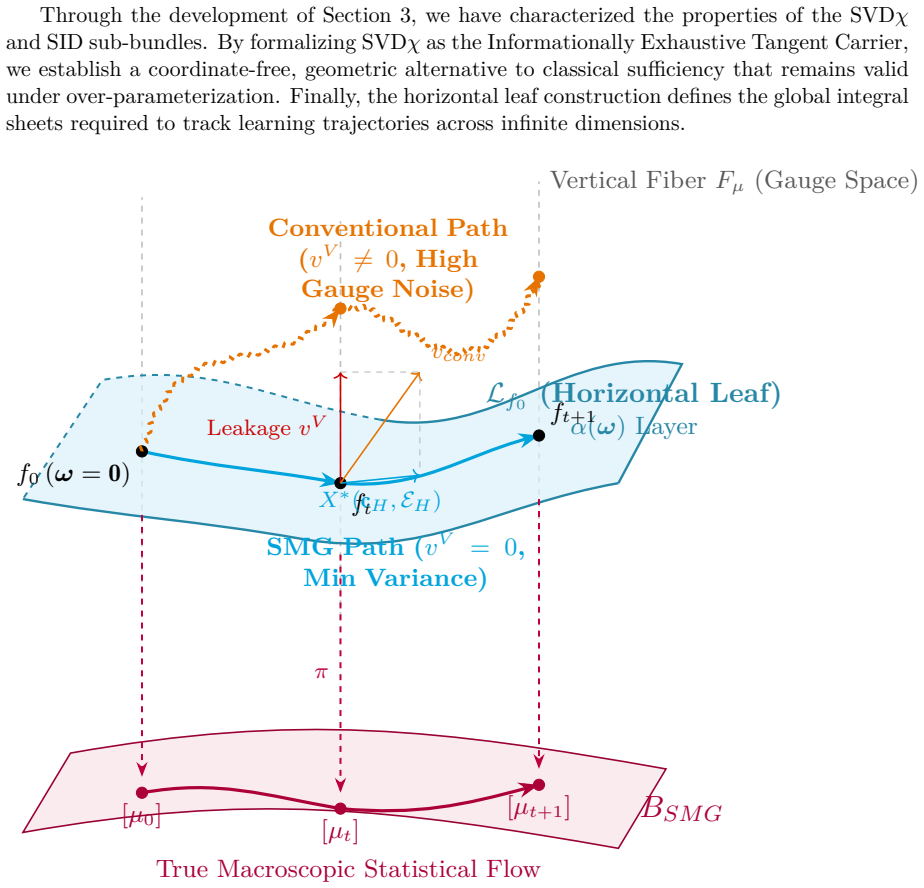
The Ehresmann connection 1-form ω on the SMG fiber bundle (M, B, π, V, H, ω), which splits the tangent space into vertical Structural Internal Directions (SID) and horizontal Statistical Variational Directions (SVDχ) and acts as the geometric filter that quarantines gauge noise from observable learning.
Load-bearing premise
That a usable Ehresmann connection exists for real transformer architectures so the horizontal directions are integrable, the base is a finite-diameter identifiable manifold, and the orthogonal projection onto the historical horizontal carriage can be computed exactly.
What would settle it
Construct an explicit, computable connection for a concrete transformer, train under the filtered flow, and check whether measured out-of-distribution predictive variance stays inside the claimed base diameter while sequential adaptation leaves historical task performance unchanged to machine precision.
Editorial analysis
A structured set of objections, weighed in public.
Referee Report
Summary. The paper proposes Statistically Meaningful Geometry (SMG), lifting over-parameterized models (e.g., transformers) into infinite-dimensional Orlicz statistical manifolds equipped with a general fiber bundle (M, B, π, V, H, ω). An Ehresmann connection 1-form ω filters vertical Structural Internal Directions (SID / gauge noise) so that learning trajectories remain on the horizontal Statistically Verifiable Directions (SVDχ). Under this connection-filtered pre-training the authors claim that out-of-distribution predictive variance is strictly upper-bounded by the finite diameter of the identifiable quotient base B (Theorem 16), thereby geometrically containing generative hallucinations; projecting downstream updates onto the orthogonal complement of the historical horizontal carriage is claimed to yield non-asymptotic elimination of catastrophic forgetting (SMG Sequential Adaptation Flow). Classical MLE, natural gradient, Wilks asymptotics and PAC-Bayesian bounds are recovered on the reduced base, and three nested learning pathways (ambient filtering, leaf integration, macro inference) are shown to be equivalent under integrability.
Significance. If the geometric containment and forgetting-elimination claims hold for realistic architectures, the work would supply a coordinate-free topological foundation for structural reliability in generative AI, resolving the over-parameterization generalization paradox without parameter-counting heuristics. The manuscript supplies an extensive formal apparatus (Lemmas 1–8, Theorems 1–16) that systematically embeds transformers into Pistone–Sempi Orlicz manifolds, defines metric-compatible projections, and derives capacity-collapse and quarantine results; these machine-readable proofs and the clean Two-Fold Inference Paradigm are genuine strengths. The contribution remains purely theoretical: no constructive connection, no numerical verification, and no comparison against existing continual-learning or hallucination-mitigation baselines are provided, so practical impact is still conditional.
major comments (3)
- [§8.3, Theorem 16] §8.3, Theorem 16 (Geometric Containment of Generative Hallucinations): the hard OOD bound reduces the filtered trajectory to natural-gradient flow on B and then invokes “standard compact embedding theorems” so that the path stays inside a compact geodesic ball K of finite diameter KB independent of ambient weight dimension W. The manuscript never constructs, for a concrete transformer, a base B that is simultaneously finite-dimensional, identifiable, and of finite diameter under the induced L2 metric once the evaluation domain includes an unbounded XOOD. Without diam(B)<∞ the claimed geometric containment does not follow; the same ungrounded finite-diameter object is reused for the Capacity Collapse Theorem (Thm 12) and the forgetting argument.
- [§§2–4, 8.3–8.4] §§2–4 and 8.3–8.4 (Definitions 9, 20; Theorems 2, 10, 12, 16): all operational claims presuppose a practically usable Ehresmann connection 1-form ω such that the horizontal distribution is Frobenius-integrable (Ω≡0), the orthogonal projection onto the historical horizontal carriage is exact, and the resulting base B has finite diameter. No explicit construction, approximation scheme, or even low-rank surrogate for ω is supplied for transformer weight spaces. Consequently the “total non-asymptotic elimination” of forgetting and the hard hallucination bound remain formal statements conditional on an oracle connection.
- [Lemma 4, Theorems 6 & 12] Lemma 4 / Theorem 6 and the Capacity Collapse argument (Thm 12): once the horizontal distribution is defined as the gf-orthogonal complement of ker(dπ) and the connection is defined to project onto that complement, fiber-wise invariance of the likelihood and the collapse of ambient KL divergence to the base KL follow essentially by construction. The manuscript presents these as deep structural theorems; a clearer separation between definitional consequences and non-tautological geometric content would strengthen the load-bearing claims.
minor comments (4)
- [§§1.3, 1.7] The Two-Fold Inference Paradigm is restated almost verbatim in §§1.3 and 1.7; the four core axioms likewise appear twice with only minor rephrasing. Condensing the introductory material would improve readability.
- [Figures 1–4] Figures 1–4 are conceptually helpful but the captions and in-text references contain overlapping descriptive text that is hard to parse; a single clean schematic of the three nested pathways would suffice.
- [§5.2, Eq. (87)] Notation for the horizontal natural gradient (Eq. 87) and the induced base likelihood is introduced late and then used retroactively; a short notation table early in §2 would help.
- [Introduction / Related work] The manuscript cites Amari, Pistone–Sempi and classical PAC-Bayes correctly, yet several recent geometric deep-learning and continual-learning references that address similar gauge/redundancy issues are absent; adding a short related-work paragraph would situate the contribution more clearly.
Circularity Check
Core theorems (likelihood invariance, capacity collapse, quarantining, natural-gradient equivalence) follow by construction once SID is ker(dπ) and SVDχ its Fisher-Rao orthogonal complement; finite diam(B) for Thm 16 is assumed via external citation rather than derived for transformers.
specific steps
-
self definitional
[Lemma 4 (Fiber-Wise Invariance) / Thm 6]
"For any pair of observationally equivalent density states f1, f2 ∈ Fp, the empirical log-likelihood function satisfies absolute functional identity: ℓn(f1)=ℓn(f2). ... Because the projection submersion π isolates observable statistical manifestations... f1(x)=f2(x) µ-almost everywhere... ℓn(f1)=...=ℓn(f2)."
Fp is defined as π^{-1}(p), so elements of a fiber are observationally equivalent densities by construction; the likelihood (a functional of the density values on data) is therefore identical by definition of the fiber, not by a non-tautological derivation. Thm 6 then collapses ambient MLE to unique base MLE solely from this invariance plus the regularity assumption that B itself has unique MLE.
-
self definitional
[Theorem 3 / Definition 9]
"The Ehresmann connection 1-form ωf is identical to the canonical vertical projection operator P^V_f under the non-parametric Fisher-Rao metric gf. Consequently, the horizontal projection operator P^H_f can be expressed as: P^H_f = I − ωf."
Definition 9 sets ωf(v)=v for v∈ SIDf and ker(ωf)=SVDχf; Lemma 2 already defines P^V as the metric orthogonal projector onto SID. The 'proof' that ω≡ P^V is therefore identity of two objects given the same characterizing properties, not an independent result.
-
self definitional
[Theorem 12 (Capacity Collapse) + Assumption 2]
"Q = Q_SVDχ ⊗ δ0(SID)... P = P_SVDχ ⊗ P_SID... DKL(Q∥P)=∫_H ln(dQ_SVDχ/dP_SVDχ)dQ_SVDχ + ∫_V ln(dδ0/dP_SID)dδ0 = DKL(QB∥PB)+0."
Assumption 2 constructs the prior as an independent product over horizontal and vertical; horizontal flow (Way 2) forces the posterior to concentrate as Q_SVDχ ⊗ δ0 on a single leaf. The ambient KL therefore factors and the vertical term vanishes by construction of the product measure and Dirac, so the PAC-Bayes bound 'collapses' to the base by the definitions of Q and P rather than by a non-tautological capacity argument.
-
self definitional
[Theorem 16 (Geometric Containment) proof]
"the optimization path pt is contained within a compact geodesic ball K⊂B. ... sup_t ∥pt−p0∥^2_L2(XOOD) ≤ diam_g(K) ≜ KB <∞. This confirms that filtering... rendering... immune to generative hallucinations."
After reducing the filtered trajectory to NGD on B (itself by the lift isomorphism of the connection), the hard finite upper bound is obtained solely by invoking 'standard compact embedding theorems for regular statistical manifolds' so that diam(K)<∞. No construction is given that the base B arising from a transformer (space of regression maps X→Y) is finite-dimensional with finite diameter under the induced metric once XOOD is unbounded; the claimed 'hard geometric containment' is therefore the imported finiteness assumption restated as the theorem's conclusion.
-
self citation load bearing
[§1.3.3 / §1.2 (and repeated)]
"the Cheng-Tong orthogonal metric decomposition [9]. By showing that the total tangent space... can be severed into a direct sum where the horizontal leaf is strictly orthogonal to the vertical gauge fiber under the Fisher-Rao metric... The Blessing of Dimensionality [9]."
The orthogonal split TfM=Hf⊕Vf that underwrites the entire Two-Fold Inference Paradigm, the quarantine of infinite parameters into zero-variance SID, and the resolution of Occam's razor / over-parameterization paradox is repeatedly attributed to the authors' own prior work [9]. Although Lemma 1 re-derives the split, the narrative load-bearing claims (blessing of dimensionality, natural filtering of infinite dimensions, structural reliability) rest on that self-citation chain rather than on external verification.
full rationale
The paper defines the SMG fiber bundle with Vf ≔ ker(dπf) (SID) and Hf ≔ Vf^⊥ under the Fisher-Rao metric (SVDχ), with ω the vertical projector. Under these definitions, fiber-wise likelihood invariance (Lemma 4), ω ≡ P^V (Thm 3), quarantining by orthogonality (Thm 4), horizontal natural gradient = lift of base NGD (Thm 7), and Capacity Collapse reducing ambient KL to base KL via product prior + Dirac vertical (Thm 12 + Assump 2) are immediate unpackings of the definitions and standard projection/isometry properties; they are not independent derivations. Thm 16 reduces filtered flow to NGD on B then invokes 'standard compact embedding theorems' (citing Amari) to obtain finite diam(K) ⊂ B, but never constructs a finite-dimensional finite-diameter base for a concrete transformer (or unbounded XOOD); the hard OOD bound is therefore the finiteness assumption renamed as a geometric consequence of filtering. Self-citations to [9] (Cheng-Tong orthogonal decomposition, Blessing of Dimensionality) are load-bearing for the narrative of the two-fold paradigm and Occam resolution, though the split is re-proved in Lemma 1. No fitted-input-as-prediction or external uniqueness smuggling. The framework is largely self-contained once the axioms and connection are granted, but the strongest claims reduce by construction or by unestablished diameter, yielding moderate circularity.
Axiom & Free-Parameter Ledger
free parameters (3)
- Young function Φ(u)=cosh(u)-1 for the Orlicz space
- observational noise scale σ in the induced joint density
- dimension d of the identifiable base manifold B
axioms (5)
- ad hoc to paper Four Core Axioms of SMG (Environment Set E, System Set S, Structural Mechanism F, Invariance Principle)
- domain assumption Total space M is a Pistone–Sempi Orlicz manifold of densities with log-densities in L^Φ
- domain assumption π : M → B is a smooth surjective submersion whose fibers are the observationally equivalent configurations
- ad hoc to paper Horizontal distribution is Frobenius-integrable (curvature Ω ≡ 0) so that global horizontal leaves exist
- standard math Fisher–Rao metric is strictly positive-definite on the horizontal subspace and zero on the vertical subspace
invented entities (4)
-
Structural Internal Directions (SID) / vertical gauge fiber
no independent evidence
-
Statistically Verifiable Directions (SVDχ) / horizontal distribution
no independent evidence
-
SMG Sequential Adaptation Flow
no independent evidence
-
Two-Fold Inference Paradigm
no independent evidence
read the original abstract
Conventional uniform convergence bounds and empirical risk minimization break down in massive over-parameterized models, such as large language transformers and biological sequence networks. With near-infinite unconstrained internal degrees of freedom, their optimization landscapes develop flat vertical gauge valleys, rendering classical generalization metrics vacuous and inducing severe pathologies, specifically generative hallucination and catastrophic forgetting. We introduce the Statistically Meaningful Geometry (SMG) framework, an information-geometric paradigm lifting deterministic parametric models into infinite-dimensional non-parametric Orlicz statistical manifolds. Modeling the total state space as a differential fiber bundle ($\mathcal{M}, \mathcal{B}, \pi, \mathcal{V}, \mathcal{H}, \omega$), we establish a Two-Fold Inference Paradigm. We formalize an Ehresmann connection 1-form $\omega$ as a dynamic geometric filter that strips away vertical gauge noise (Structural Internal Directions, or SID) and isolates learning trajectories along the strictly non-degenerate horizontal distribution (Statistical Variational Directions, or SVD$\chi$). We prove that under connection-filtered pre-training, out-of-distribution predictive variance is strictly upper-bounded by the finite diameter of the identifiable quotient base manifold $\mathcal{B}$, establishing a hard geometric containment of generative hallucinations. By projecting downstream updates onto the orthogonal complement of the historical horizontal carriage, we formalize the SMG Sequential Adaptation Flow, proving the total non-asymptotic elimination of catastrophic forgetting. SMG replaces empirical fine-tuning heuristics with coordinate-free topological constraints, bridging advanced differential geometry with structural reliability in AI.
Figures



Reference graph
Works this paper leans on
-
[1]
Akaike, H. (1974). A New Look at the Statistical Model Identification . IEEE Transactions on Automatic Control, 19(6), 716–723. Brief Explanation: Establishes the Akaike Information Criterion (AIC), formalizing the classical linear parameter-counting penalty framework that breaks down in modern over- parameterized systems
1974
-
[2]
Amari, S. (1987). Dual connections on the Hilbert bundles of statistical models . In Ge- ometrization of Statistical Theory (Lancaster, 1987), ULDM Publ., Lancaster, UK, pp. 123–151
1987
-
[3]
Amari, S. (1998). Natural gradient works efficiently in learning . Neural Computation, 10(2), 251–276. Brief Explanation: The foundational paper on Natural Gradient Descent. Theorem 5.5 of SMG proves how to execute this exact algorithm on trillion-parameter models by lifting the computation to the base manifold, bypassing the singularity Amari identified
1998
-
[4]
Amari, S., & Nagaoka, H. (2000). Methods of Information Geometry . Translations of Math- ematical Monographs, American Mathematical Society, Providence, RI. Brief Explanation: The foundational monograph on finite-dimensional information geom- etry, detailing the Riemannian structure of statistical models via the Fisher Information Metric, which classical ...
2000
-
[5]
Anandan, J., & Aharonov, Y. (1990). Geometry of quantum evolution . Physical Review Letters, 65(14), 1697–1700. 73 Brief Explanation: Examines geometric phases along lifts, providing a foundation for an- alyzing how paths accumulate geometric phase shifts under non-trivial parallel transport rules
1990
-
[6]
L., Foster, D
Bartlett, P. L., Foster, D. J., & Telgarsky, M. J. (2017). Spectrally-normalized margin bounds for neural networks . Advances in Neural Information Processing Systems, 30, 6240– 6249. Brief Explanation: Establishes spectrally-normalized margin bounds to explain generaliza- tion in deep networks bypassing raw coordinate counts
2017
-
[7]
Double Descent
Belkin, M., Hsu, D., Ma, S., & Mandal, S. (2019). Reconciling modern machine-learning practice and the classical bias-variance trade-off . Proceedings of the National Academy of Sciences, 116(32), 15849–15854. Brief Explanation: The foundational paper formally identifying the “Double Descent” gen- eralization curve, empirically demonstrating that pushing ...
2019
-
[8]
Catoni, O. (2007). PAC-Bayesian Supervised Classification: The Thermodynamics of Sta- tistical Learning. Institute of Mathematical Statistics Lecture Notes—Monograph Series, Vol. 56, Hayward, CA. Brief Explanation: Formulates modern PAC-Bayesian theory via generalization bounds under information-theoretic constraints
2007
-
[9]
Cheng, B., & Tong, H. (2026). An Approach to Fisher-Rao Metric for Infinite Dimensional Non-Parametric Information Geometry . Entropy, 28(3), Article Number. Brief Explanation: Establishes the non-parametric Pistone-Sempi Orlicz manifold frame- work, rigorously justifying the application of Fisher-Rao metrics, Stein scores, and orthog- onal decompositions...
2026
-
[10]
Cencov, N. N. (1982). Statistical Decision Rules and Optimal Inference . Translations of Mathematical Monographs, Vol. 53, American Mathematical Society, Providence, RI. Brief Explanation: The foundational monograph establishing the category-theoretic unique- ness of the Fisher information metric and alpha-connections under Markov categories, proving that...
1982
-
[11]
Ehresmann, C. (1950). Les connexions infinitésimales dans un espace fibré différentiable . Colloque de Topologie, Bruxelles, pp. 29–55. Brief Explanation: Introduces the foundational theory of infinitesimal connections on gen- eral differential fiber bundles without relying on strict Lie group actions
1950
-
[12]
Fisher, R. A. (1922). On the Mathematical Foundations of Theoretical Statistics . Philo- sophical Transactions of the Royal Society of London. Series A, 222, 309–368. Brief Explanation: The classical foundational text establishing mathematical statistics, maximum likelihood estimation, and sufficiency
1922
-
[13]
French, R. M. (1999). Catastrophic forgetting in connectionist networks. Trends in Cognitive Sciences, 3(4), 128–135. Brief Explanation: Explains the cognitive and connectionist mechanics under which neural networks suffer interference during sequential learning environments. 74
1999
-
[14]
Hironaka, H. (1964). Resolution of singularities of an algebraic variety over a field of characteristic zero: I, II . Annals of Mathematics, 79(1/2), 109–326. Brief Explanation: The definitive algebraic geometry work establishing that singularities can be systematically resolved via algebraic blow-ups
1964
-
[15]
Hochreiter, S., & Schmidhuber, J. (1997). Flat minima . Neural Computation, 9(1), 1–42. Brief Explanation: Establishes the link between the curvature (Hessian) of the loss landscape and generalization, supporting the argument that the infinite-dimensional SID space acts as a geometric reservoir allowing SGD to discover flat minima without altering empirical loss
1997
-
[16]
Jacot, A., Gabriel, F., & Hongler, C. (2018). Neural Tangent Kernel: Convergence and Generalization in Neural Networks . Advances in Neural Information Processing Systems, 31. Brief Explanation: Establishes the properties of the JJT Gram matrix in the infinite-width limit. SMG’s Horizontal Lift Operator physically maps this kernel projection directly to t...
2018
-
[17]
Kallenberg, O. (2002). Foundations of Modern Probability . Springer Science & Business Media. Brief Explanation: Provides the rigorous measure-theoretic foundations for regular condi- tional probabilities and the Disintegration Theorem, essential for decomposing measures across the SMG fiber bundle
2002
-
[18]
Khesin, B., Misiolek, G., & Modin, K. (2024). Information geometry of diffeomorphism groups. arXiv preprint arXiv:2411.03265. Brief Explanation: Explores the information geometric structures and metrics constructed directly over continuous infinite-dimensional transformation spaces
Pith/arXiv arXiv 2024
-
[19]
Kirkpatrick, J., Pascanu, R., Rabinowitz, N., Veness, J., Desjardins, G., Rusu, A. A., ... & Hadsell, R. (2017). Overcoming catastrophic forgetting in neural networks. Proceedings of the National Academy of Sciences (PNAS) , 114(13), 3521–3526. Brief Explanation: Empirically characterizes the catastrophe of downstream updates de- stroying historical knowl...
2017
-
[20]
Kobayashi, S., & Nomizu, K. (1996). Foundations of Differential Geometry, Vol. 1 . Wiley- Interscience. Brief Explanation: The definitive mathematical text on differential topology, principal fiber bundles, and connections. It provides the rigorous geometric foundation for the Ehresmann connection ω utilized to decouple the SMG tangent space
1996
-
[21]
Kolmogorov, A. N. (1933). Grundbegriffe der Wahrscheinlichkeitsrechnung. Ergebnisse der Mathematik und Ihrer Grenzgebiete, Springer, Berlin. Brief Explanation: The foundational monograph establishing the modern measure-theoretic axiomatic framework of probability theory, defining the baseline sample space environments that SMG extends into infinite-dimens...
1933
-
[22]
Lang, S. (1999). Fundamentals of Differential Geometry . Springer-Verlag, New York, NY
1999
-
[23]
MacKay, D. J. (1992). A practical Bayesian framework for backpropagation networks . Neu- ral Computation, 4(3), 448–472. Brief Explanation: Demonstrates how weight-decay priors break the internal symmetries of neural networks, providing the basis for the Bayesian counter-argument to absolute invisi- bility. 75
1992
-
[24]
Mathieu, E., & Nickel, M. (2020). Riemannian Continuous Normalizing Flows. Proceedings of the 23rd International Conference on Artificial Intelligence and Statistics (AISTATS) , PMLR 108:2503–2515. Brief Explanation: Formulates continuous probability density evolution equations driven by vector fields explicitly integrated over non-Euclidean Riemannian geometries
2020
-
[25]
Maurer, A. (2004). A Note on the PAC-Bayesian Theorem . arXiv preprint cs/0411099. Brief Explanation: Provides the modernized, tight formulation of the PAC-Bayesian bound utilized in Theorem 5.3
Pith/arXiv arXiv 2004
-
[26]
McAllester, D. A. (1999). PAC-Bayesian Model Averaging. Proceedings of the Twelfth An- nual Conference on Computational Learning Theory (COLT), 164–170. Brief Explanation: The foundational paper introducing PAC-Bayesian learning bounds. SMG elevates this theorem from finite Euclidean spaces to infinite-dimensional non- parametric fiber bundles based on th...
1999
-
[27]
McCloskey, M., & Cohen, N. J. (1989). Catastrophic interference in connectionist networks: The sequential learning problem . The Psychology of Learning and Motivation, 24, 109–165. Brief Explanation: Formally identifies the pathology of structural interference when net- works sequentially update configurations on non-isolated objectives
1989
-
[28]
O’Neill, B. (1966). The fundamental equations of a submersion . Michigan Mathematical Journal, 13(4), 459–469. Brief Explanation: The foundational mathematical paper defining the tensorial equations for Riemannian submersions, establishing that non-integrable horizontal distributions generate vertical holonomy and that horizontal lifts commute with gradient flows
1966
-
[29]
Pistone, G., & Sempi, C. (1995). An infinite-dimensional geometric structure on the space of all the probability measures equivalent to a given one . The Annals of Statistics, 23(5), 1543–1561. Brief Explanation: The foundational text defining the exact non-parametric statistical man- ifold topology built on Orlicz spaces, used to house the baseline confi...
1995
-
[30]
Statistically Verifiable Directions
Popper, K. (1959). The Logic of Scientific Discovery . Routledge. Brief Explanation: The foundational text on the epistemology of science. It argues that a theory is only meaningful if it is empirically falsifiable/verifiable. This philosophically underpins the necessity of restricting statistical learning to the “Statistically Verifiable Directions” (SVDχ)
1959
-
[31]
Rao, C. R. (1945). Information and the accuracy attainable in the estimation of a statistical parameter. Bulletin of the Calcutta Mathematical Society, 37, 81–91. Brief Explanation: Establishes the foundation of information geometry by interpreting the Fisher information matrix as a Riemannian metric on parameter space
1945
-
[32]
J., & Mohamed, S
Rezende, D. J., & Mohamed, S. (2015). Variational Inference with Normalizing Flows. Proceedings of the 32nd International Conference on Machine Learning (ICML) , PMLR 37:1530–1538. Brief Explanation: Introduces the change-of-variables framework for probability density functionals transformed via continuous invertible deep functional mappings
2015
-
[33]
Sussmann, H. J. (1992). Uniqueness of the weights for minimal feedforward nets with a given input-output map . Neural Networks, 5(4), 589–593. 76 Brief Explanation: Provides rigorous proof of the profound permutation and sign-flip sym- metries present in neural networks. These symmetries are the physical generators of the Internal Degrees of Freedom (IDoF...
1992
-
[34]
Vapnik, V. N. (1998). Statistical Learning Theory . Wiley, New York, NY. Brief Explanation: Establishes the foundations of classical statistical capacity limits via VC dimension and uniform bounding laws
1998
-
[35]
Vaswani, A., Shazeer, N., Parmar, N., Uszkoreit, J., Jones, L., Gomez, A. N., ... & Polo- sukhin, I. (2017). Attention Is All You Need . Advances in Neural Information Processing Systems, 30, 5998–6008. Brief Explanation: The foundational paper introducing the Transformer architecture, whose extreme multi-layer parameter scale and latent embedding dynamic...
2017
-
[36]
Villani, C. (2009). Optimal Transport: Old and New . Graduate Studies in Mathematics, Vol. 99, Springer-Verlag, Berlin, Germany. Brief Explanation: Comprehensive reference detailing the behavior of entropy function- als, volume deformation tensors, and displacement convexity across general Riemannian manifold domains
2009
-
[37]
Warner, F. W. (1983). Foundations of Differentiable Manifolds and Lie Groups . Graduate Texts in Mathematics, Vol. 94, Springer-Verlag, New York, NY. Brief Explanation: The definitive graduate-level text detailing the rigorous modern proof of the Frobenius Theorem, differential forms, and the integration of tangent distributions on smooth manifolds
1983
-
[38]
Watanabe, S. (2009). Algebraic Geometry and Statistical Learning Theory . Cambridge Uni- versity Press, Cambridge, UK. Brief Explanation: Introduces Singular Learning Theory. Watanabe proves that hierarchical learning models inherently possess unidentifiable parameters, causing the classical Fisher Information Matrix to become degenerate. SMG actively tra...
2009
-
[39]
Statistically Invariant
Weyl, H. (1929). Elektron und Gravitation. I . Zeitschrift für Physik, 56(5-6), 330–352. Brief Explanation: The seminal paper establishing modern Gauge Theory. It introduces the concept that profound internal mathematical transformations can leave observable physics completely invariantithe direct physical analog to SMG’s “Statistically Invariant” vertical fibers
1929
-
[40]
Wilks, S. S. (1938). The large-sample distribution of the likelihood ratio for testing compos- ite hypotheses . The Annals of Mathematical Statistics, 9(1), 60–62. Brief Explanation: Establishes Wilks’ theorem on the asymptotic distribution of log- likelihood ratio statistics under regular finite-dimensional conditions
1938
-
[41]
Zhang, C., Bengio, S., Hardt, M., Recht, B., & Vinyals, O. (2021). Understanding deep learning (still) requires rethinking generalization. Communications of the ACM, 64(3), 107– 115. Brief Explanation: Empirically demonstrates the failure of uniform convergence and stan- dard VC bounds in massive over-parameterized neural models. 77
2021
discussion (0)
Sign in with ORCID, Apple, or X to comment. Anyone can read and Pith papers without signing in.