REVIEW 3 major objections 5 minor 42 references
A diffusion prior plus noise-aware pilot correction reconstructs full OFDM channel grids from sparse, noisy DMRS better than standard and diffusion baselines.
Reviewed by Pith at T0; open to challenge. T0 means a machine referee read the full paper against a public rubric. the ladder, T0–T4 →
A diffusion estimator with noise-adaptive null-space correction recovers sparse-pilot OFDM channels at lower NMSE than MMSE, toolbox, DPS, and DMPS baselines on 5G TDL/CDL simulations.
T0 review reviewed 2026-07-12 challenge →
load-bearing objection Solid OFDM packaging of null-space diffusion with a careful noise-adaptive schedule; gains are real on 3GPP sims but overstated relative to weak diffusion baselines and known-noise assumptions. the 3 major comments →
Diffusion-Based Noise-Adaptive Null-Space Channel Estimation for OFDM Systems
The pith
A machine-rendered reading of the paper's core claim, the machinery that carries it, and where it could break.
The reading
Core claim
DMRS-aided OFDM channel estimation can be solved as a sparse linear inverse problem by range-null space decomposition: pilots constrain the range-space component, a learned diffusion prior reconstructs the null-space component, and a noise-adaptive posterior correction (jointly setting the correction coefficient and residual sampling variance from the observation noise level) prevents noisy pilots from being imposed as exact constraints, yielding lower NMSE than conventional and diffusion baselines under the tested 5G NR conditions.
What carries the argument
Noise-adaptive null-space posterior correction inside reverse diffusion: after a range-null decomposition induced by the diagonal DMRS measurement operator, the reverse step corrects the range-space residual with a coefficient λ_t and residual variance Φ_DANCE_t that are jointly calibrated to the pilot noise variance so that pilot consistency and noise suppression are balanced.
Load-bearing premise
The method needs the pilot noise variance as a known input to set both the correction strength and residual sampling variance; if that variance is wrong, the validated balance no longer holds.
What would settle it
On the same 5G NR TDL/CDL setups, replace the oracle noise variance with a deliberately misestimated value (or with a real noise estimator) and check whether DANCE’s NMSE advantage over MMSE and MATLAB nrChannelEstimate disappears across the SNR, DMRS-density, and Doppler sweeps of Figures 5–7.
Editorial analysis
A structured set of objections, weighed in public.
Referee Report
Summary. The paper proposes DANCE, a diffusion-based estimator for DMRS-aided OFDM channel estimation under sparse, noisy, and configuration-dependent pilots. It casts the problem as a sparse linear inverse problem with a diagonal pilot-induced measurement operator, applies a range–null space decomposition, and reconstructs the unobserved null-space component with a learned diffusion prior. For noisy pilots, it introduces a noise-adaptive posterior correction that sets the range-space correction strength λ_t and residual sampling variance from the observation noise level (Eqs. 21–27, Algorithm 1), rather than enforcing exact pilot consistency. An OFDM-tailored conditional U-Net (real/imag channels, subcarrier-only downsampling, CFG) is used as the denoiser. On 5G NR TDL/CDL simulations, DANCE reports lower NMSE than MMSE, MATLAB nrChannelEstimate, DPS, and DMPS across SNR, DMRS configurations, Doppler, and train–test mismatches, with ablations on the correction and sampling steps.
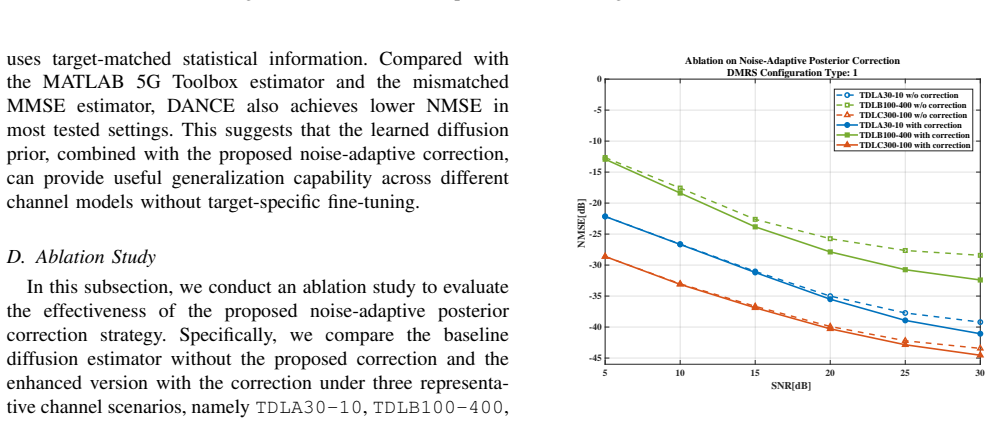
Significance. If the empirical claims hold under broader baselines and more realistic noise knowledge, the paper is a solid methods contribution for generative channel estimation: it specializes null-space diffusion sampling to the sparse diagonal DMRS operator and gives an explicit, schedule-consistent noise-adaptive correction rather than a generic posterior sampler. Strengths include a clean problem formulation for configuration-varying pilots, a practical pseudo-inverse implementation for diagonal A, broad synthetic evaluation (multiple TDL/CDL profiles, CT types, DMRS density, Doppler, In-D/OoD mismatch), and an ablation showing the correction helps especially at high SNR (Fig. 9). The work is relevant to 5G/6G CSI recovery where pilot density is limited and patterns change, though impact is currently bounded by synthetic 3GPP channels and the chosen baseline set.
major comments (3)
- §IV-B and Figs. 5–8: the central superiority claim rests heavily on DPS and DMPS, which the paper itself reports as unstable or saturating near 0 dB under sparse pilots. These baselines are not specialized to the sparse diagonal pilot operator that DANCE exploits. A load-bearing comparison is missing against a competitive structure-aware diffusion baseline using the same U-Net prior—e.g., DDNM-style null-space sampling without the proposed noise-adaptive schedule, or a carefully regularized LMMSE/interpolation network. Without that, “beats DPS/DMPS” only weakly supports “state-of-the-art diffusion posterior sampling for DMRS-OFDM.”
- §III-C, Eqs. (24)–(27) and Algorithm 1: λ_t and Φ_DANCE_t are set from a known observation noise variance σ²_y. This is a free operational assumption not stress-tested in the experiments. Because the noise-adaptive balance is central to the method, the paper should report sensitivity to σ²_y misestimation (or a practical estimator of σ²_y) under the same SNR/DMRS settings used in Figs. 5–7; otherwise the validated operating point may not transfer to receivers that only have approximate noise statistics.
- §IV-C / Fig. 8: generalization is evaluated only on synthetic 3GPP TDL/CDL profile shifts with a fixed learned prior. The MMSE reference is sometimes given target-matched second-order statistics, while DANCE is not fine-tuned. This is useful, but the headline robustness claim would be stronger with at least one additional stress test closer to deployment (e.g., pilot SNR mismatch, imperfect DMRS support knowledge, multi-antenna grids, or measured CSI). As written, superiority remains contingent on synthetic channel validity and the current baseline suite.
minor comments (5)
- Fig. 5–8 captions and axis labels are dense; consider stating CT type, DMRS symbol count, and whether CFG is used in each panel legend for standalone readability.
- Notation switches between matrix H and vectorized h; a short consistent statement near Eq. (2) would help readers track range–null operations.
- §II-B cites both σ²_t = β_t and σ²_t = β̃_t as equivalent; later the residual-variance derivation uses σ²_t = β_t—state this choice once when introducing Eq. (24).
- Report wall-clock or FLOPs for 200-step DANCE vs. MMSE/MATLAB/DMPS in §IV-A so the accuracy–complexity tradeoff is explicit.
- Clarify whether pilot symbols are assumed perfectly known after equalization of the DMRS RE, or whether residual pilot contamination is absorbed into σ²_y.
Circularity Check
No significant circularity: DANCE's noise-adaptive coefficients are schedule/noise-derived, training is standard generative fitting, and NMSE claims are held-out empirical comparisons—not quantities forced by construction.
full rationale
The paper's load-bearing chain is (i) sparse diagonal pilot model → range–null decomposition (standard linear algebra / DDNM-style construction), (ii) reverse diffusion with a noise-adaptive range-space correction whose λ_t and residual variance are closed-form functions of the diffusion schedule and assumed σ²_y (Eqs. 23–27), and (iii) empirical NMSE on held-out 5G NR TDL/CDL grids, including intentional train–test mismatches. Nothing in that chain defines the reported NMSE gains in terms of the target metric or refits parameters to the plotted test curves. The diffusion prior is trained by the usual noise-prediction loss on generated channels; evaluation uses independent ground-truth grids. Self-citation of DMPS (Meng & Kabashima) appears only as a baseline to beat, not as a uniqueness theorem that forces DANCE. Ablation (Fig. 9) and step-count (Fig. 10) studies are empirical sensitivity checks, not tautological restatements of fitted inputs. Known-σ²_y is a modeling assumption, not circularity. Score 0.
Axiom & Free-Parameter Ledger
free parameters (5)
- CFG guidance weight w =
4.0
- Reverse sampling step count =
200 (default)
- U-Net base channels and multipliers =
32; [1,2,2,2]
- Diffusion noise schedule {β_t} and training horizon T =
linear, T=1000
- Unconditional dropout probability p_uncond (CFG training)
axioms (5)
- domain assumption DMRS-aided observation is a sparse linear model y = A h + n with A diagonal from the pilot pattern and n ~ N(0, σ²_y I).
- domain assumption A learned diffusion model approximates the prior distribution q(h) of full-grid channels well enough that null-space completion is distributionally plausible.
- ad hoc to paper Observation noise variance σ²_y is available to set λ_t and Φ_DANCE_t.
- standard math Range–null decomposition h = A†A h + (I − A†A) h with A†A a projector yields a valid consistency construction for the noiseless case, extended by weighted correction when noisy.
- domain assumption 3GPP TDL/CDL MATLAB models with the listed numerology are adequate proxies for the deployment scenarios claimed in the abstract.
invented entities (2)
-
DANCE noise-adaptive posterior correction (λ_t and Φ_DANCE_t schedule)
no independent evidence
-
OFDM-tailored conditional U-Net denoiser (real/imag channels; subcarrier-only downsampling)
no independent evidence
Cite this review
Pith. "Pith review of Diffusion-Based Noise-Adaptive Null-Space Channel Estimation for OFDM Systems." pith.science (2026). https://pith.science/paper/MAE7NMWP
@misc{pith2026260703348,
  author       = {Pith},
  title        = {Pith review of: Diffusion-Based Noise-Adaptive Null-Space Channel Estimation for OFDM Systems},
  year         = {2026},
  howpublished = {\url{https://pith.science/paper/MAE7NMWP}},
  note         = {Machine review of arXiv:2607.03348}
}
read the original abstract
Accurate channel estimation in orthogonal frequency division multiplexing (OFDM) systems remains challenging when demodulation reference signal (DMRS) observations are sparse and noisy, and when DMRS configurations vary across deployment scenarios. This paper proposes DANCE (Diffusion-based Noise-Adaptive Null-space Channel Estimation), a diffusion-based channel estimator for OFDM systems. We formulate DMRS-aided channel estimation as a sparse linear inverse problem whose measurement operator is induced by the pilot pattern. The resulting range-null space decomposition separates the measurement-constrained range-space component from the unobserved null-space component, which is reconstructed through a learned diffusion prior. To avoid directly imposing noisy pilot samples as exact constraints, DANCE introduces a noise-adaptive posterior correction into the reverse diffusion process. The correction coefficient and the residual sampling variance are jointly calibrated according to the observation noise level, thereby reducing pilot-noise injection while retaining useful measurement information. We further design a conditional U-Net denoiser for complex-valued OFDM channel grids, where the real and imaginary components are represented as separate feature channels and downsampling is performed only along the subcarrier dimension. Simulations based on 5G NR tapped delay line (TDL) and clustered delay line (CDL) channel models show that DANCE achieves consistently lower normalized mean squared error (NMSE) than conventional estimators and diffusion-based posterior sampling methods under different signal-to-noise ratios, DMRS configurations, Doppler frequency shifts, and train-test distribution mismatches.
Figures



Reference graph
Works this paper leans on
-
[1]
What will 5G be?
J. G. Andrews, S. Buzzi, W. Choi, S. V . Hanly, A. Lozano, A. C. Soong, and J. C. Zhang, “What will 5G be?”IEEE Journal on Selected Areas in Communications, vol. 32, no. 6, pp. 1065–1082, 2014
2014
-
[2]
A vision of 6G wireless systems: Applications, trends, technologies, and open research problems,
W. Saad, M. Bennis, and M. Chen, “A vision of 6G wireless systems: Applications, trends, technologies, and open research problems,”IEEE Network, vol. 34, no. 3, pp. 134–142, 2019
2019
-
[3]
6G wireless networks: Vision, requirements, architecture, and key technologies,
Z. Zhang, Y . Xiao, Z. Ma, M. Xiao, Z. Ding, X. Lei, G. K. Karagiannidis, and P. Fan, “6G wireless networks: Vision, requirements, architecture, and key technologies,”IEEE Vehicular Technology Magazine, vol. 14, no. 3, pp. 28–41, 2019
2019
-
[4]
Y . G. Li and G. L. Stuber,Orthogonal frequency division multiplexing for wireless communications. Springer Science & Business Media, 2006
2006
-
[5]
Nr; physical channels and modulation,
P. Channels, “Nr; physical channels and modulation,”3rd Generation Partnership Project (3GPP), Technical Specification (TS), vol. 38, 2020
2020
-
[6]
Inverse problems: a Bayesian perspective,
A. M. Stuart, “Inverse problems: a Bayesian perspective,”Acta numer- ica, vol. 19, pp. 451–559, 2010
2010
-
[7]
S. M. Kay,Fundamentals of statistical signal processing: estimation theory. Prentice-Hall, Inc., 1993
1993
-
[8]
Deep learning,
Y . LeCun, Y . Bengio, and G. Hinton, “Deep learning,”Nature, vol. 521, no. 7553, pp. 436–444, 2015
2015
-
[9]
Deep residual learning for image recognition,
K. He, X. Zhang, S. Ren, and J. Sun, “Deep residual learning for image recognition,” inProceedings of the IEEE Conference on Computer Vision and Pattern Recognition, 2016, pp. 770–778
2016
-
[10]
Imagenet classification with deep convolutional neural networks,
A. Krizhevsky, I. Sutskever, and G. E. Hinton, “Imagenet classification with deep convolutional neural networks,”Advances in Neural Informa- tion Processing Systems, vol. 25, 2012
2012
-
[11]
Deep learning for wireless communications: An emerging interdisciplinary paradigm,
L. Dai, R. Jiao, F. Adachi, H. V . Poor, and L. Hanzo, “Deep learning for wireless communications: An emerging interdisciplinary paradigm,” IEEE Wireless Communications, vol. 27, no. 4, pp. 133–139, 2020
2020
-
[12]
Five facets of 6G: Research challenges and opportunities,
L.-H. Shen, K.-T. Feng, and L. Hanzo, “Five facets of 6G: Research challenges and opportunities,”ACM Computing Surveys, vol. 55, no. 11, pp. 1–39, 2023
2023
-
[13]
Power of deep learning for channel estimation and signal detection in ofdm systems,
H. Ye, G. Y . Li, and B.-H. Juang, “Power of deep learning for channel estimation and signal detection in ofdm systems,”IEEE Wireless Communications Letters, vol. 7, no. 1, pp. 114–117, 2017
2017
-
[14]
Deep learning-aided 5g channel estimation,
A. Le Ha, T. Van Chien, T. H. Nguyen, W. Choi, and V . D. Nguyen, “Deep learning-aided 5g channel estimation,” in2021 15th International Conference on Ubiquitous Information Management and Communica- tion (IMCOM). IEEE, 2021, pp. 1–7
2021
-
[15]
Deep learning-based channel estimation,
M. Soltani, V . Pourahmadi, A. Mirzaei, and H. Sheikhzadeh, “Deep learning-based channel estimation,”IEEE Communications Letters, vol. 23, no. 4, pp. 652–655, 2019
2019
-
[16]
Deep residual learning meets ofdm channel estimation,
L. Li, H. Chen, H.-H. Chang, and L. Liu, “Deep residual learning meets ofdm channel estimation,”IEEE Wireless Communications Let- ters, vol. 9, no. 5, pp. 615–618, 2019
2019
-
[17]
Rnn based channel estimation in doubly selective environments,
A. K. Gizzini and M. Chafii, “Rnn based channel estimation in doubly selective environments,”IEEE Transactions on Machine Learning in Communications and Networking, vol. 2, pp. 1–18, 2023
2023
-
[18]
Attention is all you need,
A. Vaswani, N. Shazeer, N. Parmar, J. Uszkoreit, L. Jones, A. N. Gomez, Ł. Kaiser, and I. Polosukhin, “Attention is all you need,”Advances in Neural Information Processing Systems, vol. 30, 2017
2017
-
[19]
Attention based neural networks for wireless channel estimation,
D. Luan and J. Thompson, “Attention based neural networks for wireless channel estimation,” in2022 IEEE 95th Vehicular Technology Conference:(VTC2022-Spring). IEEE, 2022, pp. 1–5
2022
-
[20]
Auto-encoding variational bayes,
D. P. Kingma and M. Welling, “Auto-encoding variational bayes,”arXiv preprint arXiv:1312.6114, 2013. 13
Pith/arXiv arXiv 2013
-
[21]
Generative adversarial networks,
I. Goodfellow, J. Pouget-Abadie, M. Mirza, B. Xu, D. Warde-Farley, S. Ozair, A. Courville, and Y . Bengio, “Generative adversarial networks,” Communications of the ACM, vol. 63, no. 11, pp. 139–144, 2020
2020
-
[22]
High dimensional channel estimation using deep generative networks,
E. Balevi, A. Doshi, A. Jalal, A. Dimakis, and J. G. Andrews, “High dimensional channel estimation using deep generative networks,”IEEE Journal on Selected Areas in Communications, vol. 39, no. 1, pp. 18–30, 2020
2020
-
[23]
Channel estimation for quantized systems based on conditionally gaussian latent models,
B. Fesl, N. Turan, B. B ¨ock, and W. Utschick, “Channel estimation for quantized systems based on conditionally gaussian latent models,”IEEE Transactions on Signal Processing, vol. 72, pp. 1475–1490, 2024
2024
-
[24]
Introvae: Introspective variational autoencoders for photographic image synthesis,
H. Huang, R. He, Z. Sun, T. Tanet al., “Introvae: Introspective variational autoencoders for photographic image synthesis,”Advances in Neural Information Processing Systems, vol. 31, 2018
2018
-
[25]
A large- scale study on regularization and normalization in gans,
K. Kurach, M. Lu ˇci´c, X. Zhai, M. Michalski, and S. Gelly, “A large- scale study on regularization and normalization in gans,” inInternational Conference on Machine Learning. PMLR, 2019, pp. 3581–3590
2019
-
[26]
Deep unsupervised learning using nonequilibrium thermodynamics,
J. Sohl-Dickstein, E. Weiss, N. Maheswaranathan, and S. Ganguli, “Deep unsupervised learning using nonequilibrium thermodynamics,” inInternational Conference on Machine Learning. PMLR, 2015, pp. 2256–2265
2015
-
[27]
Denoising diffusion probabilistic models,
J. Ho, A. Jain, and P. Abbeel, “Denoising diffusion probabilistic models,” Advances in Neural Information Processing Systems, vol. 33, pp. 6840– 6851, 2020
2020
-
[28]
Score-based generative modeling through stochastic differ- ential equations,
Y . Song, J. Sohl-Dickstein, D. P. Kingma, A. Kumar, S. Ermon, and B. Poole, “Score-based generative modeling through stochastic differ- ential equations,”arXiv preprint arXiv:2011.13456, 2020
Pith/arXiv arXiv 2011
-
[29]
Diffusion models beat gans on image synthesis,
P. Dhariwal and A. Nichol, “Diffusion models beat gans on image synthesis,”Advances in Neural Information Processing Systems, vol. 34, pp. 8780–8794, 2021
2021
-
[30]
MIMO channel estimation using score-based generative models,
M. Arvinte and J. I. Tamir, “MIMO channel estimation using score-based generative models,”IEEE Transactions on Wireless Communications, vol. 22, no. 6, pp. 3698–3713, 2022
2022
-
[31]
Generative diffusion models for high dimensional channel estimation,
X. Zhou, L. Liang, J. Zhang, P. Jiang, Y . Li, and S. Jin, “Generative diffusion models for high dimensional channel estimation,”IEEE Trans- actions on Wireless Communications, 2025
2025
-
[32]
A survey on diffusion models for inverse problems,
G. Daras, H. Chung, C.-H. Lai, Y . Mitsufuji, J. C. Ye, P. Milanfar, A. G. Dimakis, and M. Delbracio, “A survey on diffusion models for inverse problems,”arXiv preprint arXiv:2410.00083, 2024
Pith/arXiv arXiv 2024
-
[33]
Diffusion posterior sampling for general noisy inverse problems,
H. Chung, J. Kim, M. T. Mccann, M. L. Klasky, and J. C. Ye, “Diffusion posterior sampling for general noisy inverse problems,”arXiv preprint arXiv:2209.14687, 2022
Pith/arXiv arXiv 2022
-
[34]
Diffusion model based posterior sampling for noisy linear inverse problems,
X. Meng and Y . Kabashima, “Diffusion model based posterior sampling for noisy linear inverse problems,”arXiv preprint arXiv:2211.12343, 2022
Pith/arXiv arXiv 2022
-
[35]
Zero-shot image restoration using denoising diffusion null-space model,
Y . Wang, J. Yu, and J. Zhang, “Zero-shot image restoration using denoising diffusion null-space model,”arXiv preprint arXiv:2212.00490, 2022
Pith/arXiv arXiv 2022
-
[36]
Classifier-free diffusion guidance,
J. Ho and T. Salimans, “Classifier-free diffusion guidance,”arXiv preprint arXiv:2207.12598, 2022
Pith/arXiv arXiv 2022
-
[37]
Variational diffusion models,
D. Kingma, T. Salimans, B. Poole, and J. Ho, “Variational diffusion models,”Advances in Neural Information Processing Systems, vol. 34, pp. 21 696–21 707, 2021
2021
-
[38]
Denoising diffusion implicit models,
J. Song, C. Meng, and S. Ermon, “Denoising diffusion implicit models,” arXiv preprint arXiv:2010.02502, 2020
Pith/arXiv arXiv 2010
-
[39]
U-net: Convolutional net- works for biomedical image segmentation,
O. Ronneberger, P. Fischer, and T. Brox, “U-net: Convolutional net- works for biomedical image segmentation,” inInternational Confer- ence on Medical Image Computing and Computer-assisted Intervention. Springer, 2015, pp. 234–241
2015
-
[40]
Study on channel model for frequencies from 0.5 to 100 GHz (release 17),
3GPP, “Study on channel model for frequencies from 0.5 to 100 GHz (release 17),” 3rd Generation Partnership Project (3GPP), Technical Report TR 38.901, Apr. 2022, [Online]. Available: https://www.etsi.org/deliver/etsi tr/138900 138999/138901/17.00. 00 60/tr 138901v170000p.pdf
2022
-
[41]
[Online]
MathWorks,nrChannelEstimate, 2023, MATLAB 5G Toolbox Documentation, [Online; accessed 2023-10-15]. [Online]. Available: https://www.mathworks.com/help/5g/ref/nrchannelestimate.html
2023
-
[42]
Requestnet: A foundational learning model for channel estimation,
K. Pratik, P. Sadeghi, G. Cesa, S. Barghi, J. B. Soriaga, Y . Yu, S. Bhattacharjee, and A. Behboodi, “Requestnet: A foundational learning model for channel estimation,”arXiv preprint arXiv:2508.08790, 2025
Pith/arXiv arXiv 2025
This paper was first reviewed by grok-4.5 on July 12, 2026.
discussion (0)
Sign in with ORCID, Apple, or X to comment. Anyone can read and Pith papers without signing in.