REVIEW 2 major objections 5 minor 56 references
Identity-specific motion is learnable from free-throws, but video models skip it for faces and jerseys unless appearance is stripped away.
Reviewed by Pith at T0; open to challenge. T0 means a machine referee read the full paper against a public rubric. the ladder, T0–T4 →
T0 review · grok-4.5
2026-07-12 01:02 UTC pith:HB3OHGZG
load-bearing objection Clean diagnostic study with a useful new free-throw dataset: models ignore available motion until appearance is stripped; residual shape/pose leakage is real but does not sink the main result. the 2 major comments →
Probing Identity-Specific Motion Signatures: A Controlled Diagnostic Study
The pith
A machine-rendered reading of the paper's core claim, the machinery that carries it, and where it could break.
Core claim
Identity-specific motion signatures in free-throw execution are present, informative, and learnable by modern video backbones, but those models preferentially exploit static appearance shortcuts (faces, jersey regions) when both are available; only explicit appearance suppression forces the same architectures onto distinctive, phase-aligned kinematic patterns that remain competitive and more robust under appearance shift.
What carries the argument
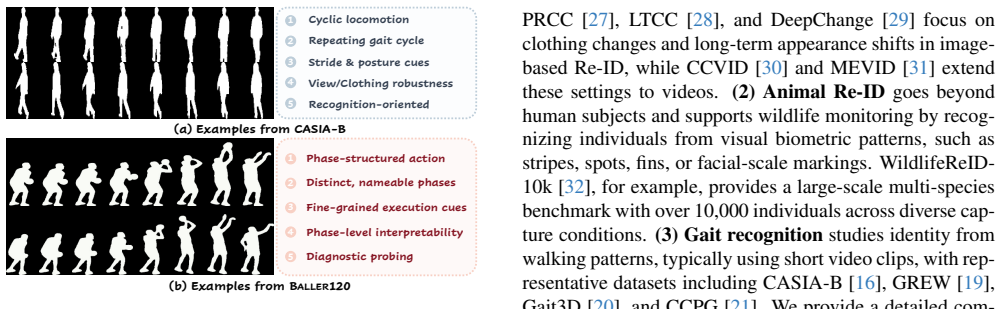
BALLER120: a controlled diagnostic dataset of free-throw sequences from 120 NBA players, paired with appearance, silhouette, and skeleton regimes that hold the multi-phase action fixed while suppressing execution-independent cues, allowing direct comparison of what evidence identity classifiers actually use.
Load-bearing premise
That free-throw differences among professional players, after cropping, scale normalization, and mask or skeleton abstraction, mainly reflect stable individual movement habits rather than leftover capture biases still tied to identity.
What would settle it
Train and test the same silhouette or skeleton models after deliberately injecting controlled residual cues (fixed camera-angle clusters per player, or pose-estimator noise correlated with identity) and check whether accuracy and saliency maps still track player-specific execution phases; collapse under those controls would falsify the claim that the recovered signal is pure motion signature.
Editorial analysis
A structured set of objections, weighed in public.
Referee Report
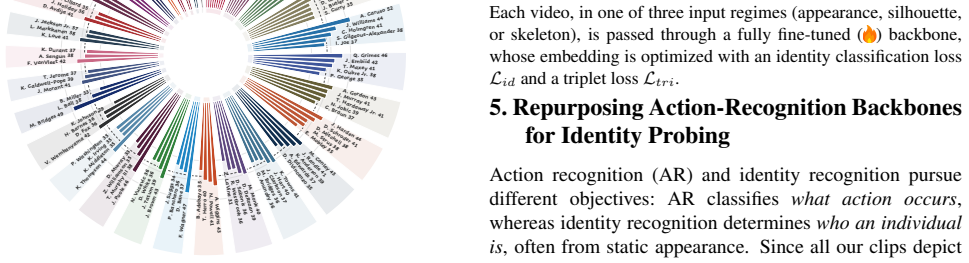
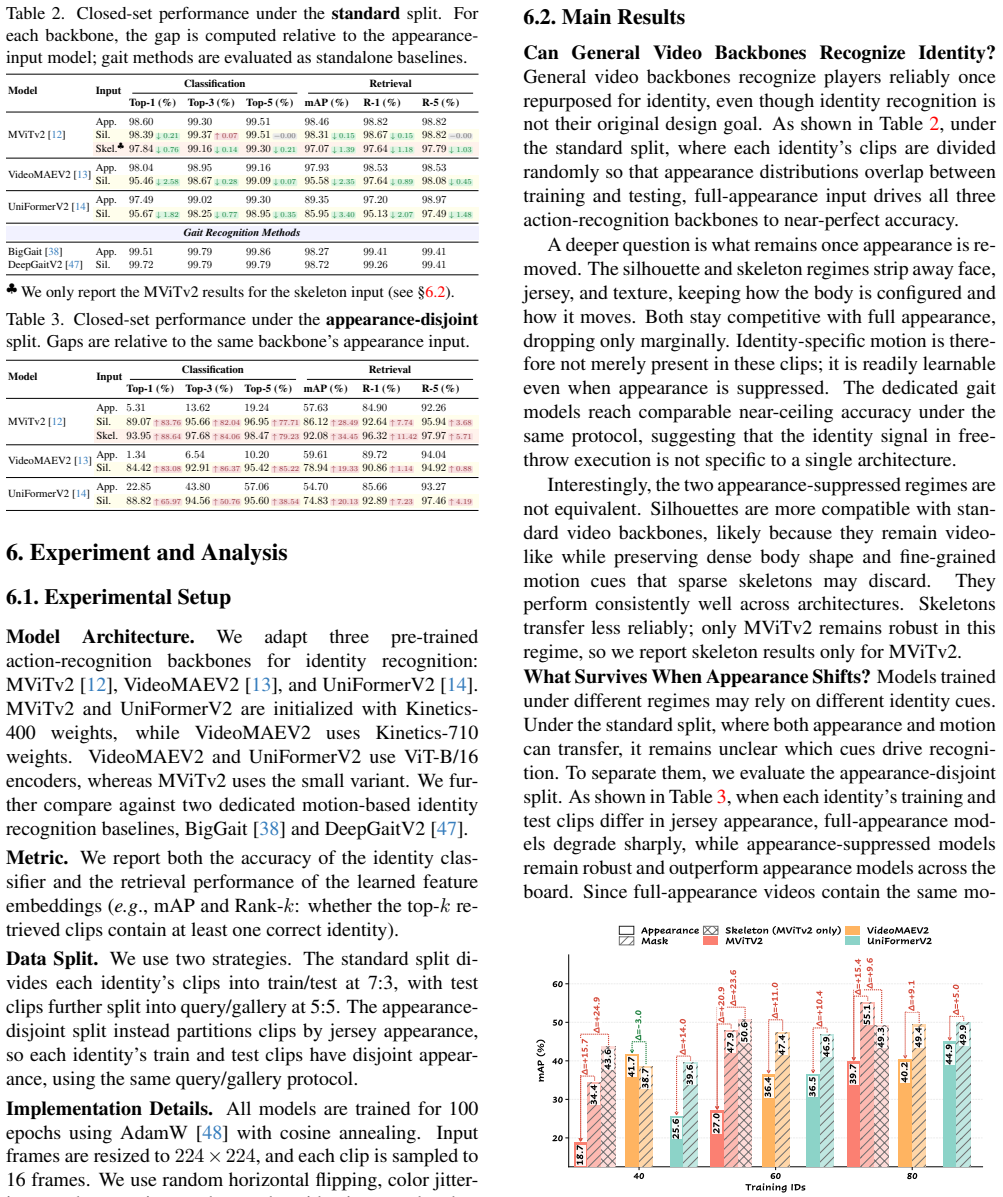
Summary. This paper asks whether modern video models use identity-specific motion when such cues are clearly available, or whether they prefer static appearance shortcuts. It introduces BALLER120, a controlled diagnostic set of 4,583 free-throw clips from 120 NBA players, with paired appearance, silhouette, and skeleton regimes. Using MViTv2, VideoMAEv2, and UniFormerV2 fine-tuned for closed-set identity recognition, the authors show near-ceiling accuracy under a standard split for all regimes (Table 2), sharp collapse of appearance models under an appearance-disjoint split while silhouette/skeleton models remain robust (Table 3), competitive open-set transfer for appearance-suppressed inputs (Fig. 6), limited sensitivity to contour degradation (Table 4), and CAM/pose-region analyses indicating phase-aligned, identity-distinct attention under suppression (Figs. 8–11). Complementary probes (static DINOv3 frames, temporal shuffle, action-recognition control) support a task-induced appearance bias: models exploit the easiest predictive signal unless appearance is suppressed.
Significance. If the result holds, the paper makes a clear diagnostic contribution rather than another unconstrained Re-ID leaderboard entry. BALLER120 is carefully designed to reduce action-level and acquisition confounds while pairing appearance with appearance-suppressed regimes, enabling cue attribution that gait and clothing-change Re-ID datasets do not isolate as cleanly. The multi-backbone, multi-split, ablation, and saliency package is unusually thorough for a diagnostic study and yields a falsifiable, practically relevant message: identity-specific execution cues are learnable and more robust under appearance shift, but standard video fine-tuning will often ignore them. Strengths include explicit multi-regime construction, appearance-disjoint and open-set protocols, contour-degradation and temporal-shuffle controls, and transparent positioning as a probe rather than a general benchmark. These make the work useful for biometrics, sports analytics, and video representation research even if residual non-dynamic cues remain partially entangled.
major comments (2)
- [§3–4, Tables 3–5, abstract/§7] The central claim that silhouette/skeleton success reflects identity-specific motion signatures is only partially isolated from residual execution-independent or multi-pose static anatomy. §4’s union-crop + common-scale resize removes absolute height/camera distance, and Table 4/Fig. 7 show contour degradation barely hurts accuracy, but limb proportions, torso aspect, and phase-specific joint configurations (or RTMPose biases correlated with body type) can still identify players without continuous dynamics. Table 5 is the load-bearing control: multi-frame DINOv3 on silhouettes already reaches ~90% Top-1, so ordered video is helpful but not uniquely necessary. Temporal shuffle (Supp. Table F1) and multi-view consistency help, yet the abstract and §7 still state the result primarily as “motion micro-patterns” / “motion signatures.” Please either (i) reframe claims around execution-dependen
- [§6.2, Table 2, Supp. Table C1] Skeleton results are reported as supporting appearance-suppressed motion learning, but Table 2 and Supp. Table C1 show strong backbone dependence: only MViTv2 remains near ceiling; VideoMAEv2 collapses (~25% Top-1). The paper notes this and supplies saliency hypotheses in Supp. §C–D, but the main-text claim that “skeleton-only inputs” induce a shift toward motion micro-patterns is overstated relative to the architecture-specific evidence. Either restrict the skeleton claim to MViTv2 throughout the abstract/§6.2, or provide a controlled diagnosis (e.g., denser keypoint rendering, temporal joint features, or architecture ablations) showing when sparse skeletons preserve identity-linked dynamics rather than architecture-specific compatibility.
minor comments (5)
- [Figs. 6, 9] Fig. 1 and the teaser caption are effective, but several later figures (e.g., Fig. 9 regional saliency curves, Fig. 6 open-set bars) would benefit from explicit axis units, error bars or seed variance, and a short note on how many clips/identities underlie each bar.
- [§5, Eqs. (1)–(3)] The loss combination Lid + Ltri (Eqs. 1–3) is reasonable, but the paper does not report an ablation of classification-only vs. triplet-only training. A short note or table would clarify whether the cue-shift findings depend on the metric-learning term.
- [Table 1] Table 1’s “Explain. Support” column is informative but slightly overloaded; a one-sentence definition of what counts as phase-level interpretability support would help readers compare BALLER120 to gait sets.
- [§3–4] Minor wording: “execution-independent anatomy” vs. “fixed anatomy” is used somewhat interchangeably in §3–4; aligning terminology would reduce ambiguity with residual shape concerns.
- [§6.4, Fig. 12] The action-recognition control (three-pointers vs. free-throws, Fig. 12) is valuable; stating the number of three-point clips and whether the same players/views are used would improve reproducibility.
Circularity Check
No significant circularity: empirical diagnostic study whose claims rest on external identity labels, controlled input regimes, and measured accuracy/robustness, not on self-referential definitions or fitted-as-prediction steps.
full rationale
BALLER120 and the reported results form a standard controlled empirical probe rather than a derivation chain. Identity labels are external (NBA player identities); free-throw structure is an observed multi-phase action, not defined from model outputs. Accuracy, mAP, appearance-disjoint robustness (Tables 2–3, Fig. 6), contour-degradation sanity checks (Table 4), temporal-shuffle ablations (Supp. Table F1), and CAM saliency (Figs. 8–11) are measured outcomes under three input regimes constructed by an explicit pipeline (Grounding DINO + SAM2 + RTMPose + union-box resize). No equation equates a fitted parameter to a claimed prediction; no uniqueness theorem or ansatz is imported via self-citation to force the central claim that motion signatures are learnable yet overlooked unless appearance is suppressed. Minor design choices (ball inclusion rule, spatial normalization) and one co-author citation for Finer-CAM are non-load-bearing diagnostics. The paper is therefore self-contained against its own benchmarks; residual shape leakage is a correctness/assumption concern, not circularity.
Axiom & Free-Parameter Ledger
free parameters (4)
- label-smoothing epsilon =
0.1
- triplet margin m =
0.3
- peak learning rate / weight decay / epochs / batch size =
1e-4 / 0.05 / 100 / 8-16
- drop-path / dropout rates per backbone =
varies (e.g. VideoMAEv2 drop_path 0.0, drop 0.2)
axioms (4)
- domain assumption Professional free-throw execution contains stable, individual-specific kinematic regularities that survive spatial normalization and appearance suppression.
- domain assumption Frame-wise SAM2 masks and RTMPose skeletons sufficiently remove execution-independent appearance and anatomy while preserving execution-dependent dynamics.
- ad hoc to paper CAM-based saliency, when stable within identity, distinct across identities, and phase-aligned, constitutes valid diagnostic evidence of cue use.
- domain assumption Standard action-recognition pre-training (Kinetics) plus full fine-tuning yields representations that can be fairly compared across appearance/silhouette/skeleton regimes.
invented entities (2)
-
BALLER120 diagnostic benchmark
no independent evidence
-
task-induced appearance bias
no independent evidence
read the original abstract
Identity recognition (e.g., person, animal re-identification) has traditionally relied heavily on static appearance cues. Yet motion--consistent, individual-specific dynamics--can provide a complementary and potentially more robust signature, especially when appearance is weak or variable. This raises a fundamental question: when identity-specific motion cues are clearly present, to what extent do modern video models use them for recognition? To investigate this question, we conduct a systematic diagnostic study and introduce BALLER120, a controlled benchmark of 120 professional basketball players performing free-throws. By focusing on the same multi-phase action across individuals, BALLER120 reduces action-level variation and identity-correlated acquisition biases, enabling fine-grained analysis of identity-specific kinematic patterns. We find that modern video models can predict identity accurately from RGB videos, but often rely on static appearance cues such as faces and jersey regions, even when informative motion cues are available. Strikingly, when appearance is suppressed through silhouette-only or skeleton-only inputs, the same model architectures shift toward motion micro-patterns (e.g., foot placement and elbow bending). Despite containing less visual information, appearance-suppressed representations achieve competitive accuracy and stronger robustness to appearance shifts. Our qualitative analyses further show that appearance-suppressed models attend to distinctive motion patterns across individuals. Overall, our study demonstrates that identity-specific motion signatures are present, informative, and learnable, but modern video models may overlook them in favor of easier static shortcuts unless appearance cues are explicitly suppressed.
Figures





Reference graph
Works this paper leans on
-
[1]
Imagenet: A large-scale hierarchical image database
Jia Deng, Wei Dong, Richard Socher, Li-Jia Li, Kai Li, and Li Fei-Fei. Imagenet: A large-scale hierarchical image database. In2009 IEEE conference on computer vision and pattern recognition, pages 248–255. Ieee, 2009. 1
2009
-
[2]
Imagenet classification with deep convolutional neural net- works.Advances in neural information processing systems, 25, 2012
Alex Krizhevsky, Ilya Sutskever, and Geoffrey E Hinton. Imagenet classification with deep convolutional neural net- works.Advances in neural information processing systems, 25, 2012
2012
-
[3]
Deep learning for person re- identification: A survey and outlook.IEEE transactions on pattern analysis and machine intelligence, 44(6):2872–2893, 2021
Mang Ye, Jianbing Shen, Gaojie Lin, Tao Xiang, Ling Shao, and Steven CH Hoi. Deep learning for person re- identification: A survey and outlook.IEEE transactions on pattern analysis and machine intelligence, 44(6):2872–2893, 2021
2021
-
[4]
Fine-grained image analysis with deep learning: A survey
Xiu-Shen Wei, Yi-Zhe Song, Oisin Mac Aodha, Jianxin Wu, Yuxin Peng, Jinhui Tang, Jian Yang, and Serge Belongie. Fine-grained image analysis with deep learning: A survey. IEEE transactions on pattern analysis and machine intelli- gence, 44(12):8927–8948, 2021. 1
2021
-
[5]
Learning transferable visual models from natural language supervi- sion
Alec Radford, Jong Wook Kim, Chris Hallacy, Aditya Ramesh, Gabriel Goh, Sandhini Agarwal, Girish Sastry, Amanda Askell, Pamela Mishkin, Jack Clark, et al. Learning transferable visual models from natural language supervi- sion. InInternational conference on machine learning, pages 8748–8763. PmLR, 2021. 2
2021
-
[6]
A convnet for the 2020s
Zhuang Liu, Hanzi Mao, Chao-Yuan Wu, Christoph Feicht- enhofer, Trevor Darrell, and Saining Xie. A convnet for the 2020s. InProceedings of the IEEE/CVF conference on com- puter vision and pattern recognition, pages 11976–11986, 2022
2022
-
[7]
Sigmoid loss for language image pre-training
Xiaohua Zhai, Basil Mustafa, Alexander Kolesnikov, and Lucas Beyer. Sigmoid loss for language image pre-training. InProceedings of the IEEE/CVF international conference on computer vision, pages 11975–11986, 2023
2023
-
[8]
Yi Wang, Xinhao Li, Ziang Yan, Yinan He, Jiashuo Yu, Xi- angyu Zeng, Chenting Wang, Changlian Ma, Haian Huang, Jianfei Gao, et al. Internvideo2.5: Empowering video mllms with long and rich context modeling.arXiv preprint arXiv:2501.12386, 2025
Pith/arXiv arXiv 2025
-
[9]
Dinov3.arXiv preprint arXiv:2508.10104, 2025
Oriane Sim ´eoni, Huy V V o, Maximilian Seitzer, Federico Baldassarre, Maxime Oquab, Cijo Jose, Vasil Khalidov, Marc Szafraniec, Seungeun Yi, Micha ¨el Ramamonjisoa, et al. Dinov3.arXiv preprint arXiv:2508.10104, 2025. 2, 8
Pith/arXiv arXiv 2025
-
[10]
Passos, Rafael Gonc ¸alves Pires, Daniel Felipe Silva Santos, Lucas Pascotti Valem, Thierry P
Claudio Filipi Gonc ¸alves dos Santos, Diego De Souza Oliveira, Leandro A. Passos, Rafael Gonc ¸alves Pires, Daniel Felipe Silva Santos, Lucas Pascotti Valem, Thierry P. Moreira, Marcos Cleison S. Santana, Mateus Roder, Jo Paulo Papa, et al. Gait recognition based on deep learning: A survey.ACM Computing Surveys (CSUR), 55(2):1–34, 2022. 2
2022
-
[11]
A comprehensive survey on deep gait recog- nition: Algorithms, datasets, and challenges.IEEE Trans- actions on Biometrics, Behavior, and Identity Science, 7(2): 270–292, 2024
Chuanfu Shen, Shiqi Yu, Jilong Wang, George Q Huang, and Liang Wang. A comprehensive survey on deep gait recog- nition: Algorithms, datasets, and challenges.IEEE Trans- actions on Biometrics, Behavior, and Identity Science, 7(2): 270–292, 2024. 2
2024
-
[12]
Mvitv2: Improved multiscale vision transform- ers for classification and detection
Yanghao Li, Chao-Yuan Wu, Haoqi Fan, Karttikeya Man- galam, Bo Xiong, Jitendra Malik, and Christoph Feicht- enhofer. Mvitv2: Improved multiscale vision transform- ers for classification and detection. InProceedings of the IEEE/CVF conference on computer vision and pattern recognition, pages 4804–4814, 2022. 2, 6, 7, 8
2022
-
[13]
Videomae v2: Scaling video masked autoencoders with dual masking
Limin Wang, Bingkun Huang, Zhiyu Zhao, Zhan Tong, Yi- nan He, Yi Wang, Yali Wang, and Yu Qiao. Videomae v2: Scaling video masked autoencoders with dual masking. In Proceedings of the IEEE/CVF conference on computer vi- sion and pattern recognition, pages 14549–14560, 2023. 2, 6, 7, 8, 5
2023
-
[14]
Uniformerv2: Unlocking the po- tential of image vits for video understanding
Kunchang Li, Yali Wang, Yinan He, Yizhuo Li, Yi Wang, Limin Wang, and Yu Qiao. Uniformerv2: Unlocking the po- tential of image vits for video understanding. InProceedings of the IEEE/CVF International Conference on Computer Vi- sion, pages 1632–1643, 2023. 2, 5, 6, 7, 8
2023
-
[15]
Learning deep features for discrimina- tive localization
Bolei Zhou, Aditya Khosla, Agata Lapedriza, Aude Oliva, and Antonio Torralba. Learning deep features for discrimina- tive localization. InProceedings of the IEEE conference on computer vision and pattern recognition, pages 2921–2929,
-
[16]
A framework for evaluating the effect of view angle, clothing and carrying condition on gait recognition
Shiqi Yu, Daoliang Tan, and Tieniu Tan. A framework for evaluating the effect of view angle, clothing and carrying condition on gait recognition. In18th international con- ference on pattern recognition (ICPR’06), pages 441–444. IEEE, 2006. 3, 5
2006
-
[17]
Person re-identification in the wild
Liang Zheng, Hengheng Zhang, Shaoyan Sun, Manmohan Chandraker, Yi Yang, and Qi Tian. Person re-identification in the wild. InProceedings of the IEEE conference on computer vision and pattern recognition, pages 1367–1376, 2017. 2
2017
-
[18]
Past, present and future approaches us- ing computer vision for animal re-identification from cam- era trap data.Methods in Ecology and Evolution, 10(4):461– 470, 2019
Stefan Schneider, Graham W Taylor, Stefan Linquist, and Stefan C Kremer. Past, present and future approaches us- ing computer vision for animal re-identification from cam- era trap data.Methods in Ecology and Evolution, 10(4):461– 470, 2019
2019
-
[19]
Gait recognition in the wild: A benchmark
Zheng Zhu, Xianda Guo, Tian Yang, Junjie Huang, Jiankang Deng, Guan Huang, Dalong Du, Jiwen Lu, and Jie Zhou. Gait recognition in the wild: A benchmark. InProceedings of the IEEE/CVF international conference on computer vi- sion, pages 14789–14799, 2021. 3, 5
2021
-
[20]
Gait recognition in the wild with dense 3d representations and a benchmark
Jinkai Zheng, Xinchen Liu, Wu Liu, Lingxiao He, Cheng- gang Yan, and Tao Mei. Gait recognition in the wild with dense 3d representations and a benchmark. InProceedings of the IEEE/CVF conference on computer vision and pattern recognition, pages 20228–20237, 2022. 3, 5
2022
-
[21]
An in-depth ex- ploration of person re-identification and gait recognition in cloth-changing conditions
Weijia Li, Saihui Hou, Chunjie Zhang, Chunshui Cao, Xu Liu, Yongzhen Huang, and Yao Zhao. An in-depth ex- ploration of person re-identification and gait recognition in cloth-changing conditions. InProceedings of the IEEE/CVF Conference on Computer Vision and Pattern Recognition, pages 13824–13833, 2023. 2, 3, 5
2023
-
[22]
Deep- reid: Deep filter pairing neural network for person re- identification
Wei Li, Rui Zhao, Tong Xiao, and Xiaogang Wang. Deep- reid: Deep filter pairing neural network for person re- identification. InProceedings of the IEEE conference on computer vision and pattern recognition, pages 152–159,
-
[23]
Scalable person re-identification: A benchmark
Liang Zheng, Liyue Shen, Lu Tian, Shengjin Wang, Jing- dong Wang, and Qi Tian. Scalable person re-identification: A benchmark. InProceedings of the IEEE international con- ference on computer vision, pages 1116–1124, 2015. 3, 5
2015
-
[24]
Person transfer gan to bridge domain gap for person re- identification
Longhui Wei, Shiliang Zhang, Wen Gao, and Qi Tian. Person transfer gan to bridge domain gap for person re- identification. InProceedings of the IEEE conference on computer vision and pattern recognition, pages 79–88, 2018. 3, 5
2018
-
[25]
Person re-identification by video ranking
Taiqing Wang, Shaogang Gong, Xiatian Zhu, and Shengjin Wang. Person re-identification by video ranking. In European conference on computer vision, pages 688–703. Springer, 2014. 3, 5
2014
-
[26]
Mars: A video benchmark for large-scale person re-identification
Liang Zheng, Zhi Bie, Yifan Sun, Jingdong Wang, Chi Su, Shengjin Wang, and Qi Tian. Mars: A video benchmark for large-scale person re-identification. InEuropean conference on computer vision, pages 868–884. Springer, 2016. 3, 5
2016
-
[27]
Person re- identification by contour sketch under moderate clothing change.IEEE transactions on pattern analysis and machine intelligence, 43(6):2029–2046, 2019
Qize Yang, Ancong Wu, and Wei-Shi Zheng. Person re- identification by contour sketch under moderate clothing change.IEEE transactions on pattern analysis and machine intelligence, 43(6):2029–2046, 2019. 3, 5
2029
-
[28]
Long-term cloth-changing person re-identification
Xuelin Qian, Wenxuan Wang, Li Zhang, Fangrui Zhu, Yan- wei Fu, Tao Xiang, Yu-Gang Jiang, and Xiangyang Xue. Long-term cloth-changing person re-identification. InPro- ceedings of the Asian conference on computer vision, 2020. 3, 5
2020
-
[29]
Deepchange: A long-term per- son re-identification benchmark with clothes change
Peng Xu and Xiatian Zhu. Deepchange: A long-term per- son re-identification benchmark with clothes change. In Proceedings of the IEEE/CVF International Conference on Computer Vision, pages 11196–11205, 2023. 3, 5
2023
-
[30]
Clothes-changing person re-identification with rgb modality only
Xinqian Gu, Hong Chang, Bingpeng Ma, Shutao Bai, Shiguang Shan, and Xilin Chen. Clothes-changing person re-identification with rgb modality only. InProceedings of the IEEE/CVF conference on computer vision and pattern recognition, pages 1060–1069, 2022. 3, 5
2022
-
[31]
Mevid: Multi-view extended videos with identities for video person re-identification
Daniel Davila, Dawei Du, Bryon Lewis, Christopher Funk, Joseph Van Pelt, Roderic Collins, Kellie Corona, Matt Brown, Scott McCloskey, Anthony Hoogs, and Brian Clipp. Mevid: Multi-view extended videos with identities for video person re-identification. InProceedings of the IEEE/CVF Winter Conference on Applications of Computer Vision (WACV), pages 1634–164...
2023
-
[32]
Wildlifereid-10k: Wildlife re-identification dataset with 10k individual animals
Lukas Adam, V ojtech Cerm ´ak, Kostas Papafitsoros, and Lukas Picek. Wildlifereid-10k: Wildlife re-identification dataset with 10k individual animals. InProceedings of the IEEE/CVF Conference on Computer Vision and Pattern Recognition, pages 2124–2134, 2025. 3
2025
-
[33]
Understanding the recognition of facial identity and facial expression.Nature Reviews Neuroscience, 6(8):641–651, 2005
Andrew J Calder and Andrew W Young. Understanding the recognition of facial identity and facial expression.Nature Reviews Neuroscience, 6(8):641–651, 2005. 3
2005
-
[34]
How iris recognition works
John Daugman. How iris recognition works. InThe essential guide to image processing, pages 715–739. Elsevier, 2009
2009
-
[35]
On the individuality of fingerprints.IEEE Transactions on pattern analysis and machine intelligence, 24(8):1010–1025, 2002
Sharath Pankanti, Salil Prabhakar, and Anil K Jain. On the individuality of fingerprints.IEEE Transactions on pattern analysis and machine intelligence, 24(8):1010–1025, 2002
2002
-
[36]
Personal authentication using palm-print fea- tures.Pattern recognition, 36(2):371–381, 2003
Chin-Chuan Han, Hsu-Liang Cheng, Chih-Lung Lin, and Kuo-Chin Fan. Personal authentication using palm-print fea- tures.Pattern recognition, 36(2):371–381, 2003. 3
2003
-
[37]
Dygait: Exploiting dynamic representations for high-performance gait recogni- tion
Ming Wang, Xianda Guo, Beibei Lin, Tian Yang, Zheng Zhu, Lincheng Li, Shunli Zhang, and Xin Yu. Dygait: Exploiting dynamic representations for high-performance gait recogni- tion. InProceedings of the IEEE/CVF international confer- ence on computer vision, pages 13424–13433, 2023. 3
2023
-
[38]
Biggait: Learning gait representation you want by large vision models
Dingqiang Ye, Chao Fan, Jingzhe Ma, Xiaoming Liu, and Shiqi Yu. Biggait: Learning gait representation you want by large vision models. InProceedings of the IEEE/CVF con- ference on computer vision and pattern recognition, pages 200–210, 2024. 3, 6
2024
-
[39]
The kinetics hu- man action video dataset.arXiv preprint arXiv:1705.06950,
Will Kay, Joao Carreira, Karen Simonyan, Brian Zhang, Chloe Hillier, Sudheendra Vijayanarasimhan, Fabio Viola, Tim Green, Trevor Back, Paul Natsev, et al. The kinetics hu- man action video dataset.arXiv preprint arXiv:1705.06950,
-
[40]
A short note about kinetics- 600.arXiv preprint arXiv:1808.01340, 2018
Joao Carreira, Eric Noland, Andras Banki-Horvath, Chloe Hillier, and Andrew Zisserman. A short note about kinetics- 600.arXiv preprint arXiv:1808.01340, 2018
Pith/arXiv arXiv 2018
-
[41]
A short note on the kinetics-700 human action dataset.arXiv preprint arXiv:1907.06987, 2019
Joao Carreira, Eric Noland, Chloe Hillier, and Andrew Zis- serman. A short note on the kinetics-700 human action dataset.arXiv preprint arXiv:1907.06987, 2019. 3
Pith/arXiv arXiv 1907
-
[42]
Moments in time dataset: one million videos for event understanding
Mathew Monfort, Alex Andonian, Bolei Zhou, Kandan Ra- makrishnan, Sarah Adel Bargal, Tom Yan, Lisa Brown, Quanfu Fan, Dan Gutfreund, Carl V ondrick, et al. Moments in time dataset: one million videos for event understanding. IEEE transactions on pattern analysis and machine intelli- gence, 42(2):502–508, 2019. 3
2019
-
[43]
The” something something” video database for learning and evaluating visual common sense
Raghav Goyal, Samira Ebrahimi Kahou, Vincent Michal- ski, Joanna Materzynska, Susanne Westphal, Heuna Kim, Valentin Haenel, Ingo Fruend, Peter Yianilos, Moritz Mueller-Freitag, et al. The” something something” video database for learning and evaluating visual common sense. InProceedings of the IEEE international conference on com- puter vision, pages 5842...
2017
-
[44]
Grounding dino: Marrying dino with grounded pre-training for open-set object detection
Shilong Liu, Zhaoyang Zeng, Tianhe Ren, Feng Li, Hao Zhang, Jie Yang, Qing Jiang, Chunyuan Li, Jianwei Yang, Hang Su, et al. Grounding dino: Marrying dino with grounded pre-training for open-set object detection. InEuro- pean conference on computer vision, pages 38–55. Springer,
-
[45]
Sam 2: Segment anything in images and videos
Nikhila Ravi, Valentin Gabeur, Yuan-Ting Hu, Ronghang Hu, Chaitanya Ryali, Tengyu Ma, Haitham Khedr, Roman R¨adle, Chloe Rolland, Laura Gustafson, Eric Mintun, Junt- ing Pan, Kalyan Vasudev Alwala, Nicolas Carion, Chao- Yuan Wu, Ross Girshick, Piotr Doll´ar, and Christoph Feicht- enhofer. Sam 2: Segment anything in images and videos. arXiv preprint arXiv:...
Pith/arXiv arXiv 2024
-
[46]
Tao Jiang, Peng Lu, Li Zhang, Ningsheng Ma, Rui Han, Chengqi Lyu, Yining Li, and Kai Chen. Rtmpose: Real- time multi-person pose estimation based on mmpose.arXiv preprint arXiv:2303.07399, 2023. 4
Pith/arXiv arXiv 2023
-
[47]
Ex- ploring deep models for practical gait recognition.arXiv preprint arXiv:2303.03301, 2023
Chao Fan, Saihui Hou, Yongzhen Huang, and Shiqi Yu. Ex- ploring deep models for practical gait recognition.arXiv preprint arXiv:2303.03301, 2023. 6
Pith/arXiv arXiv 2023
-
[48]
Decoupled weight decay regularization
Ilya Loshchilov and Frank Hutter. Decoupled weight decay regularization. InICLR, 2019. 6
2019
-
[49]
” why should i trust you?” explaining the predictions of any classifier
Marco Tulio Ribeiro, Sameer Singh, and Carlos Guestrin. ” why should i trust you?” explaining the predictions of any classifier. InProceedings of the 22nd ACM SIGKDD interna- tional conference on knowledge discovery and data mining, pages 1135–1144, 2016. 2
2016
-
[50]
A unified approach to interpreting model predictions.Advances in neural informa- tion processing systems, 30, 2017
Scott M Lundberg and Su-In Lee. A unified approach to interpreting model predictions.Advances in neural informa- tion processing systems, 30, 2017. 2
2017
-
[51]
How to explain individual classification decisions.The Jour- nal of Machine Learning Research, 11:1803–1831, 2010
David Baehrens, Timon Schroeter, Stefan Harmeling, Mo- toaki Kawanabe, Katja Hansen, and Klaus-Robert M ¨uller. How to explain individual classification decisions.The Jour- nal of Machine Learning Research, 11:1803–1831, 2010. 2
2010
-
[52]
Grad-cam: Visual explanations from deep networks via gradient-based localization
Ramprasaath R Selvaraju, Michael Cogswell, Abhishek Das, Ramakrishna Vedantam, Devi Parikh, and Dhruv Batra. Grad-cam: Visual explanations from deep networks via gradient-based localization. InProceedings of the IEEE in- ternational conference on computer vision, pages 618–626,
-
[53]
Grad-cam++: General- ized gradient-based visual explanations for deep convolu- tional networks
Aditya Chattopadhay, Anirban Sarkar, Prantik Howlader, and Vineeth N Balasubramanian. Grad-cam++: General- ized gradient-based visual explanations for deep convolu- tional networks. In2018 IEEE winter conference on appli- cations of computer vision (WACV), pages 839–847. IEEE, 2018
2018
-
[54]
Score-cam: Score-weighted visual explanations for convolutional neural networks
Haofan Wang, Zifan Wang, Mengnan Du, Fan Yang, Zijian Zhang, Sirui Ding, Piotr Mardziel, and Xia Hu. Score-cam: Score-weighted visual explanations for convolutional neural networks. InProceedings of the IEEE/CVF conference on computer vision and pattern recognition workshops, pages 24–25, 2020. 2
2020
-
[55]
Finer-cam: Spotting the difference reveals finer details for visual explanation
Ziheng Zhang, Jianyang Gu, Arpita Chowdhury, Zheda Mai, David Carlyn, Tanya Berger-Wolf, Yu Su, and Wei-Lun Chao. Finer-cam: Spotting the difference reveals finer details for visual explanation. InProceedings of the Computer Vi- sion and Pattern Recognition Conference, pages 9611–9620,
-
[56]
pure motion
2 Probing Identity-Specific Motion Signatures: A Controlled Diagnostic Study Supplementary Material This supplementary material provides additional imple- mentation details and analyses that support the diagnostic findings in the main paper. It is organized as follows: • Appendix A reports the backbone configurations and training hyperparameters used in o...
2097
discussion (0)
Sign in with ORCID, Apple, or X to comment. Anyone can read and Pith papers without signing in.