REVIEW 3 major objections 5 minor 56 references
Spin-orbit torque-driven synthetic antiferromagnetic oscillator
T0 review · 3 major / 5 minor · reviewed 2026-07-12 · grok-4.5
Pith's one-line read A synthetic-antiferromagnet nanoconstriction driven by spin-orbit torque shows electrical signatures of current-selected chiral self-oscillations near the spin-flop transition.
desk verdict Solid first electrical signatures of SOT-driven SAF self-oscillations, carefully worded; the linear modes are clean, the nonlinear claim is real but still indirect. read the letter →
The pith
A machine-rendered reading of the paper's core claim, the machinery that carries it, and where it could break.
The reading
What carries the argument
Spin-rectification spectroscopy of a synthetic-antiferromagnet nanoconstriction: nonlinear mixing of the RF current with time-dependent AMR and GMR yields a DC voltage that reports both linear eigenmodes and, above threshold, injection-locked DC-driven dynamics whose chirality is set by current polarity.
What would settle it
Direct microwave-emission spectra or Brillouin light scattering from the nanoconstriction that show, or fail to show, a DC-threshold, injection-locked peak whose handedness reverses with current polarity at the same low fields where the spin-rectification peaks appear.
Extended reading notes
Core claim
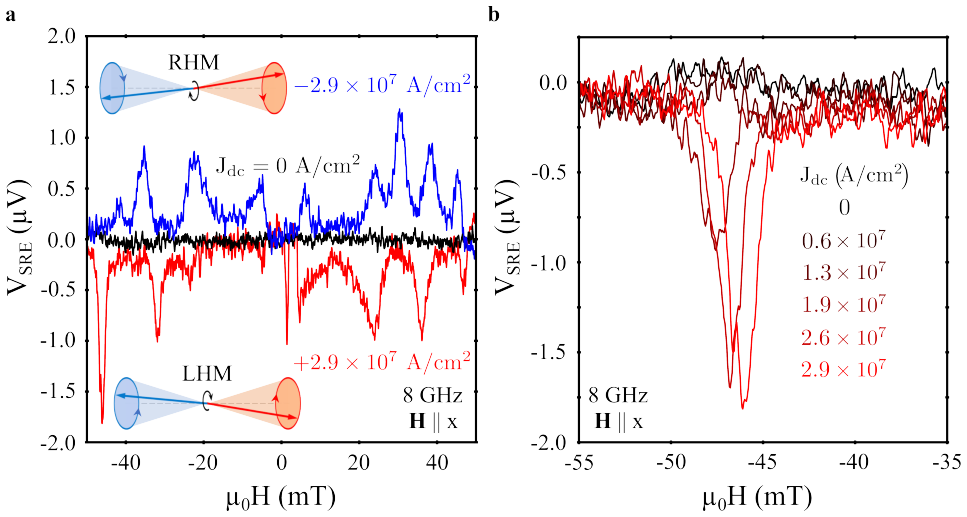
Low-field spin-rectification peaks that emerge only above a DC-current threshold near the spin-flop transition reverse with current polarity independently of magnetic-field polarity and lock to an injected RF frequency. The paper presents these peaks as electrical signatures consistent with injection-locked, current-selected chiral self-oscillatory dynamics of the synthetic-antiferromagnet order, in addition to the linear acoustic and optical eigenmodes that the same devices also support.
Load-bearing premise
The extra low-field rectification peaks are taken to come from injection-locked self-oscillations of the synthetic antiferromagnet rather than from other current-driven nonlinear rectification, heating, or domain effects that can also produce polarity-dependent voltages.
Editorial extensions
If this is right
- Synthetic-antiferromagnet nanoconstrictions become an accessible platform for current-driven antiferromagnetic-like oscillators in the GHz range.
- Self-oscillation chirality can be selected by DC current polarity rather than fixed by the applied magnetic field.
- Multi-peak, weakly RF-frequency-dependent responses near the spin-flop motivate nonlinear spintronic devices for signal processing and reservoir computing.
- TMR-based three-terminal readout or Brillouin light scattering can raise detection amplitude beyond the ~0.1% AMR/GMR limit of the present metallic stack.
Reading between the lines
- Because the stack is metallic and lithographically simple, the same dual-interface SOT nanoconstriction could be arrayed for mutual-synchronization experiments already standard in ferromagnetic spin-Hall oscillators.
- The roughly tenfold threshold mismatch with zero-temperature micromagnetic simulations points to thermal activation or local heating as likely onset mechanisms; temperature-dependent threshold maps would test that.
- If the multi-peak spectrum is chaotic rather than multi-mode, the device is a candidate physical reservoir whose fading memory is bias-tunable near the spin-flop.
- Porting the same dual heavy-metal SOT geometry onto a true collinear antiferromagnet would push the identical electrical detection scheme into the THz band predicted by theory.
Signed reviews
Editorial analysis
A structured set of objections, weighed in public.
Referee Report
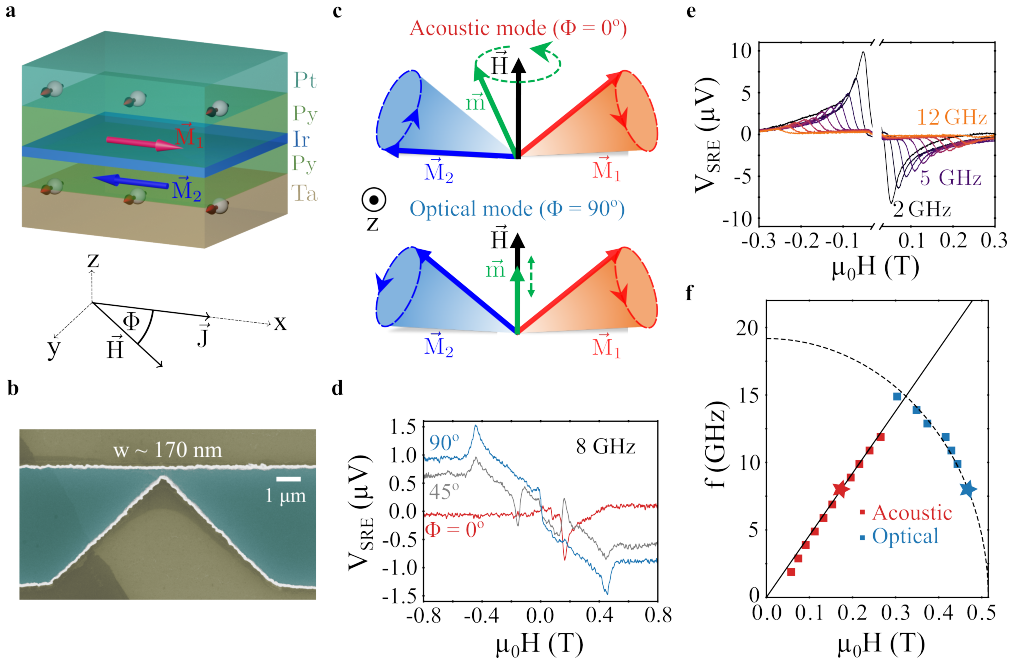
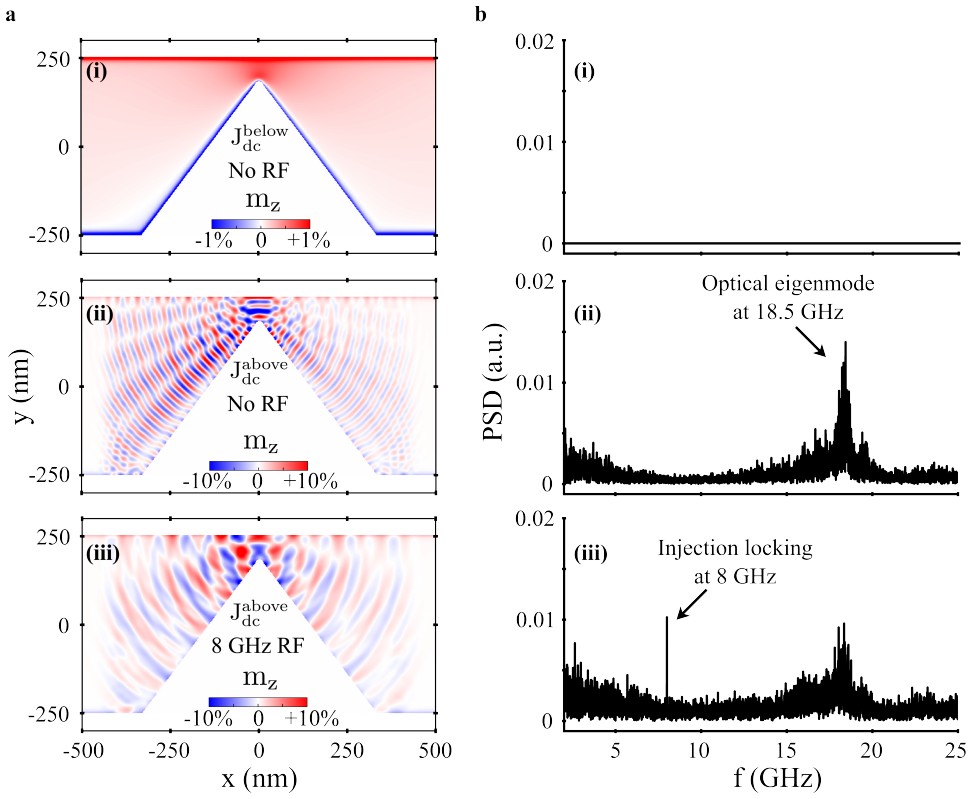
Summary. The manuscript reports SOT-driven dynamics in a Ta/Py/Ir/Py/Pt synthetic-antiferromagnet nanoconstriction. Using spin-rectification spectroscopy, the authors electrically excite and detect acoustic and optical SAF eigenmodes whose field–frequency dependence matches an easy-plane antiferromagnetic resonance model with independently measured Hex and Han. Above a DC-current threshold near the spin-flop transition they observe additional low-field SRE peaks whose sign follows DC-current polarity (independent of field polarity) and that lock to an injected RF frequency; these are interpreted as electrical signatures of current-selected chiral self-oscillatory dynamics. Micromagnetic simulations reproduce threshold self-oscillations and injection locking, while macrospin simulations predict stable and chaotic regimes in the same spin-flop window. The multi-peak, weakly frequency-dependent SRE response is presented as qualitative evidence of complex nonlinear dynamics, establishing SAF nanoconstrictions as a platform for GHz antiferromagnetic-like oscillators.
Significance. If the nonlinear interpretation holds, this is a first experimental electrical demonstration of current-driven, chirality-selectable self-oscillatory dynamics in an antiferromagnetically coupled metallic system—an important step beyond ferromagnetic STT/SOT oscillators whose chirality is field-locked. The linear-mode spectroscopy is already of high quality: resonance fields quantitatively track analytic AFM formulas using VSM-derived parameters rather than free fits, and mode selectivity with Φ is cleanly demonstrated. The combination of SRE, micromagnetic injection-locking, and macrospin Lyapunov/bifurcation analysis provides a coherent, multi-method platform that will interest the spintronics and nonlinear-dynamics communities and motivates reservoir-computing concepts. The work is carefully caveated about the absence of free-running emission/BLS, which strengthens rather than weakens its credibility.
major comments (3)
- Section 3 and Fig. 3: the central claim that the threshold low-field SRE peaks are injection-locked DC-driven limit cycles (rather than current-assisted domain reconfiguration, nonlinear mixing of static SOT canting, or residual thermal rectification) is load-bearing but not uniquely established. The H∥J geometry and even-in-current thermal exclusion are helpful, yet a decisive control is missing: e.g., RF-power dependence of the locking bandwidth, a clear free-running spectral signature (even if weak), or a quantitative comparison of the observed locking range with the simulated Arnold tongue. Without such a control the self-oscillation interpretation remains consistent but not exclusive.
- Section 3: the experimental threshold (~1.3 imes10^7 A/cm^{2}) is roughly an order of magnitude lower than the zero-temperature micromagnetic threshold (~2 imes10^8 A/cm^{2}). The authors correctly list thermal activation, Joule heating of parameters, and current-crowding uncertainty as possible causes, but the discrepancy is large enough that the simulations currently support only the qualitative symmetry of the instability, not its quantitative location. A finite-temperature micromagnetic run or an explicit estimate of the local current density at the notch (beyond the COMSOL average) is needed before the simulated self-oscillation can be regarded as the same phenomenon.
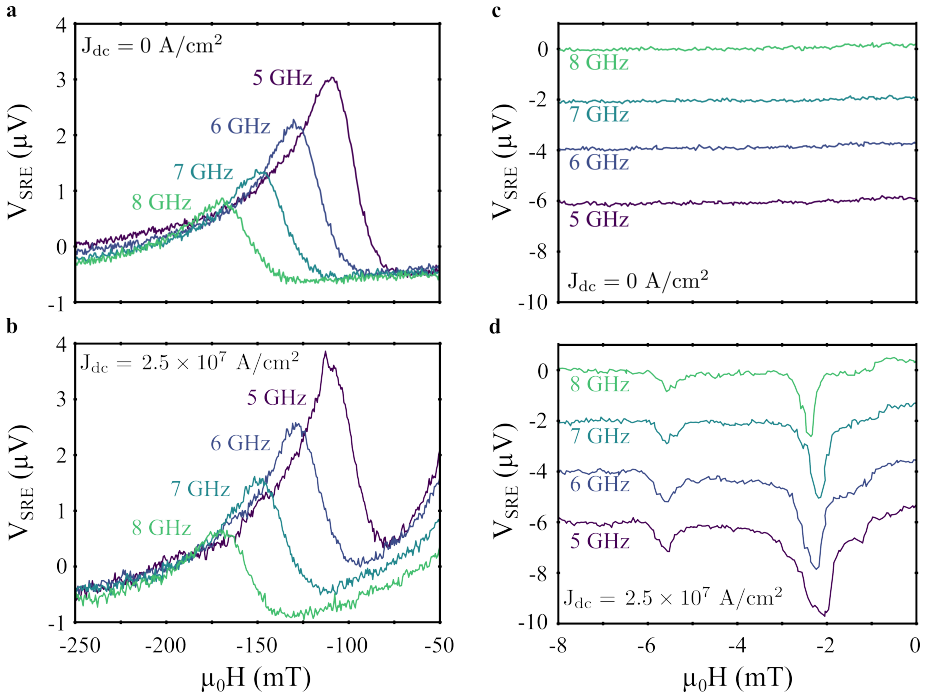
- Section 4 and Supplementary Section 7: the multi-peak, weakly RF-frequency-dependent SRE response is interpreted as a qualitative signature of complex/chaotic dynamics predicted by the macrospin Lyapunov analysis. Because the experiment lacks real-time trajectories, fluctuation spectra, or free-running emission, this remains an association rather than a demonstration. The manuscript already states this limitation; it should be reinforced in the abstract and conclusion so that the chaos language is not over-read.
minor comments (5)
- Fig. 1d and accompanying text: the assignment of damping-like SOT as the dominant drive is carefully argued via mode selectivity and domain configuration, yet a short quantitative estimate of residual field-like/Oersted contributions (already available from the COMSOL Oersted map in Supplementary Fig. S12) would make the claim tighter.
- Methods: the effective in-plane easy-axis anisotropy μ0Hu,x ≈ 5 mT and out-of-plane hard-axis μ0Hu,z ≈ −1 T used in the macrospin model are introduced without a direct experimental cross-check; a sentence linking them to the VSM or shape-anisotropy estimates would help.
- Fig. 4c,d: the vertical offsets applied for clarity should be stated in the caption so that absolute SRE amplitudes can be compared across frequencies.
- Abstract and conclusion: the phrase “qualitative signature of complex nonlinear dynamics” is appropriately cautious; ensure the same wording is used consistently when referring to chaos.
- References: the recent SAF spin-Hall nano-oscillator work with TMR readout (arXiv:2508.18770) is already cited; a brief comparison of detection schemes would situate the present AMR/GMR limitation more clearly.
Circularity Check
No load-bearing circularity: eigenmode frequencies use independent VSM parameters, and self-oscillation claims rest on threshold/polarity/locking data plus independent simulations rather than definitional or fitted reductions.
full rationale
The paper's derivation chain is self-contained against external benchmarks and does not reduce its central claims to inputs by construction. Acoustic/optical eigenmode frequencies are compared to the standard easy-plane antiferromagnetic resonance formulas using µ0Hex = 0.25 T and µ0Han = 0.98 T taken independently from VSM (not fitted to the SRE peaks). The low-field threshold SRE peaks are reported as experimental facts (onset above ~1.3e7 A/cm2, current-polarity-controlled sign independent of field polarity, RF-frequency locking, multi-peak weak frequency dependence) and interpreted as consistent with injection-locked chiral self-oscillations; micromagnetic and macrospin simulations (using the same independently fixed material parameters) are used only as qualitative support for threshold excitation, locking, and possible complex dynamics near spin-flop. The ~10x threshold mismatch and absence of free-running emission/BLS are explicitly noted, so the interpretation is not forced by redefinition. Minor self-citations of related SOT/rectification or theoretical AF-oscillator papers exist but are not uniqueness theorems or load-bearing premises that close alternatives by citation alone. No self-definitional loop, no fitted-parameter-as-prediction of the target peaks, and no ansatz smuggled via self-citation appear. Score 1 reflects only the ordinary presence of overlapping-author theory citations that are not required for the experimental result.
Assumptions & free parameters
free parameters (4)
- spin Hall angle θ_SH =
0.15
- effective in-plane easy-axis anisotropy μ0 Hu,x =
≈5 mT
- effective out-of-plane hard-axis anisotropy μ0 Hu,z =
≈−1 T
- local current density / current partitioning =
order 10^7 A/cm² experimental vs 10^8 A/cm² simulation
assumptions (4)
- domain assumption Magnetization dynamics of each Py layer obey the Landau–Lifshitz–Gilbert equation with damping-like SOT of the form τ_DL ∝ M × (M × σ).
- domain assumption The Ir spacer mediates a uniform antiferromagnetic RKKY exchange field μ0 Hex ≈ 0.25 T between the two Py layers.
- domain assumption Spin rectification voltage arises from second-order mixing of RF current with time-dependent AMR + GMR resistance of the SAF.
- domain assumption Opposite spin-Hall angles of Pt and Ta inject spin currents of identical polarization into the SAF from opposite sides, producing a staggered antidamping drive.
Cite this review
Pith. "Pith review of Spin-orbit torque-driven synthetic antiferromagnetic oscillator." pith.science (2026). https://pith.science/paper/JEQWA6VU
@misc{pith2026260703708,
  author       = {Pith},
  title        = {Pith review of: Spin-orbit torque-driven synthetic antiferromagnetic oscillator},
  year         = {2026},
  howpublished = {\url{https://pith.science/paper/JEQWA6VU}},
  note         = {Machine review of arXiv:2607.03708}
}
read the original abstract
Antiferromagnets offer a promising route toward robust spintronic devices because of their compensated magnetic order and exchange-enhanced spin dynamics. Here, we demonstrate a spin-orbit torque (SOT)-driven antiferromagnetic oscillator based on a nanoconstriction patterned from a synthetic antiferromagnet (SAF). Spin-rectification spectroscopy reveals electrical excitation of both acoustic and optical SAF eigenmodes, whose field and frequency dependences are quantitatively described by an antiferromagnetic resonance model. In addition to these linear eigenmodes, we observe low-field spin-rectification peaks that emerge only above a threshold DC current near the spin-flop transition. Their current-polarity-dependent sign and locking to an injected RF frequency provide electrical spin-rectification signatures consistent with current-selected chiral self-oscillatory dynamics. Micromagnetic simulations reproduce the threshold excitation of SOT-driven self-oscillations and injection locking, while macrospin simulations predict stable and chaotic nonlinear dynamics within the same spin-flop region. We interpret the multi-peak, weakly RF-frequency-dependent responses as a qualitative signature of complex nonlinear dynamics. These results establish SAF nanoconstrictions as an experimentally accessible platform for studying current-driven antiferromagnetic-like oscillator dynamics and motivate future work on nonlinear spintronic devices for signal processing and reservoir-computing concepts.
Figures
Figures from the paper (1 more)
Reference graph
Works this paper leans on
-
[1]
Spin-orbit torque-driven excitation of SAF eigenmodes To probe the spin dynamics of the SAF nanoconstriction, we applied a RF current and measured the resulting spin rectification voltageV SRE while sweeping an in-plane magnetic field. This voltage originates from nonlinear mixing of the time-dependent resistance, mod- ulated by anisotropic magnetoresista...
-
[2]
Micromagnetic simulation of chiral self-oscillations To gain further insight into the current-driven spin dynamics observed in the SAF nanocon- striction, we performed micromagnetic simulations using the GPU-accelerated open-source solver MuMax3 (see Methods) [44]. While micromagnetic simulations neglect exchange damping, an effect that becomes relevant i...
-
[3]
Al- 9 though the external magnetic field is applied parallel to the charge-current direction in the measurements of Fig
Threshold current and SRE signatures of chiral self-oscillatory dynamics We now discuss SRE signatures of DC-current-driven non-linear dynamics near the spin- flop transition, i.e., at low applied magnetic fields (|µ 0H|<50 mT), where no resonant eigenmodes are observed in the absence of a DC current [Supplementary Section 2]. Al- 9 though the external ma...
-
[4]
In the absence of a DC current, only the acoustic eigenmode is observed, with a resonance field that shifts monotonically to higher values as the RF frequency increases (Fig
Current-driven dynamics close to the spin-flop transition with possible sig- natures of chaotic behavior To investigate the complex dynamics predicted for SOT-driven antiferromagnetic oscillators near the spin-flop transition, we performed spin rectification measurements across a range of RF frequencies (5-8 GHz) and compared the acoustic eigenmode of Sec...
-
[5]
Emergente relativistis- che Effekte in der Kondensierten Materie
Conclusion We have demonstrated electrical signatures of a SOT-driven synthetic antiferromagnetic oscillator based on a SAF nanoconstriction. Spin-rectification spectroscopy resolves the acoustic and optical antiferromagnetic-like eigenmodes and shows that their field and fre- quency dependence are quantitatively captured by an analytical antiferromagneti...
2020
-
[6]
URLhttp://dx.doi.org/10.1038/nature23011
Torrejon, J.et al.Neuromorphic computing with nanoscale spintronic oscillators.Nature547, 428–431 (2017). URLhttp://dx.doi.org/10.1038/nature23011
-
[7]
URL http://dx.doi.org/10.1038/s41928-019-0360-9
Grollier, J.et al.Neuromorphic spintronics.Nature Electronics3, 360–370 (2020). URL http://dx.doi.org/10.1038/s41928-019-0360-9
-
[8]
Locatelli, N., Cros, V. & Grollier, J. Spin-torque building blocks.Nature Materials13, 11–20 (2013). URLhttp://dx.doi.org/10.1038/nmat3823
doi:10.1038/nmat3823 2013
Show all 56 references
-
[9]
URLhttp://dx.doi.org/10.1038/s41586-018-0632-y
Romera, M.et al.Vowel recognition with four coupled spin-torque nano-oscillators.Nature 563, 230–234 (2018). URLhttp://dx.doi.org/10.1038/s41586-018-0632-y
2018 doi
-
[10]
URLhttp://dx.doi
Zahedinejad, M.et al.Two-dimensional mutually synchronized spin hall nano-oscillator arrays for neuromorphic computing.Nature Nanotechnology15, 47–52 (2019). URLhttp://dx.doi. org/10.1038/s41565-019-0593-9
2019 doi
-
[11]
Chen, T.et al.Spin-torque and spin-hall nano-oscillators.Proceedings of the IEEE104, 1919–1945 (2016)
1919
-
[12]
Villard, P.et al.A ghz spintronic-based rf oscillator.IEEE Journal of Solid-State Circuits 45, 214–223 (2010). 18
2010
-
[13]
URLhttps://www.sciencedirect.com/science/article/ pii/S0038110115001690
Chen, T.et al.Integration of gmr-based spin torque oscillators and cmos circuitry.Solid-State Electronics111, 91–99 (2015). URLhttps://www.sciencedirect.com/science/article/ pii/S0038110115001690
2015
-
[14]
Current-driven excitation of magnetic multilayers.Journal of Magnetism and Magnetic Materials159, L1–L7 (1996)
Slonczewski, J. Current-driven excitation of magnetic multilayers.Journal of Magnetism and Magnetic Materials159, L1–L7 (1996). URLhttps://www.sciencedirect.com/science/ article/pii/0304885396000625
1996
-
[15]
Emission of spin waves by a magnetic multilayer traversed by a current.Phys
Berger, L. Emission of spin waves by a magnetic multilayer traversed by a current.Phys. Rev. B54, 9353–9358 (1996). URLhttps://link.aps.org/doi/10.1103/PhysRevB.54.9353
1996 doi
-
[16]
Tsoi, M.et al.Excitation of a magnetic multilayer by an electric current.Phys. Rev. Lett. 80, 4281–4284 (1998). URLhttps://link.aps.org/doi/10.1103/PhysRevLett.80.4281
1998 doi
-
[17]
I.et al.Microwave oscillations of a nanomagnet driven by a spin-polarized current
Kiselev, S. I.et al.Microwave oscillations of a nanomagnet driven by a spin-polarized current. Nature425, 380–383 (2003). URLhttp://dx.doi.org/10.1038/nature01967
2003 doi
-
[18]
E., Demokritov, S
Demidov, V. E., Demokritov, S. O., Reiss, G. & Rott, K. Effect of spin-polarized electric current on spin-wave radiation by spin-valve nanocontacts.Applied Physics Letters90, 172508 (2007). URLhttps://doi.org/10.1063/1.2732816. https://pubs.aip.org/aip/apl/article- pdf/doi/10....
2007 doi
-
[19]
M.et al.Bias-driven high-power microwave emission from mgo-based tunnel magne- toresistance devices.Nature Physics4, 803–809 (2008)
Deac, A. M.et al.Bias-driven high-power microwave emission from mgo-based tunnel magne- toresistance devices.Nature Physics4, 803–809 (2008). URLhttp://dx.doi.org/10.1038/ nphys1036
2008
-
[20]
& Tiberkevich, V
Slavin, A. & Tiberkevich, V. Nonlinear auto-oscillator theory of microwave generation by spin-polarized current.IEEE Transactions on Magnetics45, 1875–1918 (2009)
1918
-
[21]
E.et al.Magnetic nano-oscillator driven by pure spin current.Nature Materials 11, 1028–1031 (2012)
Demidov, V. E.et al.Magnetic nano-oscillator driven by pure spin current.Nature Materials 11, 1028–1031 (2012). URLhttp://dx.doi.org/10.1038/nmat3459
2012 doi
-
[22]
Liu, L., Pai, C.-F., Ralph, D. C. & Buhrman, R. A. Magnetic oscillations driven by the spin hall effect in 3-terminal magnetic tunnel junction devices.Phys. Rev. Lett.109, 186602 (2012). URLhttps://link.aps.org/doi/10.1103/PhysRevLett.109.186602
2012 doi
-
[23]
H., Lim, W
Liu, R. H., Lim, W. L. & Urazhdin, S. Spectral characteristics of the microwave emission by the spin hall nano-oscillator.Phys. Rev. Lett.110, 147601 (2013). URLhttps://link.aps. org/doi/10.1103/PhysRevLett.110.147601
2013 doi
-
[24]
E., Urazhdin, S., Zholud, A., Sadovnikov, A
Demidov, V. E., Urazhdin, S., Zholud, A., Sadovnikov, A. V. & Demokritov, S. O. Nanoconstriction-based spin-Hall nano-oscillator.Applied Physics Letters105, 172410 19 (2014). URLhttps://doi.org/10.1063/1.4901027. https://pubs.aip.org/aip/apl/article- pdf/doi/10.1063/1.4901027/...
2014 doi
-
[25]
URLhttp://dx.doi.org/10.1038/ncomms6616
Duan, Z.et al.Nanowire spin torque oscillator driven by spin orbit torques.Nature Commu- nications5(2014). URLhttp://dx.doi.org/10.1038/ncomms6616
2014 doi
-
[26]
URLhttp://dx.doi.org/10.1038/s41467-019-10120-4
Haidar, M.et al.A single layer spin-orbit torque nano-oscillator.Nature Communications10 (2019). URLhttp://dx.doi.org/10.1038/s41467-019-10120-4
2019 doi
-
[27]
URLhttp://dx.doi.org/10.1038/s41467-020-17833-x
Fulara, H.et al.Giant voltage-controlled modulation of spin hall nano-oscillator damping.Na- ture Communications11(2020). URLhttp://dx.doi.org/10.1038/s41467-020-17833-x
2020 doi
-
[28]
URLhttp://dx.doi.org/10.1038/s41467-022-31493-z
Choi, J.-G.et al.Voltage-driven gigahertz frequency tuning of spin hall nano-oscillators.Na- ture Communications13(2022). URLhttp://dx.doi.org/10.1038/s41467-022-31493-z
2022 doi
-
[29]
& Brataas, A
Cheng, R., Xiao, D. & Brataas, A. Terahertz antiferromagnetic spin hall nano-oscillator.Phys. Rev. Lett.116, 207603 (2016). URLhttps://link.aps.org/doi/10.1103/PhysRevLett. 116.207603
2016 doi
-
[30]
E., Rode, K., Stamenov, P., Coey, J
Troncoso, R. E., Rode, K., Stamenov, P., Coey, J. M. D. & Brataas, A. Antiferromagnetic single-layer spin-orbit torque oscillators.Phys. Rev. B99, 054433 (2019). URLhttps: //link.aps.org/doi/10.1103/PhysRevB.99.054433
2019 doi
-
[31]
& Kravchuk, V
Wolba, B., Gomonay, O. & Kravchuk, V. P. Chaotic antiferromagnetic nano-oscillator driven by spin torque.Phys. Rev. B104, 024407 (2021). URLhttps://link.aps.org/doi/10. 1103/PhysRevB.104.024407
2021
-
[32]
Parthasarathy, A., Cogulu, E., Kent, A. D. & Rakheja, S. Precessional spin-torque dynamics in biaxial antiferromagnets.Phys. Rev. B103, 024450 (2021). URLhttps://link.aps.org/ doi/10.1103/PhysRevB.103.024450
2021 doi
-
[33]
& Tserkovnyak, Y
Gomonay, O., Baltz, V., Brataas, A. & Tserkovnyak, Y. Antiferromagnetic spin textures and dynamics.Nature Physics14, 213–216 (2018). URLhttp://dx.doi.org/10.1038/ s41567-018-0049-4
2018
-
[34]
& Fukami, S
Han, J., Cheng, R., Liu, L., Ohno, H. & Fukami, S. Coherent antiferromagnetic spintronics. Nature Materials22, 684–695 (2023)
2023
-
[35]
& Wunderlich, J
Jungwirth, T., Marti, X., Wadley, P. & Wunderlich, J. Antiferromagnetic spintronics.Nature Nanotechnology11, 231–241 (2016). URLhttps://doi.org/10.1038/nnano.2016.18
2016 doi
-
[36]
Williamson, S. J. & Foner, S. Antiferromagnetic resonance in systems with dzyaloshinsky- moriya coupling; orientation dependence inαfe 2o3.Phys. Rev.136, A1102–A1106 (1964). 20 URLhttps://link.aps.org/doi/10.1103/PhysRev.136.A1102
1964 doi
-
[37]
& Kittel, C
Keffer, F. & Kittel, C. Theory of antiferromagnetic resonance.Phys. Rev.85, 329–337 (1952). URLhttps://link.aps.org/doi/10.1103/PhysRev.85.329
1952 doi
-
[38]
URLhttp: //dx.doi.org/10.1038/s41598-018-33697-0
Khymyn, R.et al.Ultra-fast artificial neuron: generation of picosecond-duration spikes in a current-driven antiferromagnetic auto-oscillator.Scientific Reports8(2018). URLhttp: //dx.doi.org/10.1038/s41598-018-33697-0
2018 doi
-
[39]
& Hu, C.-M
Harder, M., Gui, Y. & Hu, C.-M. Electrical detection of magnetization dynamics via spin rec- tification effects.Physics Reports661, 1–59 (2016). URLhttps://www.sciencedirect.com/ science/article/pii/S0370157316303167. Electrical detection of magnetization dynamics via spin rec...
2016
-
[40]
Nature Nanotechnology(2024)
Sakamoto, S.et al.Antiferromagnetic spin-torque diode effect in a kagome Weyl semimetal. Nature Nanotechnology(2024). URLhttp://dx.doi.org/10.1038/s41565-024-01820-0
2024 doi
-
[41]
& Kim, P
Choi, J. & Kim, P. Critical neuromorphic computing based on explosive syn- chronization.Chaos: An Interdisciplinary Journal of Nonlinear Science29, 043110 (2019). URLhttps://doi.org/10.1063/1.5086902. https://pubs.aip.org/aip/cha/article- pdf/doi/10.1063/1.5086902/14621310/043...
2019 doi
-
[42]
URLhttps://doi.org/10.1063/1.5079305
Markovi´ c, D.et al.Reservoir computing with the frequency, phase, and ampli- tude of spin-torque nano-oscillators.Applied Physics Letters114, 012409 (2019). URLhttps://doi.org/10.1063/1.5079305. https://pubs.aip.org/aip/apl/article- pdf/doi/10.1063/1.5079305/19751429/012409 1...
2019 doi
-
[43]
A., Lee, K.-J., Parkin, S
Duine, R. A., Lee, K.-J., Parkin, S. S. P. & Stiles, M. D. Synthetic antiferromag- netic spintronics.Nature Physics14, 217–219 (2018). URLhttps://doi.org/10.1038/ s41567-018-0050-y
2018
-
[44]
& Perel, V
Dyakonov, M. & Perel, V. Current-induced spin orientation of electrons in semiconductors. Physics Letters A35, 459–460 (1971). URLhttps://www.sciencedirect.com/science/ article/pii/0375960171901964
1971
-
[45]
Hirsch, J. E. Spin Hall Effect.Phys. Rev. Lett.83, 1834–1837 (1999). URLhttps://link. aps.org/doi/10.1103/PhysRevLett.83.1834
1999 doi
-
[46]
& Jungwirth, T
Wunderlich, J., Kaestner, B., Sinova, J. & Jungwirth, T. Experimental observation of the spin-hall effect in a two-dimensional spin-orbit coupled semiconductor system.Phys. Rev. Lett. 94, 047204 (2005). URLhttps://link.aps.org/doi/10.1103/PhysRevLett.94.047204. 21
2005 doi
-
[47]
URLhttp://dx.doi.org/10.1038/nnano.2011.68
Fang, D.et al.Spin–orbit-driven ferromagnetic resonance.Nature Nanotechnology6, 413–417 (2011). URLhttp://dx.doi.org/10.1038/nnano.2011.68
2011 doi
-
[48]
Liu, L., Moriyama, T., Ralph, D. C. & Buhrman, R. A. Spin-torque ferromagnetic resonance induced by the spin hall effect.Phys. Rev. Lett.106, 036601 (2011). URLhttps://link. aps.org/doi/10.1103/PhysRevLett.106.036601
2011 doi
-
[49]
URLhttps://doi.org/10.1063/1.4899186
Vansteenkiste, A.et al.The design and verification of mumax3.AIP Advances4, 107133 (2014). URLhttps://doi.org/10.1063/1.4899186. https://pubs.aip.org/aip/adv/article- pdf/doi/10.1063/1.4899186/12878560/107133 1 online.pdf
2014 doi
-
[50]
Dai, C. & Ma, F. Strong magnon–magnon coupling in synthetic antiferromagnets.Applied Physics Letters118, 112405 (2021). URLhttps://doi.org/10.1063/5.0041431
2021 doi
-
[51]
Wang, Y.et al.Ultrastrong to nearly deep-strong magnon-magnon coupling with a high degree of freedom in synthetic antiferromagnets.Nature Communications15(2024)
2024
-
[52]
Liu, Y.et al.Design of controllable magnon frequency comb in synthetic ferrimagnets. Phys. Rev. B109, 174412 (2024). URLhttps://link.aps.org/doi/10.1103/PhysRevB. 109.174412
2024 doi
-
[53]
URLhttps://doi
Wang, L.et al.Electrical Excitation and Detection of Chiral Magnons in a Compensated Ferrimagnetic Insulator.Physical Review Letters133, 166705 (2024). URLhttps://doi. org/10.1103/PhysRevLett.133.166705
2024 doi
-
[54]
& Narita, H
Shiota, Y., Taniguchi, T., Hayashi, D. & Narita, H. Handedness manipulation of propagating antiferromagnetic magnons.Nature Communications1–18 (2024). URLhttp://dx.doi.org/ 10.1038/s41467-024-54125-0
2024 doi
-
[55]
URLhttps://doi.org/10.1038/s41563-026-02510-z
Kurebayashi, H.et al.Dynamical stability by spin transfer in nearly isotropic magnets.Nature Materials1–8 (2026). URLhttps://doi.org/10.1038/s41563-026-02510-z
2026 doi
-
[56]
URLhttps://arxiv.org/abs/ 2508.18770
Li, C.et al.Room temperature giant magnetoresistance detection of spin hall nano-oscillator dynamics in synthetic antiferromagnetic spin-valve (2025). URLhttps://arxiv.org/abs/ 2508.18770. 2508.18770. 22 Figure Captions Fig. 1 Spin-orbit torque-driven excitation of acoustic an...
2025 arXiv
Reviewed July 12, 2026 · model on record in the stance chip above.
Discussion (0). Continue with ORCID to comment.