REVIEW 4 major objections 6 minor 82 references
A three-stage pipeline turns text into coherent ego-centric 3D Gaussian scenes by fixing multi-view consistency and depth geometry.
Reviewed by Pith at T0; open to challenge. T0 means a machine referee read the full paper against a public rubric. the ladder, T0–T4 →
T0 review · grok-4.5
2026-07-11 23:43 UTC pith:22C7ISMD
load-bearing objection Solid systems paper for ego-centric text-to-3DGS with two usable regularizers; the random-VGG story is the softest link but ablations still show gains. the 4 major comments →
CGGS: Consistency-Augmented Geometric Gaussian Splatting for Ego-centric 3D Scene Generation
The pith
A machine-rendered reading of the paper's core claim, the machinery that carries it, and where it could break.
Core claim
CGGS shows that consistency-augmented multi-view diffusion priors, followed by optical-flow-guided dense layout initialization and mutual-information depth supervision under hierarchical camera expansion, produce text-aligned ego-centric 3D Gaussian scenes that outperform earlier methods on both semantic metrics and reconstruction metrics.
What carries the argument
The consistency-augmented loss Laug, which routes per-view score-matching residuals through a frozen random VGG-16 projector so that gradient updates from different ego-centric views are forced into a common multi-scale subspace, reducing inter-view conflict while preserving text alignment.
Load-bearing premise
The claim rests on the idea that a frozen, randomly initialized multi-layer CNN is enough to turn conflicting per-view gradients into a single coherent update that simultaneously improves consistency and text fidelity.
What would settle it
Train the identical multi-view generator with and without the consistency-augmented loss on the same ego-centric trajectory set and measure whether multi-view CLIP score and cross-view feature similarity both drop when the loss is removed; if they do not, the central regularization claim fails.
If this is right
- Text-driven ego-centric 3D assets become usable for AR/VR and robotics without manual multi-view capture.
- Optical-flow-plus-point-track depth estimation can replace classical SfM for sparse outward-facing trajectories.
- Mutual-information depth loss can be dropped into other 3D Gaussian pipelines that suffer from over-smoothed geometry.
- Hierarchical supplementary cameras give a practical way to reduce viewpoint bias during per-scene optimization.
Where Pith is reading between the lines
- The same gradient-projection idea may transfer to any multi-view diffusion setting where cameras share little overlap, not only ego-centric 360° layouts.
- Because the layout stage already enforces long-range point tracks, the method could be extended to dynamic scenes by replacing static tracks with temporal ones.
- If the random VGG projector is replaced by a learned but still frozen multi-scale feature extractor, further gains in consistency might appear without re-introducing ImageNet bias.
Editorial analysis
A structured set of objections, weighed in public.
Referee Report
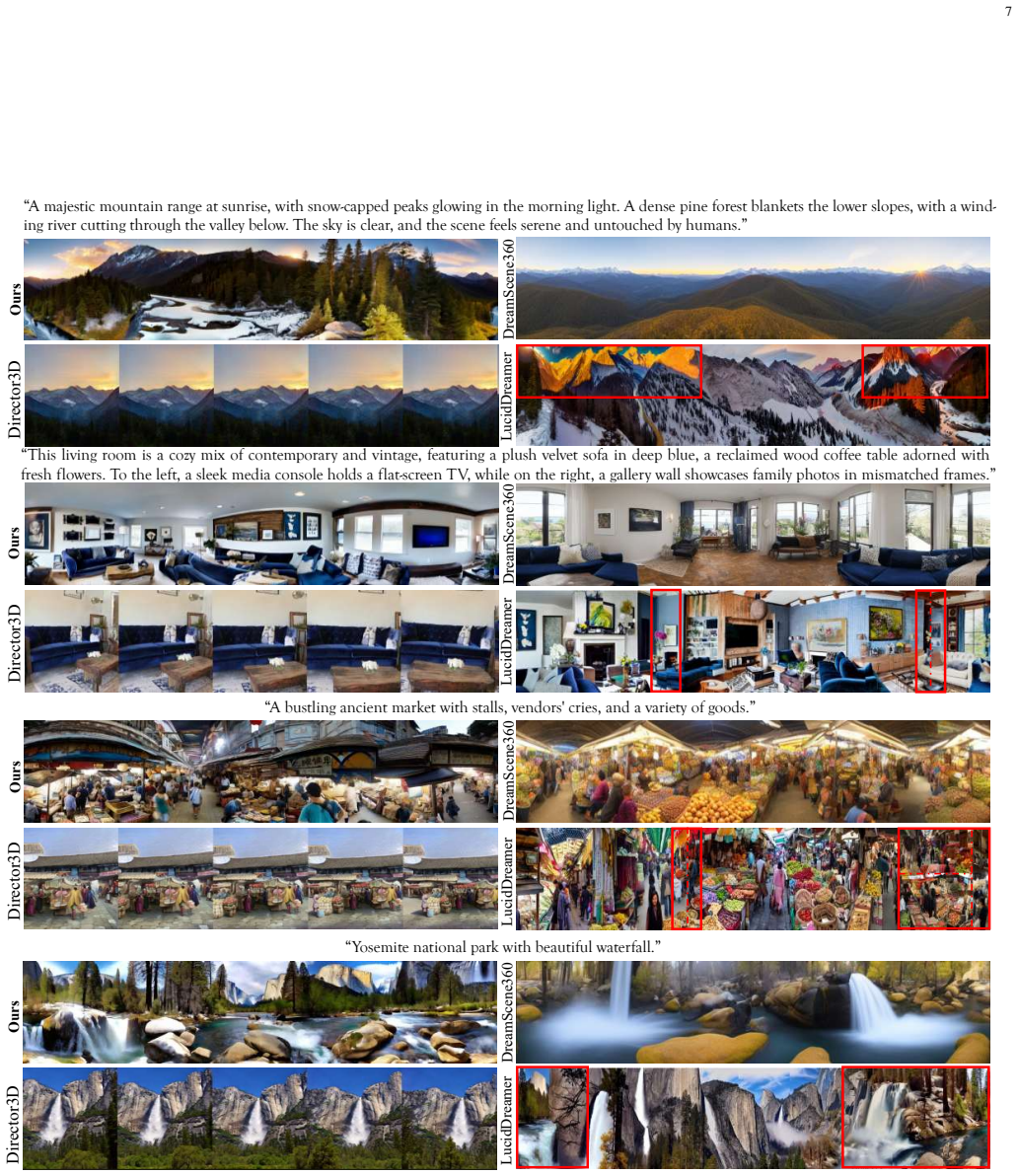
Summary. CGGS is a three-stage text-to-3D pipeline for ego-centric scenes. An Ego-centric Generator fine-tunes multi-view latent diffusion (CAA blocks) with a consistency-augmented loss that routes per-view noise residuals through a frozen, He-initialized VGG-16 projector (Eqs. 5–7). A Layout Decorator builds dense point-cloud layouts from optical flow and long-term point tracks rather than SfM. A Geometric Refiner then optimizes 3D Gaussians with a Mutual Information Depth (MID) loss (Eqs. 12–14) plus hierarchical supplementary cameras. On 24 indoor/outdoor scenes the method reports higher CLIP Score (26.253), Q-Align (0.839), PSNR (37.345), SSIM (0.977) and lower LPIPS (0.0193) than Text2Room, LucidDreamer, Director3D and DreamScene360, with ablations isolating each module.
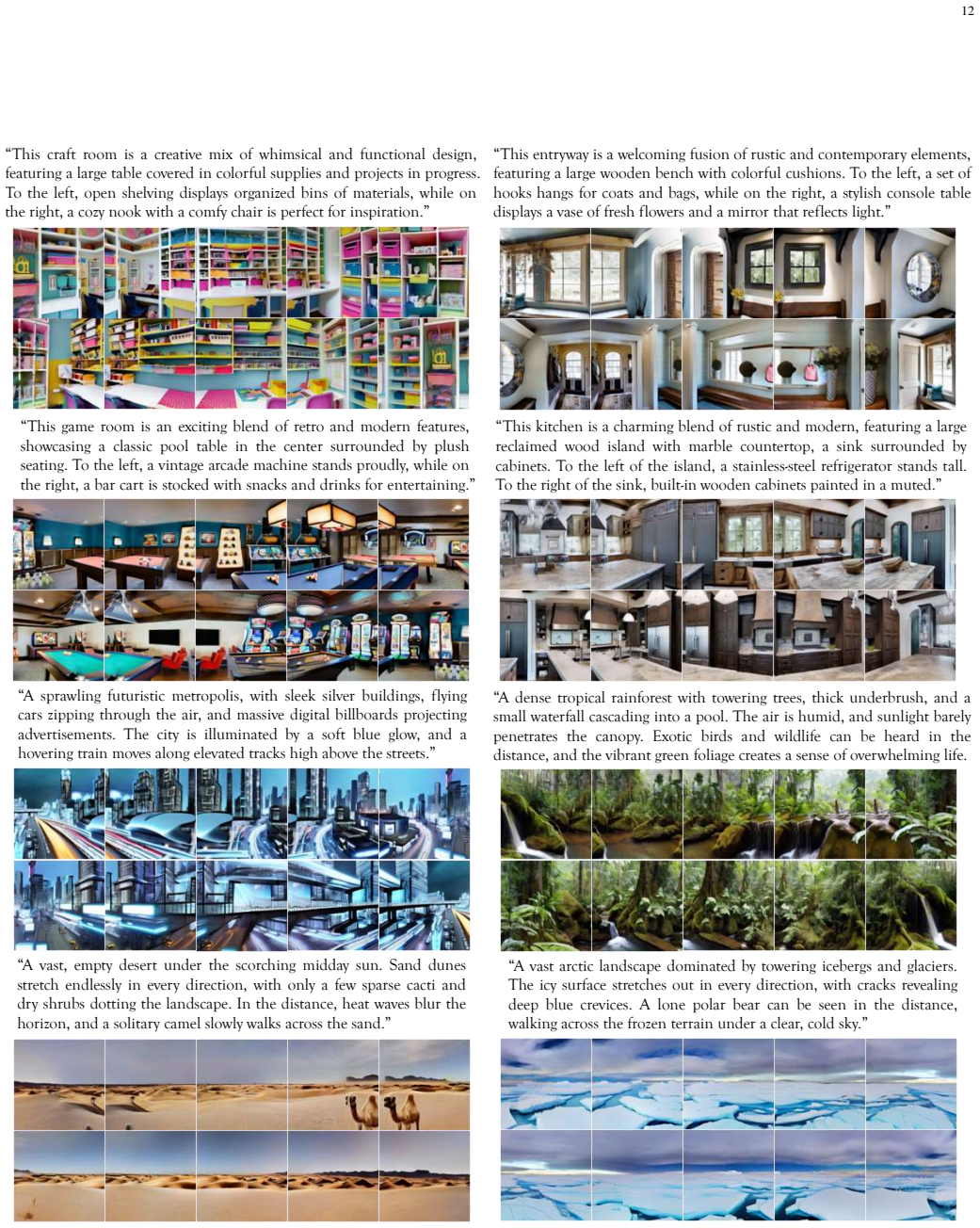
Significance. Ego-centric (outward-facing, limited-overlap) text-to-3D remains under-served relative to object-centric or panoramic pipelines; a practical system that improves multi-view coherence and geometric initialization would be useful for AR/VR, robotics and synthetic data. Strengths include a clean modular design, component-wise ablations (Tables II–IV, Figs. 7–8), domain-free qualitative results despite indoor-only CAA fine-tuning, and an explicit project page. The empirical gains on both generation and self-reconstruction metrics, if robust under fairer protocols, constitute a solid systems contribution for TIP-style venues.
major comments (4)
- [Sec. IV-C, Eqs. (12)–(13)] Sec. IV-C, Eqs. (12)–(13): Mutual information is written for continuous depth maps, yet the manuscript never states how I(D_render; D_gt) is estimated (histogram binning, KDE, neural estimator, discretization, etc.). Continuous MI estimation is non-trivial and directly determines the behavior of L_MID versus Pearson depth loss. Without this specification the Geometric Refiner is not reproducible and the claim that MID better preserves high-frequency structure (vs. PD in Table IV / Fig. 8) cannot be verified.
- [Sec. V-D, Table I] Sec. V-D / Table I: LucidDreamer is seeded with the first frame produced by CGGS. This couples the baseline to the proposed generator’s style and content and inflates the apparent gap on both CLIP-based and reconstruction metrics. A fair comparison requires an independent text-only (or independently generated) seed, or at minimum an ablation that reports LucidDreamer with a neutral seed. The current protocol weakens the central outperformance claim.
- [Sec. IV-A, Eqs. (5)–(7)] Sec. IV-A, Eqs. (5)–(7): The paper asserts that a frozen random VGG-16 Jacobian projects conflicting per-view gradients onto a shared singular subspace that systematically improves geometric coherence. No measurement of gradient cosine similarity, singular-vector alignment, or frequency content is provided; Table II shows only modest multi-view CLIP gains (25.869 o25.949) while the larger panorama gain could arise from multi-scale smoothing or the extra loss weight alone. Either supply a direct diagnostic of the claimed mechanism or soften the theoretical language so that the contribution rests on the empirical regularizer rather than an untested inductive-bias story.
- [Table I, Sec. V-D] Table I reconstruction columns (PSNR/SSIM/LPIPS): These metrics measure how well 3DGS fits the method’s own generated multi-view images, not absolute geometric accuracy against real multi-view ground truth. Extremely high numbers (PSNR 37.3, SSIM 0.977) are therefore expected once the Layout Decorator supplies consistent depths, and do not by themselves establish superior scene geometry. Clarify this interpretation and, if possible, add a cross-view depth-consistency or novel-view geometric metric that is independent of the training views.
minor comments (6)
- [Sec. V-A] Implementation details (Sec. V-A) refer to “Geometric Decorator” while the rest of the paper uses “Geometric Refiner”; unify the name.
- [Tables I–V] No error bars or statistical tests are reported on the 24-scene averages in Tables I–V; even simple standard deviations would strengthen the quantitative claims.
- [Fig. 1] Fig. 1 caption is very long and mixes three distinct failure modes; consider splitting into sub-captions or a short bullet list for readability.
- [Eq. (17)] Eq. (17) re-introduces λ_SSIM without stating its relation to the earlier (1−λ_MID) weighting in Eq. (14); a single consistent loss formula would help.
- [Table I] Director3D reconstruction metrics are left blank with only a brief note; a short qualitative or proxy metric would make Table I more complete.
- [Sec. VI] Typo: “3D Gussians” in the Conclusion; also “Geometric Decorator” vs Refiner already noted.
Circularity Check
No circularity: empirical pipeline with external training data and independent ablations; no equation or claim reduces reported metrics to fitted inputs by construction.
full rationale
CGGS is a standard empirical text-to-3D pipeline. The Ego-centric Generator fine-tunes CAA blocks of a multi-view LDM on Matterport3D with the proposed Laug (Eqs. 5–7) that routes residuals through a frozen He-initialized VGG-16; Layout Decorator trains a flow+point-track depth estimator on RealEstate-10k/CO3Dv2; Geometric Refiner optimizes 3DGS with MID (Eqs. 12–14) plus hierarchical cameras. All components are trained on external real-world datasets and evaluated on held-out GPT-4 prompts across 24 scenes with standard metrics (CLIP, Q-Align, PSNR/SSIM/LPIPS). Ablations (Tabs. II–IV, Figs. 7–8) isolate each term without redefining the target quantities. No uniqueness theorem, self-citation chain, or fitted parameter is re-labeled as a first-principles prediction; the project-page link is non-load-bearing. The derivation chain is therefore self-contained against external benchmarks.
Axiom & Free-Parameter Ledger
free parameters (5)
- λ_aug =
0.5
- λ_MID =
0.05
- N (number of base views) =
8
- hierarchical stages n =
3
- λ_SSIM =
0.2
axioms (4)
- domain assumption Camera trajectories C are known a priori and can be used both for multi-view generation and for back-projection.
- ad hoc to paper A frozen, randomly He-initialized VGG-16 defines a stationary multi-scale metric that aligns conflicting per-view gradients without introducing semantic bias.
- domain assumption Optical flow (RAFT) plus long-term point tracks (CoTracker) supply sufficiently accurate correspondences to supervise a depth network under narrow-baseline ego-centric views.
- ad hoc to paper Mutual information between rendered and estimated depth maps is a better geometric regularizer than Pearson correlation for 3DGS under ego-centric sparsity.
invented entities (3)
-
Consistency-Augmented Loss (Laug) with frozen random VGG-16 projector
no independent evidence
-
Mutual Information Depth Loss (MID)
no independent evidence
-
Layout Decorator (Flow-Depth Estimator)
no independent evidence
read the original abstract
Challenges remain in ego-centric 3D scene generation due to limited view overlap and the dominant influence of individual perspectives on scene interpretation. These factors hinder the creation of viewpoint-consistent and semantically aligned visual content, as well as the construction of accurate geometric structures. In this paper, we propose CGGS, a text-to-3D framework aiming to enhance 3D-content-awareness and address geometric distortions in ego-centric scene generation. Firstly, the Ego-centric Generator is proposed by fine-tuning a Multi-View Latent Diffusion Model with consistency-augmented loss to generate consistent, high-fidelity 2D content aligned with textual descriptions. Then, Layout Decorator leverages optical flow and point-track correspondence to estimate depth, therefore producing dense point clouds as coarse layouts from the ego-centric 2D priors. Building on this initialization, Geometric Refiner is proposed to enhance 3D Gaussian reconstruction via an entropy-based Mutual Information Depth Loss (MID) combined with a hierarchical optimization scheme for improving visual quality and geometric structure. Comprehensive experiments demonstrate that CGGS outperforms previous methods in generating coherent and accurate text-driven 3D scenes. Project page: [https://cggs-26.github.io/cggs26/](https://cggs-26.github.io/cggs26/).
Figures





Reference graph
Works this paper leans on
-
[1]
Dreamscene360: Unconstrained text-to-3d scene generation with panoramic gaussian splatting,
S. Zhou, Z. Fan, D. Xu, H. Chang, P. Chari, T. Bharadwaj, S. You, Z. Wang, and A. Kadambi, “Dreamscene360: Unconstrained text-to-3d scene generation with panoramic gaussian splatting,” inECCV, 2024
2024
-
[2]
Glide: Towards photorealistic image gen- eration and editing with text-guided diffusion models,
A. Nichol, P. Dhariwal, A. Ramesh, P. Shyam, P. Mishkin, B. McGrew, I. Sutskever, and M. Chen, “Glide: Towards photorealistic image gen- eration and editing with text-guided diffusion models,”arXiv preprint arXiv:2112.10741, 2021
Pith/arXiv arXiv 2021
-
[3]
Hierarchical text-conditional image generation with clip latents,
A. Ramesh, P. Dhariwal, A. Nichol, C. Chu, and M. Chen, “Hierarchical text-conditional image generation with clip latents,”arXiv preprint arXiv:2204.06125, 2022
Pith/arXiv arXiv 2022
-
[4]
Photoreal- istic text-to-image diffusion models with deep language understanding,
C. Saharia, W. Chan, S. Saxena, L. Li, J. Whang, E. L. Denton, K. Ghasemipour, R. G. Lopes, B. K. Ayan, T. Salimanset al., “Photoreal- istic text-to-image diffusion models with deep language understanding,” inNeurIPS, 2022
2022
-
[5]
High resolution image synthesis with latent diffusion models,
R. Rombach, A. Blattmann, D. Lorenz, P. Esser, and B. Ommer, “High resolution image synthesis with latent diffusion models,” inCVPR, 2022
2022
-
[6]
Nerf: Representing scenes as neural radiance fields for view synthesis,
B. Mildenhall, P. P. Srinivasan, M. Tancik, J. T. Barron, R. Ramamoorthi, and R. Ng, “Nerf: Representing scenes as neural radiance fields for view synthesis,” inECCV, 2020
2020
-
[7]
Learning transferable visual models from natural language supervision,
A. Radford, J. W. Kim, C. Hallacy, A. Ramesh, G. Goh, S. Agarwal, G. Sastry, A. Askell, P. Mishkin, J. Clark, and et al., “Learning transferable visual models from natural language supervision,” inICML, 2021
2021
-
[8]
Zero-shot text-guided object generation with dream fields,
A. Jain, B. Mildenhall, J. T. Barron, P. Abbeel, and B. Poole, “Zero-shot text-guided object generation with dream fields,” inCVPR, 2022
2022
-
[9]
Dreamfusion: Text- to-3d using 2d diffusion,
B. Poole, A. Jain, J. T. Barron, and B. Mildenhall, “Dreamfusion: Text- to-3d using 2d diffusion,” inICLR, 2023
2023
-
[10]
Magic3d: High-resolution text-to-3d content creation,
C.-H. Lin, J. Gao, L. Tang, T. Takikawa, X. Zeng, X. Huang, K. Kreis, S. Fidler, M.-Y . Liu, and T.-Y . Lin, “Magic3d: High-resolution text-to-3d content creation,” inCVPR, 2023
2023
-
[11]
Score jacobian chaining: Lifting pretrained 2d diffusion models for 3d generation,
H. Wang, X. Du, J. Li, R. A. Yeh, and G. Shakhnarovich, “Score jacobian chaining: Lifting pretrained 2d diffusion models for 3d generation,” in CVPR, 2023
2023
-
[12]
Mvdream: Multi- view diffusion for 3d generation,
Y . Shi, P. Wang, J. Ye, L. Mai, K. Li, and X. Yang, “Mvdream: Multi- view diffusion for 3d generation,” inICLR, 2024
2024
-
[13]
Text2room: Extracting textured 3d meshes from 2d text-to-image models,
L. H ¨ollein, A. Cao, A. Owens, J. Johnson, and M. Nießner, “Text2room: Extracting textured 3d meshes from 2d text-to-image models,” inICCV, 2023
2023
-
[14]
Luciddreamer: Domain-free generation of 3d gaussian splatting scenes,
J. Chung, S. Lee, H. Nam, J. Lee, and K. M. Lee, “Luciddreamer: Domain-free generation of 3d gaussian splatting scenes,”arXiv preprint arXiv:2311.13384, 2023
Pith/arXiv arXiv 2023
-
[15]
Text2nerf: Text-driven 3d scene generation with neural radiance fields,
J. Zhang, X. Li, Z. Wan, C. Wang, and J. Liao, “Text2nerf: Text-driven 3d scene generation with neural radiance fields,”IEEE Transactions on Visualization and Computer Graphics, 2024
2024
-
[16]
Wonderjourney: Going from anywhere to everywhere,
H.-X. Yu, H. Duan, J. Hur, K. Sargent, M. Rubinstein, W. T. Freeman, F. Cole, D. Sun, N. Snavely, J. Wuet al., “Wonderjourney: Going from anywhere to everywhere,” inProceedings of the IEEE/CVF Conference on Computer Vision and Pattern Recognition (CVPR), 2024
2024
-
[17]
Realmdreamer: Text-driven 3d scene generation with inpainting and depth diffusion,
J. Shriram, A. Trevithick, L. Liu, and R. Ramamoorthi, “Realmdreamer: Text-driven 3d scene generation with inpainting and depth diffusion,” in 3DV, 2025
2025
-
[18]
Recurrent diffusion for 3d point cloud generation from a single image,
Y . Zhou, D. Ye, H. Zhang, X. Xu, H. Sun, Y . Xu, X. Liu, and Y . Zhou, “Recurrent diffusion for 3d point cloud generation from a single image,” IEEE Transactions on Image Processing, vol. 34, pp. 1753–1765, 2025
2025
-
[19]
3d gaussian splatting for real-time radiance field rendering,
B. Kerbl, G. Kopanas, T. Leimk ¨uhler, and G. Drettakis, “3d gaussian splatting for real-time radiance field rendering,”ACM Transactions on Graphics, 2023
2023
-
[20]
Scene- dreamer360: Text-driven 3d-consistent scene generation with panoramic gaussian splatting,
W. Li, F. Cai, Y . Mi, Z. Yang, W. Zuo, X. Wang, and X. Fan, “Scene- dreamer360: Text-driven 3d-consistent scene generation with panoramic gaussian splatting,”arXiv preprint arXiv:2408.13711, 2024
Pith/arXiv arXiv 2024
-
[21]
Holodreamer: Holistic 3d panoramic world generation from text descriptions,
H. Zhou, X. Cheng, W. Yu, Y . Tian, and L. Yuan, “Holodreamer: Holistic 3d panoramic world generation from text descriptions,”arXiv preprint arXiv:2407.15187, 2024
Pith/arXiv arXiv 2024
-
[22]
Director3d: Real-world camera trajectory and 3d scene generation from text,
X. Li, Z. Lai, L. Xu, Y . Qu, L. Cao, S. Zhang, B. Dai, and R. Ji, “Director3d: Real-world camera trajectory and 3d scene generation from text,” inNeurIPS, 2024
2024
-
[23]
Prometheus: 3d-aware latent diffusion models for feed-forward text-to-3d scene generation,
Y . Yang, J. Shao, X. Li, Y . Shen, A. Geiger, and Y . Liao, “Prometheus: 3d-aware latent diffusion models for feed-forward text-to-3d scene generation,”arXiv preprint arXiv:2412.21117, 2024
Pith/arXiv arXiv 2024
-
[24]
Matterport3D: Learning from RGB-D data in indoor environments,
A. Chang, A. Dai, T. Funkhouser, M. Halber, M. Niessner, M. Savva, S. Song, A. Zeng, and Y . Zhang, “Matterport3D: Learning from RGB-D data in indoor environments,” in3DV, 2017
2017
-
[25]
Stereo magnification: Learning view synthesis using multiplane images,
T. Zhou, R. Tucker, J. Flynn, G. Fyffe, and N. Snavely, “Stereo magnification: Learning view synthesis using multiplane images,”ACM Transactions on Graphics, vol. 37, no. 4, pp. 65:1–65:12, 2018. 15
2018
-
[26]
Common objects in 3d: Large-scale learning and evaluation of real-life 3d category reconstruction,
J. Reizenstein, R. Shapovalov, P. Henzler, L. Sbordone, P. Labatut, and D. Novotny, “Common objects in 3d: Large-scale learning and evaluation of real-life 3d category reconstruction,” inICCV, 2021
2021
-
[27]
Mvdiffusion: Enabling holistic multi-view image generation with correspondence- aware diffusion,
S. Tang, F. Zhang, J. Chen, P. Wang, and F. Yasutaka, “Mvdiffusion: Enabling holistic multi-view image generation with correspondence- aware diffusion,”arXiv preprint arXiv:2307.01097, 2023
Pith/arXiv arXiv 2023
-
[28]
Stable diffusion 2,
StabilityAI, “Stable diffusion 2,” https://huggingface.co/stabilityai/ stable-diffusion-2, 2023
2023
-
[29]
Structure-from-motion revisited,
J. L. Schonberger and J.-M. Frahm, “Structure-from-motion revisited,” inCVPR, 2016
2016
-
[30]
Generative adversarial nets,
I. Goodfellow, J. Pouget-Abadie, M. Mirza, B. Xu, D. Warde-Farley, S. Ozair, A. Courville, and Y . Bengio, “Generative adversarial nets,” in NeurIPS, 2014
2014
-
[31]
Generative modeling by estimating gradients of the data distribution,
Y . Song and S. Ermon, “Generative modeling by estimating gradients of the data distribution,” inNeurIPS, 2019
2019
-
[32]
Denoising diffusion probabilistic models,
J. Ho, A. Jain, and P. Abbeel, “Denoising diffusion probabilistic models,” inNeurIPS, 2020
2020
-
[33]
Denoising diffusion implicit models,
J. Song, C. Meng, and S. Ermon, “Denoising diffusion implicit models,” inICLR, 2021
2021
-
[34]
Score-based generative modeling through stochastic differ- ential equations,
Y . Song, J. Sohl-Dickstein, D. P. Kingma, A. Kumar, S. Ermon, and B. Poole, “Score-based generative modeling through stochastic differ- ential equations,” inICLR, 2021
2021
-
[35]
Classifier-free diffusion guidance,
J. Ho and T. Salimans, “Classifier-free diffusion guidance,”arXiv preprint arXiv:2207.12598, 2022
Pith/arXiv arXiv 2022
-
[36]
Boosting latent diffusion with perceptual objectives,
T. Berrada, P. Astolfi, M. Hall, M. Havasi, Y . Benchetrit, A. Romero- Soriano, K. Alahari, M. Drozdzal, and J. Verbeek, “Boosting latent diffusion with perceptual objectives,”arXiv preprint arXiv:2411.04873, 2025
Pith/arXiv arXiv 2025
-
[37]
Diffusion model with perceptual loss,
S. Lin and X. Yang, “Diffusion model with perceptual loss,”arXiv preprint arXiv:2401.00110, 2025
Pith/arXiv arXiv 2025
-
[38]
Multidiffusion: Fus- ing diffusion paths for controlled image generation,
O. Bar-Tal, L. Yariv, Y . Lipman, and T. Dekel, “Multidiffusion: Fus- ing diffusion paths for controlled image generation,”arXiv preprint arXiv:2302.08113, 2023
Pith/arXiv arXiv 2023
-
[39]
Panogen: Text-conditioned panoramic environ- ment generation for vision-and-language navigation,
J. Li and M. Bansal, “Panogen: Text-conditioned panoramic environ- ment generation for vision-and-language navigation,”arXiv preprint arXiv:2305.19195, 2023
Pith/arXiv arXiv 2023
-
[40]
Diffcollage: Parallel generation of large content with diffusion models,
Q. Zhang, J. Song, X. Huang, Y . Chen, and M. yu Liu, “Diffcollage: Parallel generation of large content with diffusion models,” inCVPR, 2023
2023
-
[41]
Customizing 360-degree panoramas through text-to-image diffusion models,
H. Wang, X. Xiang, Y . Fan, and J.-H. Xue, “Customizing 360-degree panoramas through text-to-image diffusion models,” inWACV, 2024
2024
-
[42]
Taming stable diffusion for text to 360◦ panorama image generation,
C. Zhang, Q. Wu, C. Cruz Gambardella, X. Huang, D. Phung, W. Ouyang, and J. Cai, “Taming stable diffusion for text to 360◦ panorama image generation,” inCVPR, 2024
2024
-
[43]
Text2mesh: Text-driven 3d mesh generation,
X. Z. Wei, K. H. Lee, Y . H. Lee, J. Lee, and A. Y . K. Y . Cheung, “Text2mesh: Text-driven 3d mesh generation,” inCVPR, 2022
2022
-
[44]
Fantasia3d: Disentangling geometry and appearance for high-quality text-to-3d content creation,
R. Chen, Y . Chen, N. Jiao, and K. Jia, “Fantasia3d: Disentangling geometry and appearance for high-quality text-to-3d content creation,” inICCV, 2023
2023
-
[45]
Prolific- dreamer: High-fidelity and diverse text-to-3d generation with variational score distillation,
Z. Wang, C. Lu, Y . Wang, F. Bao, C. Li, H. Su, and J. Zhu, “Prolific- dreamer: High-fidelity and diverse text-to-3d generation with variational score distillation,” inNeurIPS, 2024
2024
-
[46]
3dtopia: Large text-to-3d generation model with hybrid diffusion priors,
F. Hong, J. Tang, Z. Cao, M. Shi, T. Wu, Z. Chen, T. Wang, L. Pan, D. Lin, and Z. Liu, “3dtopia: Large text-to-3d generation model with hybrid diffusion priors,”arXiv preprint arXiv:2403.02234, 2024
Pith/arXiv arXiv 2024
-
[47]
Rgbd2: Generative scene synthesis via incremental view inpainting using rgbd diffusion models,
J. Zhang, Y . Xu, W. Wang, J. Yang, Y . Shen, X. Li, L. Xie, and F. Yu, “Rgbd2: Generative scene synthesis via incremental view inpainting using rgbd diffusion models,” inCVPR, 2023
2023
-
[48]
Text2immersion: Generative immersive scene with 3d gaussians,
H. Ouyang, K. Heal, S. Lombardi, and T. Sun, “Text2immersion: Generative immersive scene with 3d gaussians,”arXiv preprint arXiv:2312.09242, 2023
Pith/arXiv arXiv 2023
-
[49]
Scenescape: Text- driven consistent scene generation,
R. Fridman, A. Abecasis, Y . Kasten, and T. Dekel, “Scenescape: Text- driven consistent scene generation,”arXiv preprint arXiv:2302.01133, 2023
Pith/arXiv arXiv 2023
-
[50]
Vistadream: Sampling multiview consistent images for single-view scene reconstruc- tion,
H. Wang, Y . Liu, Z. Liu, W. Wang, Z. Dong, and B. Yang, “Vistadream: Sampling multiview consistent images for single-view scene reconstruc- tion,”arXiv preprint arXiv:2410.16892, 2024
Pith/arXiv arXiv 2024
-
[51]
Towards robust monocular depth estimation: Mixing datasets for zero-shot cross-dataset transfer,
R. Ranftl, K. Lasinger, and V . Koltun, “Towards robust monocular depth estimation: Mixing datasets for zero-shot cross-dataset transfer,”IEEE Transactions on Pattern Analysis and Machine Intelligence, vol. 44, no. 3, pp. 1624–1637, 2022
2022
-
[52]
Zoedepth: Zero-shot transfer by combining relative and metric depth,
S. F. Bhat, R. Birkl, D. Wofk, P. Wonka, and M. M ¨uller, “Zoedepth: Zero-shot transfer by combining relative and metric depth,”arXiv preprint arXiv:2302.12288, 2023
Pith/arXiv arXiv 2023
-
[53]
Depth anything: Unleashing the power of large-scale unlabeled data,
L. Yang, B. Kang, Z. Huang, X. Xu, J. Feng, and H. Zhao, “Depth anything: Unleashing the power of large-scale unlabeled data,” inCVPR, 2024
2024
-
[54]
Learning a locally unified 3d point cloud for view synthesis,
M. You, M. Guo, X. Lyu, H. Liu, and J. Hou, “Learning a locally unified 3d point cloud for view synthesis,”IEEE Transactions on Image Processing, vol. 32, pp. 5610–5622, 2023
2023
-
[55]
pixelnerf: Neural radiance fields from one or few images,
A. Yu, V . Ye, M. Tancik, and A. Kanazawa, “pixelnerf: Neural radiance fields from one or few images,” inCVPR, 2021
2021
-
[56]
Nope-nerf: Optimising neural radiance field with no pose prior,
W. Bian, Z. Wang, K. Li, J. Bian, and V . A. Prisacariu, “Nope-nerf: Optimising neural radiance field with no pose prior,” inCVPR, 2023
2023
-
[57]
Latent-nerf for shape-guided generation of 3d shapes and textures,
G. Metzer, E. Richardson, O. Patashnik, R. Giryes, and D. Cohen-Or, “Latent-nerf for shape-guided generation of 3d shapes and textures,” in CVPR, 2023
2023
-
[58]
Diffusionerf: Regularizing neural radiance fields with denoising diffusion models,
J. Wynn and D. Turmukhambetov, “Diffusionerf: Regularizing neural radiance fields with denoising diffusion models,” inCVPR, 2023
2023
-
[59]
Global structure-from-motion revisited,
L. Pan, D. Bar ´ath, M. Pollefeys, and J. L. Sch ¨onberger, “Global structure-from-motion revisited,” inECCV 2024, 2024
2024
-
[60]
Flowmap: High- quality camera poses, intrinsics, and depth via gradient descent,
C. Smith, D. Charatan, A. Tewari, and V . Sitzmann, “Flowmap: High- quality camera poses, intrinsics, and depth via gradient descent,”arXiv preprint arXiv:2404.15259, 2024
Pith/arXiv arXiv 2024
-
[61]
Lgm: Large multi-view gaussian model for high-resolution 3d content creation,
J. Tang, Z. Chen, X. Chen, T. Wang, G. Zeng, and Z. Liu, “Lgm: Large multi-view gaussian model for high-resolution 3d content creation,” in ECCV, 2024
2024
-
[62]
Gs-lrm: Large reconstruction model for 3d gaussian splatting,
K. Zhang, S. Bi, H. Tan, Y . Xiangli, N. Zhao, K. Sunkavalli, and Z. Xu, “Gs-lrm: Large reconstruction model for 3d gaussian splatting,” inECCV, 2024
2024
-
[63]
Grm: Large gaussian reconstruction model for efficient 3d reconstruction and generation,
Y . Xu, Z. Shi, W. Yifan, H. Chen, C. Yang, S. Peng, Y . Shen, and G. Wetzstein, “Grm: Large gaussian reconstruction model for efficient 3d reconstruction and generation,” inECCV, 2024
2024
-
[64]
Mvsplat: Efficient 3d gaussian splatting from sparse multi-view images,
Y . Chen, H. Xu, C. Zheng, B. Zhuang, M. Pollefeys, A. Geiger, T.-J. Cham, and J. Cai, “Mvsplat: Efficient 3d gaussian splatting from sparse multi-view images,” inECCV, 2024
2024
-
[65]
Pixelsplat: 3d gaussian splats from image pairs for scalable generalizable 3d reconstruction,
D. Charatan, S. Li, A. Tagliasacchi, and V . Sitzmann, “Pixelsplat: 3d gaussian splats from image pairs for scalable generalizable 3d reconstruction,” inCVPR, 2024
2024
-
[66]
Splatter image: Ultra- fast single-view 3d reconstruction,
S. Szymanowicz, C. Rupprecht, and A. Vedaldi, “Splatter image: Ultra- fast single-view 3d reconstruction,” inCVPR, 2024
2024
-
[67]
Dngaussian: Optimizing sparse-view 3d gaussian radiance fields with global-local depth normalization,
J. Li, J. Zhang, X. Bai, J. Zheng, X. Ning, J. Zhou, and L. Gu, “Dngaussian: Optimizing sparse-view 3d gaussian radiance fields with global-local depth normalization,” inCVPR, 2024
2024
-
[68]
Fsgs: Real-time few-shot view synthesis using gaussian splatting,
Z. Zhu, Z. Fan, Y . Jiang, and Z. Wang, “Fsgs: Real-time few-shot view synthesis using gaussian splatting,” inECCV, 2024
2024
-
[69]
Wonderworld: Interactive 3d scene generation from a single image,
H.-X. Yu, H. Duan, C. Herrmann, W. T. Freeman, and J. Wu, “Wonderworld: Interactive 3d scene generation from a single image,” arXiv:2406.09394, 2024
Pith/arXiv arXiv 2024
-
[70]
Auto-encoding variational bayes,
D. P. Kingma and M. Welling, “Auto-encoding variational bayes,” in ICLR, 2014
2014
-
[71]
Very deep convolutional networks for large-scale image recognition,
K. Simonyan and A. Zisserman, “Very deep convolutional networks for large-scale image recognition,” inICLR, 2015
2015
-
[72]
Delving deep into rectifiers: Surpassing human-level performance on imagenet classification,
K. He, X. Zhang, S. Ren, and J. Sun, “Delving deep into rectifiers: Surpassing human-level performance on imagenet classification,” in ICCV, 2015
2015
-
[73]
Imagenet: A large-scale hierarchical image database,
J. Deng, W. Dong, R. Socher, L.-J. Li, K. Li, and F.-F. Li, “Imagenet: A large-scale hierarchical image database,” inCVPR, 2009
2009
-
[74]
Raft: Recurrent all-pairs field transforms for optical flow,
Z. Teed and J. Deng, “Raft: Recurrent all-pairs field transforms for optical flow,” inECCV, 2020
2020
-
[75]
Cotracker: It is better to track together,
N. Karaev, I. Rocco, B. Graham, N. Neverova, A. Vedaldi, and C. Rup- precht, “Cotracker: It is better to track together,” inECCV, 2024
2024
-
[76]
Nexusgs: Sparse view synthesis with epipolar depth priors in 3d gaussian splatting,
Y . Zheng, Z. Jiang, S. He, Y . Sun, J. Dong, H. Zhang, and Y . Du, “Nexusgs: Sparse view synthesis with epipolar depth priors in 3d gaussian splatting,”arXiv preprint arXiv:2503.18794, 2025
Pith/arXiv arXiv 2025
-
[77]
Gpt-4 technical report,
OpenAI, “Gpt-4 technical report,” OpenAI, Tech. Rep., 2024. [Online]. Available: https://platform.openai.com/docs/gpt-4
2024
-
[78]
Tanks and temples: Benchmarking large-scale scene reconstruction,
A. Knapitsch, J. Park, Q.-Y . Zhou, and V . Koltun, “Tanks and temples: Benchmarking large-scale scene reconstruction,” inACM Transactions on Graphics (TOG), 2017
2017
-
[79]
Scannet: Richly-annotated 3d reconstructions of indoor scenes,
A. Dai, A. X. Chang, M. Savva, M. Halber, T. Funkhouser, and M. Nießner, “Scannet: Richly-annotated 3d reconstructions of indoor scenes,” inCVPR, 2017
2017
-
[80]
CLIPScore: a reference-free evaluation metric for image captioning,
J. Hessel, A. Holtzman, M. Forbes, R. L. Bras, and Y . Choi, “CLIPScore: a reference-free evaluation metric for image captioning,” inEMNLP, 2021
2021
discussion (0)
Sign in with ORCID, Apple, or X to comment. Anyone can read and Pith papers without signing in.