REVIEW 3 major objections 5 minor 43 references
Blind 3D reconstruction from extreme motion blur is possible by coupling deep topology recovery, probabilistic densification, and continuous camera trajectories.
Reviewed by Pith at T0; open to challenge. T0 means a machine referee read the full paper against a public rubric. the ladder, T0–T4 →
PRISM3D bootstraps 3D Gaussian Splatting from extreme motion blur via VGGSfM initialization, MCMC densification, and Bézier trajectories, with an event-assisted extension that sets new SOTA.
T0 review reviewed 2026-07-11 challenge →
load-bearing objection Solid engineering that actually closes the extreme-blur 3DGS gap; the VGGSfM residual-error worry is real but secondary to the empirical gains and ablations. the 3 major comments →
PRISM3D: Probabilistic Refinement and Robust Initialization for Physically Consistent Scene Modeling under Extreme Motion Blur
The pith
A machine-rendered reading of the paper's core claim, the machinery that carries it, and where it could break.
The reading
Core claim
A sparse topological skeleton recovered by deep dense tracking is already sufficient to bootstrap high-fidelity 3D Gaussian Splatting from extreme motion blur, provided the subsequent densification is performed probabilistically via MCMC and the image-formation model uses continuous Bézier trajectories rather than linear or cubic splines.
What carries the argument
The coupled triple of VGGSfM deep topology recovery, 3DGS-MCMC densification under Stochastic Gradient Langevin Dynamics, and continuous SE(3) Bézier exposure paths that jointly optimize geometry and camera momentum against the observed blurry images.
Load-bearing premise
That an off-the-shelf deep tracker trained on ordinary sharp images still yields a usable topological skeleton even when the input frames have been averaged across as many as eleven consecutive sharp frames.
What would settle it
Run the identical VGGSfM-plus-MCMC-plus-Bézier pipeline on a new set of real extreme-blur sequences whose ground-truth sharp geometry is known independently; if registration collapses or novel-view PSNR falls below that of a pure event-based baseline, the claim that the sparse skeleton is sufficient is falsified.
Editorial analysis
A structured set of objections, weighed in public.
Referee Report
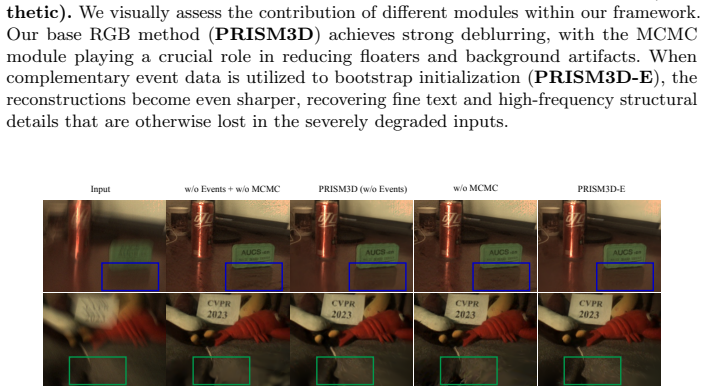
Summary. PRISM3D addresses blind 3D scene reconstruction from extremely motion-blurred images by coupling three components: (i) robust initialization via VGGSfM deep dense tracking to recover global topology where classical SfM fails, (ii) probabilistic densification of the resulting sparse/noisy geometry via 3DGS-MCMC (SGLD), and (iii) continuous SE(3) Bézier trajectory modeling of the physical blur formation process. The authors further introduce PRISM3D-E, which uses event streams only to synthesize EDI pseudo-sharp priors for VGGSfM initialization (not photometric supervision), and contribute the PRISM3D-E Benchmark of extreme-blur RGB paired with synthetic events. Experiments on eight synthetic scenes and five real DAVIS346 sequences, with systematic blur-level sweeps (1–11 frames), trajectory ablations, and component ablations, report new state-of-the-art novel-view and deblurring metrics for both the RGB-only and event-assisted pipelines, with strong efficiency claims (~7 min, ~1.55 GiB).
Significance. If the claims hold, the work removes a practical bottleneck that has forced prior 3DGS/NeRF deblurring methods to rely on sharp-image COLMAP oracles. The combination of deep topology recovery, MCMC densification, and continuous Bézier blur modeling is a coherent and well-motivated response to the initialization–optimization gap, and the PRISM3D-E Benchmark fills a genuine multi-modal evaluation hole. The systematic blur-severity analysis, trajectory-model ablations, and clear separation of oracle vs. blind baselines are strengths that make the empirical case falsifiable and useful to the community. The efficiency numbers further increase practical impact for robotics and handheld capture.
major comments (3)
- Sec. 4.4 / Tables 4–5: VGGSfM is shown to register all views where COLMAP collapses, but translation RMSE rises from 0.18 m (blur-3) to 0.72 m (blur-11). No rotation error, absolute trajectory error after BA, or final-vs-initial pose residual after joint MCMC+Bézier optimization is reported. Without these, it remains possible that SGLD densification and trajectory fitting largely compensate for residual pose error rather than converging to a physically correct scene. Please add (i) rotation/ATE statistics for VGGSfM under the same blur sweep and (ii) pose residual before vs. after joint optimization on the synthetic data where GT poses exist.
- Sec. 4.2 and real-data evaluation (Fig. 12 / Table 3): On the five real DAVIS346 sequences there is no independent pose ground truth and no quantitative novel-view metrics against held-out sharp views (only qualitative deblurring and efficiency). The central claim of physically consistent reconstruction under extreme real blur therefore rests almost entirely on visual inspection. At minimum, report multi-view photometric consistency on held-out real frames, or an external pose estimate (e.g., from a secondary sensor or COLMAP on EDI-deblurred frames) so that residual pose error can be quantified outside the synthetic regime.
- Sec. 3.1 / Eq. (3) and Sec. 4.5: The continuous SE(3) Bézier model is a core differentiator over linear/cubic splines, yet the degree M (and the choice of 9 control points) is fixed without a sensitivity study beyond the n-virtual-camera sweep in Fig. 8. Because the physical-consistency claim hinges on this parameterization, please report (or move from supplement) an ablation on control-point count / degree and confirm that the reported 0.24–0.59 dB gains over splines remain stable under modest changes of M.
minor comments (5)
- Table numbering is inconsistent: the main quantitative table is labeled Table 1 in the body but referred to as Table 8 in the text and later as Table 8 again in the supplement; figures similarly jump between Fig. 3/4 and Fig. 11/12. Please renumber for a single coherent sequence.
- Eq. (6) writes ∂L/∂T with an extra ∂Θ/∂T factor that appears to duplicate the chain already present in ∂Ci/∂Θ; clarify the intended Jacobian path (pose → latent images → blur) or correct the expression.
- Implementation details (Sec. 4.1) list free parameters (n=15, 9 Bézier points, pose lr 1e-3, 13 event bins, SGLD τ/k) that are only partially ablated; a short hyper-parameter table in the supplement would improve reproducibility.
- Related Work (Sec. 2.3) correctly distinguishes oracle vs. blind methods, but a brief note on concurrent event-assisted 3DGS works (EvaGaussians, E2GS) regarding whether they also fail under the 9–11-frame regime would strengthen the novelty claim.
- Fig. 1 caption and Algorithm 1 are helpful; ensure the algorithm’s “optional event stream” branch matches the main-text statement that EDI images are never used for photometric supervision.
Circularity Check
No circularity: empirical pipeline with external components, ablations, and independent GT evaluation; claims do not reduce to inputs by construction.
full rationale
PRISM3D couples three external, independently published modules (VGGSfM for sparse topology, 3DGS-MCMC/SGLD densification, continuous SE(3) Bézier trajectories) and optimizes them jointly against the observed blurry images via a standard photometric loss (Eqs. 4–6). All quantitative claims (PSNR/SSIM/LPIPS tables, robustness curves, ablations in Tables 2/6/7/10) are measured against held-out sharp ground-truth images or independent baselines (Restormer, E2NeRF, BAD-Gaussians*, etc.). Hyper-parameters (n=15 virtual cameras, 9 Bézier points, learning rates) are selected by explicit ablation rather than fitted to the final reported metric. No equation equates a reported quantity to a quantity defined from the same data; no uniqueness theorem or ansatz is imported from the authors’ prior work; the “first to bootstrap 3DGS from extreme blur” claim is an empirical novelty statement, not a derivation. The pipeline is therefore self-contained against external benchmarks and exhibits zero circular reduction.
Axiom & Free-Parameter Ledger
free parameters (5)
- number of virtual camera samples n =
15
- Bézier control-point count =
9
- pose learning rate =
1e-3
- event bins for EDI =
13
- SGLD noise threshold τ and steepness k =
τ=0.005, k=100
axioms (5)
- domain assumption Motion blur is the temporal integral of latent sharp images along a continuous camera trajectory during exposure.
- domain assumption VGGSfM recovers a sufficiently accurate global topology from extremely blurred inputs for subsequent densification.
- domain assumption 3D Gaussians can be treated as samples from an underlying scene distribution updated by SGLD.
- ad hoc to paper Camera motion during exposure is well-approximated by a degree-M Bézier curve in SE(3).
- domain assumption Event streams generated by ESIM from latent sharp sequences are a faithful proxy for real event cameras under extreme blur.
invented entities (1)
-
PRISM3D-E Benchmark
no independent evidence
Cite this review
Pith. "Pith review of PRISM3D: Probabilistic Refinement and Robust Initialization for Physically Consistent Scene Modeling under Extreme Motion Blur." pith.science (2026). https://pith.science/paper/LQBSHQKL
@misc{pith2026260703855,
  author       = {Pith},
  title        = {Pith review of: PRISM3D: Probabilistic Refinement and Robust Initialization for Physically Consistent Scene Modeling under Extreme Motion Blur},
  year         = {2026},
  howpublished = {\url{https://pith.science/paper/LQBSHQKL}},
  note         = {Machine review of arXiv:2607.03855}
}
read the original abstract
We address the inverse problem of blind 3D scene reconstruction from extremely motion-blurred images, a scenario where traditional Structure-from-Motion (SfM) pipelines fail. Existing approaches typically circumvent this bottleneck by relying on impractical sharp-image supervision. In this work, we introduce PRISM3D, a unified framework enabling robust reconstruction directly from severely degraded inputs. To overcome the lack of a reliable starting point, we propose a Robust Initialization strategy utilizing deep dense tracking method (VGGSfM) to recover global topology where feature matching fails. To the best of our knowledge, we are the first to effectively leverage this paradigm to bootstrap 3D Gaussian Splatting from extreme motion blur. However, while robust, this initialization yields sparse and noisy geometry that causes deterministic optimization to diverge. To resolve this, we propose a coupled solution driven by probability and physics: we adopt a probabilistic formulation for geometric densification via Markov Chain Monte Carlo (MCMC) to robustly populate the sparse priors, while simultaneously modeling physical image formation via continuous Bezier Trajectories. Furthermore, while PRISM3D establishes a highly robust standalone pipeline, the availability of complementary event streams offers an opportunity to push the reconstruction fidelity further. To exploit this, we introduce PRISM3D-E, a multi-modal (RGB + Events) extension that seamlessly integrates high-temporal-resolution events as structural priors to maximize geometric recovery. Because existing datasets lack paired event streams under such severe degradation, we concurrently contribute the PRISM3D-E Benchmark to facilitate rigorous evaluation. Extensive experiments demonstrate that both our standalone RGB framework and its multi-modal extension establish new state-of-the-art performance.
Figures




Reference graph
Works this paper leans on
-
[1]
In: CVPR (2021) 4
Barron,J.T.,Mildenhall,B.,Tancik,M.,Hedman,P.,Martin-Brualla,R.,Srinivasan, P.P.: Mip-nerf: A multiscale representation for anti-aliasing neural radiance fields. In: CVPR (2021) 4
2021
-
[2]
In: CVPR (2022) 4
Barron, J.T., Mildenhall, B., Verbin, D., Srinivasan, P.P., Hedman, P.: Mip-nerf 360: Unbounded anti-aliased neural radiance fields. In: CVPR (2022) 4
2022
-
[3]
In: ECCV (2022) 4
Chen, A., Xu, Z., Geiger, A., Yu, J., Su, H.: Tensorf: Tensorial radiance fields. In: ECCV (2022) 4
2022
-
[4]
Proceedings of the ACM on Computer Graphics and Interactive Techniques 7(1), 1–15 (2024) 4, 5, 6, 8
Chen, W., Liu, L.: Deblur-gs: 3d gaussian splatting from camera motion blurred images. Proceedings of the ACM on Computer Graphics and Interactive Techniques 7(1), 1–15 (2024) 4, 5, 6, 8
2024
-
[5]
In: 2024 IEEE International Conference on Image Processing (ICIP)
Deguchi, H., Masuda, M., Nakabayashi, T., Saito, H.: E2gs: Event enhanced gaussian splatting. In: 2024 IEEE International Conference on Image Processing (ICIP). pp. 1676–1682. IEEE (2024) 4
2024
-
[6]
In: CVPR (2022) 4
Fridovich-Keil, S., Yu, A., Tancik, M., Chen, Q., Recht, B., Kanazawa, A.: Plenoxels: Radiance fields without neural networks. In: CVPR (2022) 4
2022
-
[7]
In: Proceedings of the IEEE/CVF International Conference on Computer Vision
Jang, H., Choi, D., Kim, D., Kang, W., Kim, M.H.: Splat-based 3d scene reconstruc- tion with extreme motion-blur. In: Proceedings of the IEEE/CVF International Conference on Computer Vision. pp. 26425–26434 (2025) 4
2025
-
[8]
CVPR (2023) 4
Jiang, Y., Hedman, P., Mildenhall, B., Xu, D., Barron, J.T., Wang, Z., Xue, T.: Alignerf: High-fidelity neural radiance fields via alignment-aware training. CVPR (2023) 4
2023
-
[9]
International Journal of Computer Vision129(2), 517–547 (2021) 4
Jin, Y., Mishkin, D., Mishchuk, A., Matas, J., Fua, P., Yi, K.M., Trulls, E.: Image matching across wide baselines: From paper to practice. International Journal of Computer Vision129(2), 517–547 (2021) 4
2021
-
[10]
ACM TOG42(4) (July 2023),https: //repo-sam.inria.fr/fungraph/3d-gaussian-splatting/2
Kerbl, B., Kopanas, G., Leimkühler, T., Drettakis, G.: 3D Gaussian Splatting for Real-Time Radiance Field Rendering. ACM TOG42(4) (July 2023),https: //repo-sam.inria.fr/fungraph/3d-gaussian-splatting/2
2023
-
[11]
TOG (2023) 4, 8, 19
Kerbl, B., Kopanas, G., Leimkühler, T., Drettakis, G.: 3d gaussian splatting for real-time radiance field rendering. TOG (2023) 4, 8, 19
2023
-
[12]
Advances in Neural Information Processing Systems37, 80965–80986 (2025) 2, 4, 5, 6, 8, 19
Kheradmand, S., Rebain, D., Sharma, G., Sun, W., Tseng, Y.C., Isack, H., Kar, A., Tagliasacchi, A., Yi, K.M.: 3d gaussian splatting as markov chain monte carlo. Advances in Neural Information Processing Systems37, 80965–80986 (2025) 2, 4, 5, 6, 8, 19
2025
-
[13]
In: ICCV (2023) 4, 5, 8, 21
Lee, D., Oh, J., Rim, J., Cho, S., Lee, K.M.: Exblurf: Efficient radiance fields for extreme motion blurred images. In: ICCV (2023) 4, 5, 8, 21
2023
-
[14]
In: CVPR (2021) 4
Lindell, D.B., Martel, J.N., Wetzstein, G.: Autoint: Automatic integration for fast neural volume rendering. In: CVPR (2021) 4
2021
-
[15]
In: Proceedings of the IEEE/CVF international conference on computer vision
Lindenberger, P., Sarlin, P.E., Larsson, V., Pollefeys, M.: Pixel-perfect structure- from-motion with featuremetric refinement. In: Proceedings of the IEEE/CVF international conference on computer vision. pp. 5987–5997 (2021) 4
2021
-
[16]
arXiv preprint arXiv:2509.25191 (2025) 2, 4, 13
Liu, Y., Luo, C., Tang, Z., Peng, J., Zhang, Z.: Vggt-x: When vggt meets dense novel view synthesis. arXiv preprint arXiv:2509.25191 (2025) 2, 4, 13
arXiv 2025
-
[17]
IEEE Transactions on Visu- alization and Computer Graphics pp
Max, N.: Optical models for direct volume rendering. IEEE Transactions on Visu- alization and Computer Graphics pp. 99–108 (1995).https://doi.org/10.1109/ 2945.4684004
arXiv 1995
-
[18]
Mildenhall, B., Srinivasan, P.P., Tancik, M., Barron, J.T., Ramamoorthi, R., Ng, R.: NeRF: Representing Scenes as Neural Radiance Fields for View Synthesis (Aug 2020).https://doi.org/10.48550/arXiv.2003.089342, 4 PRISM3D: Robust 3D Scene Modeling under Extreme Motion Blur 17
-
[19]
TOG (2022) 4
Müller, T., Evans, A., Schied, C., Keller, A.: Instant neural graphics primitives with a multiresolution hash encoding. TOG (2022) 4
2022
-
[20]
In: European Conference on Computer Vision
Pan, L., Baráth, D., Pollefeys, M., Schönberger, J.L.: Global structure-from-motion revisited. In: European Conference on Computer Vision. pp. 58–77. Springer (2024) 4
2024
-
[21]
In: Proceedings of the IEEE/CVF Conference on Computer Vision and Pattern Recognition
Pan, L., Scheerlinck, C., Yu, X., Hartley, R., Liu, M., Dai, Y.: Bringing a Blurry Frame Alive at High Frame-Rate With an Event Camera. In: Proceedings of the IEEE/CVF Conference on Computer Vision and Pattern Recognition. pp. 6820–6829 (2019) 3, 8
2019
-
[22]
Advances in neural information processing systems32(2019),https://pytorch.org/8
Paszke, A., Gross, S., Massa, F., Lerer, A., Bradbury, J., Chanan, G., Killeen, T., Lin, Z., Gimelshein, N., Antiga, L., et al.: Pytorch: An Imperative Style, High- performance Deep Learning Library. Advances in neural information processing systems32(2019),https://pytorch.org/8
2019
-
[23]
In: Proceedings of the IEEE/CVF International Conference on Computer Vision
Qi, Y., Zhu, L., Zhang, Y., Li, J.: E2NeRF: Event Enhanced Neural Radiance Fields from Blurry Images. In: Proceedings of the IEEE/CVF International Conference on Computer Vision. pp. 13254–13264 (2023) 4, 8
2023
-
[24]
In: Proceedings of the 32nd ACM International Conference on Multimedia
Qi, Y., Zhu, L., Zhao, Y., Bao, N., Li, J.: Deblurring neural radiance fields with event-driven bundle adjustment. In: Proceedings of the 32nd ACM International Conference on Multimedia. pp. 9262–9270 (2024) 4, 8
2024
-
[25]
In: Proceedings of The 2nd Conference on Robot Learning
Rebecq, H., Gehrig, D., Scaramuzza, D.: ESIM: An Open Event Camera Simulator. In: Proceedings of The 2nd Conference on Robot Learning. pp. 969–982. PMLR (Oct 2018) 8
2018
-
[26]
In: ICCV (2021) 4
Reiser, C., Peng, S., Liao, Y., Geiger, A.: Kilonerf: Speeding up neural radiance fields with thousands of tiny mlps. In: ICCV (2021) 4
2021
-
[27]
In: Proceedings of the IEEE/CVF international conference on computer vision
Reizenstein, J., Shapovalov, R., Henzler, P., Sbordone, L., Labatut, P., Novotny, D.: Common objects in 3d: Large-scale learning and evaluation of real-life 3d category reconstruction. In: Proceedings of the IEEE/CVF international conference on computer vision. pp. 10901–10911 (2021) 4
2021
-
[28]
In: CVPR (2019) 4
Sarlin, P.E., Cadena, C., Siegwart, R., Dymczyk, M.: From coarse to fine: Robust hierarchical localization at large scale. In: CVPR (2019) 4
2019
-
[29]
In: CVPR (2020) 4
Sarlin, P.E., DeTone, D., Malisiewicz, T., Rabinovich, A.: SuperGlue: Learning feature matching with graph neural networks. In: CVPR (2020) 4
2020
-
[30]
In: CVPR (2016), https://github.com/colmap/colmap2, 3, 5
Schonberger, J.L., Frahm, J.M.: Structure-from-motion Revisited. In: CVPR (2016), https://github.com/colmap/colmap2, 3, 5
2016
-
[31]
In: Proceedings of the IEEE conference on computer vision and pattern recognition
Schops, T., Schonberger, J.L., Galliani, S., Sattler, T., Schindler, K., Pollefeys, M., Geiger, A.: A multi-view stereo benchmark with high-resolution images and multi-camera videos. In: Proceedings of the IEEE conference on computer vision and pattern recognition. pp. 3260–3269 (2017) 4
2017
-
[32]
CVPR (2022) 4
Sun, C., Sun, M., Chen, H.T.: Direct voxel grid optimization: Super-fast convergence for radiance fields reconstruction. CVPR (2022) 4
2022
-
[33]
In: Proceedings of the Computer Vision and Pattern Recognition Conference
Wang, J., Chen, M., Karaev, N., Vedaldi, A., Rupprecht, C., Novotny, D.: Vggt: Visual geometry grounded transformer. In: Proceedings of the Computer Vision and Pattern Recognition Conference. pp. 5294–5306 (2025) 2, 4, 13
2025
-
[34]
In: Proceedings of the IEEE/CVF con- ference on computer vision and pattern recognition
Wang, J., Karaev, N., Rupprecht, C., Novotny, D.: Vggsfm: Visual geometry grounded deep structure from motion. In: Proceedings of the IEEE/CVF con- ference on computer vision and pattern recognition. pp. 21686–21697 (2024) 2, 4, 5, 6, 19
2024
-
[35]
In: CVPR (2023),https://wangpeng000.github.io/BAD-NeRF/ 4 18 G
Wang, P., Zhao, L., Ma, R., Liu, P.: BAD-NeRF: Bundle Adjusted Deblur Neural Radiance Fields. In: CVPR (2023),https://wangpeng000.github.io/BAD-NeRF/ 4 18 G. R. Matta et al
2023
-
[36]
Wu, L., Lee, J.Y., Bhattad, A., Wang, Y., Forsyth, D.: Diver: Real-time and accurate neural radiance fields with deterministic integration for volume rendering (2022) 4
2022
-
[37]
Journal of Machine Learning Research26(34), 1–17 (2025) 8
Ye, V., Li, R., Kerr, J., Turkulainen, M., Yi, B., Pan, Z., Seiskari, O., Ye, J., Hu, J., Tancik, M., et al.: gsplat: An open-source library for gaussian splatting. Journal of Machine Learning Research26(34), 1–17 (2025) 8
2025
-
[38]
In: ICCV (2021) 4
Yu, A., Li, R., Tancik, M., Li, H., Ng, R., Kanazawa, A.: Plenoctrees for real-time rendering of neural radiance fields. In: ICCV (2021) 4
2021
-
[39]
In: Proceedings of the IEEE/CVF International Conference on Computer Vision
Yu, W., Feng, C., Li, J., Tang, J., Yang, J., Tang, Z., Cao, M., Jia, X., Yang, Y., Yuan, L., et al.: Evagaussians: Event stream assisted gaussian splatting from blurry images. In: Proceedings of the IEEE/CVF International Conference on Computer Vision. pp. 24780–24790 (2025) 4
2025
-
[40]
In: CVPR (2022) 8
Zamir, S.W., Arora, A., Khan, S., Hayat, M., Khan, F.S., Yang, M.H.: Restormer: Efficient transformer for high-resolution image restoration. In: CVPR (2022) 8
2022
-
[41]
In: CVPR (2021),https://github
Zamir, S.W., Arora, A., Khan, S., Hayat, M., Khan, F.S., Yang, M.H., Shao, L.: Multi-stage Progressive Image Restoration. In: CVPR (2021),https://github. com/swz30/MPRNet8
2021
-
[42]
Zhang, K., Riegler, G., Snavely, N., Koltun, V.: NeRF++: Analyzing and improving neural radiance fields. arXiv:2010.07492 (2020) 4
Pith/arXiv arXiv 2010
-
[43]
In: ECCV
Zhao, L., Wang, P., Liu, P.: BAD-Gaussians: Bundle Adjusted Deblur Gaussian Splatting. In: ECCV. Springer (2024) 3, 4, 5, 6, 7, 8 PRISM3D: Robust 3D Scene Modeling under Extreme Motion Blur 19 PRISM3D: Probabilistic Refinement and Robust Initialization for Physically Consistent Scene Modeling under Extreme Motion Blur — Supplementary Material — A Prelimin...
2024
This paper was first reviewed by grok-4.5 on July 11, 2026.
discussion (0)
Sign in with ORCID, Apple, or X to comment. Anyone can read and Pith papers without signing in.