REVIEW 3 major objections 6 minor 56 references
Semantics-irrelevant texture relations, not explicit artifacts, give detectors a cue that works across image-free and image-conditioned generation.
Reviewed by Pith at T0; open to challenge. T0 means a machine referee read the full paper against a public rubric. the ladder, T0–T4 →
Semantics-irrelevant local-global texture relations, extracted after content suppression, serve as cross-paradigm forensic cues that let DTS-Det reach 99.6% accuracy on a new mixed-generation benchmark.
T0 review reviewed 2026-07-11 challenge →
load-bearing objection Solid empirical forensics paper: new mixed-paradigm benchmark + residual-relation detector that actually moves the numbers; the PRNU-style isolation claim is the soft spot, not a collapse. the 3 major comments →
Ghosts Beneath Textures: Texture-Relation Cues for Cross-Paradigm AI-Generated Image Detection
The pith
A machine-rendered reading of the paper's core claim, the machinery that carries it, and where it could break.
The reading
Core claim
After content suppression, generative models from both image-free and image-conditioned paradigms leave visible, model-related texture patterns whose structured local-global relations differ from real images; modeling those relations, rather than memorizing explicit artifacts, yields a generalizable cross-paradigm detector.
What carries the argument
DTS-Det: a dual-stream network whose texture-relation stream extracts wavelet residuals, encodes local-global texture relations with a hierarchical encoder, and injects them as continuous bias into relation-guided attention, fused with a lightweight semantic stream.
Load-bearing premise
The multi-scale residual extraction and aggregation truly isolate stable, semantics-free texture relations that stay diagnostic for generators and paradigms never seen in training.
What would settle it
Train DTS-Det only on ConImageGen, then measure accuracy on a large set of images from a brand-new architecture (neither image-free nor image-conditioned family used in the paper); if accuracy collapses toward chance while residual maps no longer show the claimed local-global structure, the central cue fails.
If this is right
- Cross-paradigm detection becomes a first-class evaluation axis rather than an afterthought.
- Detectors can shift from hunting generator-specific fingerprints to learning relation statistics that survive re-generation.
- Reconstruction and transfer attacks that erase fixed artifacts leave relation structure partly intact, raising the bar for practical evasion.
- The same residual-plus-relation pipeline can be tested as a frame-level signal for synthetic video without video-specific training.
- New generators should be checked for whether their texture-relation signature still separates from real images before deployment.
Where Pith is reading between the lines
- If texture relations track synthesis architecture more than training data, open-weight model releases could be fingerprinted by their aggregated residual maps alone.
- The same content-suppression step might expose whether watermarking or post-processing erases local-global structure or only high-frequency noise.
- A minimal detector that uses only the texture-relation stream (no semantic backbone) would test how much of the claimed gain is truly semantics-irrelevant.
Editorial analysis
A structured set of objections, weighed in public.
Referee Report
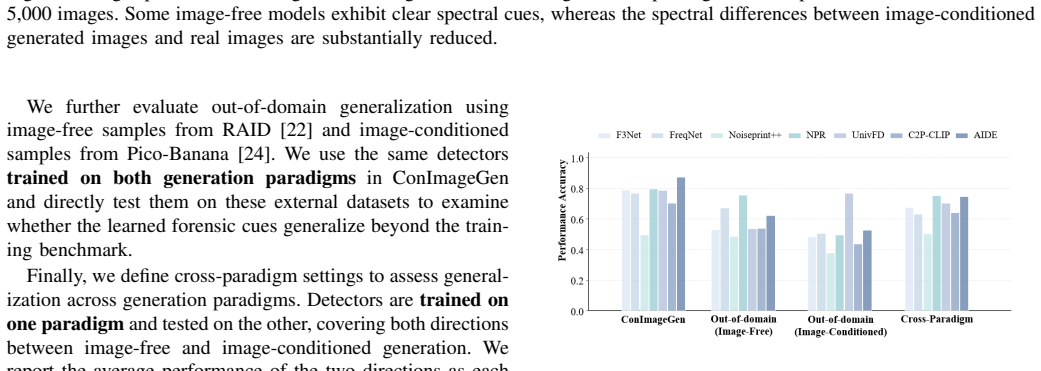
Summary. The paper studies cross-paradigm AI-generated image detection spanning image-free and image-conditioned generation. It introduces ConImageGen (364K images from 13 generators), shows that frequency, semantic, and prior semantics-irrelevant detectors transfer poorly across paradigms, and argues that PRNU-style residual aggregation reveals model-related texture patterns whose local-global relations form generalizable forensic evidence. DTS-Det encodes residual traces with SegFormer into a token-level bias that modulates DINOv3 attention (Eqs. 13–14), fused with a SigLIP2 semantic stream under LoRA adaptation. Empirically it reports 99.6% ACC on ConImageGen (+10.5 over the best baseline), 93.2%/94.1% on PicoBanana/RAID, 87.3% frame-level cross-media accuracy on GenVidBench, and strong robustness under JPEG/resizing, reconstruction, and transferable black-box attacks.
Significance. The cross-paradigm problem is well motivated and previously under-addressed; ConImageGen is a concrete, reusable contribution. The evaluation suite is unusually broad (in-domain, both transfer directions, external datasets, video frames, degradations, reconstruction, and black-box attacks), and gains over a strong dual-backbone fusion baseline (SigLIP2+DINOv3) are large and consistent across Tables I–IV and Fig. 7. If the residual-relation interpretation is substantiated, the work supplies a useful forensic perspective beyond frequency and semantic cues. Even with a more modest mechanistic claim, the benchmark and detector would remain valuable to media forensics.
major comments (3)
- [Fig. 8, Sec. V-B, Eqs. (13)–(14)] Fig. 8 / Sec. V–VI ablation does not isolate the claimed mechanism. Variants A–C are SigLIP2, DINOv3, and their fusion; D is full DTS-Det. There is no control that (i) feeds residual-encoder features as ordinary concatenated features without the relation-guided attention bias of Eq. (14), or (ii) applies relation-guided attention without the residual operator R_tex of Sec. IV-B. Without these, the 10.5-point lift over SigLIP2+DINOv3 cannot be attributed to “texture-relation modeling” rather than simply adding a residual feature stream to a dual backbone. This is load-bearing for the paper’s central framing.
- [Sec. IV-A/B, Eqs. (2)–(7), Figs. 3 and 5] Sec. IV-A/B and Eqs. (2)–(7) assert that multi-scale wavelet residual extraction, multi-window Wiener shrinkage, and MLE aggregation isolate semantics-irrelevant, model-related texture patterns. Support is mainly visual (Fig. 3) and PCE matching (Fig. 5). PCE already shows architecture clustering (SD variants, Wukong), which is equally consistent with architecture-specific fingerprints. Please add quantitative checks that residuals are weakly tied to content (e.g., correlation of residual maps with CLIP/SigLIP features before vs after extraction; same-content different-generator residual similarity) and discuss residual content leakage (high-frequency edges, lighting, editing structure). If leakage remains, the “semantics-irrelevant texture relations” interpretation is overstated even if detection accuracy is high.
- [Tables II–IV, Fig. 5] Tables II–IV report strong cross-paradigm, cross-dataset, and cross-media transfer, but the paper does not establish that held-out generators (PicoBanana, RAID-clean, GenVidBench) are architecturally novel relative to ConImageGen training models. Given the architecture clustering in Fig. 5, shared families could inflate apparent paradigm-invariant transfer. A short architectural-novelty analysis of the external sets (or an explicit leave-architecture-out split) is needed to support the claim that texture relations, rather than residual fingerprints of related generators, drive generalization.
minor comments (6)
- [Sec. III-A, References] Reference numbering is inconsistent: Sec. III-A cites GLIDE as [39], but the bibliography entry [39] is GenVidBench; GLIDE is [14]. Please renumber and recheck all generator citations.
- [Fig. 3] Fig. 3 caption states “14 models” while ConImageGen is described as 13 generators; clarify whether a real-image aggregate or an extra model is included.
- [Sec. IV-B, Sec. V-B, Sec. VI-A] Residual-extraction free parameters (wavelet levels J, window set Ω, noise std σ) and relation-guidance settings (λ, L_g=2) are only partially specified and not ablated; list defaults and sensitivity in the main text or appendix.
- [Tables I–IV] Tables I–IV report point estimates only; add multi-seed means/std or bootstrap intervals for the main averages, especially the 10.5-point claim.
- [Eq. (7)] Eq. (7) reuses intensity-weighted MLE from PRNU (T_i ⊙ X_i). Briefly justify why intensity weighting is appropriate for synthetic texture traces rather than unweighted residual averaging.
- [Abstract, Sec. IV-A] The abstract’s “for the first time” claim for semantics-irrelevant texture visualization should be tempered relative to prior PRNU/Noiseprint-style residual work, or the novelty should be stated more precisely (cross-paradigm generative models).
Circularity Check
No circularity: residual extraction is an external PRNU-style procedure, texture-relation modeling is a learned network, and all reported accuracies are empirical evaluations on held-out generators, external datasets, and attack protocols.
full rationale
The paper's chain is observational then empirical, not definitional. Sec. IV-A/B extracts single-image traces via multi-scale wavelet residual + multi-window Wiener shrinkage (Eqs. 3-6) and aggregates model-level patterns by MLE (Eq. 7), both adapted from the external PRNU literature [29]; the resulting maps (Fig. 3) and PCE correlations (Fig. 5, Eqs. 8-12) are diagnostic visualizations, not fitted constants that reappear in the detection metric. DTS-Det then encodes those traces with a SegFormer stage into a token bias m (Eq. 13) that modulates DINOv3 attention (Eq. 14) and fuses with a SigLIP2 stream; the network is trained end-to-end for binary classification and evaluated on held-out ConImageGen generators, PicoBanana, RAID, GenVidBench frames, reconstruction attacks, and black-box adversarial examples. No parameter is fitted to a subset and then called a prediction of a closely related quantity; no uniqueness theorem or self-citation forces the architecture or the accuracy numbers. The 99.6 % ACC and cross-dataset/attack figures are therefore ordinary empirical outcomes, not tautologies. Minor methodological continuity with prior residual ideas does not constitute load-bearing circularity.
Axiom & Free-Parameter Ledger
free parameters (4)
- LoRA rank and scaling (implicit)
- relation-guidance scale lambda and Lg=2
- wavelet levels J, window set Omega={3,5,7,9}, noise std sigma
- learning rate 1e-5, weight decay 0.05, input size 384
axioms (3)
- domain assumption Averaging sufficiently diverse same-resolution images suppresses semantic content while preserving model-consistent texture (PRNU-style maximum-likelihood aggregation).
- domain assumption High-frequency wavelet sub-bands after multi-window Wiener shrinkage are semantics-irrelevant.
- domain assumption Pretrained DINOv3 and SigLIP2 representations remain useful after light LoRA adaptation for forensic discrimination.
invented entities (1)
-
semantics-irrelevant texture relations (as forensic evidence)
independent evidence
Cite this review
Pith. "Pith review of Ghosts Beneath Textures: Texture-Relation Cues for Cross-Paradigm AI-Generated Image Detection." pith.science (2026). https://pith.science/paper/62TANHOJ
@misc{pith2026260703862,
  author       = {Pith},
  title        = {Pith review of: Ghosts Beneath Textures: Texture-Relation Cues for Cross-Paradigm AI-Generated Image Detection},
  year         = {2026},
  howpublished = {\url{https://pith.science/paper/62TANHOJ}},
  note         = {Machine review of arXiv:2607.03862}
}
read the original abstract
AI-generated images have proliferated rapidly, motivating extensive research. Most existing AI-generated image detectors are developed and evaluated under image-free generation paradigms, such as noise-based or text-guided generation. However, image-conditioned generation has become increasingly important in practical applications, as it enables more fine-grained control over generated content. Detecting AI-generated images across these two paradigms creates a critical cross-paradigm detection problem that has long been overlooked. To study this problem, we construct ConImageGen, a benchmark for cross-paradigm AI-generated image detection. Evaluations on ConImageGen show that existing detectors fail to generalize reliably across image-free and image-conditioned generation. To address this failure, this paper identifies a cross-paradigm forensic cue and provides a new perspective for generalized AI-generated image detection. Specifically, by suppressing semantic interference, we visualize, for the first time, semantics-irrelevant texture patterns across generation paradigms. These patterns exhibit structured local-global texture relations, indicating a generalizable form of forensic evidence. Motivated by this finding, we shift the focus from directly exploiting explicit artifacts to modeling texture relations and propose DTS-Det, a detection framework that captures and leverages such relations for generalized AI-generated image detection. Extensive experiments validate the effectiveness of our method. DTS-Det achieves state-of-the-art performance across diverse evaluation settings, reaching 99.6% ACC on ConImageGen with a 10.5% gain over the best baseline. It also achieves 93.2%/94.1% ACC in cross-dataset evaluation on PicoBanana/RAID and maintains detection rates of 95.2%/88.1% under reconstruction attacks and black-box adversarial attacks, respectively.
Figures



Reference graph
Works this paper leans on
-
[1]
Media forensics and deepfakes: An overview,
L. Verdoliva, “Media forensics and deepfakes: An overview,”IEEE Journal of Selected Topics in Signal Processing, pp. 910–932, 2020
2020
-
[2]
A sanity check for ai-generated image detection,
S. Yan, O. Li, J. Cai, Y . Hao, X. Jiang, Y . Hu, and W. Xie, “A sanity check for ai-generated image detection,” inInternational Conference on Learning Representations, 2025, pp. 70 702–70 720
2025
-
[3]
Rethinking the up-sampling operations in cnn-based generative network for general- izable deepfake detection,
C. Tan, H. Liu, Y . Zhao, S. Wei, G. Gu, P. Liu, and Y . Wei, “Rethinking the up-sampling operations in cnn-based generative network for general- izable deepfake detection,” in2024 IEEE/CVF Conference on Computer Vision and Pattern Recognition (CVPR), 2024, pp. 28 130–28 139
2024
-
[4]
Frequency-aware deepfake detection: improving generalizability through frequency space domain learning,
C. Tan, Y . Zhao, S. Wei, G. Gu, P. Liu, and Y . Wei, “Frequency-aware deepfake detection: improving generalizability through frequency space domain learning,” inProceedings of the Thirty-Eighth AAAI Conference on Artificial Intelligence and Thirty-Sixth Conference on Innovative Applications of Artificial Intelligence and Fourteenth Symposium on Education...
2024
-
[5]
Unmasking ai-created visual content: a review of generated images and deepfake detection technologies,
Y . Zhang, Z. Pang, S. Huang, C. Wang, and X. Zhou, “Unmasking ai-created visual content: a review of generated images and deepfake detection technologies,”Journal of King Saud University Computer and Information Sciences, p. 148, 2025
2025
-
[6]
Detecting and simulating artifacts in gan fake images,
X. Zhang, S. Karaman, and S.-F. Chang, “Detecting and simulating artifacts in gan fake images,” inIEEE International Workshop on Information Forensics and Security, 2019
2019
-
[7]
Fourier spectrum discrepancies in deep network generated images,
T. Dzanic, K. Shah, and F. Witherden, “Fourier spectrum discrepancies in deep network generated images,” inNeurIPS, 2020
2020
-
[8]
Thinking in frequency: Face forgery detection by mining frequency-aware clues,
Y . Qian, G. Yin, L. Sheng, Z. Chen, and J. Shao, “Thinking in frequency: Face forgery detection by mining frequency-aware clues,” inEuropean conference on computer vision, 2020, pp. 86–103
2020
-
[9]
Towards universal fake image detectors that generalize across generative models,
U. Ojha, Y . Li, and Y . J. Lee, “Towards universal fake image detectors that generalize across generative models,” inCVPR, 2023
2023
-
[10]
Learning transferable visual models from natural language supervision,
A. Radford, J. W. Kim, C. Hallacy, A. Ramesh, G. Goh, S. Agarwal, G. Sastry, A. Askell, P. Mishkin, J. Clarket al., “Learning transferable visual models from natural language supervision,” inInternational conference on machine learning, 2021, pp. 8748–8763
2021
-
[11]
C2p-clip: Injecting category common prompt in clip to enhance generalization in deepfake detection,
C. Tan, R. Tao, H. Liu, G. Gu, B. Wu, Y . Zhao, and Y . Wei, “C2p-clip: Injecting category common prompt in clip to enhance generalization in deepfake detection,”Proceedings of the AAAI Conference on Artificial Intelligence, pp. 7184–7192, 2025
2025
-
[12]
Trufor: Leveraging all-round clues for trustworthy image forgery detection and localization,
F. Guillaro, D. Cozzolino, A. Sud, N. Dufour, and L. Verdoliva, “Trufor: Leveraging all-round clues for trustworthy image forgery detection and localization,” inProceedings of the IEEE/CVF Conference on Computer Vision and Pattern Recognition (CVPR), 2023, pp. 20 606–20 615
2023
-
[13]
Denoising diffusion probabilistic models,
J. Ho, A. Jain, and P. Abbeel, “Denoising diffusion probabilistic models,” inAdvances in Neural Information Processing Systems, vol. 33, 2020, pp. 6840–6851
2020
-
[14]
Glide: Towards photorealistic image gen- eration and editing with text-guided diffusion models,
A. Nichol, P. Dhariwal, A. Ramesh, P. Shyam, P. Mishkin, B. McGrew, I. Sutskever, and M. Chen, “Glide: Towards photorealistic image gen- eration and editing with text-guided diffusion models,”arXiv preprint arXiv:2112.10741, 2021
Pith/arXiv arXiv 2021
-
[15]
High- resolution image synthesis with latent diffusion models,
R. Rombach, A. Blattmann, D. Lorenz, P. Esser, and B. Ommer, “High- resolution image synthesis with latent diffusion models,” inProceedings of the IEEE/CVF Conference on Computer Vision and Pattern Recogni- tion, 2022, pp. 10 684–10 695
2022
-
[16]
Instructpix2pix: Learning to follow image editing instructions,
T. Brooks, A. Holynski, and A. A. Efros, “Instructpix2pix: Learning to follow image editing instructions,” inProceedings of the IEEE/CVF Conference on Computer Vision and Pattern Recognition, 2023, pp. 18 392–18 402
2023
-
[17]
Adding conditional control to text-to-image diffusion models,
L. Zhang, A. Rao, and M. Agrawala, “Adding conditional control to text-to-image diffusion models,” inProceedings of the IEEE/CVF International Conference on Computer Vision, 2023, pp. 3836–3847
2023
-
[18]
Dreambooth: Fine tuning text-to-image diffusion models for subject- driven generation,
N. Ruiz, Y . Li, V . Jampani, Y . Pritch, M. Rubinstein, and K. Aberman, “Dreambooth: Fine tuning text-to-image diffusion models for subject- driven generation,” inProceedings of the IEEE/CVF Conference on Computer Vision and Pattern Recognition, 2023, pp. 22 500–22 510
2023
-
[19]
Towards universal fake image detec- tors that generalize across generative models,
U. Ojha, Y . Li, and Y . J. Lee, “Towards universal fake image detec- tors that generalize across generative models,” inProceedings of the IEEE/CVF Conference on Computer Vision and Pattern Recognition, 2023, pp. 24 480–24 489
2023
-
[20]
Genimage: A million-scale benchmark for detecting ai-generated image,
M. Zhu, H. Chen, Q. Y AN, X. Huang, G. Lin, W. Li, Z. Tu, H. Hu, J. Hu, and Y . Wang, “Genimage: A million-scale benchmark for detecting ai-generated image,” inAdvances in Neural Information Processing Systems. Curran Associates, Inc., 2023, pp. 77 771–77 782
2023
-
[21]
DRCT: Diffusion recon- struction contrastive training towards universal detection of diffusion generated images,
B. Chen, J. Zeng, J. Yang, and R. Yang, “DRCT: Diffusion recon- struction contrastive training towards universal detection of diffusion generated images,” inProceedings of the 41st International Conference on Machine Learning, 2024, pp. 7621–7639
2024
-
[22]
Raid: A dataset for testing the adversarial robustness of ai-generated image detectors,
H. Eddoubi, J. Ricker, F. Cocchi, L. Baraldi, A. Sotgiu, M. Pintor, M. Cornia, A. Fischer, R. Cucchiara, and B. Biggio, “Raid: A dataset for testing the adversarial robustness of ai-generated image detectors,” arXiv preprint arXiv:2506.03988, 2025
arXiv 2025
-
[23]
X2edit: Revisiting arbitrary-instruction image editing through self-constructed data and task-aware representation learning,
J. Ma, X. Zhu, Z. Pan, Q. Peng, X. Guo, C. Chen, and H. Lu, “X2edit: Revisiting arbitrary-instruction image editing through self-constructed data and task-aware representation learning,” inProceedings of the AAAI Conference on Artificial Intelligence, 2026, pp. 7764–7772
2026
-
[24]
Pico-banana-400k: A large-scale dataset for text-guided image editing,
Y . Qian, E. Bocek-Rivele, L. Song, J. Tong, Y . Yang, J. Lu, W. Hu, and Z. Gan, “Pico-banana-400k: A large-scale dataset for text-guided image editing,”arXiv preprint arXiv:2510.19808, 2025
arXiv 2025
-
[25]
Towards universal ai-generated image detection by variational information bottleneck net- work,
H. Zhang, Q. He, X. Bi, W. Li, B. Liu, and B. Xiao, “Towards universal ai-generated image detection by variational information bottleneck net- work,” inProceedings of the IEEE/CVF Conference on Computer Vision and Pattern Recognition (CVPR), 2025, pp. 23 828–23 837
2025
-
[26]
A closer look at fourier spectrum discrepancies for cnn-generated images detection,
K. Chandrasegaran, N.-T. Tran, and N.-M. Cheung, “A closer look at fourier spectrum discrepancies for cnn-generated images detection,” inProceedings of the IEEE/CVF Conference on Computer Vision and Pattern Recognition, 2021, pp. 7200–7209
2021
-
[27]
Breaking semantic artifacts for generalized ai-generated image detec- tion,
C. Zheng, C. Lin, Z. Zhao, H. Wang, X. Guo, S. Liu, and C. Shen, “Breaking semantic artifacts for generalized ai-generated image detec- tion,” inAdvances in Neural Information Processing Systems, 2024, pp. 59 570–59 596
2024
-
[28]
Reducing the content bias for ai-generated image detection,
S. Gye, J. Ko, H. Shon, M. Kwon, and J. Kim, “Reducing the content bias for ai-generated image detection,” inProceedings of the Winter Conference on Applications of Computer Vision (WACV), 2025, pp. 399– 408
2025
-
[29]
Determining image ori- gin and integrity using sensor noise,
M. Chen, J. Fridrich, M. Goljan, and J. Lukas, “Determining image ori- gin and integrity using sensor noise,”IEEE Transactions on Information Forensics and Security, pp. 74–90, 2008
2008
-
[30]
Evading deepfake-image detectors with white- and black-box attacks,
N. Carlini and H. Farid, “Evading deepfake-image detectors with white- and black-box attacks,” inProceedings of the IEEE/CVF Conference on Computer Vision and Pattern Recognition Workshops, 2020, pp. 658– 659
2020
-
[31]
Robustness of ai-image detectors: Fundamental limits and practical attacks,
M. Saberi, V . S. Sadasivan, K. Rezaei, A. Kumar, A. Chegini, W. Wang, and S. Feizi, “Robustness of ai-image detectors: Fundamental limits and practical attacks,” inInternational Conference on Learning Representa- tions, 2024
2024
-
[32]
Practical black-box attacks against machine learning,
N. Papernot, P. McDaniel, I. Goodfellow, S. Jha, Z. B. Celik, and A. Swami, “Practical black-box attacks against machine learning,” in Proceedings of the 2017 ACM on Asia Conference on Computer and Communications Security, 2017, pp. 506–519
2017
-
[33]
Fakepolisher: Making deepfakes more detection- evasive by shallow reconstruction,
Y . Huang, F. Juefei-Xu, R. Wang, Q. Guo, L. Ma, X. Xie, J. Li, W. Miao, Y . Liu, and G. Pu, “Fakepolisher: Making deepfakes more detection- evasive by shallow reconstruction,” inProceedings of the 28th ACM international conference on multimedia, 2020, pp. 1217–1226
2020
-
[34]
Cnn- generated images are surprisingly easy to spot... for now,
S.-Y . Wang, O. Wang, R. Zhang, A. Owens, and A. A. Efros, “Cnn- generated images are surprisingly easy to spot... for now,” inProceedings of the IEEE/CVF Conference on Computer Vision and Pattern Recogni- tion, 2020, pp. 8695–8704
2020
-
[35]
Diffusion models beat gans on image synthesis,
P. Dhariwal and A. Nichol, “Diffusion models beat gans on image synthesis,”Advances in neural information processing systems, pp. 8780–8794, 2021
2021
-
[36]
Large scale gan training for high fidelity natural image synthesis,
A. Brock, J. Donahue, and K. Simonyan, “Large scale gan training for high fidelity natural image synthesis,”arXiv preprint arXiv:1809.11096, 2018
Pith/arXiv arXiv 2018
-
[37]
High- resolution image synthesis with latent diffusion models,
R. Rombach, A. Blattmann, D. Lorenz, P. Esser, and B. Ommer, “High- resolution image synthesis with latent diffusion models,” inProceedings 14 of the IEEE/CVF conference on computer vision and pattern recognition, 2022, pp. 10 684–10 695
2022
-
[38]
Vector quantized diffusion model for text-to-image synthesis,
S. Gu, D. Chen, J. Bao, F. Wen, B. Zhang, D. Chen, L. Yuan, and B. Guo, “Vector quantized diffusion model for text-to-image synthesis,” inProceedings of the IEEE/CVF conference on computer vision and pattern recognition, 2022, pp. 10 696–10 706
2022
-
[39]
Genvidbench: A 6-million benchmark for ai-generated video detection,
Z. Ni, Q. Yan, M. Huang, T. Yuan, Y . Tang, H. Hu, X. Chen, and Y . Wang, “Genvidbench: A 6-million benchmark for ai-generated video detection,” inProceedings of the AAAI Conference on Artificial Intelligence, 2026, pp. 15 582–15 590
2026
-
[40]
Midjourney,
Midjourney, “Midjourney,” https://www.midjourney.com/home/, 2022, accessed: 2026-05-05
2022
-
[41]
WuKong-HuaHua,
WuKong-HuaHua Contributors, “WuKong-HuaHua,” https://github.com/JeffDing/WuKong-HuaHua, 2022, accessed: 2026- 05-05
2022
-
[42]
Emerging properties in unified multimodal pretraining,
C. Deng, D. Zhu, K. Li, C. Gou, F. Li, Z. Wang, S. Zhong, W. Yu, X. Nie, Z. Songet al., “Emerging properties in unified multimodal pretraining,” arXiv preprint arXiv:2505.14683, 2025
Pith/arXiv arXiv 2025
-
[43]
Flux. 1 kontext: Flow matching for in-context image generation and editing in latent space,
S. Batifol, A. Blattmann, F. Boesel, S. Consul, C. Diagne, T. Dockhorn, J. English, Z. English, P. Esser, S. Kulalet al., “Flux. 1 kontext: Flow matching for in-context image generation and editing in latent space,” arXiv e-prints, pp. arXiv–2506, 2025
2025
-
[44]
Omniconsistency: Learning style- agnostic consistency from paired stylization data,
Y . Song, C. Liu, and M. Z. Shou, “Omniconsistency: Learning style- agnostic consistency from paired stylization data,”arXiv preprint arXiv:2505.18445, 2025
Pith/arXiv arXiv 2025
-
[45]
A. Hurst, A. Lerer, A. P. Goucher, A. Perelman, A. Ramesh, A. Clark, A. Ostrow, A. Welihinda, A. Hayes, A. Radfordet al., “Gpt-4o system card,”arXiv preprint arXiv:2410.21276, 2024
Pith/arXiv arXiv 2024
-
[46]
Step1x-edit: A practical framework for general image editing,
S. Liu, Y . Han, P. Xing, F. Yin, R. Wang, W. Cheng, J. Liao, Y . Wang, H. Fu, C. Hanet al., “Step1x-edit: A practical framework for general image editing,”arXiv preprint arXiv:2504.17761, 2025
Pith/arXiv arXiv 2025
-
[47]
Spatially adaptive statistical modeling of wavelet image coefficients and its application to denoising,
M. K. Mihcak, I. Kozintsev, and K. Ramchandran, “Spatially adaptive statistical modeling of wavelet image coefficients and its application to denoising,” in1999 IEEE International Conference on Acoustics, Speech, and Signal Processing. Proceedings. ICASSP99 (Cat. No. 99CH36258), 1999, pp. 3253–3256
1999
-
[48]
Segformer: Simple and efficient design for semantic segmentation with transformers,
E. Xie, W. Wang, Z. Yu, A. Anandkumar, J. M. Alvarez, and P. Luo, “Segformer: Simple and efficient design for semantic segmentation with transformers,” inNeural Information Processing Systems (NeurIPS), 2021
2021
-
[49]
O. Sim ´eoni, H. V . V o, M. Seitzer, F. Baldassarre, M. Oquab, C. Jose, V . Khalidov, M. Szafraniec, S. Yi, M. Ramamonjisoa, F. Massa, D. Haz- iza, L. Wehrstedt, J. Wang, T. Darcet, T. Moutakanni, L. Sentana, C. Roberts, A. Vedaldi, J. Tolan, J. Brandt, C. Couprie, J. Mairal, H. J ´egou, P. Labatut, and P. Bojanowski, “DINOv3,”arXiv preprint arXiv:2508.1...
Pith/arXiv arXiv 2025
-
[50]
Attention is all you need,
A. Vaswani, N. Shazeer, N. Parmar, J. Uszkoreit, L. Jones, A. N. Gomez, Ł. Kaiser, and I. Polosukhin, “Attention is all you need,” inAdvances in Neural Information Processing Systems, 2017
2017
-
[51]
Swin transformer: Hierarchical vision transformer using shifted windows,
Z. Liu, Y . Lin, Y . Cao, H. Hu, Y . Wei, Z. Zhang, S. Lin, and B. Guo, “Swin transformer: Hierarchical vision transformer using shifted windows,” inProceedings of the IEEE/CVF International Conference on Computer Vision, 2021, pp. 10 012–10 022
2021
-
[52]
M. Tschannen, A. Gritsenko, X. Wang, M. F. Naeem, I. Alabdulmohsin, N. Parthasarathy, T. Evans, L. Beyer, Y . Xia, B. Mustafa, O. H ´enaff, J. Harmsen, A. Steiner, and X. Zhai, “Siglip 2: Multilingual vision- language encoders with improved semantic understanding, localization, and dense features,”arXiv preprint arXiv:2502.14786, 2025
Pith/arXiv arXiv 2025
-
[53]
Lora: Low-rank adaptation of large language models
E. J. Hu, Y . Shen, P. Wallis, Z. Allen-Zhu, Y . Li, S. Wang, L. Wang, W. Chenet al., “Lora: Low-rank adaptation of large language models.” Iclr, p. 3, 2022
2022
-
[54]
Deep residual learning for image recognition,
K. He, X. Zhang, S. Ren, and J. Sun, “Deep residual learning for image recognition,” inProceedings of the IEEE conference on computer vision and pattern recognition, 2016, pp. 770–778
2016
-
[55]
Xception: Deep learning with depthwise separable convolu- tions,
F. Chollet, “Xception: Deep learning with depthwise separable convolu- tions,” inProceedings of the IEEE conference on computer vision and pattern recognition, 2017, pp. 1251–1258
2017
-
[56]
Decoupled weight decay regularization,
I. Loshchilov and F. Hutter, “Decoupled weight decay regularization,” inInternational Conference on Learning Representations, 2019. 15
2019
This paper was first reviewed by grok-4.5 on July 11, 2026.
discussion (0)
Sign in with ORCID, Apple, or X to comment. Anyone can read and Pith papers without signing in.