REVIEW 7 minor 279 references
Radiative, tidal and magnetic star-planet couplings form one interconnected system that shapes atmospheres, interiors and orbits over time.
Reviewed by Pith at T0; open to challenge. T0 means a machine referee read the full paper against a public rubric. the ladder, T0–T4 →
T0 review · grok-4.5
2026-07-11 23:20 UTC pith:JU5FGKJG
load-bearing objection Solid, high-utility review that unifies the three SPI channels and already flags where Solar-System analogues break; no new physics, but the organization and caveats make it worth citing and refereeing.
Star Planet Interactions
The pith
A machine-rendered reading of the paper's core claim, the machinery that carries it, and where it could break.
Core claim
Radiative, tidal and magnetic interactions operate as an interconnected system whose long-term impact on planetary atmospheres, interiors and orbital evolution is controlled by stellar evolution, planetary properties, atmospheric structure and magnetic-field strength; presenting them together identifies the key observational signatures for future exoplanet-evolution and habitability work.
What carries the argument
The three pillars of star-planet interaction—radiative (XUV-driven heating, photochemistry and escape), tidal (equilibrium and dynamical tides that redistribute angular momentum and heat interiors) and magnetic (unipolar/dipolar inductors, Alfvén wings, reconnection and induction heating)—treated as a single coupled energy-momentum-mass exchange.
Load-bearing premise
That Solar-System analogues, especially the Jovian moons in sub-Alfvénic flow, remain quantitatively useful for scaling laws of star-planet magnetic interactions even though Alfvén-speed and Mach-number profiles differ by orders of magnitude between the two environments.
What would settle it
A statistically significant sample of close-in planets around well-characterised stars whose measured chromospheric-hotspot powers, radio luminosities or atmospheric mass-loss rates systematically deviate from the combined radiative-tidal-magnetic scaling laws once stellar wind and magnetic topology are independently constrained.
Editorial analysis
A structured set of objections, weighed in public.
Referee Report
Summary. This review synthesises theoretical and observational understanding of star-planet interactions (SPIs), framing radiative, tidal and magnetic (plus particle-driven) processes as interconnected pillars that exchange energy, momentum and mass. It covers tidal dissipation and orbital evolution (including Darwin stability and stellar spin-up), magnetic coupling (unipolar/dipolar inductors, Ohmic heating, Alfvén wings, reconnection and stress models, magnetic migration), and radiative drivers of thermospheres, thermal/non-thermal escape, photochemistry and core-powered mass loss. Solar-System analogues (heliosphere, magnetospheres, Galilean moons) are used as a laboratory, with an explicit critical assessment of their applicability to exoplanets (especially sub-Alfvénic SPMI). Multi-wavelength diagnostics, extreme cases (transients, pulsar planets) and open questions complete the survey. The central organisational claim is that long-term outcomes for atmospheres, interiors and orbits depend on stellar evolution, planetary properties, atmospheric structure and magnetic-field strength, and that a unified presentation identifies the key observational signatures for evolution and habitability studies.
Significance. If the synthesis holds, the paper supplies a timely, field-spanning reference that places radiative, tidal and magnetic SPIs on equal footing and makes their interconnections explicit. Strengths include accurate reproduction of standard scalings (tidal torque Eq. 1, energy-limited escape Eq. 44, Alfvén-wing power Eq. 27, induction skin-depth formulae) together with explicit caveats (Krenn et al. 2021 critique of energy-limited escape; efficiency factors E1–E4), the careful comparison of Jovian versus SPMI Alfvén profiles in §4.1 that limits rather than over-extends Solar-System analogues, and the compilation of numerical scaling laws (Strugarek, Paul & Strugarek) that go beyond purely analytical estimates. The work is therefore useful both as a graduate-level entry point and as a map of observational diagnostics for future facilities. No new quantitative result is claimed; the contribution is organisational and pedagogical.
minor comments (7)
- Abstract and opening of §1 still list “particle-driven” processes as a fourth pillar while the body is organised around three pillars; a one-sentence clarification that particle interactions are treated under magnetic/radiative headings would remove the minor inconsistency.
- §2.1.1, Eq. (1) and surrounding text: the leading-order torque omits explicit frequency dependence; a brief pointer to Mathis (2018) (already cited later) would help readers who expect the full constant-time-lag or constant-Q forms.
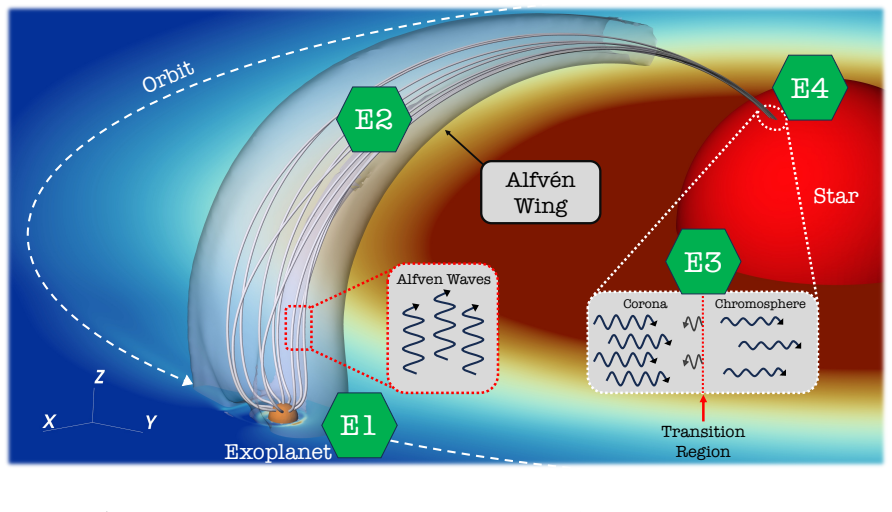
- §2.2.5 and Fig. 8: the upper-limit comparison for τ Boo is useful, but the caption and text could state more explicitly that all efficiency factors are set to unity so that the plotted values are theoretical ceilings rather than predicted hotspot powers.
- §2.3.2, discussion of energy-limited escape: the excellent summary of Krenn et al. (2021) could be cross-referenced earlier when Eq. (44) is first introduced, so that readers do not temporarily take the formula as a general estimator.
- §4.1 / Fig. 25: the Alfvén-speed and Mach-number comparison is one of the paper’s strongest critical contributions; ensuring that the colour scales and normalisations are identical between panels (as claimed) will maximise its impact.
- Occasional typographical slips (e.g., “magnetospehric”, “atmoshperes”, “reseased”, “stallar”) and a few incomplete sentences near the truncation point of the supplied text should be cleaned in proof.
- A short table or box summarising the principal observational signatures (Ca II hotspots, radio emission, Lyα absorption, transit-timing variations, etc.) linked to each pillar would improve navigability for observational readers.
Circularity Check
No significant circularity: literature synthesis with openly labeled free parameters and self-citations used only as illustrations, not as load-bearing proofs.
full rationale
This is a review that organises existing tidal, magnetic and radiative SPI theory and observations into a unified three-pillar framework. It does not claim a new first-principles derivation whose conclusion is forced by its inputs. Scaling laws (Zarka, Saur, Lanza, Strugarek, Paul & Strugarek) are quoted from the literature and compared; efficiency factors E1–E4 and ϵ, α, f_AP are explicitly left unconstrained rather than fitted and re-labelled as predictions. Self-citations (Kislyakova induction-heating models, Strugarek/Paul Alfvén-wing energetics and the §4.1 Alfvén-profile comparison) supply previously published simulations used as illustrations and domain-of-validity caveats; they are not invoked as uniqueness theorems that forbid alternatives, nor do they close a definitional loop. Section 4.1 itself limits the Jovian-moon analogy rather than smuggling it in as a forced result. No self-definitional identities, fitted-input-as-prediction steps, or ansatz-via-citation reductions appear in the load-bearing claims. Score 0 is therefore the honest finding.
Axiom & Free-Parameter Ledger
axioms (3)
- domain assumption Solar-System plasma and tidal processes can be scaled to exoplanetary regimes once Alfvén Mach number, XUV flux and mass ratio are matched.
- domain assumption Energy-limited escape, constant-Q tidal theory and ideal Alfvén-wing Poynting flux supply useful order-of-magnitude estimates even though each contains known efficiency factors of order 0.01–1.
- domain assumption Stellar magnetic fields and winds evolve according to the standard rotation–activity–age relations calibrated on solar analogues.
Cite this review
Pith. "Pith review of Star Planet Interactions." pith.science (2026). https://pith.science/paper/JU5FGKJG
@misc{pith2026260703874,
  author       = {Pith},
  title        = {Pith review of: Star Planet Interactions},
  year         = {2026},
  howpublished = {\url{https://pith.science/paper/JU5FGKJG}},
  note         = {Machine review of arXiv:2607.03874}
}
read the original abstract
Star-planet interactions (SPIs) describe the continuous exchange of energy, momentum, and mass between exoplanets and their host stars through radiative, tidal, magnetic, and particle-driven processes. Together, these interactions shape the structure, evolution, and observable properties of exoplanetary systems. In this review, we bring together current theoretical and observational understanding of SPIs, highlighting how stellar radiation, winds, and magnetic activity influence planetary atmospheres, interiors, and orbital evolution, while using the Solar System as a valuable reference for interpreting these processes. High-energy stellar radiation, particularly in the far- and extreme-ultraviolet and X-ray bands, drives atmospheric heating, photochemistry, ionisation, and escape. These effects are further influenced by stellar winds and magnetic interactions, which can either protect planetary atmospheres or accelerate their loss over time. Tidal interactions redistribute energy and angular momentum, producing internal heating and driving orbital migration and circularisation. Magnetic star-planet coupling provides additional pathways for energy transfer through reconnection and current systems, potentially enhancing atmospheric escape, heating planetary ionospheres and interiors, and generating observable signatures such as radio emission and enhanced stellar activity. We discuss how these processes work together, emphasising that their long-term impact depends on stellar evolution, planetary properties, atmospheric structure, and magnetic field strength. By presenting radiative, tidal, and magnetic interactions within a unified framework, this review highlights the physical mechanisms that shape planetary environments and identifies the key observational signatures that will complement future studies of exoplanet evolution and habitability.
Figures












Reference graph
Works this paper leans on
-
[1]
Abe, T., Whalen, B. A., Yau, A. W., et al. 1993, J. Geophys. Res., 98, 11191, doi:10.1029/92JA01971
-
[2]
L., Saar, S
Acharya, A., Kashyap, V. L., Saar, S. H., Singh, K. P., & Cuntz, M. 2023, ApJ, 951, 152, doi:10. 3847/1538-4357/acd054
2023
-
[3]
Achilleos, N., Guio, P., Hardy, F., Paranicas, C., & Sorba, A. M. 2021, in Magnetospheres in the Solar System, ed. R. Maggiolo, N. Andr´ e, H. Hasegawa, & D. T. Welling, Vol. 2, 455
2021
-
[4]
Acuna, M. H., & Ness, N. F. 1976, J. Geophys. Res., 81, 2917, doi:10.1029/JA081i016p02917
-
[5]
Acuna, M. H., Connerney, J. E. P., Wasilewski, P., et al. 1998, Science, 279, 1676, doi:10.1126/ science.279.5357.1676
arXiv 1998
-
[6]
Adams, F. C. 2011, ApJ, 730, 27, doi:10.1088/0004-637X/730/1/27
-
[7]
V., Kubyshkina, D., & Fossati, L
Affolter, L., Mordasini, C., Oza, A. V., Kubyshkina, D., & Fossati, L. 2023, A&A, 676, A119, doi:10. 1051/0004-6361/202142205 †Views and opinions expressed are however those of the author(s) only and do not necessarily reflect those of the European Union or the European Research Council Executive Agency. Neither the European Union nor the granting authori...
-
[8]
A., Bogovalov, S
Aharonian, F. A., Bogovalov, S. V., & Khangulyan, D. 2012, Nature, 482, 507, doi:10.1038/ nature10793
2012
-
[11]
AIKIN, A. C. 1970, Nature, 227, 1334, doi:10.1038/2271334a0
-
[13]
Akhavan-Tafti, M., Slavin, J. A., Le, G., et al. 2018, Journal of Geophysical Research: Space Physics, 123, 1224, doi:https://doi.org/10.1002/2017JA024681
-
[14]
Albrecht, S. H., Marcussen, M. L., Winn, J. N., Dawson, R. I., & Knudstrup, E. 2021, ApJ, 916, L1, doi:10.3847/2041-8213/ac0f03
-
[15]
Alderson, L., Wakeford, H. R., Alam, M. K., et al. 2023, Nature, 614, 664, doi:10.1038/ s41586-022-05591-3 Alvarado-G´ omez, J. D., Drake, J. J., Cohen, O., Moschou, S. P., & Garraffo, C. 2018, ApJ, 862, 93, doi:10.3847/1538-4357/aacb7f Alvarado-G´ omez, J. D., Drake, J. J., Garraffo, C., et al. 2020, ApJ, 902, L9, doi:10.3847/2041-8213/ abb885 Alvarado-G...
-
[16]
V., Gr¨ oller, H., Lichtenegger, H., et al
Amerstorfer, U. V., Gr¨ oller, H., Lichtenegger, H., et al. 2017, Journal of Geophysical Research (Plan- ets), 122, 1321, doi:10.1002/2016JE005175
-
[17]
J., Acu˜ na, M
Anderson, B. J., Acu˜ na, M. H., Korth, H., et al. 2010, Space Sci. Rev., 152, 307, doi:10.1007/ s11214-009-9544-3
2010
-
[18]
2014, in IAU Symposium, Vol
Angerhausen, D., Sapers, H., Simoncini, E., et al. 2014, in IAU Symposium, Vol. 293, Formation, Detection, and Characterization of Extrasolar Habitable Planets, ed. N. Haghighipour, 192–196
2014
-
[19]
J., et al
Argiroffi, C., Reale, F., Drake, J. J., et al. 2019, Nature Astronomy, 3, 742, doi:10.1038/ s41550-019-0781-4
2019
-
[20]
S., Andr´ e, N., Bertucci, C
Arridge, C. S., Andr´ e, N., Bertucci, C. L., et al. 2011, Space Sci. Rev., 162, 25, doi:10.1007/ s11214-011-9849-x
2011
-
[21]
Backer, D. C., Kulkarni, S. R., Heiles, C., Davis, M. M., & Goss, W. M. 1982, Nature, 300, 615, doi:10.1038/300615a0 84
doi:10.1038/300615a0 1982
-
[22]
2015, Space Science Reviews, 187
Badman, S., Branduardi-Raymont, G., Galand, M., et al. 2015, Space Science Reviews, 187
2015
-
[23]
Bagenal, F., & Delamere, P. A. 2011, Journal of Geophysical Research: Space Physics, 116, doi:https: //doi.org/10.1029/2010JA016294
-
[24]
2020, Journal of Geophysical Research (Space Physics), 125, e27485, doi:10
Bagenal, F., & Dols, V. 2020, Journal of Geophysical Research (Space Physics), 125, e27485, doi:10. 1029/2019JA027485
2020
-
[25]
2007, Science, 315, 501–503, doi:10.1126/ science.1134358
Barabash, S., Fedorov, A., Lundin, R., & Sauvaud, J.-A. 2007, Science, 315, 501–503, doi:10.1126/ science.1134358
2007
-
[26]
S., Allard, F., & Hauschildt, P
Baraffe, I., Chabrier, G., Barman, T. S., Allard, F., & Hauschildt, P. H. 2003, A&A, 402, 701, doi:10.1051/0004-6361:20030252
-
[27]
Barr, A. C., Dobos, V., & Kiss, L. L. 2018, A&A, 613, A37, doi:10.1051/0004-6361/201731992
-
[28]
2021, MNRAS, 502, 3569, doi:10.1093/mnras/stab225
Basak, A., & Nandy, D. 2021, MNRAS, 502, 3569, doi:10.1093/mnras/stab225
-
[29]
Bastian, T. S., Dulk, G. A., & Leblanc, Y. 2000, ApJ, 545, 1058, doi:10.1086/317864
doi:10.1086/317864 2000
-
[30]
Bauer, S. J., & Lammer, H. 2004, Planetary Aeronomy, doi:10.1007/978-3-662-09362-7
-
[31]
2010, Space Sci
Baumjohann, W., Blanc, M., Fedorov, A., & Glassmeier, K.-H. 2010, Space Sci. Rev., 152, 99, doi:10. 1007/s11214-010-9629-z
2010
-
[32]
Baumjohann, W., & Treumann, R. A. 2012, Basic Space Plasma Physics (Revised Edition), doi:10. 1142/p850
2012
-
[33]
G., Welbanks, L., Schlawin, E., et al
Beatty, T. G., Welbanks, L., Schlawin, E., et al. 2024, ApJ, 970, L10, doi:10.3847/2041-8213/ad55e9
-
[36]
S., Le Poncin-Lafitte, C., & Mathis, S
Benbakoura, M., R´ eville, V., Brun, A. S., Le Poncin-Lafitte, C., & Mathis, S. 2019, A&A, 621, A124, doi:10.1051/0004-6361/201833314
-
[37]
2011, Space Science Reviews, 162, 113–171, doi:10.1007/ s11214-011-9845-1
Bertucci, C., Duru, F., Edberg, N., et al. 2011, Space Science Reviews, 162, 113–171, doi:10.1007/ s11214-011-9845-1
2011
-
[38]
C., Kurth, W
Bertucci, C., Hamilton, D. C., Kurth, W. S., et al. 2015, Geophys. Res. Lett., 42, 193, doi:10.1002/ 2014GL062106
2015
-
[40]
2013, Icarus, 223, 308, doi:10.1016/j.icarus.2012.11.020
Beuthe, M. 2013, Icarus, 223, 308, doi:10.1016/j.icarus.2012.11.020
-
[41]
Bidinosti, C. P., Chapple, E. M., & Hayden, M. E. 2007, Concepts in Magnetic Resonance Part B: Magnetic Resonance Engineering, 31B, 191, doi:10.1002/cmr.b.20090
-
[42]
Bigg, E. K. 1964, Nature, 203, 1008
1964
-
[43]
Biggin, A. J., Piispa, E. J., Pesonen, L. J., et al. 2015, Nature, 526, 245, doi:10.1038/nature15523
-
[44]
C., Kellett, B
Bingham, R., Speirs, D. C., Kellett, B. J., et al. 2013, Space Sci. Rev., 178, 695, doi:10.1007/ s11214-013-9963-z 85
2013
-
[45]
Blackman, E. G., & Tarduno, J. A. 2018, MNRAS, 481, 5146, doi:10.1093/mnras/sty2640
-
[46]
Bogovalov, S. V. 1999, aap, 349, 1017, doi:10.48550/arXiv.astro-ph/9907051
-
[47]
2016, Celestial Mechanics and Dynamical Astronomy, 126, 275, doi:10
Bolmont, E., & Mathis, S. 2016, Celestial Mechanics and Dynamical Astronomy, 126, 275, doi:10. 1007/s10569-016-9690-3
2016
-
[48]
Bouma, L. G., & Jardine, M. M. 2025, ApJ, 988, L3, doi:10.3847/2041-8213/ade39a
-
[49]
2020, ApJ, 895, 77, doi:10.3847/1538-4357/ab8e2d
Bourgalais, J., Carrasco, N., Changeat, Q., et al. 2020, ApJ, 895, 77, doi:10.3847/1538-4357/ab8e2d
-
[50]
2018, A&A, 620, A147, doi:10.1051/ 0004-6361/201833675
Bourrier, V., Lecavelier des Etangs, A., Ehrenreich, D., et al. 2018, A&A, 620, A147, doi:10.1051/ 0004-6361/201833675
2018
-
[51]
2023, A&A, 669, A63, doi:10.1051/0004-6361/202245004
Bourrier, V., Attia, M., Mallonn, M., et al. 2023, A&A, 669, A63, doi:10.1051/0004-6361/202245004
-
[52]
A., Halekas, J
Brain, D. A., Halekas, J. S., Lillis, R., et al. 2005, Geophys. Res. Lett., 32, L18203, doi:10.1029/ 2005GL023126
2005
-
[53]
Bromley, B. C., & Kenyon, S. J. 2011, ApJ, 735, 29, doi:10.1088/0004-637X/735/1/29 —. 2022, AJ, 164, 229, doi:10.3847/1538-3881/ac9301
-
[54]
A., Arons, J., Quataert, E., & Del Zanna, L
Bucciantini, N., Thompson, T. A., Arons, J., Quataert, E., & Del Zanna, L. 2006, Monthly Notices of the Royal Astronomical Society, 368, 1717, doi:10.1111/j.1365-2966.2006.10217.x
-
[55]
Buffett, B. A. 2000, Science, 288, 2007, doi:10.1126/science.288.5473.2007
-
[57]
2023, ApJ, 948, 37, doi:10.3847/1538-4357/acc738
Burne, S., Bertucci, C., Sergis, N., et al. 2023, ApJ, 948, 37, doi:10.3847/1538-4357/acc738
-
[58]
Callingham, J. R., Vedantham, H. K., Shimwell, T. W., et al. 2021, Nature Astronomy, 5, 1233, doi:10.1038/s41550-021-01483-0
-
[59]
R., Tasse, C., Keers, R., et al
Callingham, J. R., Tasse, C., Keers, R., et al. 2025, Nature, 647, 603, doi:10.1038/ s41586-025-09715-3
2025
-
[60]
A., Hazra, G., Villarreal D’Angelo, C., & Kubyshkina, D
Carolan, S., Vidotto, A. A., Hazra, G., Villarreal D’Angelo, C., & Kubyshkina, D. 2021, MNRAS, 508, 6001, doi:10.1093/mnras/stab2947
-
[61]
Carolan, S., Vidotto, A. A., Loesch, C., & Coogan, P. 2019, Monthly Notices of the Royal Astronomical Society, 489, 5784, doi:10.1093/mnras/stz2422
-
[62]
2020, MNRAS, 496, 3582, doi:10.1093/mnras/staa1733
Carone, L., Baeyens, R., Molli` ere, P., et al. 2020, MNRAS, 496, 3582, doi:10.1093/mnras/staa1733
-
[64]
2007b, MNRAS, 374, L42, doi:10.1111/j.1745-3933.2006.00261.x
Catala, C., Donati, J.-F., Shkolnik, E., Bohlender, D., & Alecian, E. 2007b, MNRAS, 374, L42, doi:10.1111/j.1745-3933.2006.00261.x
-
[65]
Cauley, P. W., Shkolnik, E. L., Llama, J., Bourrier, V., & Moutou, C. 2018, The Astronomical Journal, 156, 262, doi:10.3847/1538-3881/aae841
-
[66]
W., Shkolnik, E
Cauley, P. W., Shkolnik, E. L., Llama, J., & Lanza, A. F. 2019, Nature Astronomy, 3, 1128, doi:10. 1038/s41550-019-0840-x
2019
-
[67]
M., S´ anchez-Cano, B., & Mays, M
Cecconi, B., Witasse, O., Jackman, C. M., S´ anchez-Cano, B., & Mays, M. L. 2022, Frontiers in Astronomy and Space Sciences, 9, 800279, doi:10.3389/fspas.2022.800279
-
[68]
Cerutti, B., & Beloborodov, A. M. 2016, Space Science Reviews, 207, 111–136, doi:10.1007/ s11214-016-0315-7 86
2016
-
[69]
2019, ApJ, 872, 51, doi:10.3847/1538-4357/aaf99f
Chabrier, G., Mazevet, S., & Soubiran, F. 2019, ApJ, 872, 51, doi:10.3847/1538-4357/aaf99f
-
[70]
2018, ApJ, 867, 129, doi:10.3847/1538-4357/aae3e7
Chang, Q., Xu, X., Zhang, T., et al. 2018, ApJ, 867, 129, doi:10.3847/1538-4357/aae3e7
-
[71]
Chebly, J. J., Alvarado-G´ omez, J. D., Poppenh¨ ager, K., & Garraffo, C. 2023a, MNRAS, 524, 5060, doi:10.1093/mnras/stad2100 —. 2023b, MNRAS, 524, 5060, doi:10.1093/mnras/stad2100
-
[72]
Chebly, J. J., Louis, C. K., Strugarek, A., Alvarado G´ omez, J. D., & Zarka, P. 2026a, A&A, 705, A149, doi:10.1051/0004-6361/202557706 —. 2026b, A&A, 705, A149, doi:10.1051/0004-6361/202557706
-
[73]
2017, ApJ, 834, 17, doi:10.3847/1538-4357/834/1/17
Chen, J., & Kipping, D. 2017, ApJ, 834, 17, doi:10.3847/1538-4357/834/1/17
-
[74]
2024, Geophysical Research Letters, 51, e2024GL108894, doi:https://doi.org/10.1029/2024GL108894
Chen, L.-J., Gershman, D., Burkholder, B., et al. 2024, Geophysical Research Letters, 51, e2024GL108894, doi:https://doi.org/10.1029/2024GL108894
-
[75]
Christensen, U. R., & Aubert, J. 2006a, Geophysical Journal International, 166, 97, doi:10.1111/j. 1365-246X.2006.03009.x —. 2006b, Geophysical Journal International, 166, 97, doi:10.1111/j.1365-246X.2006.03009.x
Pith/arXiv arXiv doi:10.1111/j 2006
-
[76]
R., Holzwarth, V., & Reiners, A
Christensen, U. R., Holzwarth, V., & Reiners, A. 2009, Nature, 457, 167, doi:10.1038/nature07626
-
[77]
W., Sheets, J., Cohen, M., et al
Claire, M. W., Sheets, J., Cohen, M., et al. 2012, ApJ, 757, 95, doi:10.1088/0004-637X/757/1/95
-
[78]
T., Mayyasi, M., Bhattacharyya, D., et al
Clarke, J. T., Mayyasi, M., Bhattacharyya, D., et al. 2024, Science Advances, 10, eadm7499, doi:10. 1126/sciadv.adm7499
2024
-
[79]
Cochrane, C. J., Vance, S. D., Castillo-Rogez, J. C., Styczinski, M. J., & Liuzzo, L. 2025, AGU Advances, 6, 2024AV001237, doi:10.1029/2024AV001237
-
[81]
2024, ApJ, 962, 157, doi:10.3847/1538-4357/ad206a
Cohen, O., Glocer, A., Garraffo, C., et al. 2024, ApJ, 962, 157, doi:10.3847/1538-4357/ad206a
-
[82]
Cohen, O., Kashyap, V. L., Drake, J. J., et al. 2011, ApJ, 733, 67, doi:10.1088/0004-637X/733/1/67
-
[83]
Cohen, O., Ma, Y., Drake, J. J., et al. 2015, ApJ, 806, 41, doi:10.1088/0004-637X/806/1/41
-
[84]
Colburn, D. S. 1980, J. Geophys. Res., 85, 7257, doi:10.1029/JB085iB12p07257
-
[85]
Connerney, J. E. P., Acu˜ na, M. H., & Ness, N. F. 1981, Journal of Geophysical Research: Space Physics, 86, 8370, doi:https://doi.org/10.1029/JA086iA10p08370
-
[86]
Connerney, J. E. P., Timmins, S., Herceg, M., & Joergensen, J. L. 2020, Journal of Geophysical Research: Space Physics, 125, e2020JA028138, doi:https://doi.org/10.1029/2020JA028138
-
[87]
Connerney, J. E. P., Kotsiaros, S., Oliversen, R. J., et al. 2018, Geophys. Res. Lett., 45, 2590, doi:10. 1002/2018GL077312
2018
-
[88]
1999, The Astrophysical Journal, 511, 351, doi:10.1086/ 306652
Contopoulos, I., Kazanas, D., & Fendt, C. 1999, The Astrophysical Journal, 511, 351, doi:10.1086/ 306652
1999
-
[89]
Cordes, J. M., & Downs, G. S. 1985, ApJS, 59, 343, doi:10.1086/191076
doi:10.1086/191076 1985
discussion (0)
Sign in with ORCID, Apple, or X to comment. Anyone can read and Pith papers without signing in.