REVIEW 3 major objections 5 minor 33 references
Close-up 3D Gaussian renders fail because reference features are not scale-invariant; MACRO fixes it by matching scale in image space before encoding.
Reviewed by Pith at T0; open to challenge. T0 means a machine referee read the full paper against a public rubric. the ladder, T0–T4 →
T0 review · grok-4.5
2026-07-11 23:19 UTC pith:4UNTVHK4
load-bearing objection Solid systems paper: scale-mismatch diagnosis is real, multi-plane image-space crops fix it without training, and the two new close-up benchmarks are useful; depth dependence is the main caveat and already scoped honestly. the 3 major comments →
MACRO: Training-free Multi-plane Attention for Closeup Render Optimization
The pith
A machine-rendered reading of the paper's core claim, the machinery that carries it, and where it could break.
Core claim
The root failure of reference-conditioned close-up enhancement is a scale gap: VAE and U-Net features are not scale-invariant, so cross-view attention retrieves incorrect correspondences, and the VAE is not scale-equivariant, so the mismatch cannot be corrected in latent space. Aligning scale by depth-plane crops in image space before encoding restores correct attention and yields faithful close-ups without training.
What carries the argument
MACRO: multi-plane depth decomposition of the close-up, image-space scale-matched reference crops (then VAE encoding), and a depth-aware attention mask that lets each close-up token attend only to the matching-scale reference tokens.
Load-bearing premise
The method assumes the 3DGS depth map of the close-up is accurate enough to set plane centroids, crop locations, scale factors, and token masks even where the close-up itself is poorly reconstructed.
What would settle it
On a scene with large depth error in under-observed regions, measure whether the scale-matched crops and attention masks still point to the true corresponding content; if attention maps and final textures systematically miss the ground-truth locations, the depth premise fails.
If this is right
- Reference-guided enhancers for close-ups should perform scale alignment in image space rather than only in latent space.
- Depth-plane decomposition plus masked attention can be dropped onto existing single-step diffusion enhancers without architecture changes or finetuning.
- The two new close-up benchmarks become the first standardized test for methods that claim to handle large scale gaps from training views.
- Training-free scale matching is usable where close-up training data cannot be collected, such as fixed camera arrays for dynamic scenes.
Where Pith is reading between the lines
- Any reference-conditioned model whose encoder is not scale-equivariant will likely need the same image-space pre-alignment for extreme zoom or multi-scale fusion tasks.
- Adaptive per-image plane counts, rather than a fixed P=3, could further reduce residual blur-realism tradeoffs on scenes with complex depth structure.
- The same multi-plane crop idea may transfer to progressive or video-based enhancers that currently bridge scale only by intermediate viewpoints.
Editorial analysis
A structured set of objections, weighed in public.
Referee Report
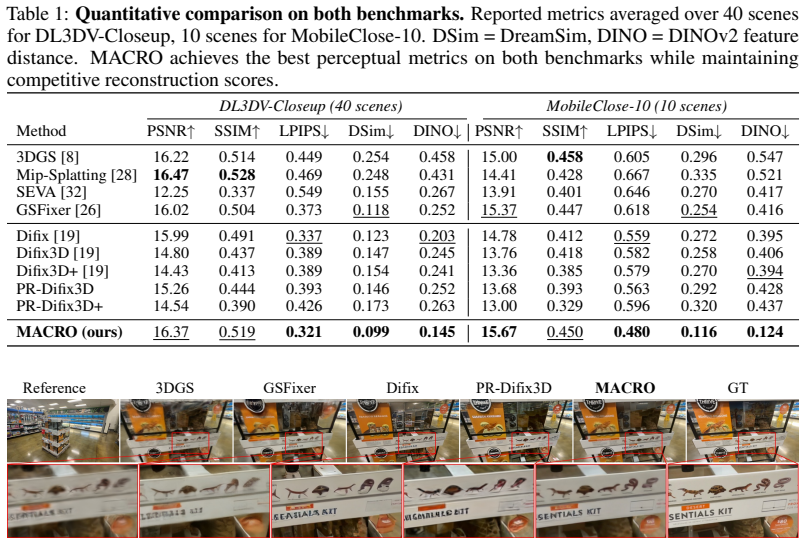
Summary. The paper studies close-up novel view synthesis from 3D Gaussian Splatting, where reference-conditioned diffusion enhancers fail under large scale gaps. It diagnoses the failure as non-scale-invariant U-Net/VAE features (so cross-view attention retrieves wrong correspondences) plus a non-scale-equivariant VAE encoder (so latent-space correction is invalid). MACRO is a training-free fix: k-means depth planes on the 3DGS depth map, image-space scale-matched crops of K references (upsampled by PFT-SR), and a depth-aware attention mask so each close-up token attends only to the matching-scale crop. The method is demonstrated on Difix without architectural changes. Two new benchmarks (DL3DV-Closeup, MobileClose-10) are introduced with a construction protocol, and MACRO reports the best perceptual metrics (LPIPS, DreamSim, DINOv2) while remaining competitive on PSNR/SSIM against 3DGS, Mip-Splatting, SEVA, GSFixer, Difix, and progressive variants.
Significance. Close-up NVS is practically important for virtual production and interactive 3D, and the paper supplies both a clear mechanistic diagnosis (Fig. 3 attention-matching curves and VAE cosine-similarity drop) and a lightweight, training-free remedy that injects 3D structure into an existing 2D enhancement backbone. The two standardized close-up benchmarks and the first explicit evaluation protocol for large scale-gap NVS are reusable contributions. Ablations (Table 2) isolate references, mask, upsampler, and warping; the primary driver is image-space scale matching before encoding. If the results hold under independent reimplementation and released data, the work is a solid systems-level advance for reference-guided 3DGS enhancement rather than a new generative architecture.
major comments (3)
- §5.1–5.2 and Appendix B.2: several progressive baselines (PR-Difix3D implementing Close-up-GS, GSFixer trajectory for CloseUpShot) are author reimplementations of unavailable code. The SOTA perceptual claim in Table 1 is load-bearing; the manuscript should either release the reimplementation details/configs or add a sensitivity check so that residual implementation differences cannot explain the gap to MACRO.
- §4.2–4.4 and Limitations §5.4: plane centroids, scale factors s_p (Eq. 5), crop centers, and the attention mask A all depend on 3DGS-rendered depth for close-ups that are themselves poorly reconstructed. Although Table 2 shows the mask ablation is modest and depth is used only coarsely, a quantitative stress test (e.g., additive depth noise or monocular depth substitution on a subset of DL3DV-Closeup) is still needed to bound how much of the perceptual gain survives when depth is systematically wrong in under-observed regions.
- Appendix D and Table 1: absolute PSNR/SSIM remain modest, partly attributed to exposure mismatch between wide and close-up captures. The paper should report the fraction of pairs affected and, if feasible, an exposure-normalized or tone-matched evaluation so that reconstruction metrics can be interpreted cleanly alongside the strong perceptual gains.
minor comments (5)
- Fig. 3(a): clarify token-radius definition and whether ground-truth correspondence is established by geometric projection or by the crop construction itself.
- Eq. (5): d_ref_p is not fully specified when the plane content is only partially visible in a given reference; a short sentence on fallback would help.
- Appendix B.1: runtime (~34 s / ~104 s) is useful; stating the backbone step count and whether SR is batched would aid reproducibility.
- Related work: briefly contrast multi-scale / anti-aliased 3DGS methods with the generative enhancement setting so the scope boundary is sharper.
- Typos / notation: “V AE” spacing, occasional “Difix3D+” vs “Difix3D +”, and consistent use of K×P vs KP.
Circularity Check
No significant circularity: empirical training-free method with independent scale-mismatch diagnosis, image-space fix, and held-out benchmark evaluation.
full rationale
The paper's central claims rest on empirical measurements (U-Net attention nearest-neighbor accuracy vs. scale ratio in Fig. 3a; VAE cosine similarity E(Resize_s(x)) vs. Resize_s(E(x)) dropping to ~0.70 at 4 imes in Fig. 3b) that establish non-invariance and non-equivariance, followed by a constructive pipeline (k-means depth planes, image-space crops/resizes before encoding, depth-aware attention mask) that does not redefine its success metric in terms of those inputs. Hyperparameters K=P=3 are selected by grid search on a held-out subset of 8 scenes (Appendix C.1) and then frozen; the reported gains on DL3DV-Closeup and MobileClose-10 are measured against external baselines and ground-truth close-ups, not against quantities fitted from the same data. Depth is used only for coarse plane assignment and global scale factors (Eqs. 4–6), with ablation (Table 2) showing the mask is secondary; this is ordinary geometric coupling, not a definitional loop. No uniqueness theorems, self-citation chains, or renamed known results carry the argument. The derivation is therefore self-contained and non-circular.
Axiom & Free-Parameter Ledger
free parameters (4)
- Number of depth planes P =
3
- Number of reference views K =
3
- k-means clustering in reciprocal depth 1/z =
k-means on 1/z, P clusters
- Reference crop upsampler (PFT-SR) =
PFT-SR
axioms (5)
- domain assumption Pretrained VAE and U-Net features used by reference-conditioned enhancers are not scale-invariant, so cross-view attention fails under large scale gaps.
- domain assumption VAE encoder is not scale-equivariant: E(Resize_s(x)) ≠ Resize_s(E(x)), so scale alignment must occur in image space.
- domain assumption 3DGS-rendered depth and known camera poses suffice to compute plane centroids, scale factors, and crop centers for close-up views.
- domain assumption Difix-style joint self-attention between target and reference latents is a valid texture-transfer mechanism when scales match.
- standard math Standard k-means / attention / VAE math and 3D projection geometry.
invented entities (2)
-
MACRO multi-plane attention pipeline
no independent evidence
-
DL3DV-Closeup and MobileClose-10 benchmarks
no independent evidence
read the original abstract
Close-up rendering, zooming into a scene well beyond any training camera, is important for virtual production and interactive 3D content, yet remains an open challenge. 3D Gaussian splatting (3DGS) enables high-fidelity, real-time novel view synthesis, but its rendering quality degrades at close range. Recent diffusion-based methods that enhance the rendering by conditioning on reference images from the training set produce significant artifacts in this setting. We analyze this failure and identify its root cause: the scale gap between the close-up and reference views. We show that the features in reference-conditioned enhancement models are not scale-invariant, causing cross-view attention to retrieve incorrect correspondences when the same content appears at different scales, and that this mismatch cannot be corrected in latent space because the VAE encoder is not scale-equivariant. Building on this analysis we introduce MACRO, Multi-plane Attention for Closeup Render Optimization, a training-free method for high-quality close-up novel view synthesis from 3DGS. MACRO resolves the scale gap by leveraging the scene's known 3D structure: it decomposes the close-up into depth planes, crops and resizes references in image space to match the scale of each plane before encoding, and applies a depth-aware attention mask so each token attends only to scale-matched references. The method requires no architectural changes or additional training. We further contribute two new close-up novel view synthesis benchmarks, the first standardized evaluation protocol for this setting, and demonstrate state-of-the-art results on both, outperforming existing 3DGS and diffusion-based methods on both reconstruction and perceptual metrics. Project page: https://nitzanhod.github.io/MACRO
Figures




Reference graph
Works this paper leans on
-
[1]
Splatsure: Selective super-resolution for multi-view consistent 3d gaussian splatting,
Pranav Asthana, Alex Hanson, Allen Tu, Tom Goldstein, Matthias Zwicker, and Amitabh Varshney. Splatsure: Selective super-resolution for multi-view consistent 3d gaussian splatting,
-
[2]
URLhttps://arxiv.org/abs/2512.02172
-
[3]
Artifixer: Enhancing and extending 3d reconstruction with auto-regressive diffusion models
Riccardo de Lutio, Tobias Fischer, Yen-Yu Chang, Yuxuan Zhang, Jay Zhangjie Wu, Xuanchi Ren, Tianchang Shen, Katarina Tothova, Zan Gojcic, and Haithem Turki. Artifixer: Enhancing and extending 3d reconstruction with auto-regressive diffusion models. InSIGGRAPH, 2026
2026
-
[4]
Xiang Feng, Tieshi Zhong, Shuo Chang, Weiliu Wang, Chengkai Wang, Yifei Chen, Tongyu Hu, Yuhe Wang, Zhenzhong Kuang, Xuefei Yin, and Yanming Zhu. IE-SRGS: an internal-external knowledge fusion framework for high-fidelity 3d gaussian splatting super-resolution. In Sven Koenig, Chad Jenkins, and Matthew E. Taylor, editors,Fortieth AAAI Conference on Artific...
-
[5]
FlowR: Flowing from sparse to dense 3d reconstructions
Tobias Fischer, Samuel Rota Bulò, Yung-Hsu Yang, Nikhil Keetha, Lorenzo Porzi, Norman Müller, Katja Schwarz, Jonathon Luiten, Marc Pollefeys, and Peter Kontschieder. FlowR: Flowing from sparse to dense 3d reconstructions. InProceedings of the IEEE/CVF International Conference on Computer Vision (ICCV), 2025
2025
-
[6]
DreamSim: Learning new dimensions of human visual similarity using synthetic data
Stephanie Fu, Netanel Tamir, Shobhita Sundaram, Lucy Chai, Richard Zhang, Tali Dekel, and Phillip Isola. DreamSim: Learning new dimensions of human visual similarity using synthetic data. InAdvances in Neural Information Processing Systems, volume 36, pages 50742–50768, 2023
2023
-
[7]
Ruiqi Gao, Aleksander Holynski, Philipp Henzler, Arthur Brussee, Ricardo Martin-Brualla, Pratul Srinivasan, Jonathan T. Barron, and Ben Poole. Cat3d: Create anything in 3d with multi-view diffusion models, 2024. URLhttps://arxiv.org/abs/2405.10314
Pith/arXiv arXiv 2024
-
[8]
Mvsany- where: Zero-shot multi-view stereo, 2025
Sergio Izquierdo, Mohamed Sayed, Michael Firman, Guillermo Garcia-Hernando, Daniyar Tur- mukhambetov, Javier Civera, Oisin Mac Aodha, Gabriel Brostow, and Jamie Watson. Mvsany- where: Zero-shot multi-view stereo, 2025. URLhttps://arxiv.org/abs/2503.22430
Pith/arXiv arXiv 2025
-
[9]
3d gaussian splatting for real-time radiance field rendering.ACM Trans
Bernhard Kerbl, Georgios Kopanas, Thomas Leimkühler, and George Drettakis. 3d gaussian splatting for real-time radiance field rendering.ACM Trans. Graph., 42(4):139:1–139:14, 2023. doi: 10.1145/3592433. URLhttps://doi.org/10.1145/3592433
doi:10.1145/3592433 2023
-
[10]
EQ-V AE: equivariance regularized latent space for improved generative image modeling
Theodoros Kouzelis, Ioannis Kakogeorgiou, Spyros Gidaris, and Nikos Komodakis. EQ-V AE: equivariance regularized latent space for improved generative image modeling. In Aarti Singh, Maryam Fazel, Daniel Hsu, Simon Lacoste-Julien, Felix Berkenkamp, Tegan Maharaj, Kiri Wagstaff, and Jerry Zhu, editors,Forty-second International Conference on Machine Learnin...
2025
-
[11]
Grounding image matching in 3d with mast3r, 2024
Vincent Leroy, Yohann Cabon, and Jérôme Revaud. Grounding image matching in 3d with mast3r, 2024. URLhttps://arxiv.org/abs/2406.09756
Pith/arXiv arXiv 2024
-
[12]
Analytic-splatting: Anti-aliased 3d gaussian splatting via analytic integration
Zhihao Liang, Qi Zhang, Wenbo Hu, Lei Zhu, Ying Feng, and Kui Jia. Analytic-splatting: Anti-aliased 3d gaussian splatting via analytic integration. In Ales Leonardis, Elisa Ricci, Stefan Roth, Olga Russakovsky, Torsten Sattler, and Gül Varol, editors,Computer Vision - ECCV 2024 - 18th European Conference, Milan, Italy, September 29-October 4, 2024, Procee...
-
[13]
DL3DV- 10K: A large-scale scene dataset for deep learning-based 3d vision
Lu Ling, Yichen Sheng, Zhi Tu, Wentian Zhao, Cheng Xin, Kun Wan, Lantao Yu, Qianyu Guo, Zixun Yu, Yawen Lu, Xuanmao Li, Xingpeng Sun, Rohan Ashok, Aniruddha Mukherjee, Hao Kang, Xiangrui Kong, Gang Hua, Tianyi Zhang, Bedrich Benes, and Aniket Bera. DL3DV- 10K: A large-scale scene dataset for deep learning-based 3d vision. InIEEE/CVF Conference 10 on Compu...
-
[14]
Progressive focused transformer for single image super-resolution
Wei Long, Xingyu Zhou, Leheng Zhang, and Shuhang Gu. Progressive focused transformer for single image super-resolution. InProceedings of the Computer Vision and Pattern Recognition Conference, pages 2279–2288, 2025
2025
-
[15]
Scaffold- gs: Structured 3d gaussians for view-adaptive rendering
Tao Lu, Mulin Yu, Linning Xu, Yuanbo Xiangli, Limin Wang, Dahua Lin, and Bo Dai. Scaffold- gs: Structured 3d gaussians for view-adaptive rendering. InProceedings of the IEEE/CVF Conference on Computer Vision and Pattern Recognition, pages 20654–20664, 2024
2024
-
[16]
Maxime Oquab, Timothée Darcet, Théo Moutakanni, Huy V . V o, Marc Szafraniec, Vasil Khalidov, Pierre Fernandez, Daniel Haziza, Francisco Massa, Alaaeldin El-Nouby, Mido Assran, Nicolas Ballas, Wojciech Galuba, Russell Howes, Po-Yao Huang, Shang-Wen Li, Ishan Misra, Michael Rabbat, Vasu Sharma, Gabriel Synnaeve, Hu Xu, Hervé Jégou, Julien Mairal, Patrick L...
2024
-
[17]
Md Ashiqur Rahman and Raymond A. Yeh. Truly scale-equivariant deep nets with fourier layers, 2023. URLhttps://arxiv.org/abs/2311.02922
Pith/arXiv arXiv 2023
-
[18]
Disco: accurate discrete scale convo- lutions.arXiv preprint arXiv:2106.02733, 2021
Ivan Sosnovik, Artem Moskalev, and Arnold Smeulders. Disco: accurate discrete scale convo- lutions.arXiv preprint arXiv:2106.02733, 2021
Pith/arXiv arXiv 2021
-
[19]
Daniel E. Worrall and Max Welling. Deep scale-spaces: Equivariance over scale, 2019. URL https://arxiv.org/abs/1905.11697
Pith/arXiv arXiv 2019
-
[20]
Difix3d+: Improving 3d reconstructions with single-step diffusion models
Jay Zhangjie Wu, Yuxuan Zhang, Haithem Turki, Xuanchi Ren, Jun Gao, Mike Zheng Shou, Sanja Fidler, Zan Gojcic, and Huan Ling. Difix3d+: Improving 3d reconstructions with single-step diffusion models. InProceedings of the Computer Vision and Pattern Recognition Conference, pages 26024–26035, 2025
2025
-
[21]
Srinivasan, Dor Verbin, Jonathan T
Rundi Wu, Ben Mildenhall, Philipp Henzler, Keunhong Park, Ruiqi Gao, Daniel Watson, Pratul P. Srinivasan, Dor Verbin, Jonathan T. Barron, Ben Poole, and Aleksander Holynski. Reconfusion: 3d reconstruction with diffusion priors, 2023. URL https://arxiv.org/abs/2312.02981
Pith/arXiv arXiv 2023
-
[22]
Jiatong Xia and Lingqiao Liu. Close-up-gs: Enhancing close-up view synthesis in 3d gaussian splatting with progressive self-training, 2025. URL https://arxiv.org/abs/2503.09396
Pith/arXiv arXiv 2025
-
[23]
Enhancing close-up novel view synthesis via pseudo- labeling, 2025
Jiatong Xia, Libo Sun, and Lingqiao Liu. Enhancing close-up novel view synthesis via pseudo- labeling, 2025. URLhttps://arxiv.org/abs/2503.15908
Pith/arXiv arXiv 2025
-
[24]
Shiyun Xie, Zhiru Wang, Xu Wang, Yinghao Zhu, Chengwei Pan, and Xiwang Dong. Supergs: Super-resolution 3d gaussian splatting enhanced by variational residual features and uncertainty- augmented learning, 2024. URLhttps://arxiv.org/abs/2410.02571
Pith/arXiv arXiv 2024
-
[25]
Multi-scale 3d gaussian splatting for anti-aliased rendering
Zhiwen Yan, Weng Fei Low, Yu Chen, and Gim Hee Lee. Multi-scale 3d gaussian splatting for anti-aliased rendering. InIEEE/CVF Conference on Computer Vision and Pattern Recognition, CVPR 2024, Seattle, WA, USA, June 16-22, 2024, pages 20923–20931. IEEE, 2024. doi: 10.1109/CVPR52733.2024.01977. URL https://doi.org/10.1109/CVPR52733.2024. 01977
-
[26]
Cogvideox: Text-to-video diffusion models with an expert transformer
Zhuoyi Yang, Jiayan Teng, Wendi Zheng, Ming Ding, Shiyu Huang, Jiazheng Xu, Yuanming Yang, Wenyi Hong, Xiaohan Zhang, Guanyu Feng, Da Yin, Yuxuan Zhang, Weihan Wang, Yean Cheng, Bin Xu, Xiaotao Gu, Yuxiao Dong, and Jie Tang. Cogvideox: Text-to-video diffusion models with an expert transformer. InThe Thirteenth International Conference on Learning Represen...
2025
-
[27]
Xingyilang Yin, Qi Zhang, Jiahao Chang, Ying Feng, Qingnan Fan, Xi Yang, Chi-Man Pun, Huaqi Zhang, and Xiaodong Cun. Gsfixer: Improving 3d gaussian splatting with reference- guided video diffusion priors.CoRR, abs/2508.09667, 2025. doi: 10.48550/ARXIV .2508.09667. URLhttps://doi.org/10.48550/arXiv.2508.09667
-
[28]
Viewcrafter: Taming video diffusion models for high-fidelity novel view synthesis, 2024
Wangbo Yu, Jinbo Xing, Li Yuan, Wenbo Hu, Xiaoyu Li, Zhipeng Huang, Xiangjun Gao, Tien-Tsin Wong, Ying Shan, and Yonghong Tian. Viewcrafter: Taming video diffusion models for high-fidelity novel view synthesis, 2024. URLhttps://arxiv.org/abs/2409.02048
Pith/arXiv arXiv 2024
-
[29]
Mip-splatting: Alias-free 3d gaussian splatting
Zehao Yu, Anpei Chen, Binbin Huang, Torsten Sattler, and Andreas Geiger. Mip-splatting: Alias-free 3d gaussian splatting. InIEEE/CVF Conference on Computer Vision and Pat- tern Recognition, CVPR 2024, Seattle, WA, USA, June 16-22, 2024, pages 19447–19456. IEEE, 2024. doi: 10.1109/CVPR52733.2024.01839. URL https://doi.org/10.1109/ CVPR52733.2024.01839
-
[30]
Jiahui Zhang, Fangneng Zhan, Muyu Xu, Shijian Lu, and Eric P. Xing. Fregs: 3d gaussian splatting with progressive frequency regularization. InIEEE/CVF Conference on Computer Vision and Pattern Recognition, CVPR 2024, Seattle, WA, USA, June 16-22, 2024, pages 21424– 21433. IEEE, 2024. doi: 10.1109/CVPR52733.2024.02024. URL https://doi.org/10. 1109/CVPR5273...
-
[31]
Efros, Eli Shechtman, and Oliver Wang
Richard Zhang, Phillip Isola, Alexei A. Efros, Eli Shechtman, and Oliver Wang. The unreasonable effectiveness of deep features as a perceptual metric, 2018. URL https: //arxiv.org/abs/1801.03924
Pith/arXiv arXiv 2018
-
[32]
Yuqi Zhang, Guanying Chen, Jiaxing Chen, Chuanyu Fu, Chuan Huang, and Shuguang Cui. Closeupshot: Close-up novel view synthesis from sparse-views via point-conditioned diffusion model, 2025. URLhttps://arxiv.org/abs/2511.13121
arXiv 2025
-
[33]
Jensen Zhou, Hang Gao, Vikram V oleti, Aaryaman Vasishta, Chun-Han Yao, Mark Boss, Philip Torr, Christian Rupprecht, and Varun Jampani. Stable virtual camera: Generative view synthesis with diffusion models, 2025. URLhttps://arxiv.org/abs/2503.14489. 12 MACRO: Training-free Multi-plane Attention for Closeup Render Optimization ———— Supplementary Material ...
Pith/arXiv arXiv 2025
discussion (0)
Sign in with ORCID, Apple, or X to comment. Anyone can read and Pith papers without signing in.