REVIEW 3 major objections 6 minor 75 references
A single 360° image is enough to generate a complete indoor 3D scene with floors, walls, and separately textured furniture.
Reviewed by Pith at T0; open to challenge. T0 means a machine referee read the full paper against a public rubric. the ladder, T0–T4 →
T0 review · grok-4.5
2026-07-11 22:28 UTC pith:TDQFNHCI
load-bearing objection Solid engineering paper that correctly targets the missing layout problem in indoor scene generation and ships a useful dataset; comparative claims rest on thin real-world and baseline evidence. the 3 major comments →
InSpace: Structure-Aware 3D Indoor Scene Generation from a Single 360{deg} Image
The pith
A machine-rendered reading of the paper's core claim, the machinery that carries it, and where it could break.
Core claim
From a single equirectangular 360° image, InSpace recovers a complete 3D indoor scene that includes both the structural layout (floors and walls) and separately textured assets, with placements that respect the recovered geometry, by cascading partial-geometry priors, view-selective coarse structure generation, and hybrid global-local refinement under flow matching.
What carries the argument
View-selective cross-attention (and its asset-selective counterpart): each voxel or asset token is allowed to attend only to the cubemap faces or image regions that are geometrically visible from the calibrated camera center, so the model composes the full room without receiving conflicting cues from opposite walls.
Load-bearing premise
The monocular depth map and the camera center derived from it must be accurate enough that the resulting visibility masks and partial geometry really do point each voxel at the correct faces of the panorama.
What would settle it
Replace the estimated depth with systematically biased or noisy depth on the same ERP inputs; if view-selective attention and layout-guided inversion still produce coherent rooms whose IoU and asset placement match the reported numbers, the claim that the geometric prior is essential fails.
Editorial analysis
A structured set of objections, weighed in public.
Referee Report
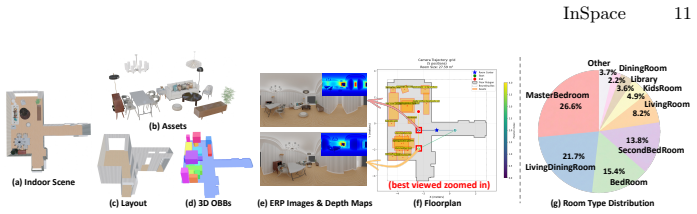
Summary. InSpace generates complete 3D indoor scenes—structural layout (floors/walls) plus separately textured assets—from a single equirectangular (ERP) 360° image. The pipeline has three stages: (1) monocular depth lifting to a Partial Scene Geometry (PSG) and calibrated camera center; (2) coarse dense-voxel structure generation with view-selective cross-attention over cubemap features, plus optional Layout-Guided Structure Inversion from the PSG and a 3D OBB detector; (3) layout- and asset-aware fine geometry/texture via global self-attention and asset-selective cross-attention under flow matching, built on TRELLIS.2 O-Voxel latents. The authors introduce ERP-FRONT (~29K synthetic ERP–mesh pairs from 3D-FRONT) and report 3D (IoU, CD, F1) and 2D (PSNR, LPIPS) metrics, ablations of view-selective attention and inversion, and limited comparisons to SceneGen, MIDI, and SAM3D plus qualitative/self-reconstruction results on ReplicaPano.
Significance. The problem framing is well motivated: limited-FOV single-image scene generators omit structural layout and often produce floating or interpenetrating assets. Using full 360° ERP context as the spatial anchor, together with view-selective and asset-selective attention that couple voxel latents to geometrically visible image regions, is a clear technical step beyond asset-only multi-instance pipelines. ERP-FRONT is a useful community resource for paired ERP-to-scene training. Ablations cleanly isolate view-selective attention (Stage-2 IoU ~44→57, CD roughly halved) and inversion (t0 sweeps), which strengthens confidence in the core mechanisms. If the comparative and real-world evidence were tightened, this would be a solid contribution to structure-aware indoor scene generation.
major comments (3)
- Sec. 6.2 and Supp. D: Head-to-head comparison with SceneGen, MIDI, and SAM3D uses only 20 scenes, requires manual alignment then ICP, and evaluates asset-level metrics only inside a perspective crop (red dashed boxes), not full-scene layout. This protocol is too narrow and operator-dependent to support a general outperformance claim for complete layout+asset scenes. Either expand to a larger automatic-alignment protocol (or report full-scene metrics where baselines can be fairly scored), or clearly restrict claims to the ERP-FRONT self-benchmark and treat baselines as qualitative context.
- Supp. C.2–C.3 (ReplicaPano): Generalization is shown on 7 scenes with self-reconstruction metrics and no competing methods. Domain-gap failures (frames, curtains, texture style) are acknowledged, but the abstract/conclusion still state that InSpace “generalizes well” to realistic panoramas. Strengthen this with more scenes, failure-rate reporting, and/or a limited baseline comparison under the same ERP input; otherwise tone the generalization claim to match the evidence.
- Sec. 4.1–4.2, Eq. (5), Fig. 3: View-selective masks and Layout-Guided Structure Inversion both depend on monocular depth and the calibrated camera center c. There is no sensitivity study to depth error, camera-height error, or PSG incompleteness (e.g., wrong depth → wrong visibility cones and inversion prior). A controlled noise/ablation on depth or c would show whether the Stage-2 gains remain when the spatial prior is imperfect—especially important for real ERP inputs where depth is noisier than on ERP-FRONT.
minor comments (6)
- Table 1: Optimal t0 differs between Stage 2 (0.5) and Stage 3 (0.7); the text explains this, but a single recommended default and a short note on how users should choose t0 would help reproducibility.
- Fig. 2 and Sec. 1: “Existing methods” are illustrated with floating/misplacement; cite which specific outputs (method + figure) are shown so the failure modes are attributable.
- Sec. 4.2: Cubemap FoV=120° and α=50 are fixed; a brief sensitivity note (or appendix) would clarify robustness of M_vs.
- Supp. B / Table B.1: 3D OBB F1@0.75 is low (~29%); discuss how OBB size/yaw error propagates into Stage-3 asset quality, since Stage 3 is conditioned on these boxes.
- Related Work: PanoContext-Former is noted as closest prior with unavailable code; a short qualitative discussion of its reported limitations versus InSpace’s outputs would better position novelty.
- Notation: N0/s0 vs 16^3 latent resolution appears in several places; keep a single consistent symbol for the coarse latent grid size.
Circularity Check
No circularity: standard cascaded generative pipeline trained and evaluated on a held-out synthetic split with external geometric/perceptual metrics; no prediction reduces to a fitted free parameter or self-citation by construction.
full rationale
InSpace is an engineering paper proposing a three-stage flow-matching pipeline (PSG initialization from monocular depth + equirectangular lift, view-selective DiT for coarse voxels, then OBB-guided global-local hybrid attention for layout+assets). The only free parameters are ordinary network weights trained by rectified flow matching on the authors' new ERP-FRONT training split (26.5k pairs derived from 3D-FRONT); evaluation uses a disjoint test split plus standard external metrics (Voxel IoU, Chamfer, F1, PSNR, LPIPS) and a small external real-world set (ReplicaPano). Layout-Guided Structure Inversion (t0) is an inference-time SDEdit-style schedule, not a fit that is then re-reported as a prediction. View-selective and asset-selective masks (Eqs. 5-9) are geometric constructions from camera center and OBB projection; they do not encode the target geometry by definition. Citations to TRELLIS.2, DINOv3, flow matching, CenterPoint-style detection, etc., are ordinary background tooling, not load-bearing uniqueness theorems by overlapping authors. No equation or claim reduces a reported result to its own input by construction. Circularity burden is therefore zero.
Axiom & Free-Parameter Ledger
free parameters (4)
- inversion noise level t0 =
0.7 (default)
- visibility sigmoid scale α =
50
- cubemap FoV =
120°
- 3D OBB detector loss weights (λ_hm, λ_off, λ_sz, …) =
(1,1,5,2,2,1)
axioms (5)
- domain assumption Monocular depth estimator (DA2) produces sufficiently accurate ERP depth for back-projection into a usable Partial Scene Geometry.
- domain assumption Sparse voxel latents and SC-VAEs pretrained on TRELLIS.2 transfer without finetuning to indoor scene geometry and materials.
- standard math Rectified flow matching with DiT blocks can denoise dense/sparse voxel latents conditioned on DINOv3 cubemap tokens.
- domain assumption A 64³ coarse occupancy grid plus a lightweight 3D U-Net detector yields 3D OBBs accurate enough for asset-selective generation.
- ad hoc to paper Synthetic rooms rendered from 3D-FRONT are distributionally close enough to real panoramas for the learned model to generalize (or at least produce plausible outputs).
invented entities (4)
-
View-selective cross-attention mask M_vs
no independent evidence
-
Asset-selective cross-attention mask M_as
no independent evidence
-
Partial Scene Geometry (PSG) + Layout-Guided Structure Inversion
no independent evidence
-
ERP-FRONT dataset
independent evidence
read the original abstract
Recent advances in single image-to-3D generation have enabled high-quality asset synthesis, yet extending these capabilities to indoor scene generation remains challenging. Existing methods focus on asset-level generation while neglecting the structural layout, which is essential for downstream applications and serves as the spatial anchor for grounding assets. However, a single image with a limited field of view lacks the spatial coverage to recover a coherent global layout. To this end, we use a 360{\deg} image represented in equirectangular projection (ERP) and propose InSpace, a structure-aware framework for 3D indoor scene generation. InSpace comprises three stages: (1) estimating partial scene geometry as spatial priors, (2) generating coarse scene structure with view-selective cross-attention, and (3) producing detailed layout and asset geometry with textures through a global-local hybrid attention, using flow matching. We also propose ERP-FRONT, a paired ERP-Image-to-3D indoor scene dataset based on 3D-FRONT. Experiments show that InSpace generates complete 3D indoor scenes with structural layout, along with separate textured assets from a single ERP image, achieving strong performance across 3D and 2D metrics. Project Page: https://kookie12.github.io/InSpace-Project-Page/
Figures




Reference graph
Works this paper leans on
-
[1]
ai et al
Ai, H., Cao, Z., Wang, L.: A survey of representation learning, optimization strate- gies, and applications for omnidirectional vision: H. ai et al. International Journal of Computer Vision133(8), 4973–5012 (2025) 2
2025
-
[2]
arXiv preprint arXiv:2205.10468 (2022) 2
Ai, H., Cao, Z., Zhu, J., Bai, H., Chen, Y., Wang, L.: Deep learning for omnidi- rectional vision: A survey and new perspectives. arXiv preprint arXiv:2205.10468 (2022) 2
Pith/arXiv arXiv 2022
-
[3]
In: Sensor fusion IV: control paradigms and data structures
Besl, P.J., McKay, N.D.: Method for registration of 3-d shapes. In: Sensor fusion IV: control paradigms and data structures. vol. 1611, pp. 586–606. Spie (1992) 12
1992
-
[4]
In: European conference on computer vision
Carion, N., Massa, F., Synnaeve, G., Usunier, N., Kirillov, A., Zagoruyko, S.: End- to-end object detection with transformers. In: European conference on computer vision. pp. 213–229. Springer (2020) 3
2020
-
[5]
In: 2017 International Conference on 3D Vision (3DV)
Chang, A., Dai, A., Funkhouser, T., Halber, M., Niebner, M., Savva, M., Song, S., Zeng, A., Zhang, Y.: Matterport3d: Learning from rgb-d data in indoor environ- ments. In: 2017 International Conference on 3D Vision (3DV). pp. 667–676. IEEE Computer Society (2017) 3
2017
-
[6]
In: Proceedings of the IEEE/CVF Conference on Computer Vision and Pattern Recognition
Chen, X., Chu, F.J., Gleize, P., Liang, K.J., Sax, A., Tang, H., Wang, W., Guo, M., Hardin, T., Li, X., et al.: Sam 3d: 3dfy anything in images. In: Proceedings of the IEEE/CVF Conference on Computer Vision and Pattern Recognition. pp. 7220–7232 (2026) 2, 4, 12, 35, 37
2026
-
[7]
arXiv preprint arXiv:2507.17745 (2025) 4 InSpace 17
Chen, Y., Li, Z., Wang, Y., Zhang, H., Li, Q., Zhang, C., Lin, G.: Ultra3d: Efficient and high-fidelity 3d generation with part attention. arXiv preprint arXiv:2507.17745 (2025) 4 InSpace 17
Pith/arXiv arXiv 2025
-
[8]
In: ICLR 2023 (Eleventh International Conference on Learning Representations) (2023) 8
Couairon, G., Verbeek, J., Schwenk, H., Cord, M.: Diffedit: Diffusion-based se- mantic image editing with mask guidance. In: ICLR 2023 (Eleventh International Conference on Learning Representations) (2023) 8
2023
-
[9]
arXiv preprint arXiv:1911.01911 (2019) 11, 24
Denninger, M., Sundermeyer, M., Winkelbauer, D., Zidan, Y., Olefir, D., El- badrawy, M., Lodhi, A., Katam, H.: Blenderproc. arXiv preprint arXiv:1911.01911 (2019) 11, 24
Pith/arXiv arXiv 1911
-
[10]
Ding, L., Dong, S., Li, Y., Gao, C., Chen, X., Han, R., Kuang, Y., Zhang, H., Huang, B., Huang, Z., Wang, Z., Xu, D., Xue, T.: Fullpart: Generating each 3d part at full resolution (2025),https://arxiv.org/abs/2510.261405
arXiv 2025
-
[11]
In: Proceedings of the 33rd ACM International Conference on Multimedia
Dong, W., Yang, B., Yang, Z., Li, Y., Hu, T., Bao, H., Ma, Y., Cui, Z.: Hiscene: creating hierarchical 3d scenes with isometric view generation. In: Proceedings of the 33rd ACM International Conference on Multimedia. pp. 9783–9792 (2025) 4
2025
-
[12]
In: Proceedings of the IEEE/CVF Conference on Computer Vision and Pattern Recognition
Dong, Y., Fang, C., Bo, L., Dong, Z., Tan, P.: Panocontext-former: Panoramic total scene understanding with a transformer. In: Proceedings of the IEEE/CVF Conference on Computer Vision and Pattern Recognition. pp. 28087–28097 (2024) 3, 4, 12, 13, 32
2024
-
[13]
In: Proceedings of the IEEE/CVF International Conference on Computer Vision
Fu, H., Cai, B., Gao, L., Zhang, L.X., Wang, J., Li, C., Zeng, Q., Sun, C., Jia, R., Zhao, B., et al.: 3d-front: 3d furnished rooms with layouts and semantics. In: Proceedings of the IEEE/CVF International Conference on Computer Vision. pp. 10933–10942 (2021) 3, 11, 23
2021
-
[14]
International Journal of Computer Vision129(12), 3313–3337 (2021) 23
Fu, H., Jia, R., Gao, L., Gong, M., Zhao, B., Maybank, S., Tao, D.: 3d-future: 3d furniture shape with texture. International Journal of Computer Vision129(12), 3313–3337 (2021) 23
2021
-
[15]
ACM Trans- actions on Graphics (TOG)43(4), 1–15 (2024) 4
Gao, D., Rozenberszki, D., Leutenegger, S., Dai, A.: Diffcad: Weakly-supervised probabilistic cad model retrieval and alignment from an rgb image. ACM Trans- actions on Graphics (TOG)43(4), 1–15 (2024) 4
2024
-
[16]
In: Proceedings of the Computer Vision and Pattern Recognition Conference
Gu, Z., Cui, Y., Li, Z., Wei, F., Ge, Y., Gu, J., Liu, M.Y., Davis, A., Ding, Y.: Ar- tiscene: Language-driven artistic 3d scene generation through image intermediary. In: Proceedings of the Computer Vision and Pattern Recognition Conference. pp. 2891–2901 (2025) 2, 4
2025
-
[17]
In: Proceedings of the IEEE/CVF conference on computer vision and pattern recognition
Gümeli, C., Dai, A., Nießner, M.: Roca: Robust cad model retrieval and alignment from a single image. In: Proceedings of the IEEE/CVF conference on computer vision and pattern recognition. pp. 4022–4031 (2022) 4
2022
-
[18]
In: Proceedings of the IEEE/CVF International Conference on Computer Vision
He, X., Zou, Z.X., Chen, C.H., Guo, Y.C., Liang, D., Yuan, C., Ouyang, W., Cao, Y.P., Li, Y.: Sparseflex: High-resolution and arbitrary-topology 3d shape modeling. In: Proceedings of the IEEE/CVF International Conference on Computer Vision. pp. 14822–14833 (2025) 4
2025
-
[19]
In: Proceedings of the IEEE/CVF Conference on Computer Vision and Pattern Recognition
Hong, J.W., Ton, T., Pham, T.X., Koo, G., Yoon, S., Yoo, C.D.: Ita-mdt: Image- timestep-adaptive masked diffusion transformer framework for image-based virtual try-on. In: Proceedings of the IEEE/CVF Conference on Computer Vision and Pattern Recognition. pp. 28284–28294 (2025) 37
2025
-
[20]
In: International Conference on Learning Representations
Hong, Y., Zhang, K., Gu, J., Bi, S., Zhou, Y., Liu, D., Liu, F., Sunkavalli, K., Bui, T., Tan, H.: Lrm: Large reconstruction model for single image to 3d. In: International Conference on Learning Representations. vol. 2024, pp. 50678–50702 (2024) 2
2024
-
[21]
In: Proceedings of the IEEE/CVF Conference on Computer Vision and Pattern Recognition
Huang, Z., Guo, Y.C., An, X., Yang, Y., Li, Y., Zou, Z.X., Liang, D., Liu, X., Cao, Y.P., Sheng, L.: Midi: Multi-instance diffusion for single image to 3d scene generation. In: Proceedings of the IEEE/CVF Conference on Computer Vision and Pattern Recognition. pp. 23646–23657 (2025) 2, 4, 12, 35, 37 18 G. Koo et al
2025
-
[22]
arXiv preprint arXiv:2506.15442 (2025) 2, 4, 7
Hunyuan3D, T., Yang, S., Yang, M., Feng, Y., Huang, X., Zhang, S., He, Z., Luo, D., Liu, H., Zhao, Y., et al.: Hunyuan3d 2.1: From images to high-fidelity 3d assets with production-ready pbr material. arXiv preprint arXiv:2506.15442 (2025) 2, 4, 7
Pith/arXiv arXiv 2025
-
[23]
In: International conference on machine learning
Jaegle, A., Gimeno, F., Brock, A., Vinyals, O., Zisserman, A., Carreira, J.: Per- ceiver: General perception with iterative attention. In: International conference on machine learning. pp. 4651–4664. PMLR (2021) 3
2021
-
[24]
Jia, T., Yan, D., Hao, D., Li, Y., Zhang, K., He, X., Li, L., Wang, Y., Chen, J., Jiang, L., Yin, Q., Quan, L., Chen, Y.C., Yuan, L.: Ultrashape 1.0: High-fidelity 3d shape generation via scalable geometric refinement (2025),https://arxiv.org/ abs/2512.211854
arXiv 2025
-
[25]
arXiv preprint arXiv:1312.6114 (2013) 3
Kingma, D.P., Welling, M.: Auto-encoding variational bayes. arXiv preprint arXiv:1312.6114 (2013) 3
Pith/arXiv arXiv 2013
-
[26]
In: Proceedings of the IEEE/CVF international conference on computer vision
Kirillov, A., Mintun, E., Ravi, N., Mao, H., Rolland, C., Gustafson, L., Xiao, T., Whitehead, S., Berg, A.C., Lo, W.Y., et al.: Segment anything. In: Proceedings of the IEEE/CVF international conference on computer vision. pp. 4015–4026 (2023) 12
2023
-
[27]
In: European Conference on Computer Vision
Koo, G., Yoon, S., Hong, J.W., Yoo, C.D.: Flexiedit: Frequency-aware latent re- finement for enhanced non-rigid editing. In: European Conference on Computer Vision. pp. 363–379. Springer (2024) 8, 37
2024
-
[28]
In: International Conference on Machine Learning
Koo, G., Yoon, S., Lee, Y., Hong, J.W., Yoo, C.D.: Flowdrag: 3d-aware drag-based image editing with mesh-guided deformation vector flow fields. In: International Conference on Machine Learning. pp. 31467–31485. PMLR (2025) 8, 37
2025
-
[29]
In: ICASSP 2024-2024 IEEE International Confer- ence on Acoustics, Speech and Signal Processing (ICASSP)
Koo, G., Yoon, S., Yoo, C.D.: Wavelet-guided acceleration of text inversion in diffusion-based image editing. In: ICASSP 2024-2024 IEEE International Confer- ence on Acoustics, Speech and Signal Processing (ICASSP). pp. 4380–4384. IEEE (2024) 37
2024
-
[30]
In: European Conference on Computer Vision
Kuo, W., Angelova, A., Lin, T.Y., Dai, A.: Mask2cad: 3d shape prediction by learning to segment and retrieve. In: European Conference on Computer Vision. pp. 260–277. Springer (2020) 4
2020
-
[31]
In: Proceedings of the IEEE/CVF International Conference on Computer Vision
Kuo, W., Angelova, A., Lin, T.Y., Dai, A.: Patch2cad: Patchwise embedding learn- ing for in-the-wild shape retrieval from a single image. In: Proceedings of the IEEE/CVF International Conference on Computer Vision. pp. 12589–12599 (2021) 4
2021
-
[32]
1 kontext: Flow match- ing for in-context image generation and editing in latent space
Labs, B.F., Batifol, S., Blattmann, A., Boesel, F., Consul, S., Diagne, C., Dock- horn, T., English, J., English, Z., Esser, P., et al.: Flux. 1 kontext: Flow match- ing for in-context image generation and editing in latent space. arXiv preprint arXiv:2506.15742 (2025) 3
Pith/arXiv arXiv 2025
-
[33]
In: Proceedings of the IEEE/CVF Conference on Computer Vision and Pattern Recognition
Lai, Z., Zhao, Y., Zhao, Z., Liu, H., Lin, Q., Huang, J., Guo, C., Yue, X.: Lattice: Democratize high-fidelity 3d generation at scale. In: Proceedings of the IEEE/CVF Conference on Computer Vision and Pattern Recognition. pp. 19982–19992 (2026) 4
2026
-
[34]
arXiv preprint arXiv:2503.16302 (2025) 2, 4
Lai, Z., Zhao, Y., Zhao, Z., Liu, H., Wang, F., Shi, H., Yang, X., Lin, Q., Huang, J., Liu, Y., et al.: Unleashing vecset diffusion model for fast shape generation. arXiv preprint arXiv:2503.16302 (2025) 2, 4
Pith/arXiv arXiv 2025
-
[35]
In: Proceed- ings of the European conference on computer vision (ECCV)
Law, H., Deng, J.: Cornernet: Detecting objects as paired keypoints. In: Proceed- ings of the European conference on computer vision (ECCV). pp. 734–750 (2018) 27
2018
-
[36]
arXiv preprint arXiv:2605.10922 (2026) 4 InSpace 19
Li, D.Y., Zhao, W., Chen, Y., Hu, W., Guo, M.H., Zhang, F.L., Shan, Y., Hu, S.M.: Pixal3d: Pixel-aligned 3d generation from images. arXiv preprint arXiv:2605.10922 (2026) 4 InSpace 19
Pith/arXiv arXiv 2026
-
[37]
Li, H., Zheng, W., He, J., Liu, Y., Lin, X., Yang, X., Chen, Y.C., Guo, C.: Da2: Depth anything in any direction (2025),https://arxiv.org/abs/2509.266182, 6
arXiv 2025
-
[38]
arXiv preprint arXiv:2405.14979 (2024) 2, 4
Li, W., Liu, J., Chen, R., Liang, Y., Chen, X., Tan, P., Long, X.: Craftsman: High-fidelity mesh generation with 3d native generation and interactive geometry refiner. arXiv preprint arXiv:2405.14979 (2024) 2, 4
Pith/arXiv arXiv 2024
-
[39]
arXiv preprint arXiv:2505.07747 (2025) 2, 4
Li, W., Zhang, X., Sun, Z., Qi, D., Li, H., Cheng, W., Cai, W., Wu, S., Liu, J., Wang, Z., et al.: Step1x-3d: Towards high-fidelity and controllable generation of textured 3d assets. arXiv preprint arXiv:2505.07747 (2025) 2, 4
Pith/arXiv arXiv 2025
-
[40]
IEEE Transactions on Pattern Analysis and Machine Intel- ligence (2025) 2, 4
Li, Y., Zou, Z.X., Liu, Z., Wang, D., Liang, Y., Yu, Z., Liu, X., Guo, Y.C., Liang, D., Ouyang, W., et al.: Triposg: High-fidelity 3d shape synthesis using large-scale rectified flow models. IEEE Transactions on Pattern Analysis and Machine Intel- ligence (2025) 2, 4
2025
-
[41]
Advances in Neural Informa- tion Processing Systems38, 118582–118600 (2026) 4
Li, Z., Wang, Y., Zheng, H., Luo, Y., Wen, B.: Sparc3d: Sparse representation and construction for high-resolution 3d shapes modeling. Advances in Neural Informa- tion Processing Systems38, 118582–118600 (2026) 4
2026
-
[42]
Lin, Y., Lin, C., Pan, P., Yan, H., Feng, Y., Mu, Y., Fragkiadaki, K.: Partcrafter: Structured 3d mesh generation via compositional latent diffusion transformers (2025),https://arxiv.org/abs/2506.055734
Pith/arXiv arXiv 2025
-
[43]
Ling, L., Lin, C.H., Lin, T.Y., Ding, Y., Zeng, Y., Sheng, Y., Ge, Y., Liu, M.Y., Bera, A., Li, Z.: Scenethesis: A language and vision agentic framework for 3d scene generation (2025),https://arxiv.org/abs/2505.028362, 4
Pith/arXiv arXiv 2025
-
[44]
arXiv preprint arXiv:2210.02747 (2022) 3, 5
Lipman, Y., Chen, R.T., Ben-Hamu, H., Nickel, M., Le, M.: Flow matching for generative modeling. arXiv preprint arXiv:2210.02747 (2022) 3, 5
Pith/arXiv arXiv 2022
-
[45]
In: Proceedings of the IEEE/CVF inter- national conference on computer vision
Liu, R., Wu, R., Van Hoorick, B., Tokmakov, P., Zakharov, S., Vondrick, C.: Zero- 1-to-3: Zero-shot one image to 3d object. In: Proceedings of the IEEE/CVF inter- national conference on computer vision. pp. 9298–9309 (2023) 2
2023
-
[46]
In: The Eleventh International Conference on Learning Representations (ICLR) (2023) 11
Liu, X., Gong, C., Liu, Q.: Flow straight and fast: Learning to generate and transfer data with rectified flow. In: The Eleventh International Conference on Learning Representations (ICLR) (2023) 11
2023
-
[47]
In: European conference on computer vision
Liu, Y., Wang, T., Zhang, X., Sun, J.: Petr: Position embedding transformation for multi-view 3d object detection. In: European conference on computer vision. pp. 531–548. Springer (2022) 3, 9
2022
-
[48]
In: Proceedings of the IEEE/CVF conference on computer vision and pattern recognition
Lugmayr, A., Danelljan, M., Romero, A., Yu, F., Timofte, R., Van Gool, L.: Re- paint: Inpainting using denoising diffusion probabilistic models. In: Proceedings of the IEEE/CVF conference on computer vision and pattern recognition. pp. 11461– 11471 (2022) 8
2022
-
[49]
arXiv preprint arXiv:2108.01073 (2021) 8
Meng, C., He, Y., Song, Y., Song, J., Wu, J., Zhu, J.Y., Ermon, S.: Sdedit: Guided image synthesis and editing with stochastic differential equations. arXiv preprint arXiv:2108.01073 (2021) 8
Pith/arXiv arXiv 2021
-
[50]
In: 2026 International Conference on 3D Vision (3DV)
Meng, Y., Wu, H., Zhang, Y., Xie, W.: Scenegen: Single-image 3d scene generation in one feedforward pass. In: 2026 International Conference on 3D Vision (3DV). pp. 543–553. IEEE (2026) 2, 4, 12, 35, 37
2026
-
[51]
Peebles,W.,Xie,S.:Scalablediffusionmodelswithtransformers.In:Proceedingsof the IEEE/CVF international conference on computer vision. pp. 4195–4205 (2023) 3, 5
2023
-
[52]
Advances in neural information processing systems32(2019) 3
Razavi, A., Van den Oord, A., Vinyals, O.: Generating diverse high-fidelity images with vq-vae-2. Advances in neural information processing systems32(2019) 3
2019
-
[53]
In: Proceedings of the 20 G
Ren, X., Huang, J., Zeng, X., Museth, K., Fidler, S., Williams, F.: Xcube: Large- scale 3d generative modeling using sparse voxel hierarchies. In: Proceedings of the 20 G. Koo et al. IEEE/CVF conference on computer vision and pattern recognition. pp. 4209–4219 (2024) 4
2024
-
[54]
In: Proceedings of the IEEE/CVF conference on computer vision and pattern recognition
Rombach, R., Blattmann, A., Lorenz, D., Esser, P., Ommer, B.: High-resolution image synthesis with latent diffusion models. In: Proceedings of the IEEE/CVF conference on computer vision and pattern recognition. pp. 10684–10695 (2022) 3
2022
-
[55]
In: Proceedings of the IEEE/CVF conference on computer vision and pattern recognition
Shi, Y., Xue, C., Liew, J.H., Pan, J., Yan, H., Zhang, W., Tan, V.Y., Bai, S.: Dragdiffusion: Harnessing diffusion models for interactive point-based image edit- ing. In: Proceedings of the IEEE/CVF conference on computer vision and pattern recognition. pp. 8839–8849 (2024) 8
2024
-
[56]
arXiv preprint arXiv:2508.10104 (2025) 7, 12
Siméoni, O., Vo, H.V., Seitzer, M., Baldassarre, F., Oquab, M., Jose, C., Khali- dov, V., Szafraniec, M., Yi, S., Ramamonjisoa, M., et al.: Dinov3. arXiv preprint arXiv:2508.10104 (2025) 7, 12
Pith/arXiv arXiv 2025
-
[57]
arXiv preprint arXiv:1906.05797 (2019) 3, 13, 32
Straub, J., Whelan, T., Ma, L., Chen, Y., Wijmans, E., Green, S., Engel, J.J., Mur-Artal, R., Ren, C., Verma, S., et al.: The replica dataset: A digital replica of indoor spaces. arXiv preprint arXiv:1906.05797 (2019) 3, 13, 32
Pith/arXiv arXiv 1906
-
[58]
Advances in Neural Information Processing Systems38, 170778–170804 (2026) 2, 4
Wu, S., Lin, Y., Zhang, F., Zeng, Y., Yang, Y., Qian, J., Zhu, S., Cao, X., Torr, P., Yao, Y., et al.: Direct3d-s2: Gigascale 3d generation made easy with spatial sparse attention. Advances in Neural Information Processing Systems38, 170778–170804 (2026) 2, 4
2026
-
[59]
arXiv preprint arXiv:2512.14692 (2025) 2, 3, 4, 5, 6, 7, 12, 32
Xiang, J., Chen, X., Xu, S., Wang, R., Lv, Z., Deng, Y., Zhu, H., Dong, Y., Zhao, H., Yuan, N.J., et al.: Native and compact structured latents for 3d generation. arXiv preprint arXiv:2512.14692 (2025) 2, 3, 4, 5, 6, 7, 12, 32
Pith/arXiv arXiv 2025
-
[60]
In: Proceedings of the Computer Vision and Pattern Recognition Conference
Xiang, J., Lv, Z., Xu, S., Deng, Y., Wang, R., Zhang, B., Chen, D., Tong, X., Yang, J.: Structured 3d latents for scalable and versatile 3d generation. In: Proceedings of the Computer Vision and Pattern Recognition Conference. pp. 21469–21480 (2025) 2, 4
2025
-
[61]
arXiv preprint arXiv:2404.07191 (2024) 2
Xu, J., Cheng, W., Gao, Y., Wang, X., Gao, S., Shan, Y.: Instantmesh: Efficient 3d mesh generation from a single image with sparse-view large reconstruction models. arXiv preprint arXiv:2404.07191 (2024) 2
Pith/arXiv arXiv 2024
-
[62]
Advances in neural information processing systems38, 140319–140351 (2026) 2, 4
Yang, Y., Jia, B., Zhang, S., Huang, S.: Sceneweaver: All-in-one 3d scene syn- thesis with an extensible and self-reflective agent. Advances in neural information processing systems38, 140319–140351 (2026) 2, 4
2026
-
[63]
In: Proceedings of the SIGGRAPH Asia 2025 Conference Papers
Yang, Y., Zhou, Y., Guo, Y.C., Zou, Z.X., Huang, Y., Liu, Y.T., Xu, H., Liang, D., Cao, Y.P., Liu, X.: Omnipart: Part-aware 3d generation with semantic decoupling and structural cohesion. In: Proceedings of the SIGGRAPH Asia 2025 Conference Papers. pp. 1–12 (2025) 5, 9, 10
2025
-
[64]
ACM Transactions on Graphics (TOG)44(4), 1–19 (2025) 2, 4
Yao, K., Zhang, L., Yan, X., Zeng, Y., Zhang, Q., Xu, L., Yang, W., Gu, J., Yu, J.: Cast: Component-aligned 3d scene reconstruction from an rgb image. ACM Transactions on Graphics (TOG)44(4), 1–19 (2025) 2, 4
2025
-
[65]
In: Proceed- ings of the IEEE/CVF International Conference on Computer Vision
Ye, C., Wu, Y., Lu, Z., Chang, J., Guo, X., Zhou, J., Zhao, H., Han, X.: Hi3dgen: High-fidelity 3d geometry generation from images via normal bridging. In: Proceed- ings of the IEEE/CVF International Conference on Computer Vision. pp. 25050– 25061 (2025) 2, 4
2025
-
[66]
In: Proceedings of the IEEE/CVF conference on computer vision and pattern recognition
Yin, T., Zhou, X., Krahenbuhl, P.: Center-based 3d object detection and track- ing. In: Proceedings of the IEEE/CVF conference on computer vision and pattern recognition. pp. 11784–11793 (2021) 3, 9, 12, 26
2021
-
[67]
In: European Conference on Computer Vision
Yoon, S., Koo, G., Hong, J.W., Yoo, C.D.: Dni: Dilutional noise initialization for diffusion video editing. In: European Conference on Computer Vision. pp. 180–195. Springer (2024) 8, 37 InSpace 21
2024
-
[68]
In: International Conference on Machine Learning
Yoon,S.,Koo,G.,Kim,G.,Yoo,C.D.:Frag:Frequencyadaptinggroupfordiffusion video editing. In: International Conference on Machine Learning. pp. 57315–57330. PMLR (2024) 37
2024
-
[69]
In: Proceedings of the IEEE/CVF International Conference on Computer Vision
Yoon, S., Koo, G., Lee, Y., Hong, J.W., Yoo, C.D.: Occlusion-robust stylization for drawing-based 3d animation. In: Proceedings of the IEEE/CVF International Conference on Computer Vision. pp. 12263–12273 (2025) 37
2025
-
[70]
Advances in Neural Information Process- ing Systems37, 118654–118677 (2024) 37
Yoon, S., Koo, G., Lee, Y., Yoo, C.: Tpc: Test-time procrustes calibration for diffusion-based human image animation. Advances in Neural Information Process- ing Systems37, 118654–118677 (2024) 37
2024
-
[71]
ACM Transactions On Graphics (TOG)42(4), 1–16 (2023) 3
Zhang, B., Tang, J., Niessner, M., Wonka, P.: 3dshape2vecset: A 3d shape repre- sentation for neural fields and generative diffusion models. ACM Transactions On Graphics (TOG)42(4), 1–16 (2023) 3
2023
-
[72]
ACM Transactions on Graphics (TOG)43(4), 1–20 (2024) 2, 4
Zhang, L., Wang, Z., Zhang, Q., Qiu, Q., Pang, A., Jiang, H., Yang, W., Xu, L., Yu, J.: Clay: A controllable large-scale generative model for creating high-quality 3d assets. ACM Transactions on Graphics (TOG)43(4), 1–20 (2024) 2, 4
2024
-
[73]
arXiv preprint arXiv:2501.12202 (2025) 2, 4
Zhao, Z., Lai, Z., Lin, Q., Zhao, Y., Liu, H., Yang, S., Feng, Y., Yang, M., Zhang, S., Yang, X., et al.: Hunyuan3d 2.0: Scaling diffusion models for high resolution textured 3d assets generation. arXiv preprint arXiv:2501.12202 (2025) 2, 4
Pith/arXiv arXiv 2025
-
[74]
Advances in neural information processing sys- tems36, 73969–73982 (2023) 2, 4
Zhao, Z., Liu, W., Chen, X., Zeng, X., Wang, R., Cheng, P., Fu, B., Chen, T., Yu, G., Gao, S.: Michelangelo: Conditional 3d shape generation based on shape-image- text aligned latent representation. Advances in neural information processing sys- tems36, 73969–73982 (2023) 2, 4
2023
-
[75]
In: European Conference on Computer Vision
Zheng, J., Zhang, J., Li, J., Tang, R., Gao, S., Zhou, Z.: Structured3d: A large photo-realistic dataset for structured 3d modeling. In: European Conference on Computer Vision. pp. 519–535. Springer (2020) 3 22 G. Koo et al. Supplementary Material for InSpace: Structure-Aware 3D Indoor Scene Generation from a Single 360°Image Fig. A.1:InSpace generates co...
2020
discussion (0)
Sign in with ORCID, Apple, or X to comment. Anyone can read and Pith papers without signing in.