REVIEW 3 major objections 5 minor 28 references
A single backtracking line search measures the local curvature that sets Adam's stability limit, and one fixed learning-rate cap derived from it prevents divergence across architectures.
Reviewed by Pith at T0; open to challenge. T0 means a machine referee read the full paper against a public rubric. the ladder, T0–T4 →
T0 review · deepseek-v4-flash
2026-08-02 08:42 UTC pith:KPCBUFNR
load-bearing objection The Armijo sharpness-probe result is the real, solid contribution; the 'calibration-free' rescue claim is oversold in the abstract, but the paper is worth refereeing. the 3 major comments →
Directional Curvature from Armijo Backtracking: A Low-Cost Sharpness Probe and a Calibration-Free Learning-Rate Safeguard for Adam
The pith
A machine-rendered reading of the paper's core claim, the machinery that carries it, and where it could break.
Core claim
The central claim is that the inverse of the accepted line-search step, 1/α, inverts the directional curvature q_d = dᵀHd/(−gᵀd) along the probed direction, up to the multiplicative backtracking band set by the backtracking factor β. On a quadratic model the Armijo condition accepts α exactly when α ≤ 2(1−c)/q_d, so backtracking returns a step within [β·2(1−c)/q_d, 2(1−c)/q_d]; hence the line search is a curvature sensor, not a tuner. Because the gradient direction carries a roughly constant 0.63 fraction of the top eigenvalue, log α tracks log λ₁ strongly, making the probe an online Edge-of-Stability reading at the cost of about five forward passes. Used once at initialization along Adam's
What carries the argument
The central object is the accepted step α of an Armijo backtracking line search: starting from 1, halve the candidate step until the sufficient-decrease condition L(θ+αd) ≤ L(θ) + cαgᵀd holds. On a quadratic model this accepts α exactly when α ≤ 2(1−c)/q_d, so 1/α inverts the directional curvature q_d = dᵀHd/(−gᵀd) up to the multiplicative band [1, 1/β]. The second ingredient is the empirical alignment q ≈ 0.63λ₁, inherited from Edge-of-Stability dynamics, which converts the directional reading into a top-eigenvalue proxy. The direction-matched probe runs the same search along Adam's first-step direction −g/(|g|+ε), making the conversion factor κ transferable across architectures.
Load-bearing premise
The rescue claim rests on the assumption that the ratio between the largest stable Adam learning rate and the Armijo-accepted step at initialisation is constant enough across architectures for one fixed safety factor κ=2 to work without per-architecture calibration.
What would settle it
On ten unseen architectures spanning MLPs, Transformers, and normalisation-free CNNs, measure the largest stable Adam learning rate and the initial Armijo-accepted step ᾱ. If the ratio η_stable/ᾱ varies by more than the margin allowed by κ=2 (some architectures needing η below 2ᾱ or tolerating η far above 2ᾱ), the fixed cap either fails to engage or lands in a stable-but-unproductive band, falsifying the calibration-free claim.
If this is right
- On any architecture where the Armijo constraint binds, the accepted step gives an online estimate of local curvature at about five forward passes per reading, with no Hessian-vector products needed.
- One probe at initialization converts a run that would diverge in the first step into a run within a few points of tuned accuracy, across η∈[10⁻³, 3.0] on CIFAR-10, Fashion-MNIST and Imagenette, and it is a no-op when the learning rate is already safe.
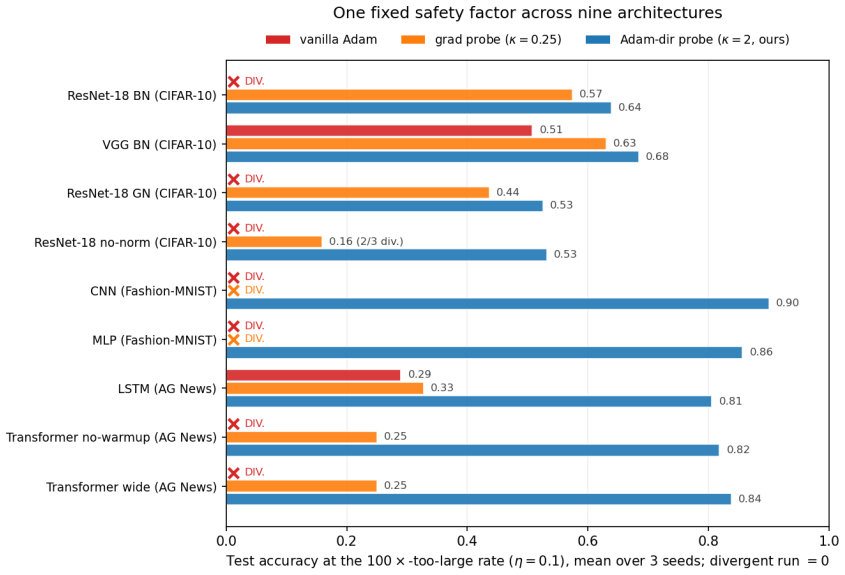
- Probing along Adam's preconditioned direction with the single fixed κ=2 avoids divergence on nine architectures and across the full learning-rate grids of four benchmarks, and transfers unchanged to AdamW.
- Periodic in-training probing adds no robust benefit; the one-shot init probe is the component that generalises.
- Gradient-norm clipping does not rescue Adam from a too-large initial rate, because the 1/√v amplification happens after clipping.
Where Pith is reading between the lines
- The AG News result suggests that on architectures whose stable learning-rate range sits far below the initial Armijo step, the fixed cap degrades from a full rescue to a pure divergence safeguard; a practical deployment might combine the fixed cap with a one-time sweep to detect such regimes.
- The measurement claim implies the same probe could be attached to other adaptive optimisers whose first-step direction differs from Adam's; the paper leaves such optimisers untested, but the direction-matched construction is optimiser-agnostic in principle.
- Because the probe reading saturates at α=1 on flat regions, its use as an online diagnostic is range-limited; a refined probe could use a finer backtracking factor near saturation to extend the readable curvature range.
Editorial analysis
A structured set of objections, weighed in public.
Referee Report
Summary. The paper makes two related claims. First, a measurement claim: a single Armijo backtracking line search, run on one mini-batch, returns a step size α whose reciprocal brackets the directional curvature q_d = d^T H d / (-g^T d) along the probed direction within a multiplicative band set by the backtracking factor; empirically, log α tracks log λ_1 with Pearson correlation −0.91 to −0.95 across CIFAR-10/ResNet-18, Fashion-MNIST/CNN, and Imagenette/ResNet-18. Second, a rescue claim: using this probe once at initialization to cap Adam's learning rate at κ·ᾱ makes Adam robust to initial learning rates spanning 10^{-3} to 3.0, with a raw-gradient variant requiring per-architecture κ and a direction-matched variant, probing along Adam's preconditioned direction d ≈ −sign(g), claimed to need only a single fixed κ = 2 across nine architectures and four benchmarks, including transfer to AdamW. The paper is explicit that the fix is a safeguard, not a faster optimizer, and that the direction-matched cap on AG News is 'a divergence safeguard only'.
Significance. If the measurement claim stands, it is a genuinely useful and low-cost diagnostic: the derivation in Section 5 is elementary and correct, the empirical correlations are reported with seed statistics and p-values, and the honest treatment of limitations (including the AG News counterexample) is a strength. The practical rescue claim is more fragile. The fixed κ = 2 is chosen from a sweep over the same architectures on which it is then validated, and the paper's own Table 7 shows that on AG News the fixed cap prevents divergence but leaves training at chance level. Thus the 'calibration-free safeguard' is at best a divergence-prevention mechanism on that benchmark, not a learning-preserving rescue. The measurement contribution is publishable; the rescue claim needs either sharp qualification or additional validation before the abstract-level claim is supportable.
major comments (3)
- [Section 5, Table 7] Table 7 (final block) is direct counterevidence to the abstract's 'calibration-free safeguard' claim. At fixed κ=2, the direction-matched probe gives 0.250 (chance) for every η ≥ 10^{-2} on AG News, and the text concedes 'the fixed cap is a divergence safeguard only'. Thus the method does not preserve learning on one of the four benchmarks; 'robust to a too-large initial learning rate across ... all four benchmarks' is too strong. Either replace the central claim with a divergence-safety claim on this architecture or provide a mechanism that also keeps the run productive.
- [Section 5, Table 10] The recommended κ=2 is selected from a safety-factor sweep over the same nine architectures on which the transfer claim is then tested (Table 9, Figure 6). This is training-set model selection, not a parameter-free constant. The claim 'single fixed safety factor κ=2 ... across every architecture we test' is therefore not a prediction. Please report a held-out split (e.g., choose κ on four architectures, then evaluate on five unseen ones) or state explicitly that κ is a global hyperparameter tuned on the test architectures.
- [Algorithm 1, step 15] The rescue mechanism assumes η_max,productive ≈ κ·ᾱ_dm with a universal κ, but the paper never reports ᾱ_dm or the actual cap values per architecture. The raw-gradient numbers show the conversion varies by roughly 30×: CIFAR ᾱ≈0.06 with stable η≈0.024; Fashion-MNIST ᾱ=1 with stable η≈0.01; AG News ᾱ≈0.031 with stable η≈3×10^{-3}. AG News (Table 7, κ=2) shows the direction-matched cap can land in the stable-but-unproductive band, so the proportionality is not established for productive training. Report ᾱ_dm per architecture and test the proportionality directly.
minor comments (5)
- [Section 3, Algorithm 1] The Armijo constant c is not given a numerical value; specify it (e.g., c = 10^{-4}) alongside β = 1/2 and K = 8, since the derived band depends on c through 2(1−c).
- [Section 5, Table 2 and mechanism runs] The text states 73% of active probe points fall inside the predicted band in the mechanism runs, while Table 2 reports 86% in band at β=0.5. Clarify whether these summarize different subsets or experiments.
- [Section 5, Table 9] Table 9 headlines a single fixed κ=3, while the recommended recipe is κ=2 from Table 10. The final claim would be easier to audit if the main transfer table used the recommended κ=2 and presented κ=3 only as a sensitivity check.
- [Figure 1] The fitted slope on CIFAR-10 is 1.46, while Fashion-MNIST and Imagenette are near 1.0. The text calls this a 'unit-slope law with a constant offset'; explain the residual slope discrepancy or soften the wording.
- [Abstract and Title] The term 'calibration-free' is used for a recipe whose κ=2 is globally tuned on the test architectures. Consider replacing it with 'per-architecture calibration-free' or 'fixed safety factor' to avoid the impression that no hyperparameter selection is involved.
Circularity Check
The 'calibration-free' direction-matched safeguard uses a κ=2 selected by a sweep over exactly the nine architectures on which its zero-divergence success is then reported; the measurement claim (Armijo band, α–λ1 correlation) is self-contained.
specific steps
-
fitted input called prediction
[Section 5 (Tables 9–10 and surrounding text) and Abstract]
"Both failures occur on a plain MLP at the100×-too-large rate, and a sweep of the safety factor (Table 10) removes them: κ = 2 and even κ = 1 give zero divergences in all54runs at no accuracy cost, so we recommend κ = 2 as the less intrusive of the two divergence-free settings. ... Abstract: 'a single fixed safety factor κ = 2 avoids divergence on all nine architectures we test and across the full learning-rate grids of all four benchmarks'"
The 'calibration-free' headline is the output of the same sweep that fixes the parameter: Table 10 evaluates κ ∈ {1,2,3} over the same nine architectures × two rates, and κ=2 is chosen because it gives zero divergences in all 54 runs; the Abstract then reports that same zero-divergence property as an empirical finding for κ=2 on those nine architectures. The prediction is statistically forced by the fit — validation is performed on the tuning set. The only κ with a nominal holdout description (κ=3, 'chosen on four architectures and held out on five unseen ones') actually failed on the held-out MLP and is abandoned; κ=2 receives no independent held-out validation. The measurement claim (Section 5 band derivation and the α–λ1 correlation) is independent and unaffected.
full rationale
The band derivation (Section 5: an Armijo-accepted backtracking step satisfies βα* < α ≤ α*, hence 1/α brackets q_d within the 1/β band) is a self-contained mathematical consequence of the sufficient-decrease condition; testing it against q measured on the same batch is a sanity check, not circularity. The α–λ1 correlation is an external empirical measurement against Lanczos eigenvalues, parameter-free and falsifiable, so it does not depend on κ. The circularity is confined to the rescue claim's calibration-free variant: the recommended fixed κ=2 is selected from Table 10's sweep over exactly the nine architectures on which the paper then reports zero divergences, so the headline 'κ=2 avoids divergence on all nine architectures' is the fit objective restated as a result. The paper is transparent about the raw-gradient probe needing calibration, and it discloses the AG News plateau, so there is independent content in the full-grid and AdamW checks. Nevertheless, the central 'no calibration' claim reduces, in its nine-architecture evidence, to parameter selection on the evaluation set, giving partial circularity (score 6 rather than 8; the measurement claim keeps the paper from collapsing entirely).
Axiom & Free-Parameter Ledger
free parameters (3)
- raw-gradient safety factor κ =
0.25 (CIFAR-10), 0.005 (Fashion-MNIST), 0.05 (AG News)
- direction-matched safety factor κ =
2
- q/λ1 alignment ratio =
≈0.63
axioms (4)
- domain assumption Loss is locally quadratic around the probe point so the second-order expansion is exact
- domain assumption The largest stable Adam learning rate is proportional to the Armijo-accepted step at initialization
- domain assumption Gradient alignment with the top Hessian eigenvector is roughly constant (q ≈ 0.63 λ1)
- domain assumption Adam's first update direction is well approximated by −sign(g)
read the original abstract
The local sharpness of the loss, the top Hessian eigenvalue $\lambda_1$, determines the largest stable gradient step, but measuring it normally requires Lanczos or Hessian-vector iterations. We observe that a single Armijo backtracking line search already carries this information at the cost of a few forward passes: the accepted step $\alpha$ brackets the \emph{directional} curvature $q = g^\top H g/\|g\|^2$ within the multiplicative band set by the backtracking factor. Across CIFAR-10, Fashion-MNIST and Imagenette, $\log\alpha$ tracks $\log\lambda_1$ at Pearson $-0.91$ to $-0.95$, giving a low-cost online Edge-of-Stability reading. Used once at initialisation, this measurement yields a learning-rate cap (a safeguard, not a faster optimiser) that makes Adam robust to a too-large initial learning rate across more than three orders of magnitude ($10^{-3}$ to $3.0$), at about one percent overhead, and it is a no-op when the chosen rate is already safe. One probe is enough: periodic in-training probing adds no robust benefit. The raw-gradient probe exposes the mechanism but needs a safety factor calibrated to the architecture by a one-minute divergence sweep. Probing along Adam's own update direction removes this calibration: a single fixed safety factor $\kappa = 2$ avoids divergence on all nine architectures we test and across the full learning-rate grids of all four benchmarks, and the recipe transfers to AdamW unchanged.
Figures


Reference graph
Works this paper leans on
-
[1]
Why Warmup the Learning Rate? Underlying Mechanisms and Improvements
Dayal Singh Kalra and Maissam Barkeshli. Why Warmup the Learning Rate? Underlying Mechanisms and Improvements. InAdvances in Neural Information Processing Systems (NeurIPS), 2024.https://doi.org/10.48550/arXiv.2406.09405
-
[2]
Miller, and Michael Shvartsman
Dayal Singh Kalra, Jean-Christophe Gagnon-Audet, Andrey Gromov, Ishita Mediratta, Kelvin Niu, Alexander H. Miller, and Michael Shvartsman. A Scalable Measure of Loss Landscape Curvature for Analyzing the Training Dynamics of LLMs.arXiv preprint arXiv:2601.16979, 2026
arXiv 2026
-
[3]
Diederik P. Kingma and Jimmy Ba. Adam: A Method for Stochastic Optimization. In International Conference on Learning Representations (ICLR), 2015.https://doi.org/10. 48550/arXiv.1412.6980
-
[4]
Decoupled Weight Decay Regularization
Ilya Loshchilov and Frank Hutter. Decoupled Weight Decay Regularization. InInternational Conference on Learning Representations (ICLR), 2019.https://openreview.net/forum?id= Bkg6RiCqY7
2019
-
[5]
Incorporating Nesterov Momentum into Adam
Timothy Dozat. Incorporating Nesterov Momentum into Adam. InICLR Workshop Track, 2016.https://openreview.net/forum?id=OM0jvwB8jIp57ZJjtNEZ
2016
-
[6]
Reddi, Satyen Kale, and Sanjiv Kumar
Sashank J. Reddi, Satyen Kale, and Sanjiv Kumar. On the Convergence of Adam and Beyond. InInternational Conference on Learning Representations (ICLR), 2018. https: //openreview.net/forum?id=ryQu7f-RZ
2018
-
[7]
Lecture 6.5—RMSProp: Divide the Gradient by a Running Average of Its Recent Magnitude.Neural Networks for Machine Learning, Coursera, 2012
Tijmen Tieleman and Geoffrey Hinton. Lecture 6.5—RMSProp: Divide the Gradient by a Running Average of Its Recent Magnitude.Neural Networks for Machine Learning, Coursera, 2012
2012
-
[8]
Leslie N. Smith. Cyclical Learning Rates for Training Neural Networks. InIEEE Winter Conference on Applications of Computer Vision (WACV), pages 464–472, 2017.https://doi. org/10.1109/WACV.2017.58
-
[9]
Leslie N. Smith and Nicholay Topin. Super-Convergence: Very Fast Training of Neural Networks Using Large Learning Rates. InArtificial Intelligence and Machine Learning for Multi-Domain Operations Applications (Proceedings of SPIE, volume 11006), article 1100612, 2019.https://doi.org/10.1117/12.2520589
-
[10]
SGDR: Stochastic Gradient Descent with Warm Restarts
Ilya Loshchilov and Frank Hutter. SGDR: Stochastic Gradient Descent with Warm Restarts. InInternational Conference on Learning Representations (ICLR), 2017.https://openreview. net/forum?id=Skq89Scxx
2017
-
[11]
Priya Goyal, Piotr Dollár, Ross Girshick, Pieter Noordhuis, Łukasz Wesolowski, Aapo Kyrola, Andrew Tulloch, Yangqing Jia, and Kaiming He. Accurate, Large Minibatch SGD: Training ImageNet in 1 Hour.arXiv preprint arXiv:1706.02677, 2017.https://doi.org/10.48550/ arXiv.1706.02677
-
[12]
Minimization of Functions Having Lipschitz Continuous First Partial Derivatives
Larry Armijo. Minimization of Functions Having Lipschitz Continuous First Partial Derivatives. Pacific Journal of Mathematics, 16(1):1–3, 1966.https://doi.org/10.2140/pjm.1966.16.1 23
-
[13]
Laradji, Mark Schmidt, Gauthier Gidel, and Simon Lacoste-Julien
Sharan Vaswani, Aaron Mishkin, Issam H. Laradji, Mark Schmidt, Gauthier Gidel, and Simon Lacoste-Julien. Painless Stochastic Gradient: Interpolation, Line-Search, and Con- vergence Rates. InAdvances in Neural Information Processing Systems (NeurIPS), volume 32, pages 3727–3740, 2019. https://proceedings.neurips.cc/paper_files/paper/2019/ hash/2557911c1bf7...
arXiv 2019
-
[14]
Laradji, and Simon Lacoste-Julien
Nicolas Loizou, Sharan Vaswani, Issam H. Laradji, and Simon Lacoste-Julien. Stochastic Polyak Step-size for SGD: An Adaptive Learning Rate for Fast Convergence. InInternational Conference on Artificial Intelligence and Statistics (AISTATS), volume 130 ofProceedings of Machine Learning Research, pages 1306–1314, 2021.https://proceedings.mlr.press/v130/ loi...
2021
-
[15]
Parabolic Approximation Line Search for DNNs
Maximus Mutschler and Andreas Zell. Parabolic Approximation Line Search for DNNs. InAdvances in Neural Information Processing Systems (NeurIPS), volume 33, pages 5405–5416, 2020. https://proceedings.neurips.cc/paper_files/paper/2020/ hash/3a30be93eb45566a90f4e95ee72a089a-Abstract.html
2020
-
[16]
Cohen, Simran Kaur, Yuanzhi Li, J
Jeremy M. Cohen, Simran Kaur, Yuanzhi Li, J. Zico Kolter, and Ameet Talwalkar. Gradient Descent on Neural Networks Typically Occurs at the Edge of Stability. InInternational Conference on Learning Representations (ICLR), 2021.https://openreview.net/forum?id= jh-rTtvkGeM
2021
-
[17]
Aitor Lewkowycz, Yasaman Bahri, Ethan Dyer, Jascha Sohl-Dickstein, and Guy Gur-Ari. The Large Learning Rate Phase of Deep Learning: The Catapult Mechanism.arXiv preprint arXiv:2003.02218, 2020.https://doi.org/10.48550/arXiv.2003.02218
-
[18]
Alex Damian, Eshaan Nichani, and Jason D. Lee. Self-Stabilization: The Implicit Bias of Gradi- ent Descent at the Edge of Stability. InInternational Conference on Learning Representations (ICLR), 2023.https://openreview.net/forum?id=nhKHA59gXz
2023
-
[19]
Zhewei Yao, Amir Gholami, Kurt Keutzer, and Michael W. Mahoney. PyHessian: Neural Networks Through the Lens of the Hessian. InIEEE International Conference on Big Data, pages 581–590, 2020.https://doi.org/10.1109/BigData50022.2020.9378171
arXiv 2020
-
[20]
On the Difficulty of Training Recurrent Neural Networks
Razvan Pascanu, Tomas Mikolov, and Yoshua Bengio. On the Difficulty of Training Recurrent Neural Networks. InInternational Conference on Machine Learning (ICML), volume 28 of Proceedings of Machine Learning Research, pages 1310–1318, 2013.https://proceedings. mlr.press/v28/pascanu13.html
2013
-
[21]
Learning-Rate-Free Learning by D-Adaptation
Aaron Defazio and Konstantin Mishchenko. Learning-Rate-Free Learning by D-Adaptation. InInternational Conference on Machine Learning (ICML), volume 202 ofProceedings of Machine Learning Research, pages 7449–7479, 2023.https://proceedings.mlr.press/v202/ defazio23a.html
2023
-
[22]
Prodigy: An Expeditiously Adaptive Parameter- Free Learner
Konstantin Mishchenko and Aaron Defazio. Prodigy: An Expeditiously Adaptive Parameter- Free Learner. InInternational Conference on Machine Learning (ICML), volume 235 of Proceedings of Machine Learning Research, pages 35779–35804, 2024.https://proceedings. mlr.press/v235/mishchenko24a.html
2024
-
[23]
Mechanic: A Learning Rate Tuner
Ashok Cutkosky, Aaron Defazio, and Harsh Mehta. Mechanic: A Learning Rate Tuner. InAdvances in Neural Information Processing Systems (NeurIPS), volume 36, pages 24 47828–47848, 2023. https://proceedings.neurips.cc/paper_files/paper/2023/hash/ 955499a8e2860ed746717c1374224c43-Abstract-Conference.html
2023
-
[24]
The Road Less Scheduled
Aaron Defazio, Xingyu Alice Yang, Harsh Mehta, Konstantin Mishchenko, Ahmed Khaled, and Ashok Cutkosky. The Road Less Scheduled. InAdvances in Neural Information Processing Systems (NeurIPS), volume 37, pages 9974– 10007, 2024. https://proceedings.neurips.cc/paper_files/paper/2024/hash/ 136b9a13861308c8948cd308ccd02658-Abstract-Conference.html
2024
-
[25]
Alexander Andreyev and Paolo Beneventano. Edge of Stochastic Stability: Revisiting the Edge of Stability for SGD.arXiv preprint arXiv:2412.20553, 2024.https://doi.org/10.48550/ arXiv.2412.20553
-
[26]
Stepping on the Edge: Curvature Aware Learning Rate Tuners
Vincent Roulet, Atish Agarwala, Jean-Bastien Grill, Grzegorz Swirszcz, Mathieu Blon- del, and Fabian Pedregosa. Stepping on the Edge: Curvature Aware Learning Rate Tuners. InAdvances in Neural Information Processing Systems (NeurIPS), volume 37, pages 47708–47740, 2024. https://proceedings.neurips.cc/paper_files/paper/2024/ hash/555479a201da27c97aaeed842d...
2024
-
[27]
Imagenette: A Smaller Subset of 10 Easily Classified Classes from ImageNet
Jeremy Howard. Imagenette: A Smaller Subset of 10 Easily Classified Classes from ImageNet. https://github.com/fastai/imagenette, 2019
2019
-
[28]
Understanding Gradient Descent on the Edge of Stability in Deep Learning
Sanjeev Arora, Zhiyuan Li, and Abhishek Panigrahi. Understanding Gradient Descent on the Edge of Stability in Deep Learning. InInternational Conference on Machine Learning (ICML), volume 162 ofProceedings of Machine Learning Research, pages 948–1024, 2022. https://proceedings.mlr.press/v162/arora22a.html A The negative result on the Golden-Section presele...
2022
discussion (0)
Sign in with ORCID, Apple, or X to comment. Anyone can read and Pith papers without signing in.