REVIEW 4 minor 55 references
Optimal detectors for TMSV reflectivity sensing switch structure at a threshold, and non-local Gaussian measurements nearly reach the quantum limit in noisy regimes.
Reviewed by Pith at T0; open to challenge. T0 means a machine referee read the full paper against a public rubric. the ladder, T0–T4 →
T0 review · grok-4.5
2026-07-11 22:15 UTC pith:Z7FKNBML
load-bearing objection Clean SLD analysis that turns known TMSV QFI into concrete receivers and a sharp measurement transition at η*=nr/(nr+1).
Detection methods for optimal target reflectivity estimation with two-mode squeezed vacuum probes
The pith
A machine-rendered reading of the paper's core claim, the machinery that carries it, and where it could break.
Core claim
For a TMSV probe in a thermal-loss channel the symmetric logarithmic derivative that saturates the quantum Fisher information undergoes a structural transition at η* = nr/(nr+1). Above this threshold a parametric-amplifier receiver followed by number-resolving detection is optimal; below it the optimal observables are two-mode squeezing generators. Suitable non-local Gaussian measurements closely approach the quantum Cramér-Rao bound in the large-noise limit, so near-optimal estimation remains achievable under realistic microwave constraints.
What carries the argument
The symmetric logarithmic derivative (SLD) of the zero-mean Gaussian output state, written as a quadratic form of the four quadratures; its eigenvalues and the sign of the coefficient c− mark the transition between parametric-amplifier and squeezing-generator regimes.
Load-bearing premise
The probe energy and thermal noise are treated as known constants, and the target is modelled as an ideal single-mode thermal-loss channel acting only on the signal; the optimal amplifier strength itself depends on the unknown reflectivity, so an adaptive protocol is required.
What would settle it
Measure the classical Fisher information of an optimized parametric-amplifier receiver versus the double-homodyne and adaptive hetero-homodyne schemes on either side of η* = nr/(nr+1) for fixed nr and nβ; a clear gap below threshold that closes above threshold would confirm the predicted transition.
If this is right
- In the high-reflectivity (reflectivity-dominated) regime a simple echo-style parametric amplifier followed by photon counting saturates the ultimate quantum limit.
- Local homodyne detection of a TMSV probe offers no entanglement advantage and can be beaten by a coherent-state probe at low reflectivity.
- Non-local Gaussian receivers already approach the quantum bound in the large-noise limit relevant to microwave radar and quantum illumination.
- The transition point η* also coincides with a crossover in how thermal noise affects the quantum Fisher information, giving a practical design rule for probe energy.
- Adaptive hetero-homodyne saturates the quantum limit in the deep quantum-illumination regime while non-local homodyne covers the complementary high-reflectivity noisy regime.
Where Pith is reading between the lines
- The same SLD transition structure should appear for any parameter of a Gaussian thermal-loss channel once the symplectic eigenvalues and the symplectic transformation exchange dominance.
- An adaptive loop that first estimates η coarsely with non-local homodyne and then fine-tunes the parametric-amplifier strength could make the optimal receiver practical without perfect prior knowledge.
- Because local Gaussian measurements are equivalent to a single-mode strategy, any claim of entanglement advantage in continuous-variable sensing must be checked against non-local Gaussian or non-Gaussian detection.
- The complementary coverage of non-local homodyne and adaptive hetero-homodyne suggests a hybrid receiver that switches mode according to a quick preliminary estimate of η could cover essentially the entire parameter space with near-optimal Gaussian measurements.
Editorial analysis
A structured set of objections, weighed in public.
Referee Report
Summary. The manuscript studies quantum and Gaussian precision limits for estimating target reflectivity η with a two-mode squeezed vacuum (TMSV) probe subject to a thermal-loss channel. It derives the quantum Fisher information (QFI, Eq. 21), the local-homodyne Fisher information (Eq. 22), and the symmetric logarithmic derivative (SLD) for the zero-mean Gaussian output state (Eqs. 30–34). The SLD exhibits a structural transition at η* = nr/(nr + 1): for η > η* a parametric-amplifier receiver followed by number-resolving detection saturates the QFI; at the transition a non-local double-homodyne measurement is optimal; for η < η* the optimal observables are two-mode squeezing generators. The authors further show that optimized non-local Gaussian measurements (PA-assisted non-local homodyne and adaptive hetero-homodyne) closely approach the quantum Cramér-Rao bound in large-noise regimes, while local homodyne does not. Asymptotic tables, symplectic-eigenvalue decompositions, and appendices A–G supply the supporting calculations.
Significance. The work supplies a complete, analytically transparent map of optimal and near-optimal detection strategies for TMSV-based reflectivity estimation across the full range of energy and loss parameters. The identification of the SLD transition at η* = nr/(nr + 1) and the demonstration that concrete non-local Gaussian receivers can nearly saturate the QFI under microwave-relevant constraints are of direct practical value for quantum illumination and microwave quantum radar. The derivations rest on standard Gaussian quantum estimation formulas, recover known QFI results, and are accompanied by closed-form expressions and numerical checks (Fig. 7), giving the claims a high degree of reproducibility and falsifiability.
minor comments (4)
- In Sec. IV A 1 the authors note that the optimal PA receiver requires knowledge of rs(η). A short quantitative estimate of the number of adaptive iterations needed to reach a given fraction of the QFI would strengthen the practical discussion.
- Fig. 7 panels (a–d) would be clearer if the vertical axes were labeled uniformly as CRB (I^{-1}) and if the crossover points between local and non-local strategies were marked explicitly.
- Table I, second row: the expression for Ih,local as η → 1 is written as s(nr,nβ) + (n_r^{2} + nr)/nr; a brief parenthetical definition of s would improve readability.
- A few typographical inconsistencies appear (e.g., “Cram´er-Rao” vs. “Cramér-Rao”, occasional missing spaces after commas in equations). A light copy-edit pass would remove them.
Circularity Check
No significant circularity: QFI, SLD transition, and Gaussian FIs are derived directly from the model covariance matrix via standard formulas, without fitted parameters or load-bearing self-citations that force the claims.
full rationale
The paper's central results follow by direct calculation from the TMSV-plus-thermal-loss covariance matrix (Eq. 6). The QFI (Eq. 21) is obtained by substituting into the standard Gaussian formula (Eq. 16); it matches an independent prior result [12] but is re-derived here. The SLD (Eq. 20) yields the quadratic form (Eqs. 30–34) whose coefficient sign change at η*=nr/(nr+1) is an algebraic consequence of comparing nr to nη, not a definition that presupposes the transition. Optimal-measurement interpretations (PA receiver for η>η*, squeezing generators for η<η*, double homodyne at equality) follow immediately from rewriting that quadratic form; the adaptive caveat for realizing the PA receiver is explicitly noted rather than hidden. Local-homodyne, non-local-homodyne, and adaptive hetero-homodyne FIs (Eqs. 22, 41, 45) are likewise obtained by projecting the same covariance matrix and optimizing over free parameters; their asymptotic agreement with the QFI in the large-noise limit is verified analytically and numerically. No parameters are fitted to data and then re-presented as predictions; no uniqueness theorem is imported from the authors' own prior work to forbid alternatives; citations to external literature supply standard tools (Gaussian QFI/SLD, entanglement criteria) rather than load-bearing premises that circularly force the new structural transition. The derivation is therefore self-contained against its own inputs.
Axiom & Free-Parameter Ledger
axioms (4)
- domain assumption The target interaction is an ideal single-mode thermal-loss channel acting only on the signal mode (Eq. 5).
- domain assumption nr (probe energy) and nβ (thermal occupation) are known exactly; only η is unknown.
- standard math Symmetric logarithmic derivative and Gaussian QFI formulas of Braunstein–Caves / Gao–Lee apply to zero-mean Gaussian states (Eqs. 16–20).
- domain assumption Microwave platforms are effectively restricted to Gaussian measurements.
read the original abstract
Target reflectivity estimation using a two-mode squeezed vacuum (TMSV) probe offers a theoretical advantage over classical schemes, but realizing this potential under the measurement constraints of microwave platforms remains a central challenge. In this work, we study the precision limits for target reflectivity estimation across different energy and loss regimes, while accounting for realistic measurement restrictions. We characterize the optimal measurements and identify a transition in their structure: above a specific reflectivity threshold, a parametric amplifier receiver is optimal, whereas below it, the optimal observables are two-mode squeezing generators. We then study the performance of Gaussian measurements. When restricted to standard local homodyne detection, the TMSV probe is highly non-optimal. However, we show that suitable non-local Gaussian measurements can closely approach the quantum Cram\'er-Rao bound at the large noise limit. These results demonstrate that near-optimal quantum target reflectivity estimation is achievable in various relevant noisy regimes, even under the restriction of Gaussian measurements.
Figures





Reference graph
Works this paper leans on
-
[1]
This behavior is illustrated in Fig
Dependence onn r As expected, bothIandI h,local grow monotonically withn r: increasing the photon number (or squeezing) yields more information. This behavior is illustrated in Fig. 3(a-b). Specifically, for sufficiently largen r, we get I ≈ 1 η(1−η)(1 + 2n β) nr,(23) andI h,local = 1 2 I. Consequently, both quantities diverge asn r → ∞. Fig. 3(b) shows t...
-
[2]
3(c), where we plot bothIandI h,local as functions ofη
Dependence onη The dependence on reflectivity is illustrated in Fig. 3(c), where we plot bothIandI h,local as functions ofη. It is evident thatI → ∞in both the low (Eq. (25)) and high (Eq. (24)) reflectivity limits. However, the behavior ofIdiffers significantly between these two regimes. In the high reflectivity limit,Idi- verges for every choice ofn β a...
-
[3]
At the crossover, the QFI is independent ofn β and equals toI= 1/(1−η) 2 .A similar crossover appears also for Ih,local at a different point
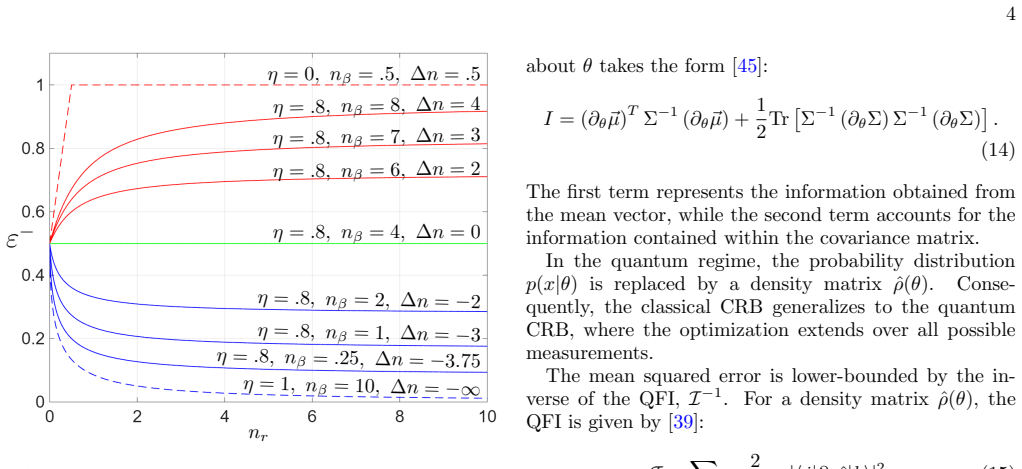
Dependence onn β The effect ofn β depends on the regime set byn r and η.The pointn r =n η marks a crossover: Forn r > n η, increasingn β lowers the QFI, while forn r < n η,the effect is the opposite: the QFI is increased withn β. At the crossover, the QFI is independent ofn β and equals toI= 1/(1−η) 2 .A similar crossover appears also for Ih,local at a di...
-
[4]
To show this, we observe that the SLD can be mapped to the total number operator through a parametric- amplifier transformation
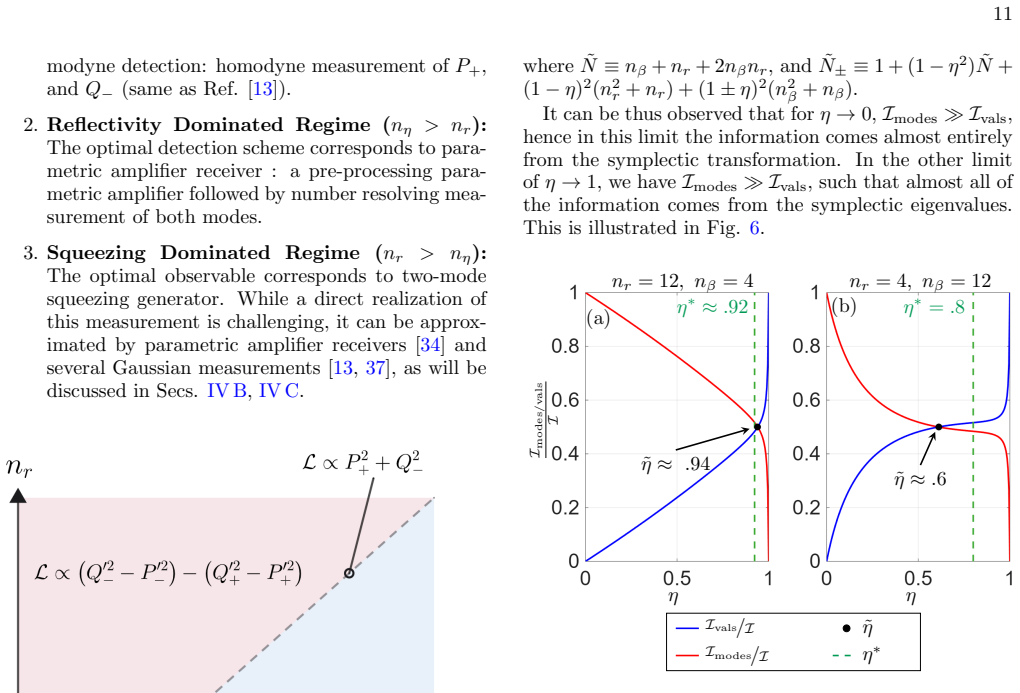
Reflectivity Dominated Regime (η > η ∗) In this regime, the optimal observableLcan be realized by applying a parametric amplifier followed by photon number resolving measurements. To show this, we observe that the SLD can be mapped to the total number operator through a parametric- amplifier transformation. In the Heisenberg picture, the action of the par...
-
[5]
The spectrum of this SLD is continuous, and thus in principle cannot be realized by a Gaussian unitary followed by a number re- solving measurement of the modes
Squeezing Dominated Regime(η < η ∗) The SLD in this regime can be written asL ∝ e2rs P 2 + +Q 2 − −e −2rs P 2 − +Q 2 + , hence defining the squeezed quadraturesP ′ ± =e ±2rs P±,Q ′ ± =e ∓2rs Q±, the SLD reduces to L ∝ Q′2 − −P ′2 − − Q′2 + −P ′2 + .(38) The optimal observable thus corresponds to the squeez- ing generators of the ˆa ′ +,ˆa′ − modes. The sp...
-
[6]
Sincec − = 0 we obtain from Eq
Transition point (η=η ∗) The transition point is given byc − = 0, or equivalently η=η ∗. Sincec − = 0 we obtain from Eq. (33) that the SLD reduces to: L ∝c + P 2 + +Q 2 − .(39) The information is thus entirely contained in theP + andQ − quadratures. Since these operators commute ([P+, Q−] = 0), the optimal strategy consists of simul- taneous measurements ...
-
[7]
S. Lloyd, Enhanced sensitivity of photodetection via quantum illumination, Science321, 1463 (2008), https://www.science.org/doi/pdf/10.1126/science.1160627
-
[8]
Barzanjeh, S
S. Barzanjeh, S. Guha, C. Weedbrook, D. Vitali, J. H. Shapiro, and S. Pirandola, Microwave quantum illumina- tion, Phys. Rev. Lett.114, 080503 (2015). 19
2015
-
[9]
S.-H. Tan, B. I. Erkmen, V. Giovannetti, S. Guha, S. Lloyd, L. Maccone, S. Pirandola, and J. H. Shapiro, Quantum illumination with gaussian states, Physical re- view letters101, 253601 (2008)
2008
-
[10]
Monras and M
A. Monras and M. G. A. Paris, Optimal quantum esti- mation of loss in bosonic channels, Phys. Rev. Lett.98, 160401 (2007)
2007
-
[11]
Spedalieri and S
G. Spedalieri and S. Pirandola, Optimal squeezing for quantum target detection, Phys. Rev. Res.3, L042039 (2021)
2021
-
[12]
G. S. Agarwal and L. Davidovich, Quantifying quantum- amplified metrology via fisher information, Phys. Rev. Res.4, L012014 (2022)
2022
-
[13]
J. Wang, R. L. d. M. Filho, G. S. Agarwal, and L. Davi- dovich, Quantum advantage of time-reversed ancilla- based metrology of absorption parameters, Phys. Rev. Res.6, 013034 (2024)
2024
-
[14]
Nair and M
R. Nair and M. Gu, Fundamental limits of quantum illu- mination, Optica7, 771 (2020)
2020
-
[15]
M. Sanz, U. Las Heras, J. J. Garc´ ıa-Ripoll, E. Solano, and R. Di Candia, Quantum estimation methods for quantum illumination, Phys. Rev. Lett.118, 070803 (2017)
2017
-
[16]
Zhang, X
S. Zhang, X. Zou, J. Shi, J. Guo, and G. Guo, Quantum illumination in the presence of photon loss, Phys. Rev. A 90, 052308 (2014)
2014
-
[17]
S.-i. Park, C. Noh, and C. Lee, Quantum loss sensing with two-mode squeezed vacuum state under noisy and lossy environment, Scientific Reports13, 5936 (2023)
2023
-
[18]
Jonsson and R
R. Jonsson and R. Di Candia, Gaussian quantum esti- mation of the loss parameter in a thermal environment, Journal of Physics A: Mathematical and Theoretical55, 385301 (2022)
2022
-
[19]
Y. Jo, S. Lee, Y. S. Ihn, Z. Kim, and S.-Y. Lee, Quantum illumination receiver using double homodyne detection, Phys. Rev. Res.3, 013006 (2021)
2021
-
[20]
Zhong, D.-Q
W. Zhong, D.-Q. Wang, W.-Y. Zhu, L. Zhou, M.-M. Du, and Y.-B. Sheng, Relation between quantum illumination and quantum parameter estimation, Physical Review A 111, 052440 (2025)
2025
-
[21]
Kamble, J
M. Kamble, J. Wang, and G. S. Agarwal, Quantum metrology of absorption and gain parameters using two- mode bright squeezed light, Phys. Rev. A109, 053715 (2024)
2024
-
[23]
Norouzi, S
M. Norouzi, S. M. Hosseiny, and J. Seyed-Yazdi, An ar- ray of two jpas in a quantum two-mode squeezed radar, Scientific Reports15, 7696 (2025)
2025
-
[24]
Y. Tao, X. Li, L. Li, J. Huang, H. Li, T. Wang, L. Zhou, and G. Zeng, Surpassing the quantum limit in bosonic loss estimation without quantum probes, Phys. Rev. Lett.133, 060801 (2024)
2024
-
[25]
G. Y. Tham, R. Nair, and M. Gu, Quantum limits of covert target detection, Physical Review Letters133, 110801 (2024)
2024
-
[26]
S. Ng, S. Z. Ang, T. A. Wheatley, H. Yonezawa, A. Furu- sawa, E. H. Huntington, and M. Tsang, Spectrum anal- ysis with quantum dynamical systems, Physical Review A93, 042121 (2016)
2016
-
[27]
Tsang, Quantum noise spectroscopy as an incoherent imaging problem, Physical Review A107, 012611 (2023)
M. Tsang, Quantum noise spectroscopy as an incoherent imaging problem, Physical Review A107, 012611 (2023)
2023
-
[28]
H. Shi and Q. Zhuang, Ultimate precision limit of noise sensing and dark matter search, npj Quantum Informa- tion9, 10.1038/s41534-023-00693-w (2023)
-
[29]
J. W. Gardner, T. Gefen, S. A. Haine, J. J. Hope, J. Preskill, Y. Chen, and L. McCuller, Stochastic wave- form estimation at the fundamental quantum limit, PRX Quantum6, 030311 (2025)
2025
-
[30]
H. Shi, A. J. Brady, W. G´ orecki, L. Maccone, R. Di Can- dia, and Q. Zhuang, Quantum-enhanced dark matter de- tection with in-cavity control: mitigating the rayleigh curse, npj Quantum Information11, 48 (2025)
2025
-
[31]
Adesso, F
G. Adesso, F. Dell’Anno, S. De Siena, F. Illuminati, and L. Souza, Optimal estimation of losses at the ultimate quantum limit with non-gaussian states, Physical Review A—Atomic, Molecular, and Optical Physics79, 040305 (2009)
2009
-
[32]
Nair, Quantum-limited loss sensing: Multiparame- ter estimation and bures distance between loss channels, Physical Review Letters121, 230801 (2018)
R. Nair, Quantum-limited loss sensing: Multiparame- ter estimation and bures distance between loss channels, Physical Review Letters121, 230801 (2018)
2018
-
[33]
J. W. Gardner, S. A. Haine, J. J. Hope, Y. Chen, and T. Gefen, Lindblad estimation with fast and precise quantum control, Physical Review Applied24, 044055 (2025)
2025
-
[34]
G´ orecki, F
W. G´ orecki, F. Albarelli, S. Felicetti, R. Di Candia, and L. Maccone, Interplay between time and energy in bosonic noisy quantum metrology, PRX Quantum6, 020351 (2025)
2025
-
[35]
J. W. Gardner, T. Gefen, and M. Fadel, Stochastic signal sensing with finite energy and dead time at the funda- mental quantum limit, arXiv preprint arXiv:2606.18133 (2026)
Pith/arXiv arXiv 2026
-
[36]
Eddins, S
A. Eddins, S. Schreppler, D. M. Toyli, L. S. Martin, S. Hacohen-Gourgy, L. C. G. Govia, H. Ribeiro, A. A. Clerk, and I. Siddiqi, Stroboscopic qubit measurement with squeezed illumination, Phys. Rev. Lett.120, 040505 (2018)
2018
-
[37]
W. Qin, A. Miranowicz, and F. Nori, Exponentially improved dispersive qubit readout with squeezed light, Phys. Rev. Lett.133, 233605 (2024)
2024
-
[38]
Z. Gong, C. N. Gagatsos, S. Guha, and B. A. Bash, Fun- damental limits of loss sensing over bosonic channels, in 2021 IEEE Int. Symp. Inf. Theory (ISIT) (IEEE, 2021) pp. 1182–1187
2021
-
[39]
Bradshaw, L
M. Bradshaw, L. O. Conlon, S. Tserkis, M. Gu, P. K. Lam, and S. M. Assad, Optimal probes for continuous- variable quantum illumination, Physical Review A103, 062413 (2021)
2021
-
[40]
S. Guha and B. I. Erkmen, Gaussian-state quantum- illumination receivers for target detection, arXiv preprint arXiv:0911.0950 (2009)
Pith/arXiv arXiv 2009
-
[41]
Zhuang, Z
Q. Zhuang, Z. Zhang, and J. H. Shapiro, Opti- mum mixed-state discrimination for noisy entanglement- enhanced sensing, Physical review letters118, 040801 (2017)
2017
-
[42]
H. Shi, B. Zhang, and Q. Zhuang, Fulfilling entangle- ment’s optimal advantage via converting correlation to coherence, in CLEO: Fundamental Science (Optica Pub- lishing Group, 2023) pp. FTh4A–6
2023
-
[43]
Reichert, Q
M. Reichert, Q. Zhuang, J. H. Shapiro, and R. Di Candia, Quantum illumination with a hetero-homodyne receiver and sequential detection, Physical Review Applied20, 014030 (2023)
2023
-
[44]
X. Gu, A. F. Kockum, A. Miranowicz, Y. xi Liu, and F. Nori, Microwave photonics with superconducting quantum circuits, Physics Reports718-719, 1 (2017), microwave photonics with superconducting quantum cir- 20 cuits
2017
-
[45]
S. L. Braunstein and C. M. Caves, Statistical distance and the geometry of quantum states, Physical Review Letters72, 3439 (1994)
1994
-
[46]
Gao and H
Y. Gao and H. Lee, Bounds on quantum multiple- parameter estimation with gaussian state, The European Physical Journal D68, 347 (2014)
2014
-
[47]
Williamson, On the algebraic problem concerning the normal forms of linear dynamical systems, American journal of mathematics58, 141 (1936)
J. Williamson, On the algebraic problem concerning the normal forms of linear dynamical systems, American journal of mathematics58, 141 (1936)
1936
-
[48]
A. Ferraro, S. Olivares, and M. G. Paris, Gaussian states in continuous variable quantum information, arXiv preprint quant-ph/0503237 (2005)
Pith/arXiv arXiv 2005
-
[49]
Weedbrook, S
C. Weedbrook, S. Pirandola, R. Garc´ ıa-Patr´ on, N. J. Cerf, T. C. Ralph, J. H. Shapiro, and S. Lloyd, Gaussian quantum information, Rev. Mod. Phys.84, 621 (2012)
2012
-
[50]
Adesso, A
G. Adesso, A. Serafini, and F. Illuminati, Extremal en- tanglement and mixedness in continuous variable sys- tems, Phys. Rev. A70, 022318 (2004)
2004
-
[51]
S. M. Kay, Statistical signal processing: estimation the- ory, Prentice Hall1, Chapter (1993)
1993
-
[52]
A. Monras, Phase space formalism for quantum estima- tion of gaussian states, arXiv preprint arXiv:1303.3682 (2013)
Pith/arXiv arXiv 2013
-
[53]
ˇSafr´ anek, A
D. ˇSafr´ anek, A. R. Lee, and I. Fuentes, Quantum param- eter estimation using multi-mode gaussian states, New Journal of Physics17, 073016 (2015)
2015
-
[54]
Bradshaw, S
M. Bradshaw, S. M. Assad, J. Y. Haw, S.-H. Tan, P. K. Lam, and M. Gu, Overarching framework between gaus- sian quantum discord and gaussian quantum illumina- tion, Physical Review A95, 022333 (2017)
2017
-
[55]
Assouly, R
R. Assouly, R. Dassonneville, T. Peronnin, A. Bienfait, and B. Huard, Quantum advantage in microwave quan- tum radar, Nature Physics19, 1418 (2023)
2023
-
[56]
Kruse, C
R. Kruse, C. S. Hamilton, L. Sansoni, S. Barkhofen, C. Silberhorn, and I. Jex, Detailed study of gaussian bo- son sampling, Physical Review A100, 032326 (2019)
2019
discussion (0)
Sign in with ORCID, Apple, or X to comment. Anyone can read and Pith papers without signing in.