REVIEW 3 major objections 7 minor 52 references
Internal hallucination signals extracted from LLM activations transfer across languages and domains for most models.
Reviewed by Pith at T0; open to challenge. T0 means a machine referee read the full paper against a public rubric. the ladder, T0–T4 →
T0 review · grok-4.5
2026-07-11 22:12 UTC pith:2Q66Y3Q5
load-bearing objection First clean transfer study of internal-state hallucination detectors across English/Arabic and two Arabic domains; results hold for most of six models once you accept the GPT-4o labels. the 3 major comments →
CrossHallu: Do Hallucination Signals Generalize Across Languages and Domains in Large Language Model's Internals?
The pith
A machine-rendered reading of the paper's core claim, the machinery that carries it, and where it could break.
Core claim
Internal-state hallucination signals from hidden states, attention patterns, and token probabilities transfer across languages and domains for most of the six evaluated LLMs. Cross-lingual success is governed by class separability within each language and by how well English and Arabic embeddings overlap; cross-domain transfer within Arabic is feasible yet asymmetric, with training on TruthfulQA Arabic transferring better to HalluScore than the reverse.
What carries the argument
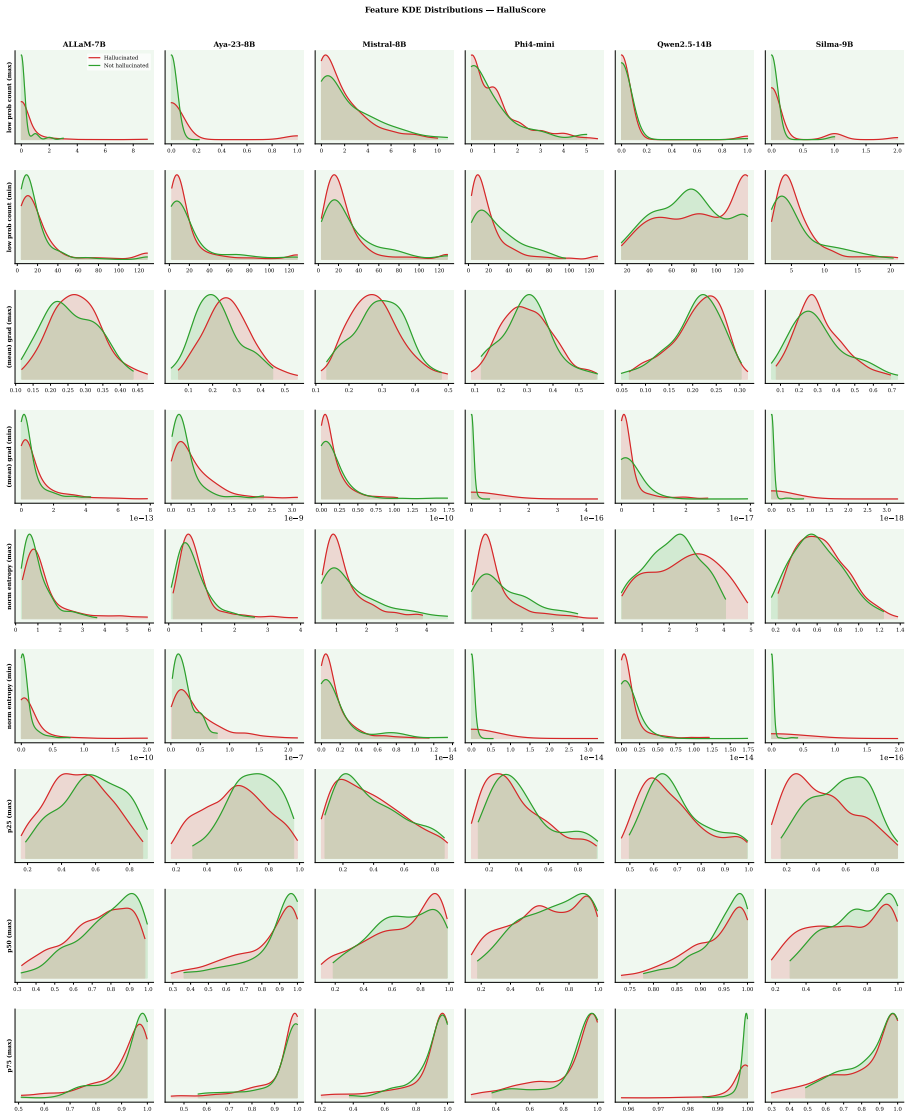
CrossHallu feature vectors: Wasserstein distances and cosine similarities between consecutive even/odd layers of hidden states and attention, plus eight token-probability statistics (min-of-max, max spread, normalized entropy, low-probability counts, mean gradient, and three percentiles), concatenated and fed to a three-layer MLP binary detector.
Load-bearing premise
The GPT-4o binary labels for English and Arabic answers are accurate enough that measured transfer reflects real internal-signal generalization rather than shared judge artifacts.
What would settle it
Replace the GPT-4o labels with a large human-verified set (or a second independent judge that agrees strongly with humans) for both languages and re-run every transfer experiment; if cross-lingual AUC-ROC collapses while monolingual scores stay high, the transfer claim is false.
If this is right
- A detector trained only on English internal states can be applied to Arabic generations for models whose English and Arabic embeddings already interleave.
- Training on a cleaner Arabic QA set can raise detection on a harder Arabic set, so data quality matters more than matching the exact target domain.
- Multilingual models with shared language-agnostic subspaces are better zero-shot monitoring candidates than Arabic-centric models.
- Combined language-plus-domain shift remains the hardest case, so production systems may still need light target calibration.
- The same internal features can diagnose how language-agnostic a model’s deeper layers actually are.
Where Pith is reading between the lines
- The same transfer protocol could probe whether other reliability signals (toxicity, bias) also live in shared subspaces without new labeled data.
- If late-layer cosine drops are the main discriminative cue, detectors could be restricted to upper layers only, cutting extraction cost.
- Extending the pair set beyond Arabic–English would likely show sharper transfer collapse once morphological or script distance breaks feature-space alignment.
- Asymmetric domain transfer implies that easier, cleaner hallucination corpora may be more valuable as source data than large noisy ones.
Editorial analysis
A structured set of objections, weighed in public.
Referee Report
Summary. CrossHallu is an empirical study of whether internal-state features used for hallucination detection (hidden-state and attention Wasserstein/cosine shifts plus token-probability statistics, following HalluShift) transfer across languages and domains. The authors evaluate six Arabic-capable LLMs on generative QA under monolingual baselines, English↔Arabic transfer on aligned TruthfulQA, Arabic cross-domain transfer (TruthfulQA-AR ↔ HalluScore), and combined language+domain transfer, reporting F1, AUC-ROC, and PR-AUC for a fixed three-layer MLP. They conclude that internal hallucination signals transfer for most models, that cross-lingual success tracks class separability and English–Arabic feature-space alignment (supported by t-SNE and layer-wise cosine trajectories), and that Arabic cross-domain transfer is asymmetric (Ar→HS often better than HS→Ar).
Significance. The paper fills a clear gap: internal-state hallucination detectors have been studied almost exclusively in English, while multilingual deployment and higher hallucination rates in lower-resource languages make transferability practically important. The experimental matrix cleanly isolates language shift, domain shift, and their combination; the public code, multi-model coverage, and supporting t-SNE / layer-wise analyses are genuine strengths. If the transfer patterns hold under more carefully validated labels and stricter normalization, the work would provide useful guidance on which model families support language-agnostic hallucination probes and on when training on a cleaner source domain helps a harder target. The contribution is primarily empirical and methodological rather than theoretical.
major comments (3)
- §4.4 Feature normalization: for cross-lingual (and by implication CL-CD) runs, a QuantileTransformer is “fit independently on the training and test feature sets.” Using test-set quantiles adapts the target representation with target statistics and is not pure zero-shot transfer of a detector trained only on the source. This choice is load-bearing for the central transfer claim in Table 1 (CL and CL-CD blocks). Please either (i) report the main numbers with a scaler fit only on the source/train features and applied to the target, or (ii) reframe those settings as unsupervised feature alignment / domain adaptation and add the pure-transfer numbers as the primary result. The monolingual StandardScaler protocol is fine.
- §3.2 and Appendix D: every F1/AUC number in Table 1 is defined against binary labels from a single GPT-4o judge (temperature 0, four rules, bilingual CoT prompts). There is no human agreement, multi-judge consensus, or even GPT-4o–BLEURT/human correlation on the Arabic subset, despite the paper’s own note that BLEURT is weak on Arabic and that TruthfulQA/HalluScore contain misconception and culturally nuanced items. This is the softest load-bearing premise for the transfer conclusions. At minimum, provide human validation (or multi-judge agreement) on a stratified subset of English and Arabic labels, report agreement statistics, and discuss residual language- or culture-dependent judge bias as a threat to interpreting “signal transfer.”
- Table 1 and §5 Cross-domain: HalluScore is introduced as “currently the only available Arabic dataset specifically designed for hallucination detection” and is authored by two of the present authors (Alansari & Luqman, 2026). Using predefined splits is appropriate, but the Ar→HS gains (e.g., Phi4-mini 57.19→72.59, Aya 80.37→86.90) and the asymmetry argument rest on treating HalluScore as an independent harder domain. Please add an explicit discussion of possible construction/overlap effects between TruthfulQA-style misconception items and HalluScore, and, if feasible, a small external Arabic QA set or a leave-one-category-out check so that cross-domain claims are not solely internal to the authors’ own benchmark.
minor comments (7)
- Table 1 header and caption: “1st, 2nd, 3rd best AUC-ROC per row” is stated but the manuscript text does not specify how ties or near-ties are broken; a short note would help.
- §3.1: the token-probability feature list mentions “max/min entropy, low-prob count, gradients, percentiles” in Figure 2 but the prose derives eight scalars from pmax/pmin; a single explicit feature-dimension table (per model if dimensions differ) would improve reproducibility.
- Figure 4 / Figure 6: layer-pair indices differ across models (different depths); stating L and the exact even/odd index sets per model in the caption or appendix would reduce ambiguity.
- §4.1: 772/817 TruthfulQA items retained after translation; a brief characterization of excluded items (categories, failure modes) would help assess selection bias in the bilingual subset.
- PR-AUC is repeatedly high due to class imbalance (§5); consider reporting positive-class prevalence per model/dataset in Table 1 or Appendix E so readers can calibrate F1/PR-AUC.
- Acknowledgments section still contains the ACL template boilerplate (“This document has been adapted by Steven Bethard…”); replace with actual acknowledgments or remove.
- Code link in the abstract points to github.com/aishaalansari57/CrossHal while Appendix C cites an anonymous.4open URL; align the public repository reference for the camera-ready version.
Circularity Check
No significant circularity; purely empirical transfer measurement with standard train/test splits and external baselines.
full rationale
The paper's central claims are empirical measurements of MLP detector performance (F1/AUC-ROC/PR-AUC) under monolingual, cross-lingual, cross-domain, and combined transfer settings on features extracted from six LLMs. Feature extraction follows the external HalluShift pipeline (hidden-state/attention Wasserstein+cosine, token-probability statistics); labels come from an independent GPT-4o judge under explicit rules; the detector is a standard three-layer MLP trained with BCE/Adam on fixed 75/25 or predefined splits. No equation, parameter, or decision boundary is defined in terms of the quantity later reported as a 'prediction' or 'transfer result.' HalluScore (co-authored by two of the present authors) is used only as one evaluation set with its published train/test split; it does not define the detector, the features, or the transfer metric. Self-citations to the authors' prior surveys and the HalluScore paper supply background and a dataset, not a uniqueness theorem or ansatz that forces the reported numbers. Once the (externally generated) labels are taken as given, every reported transfer score is an ordinary out-of-sample evaluation and does not reduce to its inputs by construction. Score 0 is therefore the correct assessment.
Axiom & Free-Parameter Ledger
free parameters (4)
- MLP hidden sizes / dropout / lr / epochs
- low-probability threshold τ
- layer-subsampling stride
- QuantileTransformer vs StandardScaler choice
axioms (3)
- domain assumption Distributional shifts in consecutive-layer hidden states, attention tensors, and token-probability statistics are informative of hallucination (inherited from HalluShift).
- domain assumption GPT-4o with the supplied bilingual CoT prompt produces labels that are sufficiently accurate for both English and Arabic to serve as ground truth.
- domain assumption The 772 retained TruthfulQA items after manual translation filtering remain distributionally comparable to the original English set.
read the original abstract
Recent hallucination detection techniques in large language models (LLMs) focus on directly extracting features from a model's internal representations and training a classifier on these features to detect hallucinations, demonstrating promising results. Notwithstanding this advancement, most internal-state hallucination detection techniques have been explored predominantly in English, raising the question of whether such internal signals generalize across different languages and domains. To address this gap, we present CrossHallu, the first study to evaluate the cross-lingual and cross-domain generalization of hallucination detection using internal representations from six LLMs on the generative question-answering task. We conduct a systematic Arabic <-> English evaluation using TruthfulQA, an Arabic translated version of TruthfulQA, and HalluScore. This evaluation encompasses monolingual training and testing, cross-lingual transfer, cross-domain transfer, and combined cross-lingual and cross-domain transfer. The results reveal that internal-state hallucination signals in LLMs transfer across languages and domains for most models, with cross-lingual performance highly dependent on both class separability and language alignment in the feature space, whereas cross-domain transfer within Arabic varies depending on the training and testing datasets used for the hallucination detector. The code is publicly available at https://github.com/aishaalansari57/CrossHal.
Figures


Reference graph
Works this paper leans on
-
[1]
Aho and Jeffrey D
Alfred V. Aho and Jeffrey D. Ullman , title =. 1972
1972
-
[2]
Publications Manual , year = "1983", publisher =
1983
-
[3]
Ashok K. Chandra and Dexter C. Kozen and Larry J. Stockmeyer , year = "1981", title =. doi:10.1145/322234.322243
-
[4]
Scalable training of
Andrew, Galen and Gao, Jianfeng , booktitle=. Scalable training of. 2007 , url=
2007
-
[5]
Dan Gusfield , title =. 1997
1997
-
[6]
Tetreault , title =
Mohammad Sadegh Rasooli and Joel R. Tetreault , title =. Computing Research Repository , volume =. 2015 , url =
2015
-
[7]
A Framework for Learning Predictive Structures from Multiple Tasks and Unlabeled Data , Volume =
Ando, Rie Kubota and Zhang, Tong , Issn =. A Framework for Learning Predictive Structures from Multiple Tasks and Unlabeled Data , Volume =. Journal of Machine Learning Research , Month = dec, Numpages =. 2005 , url=
2005
-
[8]
and Tukey, John W
Cooley, James W. and Tukey, John W. , journal=. An algorithm for the machine calculation of complex. 1965 , url=
1965
-
[9]
Proceedings of the 2024 Conference on Empirical Methods in Natural Language Processing , pages=
Leveraging large language models for NLG evaluation: Advances and challenges , author=. Proceedings of the 2024 Conference on Empirical Methods in Natural Language Processing , pages=
2024
-
[10]
ACM Transactions on Information Systems , volume=
A survey on hallucination in large language models: Principles, taxonomy, challenges, and open questions , author=. ACM Transactions on Information Systems , volume=. 2025 , publisher=
2025
-
[11]
arXiv preprint arXiv:2510.06265 , year=
Large language models hallucination: A comprehensive survey , author=. arXiv preprint arXiv:2510.06265 , year=
-
[12]
ACM computing surveys , volume=
Survey of hallucination in natural language generation , author=. ACM computing surveys , volume=. 2023 , publisher=
2023
-
[13]
Proceedings of the 58th annual meeting of the association for computational linguistics , pages=
On faithfulness and factuality in abstractive summarization , author=. Proceedings of the 58th annual meeting of the association for computational linguistics , pages=
-
[14]
Proceedings of the 2023 conference on empirical methods in natural language processing , pages=
Selfcheckgpt: Zero-resource black-box hallucination detection for generative large language models , author=. Proceedings of the 2023 conference on empirical methods in natural language processing , pages=
2023
-
[15]
Findings of the Association for Computational Linguistics: EMNLP 2023 , pages=
Hallucination detection for grounded instruction generation , author=. Findings of the Association for Computational Linguistics: EMNLP 2023 , pages=
2023
-
[16]
Proceedings of the 2024 Conference on Empirical Methods in Natural Language Processing , pages=
Lookback lens: Detecting and mitigating contextual hallucinations in large language models using only attention maps , author=. Proceedings of the 2024 Conference on Empirical Methods in Natural Language Processing , pages=
2024
-
[17]
Proceedings of the 2025 Conference on Empirical Methods in Natural Language Processing , pages=
A head to predict and a head to question: Pre-trained uncertainty quantification heads for hallucination detection in llm outputs , author=. Proceedings of the 2025 Conference on Empirical Methods in Natural Language Processing , pages=
2025
-
[18]
Proceedings of the 2025 Conference on Empirical Methods in Natural Language Processing , pages=
Attention-guided self-reflection for zero-shot hallucination detection in large language models , author=. Proceedings of the 2025 Conference on Empirical Methods in Natural Language Processing , pages=
2025
-
[19]
Proceedings of the 14th Joint Conference on Lexical and Computational Semantics (* SEM 2025) , pages=
Hallucinated Span Detection with Multi-View Attention Features , author=. Proceedings of the 14th Joint Conference on Lexical and Computational Semantics (* SEM 2025) , pages=
2025
-
[20]
arXiv preprint arXiv:2601.01552 , year=
HalluZig: Hallucination Detection using Zigzag Persistence , author=. arXiv preprint arXiv:2601.01552 , year=
-
[21]
2025 International Joint Conference on Neural Networks (IJCNN) , pages=
Hallushift: Measuring distribution shifts towards hallucination detection in llms , author=. 2025 International Joint Conference on Neural Networks (IJCNN) , pages=. 2025 , organization=
2025
-
[22]
Proceedings of the 17th Conference of the European Chapter of the Association for Computational Linguistics , pages=
Looking for a needle in a haystack: A comprehensive study of hallucinations in neural machine translation , author=. Proceedings of the 17th Conference of the European Chapter of the Association for Computational Linguistics , pages=
-
[23]
arXiv preprint arXiv:2310.04782 , year=
Improving the reliability of large language models by leveraging uncertainty-aware in-context learning , author=. arXiv preprint arXiv:2310.04782 , year=
-
[24]
Proceedings of the 2025 Conference on Empirical Methods in Natural Language Processing , pages=
How Much Do LLMs Hallucinate across Languages? On Realistic Multilingual Estimation of LLM Hallucination , author=. Proceedings of the 2025 Conference on Empirical Methods in Natural Language Processing , pages=
2025
-
[25]
Proceedings of The Third Arabic Natural Language Processing Conference , pages=
Arahallueval: A fine-grained hallucination evaluation framework for arabic llms , author=. Proceedings of The Third Arabic Natural Language Processing Conference , pages=
-
[26]
Proceedings of the 63rd Annual Meeting of the Association for Computational Linguistics (Volume 1: Long Papers) , pages=
Cross-lingual generalization and compression: from language-specific to shared neurons , author=. Proceedings of the 63rd Annual Meeting of the Association for Computational Linguistics (Volume 1: Long Papers) , pages=
-
[27]
Proceedings of the Second Workshop on Scaling Up Multilingual & Multi-Cultural Evaluation , pages=
Cross-lingual document recommendations with transformer-based representations: Evaluating multilingual models and mapping techniques , author=. Proceedings of the Second Workshop on Scaling Up Multilingual & Multi-Cultural Evaluation , pages=
-
[28]
Proceedings of the 60th annual meeting of the association for computational linguistics (volume 1: long papers) , pages=
Truthfulqa: Measuring how models mimic human falsehoods , author=. Proceedings of the 60th annual meeting of the association for computational linguistics (volume 1: long papers) , pages=
-
[29]
Proceedings of the 2024 Conference on Empirical Methods in Natural Language Processing , pages=
Embedding and gradient say wrong: A white-box method for hallucination detection , author=. Proceedings of the 2024 Conference on Empirical Methods in Natural Language Processing , pages=
2024
-
[30]
Advances in Neural Information Processing Systems , volume=
Llm-check: Investigating detection of hallucinations in large language models , author=. Advances in Neural Information Processing Systems , volume=
-
[31]
Proceedings of the 62nd Annual Meeting of the Association for Computational Linguistics (Volume 1: Long Papers) , pages=
Ragtruth: A hallucination corpus for developing trustworthy retrieval-augmented language models , author=. Proceedings of the 62nd Annual Meeting of the Association for Computational Linguistics (Volume 1: Long Papers) , pages=
-
[32]
Proceedings of the 2023 Conference on Empirical Methods in Natural Language Processing , pages=
KCTS: Knowledge-constrained tree search decoding with token-level hallucination detection , author=. Proceedings of the 2023 Conference on Empirical Methods in Natural Language Processing , pages=
2023
-
[33]
Proceedings of the 63rd Annual Meeting of the Association for Computational Linguistics (Volume 1: Long Papers) , pages=
Prompt-guided internal states for hallucination detection of large language models , author=. Proceedings of the 63rd Annual Meeting of the Association for Computational Linguistics (Volume 1: Long Papers) , pages=
-
[34]
arXiv preprint arXiv:2504.07863 , year=
Robust hallucination detection in llms via adaptive token selection , author=. arXiv preprint arXiv:2504.07863 , year=
-
[35]
arXiv preprint arXiv:2512.24562 , year=
HaluNet: Multi-Granular Uncertainty Modeling for Efficient Hallucination Detection in LLM Question Answering , author=. arXiv preprint arXiv:2512.24562 , year=
-
[36]
Proceedings of the 2025 Conference on Empirical Methods in Natural Language Processing , pages=
Hallucination detection in llms using spectral features of attention maps , author=. Proceedings of the 2025 Conference on Empirical Methods in Natural Language Processing , pages=
2025
-
[37]
arXiv preprint arXiv:2504.10063 , year=
Hallucination detection in llms with topological divergence on attention graphs , author=. arXiv preprint arXiv:2504.10063 , year=
-
[38]
Findings of the Association for Computational Linguistics: ACL 2024 , pages=
Probing the emergence of cross-lingual alignment during LLM training , author=. Findings of the Association for Computational Linguistics: ACL 2024 , pages=
2024
-
[39]
Proceedings of the 63rd Annual Meeting of the Association for Computational Linguistics (Volume 1: Long Papers) , pages=
From Neurons to Semantics: Evaluating Cross-Linguistic Alignment Capabilities of Large Language Models via Neurons Alignment , author=. Proceedings of the 63rd Annual Meeting of the Association for Computational Linguistics (Volume 1: Long Papers) , pages=
-
[40]
Journal of Systems and Software , volume=
Syntactic multilingual probing of pre-trained language models of code , author=. Journal of Systems and Software , volume=. 2026 , publisher=
2026
-
[41]
Proceedings of the 63rd Annual Meeting of the Association for Computational Linguistics (Volume 1: Long Papers) , pages=
Middle-layer representation alignment for cross-lingual transfer in fine-tuned llms , author=. Proceedings of the 63rd Annual Meeting of the Association for Computational Linguistics (Volume 1: Long Papers) , pages=
-
[42]
arXiv preprint arXiv:2506.17748 , year=
HIDE and Seek: Detecting Hallucinations in Language Models via Decoupled Representations , author=. arXiv preprint arXiv:2506.17748 , year=
-
[43]
Proceedings of the 58th annual meeting of the association for computational linguistics , pages=
BLEURT: Learning robust metrics for text generation , author=. Proceedings of the 58th annual meeting of the association for computational linguistics , pages=
-
[44]
arXiv preprint arXiv:2407.15390 , year=
Allam: Large language models for arabic and english , author=. arXiv preprint arXiv:2407.15390 , year=
-
[45]
SILMA 9B Instruct v1.0 , year =
-
[46]
arXiv preprint arXiv:2405.15032 , year=
Aya 23: Open weight releases to further multilingual progress , author=. arXiv preprint arXiv:2405.15032 , year=
-
[47]
2025 , howpublished =
Phi-4-mini-instruct , author =. 2025 , howpublished =
2025
-
[48]
2024 , howpublished =
Ministral-8B-Instruct-2410 , author =. 2024 , howpublished =
2024
-
[49]
Advances in Neural Information Processing Systems , volume=
Haloscope: Harnessing unlabeled llm generations for hallucination detection , author=. Advances in Neural Information Processing Systems , volume=
-
[50]
2024 , howpublished =
Qwen2.5-14B-Instruct , author =. 2024 , howpublished =
2024
-
[51]
arXiv preprint arXiv:2412.05579 , year=
Llms-as-judges: a comprehensive survey on llm-based evaluation methods , author=. arXiv preprint arXiv:2412.05579 , year=
-
[52]
2026 , eprint=
HalluScore: Large Language Model Hallucination Question Answering Benchmark , author=. 2026 , eprint=
2026
discussion (0)
Sign in with ORCID, Apple, or X to comment. Anyone can read and Pith papers without signing in.