REVIEW 3 major objections 6 minor 80 references
Multi-compartment Hodgkin–Huxley models fit from minutes of extracellular MEA data predict unseen multi-electrode stimulation responses at 90.6% accuracy.
Reviewed by Pith at T0; open to challenge. T0 means a machine referee read the full paper against a public rubric. the ladder, T0–T4 →
Hodgkin–Huxley models fit from extracellular electrical images and single-electrode thresholds predict unseen multi-electrode retinal stimulation responses at 90.6% accuracy.
T0 review reviewed 2026-07-11 challenge →
load-bearing objection Real multi-compartment HH fits from MEA EIs plus single-electrode thresholds that actually predict held-out multi-electrode maps on macaque retina—solid pipeline, with the 90.6% number needing the ablation and scale-factor caveats stated up front. the 3 major comments →
Learning Biophysical Models of Large-Scale Multineuronal Data to Enable Precise Neurostimulation
The pith
A machine-rendered reading of the paper's core claim, the machinery that carries it, and where it could break.
The reading
Core claim
Hodgkin–Huxley parameters recovered from designed extracellular features (peak amplitudes, propagation timing) and single-electrode thresholds suffice to predict previously unseen multi-electrode stimulation responses on real retinal ganglion cells at 90.6% accuracy, using only minutes of recording per cell.
What carries the argument
A differentiable feature-based loss on electrical-image peak amplitudes, duration, and propagation delays, plus a smooth single-electrode spike-probability surrogate, optimized inside a multi-compartment HH simulator (or amortized by neural posterior estimation).
Load-bearing premise
That a homogeneous extracellular medium plus a single current scale factor per electrode, fit only to match single-electrode thresholds, is enough for the model to generalize to simultaneous multi-electrode outcomes.
What would settle it
If, on the same 37-cell multi-electrode maps, models whose single-electrode thresholds match experiment still fail to predict the observed independent-site versus superposition interaction geometry once the homogeneous-resistivity and per-electrode scale assumptions are relaxed or measured tissue resistivity is heterogeneous, the central generalization claim fails.
If this is right
- Minutes of extracellular recording can replace hours of multi-electrode stimulus testing for predicting which current patterns will drive spikes.
- A calibrated multi-compartment HH twin can explore stimulus spaces too large for exhaustive empirical measurement.
- Population-scale biophysical digital twins become feasible from standard high-density MEA data without intracellular access.
- Feature ablation shows that peak-amplitude bands plus thresholds, not full waveform matching, drive multi-electrode generalization.
Where Pith is reading between the lines
- The same pipeline could be tested on other high-density preparations (cortex, culture) where EIs are recoverable but multi-electrode maps are costly.
- If heterogeneous resistivity maps become available at electrode pitch, re-fitting with a non-homogeneous forward model is the natural next accuracy test.
- Closed-loop systems that re-estimate θ online as the electrode–tissue interface drifts would extend the clinical lifetime of a calibrated twin.
Editorial analysis
A structured set of objections, weighed in public.
Referee Report
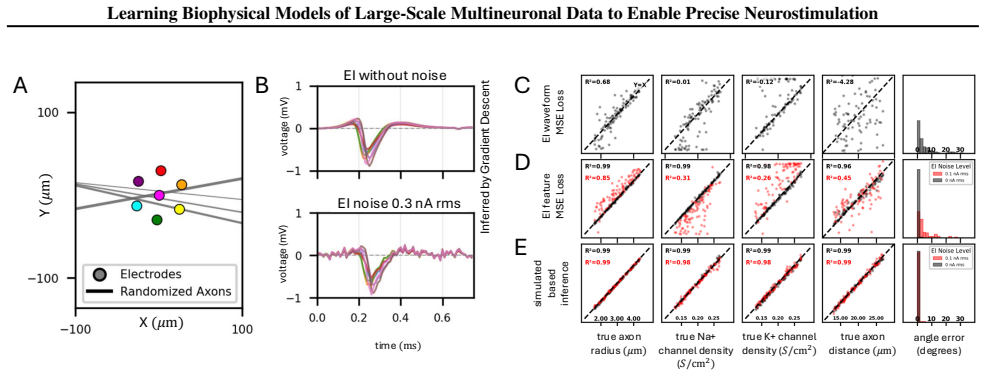
Summary. The paper proposes a framework for fitting multi-compartment Hodgkin–Huxley models of retinal ganglion cells from high-density extracellular MEA data alone, using designed electrical-image (EI) features and single-electrode stimulation thresholds, with gradient-based optimization in JAXLEY and optional simulation-based inference. Simulated straight-axon and heterogeneous RGC recovery experiments support identifiability under a feature-based loss. On isolated macaque retina (198 parasol cells; 37 with multi-electrode maps), models fit from EI features and single-electrode thresholds predict held-out simultaneous multi-electrode spike/no-spike outcomes, with a reported mean per-cell accuracy of 90.6% for the best loss-feature ablation, outperforming independent-site, superposition, and MLP baselines and motivating replacement of hours of clinical stimulus testing by minutes of recording.
Significance. If the multi-electrode generalization result holds under transparent primary metrics and hardware calibration, this is a substantial step for translational neuroengineering: cell-specific biophysical digital twins from scalable extracellular data, without intracellular access, with direct relevance to epiretinal prosthesis calibration. Strengths include a large real-data multi-electrode evaluation (~3×10^5 combinations across 37 cells), systematic simulated recovery and feature ablations, comparison to both biophysical heuristics and a multi-electrode-supervised MLP, public code/data, and clear discussion of forward-model misspecification. The combination of differentiable multi-compartment simulation with engineered extracellular features is a concrete methodological contribution beyond prior simulated-only extracellular HH inference.
major comments (3)
- Abstract and Table 1 headline 90.6% as the multi-electrode accuracy, but Appendix T.2 states this is the best of 64 post-hoc loss-feature ablations (potassium peaks + stimulation thresholds only); the all-features fit used for Figure 4 is 0.895. For a central claim that models “fit from only a few minutes of recording” replace hours of testing, the primary reported number should be a pre-specified objective (e.g., all supervised features, or a single a priori subset), with ablations as secondary analysis. Please revise Abstract/Table 1 to lead with the primary metric and report the best-ablation result as exploratory.
- §4.2 and Appendix T.6: before multi-electrode evaluation, a per-electrode current scale factor is chosen so the model’s single-electrode threshold matches experiment, absorbing electrode-specific shunting (bath fractions 0.3–0.85). Scales use only single-electrode data already in the supervision set, so multi-electrode labels remain held out; however, the reported accuracy is not pure biophysical extrapolation from unscaled EI geometry. The manuscript should report multi-electrode metrics with (i) no scale, (ii) a single global scale per cell, and (iii) the current per-electrode scales, and state clearly in Abstract/§4.2 that hardware gain calibration is part of the pipeline. Without this, the gap over Independent/Superposition/MLP is hard to interpret.
- Figure 4 / Table 10 and Discussion: amplitude and threshold features are only moderately recovered (e.g., sodium R²≈0.61, velocity ≈0.41, duration ≈0.11 under GD), yet multi-electrode accuracy remains high. Appendix T.2’s finding that dropping timing features can improve multi-electrode accuracy supports the claim that prediction is driven mainly by axon location and local excitability. That is scientifically interesting but undercuts the framing of a fully identified multi-compartment HH digital twin. Please state more sharply which parameters/features are identified for the stimulation task versus which remain misspecified, and avoid implying that all EI features are jointly well matched when the headline application succeeds.
minor comments (6)
- Clarify in the main text (not only Appendix F) that propagation supervision uses a single AIS-to-distal delay rather than all pairwise Δt_prop terms in Eq. (13).
- Figure 5: state explicitly that maps are 2D cross-sections of three-electrode grids with the third electrode at zero; point readers to Figure 20 for the full cube.
- Table 1 vs Appendix O: reconcile “~2×10^5 simultaneous stimuli per cell” (Table 1 caption) with the cohort-level ~3.2×10^5 unique combinations across 37 cells.
- SBI real-data feature R² (Table 10) uses IQR-downweighted R² while GD uses plain Pearson R²; report both metrics for both methods for fair comparison.
- Impact Statement and §6 correctly flag homogeneous medium and limited waveform generality (150 µs triphasic, ≤3 electrodes); a short main-text sentence on these bounds next to the accuracy claim would help non-specialist readers.
- Minor typos: “with with data collection” (Appendix A); “V oltage” spacing in Table 5; arXiv ID formatting in the prompt header is fine for the manuscript itself.
Circularity Check
Mild post-fit per-electrode current scaling from single-electrode thresholds plus best-of-64 ablation reporting; multi-electrode hold-out and biophysical interactions remain independent of the fit.
specific steps
-
fitted input called prediction
[§4.2 and Appendix T (T.6)]
"Prior to evaluating multi-electrode predictions, a per-electrode current scale factor was estimated for each cell by matching the model’s predicted single-electrode threshold to the experimentally measured threshold, accounting for unmeasured shunting of injected current. This scale factor is derived entirely from the same single-electrode threshold measurements used during fitting and does not introduce additional supervision (Appendix T)."
After the loss already enforces P_stim( heta,T_m)=0.5, an additional per-electrode scale is chosen so that the model’s single-electrode thresholds match experiment exactly; multi-electrode currents are then multiplied by these scales. Multi-electrode labels remain held out, yet the effective stimulus amplitudes supplied to f_stim are calibrated by construction from the training thresholds (absorbing the reported 0.3–0.85 electrode-specific shunting). This is standard hardware calibration rather than label leakage, but it means part of the multi-electrode accuracy reflects re-scaled single-electrode consistency rather than pure unadjusted biophysical extrapolation.
-
other
[Abstract; Table 1; Appendix T.2]
"Our framework predicted previously unseen multi-electrode stimulation responses with 90.6% accuracy using HH models fit from only a few minutes of recording… HH (GD) denotes gradient descent with the best-performing loss-feature ablation (potassium and stimulation thresholds; sodium and stimulation thresholds achieved identical mean per-cell accuracy); HH (GD, all) uses all feature groups in training… 0.895"
The headline 90.6% figure is the maximum mean per-cell accuracy over all 2^6=64 subsets of the six supervised feature groups, evaluated on the same 37-cell multi-electrode cohort used for ranking. The all-features model that produced the EI-recovery plots scores 0.895. Selecting and reporting the best ablation as “the framework” accuracy is a mild post-hoc choice on the evaluation set; it does not make the multi-electrode outcomes equal the training loss by construction, but it inflates the abstract claim relative to the untuned all-features pipeline.
full rationale
The core chain is not circular. heta is inferred from EI features (peak amplitudes, timing) plus single-electrode thresholds via a differentiable loss (or SBI) that never sees multi-electrode maps; f_stim then predicts held-out simultaneous multi-electrode spike/no-spike outcomes on 37 cells. Baselines that use the identical single-electrode thresholds (independent-site, superposition) and an MLP given multi-electrode labels on training cells both underperform the HH models, showing that the reported accuracy is not forced by the single-electrode supervision alone. The only mild issues are (1) a disclosed per-electrode scale factor, estimated solely from the same single-electrode thresholds already used in fitting, that absorbs measured hardware shunting before multi-electrode evaluation, and (2) the abstract/Table-1 headline of 90.6% being the best of 64 loss-feature ablations rather than the all-features model (0.895). Neither reduces the multi-electrode prediction to its inputs by construction, nor relies on load-bearing self-citation uniqueness theorems. Self-citations to prior Vilkhu/Vasireddy work supply morphology templates and heuristic baselines but are not required for the new inference or the hold-out result. Score 2 reflects these presentation/calibration caveats while confirming the derivation is otherwise self-contained against external benchmarks.
Axiom & Free-Parameter Ledger
free parameters (6)
- Per-cell HH parameter vector θ (region-wise ḡNa, ḡK, radii, spline control points / locations)
- Per-electrode current scale factors
- Loss feature-group weights (wk, wprop, wdur, wstim) and ablation subset
- Differentiable spike surrogate parameters (Vthresh, γ+, γ−, tind)
- Extracellular conductivity σ and fixed Nernst/kinetics constants
- SBI noise scale σI and prior bounds
axioms (6)
- domain assumption Multi-compartment HH dynamics with fixed voltage-dependent rate functions (Fohlmeister et al. 2010) and region template (Kish/Vilkhu) adequately describe RGC spikes and stimulation in this regime.
- domain assumption Line-source approximation in a homogeneous conductive half-space maps membrane currents to MEA voltages (Eq. 4, 6).
- domain assumption Extracellular stimulation acts primarily via axial currents from extracellular potential differences (Eq. 7), not direct transmembrane injection.
- domain assumption Spike-sorted electrical images from light-evoked activity are stable single-neuron signatures usable for biophysical fitting.
- ad hoc to paper Designed EI features (Acap, ANa, AK, Δtdur, Δtprop) plus single-electrode 50% thresholds sufficiently identify geometry and conductances for multi-electrode generalization.
- standard math Standard automatic differentiation / Adam optimization and neural posterior estimation are valid inference tools for this simulator.
invented entities (3)
-
Differentiable EI feature extractor (soft-argmax peak times, peak amplitudes, propagation/duration features)
no independent evidence
-
Differentiable single-electrode spike probability surrogate Pstim,m
no independent evidence
-
EI-driven axon trajectory initialization (soma/AIS/axon electrode landmarks → B-spline control points)
no independent evidence
Cite this review
Pith. "Pith review of Learning Biophysical Models of Large-Scale Multineuronal Data to Enable Precise Neurostimulation." pith.science (2026). https://pith.science/paper/Q3C2Z7S2
@misc{pith2026260704063,
  author       = {Pith},
  title        = {Pith review of: Learning Biophysical Models of Large-Scale Multineuronal Data to Enable Precise Neurostimulation},
  year         = {2026},
  howpublished = {\url{https://pith.science/paper/Q3C2Z7S2}},
  note         = {Machine review of arXiv:2607.04063}
}
read the original abstract
Multi-compartment Hodgkin-Huxley (HH) models provide a principled framework for predicting neural dynamics and responses to electrical stimulation. However, fitting HH biophysical parameters typically requires intracellular recordings, which are invasive and low-throughput, limiting the ability to capture the geometry and cell-specific properties of many neurons in a given neural circuit. Multi-electrode arrays (MEAs) offer a scalable alternative - high-density extracellular measurements from full neural populations, but HH model complexity has so far precluded reliable biophysical inference from extracellular data alone. Here, we introduce a framework to rapidly infer HH parameters from designed features of extracellular MEA measurements by leveraging differentiable biophysical simulation and simulation-based inference, unlocking a wide range of downstream applications. In this work, we focus on a central goal of translational neuroengineering: predicting neural spiking responses to candidate neurostimulation patterns that would take hours to measure clinically. To validate our approach, we collected hundreds of hours of stimulation and recording data from isolated macaque retina with a 30 um-pitch 512-electrode array. Our framework predicted previously unseen multi-electrode stimulation responses with 90.6% accuracy using HH models fit from only a few minutes of recording, replacing hours of stimulus testing.
Figures






Reference graph
Works this paper leans on
-
[1]
Journal of neurophysiology , volume=
On the origin of the extracellular action potential waveform: a modeling study , author=. Journal of neurophysiology , volume=. 2006 , publisher=
2006
-
[2]
, author=
B (asic)-Spline Basics. , author=
-
[3]
arXiv preprint arXiv:2007.09114 , year=
SBI--A toolkit for simulation-based inference , author=. arXiv preprint arXiv:2007.09114 , year=
Pith/arXiv arXiv 2007
-
[4]
2024 , howpublished =
Braun, Cornelius , title =. 2024 , howpublished =
2024
-
[5]
Proceedings of the National Academy of Sciences , volume=
The frontier of simulation-based inference , author=. Proceedings of the National Academy of Sciences , volume=. 2020 , publisher=
2020
-
[6]
Journal of neural engineering , volume=
Understanding responses to multi-electrode epiretinal stimulation using a biophysical model , author=. Journal of neural engineering , volume=. 2025 , publisher=
2025
-
[7]
Journal of neural engineering , volume=
Modeling extracellular stimulation of retinal ganglion cells: theoretical and practical aspects , author=. Journal of neural engineering , volume=. 2023 , publisher=
2023
-
[8]
Cell Reports , volume=
Leveraging current steering and the biophysics of spike generation for cellular-resolution electrical stimulation of neurons , author=. Cell Reports , volume=. 2026 , publisher=
2026
-
[9]
Advances in Neural Information Processing Systems , volume=
Identifying multi-compartment Hodgkin-Huxley models with high-density extracellular voltage recordings , author=. Advances in Neural Information Processing Systems , volume=
-
[10]
Nature Methods , pages=
Jaxley: differentiable simulation enables large-scale training of detailed biophysical models of neural dynamics , author=. Nature Methods , pages=. 2025 , publisher=
2025
-
[11]
Advances in neural information processing systems , volume=
Fast and accurate spike sorting of high-channel count probes with KiloSort , author=. Advances in neural information processing systems , volume=
-
[12]
Journal of computational neuroscience , volume=
Using extracellular action potential recordings to constrain compartmental models , author=. Journal of computational neuroscience , volume=. 2007 , publisher=
2007
-
[13]
2023 11th International IEEE/EMBS Conference on Neural Engineering (NER) , pages=
Partitioned temporal dithering for efficient epiretinal electrical stimulation , author=. 2023 11th International IEEE/EMBS Conference on Neural Engineering (NER) , pages=. 2023 , organization=
2023
-
[14]
and Lotlikar, Amrith and Kling, Alexandra and Hays, Madeline and Vasireddy, Praful and Hofflich, Bella and Sharon, Aviv and Sommeling, Michael A
Phillips, A.J. and Lotlikar, Amrith and Kling, Alexandra and Hays, Madeline and Vasireddy, Praful and Hofflich, Bella and Sharon, Aviv and Sommeling, Michael A. and Brown, Jeff and Baum, Claire and Nguyen, Huy and Lim, Ye-Lim and Hottowy, Pawel and Sher, Alexander and Litke, Alan M. and Chichilnisky, E.J. , title =. 2026 , doi =. https://www.biorxiv.org/c...
2026
-
[15]
Journal of Comparative Neurology , volume=
Large-scale morphological survey of mouse retinal ganglion cells , author=. Journal of Comparative Neurology , volume=. 2002 , publisher=
2002
-
[16]
and Cohen, E
Fohlmeister, John F. and Cohen, E. D. and Newman, Eric A. , title =. Journal of Neurophysiology , year =
-
[17]
and Kachiguine, Sergei and Mathieson, Keith and Sher, Alexander and Wi
Hottowy, Pawel and Skoczen, Andrzej and Gunning, Douglas E. and Kachiguine, Sergei and Mathieson, Keith and Sher, Alexander and Wi. Properties and Application of a Multichannel Integrated Circuit for Low-Artifact, Patterned Electrical Stimulation of Neural Tissue , journal =. 2012 , volume =
2012
-
[18]
and Phillips, A
Shah, Nishal P. and Phillips, A. J. and Madugula, Sasidhar and Lotlikar, Amrith and Gogliettino, Alex R. and Hays, Madeline R. and Grosberg, Lauren and Brown, Jeff B. and Dusi, Aditya and Tandon, Pulkit and Hottowy, Pawel and Dabrowski, Wladyslaw and Sher, Alexander and Litke, Alan M. and Mitra, Subhasish and Chichilnisky, E. J. , title =. eLife , year =
-
[19]
2005 , publisher=
Theoretical neuroscience: computational and mathematical modeling of neural systems , author=. 2005 , publisher=
2005
-
[20]
2004 , publisher=
Biophysics of computation: information processing in single neurons , author=. 2004 , publisher=
2004
-
[21]
Dendritic computation , author=. Annu. Rev. Neurosci. , volume=. 2005 , publisher=
2005
-
[22]
Nature , volume=
Actions from thoughts , author=. Nature , volume=. 2001 , publisher=
2001
-
[23]
Physiological reviews , year=
Brain-machine interfaces: from basic science to neuroprostheses and neurorehabilitation , author=. Physiological reviews , year=
-
[24]
The Journal of physiology , volume=
A quantitative description of membrane current and its application to conduction and excitation in nerve , author=. The Journal of physiology , volume=
-
[25]
2006 , publisher=
The NEURON book , author=. 2006 , publisher=
2006
-
[26]
Annual review of physiology , volume=
Patch clamp techniques for studying ionic channels in excitable membranes , author=. Annual review of physiology , volume=. 1984 , publisher=
1984
-
[27]
Improved patch-clamp techniques for high-resolution current recording from cells and cell-free membrane patches , author=. Pfl. 1981 , publisher=
1981
-
[28]
Journal of neurophysiology , volume=
Efficient estimation of detailed single-neuron models , author=. Journal of neurophysiology , volume=. 2006 , publisher=
2006
-
[29]
Journal of neurophysiology , volume=
Parameter extraction and classification of three cortical neuron types reveals two distinct adaptation mechanisms , author=. Journal of neurophysiology , volume=. 2012 , publisher=
2012
-
[30]
Journal of Neuroscience , volume=
A quantitative description of dendritic conductances and its application to dendritic excitation in layer 5 pyramidal neurons , author=. Journal of Neuroscience , volume=. 2014 , publisher=
2014
-
[31]
elife , volume=
Training deep neural density estimators to identify mechanistic models of neural dynamics , author=. elife , volume=. 2020 , publisher=
2020
-
[32]
In vivo, low-resistance, whole-cell recordings from neurons in the anaesthetized and awake mammalian brain , author=. Pfl. 2002 , publisher=
2002
-
[33]
1994 , publisher=
Foundations of cellular neurophysiology , author=. 1994 , publisher=
1994
-
[34]
bioRxiv , pages=
Ultra-high density electrodes improve detection, yield, and cell type identification in neuronal recordings , author=. bioRxiv , pages=
-
[35]
Nature neuroscience , volume=
Spike sorting for large, dense electrode arrays , author=. Nature neuroscience , volume=. 2016 , publisher=
2016
-
[36]
Current opinion in neurobiology , volume=
Towards reliable spike-train recordings from thousands of neurons with multielectrodes , author=. Current opinion in neurobiology , volume=. 2012 , publisher=
2012
-
[37]
bioRxiv , pages=
Differentiable simulation enables large-scale training of detailed biophysical models of neural dynamics , author=. bioRxiv , pages=. 2024 , publisher=
2024
-
[38]
2023 , publisher=
Bayesian filtering and smoothing , author=. 2023 , publisher=
2023
-
[39]
Nature Reviews Neuroscience , volume=
Variability, compensation and homeostasis in neuron and network function , author=. Nature Reviews Neuroscience , volume=. 2006 , publisher=
2006
-
[40]
science , volume=
Modeling single-neuron dynamics and computations: a balance of detail and abstraction , author=. science , volume=. 2006 , publisher=
2006
-
[41]
arXiv preprint arXiv:1412.6980 , year=
Adam: A method for stochastic optimization , author=. arXiv preprint arXiv:1412.6980 , year=
-
[42]
Continual Lifelong Learning Workshop at ACML 2022 , year=
On diagonal approximations to the extended Kalman filter for online training of Bayesian neural networks , author=. Continual Lifelong Learning Workshop at ACML 2022 , year=
2022
-
[43]
2023 , howpublished =
Martin Schubert , title =. 2023 , howpublished =
2023
-
[44]
2020 , note =
MEA2100-System Installation Guide , author =. 2020 , note =
2020
-
[45]
Journal of Open Source Software , volume=
Dynamax: A Python package for probabilistic state space modeling with JAX , author=. Journal of Open Source Software , volume=
-
[46]
Frontiers in neuroinformatics , volume=
LFPy: a tool for biophysical simulation of extracellular potentials generated by detailed model neurons , author=. Frontiers in neuroinformatics , volume=. 2014 , publisher=
2014
-
[47]
Hippocampus , volume=
Encoding and retrieval in a model of the hippocampal CA1 microcircuit , author=. Hippocampus , volume=. 2010 , publisher=
2010
-
[48]
Neuron , volume=
Arithmetic of subthreshold synaptic summation in a model CA1 pyramidal cell , author=. Neuron , volume=. 2003 , publisher=
2003
-
[49]
Journal of computational neuroscience , volume=
Role of an A-type K+ conductance in the back-propagation of action potentials in the dendrites of hippocampal pyramidal neurons , author=. Journal of computational neuroscience , volume=. 1999 , publisher=
1999
-
[50]
Advances in Neural Information Processing Systems , volume=
Generalized bayesian inference for scientific simulators via amortized cost estimation , author=. Advances in Neural Information Processing Systems , volume=
-
[51]
Iscience , volume=
Controlling morpho-electrophysiological variability of neurons with detailed biophysical models , author=. Iscience , volume=. 2023 , publisher=
2023
-
[52]
Nature Reviews Neuroscience , volume=
Pyramidal neurons: dendritic structure and synaptic integration , author=. Nature Reviews Neuroscience , volume=. 2008 , publisher=
2008
-
[53]
Neuron , volume=
Pyramidal neuron as two-layer neural network , author=. Neuron , volume=. 2003 , publisher=
2003
-
[54]
Science , volume=
Dendritic action potentials and computation in human layer 2/3 cortical neurons , author=. Science , volume=. 2020 , publisher=
2020
-
[55]
Proceedings of the National Academy of Sciences , volume=
Ion channel degeneracy enables robust and tunable neuronal firing rates , author=. Proceedings of the National Academy of Sciences , volume=. 2015 , publisher=
2015
-
[56]
Proceedings of the National Academy of Sciences , volume=
Correlations in ion channel expression emerge from homeostatic tuning rules , author=. Proceedings of the National Academy of Sciences , volume=. 2013 , publisher=
2013
-
[57]
Neuron , volume=
Circuit robustness to temperature perturbation is altered by neuromodulators , author=. Neuron , volume=. 2018 , publisher=
2018
-
[58]
Nature , volume=
Active propagation of somatic action potentials into neocortical pyramidal cell dendrites , author=. Nature , volume=. 1994 , publisher=
1994
-
[59]
Journal of neural engineering , volume=
Focal electrical stimulation of human retinal ganglion cells for vision restoration , author=. Journal of neural engineering , volume=. 2022 , publisher=
2022
-
[60]
Journal of neurophysiology , volume=
Electrical stimulation of mammalian retinal ganglion cells with multielectrode arrays , author=. Journal of neurophysiology , volume=. 2006 , publisher=
2006
-
[61]
Scientific reports , volume=
A new reduced-morphology model for CA1 pyramidal cells and its validation and comparison with other models using HippoUnit , author=. Scientific reports , volume=. 2021 , publisher=
2021
-
[62]
Frontiers in systems neuroscience , volume=
Deciphering the role of CA1 inhibitory circuits in sharp wave-ripple complexes , author=. Frontiers in systems neuroscience , volume=. 2013 , publisher=
2013
-
[63]
Nature neuroscience , volume=
Similar network activity from disparate circuit parameters , author=. Nature neuroscience , volume=. 2004 , publisher=
2004
-
[64]
2023 , publisher=
Principles of computational modelling in neuroscience , author=. 2023 , publisher=
2023
-
[65]
Journal of neurophysiology , volume=
Mechanisms and distribution of ion channels in retinal ganglion cells: using temperature as an independent variable , author=. Journal of neurophysiology , volume=. 2010 , publisher=
2010
-
[66]
arXiv preprint arXiv:2508.12939 , year=
Simulation-based inference: A practical guide , author=. arXiv preprint arXiv:2508.12939 , year=
-
[67]
Neuron , volume=
The scientific case for brain simulations , author=. Neuron , volume=. 2019 , publisher=
2019
-
[68]
Neural networks , volume=
Multilayer feedforward networks are universal approximators , author=. Neural networks , volume=. 1989 , publisher=
1989
-
[69]
Journal of neuroengineering and rehabilitation , volume=
A computational model to design neural interfaces for lower-limb sensory neuroprostheses , author=. Journal of neuroengineering and rehabilitation , volume=. 2020 , publisher=
2020
-
[70]
Journal of neural engineering , volume=
A comprehensive model-based framework for optimal design of biomimetic patterns of electrical stimulation for prosthetic sensation , author=. Journal of neural engineering , volume=. 2020 , publisher=
2020
-
[71]
Nature neuroscience , volume=
A deep learning framework for neuroscience , author=. Nature neuroscience , volume=. 2019 , publisher=
2019
-
[72]
PLoS computational biology , volume=
Smoothing of, and parameter estimation from, noisy biophysical recordings , author=. PLoS computational biology , volume=. 2009 , publisher=
2009
-
[73]
2013 IEEE International Symposium on Circuits and Systems (ISCAS) , pages=
Parameter estimation of Hodgkin-Huxley neuronal model using dual extended Kalman filter , author=. 2013 IEEE International Symposium on Circuits and Systems (ISCAS) , pages=. 2013 , organization=
2013
-
[74]
Patterns , volume=
Combined statistical-biophysical modeling links ion channel genes to physiology of cortical neuron types , author=. Patterns , volume=. 2025 , publisher=
2025
-
[75]
Advances in Neural Information Processing Systems , volume=
Efficient identification of informative features in simulation-based inference , author=. Advances in Neural Information Processing Systems , volume=
-
[76]
Elife , volume=
Generation of biophysical neuron model parameters from recorded electrophysiological responses , author=. Elife , volume=. 2025 , publisher=
2025
-
[77]
PloS one , volume=
Systematic generation of biophysically detailed models with generalization capability for non-spiking neurons , author=. PloS one , volume=. 2022 , publisher=
2022
-
[78]
GradNorm: Gradient Normalization for Adaptive Loss Balancing in Deep Multitask Networks , journal =
Zhao Chen and Vijay Badrinarayanan and Chen. GradNorm: Gradient Normalization for Adaptive Loss Balancing in Deep Multitask Networks , journal =. 2017 , url =. 1711.02257 , timestamp =
Pith/arXiv arXiv 2017
-
[79]
Journal of Neural Engineering , volume=
Decomposition of retinal ganglion cell electrical images for cell type and functional inference , author=. Journal of Neural Engineering , volume=. 2025 , publisher=
2025
-
[80]
Network: computation in neural systems , volume=
A simple white noise analysis of neuronal lightresponses , author=. Network: computation in neural systems , volume=. 2001 , publisher=
2001
This paper was first reviewed by grok-4.5 on July 11, 2026.
discussion (0)
Sign in with ORCID, Apple, or X to comment. Anyone can read and Pith papers without signing in.